NEET 2026 Chemistry & Biology
Cheatsheet Content
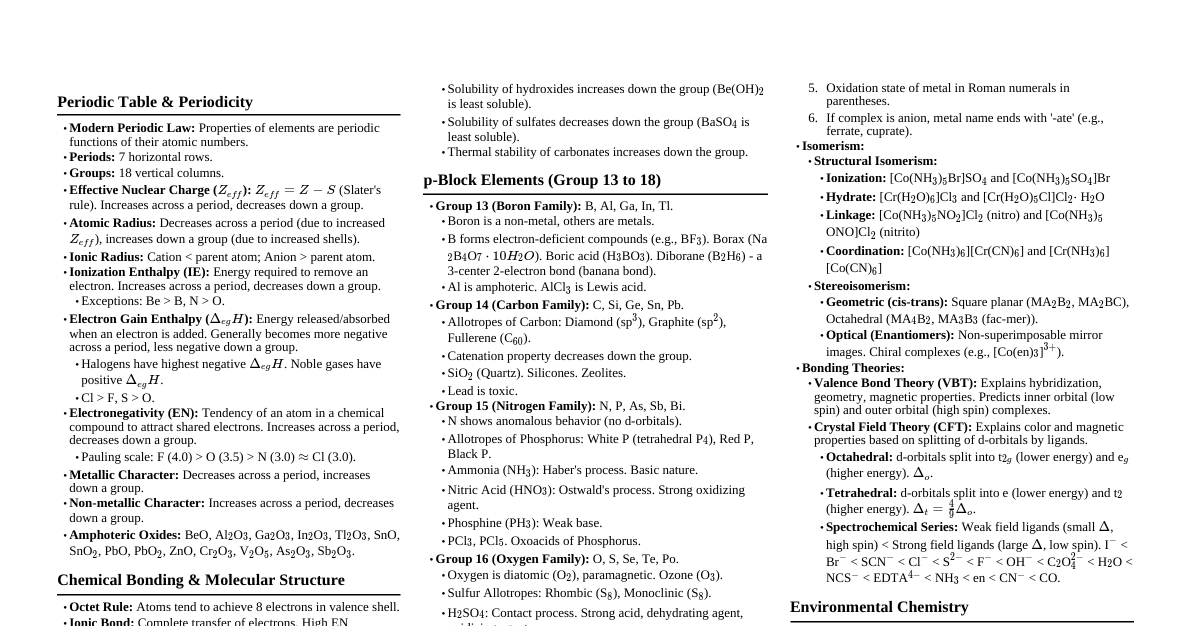
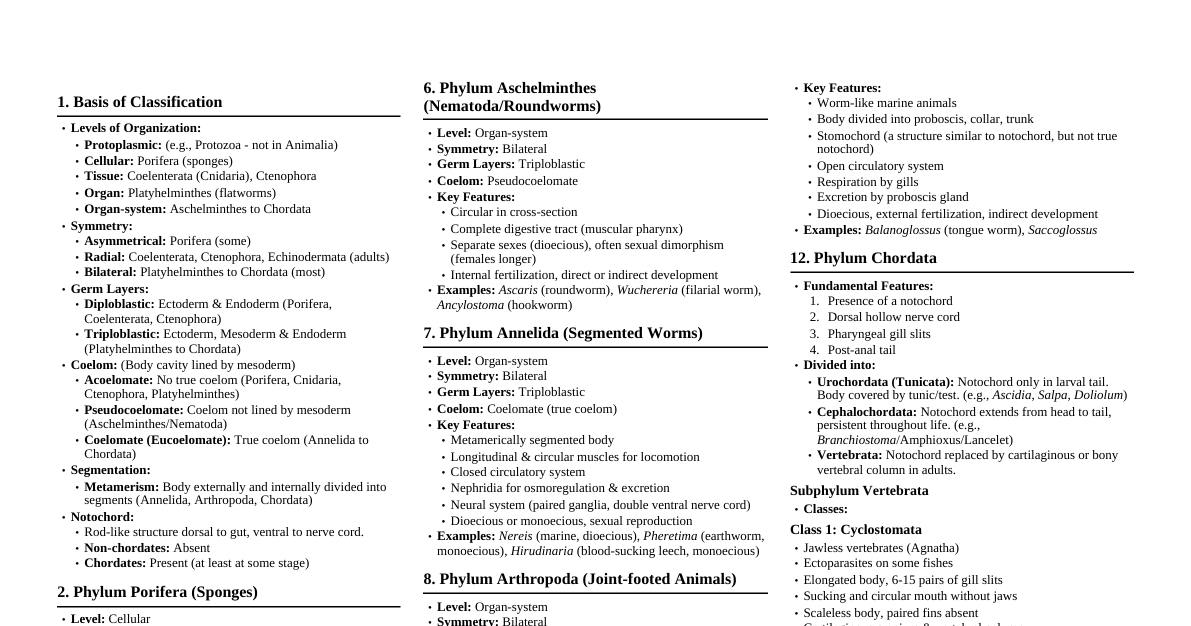
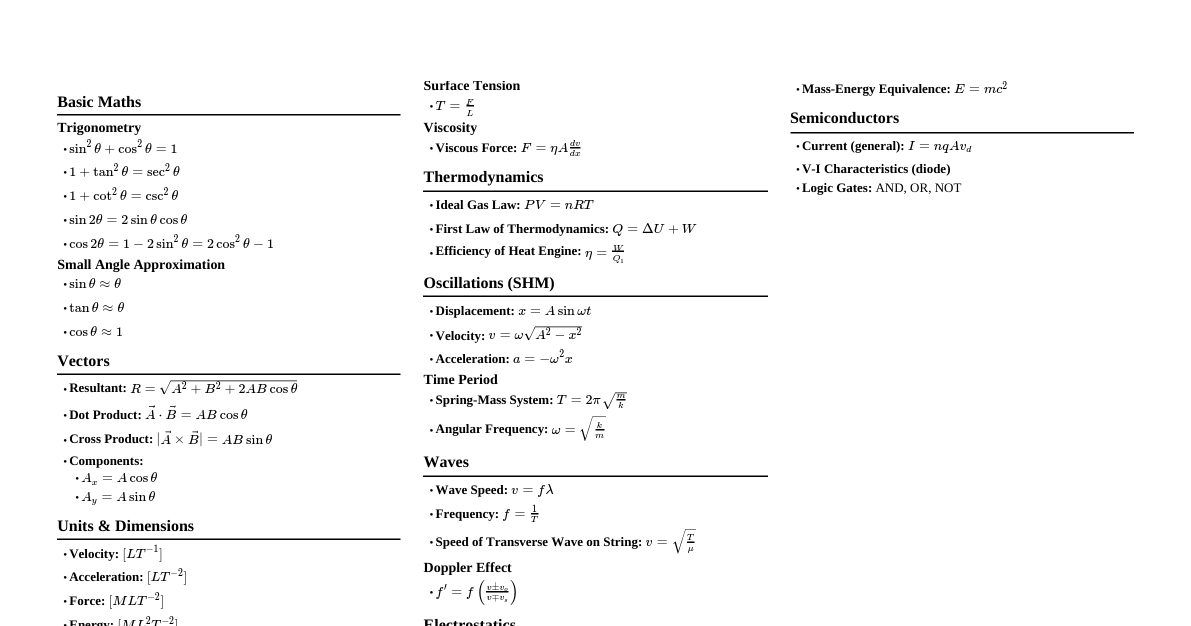
### Redox Reactions - **Oxidation:** Loss of electrons, increase in oxidation state. - **Reduction:** Gain of electrons, decrease in oxidation state. - **Oxidizing agent:** Substance that oxidizes others and gets reduced itself. - **Reducing agent:** Substance that reduces others and gets oxidized itself. - **Oxidation Number Rules:** 1. Uncombined element: 0 2. Monatomic ion: charge of the ion 3. Group 1 metals: +1; Group 2 metals: +2 4. Fluorine: -1 5. Hydrogen: +1 (except in metal hydrides, -1) 6. Oxygen: -2 (except peroxides -1, superoxides -1/2, OF2 +2) 7. Sum of oxidation numbers in a neutral compound is 0. 8. Sum of oxidation numbers in a polyatomic ion equals the charge of the ion. - **Balancing Redox Reactions:** - **Ion-electron method (half-reaction method):** 1. Separate into oxidation and reduction half-reactions. 2. Balance atoms other than O and H. 3. Balance O atoms by adding H2O. 4. Balance H atoms by adding H+ (acidic medium) or H2O and OH- (basic medium). 5. Balance charge by adding electrons. 6. Multiply half-reactions to equalize electrons. 7. Add half-reactions and cancel common terms. - **Oxidation number method:** 1. Write the unbalanced equation. 2. Assign oxidation numbers to all atoms. 3. Identify atoms undergoing change in oxidation number. 4. Calculate total increase/decrease in oxidation number. 5. Equalize increase/decrease by multiplying with suitable integers. 6. Balance other atoms (except H and O). 7. Balance H and O as in ion-electron method. ### Periodic Classification of Elements - **Modern Periodic Law:** The physical and chemical properties of elements are periodic functions of their atomic numbers. - **Periods:** Horizontal rows (1-7), indicate number of shells. - **Groups:** Vertical columns (1-18), indicate number of valence electrons (for main group elements) and similar chemical properties. - **Blocks:** - **s-block:** Groups 1 & 2 (Alkali & Alkaline earth metals). Reactive metals, low ionization enthalpy. - **p-block:** Groups 13-18 (Non-metals, metalloids, noble gases). Diverse properties. - **d-block:** Groups 3-12 (Transition metals). Variable oxidation states, colored compounds. - **f-block:** Lanthanides & Actinides (Inner transition metals). - **Periodic Trends:** - **Atomic Radius:** Decreases across a period (due to increased effective nuclear charge), increases down a group (due to increased number of shells). - **Ionization Enthalpy:** Energy required to remove an electron. Increases across a period, decreases down a group. - **Electron Gain Enthalpy:** Energy released when an electron is added. Generally becomes more negative across a period, less negative down a group. Halogens have high negative EGE. - **Electronegativity:** Tendency to attract shared electrons. Increases across a period, decreases down a group. (F > O > N ≈ Cl) - **Metallic Character:** Decreases across a period, increases down a group. - **Non-metallic Character:** Increases across a period, decreases down a group. - **Anomalous Properties of Second Period Elements:** Small size, high electronegativity, absence of d-orbitals. Exhibit diagonal relationships. ### P-Block Elements - **General Characteristics:** Valence shell configuration $ns^2np^{1-6}$. Tend to form covalent bonds. Exhibit multiple oxidation states. - **Group 13 (Boron Family):** $ns^2np^1$. B is non-metal, Al, Ga, In, Tl are metals. - Boron forms electron-deficient compounds (e.g., BF3, BH3). - Aluminium is amphoteric. - **Group 14 (Carbon Family):** $ns^2np^2$. C (non-metal), Si, Ge (metalloids), Sn, Pb (metals). - Carbon exhibits catenation (self-linking). Allotropes: Diamond, Graphite, Fullerenes. - Silicon forms silicates and silicones. - **Group 15 (Nitrogen Family):** $ns^2np^3$. N, P (non-metals), As, Sb (metalloids), Bi (metal). - Nitrogen exists as N2 (triple bond), highly stable. - Phosphorus exists as P4 (white, red, black). - Hydrides (NH3, PH3, etc.) show decreasing basicity down the group. - **Group 16 (Oxygen Family / Chalcogens):** $ns^2np^4$. O, S, Se (non-metals), Te (metalloid), Po (metal). - Oxygen is highly electronegative. O2 is paramagnetic. - Sulphur exists as S8 (rhombic, monoclinic). - **Group 17 (Halogens):** $ns^2np^5$. F, Cl, Br, I, At (all non-metals). - Highly reactive non-metals, strong oxidizing agents. - Form HX acids; acidity increases down the group (HF ### Chemical Bonding and Molecular Structure - **Octet Rule:** Atoms combine to achieve a stable electron configuration (8 valence electrons). - **Ionic Bond:** Transfer of electrons, forms electrostatic attraction between ions (e.g., NaCl). - Favored by low ionization enthalpy of metal, high electron gain enthalpy of non-metal, high lattice enthalpy. - **Covalent Bond:** Sharing of electrons (e.g., H2O, CH4). - **Lewis Structures:** Representation of valence electrons and bonds. - **Formal Charge:** $FC = V - L - \frac{1}{2}S$ (V=valence e-, L=lone pair e-, S=shared e-) - **Resonance:** Delocalization of electrons over multiple structures (e.g., CO3^2-, O3). - **VSEPR Theory (Valence Shell Electron Pair Repulsion):** Predicts molecular geometry based on minimizing electron pair repulsion. - Lone pair-lone pair > Lone pair-bond pair > Bond pair-bond pair repulsion. - **Common Geometries:** Linear, Trigonal Planar, Tetrahedral, Trigonal Bipyramidal, Octahedral. - **Valence Bond Theory (VBT):** Overlap of atomic orbitals to form bonds. - **Hybridization:** Mixing of atomic orbitals to form new hybrid orbitals (e.g., $sp, sp^2, sp^3, sp^3d, sp^3d^2$). - **Sigma ($\sigma$) Bond:** Head-on overlap, strong. - **Pi ($\pi$) Bond:** Sideways overlap, weaker. Double bond = 1 $\sigma$ + 1 $\pi$; Triple bond = 1 $\sigma$ + 2 $\pi$. - **Molecular Orbital Theory (MOT):** Atomic orbitals combine to form molecular orbitals. - **Bonding MOs (lower energy):** $\sigma, \pi$ - **Antibonding MOs (higher energy):** $\sigma^*, \pi^*$ - **Bond Order:** $BO = \frac{1}{2}(N_b - N_a)$ (Nb = electrons in bonding MOs, Na = electrons in antibonding MOs). - **Magnetic Properties:** Paramagnetic (unpaired electrons), Diamagnetic (all electrons paired). - **Hydrogen Bonding:** Special dipole-dipole interaction involving H bonded to a highly electronegative atom (F, O, N). - **Intermolecular H-bonding:** Between molecules (e.g., H2O). - **Intramolecular H-bonding:** Within the same molecule (e.g., o-nitrophenol). ### The Living World (Biology) - **What is Living?** Characteristics: - **Growth:** Increase in mass and number of individuals. (Irreversible in living organisms). - **Reproduction:** Production of progeny. (Not defining for all living organisms, e.g., mules, sterile worker bees). - **Metabolism:** Sum total of all chemical reactions occurring in a body. (Defining feature, occurs in vitro also but not living). - **Cellular Organization:** All living organisms are made of cells. (Defining feature). - **Consciousness:** Ability to sense environment and respond. (Defining feature). - **Adaptation, Homeostasis, Self-replication, Self-organization, Interaction, Emergence.** - **Diversity in the Living World:** - **Biodiversity:** Number and types of organisms present on Earth. - **Nomenclature:** - **Binomial Nomenclature:** Given by Carolus Linnaeus. Two components: Generic name (genus) and specific epithet (species). - **Universal Rules of Nomenclature:** - Latin origin, italicized. - First word genus (capitalized), second species (lowercase). - Underlined separately when handwritten. - Name of author after specific epithet (e.g., *Mangifera indica* Linn.). - **Taxonomy & Systematics:** - **Taxonomy:** Process of classification based on characteristics. - **Systematics:** Study of relationships among organisms. - **Taxonomic Categories (Hierarchy):** - Kingdom $\rightarrow$ Phylum/Division $\rightarrow$ Class $\rightarrow$ Order $\rightarrow$ Family $\rightarrow$ Genus $\rightarrow$ Species - **Species:** Group of individuals with fundamental similarities, can interbreed to produce fertile offspring. - **Genus:** Group of related species. - **Family:** Group of related genera. - **Order:** Group of related families. - **Class:** Group of related orders. - **Phylum/Division:** Group of related classes (Phylum for animals, Division for plants). - **Kingdom:** Highest category. - **Taxonomical Aids:** Herbarium, Botanical Gardens, Museums, Zoological Parks, Key (analytical for identification), Flora, Manuals, Monographs, Catalogues. ### Biological Classification - **Aristotle's Classification:** Based on simple morphological characters. Plants (trees, shrubs, herbs), Animals (with red blood, without red blood). - **Two Kingdom Classification (Linnaeus):** Plantae & Animalia. - Drawbacks: No distinction between prokaryotes/eukaryotes, unicellular/multicellular, photosynthetic/non-photosynthetic. - **Five Kingdom Classification (R.H. Whittaker, 1969):** Monera, Protista, Fungi, Plantae, Animalia. - Criteria: Cell structure, Thallus organization, Mode of nutrition, Reproduction, Phylogenetic relationships. - **Kingdom Monera:** - All prokaryotes (bacteria). Unicellular. - Cell wall (peptidoglycan), no true nucleus, no membrane-bound organelles. - Nutrition: Autotrophic (chemosynthetic, photosynthetic) or Heterotrophic (saprophytic, parasitic). - **Archaebacteria:** Live in extreme conditions (methanogens, halophiles, thermoacidophiles). Different cell wall structure. - **Eubacteria (True Bacteria):** - **Cyanobacteria (Blue-green algae):** Photosynthetic autotrophs, have chlorophyll a. Often form blooms. Some fix atmospheric nitrogen (e.g., *Nostoc*, *Anabaena*). - **Chemosynthetic Autotrophs:** Oxidize inorganic substances (nitrates, nitrites, ammonia) for energy. - **Heterotrophic Bacteria:** Decomposers, pathogens, symbiotic (e.g., *Lactobacillus*). - **Mycoplasma:** Smallest living cells, lack cell wall, pathogenic. - **Kingdom Protista:** - All single-celled eukaryotes. - Primarily aquatic. - Nutrition: Photosynthetic, Heterotrophic, Mixotrophic. - **Chrysophytes:** Diatoms, desmids. Photosynthetic. Diatomaceous earth. - **Dinoflagellates:** Marine, photosynthetic. Red tides (*Gonyaulax*). - **Euglenoids:** Freshwater, photosynthetic in light, heterotrophic in dark. Have pellicle. (e.g., *Euglena*). - **Slime Moulds:** Saprophytic protists. Form plasmodium under favorable conditions. - **Protozoans:** Heterotrophic, predators/parasites. - Amoeboid (e.g., *Amoeba*), Flagellated (e.g., *Trypanosoma*), Ciliated (e.g., *Paramecium*), Sporozoans (e.g., *Plasmodium*). - **Kingdom Fungi:** - Heterotrophic (saprophytic or parasitic). - Cell wall of chitin and polysaccharides. - Body is filamentous (hyphae) forming mycelium. - Reproduction: Fragmentation, fission, budding, spores (asexual: conidia, sporangiospores, zoospores; sexual: oospores, ascospores, basidiospores). - **Classes:** - **Phycomycetes:** Aquatic habitats, obligate parasites. Asexual zoospores/aplanospores. (e.g., *Mucor*, *Rhizopus*, *Albugo*). - **Ascomycetes (Sac Fungi):** Unicellular yeast, multicellular *Penicillium*. Asexual conidia, sexual ascospores in ascocarps. (e.g., *Saccharomyces*, *Neurospora*). - **Basidiomycetes (Club Fungi):** Mushrooms, bracket fungi. Asexual fragmentation, sexual basidiospores in basidiocarps. (e.g., *Agaricus*, *Puccinia*, *Ustilago*). - **Deuteromycetes (Imperfect Fungi):** Only asexual or vegetative phases known. Decomposers. (e.g., *Alternaria*, *Colletotrichum*, *Trichoderma*). - **Kingdom Plantae:** All eukaryotic chlorophyll-containing organisms. (See Plant Kingdom section) - **Kingdom Animalia:** All eukaryotic heterotrophic organisms. (See Animal Kingdom section) - **Viruses, Viroids, Lichens:** - **Viruses:** Non-cellular, obligate intracellular parasites. Protein coat (capsid) + genetic material (DNA or RNA). (e.g., TMV, bacteriophages). - **Viroids:** Free RNA, no protein coat. Cause potato spindle tuber disease. - **Lichens:** Symbiotic association between algae (phycobiont) and fungi (mycobiont). Pioneer species on bare rocks. ### Plant Kingdom - **Algae:** - Simple, thalloid, autotrophic, mostly aquatic. - Pigments: Chlorophyll a, b, c, d; Fucoxanthin; Phycoerythrin. - Reproduction: Vegetative (fragmentation), Asexual (spores), Sexual (isogamous, anisogamous, oogamous). - **Chlorophyceae (Green Algae):** Grass-green, chlorophyll a, b. Stored food: starch. Cell wall: cellulose. (e.g., *Chlamydomonas*, *Spirogyra*, *Volvox*). - **Phaeophyceae (Brown Algae):** Fucoxanthin. Stored food: laminarin, mannitol. Cell wall: cellulose, algin. (e.g., *Ectocarpus*, *Fucus*, *Laminaria*, *Sargassum*). - **Rhodophyceae (Red Algae):** Phycoerythrin. Stored food: floridean starch. Cell wall: cellulose, pectin, phycocolloids. (e.g., *Polysiphonia*, *Porphyra*, *Gracilaria*, *Gelidium*). - **Bryophytes (Amphibians of Plant Kingdom):** - Live in moist, shaded areas. - Plant body: Thallus-like, prostrate or erect. Lacks true roots, stem, leaves. Rhizoids present. - Dominant phase: Gametophyte (haploid). - Sex organs: Antheridia (male, produce antherozoids), Archegonia (female, produce egg). - Water needed for fertilization. - Sporophyte (diploid) is parasitic on gametophyte. - **Liverworts:** Thalloid (*Marchantia*). Asexual reproduction by gemmae. - **Mosses:** Leafy stage (protonema, leafy stage). (e.g., *Funaria*, *Sphagnum*, *Polytrichum*). - **Pteridophytes (First Terrestrial Plants with Vascular Tissues):** - Found in cool, damp, shady places. - Plant body: True roots, stem, leaves. Presence of xylem and phloem. - Dominant phase: Sporophyte (diploid). - Spores produced in sporangia, which are borne on sporophylls. - Homosporous (most) or Heterosporous (*Selaginella*, *Salvinia*). - Gametophyte (prothallus) is small, independent, requires water for fertilization. - **Classes:** Psilopsida (*Psilotum*), Lycopsida (*Selaginella*, *Lycopodium*), Sphenopsida (*Equisetum*), Pteropsida (*Dryopteris*, *Pteris*, *Adiantum*). - **Gymnosperms:** - Naked seeds (ovules not enclosed by ovary wall). - Roots: Tap roots. Coralloid roots (*Cycas*) with N2-fixing cyanobacteria, Mycorrhizal roots (*Pinus*). - Stem: Unbranched (*Cycas*), Branched (*Pinus*, *Cedrus*). - Leaves: Simple or compound. Needle-like (*Pinus*), pinnate (*Cycas*). - Heterosporous: Microspores (male cones) and Megaspores (female cones). - Pollen grain carried by air. Fertilization without external water (unlike bryophytes, pteridophytes). - (e.g., *Pinus*, *Cycas*, *Sequoia* - tallest tree). - **Angiosperms (Flowering Plants):** - Seeds enclosed within fruits. - Highly diversified, dominant plant group. - Two classes: - **Dicotyledons:** Two cotyledons, reticulate venation, tetramerous/pentamerous flowers. - **Monocotyledons:** One cotyledon, parallel venation, trimerous flowers. - Double fertilization (unique to angiosperms): One male gamete fuses with egg (syngamy), other fuses with central cell (triple fusion) to form endosperm. - **Plant Life Cycles:** - **Haplontic:** Dominant gametophyte (e.g., *Volvox*, *Spirogyra*). Zygotic meiosis. - **Diplontic:** Dominant sporophyte (e.g., Fucus, all gymnosperms, angiosperms). Gametic meiosis. - **Haplo-diplontic:** Both multicellular gametophyte and sporophyte phases (e.g., Bryophytes, Pteridophytes, *Ectocarpus*, *Polysiphonia*, *Kelps*). ### Animal Kingdom - **Basis of Classification:** - **Levels of Organization:** - Cellular Level (Porifera) - Tissue Level (Cnidaria, Ctenophora) - Organ Level (Platyhelminthes) - Organ System Level (Aschelminthes to Chordata) - **Symmetry:** - Asymmetrical (Porifera) - Radial (Cnidaria, Ctenophora, adult Echinodermata) - Bilateral (Platyhelminthes to Chordata) - **Germ Layers:** - Diploblastic (Cnidaria, Ctenophora): Ectoderm, Endoderm. Mesoglea in between. - Triploblastic (Platyhelminthes to Chordata): Ectoderm, Mesoderm, Endoderm. - **Coelom (Body Cavity):** - Acoelomates (Platyhelminthes): No body cavity. - Pseudocoelomates (Aschelminthes): False coelom. - Coelomates (Annelida to Chordata): True coelom, lined by mesoderm. - **Segmentation:** Metameric segmentation (Annelida, Arthropoda, Chordata). - **Notochord:** Rod-like structure dorsal to gut (Chordates). - **Phyla:** - **Porifera (Sponges):** Cellular level, asymmetrical. Water canal system (spongocoel, ostia, osculum). Choanocytes. Hermaphrodite. (e.g., *Sycon*, *Spongilla*, *Euspongia*). - **Cnidaria (Coelenterates):** Tissue level, radial symmetry, diploblastic. Cnidoblasts/Nematocysts. Polyp (sessile) and Medusa (free-swimming) forms. Metagenesis. (e.g., *Hydra*, *Aurelia*, *Adamsia*, *Physalia*). - **Ctenophora (Comb Jellies):** Tissue level, radial symmetry, diploblastic. Comb plates for locomotion. Bioluminescence. (e.g., *Pleurobrachia*, *Ctenoplana*). - **Platyhelminthes (Flatworms):** Organ level, bilateral symmetry, triploblastic, acoelomate. Hooks and suckers (parasites). Flame cells for osmoregulation. (e.g., *Taenia*, *Fasciola*, *Planaria*). - **Aschelminthes (Roundworms):** Organ system level, bilateral symmetry, triploblastic, pseudocoelomate. Separate sexes. (e.g., *Ascaris*, *Wuchereria*, *Ancylostoma*). - **Annelida (Segmented Worms):** Organ system level, bilateral symmetry, triploblastic, coelomate. Metameric segmentation. Nephridia for osmoregulation. Closed circulatory system. (e.g., *Nereis*, *Pheretima*, *Hirudinaria*). - **Arthropoda (Largest Phylum):** Organ system level, bilateral, triploblastic, coelomate. Exoskeleton of chitin. Jointed appendages. Compound eyes. Respiration: gills, book gills, book lungs, tracheal system. (e.g., Prawn, Crab, Insects, Spiders, Scorpions). - **Mollusca (Second Largest Phylum):** Organ system level, bilateral, triploblastic, coelomate. Soft body, usually with shell. Mantle, visceral hump, foot. Radula. (e.g., *Pila*, *Octopus*, *Sepia*, *Dentalium*). - **Echinodermata:** Organ system level, radial symmetry (adult), bilateral (larva), triploblastic, coelomate. Calcareous ossicles. Water vascular system (locomotion, food capture, respiration). (e.g., *Asterias*, *Echinus*, *Ophiura*). - **Hemichordata:** Organ system level, bilateral, triploblastic, coelomate. Worm-like. Stomochord. (e.g., *Balanoglossus*, *Saccoglossus*). - **Chordata:** Organ system level, bilateral, triploblastic, coelomate. Notochord, dorsal hollow nerve cord, pharyngeal gill slits, post-anal tail. - **Urochordata (Tunicates):** Notochord only in larval tail. (e.g., *Ascidia*). - **Cephalochordata (Lancelets):** Notochord extends from head to tail, persistent. (e.g., *Branchiostoma*). - **Vertebrata:** Notochord replaced by vertebral column. - **Cyclostomata:** Jawless fish. (e.g., *Petromyzon*, *Myxine*). - **Chondrichthyes (Cartilaginous Fish):** Cartilaginous endoskeleton, placoid scales. (e.g., Sharks, Rays). - **Osteichthyes (Bony Fish):** Bony endoskeleton, cycloid/ctenoid scales. (e.g., Rohu, Seahorse). - **Amphibia:** Dual life (water & land). Moist skin, no scales. (e.g., Frog, Salamander). - **Reptilia:** Creeping/crawling. Dry, cornified skin, scales/scutes. Poikilotherms. (e.g., Lizards, Snakes, Crocodiles, Turtles). - **Aves (Birds):** Feathers, forelimbs modified into wings. Pneumatic bones. Homeotherms. (e.g., Crow, Pigeon, Ostrich). - **Mammalia:** Mammary glands. Hair on body. External ears. Homeotherms. (e.g., Human, Bat, Whale, Kangaroo). ### Animal Tissues - **Epithelial Tissue:** Covers surfaces, lines cavities. Cells tightly packed, little intercellular matrix. - **Simple Epithelium (single layer):** - **Squamous:** Flat, irregular boundaries. (e.g., blood vessels, air sacs of lungs). - **Cuboidal:** Cube-like. (e.g., ducts of glands, kidney tubules). - **Columnar:** Tall and slender. (e.g., lining of stomach, intestine). Ciliated in bronchioles, fallopian tubes. - **Compound Epithelium (multi-layered):** Protection against chemical and mechanical stress. (e.g., skin, buccal cavity). - **Glandular Epithelium:** Specialized for secretion. - Unicellular (goblet cells) or Multicellular (salivary gland). - Exocrine (ducts) or Endocrine (ductless). - **Connective Tissue:** Most abundant and widely distributed. Links and supports other tissues. Cells loosely packed in intercellular matrix. - **Loose Connective Tissue:** - **Areolar:** Beneath skin, supports epithelia. Contains fibroblasts, macrophages, mast cells. - **Adipose:** Stores fat. Beneath skin. - **Dense Connective Tissue:** - **Dense Regular:** Collagen fibres in parallel rows. (e.g., Tendons - muscle to bone, Ligaments - bone to bone). - **Dense Irregular:** Fibres irregularly oriented. (e.g., skin). - **Specialized Connective Tissue:** - **Cartilage:** Solid, pliable matrix (chondrocytes). (e.g., nose tip, outer ear, vertebral column). - **Bone:** Hard, non-pliable matrix (osteocytes in lacunae). Haversian systems. (e.g., skeleton). - **Blood:** Fluid connective tissue. Plasma, RBCs, WBCs, Platelets. - **Muscular Tissue:** Contractile cells (muscle fibres). Movement. - **Skeletal Muscle:** Striated, voluntary, multinucleated. Attached to bones. - **Smooth Muscle:** Non-striated, involuntary, uninucleated. Walls of internal organs (e.g., stomach, intestine). - **Cardiac Muscle:** Striated, involuntary, uninucleated, branched. Intercalated discs. Found in heart. - **Neural Tissue:** Excitability, transmission of nerve impulses. - **Neurons:** Structural and functional unit. Cell body, dendrites, axon. - **Neuroglia:** Support and protect neurons. ### Cockroach (*Periplaneta americana*) - **Phylum:** Arthropoda, **Class:** Insecta. Nocturnal, omnivorous. - **Morphology:** - **Body:** Segmented, divisible into Head, Thorax, Abdomen. Covered by hard, chitinous exoskeleton (sclerites). - **Head:** Triangular, at right angles to body. Pair of antennae, compound eyes. Mouthparts: labrum (upper lip), mandibles, maxillae, labium (lower lip), hypopharynx (tongue). - **Thorax:** Prothorax, Mesothorax, Metathorax. Each bears a pair of legs. - Forewings (tegmina) from mesothorax, hindwings (membranous) from metathorax. - **Abdomen:** 10 segments. - Males: Anal cerci (paired), anal style (paired, short). - Females: Only anal cerci. - **Anatomy:** - **Digestive System:** Alimentary canal: Mouth $\rightarrow$ Pharynx $\rightarrow$ Oesophagus $\rightarrow$ Crop (storage) $\rightarrow$ Gizzard (grinding) $\rightarrow$ Midgut (mesenteron, digestion & absorption) $\rightarrow$ Hindgut (ileum, colon, rectum) $\rightarrow$ Anus. - Hepatic caeca (6-8 at midgut-foregut junction) secrete digestive juice. - Malpighian tubules (100-150 at midgut-hindgut junction) for excretion. - **Circulatory System:** Open type. Heart is elongated, tubular, 13-chambered. Haemolymph (colorless). - **Respiratory System:** Network of tracheae (tubes) opening via 10 pairs of spiracles on lateral side. - **Excretory System:** Malpighian tubules. Uricotelic. - **Nervous System:** Ganglia (supra-oesophageal, thoracic, abdominal) joined by commissures. Brain in head. - **Reproductive System:** - **Male:** Pair of testes (4th-6th ab. segment) $\rightarrow$ Vasa deferentia $\rightarrow$ Ejaculatory duct $\rightarrow$ Gonopore. Mushroom-shaped gland, phallic gland, external genitalia (gonapophysis). Spermatophores produced. - **Female:** Pair of ovaries (2nd-6th ab. segment) $\rightarrow$ Oviducts $\rightarrow$ Vagina $\rightarrow$ Genital chamber. Spermatheca stores sperm. Collateral glands. Ootheca (dark reddish-brown capsule containing 14-16 eggs). - **Development:** Paurometabolous (incomplete metamorphosis - nymph $\rightarrow$ adult). Nymph molts 13 times. ### Frog (*Rana tigrina*) - **Phylum:** Chordata, **Class:** Amphibia. Poikilotherms. Hibernation (winter sleep), Aestivation (summer sleep). - **Morphology:** - **Skin:** Moist, smooth, slippery. Dorsally olive green with dark irregular spots, ventrally pale yellow. Cryptic coloration (camouflage). - No scales, external ears, neck. - **Head:** Pair of nostrils, bulging eyes (nictitating membrane). Tympanum (ear). - **Limbs:** Forelimbs (4 digits), Hindlimbs (5 digits, webbed). - **Sexes:** Separate. Males have vocal sacs and copulatory pads on first digit of forelimbs. - **Anatomy:** - **Digestive System:** Alimentary canal: Mouth $\rightarrow$ Buccal cavity $\rightarrow$ Pharynx $\rightarrow$ Oesophagus $\rightarrow$ Stomach $\rightarrow$ Intestine $\rightarrow$ Rectum $\rightarrow$ Cloaca. - Liver (bile), Pancreas (digestive enzymes). Carnivorous. - **Respiratory System:** - **Cutaneous respiration:** Through moist skin (on land and in water). - **Buccal respiration:** Through lining of buccal cavity. - **Pulmonary respiration:** Lungs (on land). - **Circulatory System:** Closed type. - **Heart:** 3-chambered (2 atria, 1 ventricle). Mixed blood in ventricle. - **Blood vessels:** Arteries, veins, capillaries. - **Blood:** Plasma, RBCs (nucleated), WBCs, Platelets. - **Excretory System:** Pair of kidneys (mesonephric). Ureters, urinary bladder, cloaca. Ureotelic. - **Nervous System:** Brain (forebrain, midbrain, hindbrain), spinal cord, cranial nerves (10 pairs). - **Endocrine System:** Pituitary, thyroid, parathyroid, thymus, pineal, pancreas, adrenal, gonads. - **Reproductive System:** - **Male:** Pair of testes (yellowish, ovoid, near kidneys). Vasa efferentia (10-12) connect testes to kidney. Bidder's canal, ureterogenital duct, cloaca. - **Female:** Pair of ovaries (near kidneys). Oviducts $\rightarrow$ Cloaca. - **Fertilization:** External, in water. Amplexus. Lays 2500-3000 eggs. - **Development:** Indirect (tadpole larva $\rightarrow$ metamorphosis). ### Units and Dimensions (Physics) - **Physical Quantities:** Quantities that can be measured. - **Fundamental Quantities:** Independent of other quantities. (Mass, Length, Time, Electric Current, Temperature, Luminous Intensity, Amount of Substance). - **Derived Quantities:** Derived from fundamental quantities. (Velocity, Force, Energy, etc.). - **Units:** Standard chosen to measure a physical quantity. - **SI Units (International System of Units):** - Length: meter (m) - Mass: kilogram (kg) - Time: second (s) - Electric Current: ampere (A) - Temperature: kelvin (K) - Luminous Intensity: candela (cd) - Amount of Substance: mole (mol) - **Supplementary Units:** - Plane angle: radian (rad) - Solid angle: steradian (sr) - **Dimensions:** The powers to which the fundamental units must be raised to represent a physical quantity. - Represented by [M], [L], [T], [A], [K], [cd], [mol]. - **Examples:** - Area: $[L^2]$ - Volume: $[L^3]$ - Velocity: $[LT^{-1}]$ - Acceleration: $[LT^{-2}]$ - Force: $[MLT^{-2}]$ - Work/Energy: $[ML^2T^{-2}]$ - Power: $[ML^2T^{-3}]$ - Pressure: $[ML^{-1}T^{-2}]$ - Density: $[ML^{-3}]$ - **Dimensional Formula:** An expression showing the powers to which the fundamental quantities are raised. - **Dimensional Equation:** An equation obtained by equating a physical quantity with its dimensional formula. - **Homogeneity Principle:** Only physical quantities with the same dimensions can be added, subtracted, or equated. - **Applications of Dimensional Analysis:** 1. **Checking the correctness of an equation:** If dimensions on both sides are same, the equation is dimensionally correct (but not necessarily physically correct). 2. **Deriving relationships between physical quantities:** Assuming a power relationship ($X = k A^a B^b C^c$). 3. **Conversion of units from one system to another:** $n_1[M_1^{a}L_1^{b}T_1^{c}] = n_2[M_2^{a}L_2^{b}T_2^{c}]$. - **Limitations of Dimensional Analysis:** - Cannot determine dimensionless constants (e.g., $1/2, \pi$). - Cannot derive equations involving trigonometric, logarithmic, or exponential functions. - Cannot derive equations if a physical quantity depends on more than 3 fundamental quantities (for M, L, T system). - Cannot determine the exact form if there are multiple terms in an equation (e.g., $v = u + at$). ### Kinematics - **Rest & Motion:** Relative terms. - **Scalars & Vectors:** - **Scalar:** Magnitude only (e.g., distance, speed, mass, time). - **Vector:** Magnitude and direction (e.g., displacement, velocity, acceleration, force). - **Distance & Displacement:** - **Distance:** Total path length covered (scalar). - **Displacement:** Shortest straight-line path between initial and final points (vector). - **Speed & Velocity:** - **Speed:** Rate of change of distance (scalar). Average speed = total distance / total time. - **Velocity:** Rate of change of displacement (vector). Average velocity = total displacement / total time. - **Instantaneous Speed/Velocity:** Speed/velocity at a particular instant. $v = \frac{dx}{dt}$. - **Acceleration:** Rate of change of velocity (vector). $a = \frac{dv}{dt} = \frac{d^2x}{dt^2}$. - **Uniform Acceleration:** Constant acceleration. - **Equations of Motion (for uniform acceleration):** 1. $v = u + at$ 2. $s = ut + \frac{1}{2}at^2$ 3. $v^2 = u^2 + 2as$ 4. $s_n = u + \frac{a}{2}(2n-1)$ (distance in nth second) where $u$ = initial velocity, $v$ = final velocity, $a$ = acceleration, $t$ = time, $s$ = displacement. - **Motion under Gravity:** - If upward motion, $a = -g$. - If downward motion, $a = +g$. - At highest point, $v=0$. - **Relative Velocity:** - $\vec{v}_{AB} = \vec{v}_A - \vec{v}_B$ (velocity of A with respect to B). - **Projectile Motion:** - Motion in 2D under constant gravity. - Path is parabolic. - **Time of Flight (T):** $T = \frac{2u \sin\theta}{g}$ - **Maximum Height (H):** $H = \frac{u^2 \sin^2\theta}{2g}$ - **Horizontal Range (R):** $R = \frac{u^2 \sin(2\theta)}{g}$ - Max range at $\theta = 45^\circ$. - **Uniform Circular Motion:** - Speed is constant, but velocity changes due to change in direction. - **Centripetal Acceleration:** $a_c = \frac{v^2}{r} = \omega^2 r$, directed towards the center. - **Angular Velocity ($\omega$):** $\omega = \frac{d\theta}{dt} = \frac{v}{r} = 2\pi f = \frac{2\pi}{T}$. ### Newton's Laws of Motion (NLM) - **Newton's First Law (Law of Inertia):** An object at rest stays at rest and an object in motion stays in motion with the same speed and in the same direction unless acted upon by an unbalanced force. - **Inertia:** Resistance of an object to change its state of motion. - **Newton's Second Law:** The rate of change of momentum of an object is directly proportional to the applied unbalanced force in the direction of the force. - $\vec{F} = \frac{d\vec{p}}{dt} = m\vec{a}$ (if mass is constant). - **Momentum ($\vec{p}$):** $\vec{p} = m\vec{v}$ (vector). - **Impulse ($\vec{J}$):** Change in momentum. $\vec{J} = \int \vec{F} dt = \Delta\vec{p}$. - **Newton's Third Law:** To every action, there is always an equal and opposite reaction. - Action and reaction forces act on different bodies. - **Free Body Diagram (FBD):** Diagram showing all forces acting on an object. - **Common Forces:** - **Weight (W):** $W = mg$, always acts vertically downwards. - **Normal Force (N):** Perpendicular to the surface of contact. - **Tension (T):** Force transmitted through a string/cable. - **Friction (f):** Opposes relative motion. - **Static Friction ($f_s$):** $f_s \le \mu_s N$. - **Kinetic Friction ($f_k$):** $f_k = \mu_k N$. ($\mu_k ### Collision - **Collision:** An isolated event in which two or more bodies exert forces on each other for a relatively short time. - Linear momentum is conserved in all types of collisions (if no external force). - **Types of Collisions:** 1. **Elastic Collision:** - Linear momentum is conserved. - Kinetic energy is conserved. - Total energy is conserved. - Forces involved are conservative. - **Coefficient of Restitution (e):** $e = 1$. (Relative speed of separation = Relative speed of approach). - For 1D elastic collision: $v_1 - v_2 = -(u_1 - u_2)$. 2. **Inelastic Collision:** - Linear momentum is conserved. - Kinetic energy is NOT conserved (some energy converted to heat, sound, deformation). - Total energy is conserved. - **Coefficient of Restitution (e):** $0 \le e