Chemical Process Quantities & Conversion
Cheatsheet Content
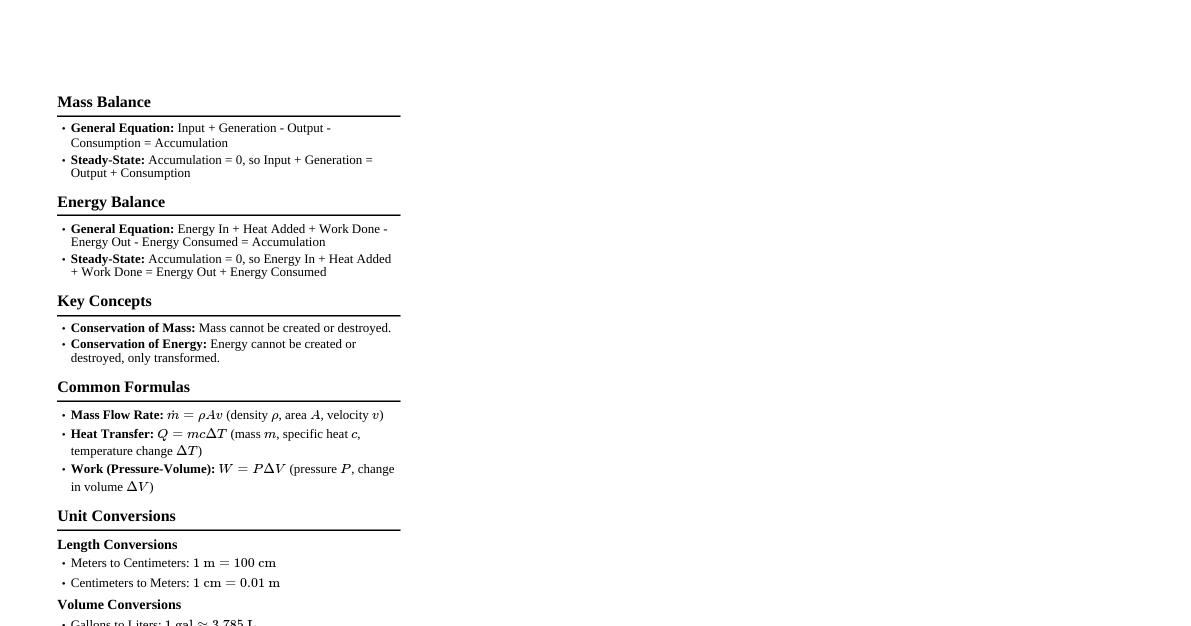
1. Mass Definition: A measure of the amount of matter in an object. SI Unit: kilogram (kg) Common Units: gram (g), pound-mass (lb$_m$), ounce (oz), ton (short/long/metric) Conversion Factors: $1 \text{ kg} = 1000 \text{ g}$ $1 \text{ lb}_m = 0.453592 \text{ kg}$ $1 \text{ kg} = 2.20462 \text{ lb}_m$ $1 \text{ oz} = 28.3495 \text{ g}$ $1 \text{ metric ton} = 1000 \text{ kg}$ $1 \text{ short ton} = 2000 \text{ lb}_m = 907.185 \text{ kg}$ 2. Length Definition: A measure of distance. SI Unit: meter (m) Common Units: centimeter (cm), millimeter (mm), kilometer (km), foot (ft), inch (in), mile (mi) Conversion Factors: $1 \text{ m} = 100 \text{ cm} = 1000 \text{ mm}$ $1 \text{ km} = 1000 \text{ m}$ $1 \text{ ft} = 0.3048 \text{ m}$ $1 \text{ m} = 3.28084 \text{ ft}$ $1 \text{ in} = 2.54 \text{ cm}$ $1 \text{ mi} = 1.60934 \text{ km}$ 3. Time Definition: The continuous sequence of existence and events. SI Unit: second (s) Common Units: minute (min), hour (h), day (d), year (yr) Conversion Factors: $1 \text{ min} = 60 \text{ s}$ $1 \text{ h} = 60 \text{ min} = 3600 \text{ s}$ $1 \text{ d} = 24 \text{ h} = 86400 \text{ s}$ $1 \text{ yr} \approx 365.25 \text{ d}$ 4. Temperature Definition: A measure of the average kinetic energy of particles in a substance. SI Unit: Kelvin (K) Common Units: degree Celsius ($^\circ$C), degree Fahrenheit ($^\circ$F), Rankine ($^\circ$R) Conversion Formulas: $T(\text{K}) = T(^\circ\text{C}) + 273.15$ $T(^\circ\text{C}) = (T(^\circ\text{F}) - 32) / 1.8$ $T(^\circ\text{F}) = 1.8 \times T(^\circ\text{C}) + 32$ $T(^\circ\text{R}) = T(^\circ\text{F}) + 459.67$ $T(^\circ\text{R}) = 1.8 \times T(\text{K})$ 5. Volume Definition: The amount of space occupied by a substance. SI Unit: cubic meter (m$^3$) Common Units: liter (L), cubic centimeter (cm$^3$), cubic foot (ft$^3$), gallon (gal), barrel (bbl) Conversion Factors: $1 \text{ L} = 0.001 \text{ m}^3 = 1000 \text{ cm}^3$ $1 \text{ m}^3 = 1000 \text{ L}$ $1 \text{ ft}^3 = 0.0283168 \text{ m}^3$ $1 \text{ m}^3 = 35.3147 \text{ ft}^3$ $1 \text{ gal (US liquid)} = 3.78541 \text{ L}$ $1 \text{ bbl (petroleum)} = 42 \text{ US gal} = 158.987 \text{ L}$ 6. Pressure Definition: Force exerted per unit area. SI Unit: Pascal (Pa) ($1 \text{ Pa} = 1 \text{ N/m}^2$) Common Units: atmosphere (atm), bar, pounds per square inch (psi), millimeters of mercury (mmHg), torr Conversion Factors: $1 \text{ atm} = 101325 \text{ Pa} = 1.01325 \text{ bar}$ $1 \text{ atm} = 14.696 \text{ psi}$ $1 \text{ bar} = 100000 \text{ Pa}$ $1 \text{ psi} = 6894.76 \text{ Pa}$ $1 \text{ atm} = 760 \text{ mmHg} = 760 \text{ Torr}$ 7. Energy/Work/Heat Definition: The capacity to do work. SI Unit: Joule (J) ($1 \text{ J} = 1 \text{ N} \cdot \text{m}$) Common Units: calorie (cal), British Thermal Unit (BTU), kilowatt-hour (kWh), foot-pound (ft-lb$_f$) Conversion Factors: $1 \text{ cal} = 4.184 \text{ J}$ $1 \text{ kcal} = 1000 \text{ cal} = 4184 \text{ J}$ $1 \text{ BTU} = 1055.06 \text{ J}$ $1 \text{ kWh} = 3.6 \times 10^6 \text{ J}$ $1 \text{ ft} \cdot \text{lb}_f = 1.35582 \text{ J}$ 8. Power Definition: The rate at which work is done or energy is transferred. SI Unit: Watt (W) ($1 \text{ W} = 1 \text{ J/s}$) Common Units: horsepower (hp), foot-pound per second (ft-lb$_f$/s), BTU per hour (BTU/h) Conversion Factors: $1 \text{ hp (mechanical)} = 745.7 \text{ W}$ $1 \text{ hp (metric)} = 735.5 \text{ W}$ $1 \text{ BTU/h} = 0.293071 \text{ W}$ $1 \text{ ft} \cdot \text{lb}_f/\text{s} = 1.35582 \text{ W}$ 9. Moles and Molecular Weight Definition (Mole): The amount of substance containing Avogadro's number of particles. Definition (Molecular Weight): The mass of one mole of a substance. SI Unit (Mole): mole (mol) SI Unit (Molecular Weight): kg/mol (often g/mol is used) Avogadro's Number ($N_A$): $6.022 \times 10^{23} \text{ particles/mol}$ Relationship: $\text{moles} = \text{mass} / \text{molecular weight}$ 10. Density Definition: Mass per unit volume. SI Unit: kilogram per cubic meter (kg/m$^3$) Common Units: g/cm$^3$, lb$_m$/ft$^3$, kg/L Conversion Factors: $1 \text{ g/cm}^3 = 1000 \text{ kg/m}^3$ $1 \text{ kg/L} = 1000 \text{ kg/m}^3$ $1 \text{ lb}_m/\text{ft}^3 = 16.0185 \text{ kg/m}^3$ Specific Gravity (SG): Ratio of a substance's density to a reference substance's density (usually water at $4^\circ\text{C}$). $\text{SG} = \rho_{\text{substance}} / \rho_{\text{H}_2\text{O at } 4^\circ\text{C}}$ $\rho_{\text{H}_2\text{O}} \approx 1000 \text{ kg/m}^3 \approx 1 \text{ g/cm}^3$ 11. Volumetric Flow Rate Definition: Volume of fluid passing per unit time. SI Unit: cubic meter per second (m$^3$/s) Common Units: L/s, gal/min (GPM), ft$^3$/min (CFM), bbl/day Conversion Factors: $1 \text{ L/s} = 0.001 \text{ m}^3/\text{s}$ $1 \text{ gal/min (US)} = 6.309 \times 10^{-5} \text{ m}^3/\text{s}$ $1 \text{ ft}^3/\text{min} = 4.719 \times 10^{-4} \text{ m}^3/\text{s}$ 12. Mass Flow Rate Definition: Mass of fluid passing per unit time. SI Unit: kilogram per second (kg/s) Common Units: kg/h, lb$_m$/h Conversion Factors: $1 \text{ kg/h} = 1/3600 \text{ kg/s}$ $1 \text{ lb}_m/\text{h} = 0.453592/3600 \text{ kg/s}$ Relationship: $\dot{m} = \rho \dot{V}$ (mass flow rate = density $\times$ volumetric flow rate) 13. Force Definition: An interaction that, when unopposed, will change the motion of an object. SI Unit: Newton (N) ($1 \text{ N} = 1 \text{ kg} \cdot \text{m/s}^2$) Common Units: pound-force (lb$_f$), dyne Conversion Factors: $1 \text{ lb}_f = 4.44822 \text{ N}$ $1 \text{ N} = 0.224809 \text{ lb}_f$ $1 \text{ dyne} = 10^{-5} \text{ N}$ Weight: $W = m \cdot g$ (mass $\times$ acceleration due to gravity) Standard Gravity ($g$): $9.80665 \text{ m/s}^2 = 32.174 \text{ ft/s}^2$ 14. Universal Gas Constant (R) Value in various units: $8.314 \text{ J/(mol} \cdot \text{K)}$ $0.08314 \text{ L} \cdot \text{bar/(mol} \cdot \text{K)}$ $0.08206 \text{ L} \cdot \text{atm/(mol} \cdot \text{K)}$ $1.987 \text{ cal/(mol} \cdot \text{K)}$ $10.73 \text{ psi} \cdot \text{ft}^3\text{/(lb-mol} \cdot ^\circ\text{R)}$ $0.7302 \text{ atm} \cdot \text{ft}^3\text{/(lb-mol} \cdot ^\circ\text{R)}$ $1.986 \text{ BTU/(lb-mol} \cdot ^\circ\text{R)}$