Temperature Units & Scales
Cheatsheet Content
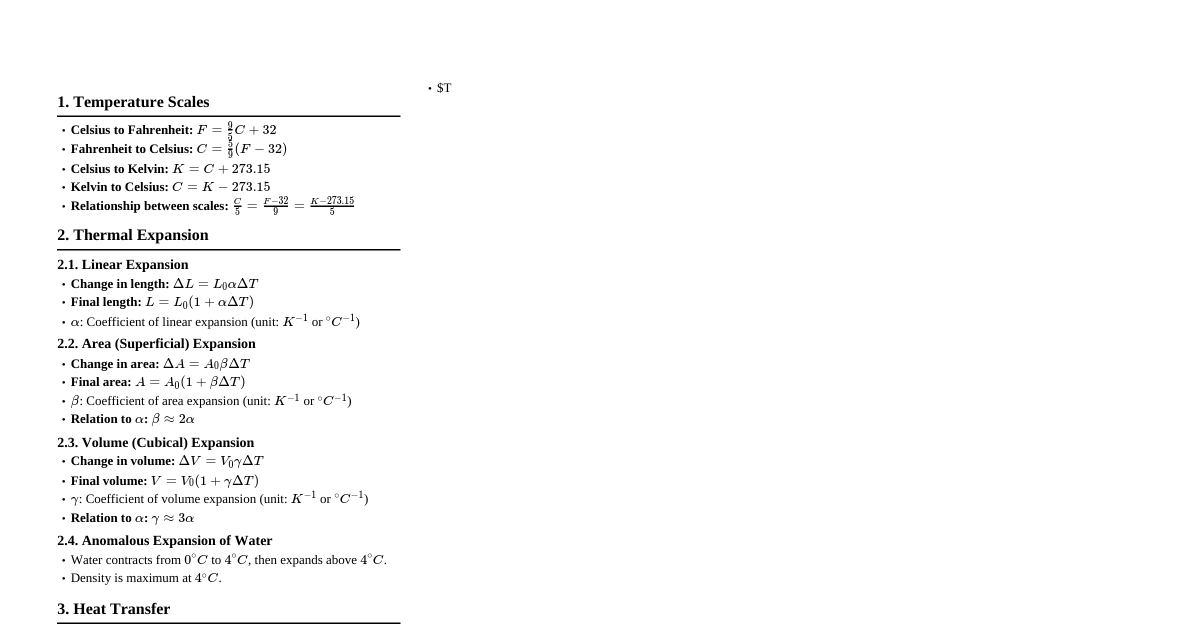
1. Temperature Scales Definition: Temperature is a measure of the average kinetic energy of the particles within a system. It determines the direction of heat flow. Absolute Zero: The theoretical lowest possible temperature where particles have minimum kinetic energy. 2. Celsius Scale ($^\circ C$) Reference Points: Freezing point of water: $0^\circ C$ Boiling point of water: $100^\circ C$ (at 1 atm) Interval: $1^\circ C$ is $1/100$th of the difference between freezing and boiling points of water. Relation to Kelvin: $T_K = T_C + 273.15$ Usage: Widely used in most parts of the world for everyday temperature measurements and in many scientific contexts. 3. Kelvin Scale (K) Definition: The absolute thermodynamic temperature scale. It is the SI base unit for temperature. Reference Point: Absolute zero is $0 \, K$. Triple point of water is defined as $273.16 \, K$. Interval: $1 \, K$ is equal to $1^\circ C$. Relation to Celsius: $T_C = T_K - 273.15$ Usage: Essential for all thermodynamic calculations (e.g., ideal gas law, entropy, free energy) because it is an absolute scale (no negative temperatures). 4. Fahrenheit Scale ($^\circ F$) Reference Points: Freezing point of water: $32^\circ F$ Boiling point of water: $212^\circ F$ (at 1 atm) Interval: $1^\circ F$ is $1/180$th of the difference between freezing and boiling points of water. Relation to Celsius: $T_F = \frac{9}{5} T_C + 32$ Relation to Kelvin: $T_K = (T_F - 32) \frac{5}{9} + 273.15$ Usage: Primarily used in the United States for everyday temperature measurements. 5. Rankine Scale ($^\circ R$ or $Ra$) Definition: An absolute thermodynamic temperature scale, similar to Kelvin, but based on the Fahrenheit interval. Reference Point: Absolute zero is $0^\circ R$. Interval: $1^\circ R$ is equal to $1^\circ F$. Relation to Fahrenheit: $T_R = T_F + 459.67$ Relation to Kelvin: $T_R = \frac{9}{5} T_K$ Usage: Used in some engineering applications in the U.S. where Fahrenheit is preferred but absolute temperature is required. 6. Conversion Formulas Summary From To Celsius ($^\circ C$) To Kelvin (K) To Fahrenheit ($^\circ F$) To Rankine ($^\circ R$) $^\circ C$ $T_C$ $T_C + 273.15$ $\frac{9}{5} T_C + 32$ $(\frac{9}{5} T_C + 32) + 459.67$ K $T_K - 273.15$ $T_K$ $\frac{9}{5} (T_K - 273.15) + 32$ $\frac{9}{5} T_K$ $^\circ F$ $\frac{5}{9} (T_F - 32)$ $\frac{5}{9} (T_F - 32) + 273.15$ $T_F$ $T_F + 459.67$ $^\circ R$ $\frac{5}{9} (T_R - 491.67)$ $\frac{5}{9} T_R$ $T_R - 459.67$ $T_R$ 7. Temperature Differences Celsius and Kelvin: A temperature difference of $1^\circ C$ is equal to $1 \, K$. $\Delta T_C = \Delta T_K$ Fahrenheit and Rankine: A temperature difference of $1^\circ F$ is equal to $1^\circ R$. $\Delta T_F = \Delta T_R$ Across Scales: A temperature difference of $1^\circ C$ (or $1 \, K$) is equal to a difference of $1.8^\circ F$ (or $1.8^\circ R$). $\Delta T_F = \frac{9}{5} \Delta T_C$ $\Delta T_C = \frac{5}{9} \Delta T_F$