English Grammar Essentials
Cheatsheet Content
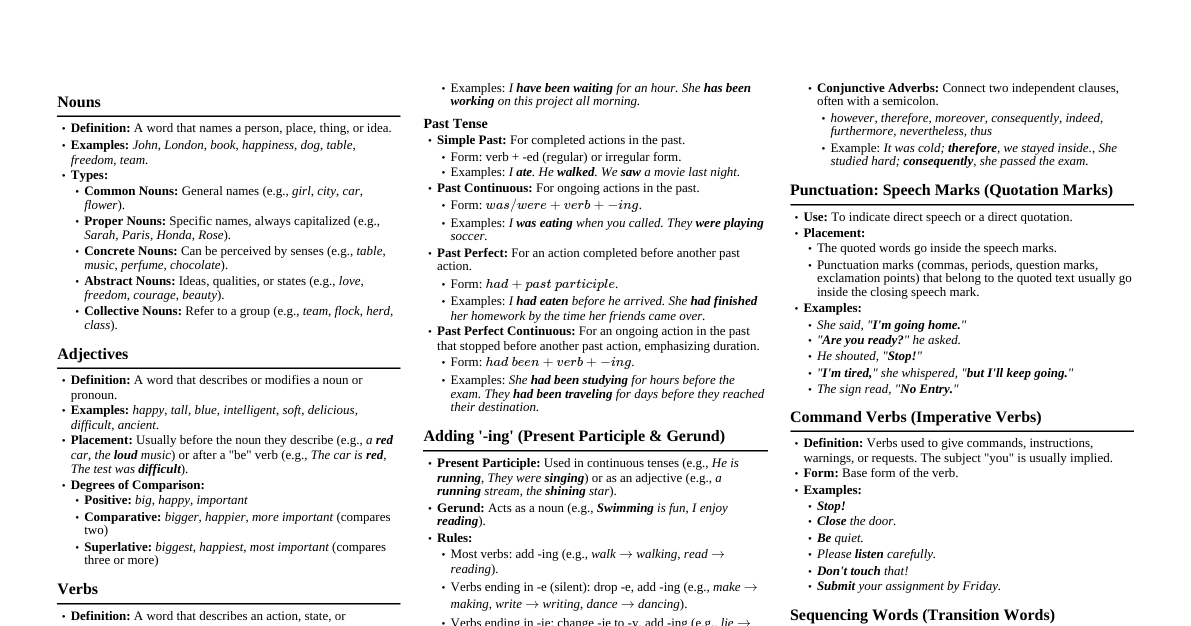
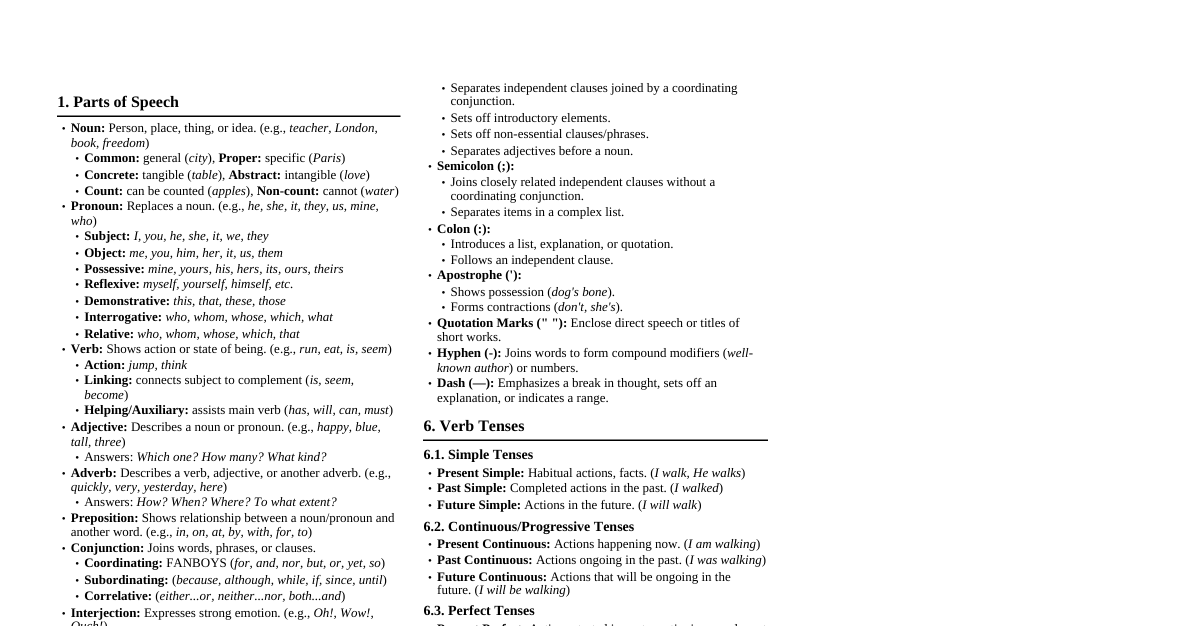
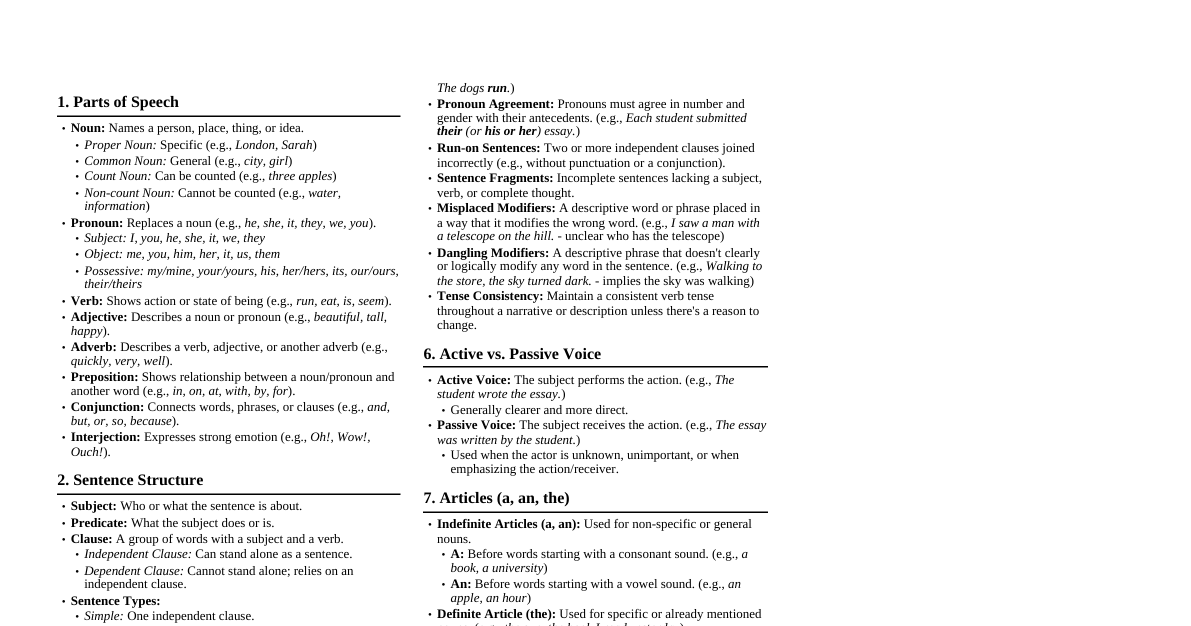
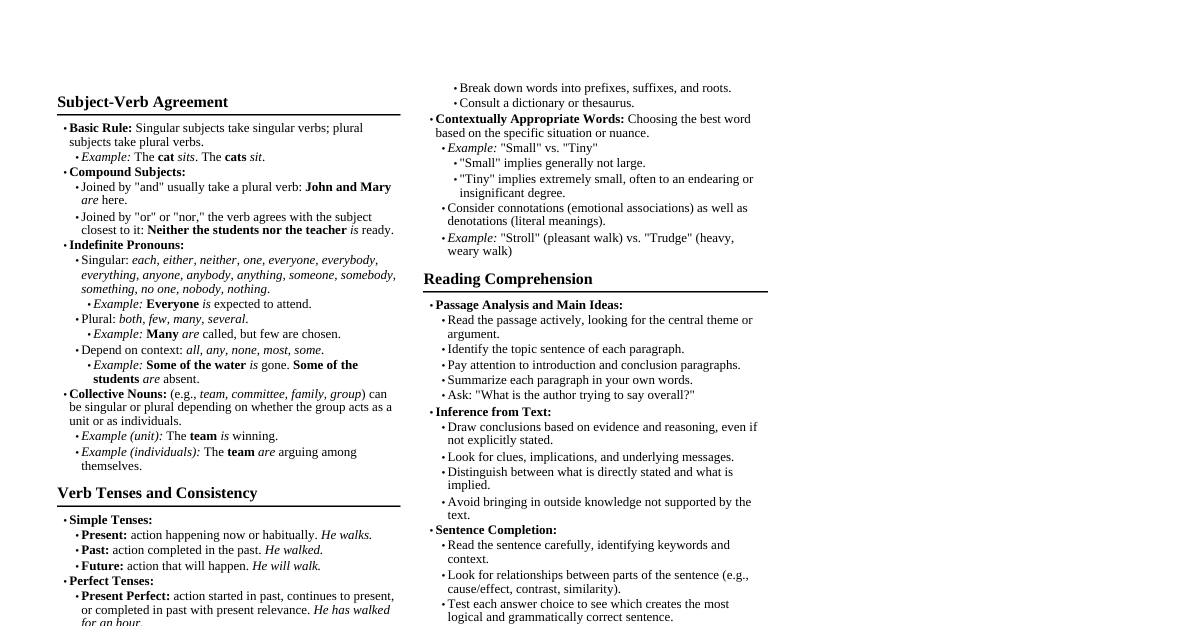
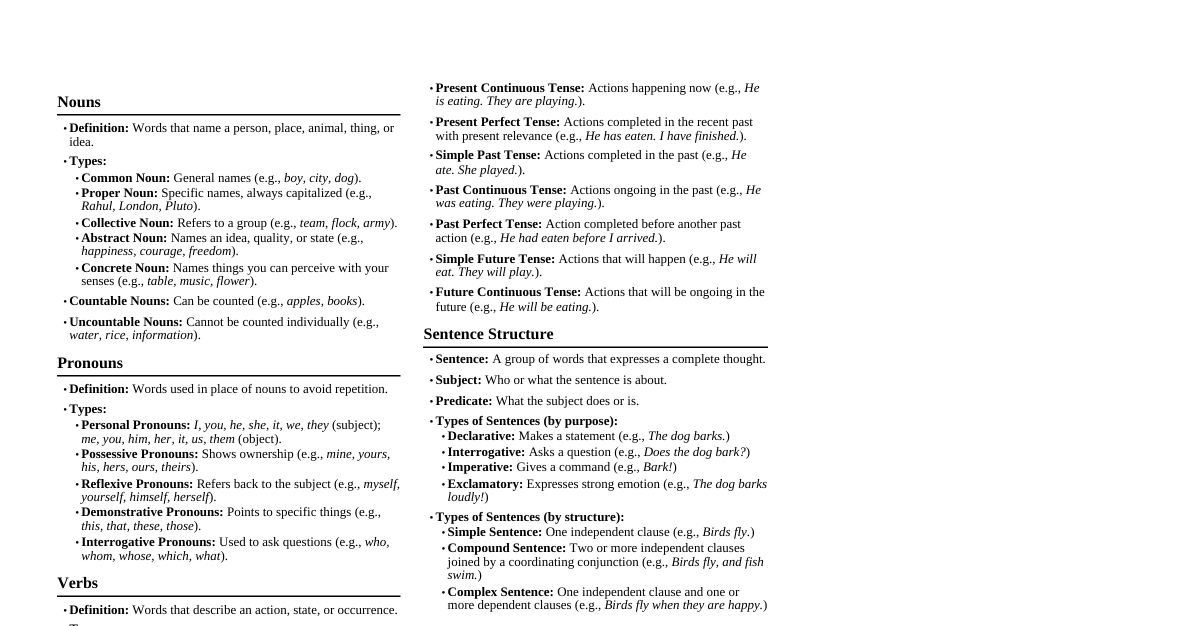
### Tenses English has 12 main tenses, formed by combining simple, continuous, and perfect aspects across past, present, and future. #### 1. Simple Tenses Used for habitual actions, facts, or completed events. | Tense | Structure | Example | Usage | Keywords | |-----------------|---------------------|----------------------------|--------------------------------------------------------------------|--------------------------------------------| | **Present Simple** | `Verb (s/es)` | `He walks.` | Habits, routines, facts, general truths, scheduled events. | always, often, usually, every day, never | | **Past Simple** | `Verb + ed` (or irregular) | `He walked.` | Completed actions at a specific time in the past. | yesterday, last week, ago, in 1999 | | **Future Simple** | `will + Verb` | `He will walk.` | Predictions, spontaneous decisions, promises, future facts. | tomorrow, next year, soon, in the future | | **Future Simple (going to)** | `am/is/are going to + Verb` | `He is going to walk.` | Plans, intentions, predictions based on present evidence. | | #### 2. Continuous Tenses (Progressive) Used for actions in progress at a specific time. | Tense | Structure | Example | Usage | Keywords | |--------------------|---------------------------------|-------------------------------|--------------------------------------------------------------------|--------------------------------------------| | **Present Continuous** | `am/is/are + Verb + ing` | `He is walking.` | Actions happening now, temporary actions, developing situations, future arrangements. | now, right now, at the moment, currently, today, this week | | **Past Continuous** | `was/were + Verb + ing` | `He was walking.` | Actions ongoing at a specific time in the past, interrupted actions, parallel actions. | while, when, as, at that time | | **Future Continuous** | `will be + Verb + ing` | `He will be walking.` | Actions that will be in progress at a specific future time. | at this time tomorrow, next year, while | #### 3. Perfect Tenses Used for actions completed before a specific point in time, or actions that started in the past and continue to the present. | Tense | Structure | Example | Usage | Keywords | |--------------------|---------------------------------|-------------------------------|--------------------------------------------------------------------|--------------------------------------------| | **Present Perfect** | `has/have + Past Participle` | `He has walked.` | Actions completed at an unspecified time in the past (result important now), actions started in past and continuing to present, experiences. | ever, never, already, yet, just, since, for, so far, recently | | **Past Perfect** | `had + Past Participle` | `He had walked.` | Action completed before another past action or specific time in the past. | before, after, by the time, already, never | | **Future Perfect** | `will have + Past Participle` | `He will have walked.` | Action that will be completed before a specific future time or another future action. | by (time), by the time, before | #### 4. Perfect Continuous Tenses Used for actions that started in the past, continued for a duration, and are either still continuing or have just stopped. | Tense | Structure | Example | Usage | Keywords | |---------------------------|-----------------------------------------|-----------------------------------|--------------------------------------------------------------------|--------------------------------------------| | **Present Perfect Continuous** | `has/have + been + Verb + ing` | `He has been walking.` | Action started in the past, continuing up to the present, and often still ongoing or has just finished with visible results. | since, for, all day/morning, recently | | **Past Perfect Continuous** | `had + been + Verb + ing` | `He had been walking.` | Action that continued for a period up to a specific point in the past. | for, since, before, until, all day | | **Future Perfect Continuous** | `will have + been + Verb + ing` | `He will have been walking.` | Action that will continue for a duration up to a specific future time. | for (duration) by (time), by the time | ### Modals - **Can/Could:** Ability, possibility, permission - `I can swim.` (Ability) - `It could rain.` (Possibility) - `Can I go?` (Permission) - **May/Might:** Possibility, permission - `It may be true.` (Possibility) - `You may leave.` (Permission) - **Must/Have to:** Obligation, necessity - `You must study.` (Strong obligation) - `I have to work.` (Necessity) - **Should/Ought to:** Advice, recommendation - `You should rest.` (Advice) - `We ought to help.` (Recommendation) - **Will/Would:** Future, request, habit - `She will arrive.` (Future) - `Would you help?` (Polite request) ### Determiners Words that precede nouns to specify their quantity or to clarify what the noun refers to. - **Articles:** `a, an, the` - `a book`, `an apple`, `the sun` - **Demonstratives:** `this, that, these, those` - `this car`, `those houses` - **Possessives:** `my, your, his, her, its, our, their` - `my pen`, `their ideas` - **Quantifiers:** `some, any, much, many, few, a few, little, a little, all, every, each, both, either, neither, several` - `some water`, `many students`, `a few friends` - **Numbers:** `one, two, three, first, second, third` - `two cats`, `the first chapter` ### Active and Passive Voice - **Active Voice:** The subject performs the action. - **Structure:** Subject + Verb + Object - **Example:** `The dog chased the ball.` (Dog is performing the action) - **Passive Voice:** The subject receives the action. - **Structure:** Object + `be` verb + Past Participle + (by + Agent) - **Example:** `The ball was chased by the dog.` (Ball is receiving the action) - **When to use:** When the performer of the action is unknown, unimportant, or obvious, or when you want to emphasize the action or the receiver of the action. ### The Passive Voice: Tense Form The passive voice is formed with a form of `to be` + the past participle of the main verb. | Tense | Active Example | Passive Structure | Passive Example | |--------------------|------------------------|-------------------------------|------------------------------| | **Simple Present** | `He writes a letter.` | `is/am/are + written` | `A letter is written.` | | **Simple Past** | `He wrote a letter.` | `was/were + written` | `A letter was written.` | | **Simple Future** | `He will write a letter.` | `will be + written` | `A letter will be written.` | | **Present Cont.** | `He is writing a letter.` | `is/am/are + being + written` | `A letter is being written.` | | **Past Cont.** | `He was writing a letter.` | `was/were + being + written` | `A letter was being written.`| | **Present Perfect**| `He has written a letter.` | `has/have + been + written` | `A letter has been written.` | | **Past Perfect** | `He had written a letter.` | `had + been + written` | `A letter had been written.` | | **Future Perfect** | `He will have written a letter.` | `will have + been + written` | `A letter will have been written.` | ### Direct and Indirect Speech - **Direct Speech:** Reports the exact words spoken, enclosed in quotation marks. - **Example:** `He said, "I am busy."` - **Indirect Speech (Reported Speech):** Reports what someone said without using their exact words, often with changes in tense, pronouns, and time/place expressions. #### Key Changes in Indirect Speech: 1. **Tense Backshift:** - Present Simple → Past Simple (`I am busy` → `he was busy`) - Present Continuous → Past Continuous (`I am working` → `he was working`) - Present Perfect → Past Perfect (`I have finished` → `he had finished`) - Past Simple → Past Perfect (`I went` → `he had gone`) - `will` → `would` - `can` → `could` - `may` → `might` - `must/have to` → `had to` 2. **Pronoun Change:** - `I` → `he/she` - `my` → `his/her` - `you` → `I/he/she/they` 3. **Time and Place Expressions:** - `now` → `then` - `today` → `that day` - `yesterday` → `the day before` - `tomorrow` → `the next day` - `here` → `there` - `this` → `that` - **Example:** - **Direct:** `She said, "I will meet you here tomorrow."` - **Indirect:** `She said that she would meet me there the next day.` ### Subject-Verb Agreement The verb in a sentence must agree in number with its subject. #### Basic Rules: 1. **Singular Subject = Singular Verb:** - `The **cat** **eats**.` - `**He** **is** a student.` 2. **Plural Subject = Plural Verb:** - `The **cats** **eat**.` - `**They** **are** students.` #### Common Pitfalls: - **Intervening Phrases:** Phrases between the subject and verb do not affect agreement. - `The **list** of items **is** on the table.` - **Compound Subjects:** - Joined by `and`: Usually plural. `**John and Mary** **are** friends.` - Joined by `or/nor`: Verb agrees with the closer subject. `Neither **John nor Mary** **is** here.` `Neither **John nor his friends** **are** here.` - **Indefinite Pronouns:** - **Singular:** `everyone, everybody, everything, someone, somebody, something, no one, nobody, nothing, anyone, anybody, anything, each, either, neither, one.` - `**Everyone** **is** welcome.` - **Plural:** `both, few, many, several.` - `**Many** **are** called.` - **Can be Singular/Plural (depends on context):** `all, any, none, most, some.` - `**Some** of the **water** **is** gone.` - `**Some** of the **students** **are** here.` - **Collective Nouns:** (`team, family, committee`) can be singular (acting as one unit) or plural (acting as individuals). - `The **team** **is** playing well.` (Unit) - `The **team** **are** arguing among themselves.` (Individuals) - **Titles, Names, Words as Subjects:** Always singular. - `**"The Grapes of Wrath"** **is** a classic.` - **Expressions of Quantity/Measurement:** Usually singular when referring to a single unit. - `**Five miles** **is** a long distance.` - `**Ten dollars** **is** a fair price.`