English Grammar (Class 7)
Cheatsheet Content
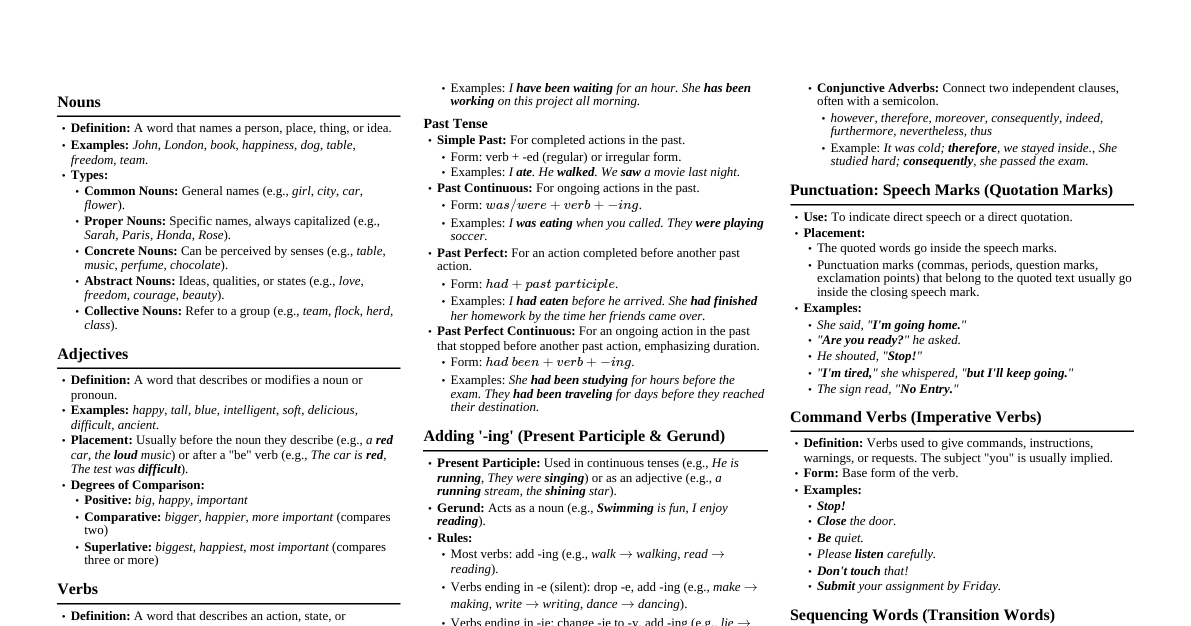
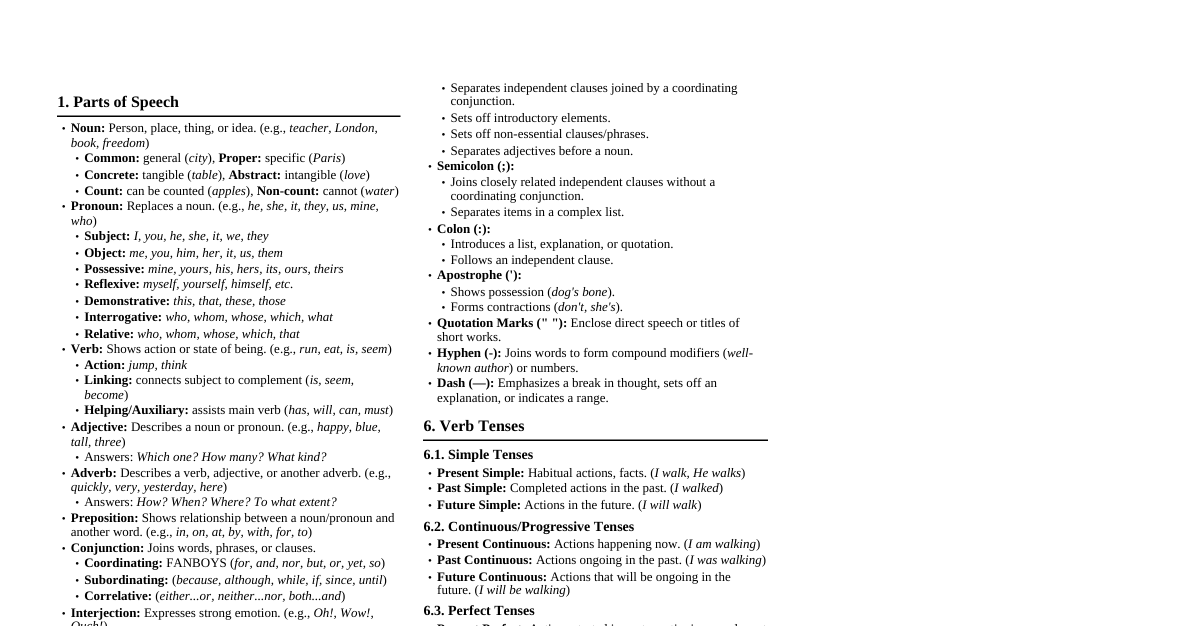
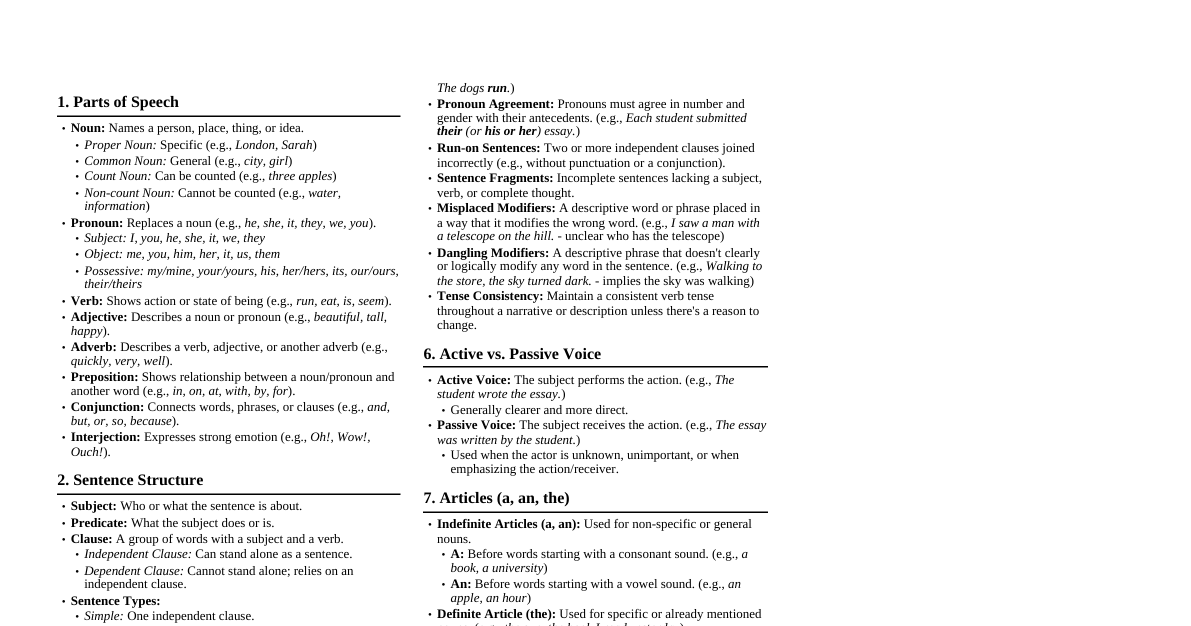
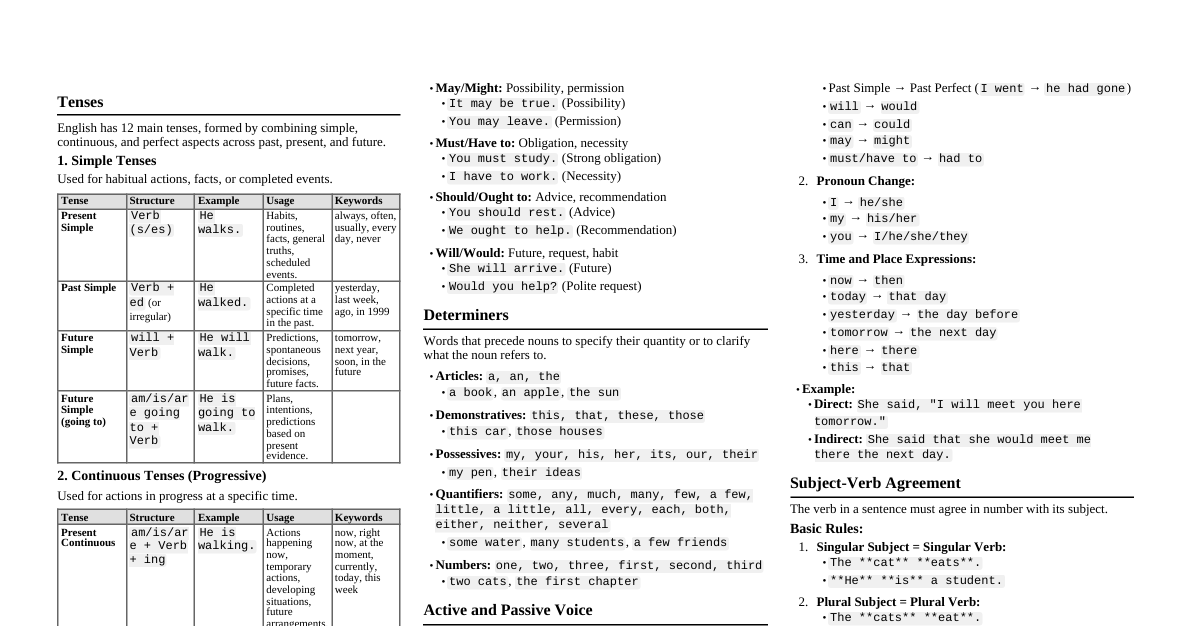
### Nouns - **Definition:** Words that name a person, place, animal, thing, or idea. - **Types:** - **Common Noun:** General names (e.g., *boy, city, dog*). - **Proper Noun:** Specific names, always capitalized (e.g., *Rahul, London, Pluto*). - **Collective Noun:** Refers to a group (e.g., *team, flock, army*). - **Abstract Noun:** Names an idea, quality, or state (e.g., *happiness, courage, freedom*). - **Concrete Noun:** Names things you can perceive with your senses (e.g., *table, music, flower*). - **Countable Nouns:** Can be counted (e.g., *apples, books*). - **Uncountable Nouns:** Cannot be counted individually (e.g., *water, rice, information*). ### Pronouns - **Definition:** Words used in place of nouns to avoid repetition. - **Types:** - **Personal Pronouns:** *I, you, he, she, it, we, they* (subject); *me, you, him, her, it, us, them* (object). - **Possessive Pronouns:** Shows ownership (e.g., *mine, yours, his, hers, ours, theirs*). - **Reflexive Pronouns:** Refers back to the subject (e.g., *myself, yourself, himself, herself*). - **Demonstrative Pronouns:** Points to specific things (e.g., *this, that, these, those*). - **Interrogative Pronouns:** Used to ask questions (e.g., *who, whom, whose, which, what*). ### Verbs - **Definition:** Words that describe an action, state, or occurrence. - **Types:** - **Action Verbs:** Show what the subject does (e.g., *run, eat, write*). - **Linking Verbs:** Connect the subject to a description (e.g., *is, am, are, was, were, become, seem*). - **Helping/Auxiliary Verbs:** Used with main verbs to form tenses (e.g., *be, have, do, can, will, may*). - **Transitive Verb:** Takes a direct object (e.g., *She **reads** a book.*). - **Intransitive Verb:** Does not take a direct object (e.g., *He **sleeps**.*). ### Adjectives - **Definition:** Words that describe or modify nouns and pronouns. - **Degrees of Comparison:** - **Positive:** (e.g., *tall, beautiful*) - **Comparative:** (e.g., *taller, more beautiful*) - **Superlative:** (e.g., *tallest, most beautiful*) - **Order of Adjectives:** Opinion, Size, Age, Shape, Color, Origin, Material, Purpose (e.g., *a lovely, small, old, round, blue, French, wooden carving knife*). ### Adverbs - **Definition:** Words that modify verbs, adjectives, or other adverbs. They answer *how, when, where, why, to what extent*. - **Types:** - **Adverbs of Manner:** (e.g., *quickly, slowly, carefully*) - **Adverbs of Time:** (e.g., *now, yesterday, soon, always*) - **Adverbs of Place:** (e.g., *here, there, everywhere, inside*) - **Adverbs of Frequency:** (e.g., *often, rarely, never, usually*) - **Adverbs of Degree:** (e.g., *very, quite, almost, too*) ### Prepositions - **Definition:** Words that show the relationship between a noun/pronoun and other words in a sentence (e.g., position, direction, time). - **Common Examples:** *in, on, at, by, for, from, with, under, over, between, among, during, before, after*. - **Phrasal Prepositions:** (e.g., *according to, because of, instead of*). ### Conjunctions - **Definition:** Words that join words, phrases, or clauses. - **Types:** - **Coordinating Conjunctions (FANBOYS):** *For, And, Nor, But, Or, Yet, So*. Connects grammatically equal parts. - **Subordinating Conjunctions:** Introduce dependent clauses (e.g., *although, because, while, since, if, when, where*). - **Correlative Conjunctions:** Pairs of conjunctions (e.g., *either...or, neither...nor, both...and, not only...but also*). ### Interjections - **Definition:** Words or phrases that express strong emotion or surprise. They often stand alone or are followed by an exclamation mark. - **Examples:** *Oh!, Wow!, Hurrah!, Alas!, Bravo!* ### Tenses - **Definition:** Show the time an action takes place. - **Simple Present Tense:** Actions that happen regularly, facts (e.g., *He eats. The sun rises.*). - **Present Continuous Tense:** Actions happening now (e.g., *He is eating. They are playing.*). - **Present Perfect Tense:** Actions completed in the recent past with present relevance (e.g., *He has eaten. I have finished.*). - **Simple Past Tense:** Actions completed in the past (e.g., *He ate. She played.*). - **Past Continuous Tense:** Actions ongoing in the past (e.g., *He was eating. They were playing.*). - **Past Perfect Tense:** Action completed before another past action (e.g., *He had eaten before I arrived.*). - **Simple Future Tense:** Actions that will happen (e.g., *He will eat. They will play.*). - **Future Continuous Tense:** Actions that will be ongoing in the future (e.g., *He will be eating.*). ### Sentence Structure - **Sentence:** A group of words that expresses a complete thought. - **Subject:** Who or what the sentence is about. - **Predicate:** What the subject does or is. - **Types of Sentences (by purpose):** - **Declarative:** Makes a statement (e.g., *The dog barks.*) - **Interrogative:** Asks a question (e.g., *Does the dog bark?*) - **Imperative:** Gives a command (e.g., *Bark!*) - **Exclamatory:** Expresses strong emotion (e.g., *The dog barks loudly!*) - **Types of Sentences (by structure):** - **Simple Sentence:** One independent clause (e.g., *Birds fly.*) - **Compound Sentence:** Two or more independent clauses joined by a coordinating conjunction (e.g., *Birds fly, and fish swim.*) - **Complex Sentence:** One independent clause and one or more dependent clauses (e.g., *Birds fly when they are happy.*) ### Active and Passive Voice - **Active Voice:** The subject performs the action (e.g., *The boy **kicked** the ball.*). - **Passive Voice:** The subject receives the action (e.g., *The ball **was kicked** by the boy.*). - **Key:** Use 'to be' verb + past participle in passive voice. ### Direct and Indirect Speech - **Direct Speech:** Reports the exact words of the speaker, enclosed in quotation marks (e.g., *He said, "I am busy."*). - **Indirect Speech (Reported Speech):** Reports what the speaker said without using their exact words, often with changes in tense and pronouns (e.g., *He said that he was busy.*). - **Changes in Tense:** Present becomes past, past becomes past perfect. - **Changes in Pronouns:** Adjust according to the context. - **Changes in Time/Place:** *Now* $\rightarrow$ *then*, *here* $\rightarrow$ *there*, *today* $\rightarrow$ *that day*.