English Grammar Essentials
Cheatsheet Content
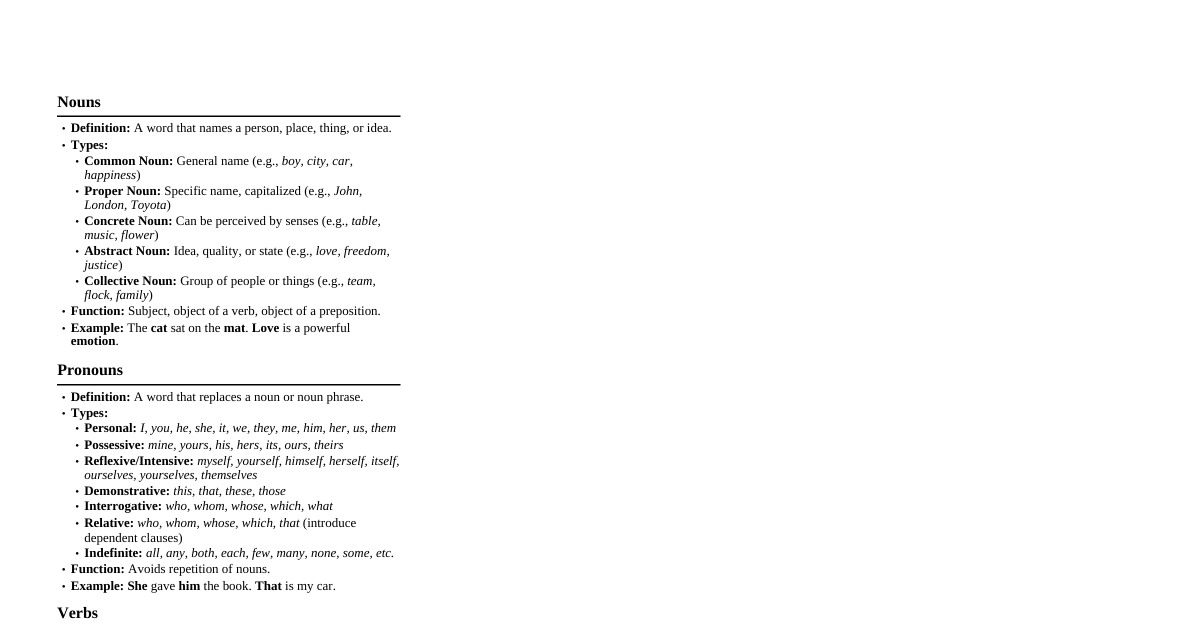
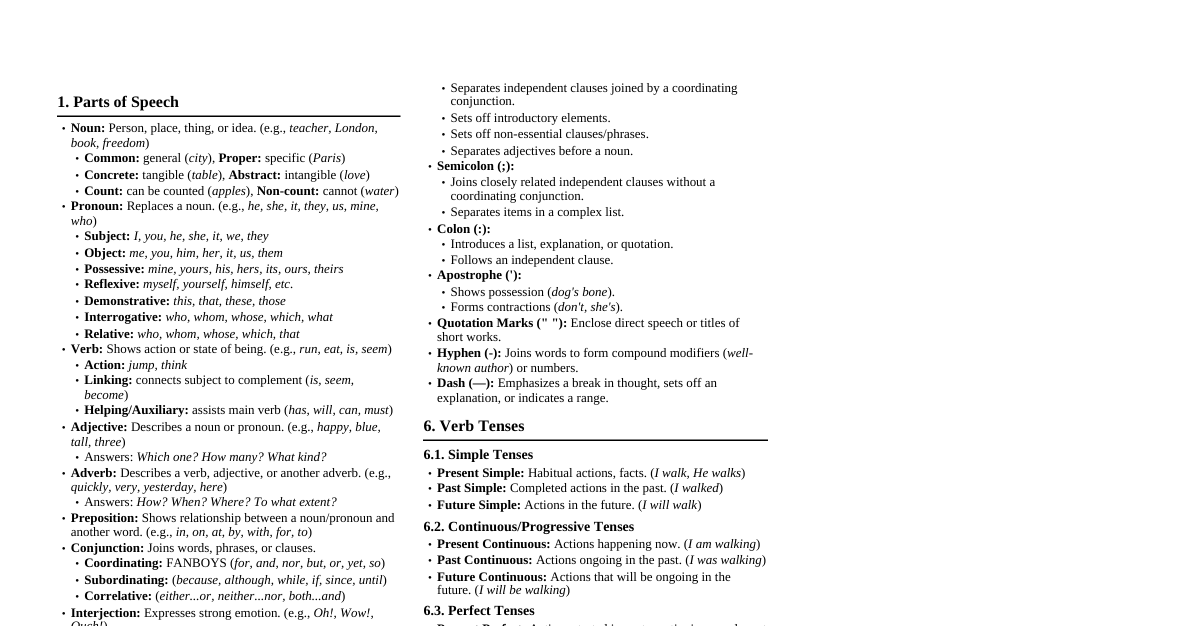
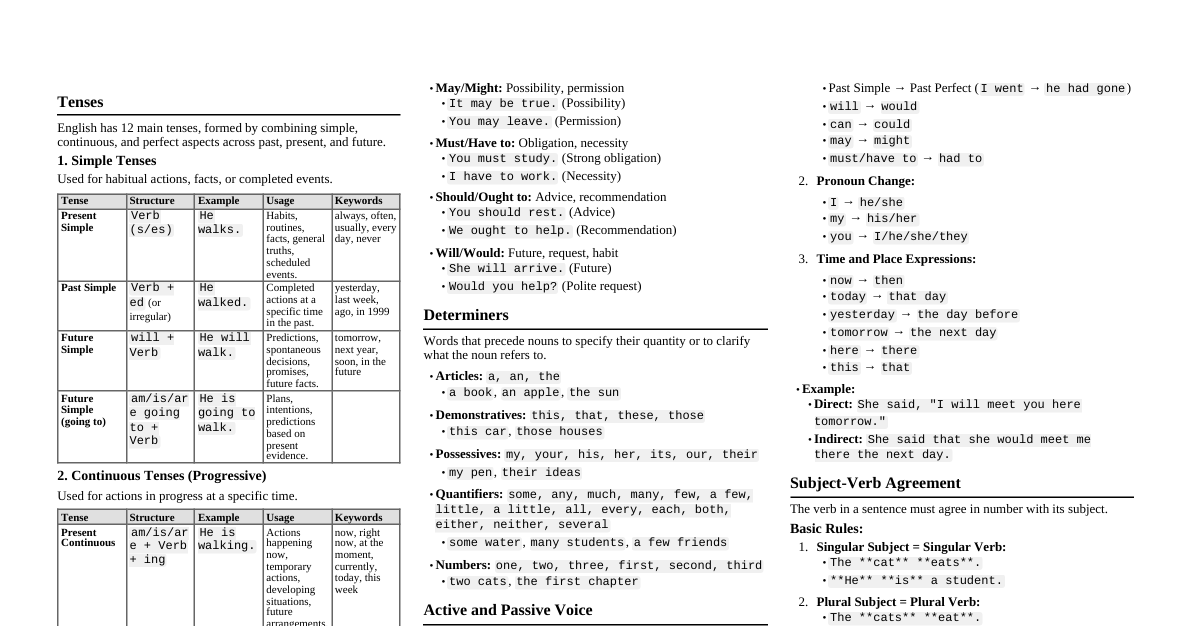
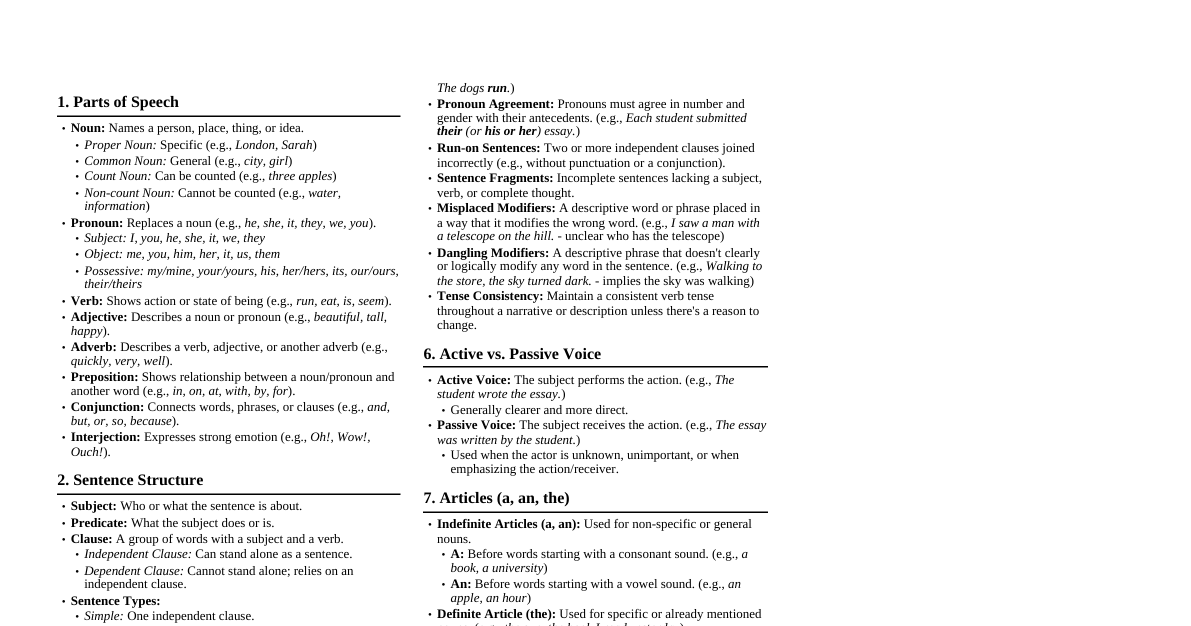
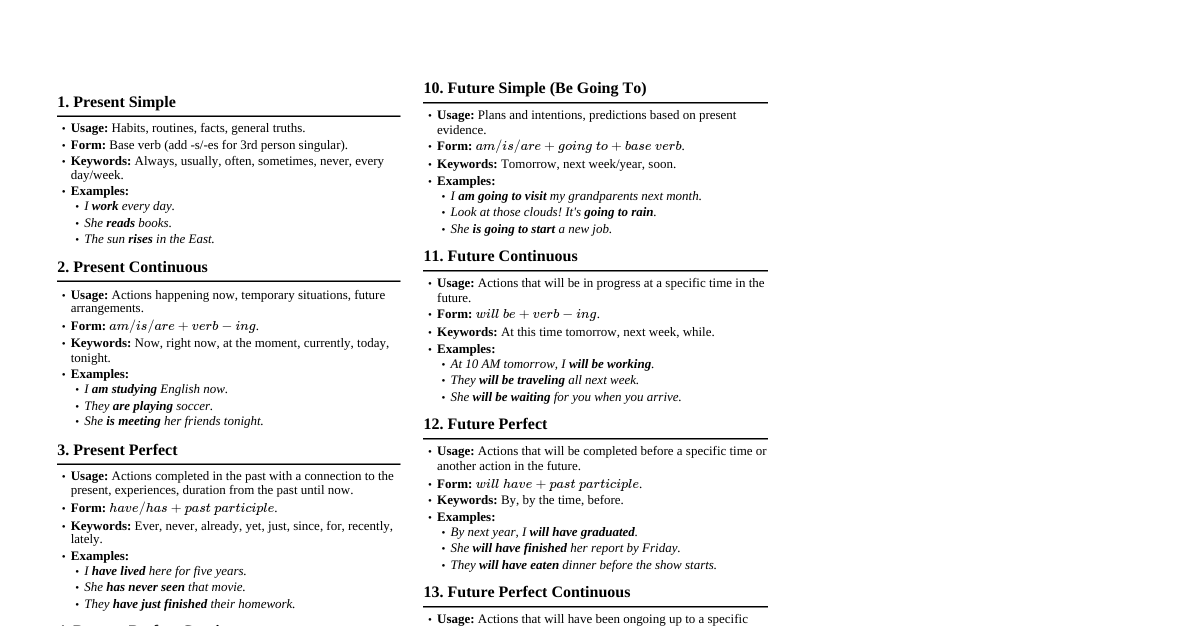
Nouns Definition: A word that names a person, place, thing, or idea. Examples: John , London , book , happiness , dog , table , freedom , team . Types: Common Nouns: General names (e.g., girl , city , car , flower ). Proper Nouns: Specific names, always capitalized (e.g., Sarah , Paris , Honda , Rose ). Concrete Nouns: Can be perceived by senses (e.g., table , music , perfume , chocolate ). Abstract Nouns: Ideas, qualities, or states (e.g., love , freedom , courage , beauty ). Collective Nouns: Refer to a group (e.g., team , flock , herd , class ). Adjectives Definition: A word that describes or modifies a noun or pronoun. Examples: happy , tall , blue , intelligent , soft , delicious , difficult , ancient . Placement: Usually before the noun they describe (e.g., a red car , the loud music ) or after a "be" verb (e.g., The car is red , The test was difficult ). Degrees of Comparison: Positive: big , happy , important Comparative: bigger , happier , more important (compares two) Superlative: biggest , happiest , most important (compares three or more) Verbs Definition: A word that describes an action, state, or occurrence. Examples: run , sing , is , become , think , feel , write , exist . Types: Action Verbs: Show an action (e.g., jump , eat , swim , talk ). Linking Verbs (Be Verbs): Connect the subject to a noun or adjective that describes it (e.g., He is a doctor , She seems tired ). Helping/Auxiliary Verbs: Used with main verbs to form tenses or moods (e.g., will , have , can , should , do , might ). Be Verbs Forms: am, is, are, was, were, be, being, been . Function: Can act as main verbs (e.g., She is happy , They were late ) or helping verbs (e.g., He is running , We are planning ). Adverbs Definition: A word that modifies a verb, an adjective, or another adverb. Often end in -ly. Examples: quickly , very , here , yesterday , always , slowly , extremely , upstairs . What they tell us: How: He runs quickly . , She sings beautifully . When: She arrived yesterday . , I always wake up early. Where: The book is here . , Go upstairs . To what extent: It's very cold. , He is extremely talented. Pronouns Definition: A word that replaces a noun. Examples: I, you, he, she, it, we, they, me, him, her, us, them, mine, yours, myself, this, who, everyone . Types: Personal: Refer to specific people or things (e.g., I, you, he, she, it, we, they, me, him, her, us, them ). Possessive: Show ownership (e.g., mine, yours, his, hers, its, ours, theirs ). Reflexive: Refer back to the subject (e.g., myself, yourself, himself, herself, itself, ourselves, yourselves, themselves ). Demonstrative: Point to something (e.g., this, that, these, those ). Interrogative: Ask questions (e.g., who, what, which, whom, whose ). Indefinite: Refer to non-specific things (e.g., everyone, something, nobody, all, many, few ). Tenses Verbs change form to show when an action happens. Present Tense Simple Present: For habits, facts, scheduled events. Form: Base verb (add -s/-es for 3rd person singular). Examples: I eat . He eats . The sun rises . They work every day. Present Continuous: For actions happening now. Form: $am/is/are + verb + -ing$. Examples: I am eating . She is reading . We are studying for the exam. Present Perfect: For actions started in the past, continuing to present, or completed at an unspecified time in the past. Form: $have/has + past \ participle$. Examples: I have eaten . He has studied . They have lived here for ten years. Present Perfect Continuous: For actions started in the past and continuing up to now, emphasizing duration. Form: $have/has \ been + verb + -ing$. Examples: I have been waiting for an hour. She has been working on this project all morning. Past Tense Simple Past: For completed actions in the past. Form: verb + -ed (regular) or irregular form. Examples: I ate . He walked . We saw a movie last night. Past Continuous: For ongoing actions in the past. Form: $was/were + verb + -ing$. Examples: I was eating when you called. They were playing soccer. Past Perfect: For an action completed before another past action. Form: $had + past \ participle$. Examples: I had eaten before he arrived. She had finished her homework by the time her friends came over. Past Perfect Continuous: For an ongoing action in the past that stopped before another past action, emphasizing duration. Form: $had \ been + verb + -ing$. Examples: She had been studying for hours before the exam. They had been traveling for days before they reached their destination. Adding '-ing' (Present Participle & Gerund) Present Participle: Used in continuous tenses (e.g., He is running , They were singing ) or as an adjective (e.g., a running stream , the shining star ). Gerund: Acts as a noun (e.g., Swimming is fun , I enjoy reading ). Rules: Most verbs: add -ing (e.g., walk $\rightarrow$ walking , read $\rightarrow$ reading ). Verbs ending in -e (silent): drop -e, add -ing (e.g., make $\rightarrow$ making , write $\rightarrow$ writing , dance $\rightarrow$ dancing ). Verbs ending in -ie: change -ie to -y, add -ing (e.g., lie $\rightarrow$ lying , die $\rightarrow$ dying ). One-syllable verbs ending in consonant-vowel-consonant (CVC): double last consonant, add -ing (e.g., run $\rightarrow$ running , sit $\rightarrow$ sitting , stop $\rightarrow$ stopping ). Noun Phrases Definition: A group of words that functions as a noun in a sentence. It includes a noun (or pronoun) and all its modifiers. Structure: Determiner + (Adjective) + Noun + (Prepositional Phrase/Other Modifier) Examples: The big red car (determiner, adjectives, noun) A student with high grades (noun, prepositional phrase as modifier) She (a pronoun alone can be a noun phrase) The very old house on the hill My best friend Suffixes Definition: A letter or group of letters added to the end of a word to change its meaning or part of speech. Common Suffixes: -ful (full of): careful , joyful , beautiful -less (without): careless , hopeless , fearless -ness (state of): happiness , kindness , darkness -ly (in a way): quickly , happily , softly (forms adverbs) -tion/-sion (act of): action , decision , information , explosion -er/-or (person/thing that does): teacher , actor , writer , sailor -able/-ible (able to be): readable , visible , enjoyable , flexible Contractions Definition: Shortened forms of words, usually two words, where an apostrophe replaces missing letters. Examples: I + am $\rightarrow$ I'm do + not $\rightarrow$ don't he + will $\rightarrow$ he'll they + have $\rightarrow$ they've it + is / it + has $\rightarrow$ it's we + are $\rightarrow$ we're you + would $\rightarrow$ you'd should + not $\rightarrow$ shouldn't Note: Be careful not to confuse it's (it is/it has) with its (possessive pronoun). Similarly, they're (they are) vs. their (possessive) vs. there (place). Connectives (Conjunctions) Definition: Words that join words, phrases, clauses, or sentences. Types: Coordinating Conjunctions (FANBOYS): Join elements of equal grammatical rank. For, And, Nor, But, Or, Yet, So Example: I like tea and coffee. , She wanted to go, but she was too tired. Subordinating Conjunctions: Introduce a dependent clause. after, although, as, because, before, if, since, though, unless, until, when, while, where, whether Example: We left because it was raining. , Although it was cold, we went for a walk. Conjunctive Adverbs: Connect two independent clauses, often with a semicolon. however, therefore, moreover, consequently, indeed, furthermore, nevertheless, thus Example: It was cold; therefore , we stayed inside. , She studied hard; consequently , she passed the exam. Punctuation: Speech Marks (Quotation Marks) Use: To indicate direct speech or a direct quotation. Placement: The quoted words go inside the speech marks. Punctuation marks (commas, periods, question marks, exclamation points) that belong to the quoted text usually go inside the closing speech mark. Examples: She said, " I'm going home. " " Are you ready? " he asked. He shouted, " Stop! " " I'm tired, " she whispered, " but I'll keep going. " The sign read, " No Entry. " Command Verbs (Imperative Verbs) Definition: Verbs used to give commands, instructions, warnings, or requests. The subject "you" is usually implied. Form: Base form of the verb. Examples: Stop! Close the door. Be quiet. Please listen carefully. Don't touch that! Submit your assignment by Friday. Sequencing Words (Transition Words) Definition: Words or phrases that help organize ideas and show the order of events or steps. Examples: Beginning: First, To start, Initially, In the beginning, At first Middle: Next, Then, After that, Secondly, Meanwhile, Subsequently, Later, During, Following this End: Finally, Lastly, In conclusion, To summarize, Eventually, In the end Example: First , mix the ingredients. Next , pour into a pan. After that , bake for 30 minutes. Finally , let it cool. Compound Words Definition: Two or more words joined together to create a new word with a new meaning. Types: Closed Compounds: Words joined without a space (e.g., sun + flower $\rightarrow$ sunflower , key + board $\rightarrow$ keyboard , moon + light $\rightarrow$ moonlight ). Hyphenated Compounds: Words joined with a hyphen (e.g., mother + in + law $\rightarrow$ mother-in-law , well-being , six-pack , editor-in-chief ). Open Compounds: Words with a space between them, but they function as a single unit (e.g., ice + cream $\rightarrow$ ice cream , high school , living room , full moon ). Examples: keyboard, moonlight, well-being, high school, living room, notebook, software, waterproof. Onomatopoeia (Sound Words) Definition: Words that imitate the natural sound of something. Examples: buzz, meow, woof, splash, bang, sizzle, tick-tock, hiss, cuckoo, boom, whisper, rustle, chirp. Use: Often used in literature and poetry to create vivid imagery and sensory details.