English Grammar & Vocab
Cheatsheet Content
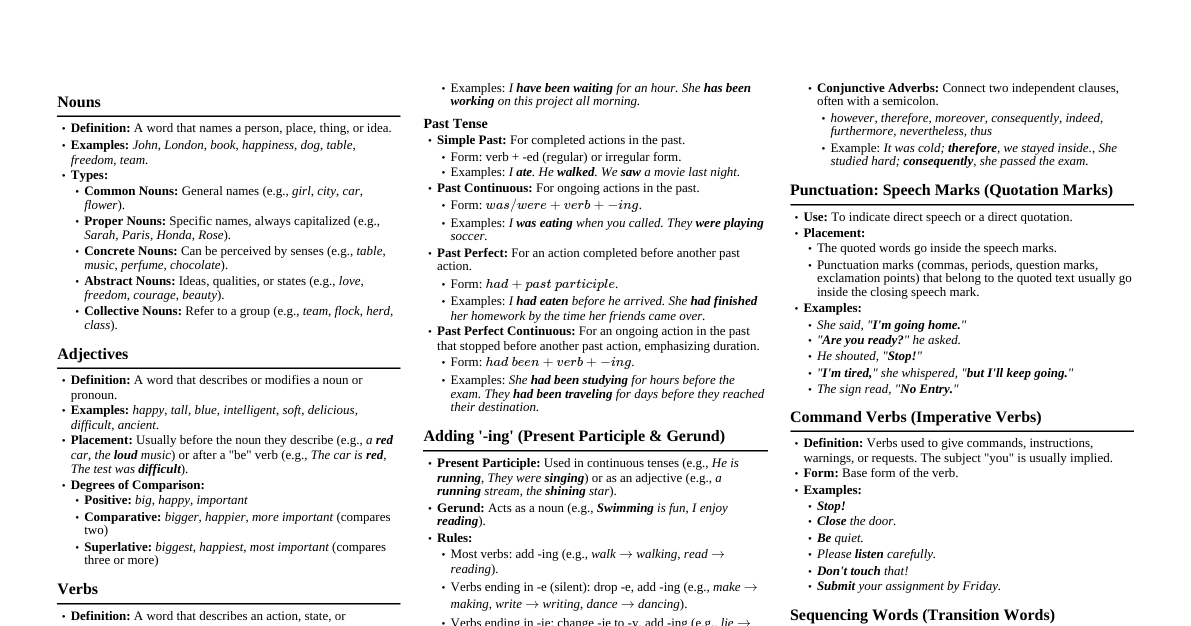
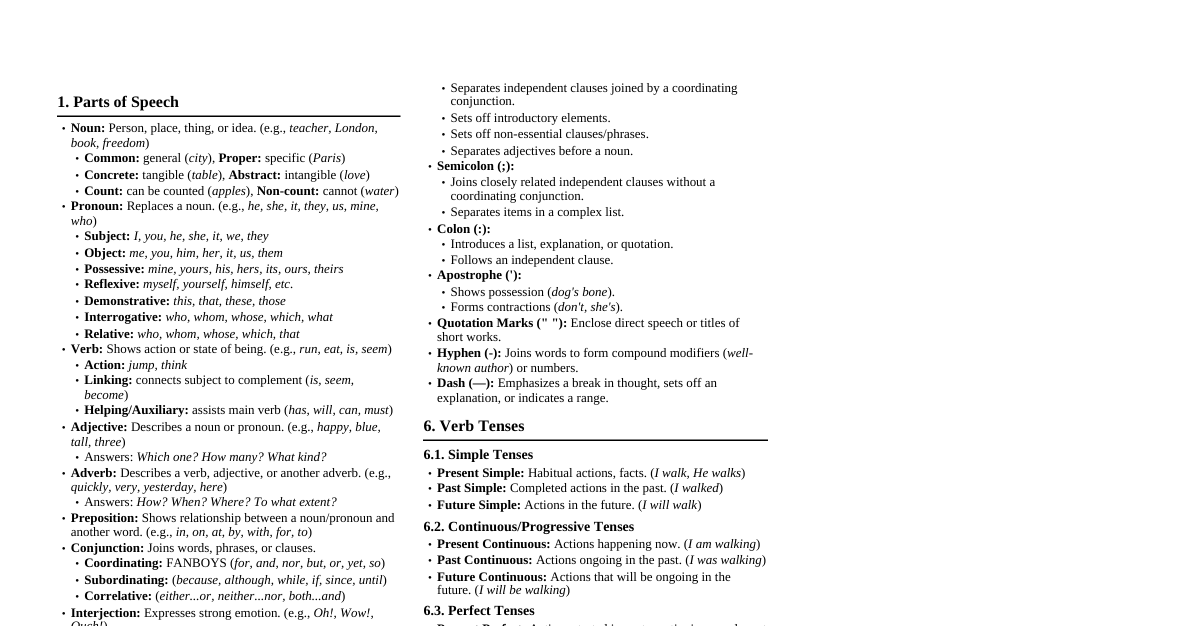
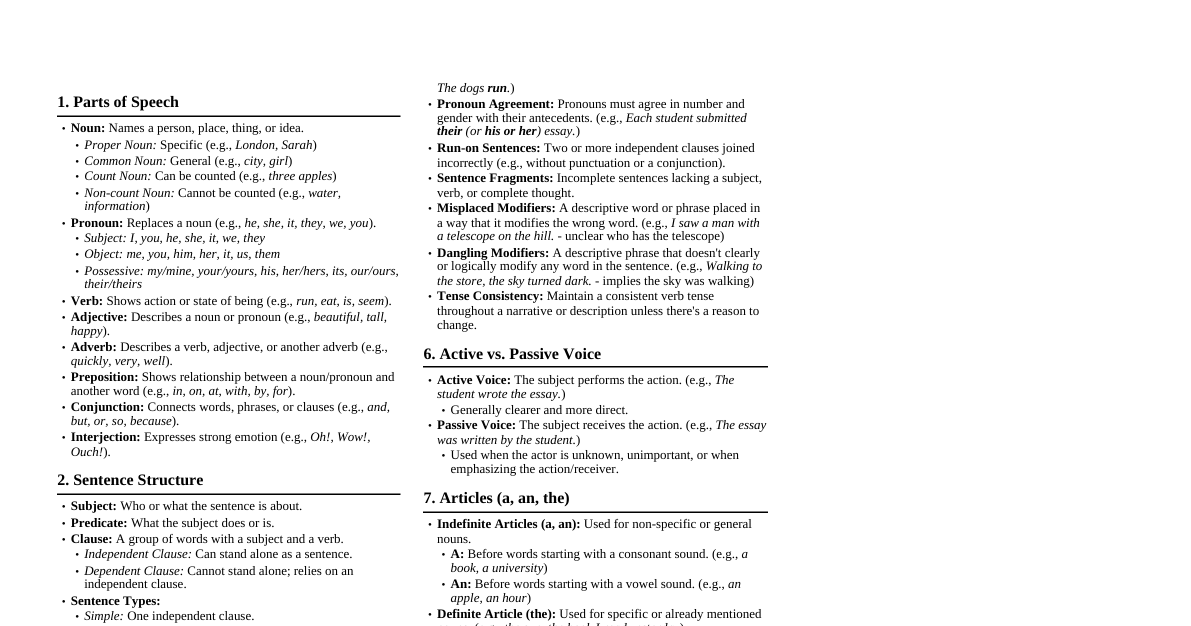
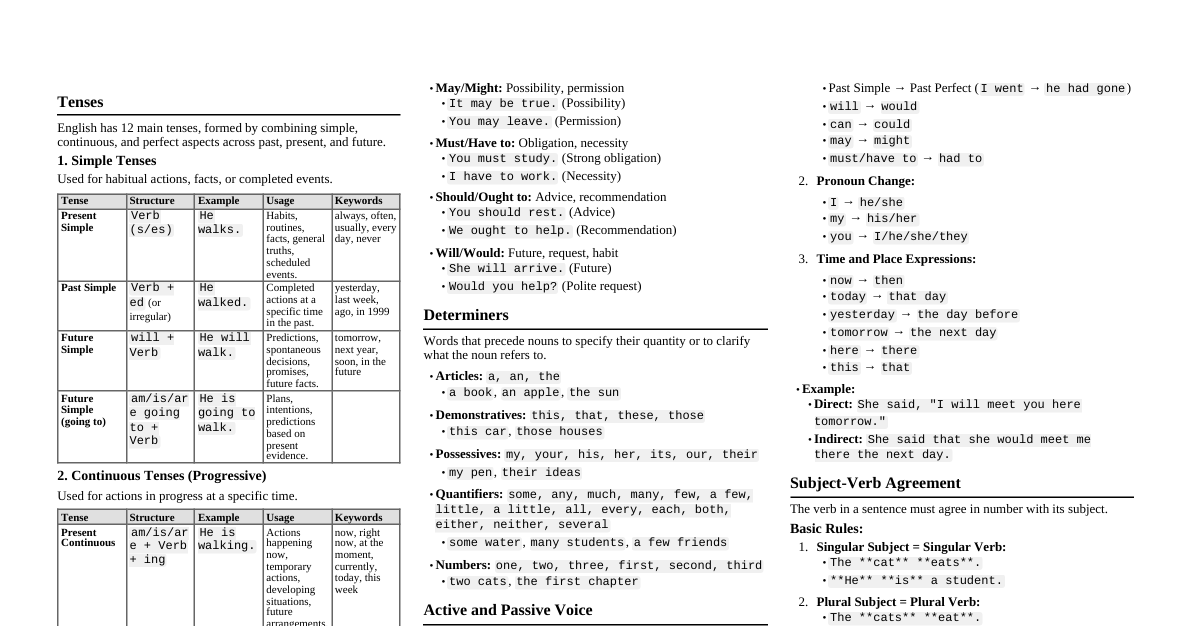
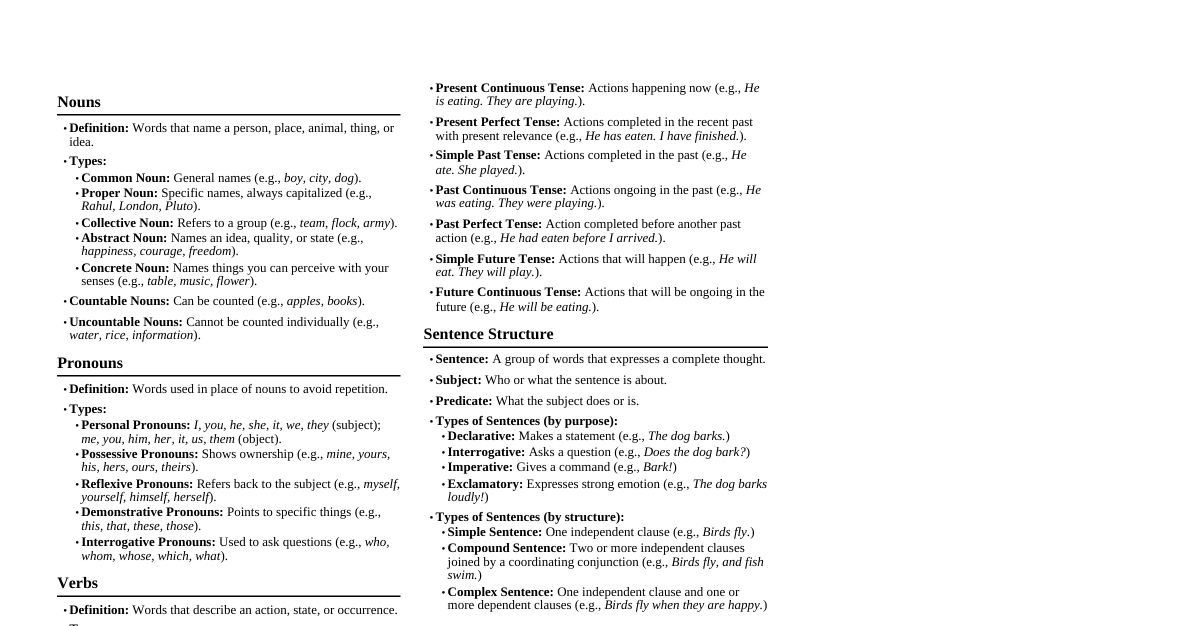
### Subject-Verb Agreement - **Basic Rule:** Singular subjects take singular verbs; plural subjects take plural verbs. - *Example:* The **cat** *sits*. The **cats** *sit*. - **Compound Subjects:** - Joined by "and" usually take a plural verb: **John and Mary** *are* here. - Joined by "or" or "nor," the verb agrees with the subject closest to it: **Neither the students nor the teacher** *is* ready. - **Indefinite Pronouns:** - Singular: *each, either, neither, one, everyone, everybody, everything, anyone, anybody, anything, someone, somebody, something, no one, nobody, nothing*. - *Example:* **Everyone** *is* expected to attend. - Plural: *both, few, many, several*. - *Example:* **Many** *are* called, but few are chosen. - Depend on context: *all, any, none, most, some*. - *Example:* **Some of the water** *is* gone. **Some of the students** *are* absent. - **Collective Nouns:** (e.g., *team, committee, family, group*) can be singular or plural depending on whether the group acts as a unit or as individuals. - *Example (unit):* The **team** *is* winning. - *Example (individuals):* The **team** *are* arguing among themselves. ### Verb Tenses and Consistency - **Simple Tenses:** - **Present:** action happening now or habitually. *He walks.* - **Past:** action completed in the past. *He walked.* - **Future:** action that will happen. *He will walk.* - **Perfect Tenses:** - **Present Perfect:** action started in past, continues to present, or completed in past with present relevance. *He has walked for an hour.* - **Past Perfect:** action completed before another past action. *He had walked before it rained.* - **Future Perfect:** action that will be completed before a future time. *He will have walked by noon.* - **Progressive Tenses:** (continuous) - **Present Progressive:** action happening now. *He is walking.* - **Past Progressive:** action ongoing in the past. *He was walking when I saw him.* - **Future Progressive:** action that will be ongoing in the future. *He will be walking tomorrow afternoon.* - **Perfect Progressive Tenses:** - **Present Perfect Progressive:** action started in past and continuing now. *He has been walking since morning.* - **Past Perfect Progressive:** action ongoing in the past before another past action. *He had been walking for hours before he rested.* - **Future Perfect Progressive:** action that will be ongoing up to a future point. *He will have been walking for two hours by then.* - **Tense Consistency:** Maintain the same verb tense throughout a sentence or paragraph unless there is a clear reason to change it (e.g., indicating a sequence of events). - *Incorrect:* She *ran* to the store and *buys* some milk. - *Correct:* She *ran* to the store and *bought* some milk. ### Pronoun-Antecedent Agreement and Modifiers - **Pronoun-Antecedent Agreement:** A pronoun must agree with its antecedent (the noun it replaces) in number, gender, and person. - *Number:* If the antecedent is singular, the pronoun must be singular. If plural, the pronoun must be plural. - *Incorrect:* **Each student** must bring *their* own lunch. - *Correct:* **Each student** must bring *his or her* own lunch. (Or rephrase: **All students** must bring *their* own lunch.) - *Gender:* Match gender if specified. - *Example:* **Sarah** lost *her* book. - *Person:* Maintain consistency (first, second, third person). - *Incorrect:* When **one** studies, *you* learn a lot. - *Correct:* When **one** studies, *one* learns a lot. - **Ambiguous Pronoun Reference:** Ensure it's clear which noun a pronoun refers to. - *Ambiguous:* John told Mike that *he* was wrong. (Who was wrong?) - *Clear:* John told Mike, "You are wrong." OR John told Mike that Mike was wrong. - **Modifiers:** Words, phrases, or clauses that describe or limit other words. - **Dangling Modifiers:** A modifier that describes something that isn't clearly stated in the sentence. - *Incorrect:* **Walking through the park, the trees were beautiful.** (The trees weren't walking.) - *Correct:* **Walking through the park, I saw beautiful trees.** - **Misplaced Modifiers:** A modifier placed in a way that it seems to modify the wrong word or phrase. - *Incorrect:* She served sandwiches to the children **on paper plates**. (Were the children on paper plates?) - *Correct:* She served sandwiches **on paper plates** to the children. ### Vocabulary - **Synonyms:** Words with similar meanings. - *Example:* Happy - Joyful, Merry, Cheerful, Glad - **Antonyms:** Words with opposite meanings. - *Example:* Hot - Cold, Freezing, Icy - **Word Meanings:** Understand the precise definitions of words. - *Strategies:* - Use context clues within the sentence or passage. - Break down words into prefixes, suffixes, and roots. - Consult a dictionary or thesaurus. - **Contextually Appropriate Words:** Choosing the best word based on the specific situation or nuance. - *Example:* "Small" vs. "Tiny" - "Small" implies generally not large. - "Tiny" implies extremely small, often to an endearing or insignificant degree. - Consider connotations (emotional associations) as well as denotations (literal meanings). - *Example:* "Stroll" (pleasant walk) vs. "Trudge" (heavy, weary walk) ### Reading Comprehension - **Passage Analysis and Main Ideas:** - Read the passage actively, looking for the central theme or argument. - Identify the topic sentence of each paragraph. - Pay attention to introduction and conclusion paragraphs. - Summarize each paragraph in your own words. - Ask: "What is the author trying to say overall?" - **Inference from Text:** - Draw conclusions based on evidence and reasoning, even if not explicitly stated. - Look for clues, implications, and underlying messages. - Distinguish between what is directly stated and what is implied. - Avoid bringing in outside knowledge not supported by the text. - **Sentence Completion:** - Read the sentence carefully, identifying keywords and context. - Look for relationships between parts of the sentence (e.g., cause/effect, contrast, similarity). - Test each answer choice to see which creates the most logical and grammatically correct sentence. - Pay attention to tone and style.