Electrostatics - Class 12
Shared 5/20/2026•2 views
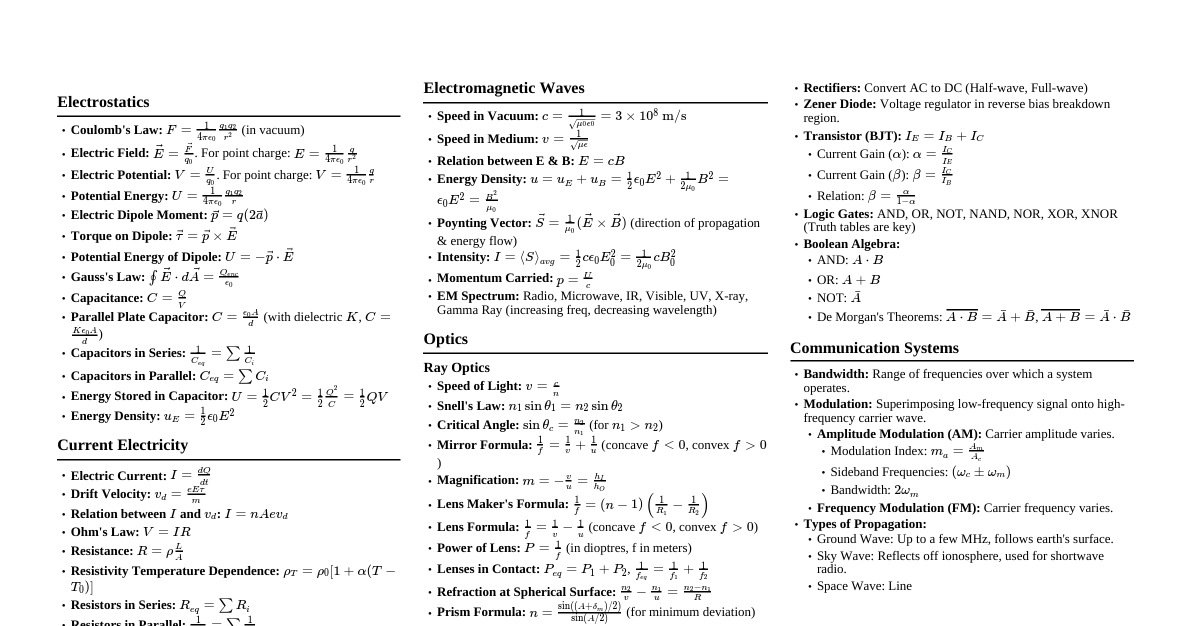
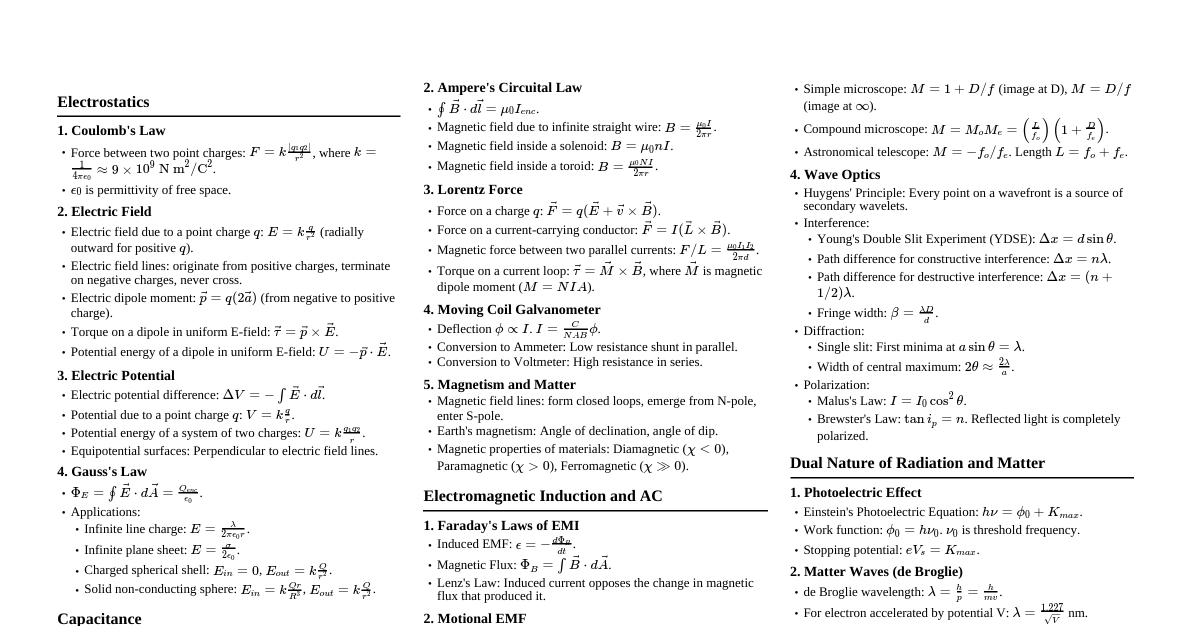
### Coulomb's Law - **Statement:** The force between two stationary point charges is directly proportional to the product of their magnitudes and inversely proportional to the square of the distance between them. - **Formula:** $F = k \frac{|q_1 q_2|}{r^2}$ where $k = \frac{1}{4\pi\epsilon_0} \approx 9 \times 10^9 \text{ Nm}^2/\text{C}^2$. - $\epsilon_0$: Permittivity of free space ($8.85 \times 10^{-12} \text{ C}^2/\text{Nm}^2$). - **Vector Form:** $\vec{F}_{12} = k \frac{q_1 q_2}{r^3} \vec{r}_{12}$ or $\vec{F}_{12} = k \frac{q_1 q_2}{|\vec{r}_{12}|^2} \hat{r}_{12}$. - **Principle of Superposition:** The total force on a given charge due to multiple other charges is the vector sum of the individual forces exerted by each of the other charges. $$\vec{F}_{\text{total}} = \vec{F}_1 + \vec{F}_2 + \dots + \vec{F}_n$$ #### Question Types - **Direct Calculation:** Find force between two or three charges. - **Equilibrium Problems:** Find position where a charge experiences zero net force. - **Vector Addition:** Problems involving forces at angles (e.g., charges at corners of a square/triangle). - **Comparing Forces:** How force changes if charges/distance are altered. ### Electric Field - **Definition:** The space around a charge where its influence can be experienced by another charge. - **Electric Field Intensity ($\vec{E}$):** Force experienced by a unit positive test charge placed at that point. $$\vec{E} = \frac{\vec{F}}{q_0}$$ - **Due to a point charge:** $E = k \frac{|q|}{r^2}$ (radially outward for positive charge, inward for negative). - **Superposition Principle:** The net electric field at a point due to a system of charges is the vector sum of the electric fields due to individual charges. $$\vec{E}_{\text{total}} = \vec{E}_1 + \vec{E}_2 + \dots + \vec{E}_n$$ - **Electric Field Lines:** - Originate from positive charges and terminate on negative charges. - Never intersect. - Tangent at any point gives direction of $\vec{E}$. - Density of lines indicates strength of $\vec{E}$. - **Electric Dipole:** Two equal and opposite charges separated by a small distance ($2a$). - **Dipole Moment ($\vec{p}$):** $p = q(2a)$, direction from negative to positive charge. - **Field on Axial Line:** $E_{\text{axial}} = \frac{2kp}{r^3}$ (for $r \gg a$). - **Field on Equatorial Line:** $E_{\text{equatorial}} = \frac{kp}{r^3}$ (for $r \gg a$). - **Torque on Dipole in Uniform Field:** $\vec{\tau} = \vec{p} \times \vec{E} \implies \tau = pE\sin\theta$. - **Potential Energy of Dipole:** $U = -\vec{p} \cdot \vec{E} = -pE\cos\theta$. #### Question Types - **Calculate E-field:** Due to point charges, dipoles (axial/equatorial/general points). - **Draw Field Lines:** For various charge configurations. - **Motion of Charge in E-field:** Acceleration, velocity, trajectory. - **Torque/Potential Energy:** Problems involving dipoles in uniform electric fields. - **Comparing E-fields:** At different points or configurations. ### Electric Flux and Gauss's Law - **Electric Flux ($\Phi_E$):** Number of electric field lines passing normally through a given area. - **Formula:** $\Phi_E = \vec{E} \cdot \vec{A} = EA\cos\theta$ (for uniform E-field and planar area). - For non-uniform E-field or non-planar area: $\Phi_E = \int \vec{E} \cdot d\vec{A}$. - **Gauss's Law:** The total electric flux through any closed surface (Gaussian surface) is equal to $\frac{1}{\epsilon_0}$ times the net charge enclosed by the surface. $$\Phi_E = \oint \vec{E} \cdot d\vec{A} = \frac{Q_{\text{enclosed}}}{\epsilon_0}$$ - **Applications of Gauss's Law:** - **Infinite Line Charge:** $E = \frac{\lambda}{2\pi\epsilon_0 r}$ ($\lambda$ = linear charge density). - **Infinite Plane Sheet of Charge:** $E = \frac{\sigma}{2\epsilon_0}$ ($\sigma$ = surface charge density). - **Uniformly Charged Thin Spherical Shell:** - Outside ($r > R$): $E = \frac{Q}{4\pi\epsilon_0 r^2}$ (like point charge at center). - On surface ($r = R$): $E = \frac{Q}{4\pi\epsilon_0 R^2}$. - Inside ($r R$): $E = \frac{Q}{4\pi\epsilon_0 r^2}$. - On surface ($r = R$): $E = \frac{Q}{4\pi\epsilon_0 R^2}$. - Inside ($r ### Electric Potential and Potential Energy - **Electric Potential Energy ($U$):** Work done in bringing a charge from infinity to a point in an electric field. - **For two point charges:** $U = k \frac{q_1 q_2}{r}$. - **For a system of charges:** Sum of potential energies of all pairs. - **Electric Potential ($V$):** Potential energy per unit test charge. $$V = \frac{U}{q_0}$$ - **Due to a point charge:** $V = k \frac{q}{r}$. - **Due to an electric dipole:** - On Axial Line: $V = \frac{kp}{r^2}$ (for $r \gg a$). - On Equatorial Line: $V = 0$. - General Point: $V = \frac{kp\cos\theta}{r^2}$. - **Superposition Principle:** $V_{\text{total}} = V_1 + V_2 + \dots + V_n$ (scalar sum). - **Relation between E and V:** $\vec{E} = -\nabla V$ or $E = -\frac{dV}{dr}$ (for 1D). - Electric field is in the direction of decreasing potential. - **Equipotential Surfaces:** Surfaces having the same electric potential at every point. - Electric field lines are always perpendicular to equipotential surfaces. - No work is done in moving a charge on an equipotential surface. - **Work done in moving a charge:** $W = q(V_B - V_A)$. #### Question Types - **Calculate Potential/Potential Energy:** Due to point charges, dipoles, system of charges. - **Work Done:** In moving a charge between two points in an E-field. - **Relation between E and V:** Find E from V or vice-versa (differentiation/integration). - **Equipotential Surfaces:** Draw them for point charges, dipoles, uniform fields. Conceptual questions on their properties. - **Stability of Dipole:** In terms of potential energy (stable for $\theta=0$, unstable for $\theta=180^\circ$). ### Conductors and Dielectrics - **Conductors:** Materials with free charge carriers (electrons) that allow easy flow of charge. - Inside a conductor, $E=0$ in electrostatic equilibrium. - Net charge resides on the surface. - Potential is constant throughout the volume and same as on its surface. - Electric field lines are perpendicular to the surface. - Electrostatic shielding: E-field inside a cavity in a conductor is zero. - **Dielectrics (Insulators):** Materials with no free charge carriers; charges are bound. - When placed in an external E-field, they get polarized. - **Polarization:** Creation of induced dipole moments. - **Polar Dielectrics:** Molecules have permanent dipole moments (e.g., HCl). - **Non-polar Dielectrics:** Molecules do not have permanent dipole moments (e.g., O$_2$, H$_2$). - Reduces the net electric field inside the material by a factor of $K$ (dielectric constant). $$E_{\text{medium}} = \frac{E_{\text{vacuum}}}{K}$$ - $K = \frac{\epsilon}{\epsilon_0}$ where $\epsilon$ is the permittivity of the medium. #### Question Types - **Conceptual Questions:** Properties of conductors in electrostatic equilibrium. - **Electrostatic Shielding:** Explanation and applications. - **Polarization:** What happens when a dielectric is placed in an E-field. - **Dielectric Constant:** Its effect on force, field, potential, and capacitance. ### Capacitance - **Definition:** Ability of a conductor to store electric charge. $$C = \frac{Q}{V}$$ - Unit: Farad (F). $1 \text{F} = 1 \text{C/V}$. - **Capacitance of an Isolated Spherical Conductor:** $C = 4\pi\epsilon_0 R$. - **Parallel Plate Capacitor:** Two parallel conducting plates separated by a dielectric. $$C = \frac{\epsilon_0 A}{d}$$ - With dielectric medium: $C = \frac{K\epsilon_0 A}{d}$. - **Series Combination of Capacitors:** $$\frac{1}{C_{\text{eq}}} = \frac{1}{C_1} + \frac{1}{C_2} + \dots$$ - Charge ($Q$) is same across each capacitor. - Potential difference ($V$) divides. - **Parallel Combination of Capacitors:** $$C_{\text{eq}} = C_1 + C_2 + \dots$$ - Potential difference ($V$) is same across each capacitor. - Charge ($Q$) divides. - **Energy Stored in a Capacitor:** $$U = \frac{1}{2}CV^2 = \frac{1}{2}\frac{Q^2}{C} = \frac{1}{2}QV$$ - **Energy Density:** Energy stored per unit volume for a parallel plate capacitor. $$u = \frac{1}{2}\epsilon_0 E^2$$ - **Loss of Energy on Sharing Charges:** When two charged capacitors are connected, energy is lost as heat/radiation. #### Question Types - **Calculate Capacitance:** For parallel plate, spherical capacitors (with/without dielectric). - **Combinations:** Find equivalent capacitance, charge, and potential difference across capacitors in series/parallel. - **Energy Stored:** Calculate energy, energy density. - **Effect of Dielectric:** How capacitance, charge, voltage, and energy change when a dielectric is inserted (battery connected/disconnected). - **Conceptual Questions:** Why capacitors store energy, how they work.