Magnetism Cheatsheet
Cheatsheet Content
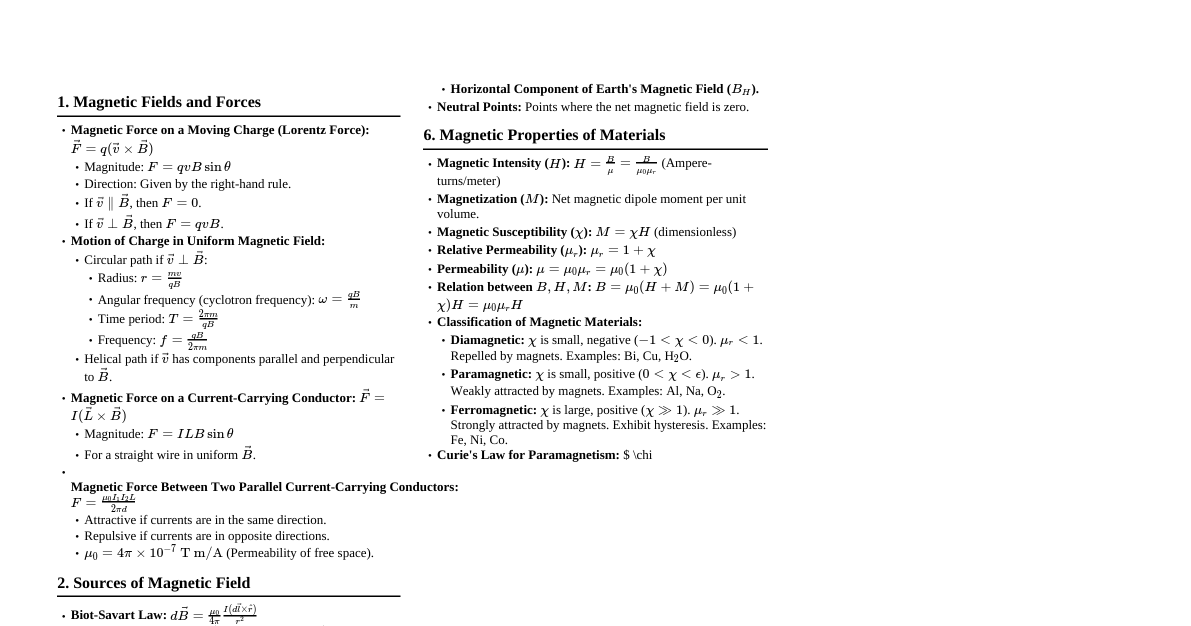
1. Introduction to Magnetism History: Early observations (600 B.C.), systematic investigation by William Gilbert, link to electricity by Oersted, unified by Maxwell. Analogy to Electrostatics: Similar concepts for magnetic field and force, but magnetic poles do not exist in isolation (no magnetic monopoles). Common Facts About Magnetism Every magnet has two poles: North and South. If a magnet is broken, each piece becomes an independent magnet with weaker fields. Like poles repel, unlike poles attract. A freely suspended bar magnet or magnetic needle aligns itself in the geographic North-South direction. 2. Magnetic Lines of Force and Magnetic Field Originate from North pole and end at South pole. Properties of Magnetic Lines of Force: Form closed loops (unlike electric field lines for dipoles). Direction of net magnetic field $\vec{B}$ at a point is tangent to the line of force. Density of lines of force (number of lines per unit area) determines magnitude of $\vec{B}$. Do not intersect (otherwise direction of $\vec{B}$ would not be unique). Magnetic Flux ($\Phi$): The total number of magnetic lines of force. SI Unit of Magnetic Flux: Weber (Wb). Magnetic Field Strength ($B$): $$ B = \frac{\Phi}{A} $$ where $A$ is the area. SI Unit of Magnetic Field: Tesla (T) or Wb/m$^2$. Conversion: $1 \text{ Tesla} = 10^4 \text{ Gauss}$. 3. The Bar Magnet Pole Strength ($q_m$): $+q_m$ at North pole, $-q_m$ at South pole. SI unit: A m. Magnetic Length ($2l$): Distance between the two poles. Often, $2l = \frac{5}{6} \times \text{Geometric length}$. Magnetic Dipole Moment ($\vec{m}$): $$ \vec{m} = q_m (2\vec{l}) $$ where $2\vec{l}$ is a vector from South to North pole. SI Unit of Magnetic Dipole Moment: A m$^2$. Axis: Line passing through both poles. Equator: Line passing through the center of the magnet and perpendicular to its axis. The plane containing all such lines is the equatorial plane. Magnetic Field due to a Bar Magnet (for $r >> l$) Axial Point (along the axis): $$ B_{axial} = \frac{\mu_0}{4\pi} \frac{2m}{r^3} $$ Direction is along $\vec{m}$. Equatorial Point (along the equator): $$ B_{eq} = -\frac{\mu_0}{4\pi} \frac{m}{r^3} $$ Direction is opposite to $\vec{m}$. Relation: $B_{axial} = 2 B_{eq}$. Magnetic Field at an Arbitrary Point $(r, \theta)$ Consider a point $P$ at distance $r$ from the center of the magnet, making an angle $\theta$ with the magnetic axis. Components of $\vec{B}$: Along $r$ (due to $m \cos\theta$): $B_r = \frac{\mu_0}{4\pi} \frac{2m \cos\theta}{r^3}$ Perpendicular to $r$ (due to $m \sin\theta$): $B_\theta = \frac{\mu_0}{4\pi} \frac{m \sin\theta}{r^3}$ Magnitude of Resultant Field: $$ B = \sqrt{B_r^2 + B_\theta^2} = \frac{\mu_0}{4\pi} \frac{m}{r^3} \sqrt{3\cos^2\theta + 1} $$ Direction of $\vec{B}$: If $\alpha$ is the angle $\vec{B}$ makes with $\vec{r}$, then $$ \tan\alpha = \frac{B_\theta}{B_r} = \frac{1}{2} \tan\theta $$ 4. Gauss' Law of Magnetism Statement: The net magnetic flux through any closed Gaussian surface is zero. $$ \oint \vec{B} \cdot d\vec{S} = 0 $$ Implication: This law signifies that magnetic monopoles do not exist. Magnetic field lines always form closed loops, entering and leaving any closed surface in equal measure. 5. Earth's Magnetism (Terrestrial Magnetism) Earth acts as a huge magnetic dipole. Magnetic Axis: Line connecting the Earth's fictitious magnetic North pole (below Antarctica) and South pole (below Norway). Magnetic Equator: A great circle perpendicular to the magnetic axis. Geographic Meridian: A vertical plane passing through the geographic North-South axis. Magnetic Meridian: A vertical plane passing through the magnetic axis. The resultant magnetic field of Earth lies in this plane. Magnetic Elements of Earth Magnetic Declination ($\alpha$): The angle between the geographic meridian and the magnetic meridian at a place. Magnetic Inclination or Angle of Dip ($\phi$): The angle made by the direction of the Earth's resultant magnetic field with the horizontal at a place. Horizontal Component ($B_H$) and Vertical Component ($B_V$) of Earth's Magnetic Field ($B$): $$ B_H = B \cos\phi $$ $$ B_V = B \sin\phi $$ $$ \tan\phi = \frac{B_V}{B_H} $$ $$ B = \sqrt{B_H^2 + B_V^2} $$ Special Cases for Dip Angle ($\phi$) Magnetic North Pole: $B_V = B$, $B_H = 0$, $\phi = 90^\circ$. Magnetic South Pole: $B_V = B$, $B_H = 0$, $\phi = 270^\circ$ (or $-90^\circ$). Magnetic Equator: $B_V = 0$, $B_H = B$, $\phi = 0^\circ$. 6. Electrostatic Analogue (Table 12.1) Quantity Electrostatics Magnetism Basic physical quantity Electrostatic charge $q$ Magnetic pole $q_m$ Field Electric Field $\vec{E}$ Magnetic Field $\vec{B}$ Constant $\frac{1}{4\pi\varepsilon_0}$ $\frac{\mu_0}{4\pi}$ Dipole moment $\vec{p} = q(2\vec{l})$ (from -ve to +ve charge) $\vec{m} = q_m(2\vec{l})$ (from S to N pole) Force $\vec{F} = q\vec{E}$ $\vec{F} = q_m\vec{B}$ Energy (in external field) of a dipole $U = -\vec{p}\cdot\vec{E}$ $U = -\vec{m}\cdot\vec{B}$ Coulomb's law $F = \frac{1}{4\pi\varepsilon_0} \frac{q_1q_2}{r^2}$ No analogous law (no magnetic monopoles) Axial field for a short dipole $\frac{1}{4\pi\varepsilon_0} \frac{2p}{r^3}$ (along $\vec{p}$) $\frac{\mu_0}{4\pi} \frac{2m}{r^3}$ (along $\vec{m}$) Equatorial field for a short dipole $-\frac{1}{4\pi\varepsilon_0} \frac{p}{r^3}$ (opposite to $\vec{p}$) $-\frac{\mu_0}{4\pi} \frac{m}{r^3}$ (opposite to $\vec{m}$)