New sheet - 10/12 07:33
Shared 5/17/2026•11 views
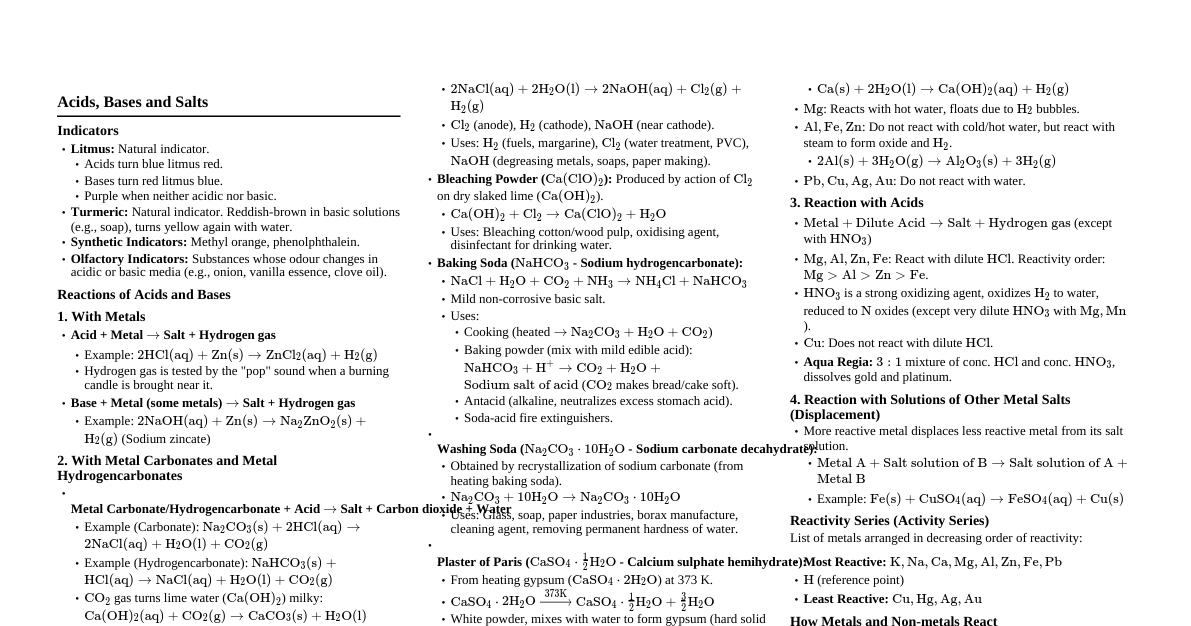
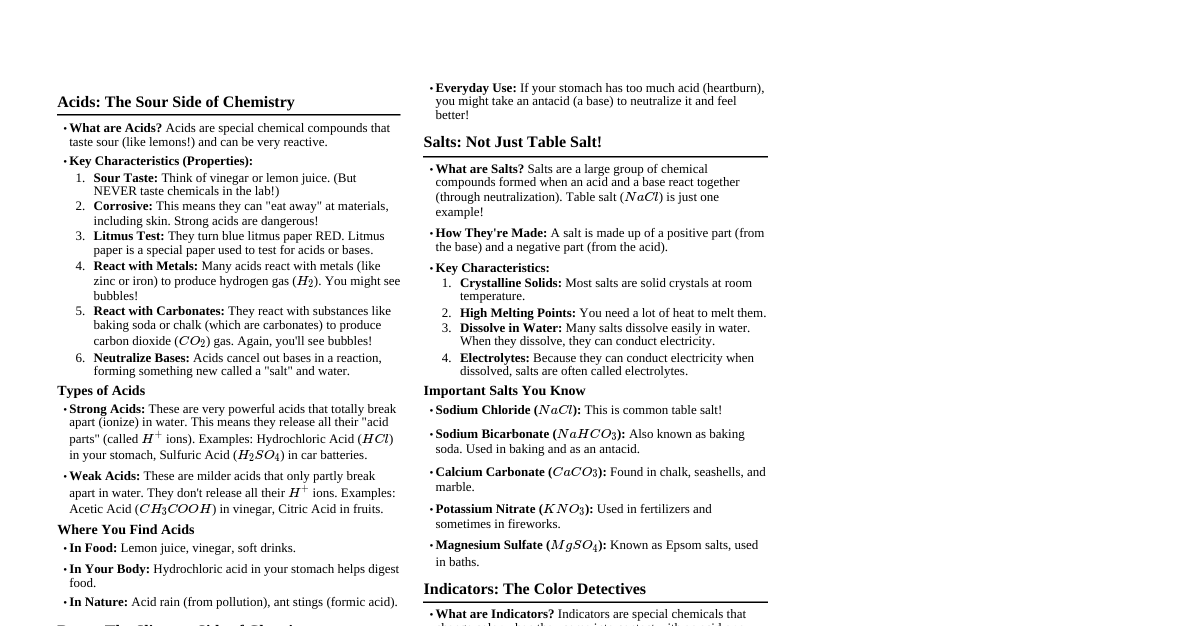
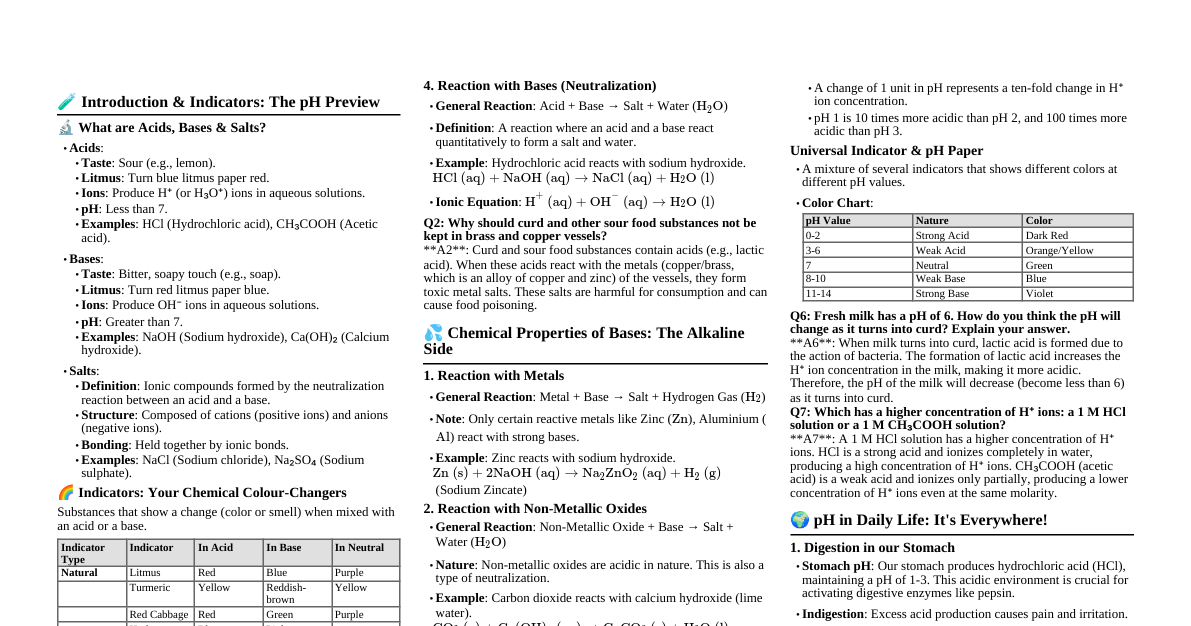
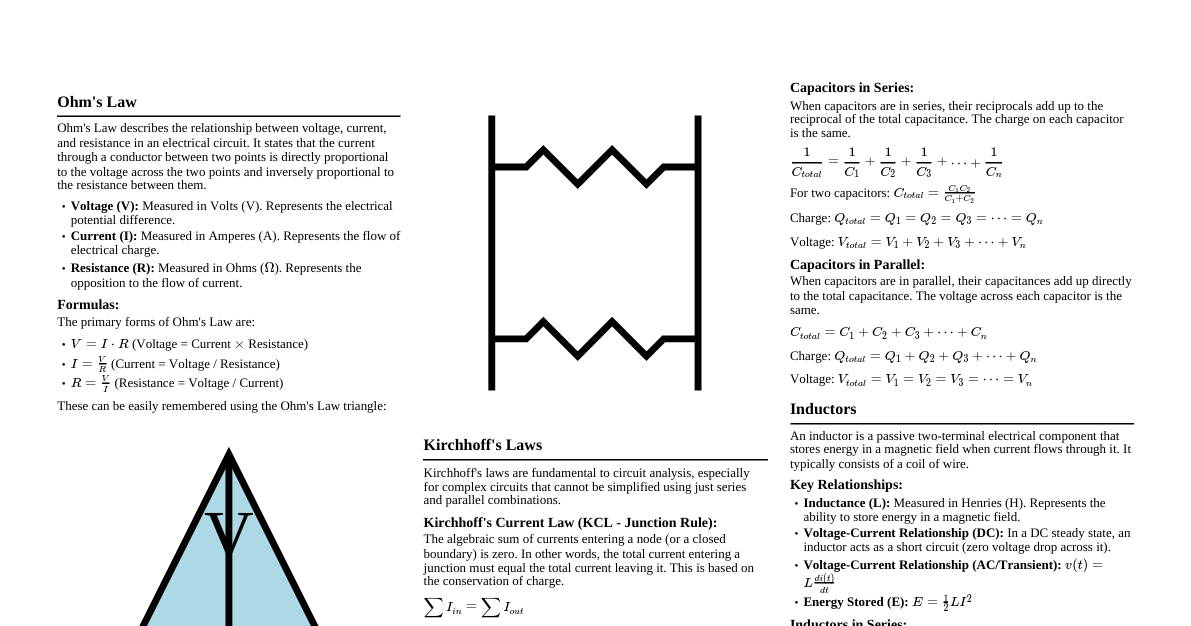
Chemical Reactions & Equations Types of Reactions Combination Reaction: Two or more reactants combine to form a single product. $CaO(s) + H_2O(l) \rightarrow Ca(OH)_2(aq)$ (Slaked lime) Decomposition Reaction: A single reactant breaks down into two or more simpler products. $CaCO_3(s) \xrightarrow{Heat} CaO(s) + CO_2(g)$ Thermal Decomposition: By heating. Electrolytic Decomposition: By electricity (e.g., electrolysis of water). Photolytic Decomposition: By light (e.g., $2AgCl(s) \xrightarrow{Sunlight} 2Ag(s) + Cl_2(g)$). Displacement Reaction: A more reactive element displaces a less reactive element from its compound. $Fe(s) + CuSO_4(aq) \rightarrow FeSO_4(aq) + Cu(s)$ Double Displacement Reaction: Exchange of ions between two reactant compounds. $Na_2SO_4(aq) + BaCl_2(aq) \rightarrow BaSO_4(s) \downarrow + 2NaCl(aq)$ Precipitation Reaction: Produces an insoluble solid (precipitate). Neutralization Reaction: Acid reacts with a base. Redox Reactions: Both oxidation and reduction occur simultaneously. Oxidation: Gain of oxygen, loss of hydrogen, loss of electrons. Reduction: Loss of oxygen, gain of hydrogen, gain of electrons. Oxidizing Agent: Substance that oxidizes another and gets reduced itself. Reducing Agent: Substance that reduces another and gets oxidized itself. $CuO(s) + H_2(g) \xrightarrow{Heat} Cu(s) + H_2O(l)$ (CuO is reduced, $H_2$ is oxidized) Exothermic Reaction: Releases heat. Respiration: $C_6H_{12}O_6(aq) + 6O_2(g) \rightarrow 6CO_2(g) + 6H_2O(l) + Energy$ Endothermic Reaction: Absorbs heat. Photosynthesis: $6CO_2(g) + 6H_2O(l) \xrightarrow{Sunlight} C_6H_{12}O_6(aq) + 6O_2(g)$ Acids, Bases, and Salts Acids Sour taste, turn blue litmus red. Produce $H^+$ ions in water. Examples: $HCl$, $H_2SO_4$, $HNO_3$. React with metals to produce $H_2$ gas. $Zn(s) + 2HCl(aq) \rightarrow ZnCl_2(aq) + H_2(g)$. React with metal carbonates/bicarbonates to produce $CO_2$ gas. $Na_2CO_3(s) + 2HCl(aq) \rightarrow 2NaCl(aq) + H_2O(l) + CO_2(g)$ Bases Bitter taste, soapy touch, turn red litmus blue. Produce $OH^-$ ions in water. Examples: $NaOH$, $KOH$, $Ca(OH)_2$. Strong bases (alkalis) are soluble in water. pH Scale Measures hydrogen ion concentration. From 0 (very acidic) to 14 (very basic). 7 is neutral. $pH = -\log[H^+]$ Importance of pH: Our body works within pH 7.0-7.8. Acid rain (pH pH in digestive system (stomach pH ~1.2-3.5). Tooth decay starts when mouth pH is below 5.5. Salts Formed by the reaction of an acid and a base (neutralization). Common Salts: Sodium Chloride ($NaCl$): Common salt, used as a raw material for many chemicals. Sodium Hydroxide ($NaOH$): Caustic soda, produced by chlor-alkali process. $2NaCl(aq) + 2H_2O(l) \xrightarrow{Electricity} 2NaOH(aq) + Cl_2(g) + H_2(g)$ Uses: Soaps, detergents, paper making, artificial fibres. Bleaching Powder ($CaOCl_2$): Produced by reaction of $Cl_2$ with dry slaked lime $Ca(OH)_2$. $Ca(OH)_2(s) + Cl_2(g) \rightarrow CaOCl_2(s) + H_2O(l)$ Uses: Bleaching cotton/linen, as an oxidizing agent, disinfectant. Baking Soda ($NaHCO_3$): Sodium hydrogen carbonate. Uses: Baking powder (mixture of baking soda and tartaric acid), antacid, in soda-acid fire extinguishers. Washing Soda ($Na_2CO_3 \cdot 10H_2O$): Sodium carbonate decahydrate. Uses: Cleaning agent, in glass, soap, paper industries, removal of permanent hardness of water. Plaster of Paris ($CaSO_4 \cdot \frac{1}{2}H_2O$): Calcium sulfate hemihydrate. Made from Gypsum ($CaSO_4 \cdot 2H_2O$) by heating to 373K. Uses: Casts for fractured bones, decorative items, fire-proofing material. Metals and Non-metals Physical Properties Property Metals Non-metals Lustre Lustrous (shiny surface) Non-lustrous (dull, except Iodine) Hardness Generally hard (except Na, K, Li are soft) Generally soft (except Diamond, an allotrope of carbon, is the hardest natural substance) State at Room Temp. Solids (except Mercury, liquid) Solids, liquids (Bromine), gases Malleability Malleable (can be hammered into thin sheets, e.g., Gold, Silver) Non-malleable (brittle) Ductility Ductile (can be drawn into wires, e.g., Gold, Copper) Non-ductile Heat/Electricity Conductivity Good conductors (Silver, Copper are best) Poor conductors (except Graphite, an allotrope of carbon) Sonority Sonorous (produce ringing sound when struck) Non-sonorous Melting/Boiling Point High (except Na, K, Hg, Ga, Cs) Low (except Diamond, Graphite) Density High (except Na, K) Low Chemical Properties Reaction with Oxygen: Metals form basic oxides ($CuO$, $MgO$). Some (Al, Zn) form amphoteric oxides (react with both acids and bases). $2Cu + O_2 \xrightarrow{Heat} 2CuO$ (black) $4Al + 3O_2 \rightarrow 2Al_2O_3$ Non-metals form acidic oxides ($CO_2$, $SO_2$) or neutral oxides ($CO$, $H_2O$). Reaction with Water: Metals react with water to form metal oxide/hydroxide and $H_2$ gas. Reactivity varies. $2Na(s) + 2H_2O(l) \rightarrow 2NaOH(aq) + H_2(g) + Heat$ (cold water, highly reactive) $3Fe(s) + 4H_2O(g) \rightarrow Fe_3O_4(s) + 4H_2(g)$ (steam, less reactive) Non-metals generally do not react with water or steam. Reaction with Acids: Metals react with dilute acids to produce salt and $H_2$ gas (unless the metal is below H in reactivity series or specific acids like $HNO_3$). $Mg(s) + 2HCl(aq) \rightarrow MgCl_2(aq) + H_2(g)$ Non-metals do not react with dilute acids. Reactivity Series: (Most reactive to least reactive) $K > Na > Ca > Mg > Al > Zn > Fe > Pb > H > Cu > Hg > Ag > Au > Pt$ A metal higher in the series can displace a metal lower in the series from its salt solution. Ionic Compounds: Formed by transfer of electrons from metal to non-metal (e.g., $NaCl$, $MgO$). High melting/boiling points. Soluble in water. Conduct electricity in molten state or in solution. Extraction of Metals (Metallurgy) Process of obtaining metals from their ores. Enrichment of Ores: Removing gangue (impurities) by physical (hand-picking, hydraulic washing, magnetic separation) or chemical methods. Conversion of Concentrated Ore to Metal: For highly reactive metals (K, Na, Ca, Mg, Al): Electrolytic reduction of their molten chlorides/oxides. (e.g., $2NaCl \xrightarrow{Electrolysis} 2Na + Cl_2$). For moderately reactive metals (Zn, Fe, Pb, Cu): Roasting: Heating sulfide ores in excess air to convert to oxide. (e.g., $2ZnS + 3O_2 \xrightarrow{Heat} 2ZnO + 2SO_2$). Calcination: Heating carbonate ores in limited air to convert to oxide. (e.g., $ZnCO_3 \xrightarrow{Heat} ZnO + CO_2$). Reduction: Metal oxide is reduced to metal using a reducing agent like Carbon (coke), Carbon Monoxide, or more reactive metal (e.g., Al for MnO2). $ZnO(s) + C(s) \xrightarrow{Heat} Zn(s) + CO(g)$ $3MnO_2(s) + 4Al(s) \xrightarrow{Heat} 3Mn(l) + 2Al_2O_3(s) + Heat$ (Thermite reaction) For less reactive metals (Ag, Hg, Au): Heating alone (e.g., $2HgS + 3O_2 \xrightarrow{Heat} 2HgO + 2SO_2 \xrightarrow{Heat} 2Hg + O_2$). These metals are often found in free state. Refining of Metals: Electrolytic refining is common for Cu, Zn, Sn, Ni, Ag, Au. Pure metal deposited at cathode, impure metal at anode. Corrosion Gradual eating away of metal by the action of air, moisture, or a chemical on their surface. Rusting of Iron: Formation of hydrated iron(III) oxide ($Fe_2O_3 \cdot xH_2O$). Requires both oxygen and water. Prevention: Painting, oiling, greasing, galvanizing (coating with Zinc), anodizing, alloying (e.g., stainless steel), electroplating. Rancidity: Oxidation of fats and oils in food, leading to unpleasant smell and taste. Prevented by adding antioxidants, packaging in nitrogen gas, refrigeration. Carbon and its Compounds Bonding in Carbon Carbon forms covalent bonds (sharing of electrons) to achieve stable electron configuration ($2, 4$). Needs 4 electrons to complete octet. Catenation: Carbon's unique ability to form long chains, branched chains, and rings by bonding with other carbon atoms. Strong C-C bonds. Tetravalency: Carbon has valency 4, can bond with four other atoms (C, H, O, N, S, halogens). Allotropes of Carbon: Diamond (hardest, insulator), Graphite (soft, conductor), Fullerene (cage-like structure). Hydrocarbons Compounds of carbon and hydrogen. Saturated Hydrocarbons (Alkanes): Contain only single bonds between carbon atoms. General formula $C_nH_{2n+2}$. Methane ($CH_4$), Ethane ($C_2H_6$), Propane ($C_3H_8$). Unsaturated Hydrocarbons: Alkenes: At least one carbon-carbon double bond. General formula $C_nH_{2n}$. Ethene ($C_2H_4$), Propene ($C_3H_6$). Alkynes: At least one carbon-carbon triple bond. General formula $C_nH_{2n-2}$. Ethyne ($C_2H_2$), Propyne ($C_3H_4$). Cyclic Hydrocarbons: Carbon atoms form a ring. Saturated: Cyclohexane ($C_6H_{12}$) Unsaturated: Benzene ($C_6H_6$) Functional Groups Atoms or group of atoms responsible for the characteristic chemical properties of organic compounds. They replace one or more hydrogen atoms in a hydrocarbon chain. Functional Group Formula Class Prefix/Suffix Halogen $-X$ (Cl, Br, I) Haloalkane halo- Alcohol $-OH$ Alcohol -ol Aldehyde $-CHO$ Aldehyde -al Ketone $C=O$ (within chain) Ketone -one Carboxylic Acid $-COOH$ Carboxylic Acid -oic acid Alkene $C=C$ Alkene -ene Alkyne $C \equiv C$ Alkyne -yne Isomerism Compounds having the same molecular formula but different structural formulas (e.g., Butane and Isobutane, Pentane isomers). Chemical Properties of Carbon Compounds Combustion: Carbon compounds burn in oxygen (air) to produce $CO_2$, $H_2O$, heat, and light. $CH_4(g) + 2O_2(g) \rightarrow CO_2(g) + 2H_2O(l) + Heat + Light$ Saturated hydrocarbons give clean flame. Unsaturated hydrocarbons give sooty flame. Oxidation: Alcohols can be oxidized to carboxylic acids using strong oxidizing agents like alkaline potassium permanganate ($KMnO_4$) or acidified potassium dichromate ($K_2Cr_2O_7$). $CH_3CH_2OH \xrightarrow{Alk. KMnO_4 + Heat} CH_3COOH$ Addition Reaction (Hydrogenation): Unsaturated hydrocarbons add hydrogen in the presence of a catalyst (Nickel, Palladium, or Platinum) to form saturated hydrocarbons. $CH_2=CH_2 + H_2 \xrightarrow{Ni} CH_3-CH_3$ Used in the hydrogenation of vegetable oils to form vegetable ghee (vanaspati). Substitution Reaction: Saturated hydrocarbons are relatively unreactive. They react with halogens (like chlorine) in the presence of sunlight to replace hydrogen atoms with halogen atoms. $CH_4 + Cl_2 \xrightarrow{Sunlight} CH_3Cl + HCl$ (monochloromethane) Ethanol ($CH_3CH_2OH$) Commonly called alcohol, ethyl alcohol. Liquid at room temperature. Uses: Solvent, in medicines (tincture iodine, cough syrups), alcoholic beverages. Reactions: Reaction with Sodium: $2Na + 2CH_3CH_2OH \rightarrow 2CH_3CH_2ONa + H_2$ (Sodium ethoxide) Dehydration (Elimination): $CH_3CH_2OH \xrightarrow{Conc. H_2SO_4, 443K} CH_2=CH_2 + H_2O$ (forms ethene) Ethanoic Acid ($CH_3COOH$) Commonly called acetic acid. 5-8% solution in water is called vinegar. Uses: Preservative, in making esters. Reactions: Esterification: Reaction with alcohol to form ester (sweet-smelling substance) in presence of an acid catalyst. $CH_3COOH + CH_3CH_2OH \xrightarrow{Acid Catalyst} CH_3COOCH_2CH_3 + H_2O$ (Ethyl ethanoate, an ester) Saponification: The alkaline hydrolysis of an ester to form alcohol and sodium salt of a carboxylic acid (soap). Reaction with bases: $CH_3COOH + NaOH \rightarrow CH_3COONa + H_2O$ Reaction with carbonates/bicarbonates: $2CH_3COOH + Na_2CO_3 \rightarrow 2CH_3COONa + H_2O + CO_2$ Soaps and Detergents Soaps: Sodium or potassium salts of long-chain carboxylic acids. Form scum with hard water. Effective in soft water. Detergents: Sodium salts of long-chain benzene sulphonic acids or long-chain alkyl hydrogen sulphates. Do not form scum with hard water. Effective in both soft and hard water. Micelle Formation: Soap molecules have a hydrophobic (water-repelling) hydrocarbon tail and a hydrophilic (water-attracting) ionic head. In water, they form a micelle structure where tails point inwards, trapping dirt/oil, and heads point outwards, allowing the dirt to be washed away. Periodic Classification of Elements Early Attempts Dobereiner's Triads (1829): Arranged elements in groups of three (triads) with similar properties, where the atomic mass of the middle element was approximately the average of the other two. (e.g., Li, Na, K; Ca, Sr, Ba; Cl, Br, I). Limitations: Could identify only a few triads. Newlands' Law of Octaves (1866): Arranged elements in increasing order of atomic masses. Found that every eighth element had properties similar to the first (like musical octaves). Limitations: Applied only up to Calcium. Properties of new elements didn't fit. Placed two elements in one slot. Mendeleev's Periodic Table (1869) Based on the law: "The properties of elements are a periodic function of their atomic masses." Achievements: Left gaps for undiscovered elements (e.g., Eka-Boron, Eka-Aluminium, Eka-Silicon, later Sc, Ga, Ge). Predicted properties of these elements with remarkable accuracy. Accommodated noble gases (discovered later) without disturbing the main table by adding a new group. Limitations: Position of Hydrogen was not fixed (behaves like alkali metals and halogens). Position of isotopes (same atomic number, different atomic mass). Atomic mass order not strictly followed in some cases (e.g., Co before Ni, Te before I). No fixed position for lanthanides and actinides. Modern Periodic Table (Henry Moseley, 1913) Based on the law: "The properties of elements are a periodic function of their atomic numbers." Arrangement: 18 vertical columns (Groups) and 7 horizontal rows (Periods). Groups: Elements in the same group have the same number of valence electrons, hence similar chemical properties. Number of shells increases down a group. Periods: Elements in the same period have the same number of shells. As you move left to right across a period: Valence electrons increase by one. Atomic size decreases (due to increased nuclear charge pulling electrons closer). Metallic character decreases. Non-metallic character increases. Blocks: s-block (Groups 1-2), p-block (Groups 13-18), d-block (Groups 3-12, transition elements), f-block (Lanthanides and Actinides). Trends in Modern Periodic Table Valency: Down a group: Remains the same (same number of valence electrons). Across a period: Increases from 1 to 4, then decreases to 0 (for noble gases). Atomic Size (Radius): Down a group: Increases (new shells are added, distance of valence electrons from nucleus increases). Across a period: Decreases (nuclear charge increases, pulling valence electrons closer to the nucleus). Metallic Character: Tendency to lose electrons. Down a group: Increases (valence electrons are further from nucleus, easier to lose). Across a period: Decreases (effective nuclear charge increases, harder to lose electrons). Non-metallic Character: Tendency to gain electrons. Down a group: Decreases. Across a period: Increases. Electronegativity: Tendency of an atom in a molecule to attract shared electrons towards itself. Down a group: Decreases. Across a period: Increases. Chemical Reactivity: Metals: Increases down a group, decreases across a period. Non-metals: Decreases down a group, increases across a period. Life Processes Nutrition Process of obtaining and utilizing food. Autotrophic Nutrition: Organisms synthesize their own food from simple inorganic substances (CO2, H2O) using light energy (photosynthesis) or chemical energy. Green plants, some bacteria. $6CO_2 + 6H_2O \xrightarrow{Sunlight, Chlorophyll} C_6H_{12}O_6 + 6O_2$ Chlorophyll: Green pigment in chloroplasts, absorbs sunlight. Stomata: Tiny pores on leaf surface for exchange of gases ($CO_2$ intake, $O_2$ release) and transpiration. Guard cells regulate opening/closing. Heterotrophic Nutrition: Organisms obtain food directly or indirectly from other organisms. Holozoic: Ingestion of complex food, followed by digestion, absorption, assimilation, and egestion (e.g., humans, amoeba, animals). Saprophytic: Obtain nutrients from dead and decaying organic matter (e.g., fungi, bacteria). Parasitic: Live on or in another organism (host) and obtain nutrients, often harming the host (e.g., Cuscuta, ticks, leeches, tapeworms). Human Digestive System: A long alimentary canal. Mouth: Ingestion. Salivary amylase (ptyalin) in saliva breaks down starch into maltose. Oesophagus (Food Pipe): Peristaltic movements push food to stomach. Stomach: Gastric glands secrete: Hydrochloric Acid (HCl): Makes medium acidic, kills germs, activates pepsin. Pepsin: Digests proteins into peptones. Mucus: Protects the inner lining of the stomach from acid. Small Intestine: Longest part, site of complete digestion and absorption. Liver: Produces bile, stored in gallbladder. Bile emulsifies fats (breaks large fat globules into smaller ones). Pancreas: Produces pancreatic juice containing: Amylase (for starch) Trypsin (for protein) Lipase (for emulsified fats) Intestinal Juice: Secreted by intestinal walls, contains enzymes that convert: Proteins to amino acids Complex carbohydrates to glucose Fats to fatty acids and glycerol Villi: Finger-like projections that increase surface area for absorption. Large Intestine: Absorbs excess water from undigested food. Faeces are stored in rectum and egested through anus. Respiration Process of releasing energy from food. Aerobic Respiration: Occurs in the presence of oxygen. More efficient, produces more ATP. Location: Cytoplasm (Glycolysis) and Mitochondria (Krebs cycle, Electron Transport Chain). Equation: $C_6H_{12}O_6 + 6O_2 \rightarrow 6CO_2 + 6H_2O + Energy (38 ATP)$ Anaerobic Respiration: Occurs in the absence of oxygen. Less efficient. In Yeast (Fermentation): $C_6H_{12}O_6 \rightarrow Ethanol + CO_2 + Energy (2 ATP)$ In Muscle Cells: $C_6H_{12}O_6 \rightarrow Lactic Acid + Energy (2 ATP)$ (Lactic acid accumulation causes muscle cramps). Human Respiratory System: Nasal passage $\rightarrow$ Pharynx $\rightarrow$ Larynx (voice box) $\rightarrow$ Trachea (windpipe, supported by cartilage rings) $\rightarrow$ Bronchi $\rightarrow$ Bronchioles $\rightarrow$ Alveoli (air sacs, site of gas exchange between air and blood). Diaphragm and rib cage aid breathing. Gas Exchange: Occurs by diffusion. Oxygen diffuses from alveoli into blood, CO2 diffuses from blood into alveoli. Transportation Movement of substances from one part of the body to another. In Humans (Circulatory System): Heart: Muscular, four-chambered organ that pumps blood. Right Atrium (deoxygenated blood from body) $\rightarrow$ Right Ventricle $\rightarrow$ Lungs (for oxygenation via pulmonary artery) $\rightarrow$ Left Atrium (oxygenated blood from lungs via pulmonary vein) $\rightarrow$ Left Ventricle $\rightarrow$ Body (via aorta). Double Circulation: Blood passes twice through the heart in one complete cycle (pulmonary and systemic circulation). Ensures efficient oxygen supply. Blood Vessels: Arteries: Carry oxygenated blood away from the heart to various organs (thick, elastic walls, no valves, high pressure). Pulmonary artery carries deoxygenated blood. Veins: Carry deoxygenated blood from organs back to the heart (thinner walls, valves to prevent backflow, low pressure). Pulmonary vein carries oxygenated blood. Capillaries: Extremely thin (one-cell thick) vessels, form networks, site of exchange of gases, nutrients, waste products between blood and cells. Blood: Connective tissue composed of: Plasma: Fluid matrix, transports food, CO2, nitrogenous wastes. Red Blood Cells (RBCs): Contain haemoglobin, transport oxygen. White Blood Cells (WBCs): Fight infection, provide immunity. Platelets: Help in blood clotting. Lymph (Tissue Fluid): Formed when some plasma, proteins, and blood cells escape into intercellular spaces. Drains into lymphatic capillaries, forms lymph. Carries digested fat, drains excess fluid from extracellular space back to blood. Also part of immune system. In Plants: Xylem: Transports water and minerals from roots to leaves and other parts. Unidirectional flow. Driven by Transpiration Pull (loss of water vapor from leaves creates a suction force). Phloem: Transports food (sugars, amino acids) from leaves (site of photosynthesis) to other parts of the plant, including storage organs. Bidirectional flow. Process called Translocation . Requires energy (ATP). Excretion Removal of harmful metabolic waste products from the body. In Humans (Excretory System): Kidneys: Paired organs, filter blood to produce urine. Nephrons: Functional units of kidney. Each kidney has millions of nephrons. Structure: Glomerulus, Bowman's capsule, long renal tubule. Process: Blood enters glomerulus for ultrafiltration $\rightarrow$ Filtrate collected in Bowman's capsule $\rightarrow$ Selective reabsorption of useful substances (glucose, amino acids, salts, water) in the renal tubule $\rightarrow$ Remaining fluid is urine. Urine Pathway: Kidneys $\rightarrow$ Ureters (transport urine) $\rightarrow$ Urinary Bladder (stores urine) $\rightarrow$ Urethra (releases urine). Dialysis: Artificial kidney used to filter blood for patients with kidney failure. In Plants: Gaseous wastes ($O_2$, $CO_2$, water vapor) are removed through stomata. Excess water is removed by transpiration. Other wastes stored in cellular vacuoles, old leaves (fall off), bark (peels off), gums, resins (in xylem). Control and Coordination Nervous System Provides quick responses to stimuli. Neurons (Nerve Cells): Structural and functional units of the nervous system. Transmit electrical signals (nerve impulses). Structure: Dendrite (receives information) $\rightarrow$ Cell body/Cyton $\rightarrow$ Axon (transmits information) $\rightarrow$ Nerve ending. Synapse: Microscopic gap between two neurons where impulse is transmitted chemically via neurotransmitters. Types of Neurons: Sensory Neurons: Carry signals from receptors to CNS. Motor Neurons: Carry signals from CNS to effectors (muscles/glands). Relay/Interneurons: Connect sensory and motor neurons within CNS. Reflex Arc: Neural pathway that mediates a reflex action (sudden, involuntary response to a stimulus). Stimulus $\rightarrow$ Receptor (e.g., skin) $\rightarrow$ Sensory neuron $\rightarrow$ Spinal cord (relay neuron) $\rightarrow$ Motor neuron $\rightarrow$ Effector (e.g., muscle) $\rightarrow$ Response. Human Brain: Main coordinating center of the body. Protected by cranium (skull) and cerebrospinal fluid. Forebrain: Largest part. Consists of Cerebrum (thinking, memory, voluntary actions, reasoning, sensory perception like touch, smell, hearing, sight), Thalamus, Hypothalamus (controls body temperature, hunger, thirst). Midbrain: Connects forebrain and hindbrain. Controls involuntary actions like pupil size, reflex movements of head, neck, trunk. Hindbrain: Cerebellum: Controls precision of voluntary actions, maintaining posture and balance. Pons: Regulates respiration. Medulla Oblongata: Controls all involuntary actions like heartbeat, breathing, blood pressure, vomiting, sneezing, coughing. Spinal Cord: Extends from medulla, protected by vertebral column. Relays messages to and from brain, mediates reflex actions. Coordination in Plants Plants do not have a nervous system or muscles. Coordination is achieved through chemical means (hormones). Tropic Movements (Tropisms): Directional growth movements in response to specific stimuli. Phototropism: Growth in response to light. Shoot grows towards light (positive), root away from light (negative). Geotropism/Gravitropism: Growth in response to gravity. Root grows downwards (positive), shoot grows upwards (negative). Hydrotropism: Growth towards water. Root grows towards water (positive). Chemotropism: Growth in response to chemicals. Pollen tube grows towards ovule (chemical stimulus). Thigmotropism: Growth in response to touch. Tendrils coil around support. Nastic Movements: Non-directional movements (e.g., folding of leaves of touch-me-not plant on touching, due to change in turgor pressure). Plant Hormones (Phytohormones): Auxins: Promote cell elongation, apical dominance, phototropism, gravitropism. Synthesized at shoot tips. Gibberellins: Promote stem elongation, seed germination, flowering. Cytokinins: Promote cell division, breaking dormancy, delay aging in leaves. Abscisic Acid (ABA): Growth inhibitor. Causes wilting of leaves, promotes dormancy in seeds, closes stomata. Ethylene: Gaseous hormone, promotes fruit ripening. Hormones in Animals (Endocrine System) Endocrine glands secrete hormones (chemical messengers) directly into the bloodstream to target organs. Gland Hormone Function Deficiency/Excess Pituitary (master gland) Growth Hormone (GH) Regulates growth and development Deficiency: Dwarfism; Excess: Gigantism Thyroid Thyroxine Regulates metabolism of carbohydrates, fats, proteins. Requires Iodine. Deficiency: Goitre Pancreas Insulin Lowers blood sugar levels Deficiency: Diabetes Adrenal Adrenaline "Fight or flight" hormone, prepares body for stress. Increases heart rate, blood pressure. Testes (males) Testosterone Male secondary sexual characteristics, sperm production Ovaries (females) Estrogen, Progesterone Female secondary sexual characteristics, menstrual cycle, pregnancy Feedback Mechanism: Regulates the timing and amount of hormone release. E.g., high blood sugar stimulates insulin release; as blood sugar falls, insulin release is inhibited. How Do Organisms Reproduce? Asexual Reproduction Involves a single parent. Offspring are genetically identical to the parent (clones). No gamete formation or fusion. Fission: Parent cell divides into two or more daughter cells. Binary Fission: Division into two equal halves (e.g., Amoeba, Paramecium, Leishmania). Multiple Fission: Division into many daughter cells simultaneously (e.g., Plasmodium, during unfavorable conditions). Fragmentation: Organism breaks into two or more fragments, and each fragment grows into a new individual (e.g., Spirogyra, some fungi). Regeneration: Ability of an organism to regrow lost body parts or an entire organism from a cut piece (e.g., Planaria, Hydra, Starfish). More complex organisms cannot regenerate fully. Budding: A small outgrowth (bud) develops on the parent body, detaches, and grows into a new individual (e.g., Hydra, Yeast). Spore Formation: Organisms produce spores, which are reproductive structures protected by thick walls. Under favorable conditions, spores germinate to form new individuals (e.g., Rhizopus/bread mould). Vegetative Propagation: New plants are produced from vegetative parts (roots, stems, leaves) of the parent plant. Natural methods: By roots (dahlia, sweet potato), stems (potato tubers, ginger rhizomes, onion bulbs), leaves (Bryophyllum). Artificial methods: Cutting (rose), Layering (jasmine), Grafting (mango, apple). Advantages: Plants can bear fruits/flowers faster, genetically identical progeny, seedless plants can be propagated. Sexual Reproduction Involves two parents (usually). Involves the formation and fusion of male and female gametes. Offspring show genetic variation. In Flowering Plants: Flower parts: Sepals: Outermost green, leaf-like structures, protect the bud. Petals: Often brightly colored, attract pollinators. Stamen (Male reproductive part): Consists of Anther (produces pollen grains) and Filament. Pistil/Carpel (Female reproductive part): Consists of Stigma (receives pollen), Style (connects stigma to ovary), Ovary (contains ovules). Pollination: Transfer of pollen grains from the anther to the stigma. Self-pollination: Pollen transferred within the same flower or to another flower on the same plant. Cross-pollination: Pollen transferred from one plant to the stigma of a flower on another plant (agents: wind, water, insects, animals). Fertilization: Fusion of male gamete (from pollen) with female gamete (egg cell in ovule). Pollen grain lands on stigma $\rightarrow$ Pollen tube grows down through the style $\rightarrow$ Reaches the ovule $\rightarrow$ Male gamete fuses with egg cell inside the ovule. After fertilization: Ovule develops into a seed, and the ovary develops into a fruit. In Humans: Male Reproductive System: Testes: Produce sperm (male gametes) and testosterone (male sex hormone). Located in scrotum outside abdomen for lower temperature. Vas deferens: Transports sperm from testes to urethra. Urethra: Common passage for urine and sperm. Accessory Glands: Seminal vesicles and prostate gland secrete fluids that nourish sperm and aid in their transport, forming semen. Female Reproductive System: Ovaries: Produce egg/ovum (female gametes) and female sex hormones (estrogen, progesterone). Oviducts (Fallopian tubes): Site of fertilization. Transport egg from ovary to uterus. Uterus (Womb): Site of embryo development and implantation. Vagina: Receives sperm, birth canal. Puberty: Period when sexual maturity is reached. Hormonal changes lead to development of secondary sexual characteristics. Menstrual Cycle: Monthly cycle in females. If egg is not fertilized, the thickened uterine lining sheds, resulting in bleeding. Fertilization: Fusion of sperm and egg, usually in the fallopian tube, forms a zygote. Implantation: Zygote divides rapidly to form an embryo, which implants in the uterine wall. Placenta: Special tissue that develops between the mother and the embryo. Provides nourishment, oxygen, and removes waste products for the developing embryo/fetus. Gestation Period: Time from conception to birth (approx. 9 months in humans). Reproductive Health: Sexually Transmitted Diseases (STDs): Infections transmitted through sexual contact. Bacterial: Gonorrhea, Syphilis, Chlamydia (treatable with antibiotics). Viral: Warts, HIV-AIDS, Herpes (no cure, management available). Contraception (Birth Control): Methods to prevent pregnancy. Barrier methods: Condoms, diaphragms (prevent sperm from meeting egg, also protect against STDs). Chemical methods (Oral Contraceptive Pills): Alter hormonal balance, prevent egg release. Intrauterine Contraceptive Devices (IUCDs): Copper-T (prevent implantation). Surgical methods: Vasectomy (males - vas deferens cut/tied), Tubectomy (females - fallopian tubes cut/tied). Provide permanent contraception. Heredity and Evolution Heredity Transmission of traits (characteristics) from parents to offspring. Genetics: Study of heredity and variation. Variations: Differences among individuals of the same species. Accumulation of variations: Crucial for evolution and adaptation to changing environments. Sources of variation: Sexual reproduction, mutations, crossing over. Mendel's Laws of Inheritance (Gregor Mendel, "Father of Genetics"): Based on experiments with pea plants. Law of Dominance: In a cross of parents with contrasting traits, only one trait (dominant) is expressed in the F1 generation, while the other (recessive) remains hidden. Law of Segregation: Alleles for a trait separate (segregate) during gamete formation, so each gamete receives only one allele. Law of Independent Assortment: Alleles for different traits assort independently of each other during gamete formation. (Applies to genes on different chromosomes or far apart on the same chromosome). Key Terms: Gene: Unit of heredity, segment of DNA. Allele: Alternative forms of a gene (e.g., T for tall, t for dwarf). Homozygous: Having two identical alleles for a trait (e.g., TT, tt). Heterozygous: Having two different alleles for a trait (e.g., Tt). Genotype: Genetic makeup of an individual (e.g., TT, Tt, tt). Phenotype: Observable characteristic (e.g., Tall, Dwarf). Dominant Trait: Expressed in heterozygous condition. Recessive Trait: Expressed only in homozygous recessive condition. Monohybrid Cross: Involving one pair of contrasting traits (e.g., Tall vs. Dwarf pea plants). Parental (P) Generation: TT (Tall) x tt (Dwarf) F1 Generation: Tt (All Tall) F2 Generation (Self-pollination of F1): Phenotypic ratio: 3 Tall : 1 Dwarf Genotypic ratio: 1 TT : 2 Tt : 1 tt Dihybrid Cross: Involving two pairs of contrasting traits (e.g., Round Yellow vs. Wrinkled Green pea seeds). Parental (P) Generation: RRYY x rryy F1 Generation: RrYy (All Round Yellow) F2 Generation (Self-pollination of F1): Phenotypic ratio: 9 Round Yellow : 3 Round Green : 3 Wrinkled Yellow : 1 Wrinkled Green Sex Determination: In humans, sex is determined by the sex chromosomes. Females have XX, males have XY. The male (XY) determines the sex of the child. If Y sperm fertilizes the egg, it's a boy (XY); if X sperm fertilizes, it's a girl (XX). Evolution Gradual change in inherited traits of biological populations over successive generations. Acquired Traits: Traits developed during an organism's lifetime due to environmental factors or use/disuse of organs. Not heritable. (e.g., learned skills, developed muscles, cut finger). Inherited Traits: Traits passed from parents to offspring through genes. (e.g., eye color, hair color, height potential). Speciation: The process by which new species (a group of organisms that can interbreed to produce fertile offspring) arise. Caused by: Genetic drift: Random changes in gene frequency in a small population. Natural selection: Organisms better adapted to their environment tend to survive and produce more offspring. Geographical isolation: Separation of populations by physical barriers (mountains, rivers). Reproductive isolation: Inability of different groups of organisms to interbreed effectively. Evolution by Stages: Evolution does not occur in a single step but in a series of small changes over generations (e.g., evolution of eyes, feathers). Homologous Organs: Organs with the same basic structural design and embryonic origin, but different functions. Indicate common ancestry (divergent evolution). Forelimbs of a frog, lizard, bird, and human. Analogous Organs: Organs with different basic structural design and embryonic origin, but similar functions. Do not indicate common ancestry (convergent evolution). Wing of a bird and wing of an insect. Fossils: Preserved remains or traces of organisms from the past. Provide direct evidence of evolution. Dating of fossils: Relative dating (by depth in rock strata) and absolute dating (using isotope decay, e.g., carbon dating). Human Evolution: Traced through fossil records, DNA comparison, and study of cultural artifacts. All humans are a single species, Homo sapiens , originating in Africa. Light: Reflection and Refraction Reflection of Light Bouncing back of light into the same medium after striking a surface. Laws of Reflection: The angle of incidence ($i$) is equal to the angle of reflection ($r$). ($ \angle i = \angle r $) The incident ray, the reflected ray, and the normal to the surface at the point of incidence all lie in the same plane. Plane Mirror: Image formed is virtual, erect, laterally inverted, and of the same size as the object. Distance of image behind the mirror is equal to the distance of the object in front of it. Spherical Mirrors: Mirrors with a curved reflecting surface. Concave Mirror: Reflecting surface is curved inwards (converging mirror). Forms real, inverted, magnified/diminished images, or virtual, erect, magnified images depending on object position. Uses: Torches, searchlights, vehicle headlights, shaving mirrors, dental mirrors, solar furnaces. Convex Mirror: Reflecting surface is curved outwards (diverging mirror). Always forms virtual, erect, and diminished images, regardless of object position. Uses: Rear-view mirrors in vehicles (wider field of view), shop security mirrors. Key Terms for Spherical Mirrors: Pole (P): Center of the reflecting surface. Centre of Curvature (C): Centre of the sphere from which mirror is cut. Radius of Curvature (R): Distance PC. Principal Axis: Line joining P and C. Principal Focus (F): Point on principal axis where parallel rays converge (concave) or appear to diverge from (convex). Focal Length (f): Distance PF. $f = R/2$. Mirror Formula: Relates object distance ($u$), image distance ($v$), and focal length ($f$). $$\frac{1}{v} + \frac{1}{u} = \frac{1}{f}$$ Magnification ($m$): Ratio of image height ($h'$) to object height ($h$). $$m = \frac{h'}{h} = -\frac{v}{u}$$ If $m > 1$, image is magnified. If $m If $m$ is positive, image is erect and virtual. If $m$ is negative, image is inverted and real. New Cartesian Sign Convention: Pole (P) is the origin. Principal axis is the x-axis. Incident light travels from left to right. Distances measured right of origin are positive, left are negative. Distances measured perpendicular to and above principal axis are positive, below are negative. Concave mirror: $f$ is negative. Convex mirror: $f$ is positive. Refraction of Light Bending of light as it passes from one transparent medium to another. Caused by change in speed of light. Laws of Refraction: The incident ray, the refracted ray, and the normal to the interface of two transparent media at the point of incidence all lie in the same plane. Snell's Law: The ratio of the sine of the angle of incidence to the sine of the angle of refraction is a constant for a given pair of media and a given color of light. $$\frac{\sin i}{\sin r} = n$$ (refractive index) Refractive Index ($n$): Ratio of speed of light in vacuum to speed of light in the medium. $$n = \frac{\text{speed of light in vacuum (c)}}{\text{speed of light in medium (v)}}$$ Relative Refractive Index: $n_{21} = \frac{n_2}{n_1} = \frac{v_1}{v_2}$ (refractive index of medium 2 with respect to medium 1). When light goes from rarer to denser medium, it bends towards the normal ($n_2 > n_1$). When light goes from denser to rarer medium, it bends away from the normal ($n_2 Lenses: Transparent materials bound by two spherical surfaces or one spherical and one plane surface. Convex Lens (Converging Lens): Thicker in the middle, thinner at edges. Forms real, inverted, magnified/diminished images, or virtual, erect, magnified images. Can form real image on screen. Uses: Magnifying glass, cameras, microscopes, telescopes, corrective lenses for hypermetropia. Concave Lens (Diverging Lens): Thinner in the middle, thicker at edges. Always forms virtual, erect, and diminished images, regardless of object position. Uses: Corrective lenses for myopia, Galilean telescopes, peepholes in doors. Key Terms for Lenses: Optical Centre (O): Central point of the lens. Principal Axis: Line passing through optical centre and centres of curvature. Principal Focus (F): Convex lens has two real foci, concave lens has two virtual foci. Focal Length (f): Distance OF. Lens Formula: $$\frac{1}{v} - \frac{1}{u} = \frac{1}{f}$$ Magnification ($m$): $$m = \frac{h'}{h} = \frac{v}{u}$$ Power of a Lens ($P$): Reciprocal of its focal length (in meters). $$P = \frac{1}{f}$$ (unit: Dioptre, D). $1 D = 1 m^{-1}$. Convex lens has positive power. Concave lens has negative power. For combined lenses: $P_{total} = P_1 + P_2 + ...$ The Human Eye and the Colourful World The Human Eye A natural optical instrument that enables us to see the world around us. Parts and Function: Cornea: Transparent bulge on the front surface of the eyeball. Most of the refraction of light occurs here. Iris: Dark muscular diaphragm behind the cornea, controls the size of the pupil. Pupil: Opening in the center of the iris, regulates the amount of light entering the eye. Crystalline Lens: Convex, transparent, fibrous, jelly-like material. Focuses light on the retina. Its focal length can be changed by ciliary muscles. Ciliary Muscles: Attached to the lens, adjust the curvature (and thus focal length) of the eye lens. Retina: Light-sensitive screen at the back of the eye. Contains photoreceptor cells: Rods: Sensitive to dim light (responsible for twilight vision). Cones: Sensitive to bright light and color vision. Optic Nerve: Transmits electrical signals (visual information) from the retina to the brain. Blind Spot: Region on the retina where the optic nerve leaves the eye. No photoreceptor cells, so no vision is possible here. Aqueous Humour: Fluid between cornea and lens. Vitreous Humour: Jelly-like substance in the space between the lens and retina. Power of Accommodation: The ability of the eye lens to adjust its focal length to focus objects at different distances on the retina. Near Point (Least distance of distinct vision): The minimum distance at which an object can be seen most distinctly without strain (approx. 25 cm for a normal eye). Far Point: The farthest distance at which the eye can see objects clearly (infinity for a normal eye). Defects of Vision (and their correction): Myopia (Nearsightedness): Person can see near objects clearly but not distant objects. Cause: Excessive curvature of the eye lens or elongation of the eyeball. Image forms in front of the retina. Correction: Concave lens (diverging lens) of appropriate power. Hypermetropia (Farsightedness): Person can see distant objects clearly but not near objects. Cause: Focal length of the eye lens is too long or the eyeball is too short. Image forms behind the retina. Correction: Convex lens (converging lens) of appropriate power. Presbyopia: Age-related defect. Difficulty in seeing near objects due to weakening of ciliary muscles and decreased flexibility of the eye lens. Correction: Bifocal lenses (convex for near vision, concave for distant vision). Cataract: Lens becomes cloudy or opaque. Leads to partial or complete loss of vision. Correction: Surgical removal of the opaque lens and implantation of an artificial lens. Refraction of Light Through a Prism A prism is a transparent optical element with flat, polished surfaces that refract light. When light passes through a prism, it bends towards the base of the prism. Dispersion of White Light: The phenomenon of splitting of white light into its constituent colors (VIBGYOR - Violet, Indigo, Blue, Green, Yellow, Orange, Red) when it passes through a prism. Cause: Different colors of light have different wavelengths, and thus travel at different speeds in the prism, leading to different refractive indices for each color. Violet light deviates the most, Red light deviates the least. Spectrum: The band of colored components of a light beam. Recombination of Spectrum: If a second identical inverted prism is placed in the path of the dispersed light from the first prism, the colors recombine to form white light. Atmospheric Refraction Refraction of light by the Earth's atmosphere, which has varying refractive indices due to temperature and density differences. Twinkling of stars: Due to continuous change in the refractive index of the atmospheric layers, the apparent position and brightness of stars fluctuate randomly. Planets do not twinkle because they are much closer and appear as extended sources. Advance sunrise and delayed sunset: Light from the sun (below the horizon) refracts through the atmosphere, making the sun visible about 2 minutes before actual sunrise and visible for about 2 minutes after actual sunset. Scattering of Light The phenomenon in which light rays are deflected from their straight path by particles in the medium. Tyndall Effect: The scattering of light by colloidal particles or very fine suspended particles in a medium, making the path of light visible. Example: Path of light in a smoky room, light beam through a forest canopy, milk solution. Blue color of the sky: Due to the scattering of blue light (shorter wavelength) more strongly than red light (longer wavelength) by the fine particles in the atmosphere. Reddish appearance of the sun at sunrise/sunset: At sunrise/sunset, light travels a longer distance through the atmosphere. Most of the blue and green light is scattered away from the line of sight, allowing only the red and orange light to reach our eyes directly. Danger signals are red: Red light has the longest wavelength and is least scattered by fog or smoke, so it can be seen clearly from a distance. Electricity Electric Current and Circuit Electric Current ($I$): The rate of flow of electric charge. $$I = \frac{Q}{t}$$ (where Q is charge, t is time) Unit: Ampere (A). 1 A = 1 Coulomb/second (1 C/s). Direction: Conventionally, from positive to negative terminal (opposite to electron flow). Electric Potential Difference ($V$): The work done to move a unit positive charge from one point to another in an electric field. $$V = \frac{W}{Q}$$ (where W is work done, Q is charge) Unit: Volt (V). 1 V = 1 Joule/Coulomb (1 J/C). Measured by a Voltmeter (always connected in parallel). Electric Circuit: A continuous and closed path of electric current. Ohm's Law: At constant temperature, the current flowing through a conductor is directly proportional to the potential difference across its ends. $$V \propto I \Rightarrow V = IR$$ Resistance ($R$): The opposition offered by a conductor to the flow of electric current. Unit: Ohm ($\Omega$). Factors affecting resistance: $$R = \rho \frac{L}{A}$$ Length (L): $R \propto L$ Area of cross-section (A): $R \propto \frac{1}{A}$ Nature of material ($\rho$): Resistivity. Temperature: Resistance of metals increases with temperature. Resistivity ($\rho$): The electrical resistance of a conductor of unit cross-sectional area and unit length. Unit: Ohm-meter ($\Omega$m). Metals and alloys have very low resistivity (good conductors). Insulators have very high resistivity. Combination of Resistors: Series Combination: Resistors connected end-to-end. $$R_{eq} = R_1 + R_2 + R_3 + ...$$ Current is the same through each resistor. Voltage divides across each resistor. Parallel Combination: Resistors connected between two common points. $$\frac{1}{R_{eq}} = \frac{1}{R_1} + \frac{1}{R_2} + \frac{1}{R_3} + ...$$ Voltage is the same across each resistor. Current divides through each resistor. Heating Effect of Electric Current (Joule's Law of Heating) When current flows through a resistor, electrical energy is converted into heat energy. Heat produced ($H$) is directly proportional to: Square of current ($I^2$) Resistance of the conductor ($R$) Time for which current flows ($t$) $$H = I^2Rt = VIt = \frac{V^2}{R}t$$ Applications: Electric heater, electric iron, electric bulb (filament heats up and glows), fuses (melt when current exceeds limit). Electric Power ($P$) The rate at which electrical energy is consumed or dissipated. $$P = \frac{W}{t} = VI = I^2R = \frac{V^2}{R}$$ Unit: Watt (W). 1 W = 1 J/s. Commercial unit: Kilowatt-hour (kWh). $1 \text{ kWh} = 1 \text{ unit} = 3.6 \times 10^6 \text{ Joules}$ Magnetic Effects of Electric Current Magnetic Field and Field Lines Magnetic Field: The region around a magnet or a current-carrying conductor where its magnetic force can be experienced. Magnetic Field Lines: Imaginary lines used to represent the magnetic field. Originate from the North pole and merge into the South pole outside the magnet. Inside the magnet, they go from South pole to North pole, forming closed continuous loops. They never intersect each other. The density of field lines indicates the strength of the magnetic field (closer lines = stronger field). The direction of the magnetic field at any point is given by the tangent to the field line at that point. Magnetic Field Due to Current Oersted's Experiment: A current-carrying conductor produces a magnetic field around it. Magnetic Field due to a Straight Current-Carrying Conductor: Field lines are concentric circles around the wire. Direction given by Right-Hand Thumb Rule: If thumb points in current direction, curled fingers give magnetic field direction. Magnetic Field due to a Circular Loop: Field lines are concentric circles near the wire, becoming more open and nearly straight at the center of the loop. Direction at the center can be found using the Right-Hand Thumb Rule or by observing the face of the loop (North pole if current is anti-clockwise, South pole if clockwise). Magnetic Field due to a Solenoid: A coil of many circular turns of insulated copper wire closely wound in the shape of a cylinder. Magnetic field lines inside a solenoid are parallel to each other, indicating a uniform magnetic field, similar to a bar magnet. Strength of magnetic field depends on: current, number of turns per unit length, and nature of core material. Electromagnet: A temporary magnet formed by placing a soft iron core inside a current-carrying solenoid. Strong magnetic field. Uses: Electric bells, cranes, medical imaging (MRI). Force on a Current-Carrying Conductor in a Magnetic Field A current-carrying conductor placed in a magnetic field experiences a mechanical force. Direction of force given by Fleming's Left-Hand Rule: Thumb: Direction of Force (Motion) Forefinger: Direction of Magnetic Field Middle finger: Direction of Current Applications: Electric motors, loudspeakers, galvanometers. Electric Motor A device that converts electrical energy into mechanical energy. Principle: A current-carrying conductor placed in a magnetic field experiences a force, causing it to rotate. Working: Current flows through a rectangular coil placed in a magnetic field. The sides of the coil experience forces in opposite directions, causing the coil to rotate. A commutator (split ring) reverses the direction of current in the coil every half rotation, ensuring continuous rotation in the same direction. Electromagnetic Induction (EMI) The phenomenon of producing an induced electric current in a conductor by changing the magnetic field lines passing through it. Discovered by Michael Faraday. Direction of induced current given by Fleming's Right-Hand Rule: Thumb: Direction of Motion of conductor Forefinger: Direction of Magnetic Field Middle finger: Direction of Induced Current Applications: Electric generators, transformers. Electric Generator A device that converts mechanical energy into electrical energy. Principle: Electromagnetic induction. Types: AC Generator: Produces alternating current (current changes direction periodically). Uses slip rings. DC Generator: Produces direct current (current flows in one direction). Uses a commutator (split ring). Domestic Electric Circuits Wiring: Usually involves three types of insulated wires: Live wire (red insulation): At high potential (typically 220-240V in India). Neutral wire (black/blue insulation): At zero potential. Earth wire (green insulation): Connected to a metal plate deep in the earth. Provides a safety path for current in case of insulation failure, preventing electric shock. Circuit connections: All appliances are connected in parallel to receive the same voltage. Short circuiting: Occurs when the live wire and neutral wire come into direct contact (e.g., due to damaged insulation). Resistance becomes very low, causing a very large current to flow, generating excessive heat and potentially causing fire. Overloading: Occurs when too many electrical appliances are connected to a single socket or circuit, drawing more current than the circuit is designed to handle. Also generates excessive heat and can cause fire. Safety Devices: Electric Fuse: A safety device that protects circuits and appliances from damage due to short-circuiting or overloading. Made of a low melting point alloy, it melts and breaks the circuit when current exceeds a safe limit. Miniature Circuit Breakers (MCBs): Automatic switches that turn off the circuit when current exceeds a safe limit. Can be reset. Earth Wiring: Connects the metal casing of electrical appliances to the earth wire, ensuring safety. Sources of Energy Conventional Sources Energy sources that have been in use for a long time and are widely available. Fossil Fuels: Coal, petroleum, natural gas. Formed from the degradation of biomass (dead plants and animals) buried deep under the Earth over millions of years. Non-renewable: Limited reserves, take millions of years to form. Environmental Impact: Burning releases greenhouse gases ($CO_2$) contributing to global warming, and pollutants ($SO_x$, $NO_x$) causing acid rain and respiratory problems. Thermal Power Plants: Use coal, petroleum, or natural gas to heat water, produce high-pressure steam, which then rotates turbines to generate electricity. Hydro Power Plants: Convert the potential energy of falling water (stored in dams) into kinetic energy, which rotates turbines to generate electricity. Renewable: Water cycle ensures continuous supply. Environmental Impact: Requires large dams, leading to displacement of people, loss of biodiversity, and ecological imbalance. Biomass: Organic matter derived from plants and animals. Renewable. Wood: Traditional biomass source. Burning releases smoke. Biogas: Produced by anaerobic decomposition of animal dung, plant waste, and sewage in a biogas plant. Main component is methane. Clean fuel, also produces excellent manure. Wind Energy: Kinetic energy of moving air (wind) is used to rotate wind turbines, which drive generators to produce electricity. Renewable, Clean: No pollution. Limitations: Requires large land areas for wind farms, consistent wind speed (minimum 15 km/h), high initial cost. Non-Conventional (Renewable) Sources Energy sources that are either newly developed or not widely used yet, and are continuously replenished. Solar Energy: Energy from the sun. Solar Cookers: Use mirrors to concentrate sunlight to heat food. Solar Water Heaters: Use solar panels to heat water. Solar Cells (Photovoltaic cells): Convert solar energy directly into electricity. Made of silicon. Efficient but expensive. Used in satellites, street lights, calculators. Ocean Energy: Tidal Energy: Harnesses the rise and fall of tides (due to moon's gravitational pull) to generate electricity. Requires barrages (dams) at narrow openings. Wave Energy: Kinetic energy of ocean waves used to generate electricity. Ocean Thermal Energy Conversion (OTEC): Uses the temperature difference between warm surface water and cold deep water in tropical oceans to operate a heat engine and generate electricity. Geothermal Energy: Heat from the Earth's interior. Steam or hot water from hot spots (regions of molten rock) is piped to turbines to generate electricity. Clean, but limited to specific geographical locations. Nuclear Energy: Energy released during nuclear fission (splitting of heavy atomic nuclei like Uranium-235 or Plutonium-239) or nuclear fusion. High energy yield. Limitations: Disposal of radioactive waste is a major environmental hazard, risk of accidental radiation leakage, high setup cost. Environmental Consequences of Energy Sources Burning fossil fuels causes air pollution, acid rain, and enhances the greenhouse effect (global warming). Construction of large dams for hydropower can lead to loss of biodiversity, deforestation, displacement of people, and ecological imbalance. Nuclear power plants produce radioactive waste that needs careful, long-term disposal. Renewable energy sources like solar and wind are generally cleaner but may have aesthetic impacts or require large land areas. Need for Sustainable Energy Sources: Emphasizes using energy efficiently and promoting renewable sources to minimize environmental impact and ensure long-term availability. Our Environment Ecosystem A self-contained unit of living organisms (biotic components) and their non-living environment (abiotic components) interacting together. Components: Biotic Components: Producers (Autotrophs): Organisms that produce their own food (e.g., green plants, some bacteria). Consumers (Heterotrophs): Organisms that depend on producers for food. Herbivores (Primary Consumers): Eat plants (e.g., deer, rabbit). Carnivores (Secondary Consumers): Eat herbivores (e.g., fox, lion). Omnivores: Eat both plants and animals (e.g., humans). Decomposers: Microorganisms (bacteria, fungi) that break down dead organic matter into simpler substances, returning nutrients to the soil. (Scavengers like vultures also help, but are not decomposers). Abiotic Components: Non-living factors like sunlight, temperature, water, soil, air, minerals. Food Chain: A sequence of organisms through which energy is transferred from one trophic level to the next. Grass $\rightarrow$ Deer $\rightarrow$ Tiger Producers $\rightarrow$ Primary Consumers $\rightarrow$ Secondary Consumers $\rightarrow$ Tertiary Consumers Food Web: A network of interconnected food chains, showing multiple feeding relationships in an ecosystem. More realistic than a single food chain. Trophic Levels: The successive levels of the food chain where the transfer of energy takes place. First Trophic Level: Producers (Autotrophs, e.g., plants). Second Trophic Level: Primary Consumers (Herbivores, e.g., deer, insects). Third Trophic Level: Secondary Consumers (Small carnivores, e.g., frog, fox). Fourth Trophic Level: Tertiary Consumers (Large carnivores, e.g., lion, hawk). Energy Flow: Unidirectional: Energy flows from producers to consumers, it does not flow back. 10% Law: Only about 10% of the energy available at one trophic level is transferred to the next trophic level. The remaining 90% is lost as heat or used for metabolic activities. This limits the number of trophic levels in a food chain (typically 3-4). Biological Magnification (Biomagnification): The phenomenon of accumulation of non-biodegradable chemicals (like DDT, pesticides, heavy metals) in increasing concentration at successive trophic levels in a food chain. Highest concentration is found in top consumers, causing severe health effects. Environmental Problems Ozone Layer Depletion: Ozone ($O_3$): A molecule composed of three oxygen atoms. The ozone layer is a region in the stratosphere (15-50 km above Earth's surface). Function: Protects Earth from harmful ultraviolet (UV) radiation from the sun. UV radiation can cause skin cancer, cataracts, damage to immune system, and crop damage. Depletion: Caused primarily by human-made chemicals, especially Chlorofluorocarbons (CFCs), used in refrigerants, fire extinguishers, aerosol sprays. CFCs release chlorine atoms that catalytically destroy ozone molecules. Montreal Protocol: International treaty to phase out ozone-depleting substances. Waste Management: Disposal of waste materials. Biodegradable Waste: Substances that can be broken down by biological processes (microorganisms) into simpler, harmless substances. (e.g., vegetable peels, food waste, paper, cotton). Non-biodegradable Waste: Substances that cannot be broken down by biological processes. They persist in the environment for long periods, causing pollution. (e.g., plastics, glass, metals, DDT, radioactive waste). Methods of waste disposal: Landfills, composting, recycling, incineration. Management of Natural Resources Natural resources are vital for human survival and development. Sustainable management is crucial to ensure their availability for future generations and minimize environmental damage. Need for Management: Rapid population growth and industrialization lead to over-exploitation. Pollution generated by resource use. Inequitable distribution of resources. The 3 R's: A strategy for sustainable living. Reduce: Use less of resources (e.g., switch off lights, save water, use public transport). Recycle: Collect and process waste materials into new products (e.g., paper, plastic, metal, glass). Requires sorting. Reuse: Use items again for their original purpose or a different purpose, extending their lifespan (e.g., plastic bottles, old clothes). Better than recycling as it uses less energy. Forests and Wildlife: Importance: Maintain ecological balance, provide timber, food, medicines, habitat for wildlife, prevent soil erosion, regulate climate. Stakeholders: Local people (depend on forests for livelihood). Forest Department (government body managing forests). Industrialists (use forest products as raw materials). Wildlife and nature enthusiasts (advocate for conservation). Conservation efforts: Chipko Andolan (movement to protect trees by hugging them), Joint Forest Management. Water Resources: Importance: Essential for life, agriculture, industries. Rainwater Harvesting: Traditional methods of collecting and storing rainwater for later use. Examples: Khadins (Rajasthan), Bundhis (UP, MP), Ahar-Pynes (Bihar), Katta (Karnataka). Large Dams: Built across rivers for irrigation, electricity generation (hydropower), and water supply. Benefits: Irrigation, electricity, flood control. Problems: Social (displacement of people), Environmental (deforestation, loss of biodiversity), Economic (high costs, unequal benefits). Coal and Petroleum: Non-renewable fossil fuels. Formed over millions of years. Limited reserves, expected to last only a few hundred years. Burning causes pollution. Need for efficient use, conservation, and exploration of alternative, sustainable energy sources. Important MCQs for CBSE Board Exams Which of the following is an example of a decomposition reaction? $H_2(g) + Cl_2(g) \rightarrow 2HCl(g)$ $2H_2O(l) \xrightarrow{Electricity} 2H_2(g) + O_2(g)$ $CuO(s) + H_2(g) \rightarrow Cu(s) + H_2O(l)$ $NaOH(aq) + HCl(aq) \rightarrow NaCl(aq) + H_2O(l)$ Correct Answer: b) $2H_2O(l) \xrightarrow{Electricity} 2H_2(g) + O_2(g)$ A solution turns red litmus blue, its pH is likely to be: 1 4 7 10 Correct Answer: d) 10 (Red litmus to blue indicates basic nature) Which of the following metals is the most reactive? Copper Zinc Potassium Iron Correct Answer: c) Potassium Catenation is the ability of an atom to form bonds with other atoms of the same element. Which of the following elements shows the property of catenation to the maximum extent? Sulphur Silicon Carbon Nitrogen Correct Answer: c) Carbon Which of the following is the correct order of decreasing atomic size? Na > K > Rb K > Na > Li Li > Na > K K > Li > Na Correct Answer: b) K > Na > Li (Atomic size increases down a group) During photosynthesis, which of the following events is not observed? Absorption of light energy by chlorophyll. Conversion of light energy to chemical energy. Reduction of carbon dioxide to carbohydrates. Oxidation of glucose to carbon dioxide. Correct Answer: d) Oxidation of glucose to carbon dioxide (This occurs during respiration). The site of complete digestion of carbohydrates, proteins, and fats in humans is: Stomach Small intestine Large intestine Oesophagus Correct Answer: b) Small intestine Which of the following is an example of a reflex action? Writing a letter Riding a bicycle Knee-jerk reflex Singing a song Correct Answer: c) Knee-jerk reflex The growth of pollen tube towards ovule is an example of: Phototropism Geotropism Chemotropism Hydrotropism Correct Answer: c) Chemotropism Which of the following is a sexually transmitted viral disease? Gonorrhea Syphilis AIDS Chlamydia Correct Answer: c) AIDS In a monohybrid cross, the phenotypic ratio of the F2 generation is: 1:2:1 3:1 9:3:3:1 2:1 Correct Answer: b) 3:1 The phenomenon of light responsible for the blue colour of the sky is: Reflection Refraction Dispersion Scattering Correct Answer: d) Scattering A person cannot see distant objects clearly. This defect can be corrected by using a: Convex lens Concave lens Bifocal lens Cylindrical lens Correct Answer: b) Concave lens (Myopia) Which of the following factors does not affect the resistance of a conductor? Length of the conductor Area of cross-section of the conductor Material of the conductor Shape of the conductor Correct Answer: d) Shape of the conductor (Resistance depends on L, A, and material, not specific shape beyond L and A). The commercial unit of electrical energy is: Joule Watt Kilowatt-hour Volt-ampere Correct Answer: c) Kilowatt-hour Which of the following rules is used to determine the direction of the magnetic field around a straight current-carrying conductor? Fleming's Left-Hand Rule Fleming's Right-Hand Rule Right-Hand Thumb Rule Maxwell's Corkscrew Rule Correct Answer: c) Right-Hand Thumb Rule The principle of electromagnetic induction is used in: Electric motor Electric generator Electric bell Loudspeaker Correct Answer: b) Electric generator Which of the following is a non-renewable source of energy? Solar energy Wind energy Coal Biomass Correct Answer: c) Coal The accumulation of non-biodegradable pesticides in the food chain in increasing amount at each higher trophic level is known as: Eutrophication Biological magnification Pollution Accumulation Correct Answer: b) Biological magnification Which of the following is not one of the 3 R's for managing natural resources sustainably? Reduce Recycle Reuse Restore Correct Answer: d) Restore