New sheet - 10/30 18:41
Cheatsheet Content
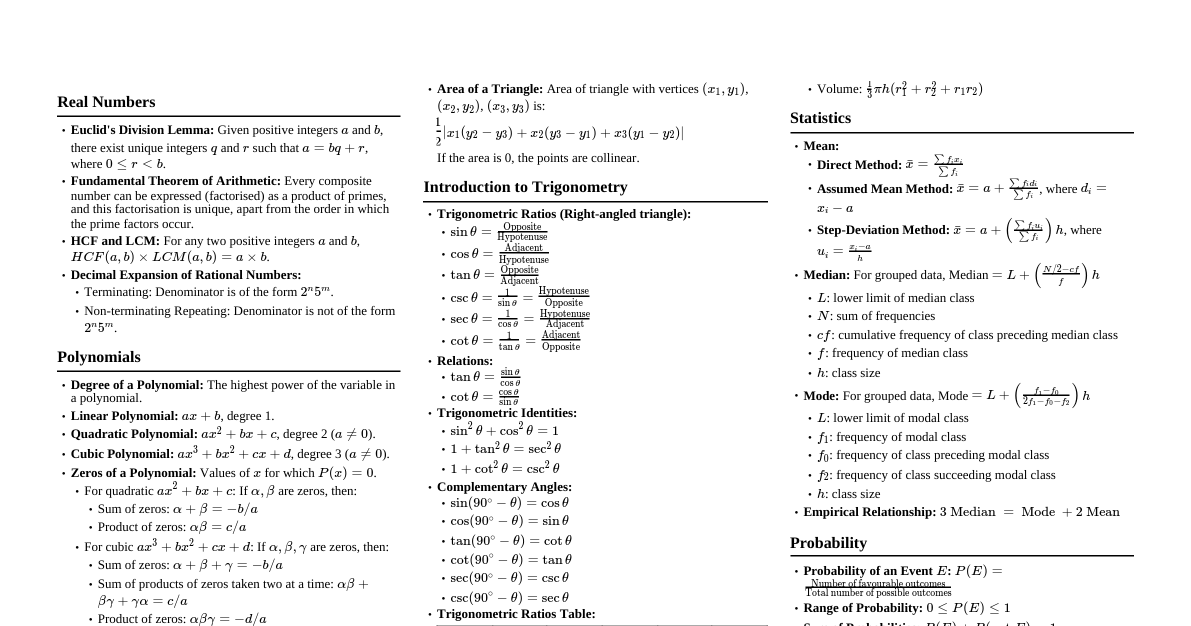
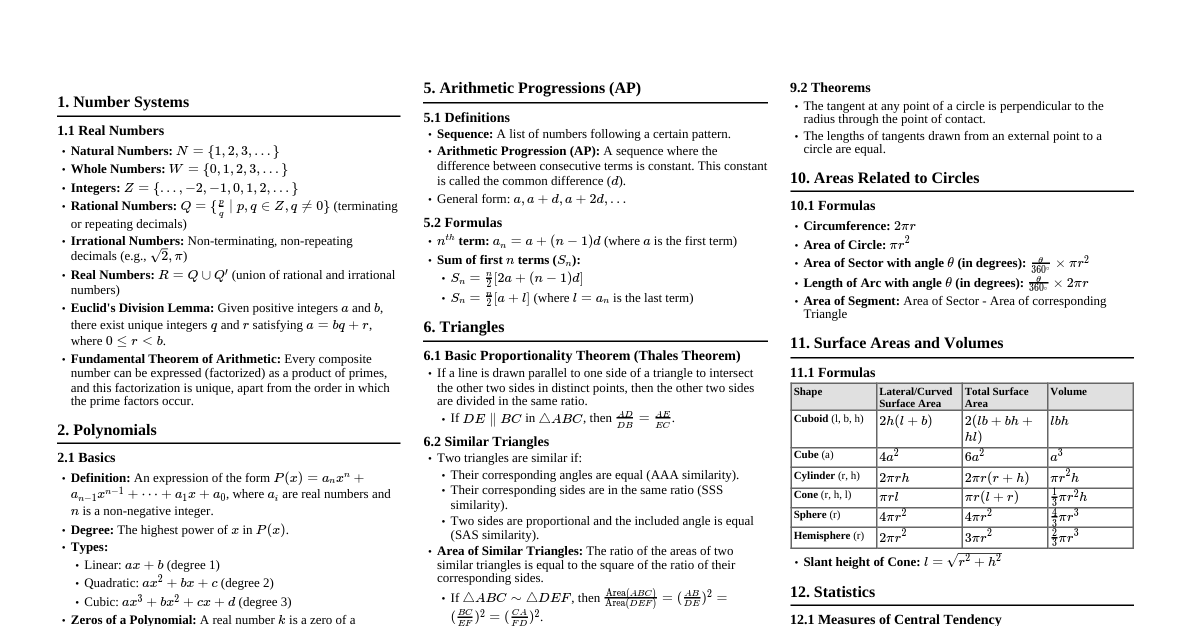
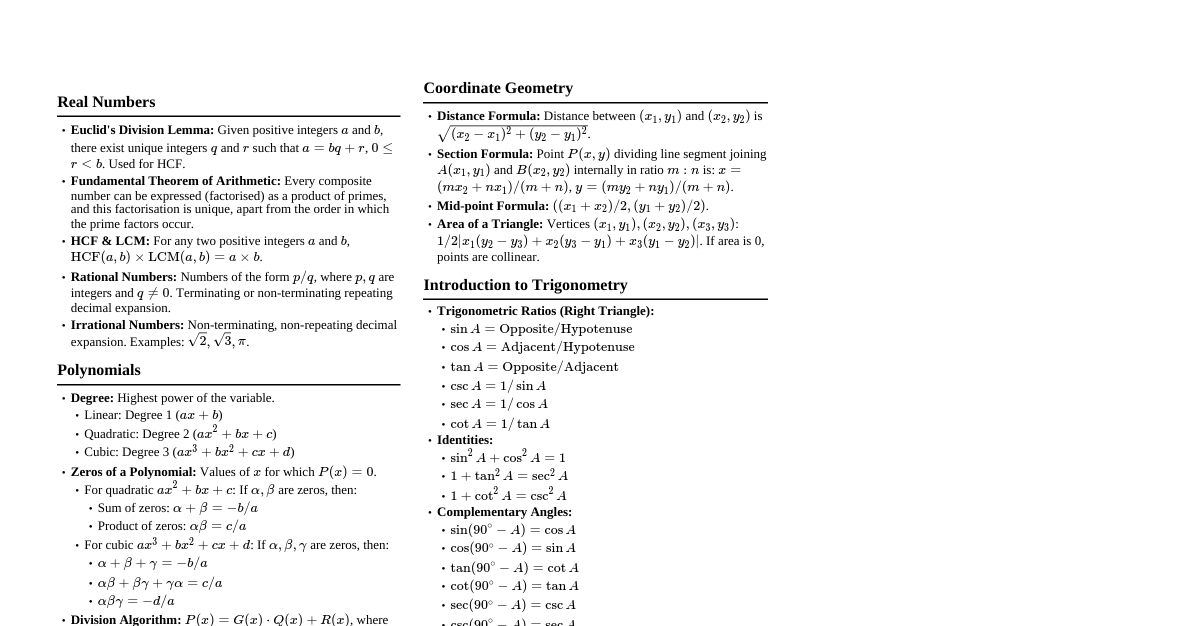
Class 10: Number Systems Real Numbers Euclid's Division Lemma: Given positive integers $a$ and $b$, there exist unique integers $q$ and $r$ such that $a = bq + r$, where $0 \le r Euclid's Division Algorithm: Used to find the HCF of two positive integers. Fundamental Theorem of Arithmetic: Every composite number can be expressed (factorized) as a product of primes, and this factorization is unique, apart from the order in which the prime factors occur. HCF and LCM: For any two positive integers $a$ and $b$, $HCF(a, b) \times LCM(a, b) = a \times b$. Rational Numbers and Their Decimal Expansions: A rational number $x = p/q$ (where $p, q$ are integers, $q \ne 0$) has a terminating decimal expansion if the prime factorization of $q$ is of the form $2^n 5^m$, where $n, m$ are non-negative integers. Otherwise, it has a non-terminating repeating decimal expansion. Solved Example: HCF using Euclid's Algorithm Problem: Find the HCF of 135 and 225. Solution: Since $225 > 135$, apply the division lemma to 225 and 135: $225 = 135 \times 1 + 90$. Since the remainder $90 \ne 0$, apply the division lemma to 135 and 90: $135 = 90 \times 1 + 45$. Since the remainder $45 \ne 0$, apply the division lemma to 90 and 45: $90 = 45 \times 2 + 0$. The remainder has become zero. The divisor at this stage is 45. Therefore, the HCF of 135 and 225 is 45. Class 10: Algebra Polynomials Degree of a polynomial: The highest power of the variable in a polynomial. Types of polynomials: Linear polynomial: $ax + b$, degree 1. Quadratic polynomial: $ax^2 + bx + c$, degree 2. Cubic polynomial: $ax^3 + bx^2 + cx + d$, degree 3. Zeros of a polynomial: The values of $x$ for which $P(x) = 0$. Graphically, these are the $x$-intercepts. Relationship between Zeros and Coefficients of a Quadratic Polynomial: For $ax^2 + bx + c$, if $\alpha$ and $\beta$ are the zeros: Sum of zeros: $\alpha + \beta = -b/a$ Product of zeros: $\alpha \beta = c/a$ Relationship between Zeros and Coefficients of a Cubic Polynomial: For $ax^3 + bx^2 + cx + d$, if $\alpha, \beta, \gamma$ are the zeros: Sum of zeros: $\alpha + \beta + \gamma = -b/a$ Sum of products of zeros taken two at a time: $\alpha \beta + \beta \gamma + \gamma \alpha = c/a$ Product of zeros: $\alpha \beta \gamma = -d/a$ Division Algorithm for Polynomials: If $P(x)$ and $G(x)$ are any two polynomials with $G(x) \ne 0$, then we can find polynomials $Q(x)$ and $R(x)$ such that $P(x) = G(x) \times Q(x) + R(x)$, where $R(x) = 0$ or degree of $R(x) Solved Example: Zeros of a Quadratic Polynomial Problem: Find the zeros of the quadratic polynomial $x^2 + 7x + 10$ and verify the relationship between the zeros and the coefficients. Solution: To find the zeros, set $x^2 + 7x + 10 = 0$. Factorize the polynomial: $x^2 + 5x + 2x + 10 = 0 \implies x(x+5) + 2(x+5) = 0 \implies (x+5)(x+2) = 0$. So, the zeros are $x = -5$ and $x = -2$. Let $\alpha = -5$ and $\beta = -2$. For $x^2 + 7x + 10$, compare with $ax^2 + bx + c$, we have $a=1, b=7, c=10$. Sum of zeros: $\alpha + \beta = -5 + (-2) = -7$. From formula: $-b/a = -7/1 = -7$. (Verified) Product of zeros: $\alpha \beta = (-5) \times (-2) = 10$. From formula: $c/a = 10/1 = 10$. (Verified) Pair of Linear Equations in Two Variables General form: $a_1x + b_1y + c_1 = 0$ and $a_2x + b_2y + c_2 = 0$. Condition Graphical Representation Algebraic Interpretation $\frac{a_1}{a_2} \ne \frac{b_1}{b_2}$ Intersecting lines Exactly one solution (unique solution) $\frac{a_1}{a_2} = \frac{b_1}{b_2} = \frac{c_1}{c_2}$ Coincident lines Infinitely many solutions $\frac{a_1}{a_2} = \frac{b_1}{b_2} \ne \frac{c_1}{c_2}$ Parallel lines No solution Methods to solve: Substitution method Elimination method Cross-multiplication method: If $\frac{a_1}{a_2} \ne \frac{b_1}{b_2}$, then $x = \frac{b_1c_2 - b_2c_1}{a_1b_2 - a_2b_1}$ and $y = \frac{c_1a_2 - c_2a_1}{a_1b_2 - a_2b_1}$. Solved Example: Consistent/Inconsistent System Problem: Check whether the pair of equations $x - 2y = 0$ and $3x + 4y - 20 = 0$ is consistent. Solution: For $x - 2y = 0$, $a_1 = 1, b_1 = -2, c_1 = 0$. For $3x + 4y - 20 = 0$, $a_2 = 3, b_2 = 4, c_2 = -20$. Calculate the ratios: $\frac{a_1}{a_2} = \frac{1}{3}$ $\frac{b_1}{b_2} = \frac{-2}{4} = -\frac{1}{2}$ Since $\frac{a_1}{a_2} \ne \frac{b_1}{b_2}$, the lines intersect at a single point. Therefore, the system has a unique solution and is consistent . Quadratic Equations General form: $ax^2 + bx + c = 0$, where $a \ne 0$. Roots of a quadratic equation: The values of $x$ that satisfy the equation. Methods to solve: Factorization method Completing the square method Quadratic formula: $x = \frac{-b \pm \sqrt{b^2 - 4ac}}{2a}$ Discriminant ($D$): $D = b^2 - 4ac$. It determines the nature of the roots. If $D > 0$: Two distinct real roots. If $D = 0$: Two equal real roots. If $D Solved Example: Quadratic Formula Problem: Find the roots of the equation $2x^2 - 5x + 3 = 0$ using the quadratic formula. Solution: Compare with $ax^2 + bx + c = 0$, we have $a=2, b=-5, c=3$. Discriminant $D = b^2 - 4ac = (-5)^2 - 4(2)(3) = 25 - 24 = 1$. Since $D > 0$, there are two distinct real roots. Using the quadratic formula: $x = \frac{-b \pm \sqrt{D}}{2a} = \frac{-(-5) \pm \sqrt{1}}{2(2)} = \frac{5 \pm 1}{4}$. So, the two roots are: $x_1 = \frac{5 + 1}{4} = \frac{6}{4} = \frac{3}{2}$ $x_2 = \frac{5 - 1}{4} = \frac{4}{4} = 1$ The roots are $3/2$ and $1$. Arithmetic Progressions (AP) Definition: A sequence of numbers such that the difference between consecutive terms is constant. This constant difference is called the common difference ($d$). General form: $a, a+d, a+2d, \dots$ $n^{th}$ term of an AP: $a_n = a + (n-1)d$, where $a$ is the first term. Sum of the first $n$ terms of an AP: $S_n = \frac{n}{2}[2a + (n-1)d]$ $S_n = \frac{n}{2}(a + l)$, where $l = a_n$ is the last term. Solved Example: AP Problem: Find the $10^{th}$ term and the sum of the first 10 terms of the AP: $2, 7, 12, \dots$ Solution: Here, $a = 2$, $d = 7 - 2 = 5$. $10^{th}$ term ($a_{10}$): $a_{10} = a + (10-1)d = 2 + 9(5) = 2 + 45 = 47$. Sum of the first 10 terms ($S_{10}$): $S_{10} = \frac{10}{2}[2a + (10-1)d] = 5[2(2) + 9(5)] = 5[4 + 45] = 5[49] = 245$. Class 10: Coordinate Geometry Distance Formula: The distance between two points $P(x_1, y_1)$ and $Q(x_2, y_2)$ is $PQ = \sqrt{(x_2 - x_1)^2 + (y_2 - y_1)^2}$. Section Formula: The coordinates of the point $P(x, y)$ which divides the line segment joining the points $A(x_1, y_1)$ and $B(x_2, y_2)$ internally in the ratio $m_1:m_2$ are: $x = \frac{m_1x_2 + m_2x_1}{m_1 + m_2}$, $y = \frac{m_1y_2 + m_2y_1}{m_1 + m_2}$. Mid-point Formula: The coordinates of the mid-point of the line segment joining $A(x_1, y_1)$ and $B(x_2, y_2)$ are: $\left(\frac{x_1 + x_2}{2}, \frac{y_1 + y_2}{2}\right)$. Area of a Triangle: The area of a triangle with vertices $(x_1, y_1)$, $(x_2, y_2)$, and $(x_3, y_3)$ is: Area $= \frac{1}{2} |x_1(y_2 - y_3) + x_2(y_3 - y_1) + x_3(y_1 - y_2)|$. If the area is 0, the points are collinear. Solved Example: Section Formula Problem: Find the coordinates of the point which divides the line segment joining $(4, -3)$ and $(8, 5)$ in the ratio $3:1$ internally. Solution: Given $(x_1, y_1) = (4, -3)$, $(x_2, y_2) = (8, 5)$, and ratio $m_1:m_2 = 3:1$. Using the section formula: $x = \frac{m_1x_2 + m_2x_1}{m_1 + m_2} = \frac{3(8) + 1(4)}{3 + 1} = \frac{24 + 4}{4} = \frac{28}{4} = 7$. $y = \frac{m_1y_2 + m_2y_1}{m_1 + m_2} = \frac{3(5) + 1(-3)}{3 + 1} = \frac{15 - 3}{4} = \frac{12}{4} = 3$. The coordinates of the point are $(7, 3)$. Class 10: Geometry Triangles Similar Triangles: Two triangles are similar if their corresponding angles are equal, and their corresponding sides are in the same ratio (proportional). AAA Similarity Criterion: If in two triangles, corresponding angles are equal, then their corresponding sides are proportional and the triangles are similar. SSS Similarity Criterion: If in two triangles, sides of one triangle are proportional to the sides of the other triangle, then their corresponding angles are equal and the triangles are similar. SAS Similarity Criterion: If one angle of a triangle is equal to one angle of the other triangle and the sides including these angles are proportional, then the two triangles are similar. Areas of Similar Triangles: The ratio of the areas of two similar triangles is equal to the square of the ratio of their corresponding sides. If $\triangle ABC \sim \triangle PQR$, then $\frac{Area(\triangle ABC)}{Area(\triangle PQR)} = \left(\frac{AB}{PQ}\right)^2 = \left(\frac{BC}{QR}\right)^2 = \left(\frac{CA}{RP}\right)^2$. Thales Theorem (Basic Proportionality Theorem - BPT): If a line is drawn parallel to one side of a triangle to intersect the other two sides in distinct points, the other two sides are divided in the same ratio. Pythagoras Theorem: In a right triangle, the square of the hypotenuse is equal to the sum of the squares of the other two sides. $h^2 = b^2 + p^2$. Converse of Pythagoras Theorem: If in a triangle, the square of one side is equal to the sum of the squares of the other two sides, then the angle opposite the first side is a right angle. Circles A tangent to a circle is a line that intersects the circle at only one point. The tangent at any point of a circle is perpendicular to the radius through the point of contact. The lengths of tangents drawn from an external point to a circle are equal. Class 10: Trigonometry Introduction to Trigonometry For a right-angled triangle: $\sin \theta = \frac{\text{Opposite}}{\text{Hypotenuse}}$ $\cos \theta = \frac{\text{Adjacent}}{\text{Hypotenuse}}$ $\tan \theta = \frac{\text{Opposite}}{\text{Adjacent}}$ $\csc \theta = \frac{1}{\sin \theta}$ $\sec \theta = \frac{1}{\cos \theta}$ $\cot \theta = \frac{1}{\tan \theta}$ $\tan \theta = \frac{\sin \theta}{\cos \theta}$ $\cot \theta = \frac{\cos \theta}{\sin \theta}$ Trigonometric Identities $\sin^2 \theta + \cos^2 \theta = 1$ $1 + \tan^2 \theta = \sec^2 \theta$ $1 + \cot^2 \theta = \csc^2 \theta$ Trigonometric Ratios of Complementary Angles $\sin(90^\circ - A) = \cos A$ $\cos(90^\circ - A) = \sin A$ $\tan(90^\circ - A) = \cot A$ $\cot(90^\circ - A) = \tan A$ $\sec(90^\circ - A) = \csc A$ $\csc(90^\circ - A) = \sec A$ Trigonometric Ratios Table Angle ($\theta$) $0^\circ$ $30^\circ$ $45^\circ$ $60^\circ$ $90^\circ$ $\sin \theta$ 0 $1/2$ $1/\sqrt{2}$ $\sqrt{3}/2$ 1 $\cos \theta$ 1 $\sqrt{3}/2$ $1/\sqrt{2}$ $1/2$ 0 $\tan \theta$ 0 $1/\sqrt{3}$ 1 $\sqrt{3}$ Undefined Solved Example: Trigonometric Identity Problem: Prove that $(\sec A + \tan A)(1 - \sin A) = \cos A$. Solution: LHS $= (\sec A + \tan A)(1 - \sin A)$ $= \left(\frac{1}{\cos A} + \frac{\sin A}{\cos A}\right)(1 - \sin A)$ $= \left(\frac{1 + \sin A}{\cos A}\right)(1 - \sin A)$ $= \frac{(1 + \sin A)(1 - \sin A)}{\cos A}$ $= \frac{1 - \sin^2 A}{\cos A}$ Since $\sin^2 A + \cos^2 A = 1$, we have $1 - \sin^2 A = \cos^2 A$. $= \frac{\cos^2 A}{\cos A} = \cos A = \text{RHS}$. Class 10: Mensuration Areas Related to Circles Circumference of a circle: $2\pi r$ Area of a circle: $\pi r^2$ Area of a sector of angle $\theta$: $\frac{\theta}{360^\circ} \times \pi r^2$ Length of an arc of a sector of angle $\theta$: $\frac{\theta}{360^\circ} \times 2\pi r$ Area of a segment: Area of corresponding sector - Area of corresponding triangle. Surface Areas and Volumes Shape Lateral/Curved Surface Area Total Surface Area Volume Cuboid (l, b, h) $2h(l+b)$ $2(lb + bh + hl)$ $lbh$ Cube (a) $4a^2$ $6a^2$ $a^3$ Cylinder (r, h) $2\pi rh$ $2\pi r(r+h)$ $\pi r^2 h$ Cone (r, h, l) $\pi rl$ $\pi r(l+r)$ $\frac{1}{3}\pi r^2 h$ Sphere (r) $4\pi r^2$ $4\pi r^2$ $\frac{4}{3}\pi r^3$ Hemisphere (r) $2\pi r^2$ $3\pi r^2$ $\frac{2}{3}\pi r^3$ Frustum of a Cone ($r_1, r_2, h, l$) $\pi(r_1+r_2)l$ $\pi(r_1+r_2)l + \pi r_1^2 + \pi r_2^2$ $\frac{1}{3}\pi h(r_1^2 + r_2^2 + r_1r_2)$ Note: $l = \sqrt{h^2 + (r_1-r_2)^2}$ for frustum, $l = \sqrt{h^2+r^2}$ for cone. Solved Example: Volume of a Cylinder Problem: A cylindrical pencil is sharpened to a conical point. The length of the cylindrical part is 10 cm and the diameter is 0.5 cm. The conical part has a height of 1 cm. Calculate the volume of the pencil. Solution: For the cylindrical part: Radius $r = 0.5/2 = 0.25$ cm Height $h_c = 10$ cm Volume $V_c = \pi r^2 h_c = \pi (0.25)^2 (10) = 0.625\pi$ cm$^3$. For the conical part: Radius $r = 0.25$ cm (same as cylinder) Height $h_{cone} = 1$ cm Volume $V_{cone} = \frac{1}{3}\pi r^2 h_{cone} = \frac{1}{3}\pi (0.25)^2 (1) = \frac{0.0625}{3}\pi$ cm$^3$. Total volume of the pencil $= V_c + V_{cone} = 0.625\pi + \frac{0.0625}{3}\pi = \pi \left(0.625 + \frac{0.0625}{3}\right)$ $= \pi \left(\frac{1.875 + 0.0625}{3}\right) = \pi \left(\frac{1.9375}{3}\right) \approx 2.03$ cm$^3$. Class 10: Statistics and Probability Statistics Mean ($\bar{x}$): Direct method: $\bar{x} = \frac{\sum f_ix_i}{\sum f_i}$ Assumed Mean method: $\bar{x} = A + \frac{\sum f_id_i}{\sum f_i}$, where $d_i = x_i - A$ Step Deviation method: $\bar{x} = A + \left(\frac{\sum f_iu_i}{\sum f_i}\right)h$, where $u_i = \frac{x_i - A}{h}$ Median: The middle-most value of the data when arranged in ascending or descending order. For grouped data: Median $= L + \left(\frac{n/2 - cf}{f}\right)h$, where $L$ is lower limit of median class, $n$ is sum of frequencies, $cf$ is cumulative frequency of class preceding median class, $f$ is frequency of median class, $h$ is class size. Mode: The value that appears most frequently in a data set. For grouped data: Mode $= L + \left(\frac{f_1 - f_0}{2f_1 - f_0 - f_2}\right)h$, where $L$ is lower limit of modal class, $f_1$ is frequency of modal class, $f_0$ is frequency of class preceding modal class, $f_2$ is frequency of class succeeding modal class, $h$ is class size. Empirical Relationship: $3 \text{ Median } = \text{ Mode } + 2 \text{ Mean}$ Probability Probability of an event E: $P(E) = \frac{\text{Number of favourable outcomes}}{\text{Total number of possible outcomes}}$ $0 \le P(E) \le 1$ $P(E) + P(\text{not } E) = 1$ An event that is impossible has probability 0. An event that is sure or certain has probability 1. Solved Example: Probability Problem: A bag contains 3 red balls and 5 black balls. A ball is drawn at random from the bag. What is the probability that the ball drawn is (i) red? (ii) not red? Solution: Total number of balls in the bag $= 3 + 5 = 8$. (i) Let E be the event that the ball drawn is red. Number of red balls = 3. $P(E) = \frac{\text{Number of red balls}}{\text{Total number of balls}} = \frac{3}{8}$. (ii) Let F be the event that the ball drawn is not red (i.e., black). Number of black balls = 5. $P(F) = \frac{\text{Number of black balls}}{\text{Total number of balls}} = \frac{5}{8}$. Alternatively, $P(\text{not red}) = 1 - P(\text{red}) = 1 - \frac{3}{8} = \frac{5}{8}$. Class 11: Sets, Relations and Functions Sets Set: A well-defined collection of objects. Representation: Roster form (list elements) or Set-builder form (describe property). Types of Sets: Empty set ($\emptyset$), Finite set, Infinite set, Singleton set. Subset: $A \subseteq B$ if every element of A is in B. Power Set: The collection of all subsets of a set A, denoted by $P(A)$. If $|A|=n$, then $|P(A)|=2^n$. Universal Set ($U$): The basic set for a given context. Operations on Sets: Union ($A \cup B$): Elements in A or B or both. Intersection ($A \cap B$): Elements common to A and B. Difference ($A - B$): Elements in A but not in B. Complement ($A'$ or $A^c$): Elements in U but not in A. $A' = U - A$. De Morgan's Laws: $(A \cup B)' = A' \cap B'$ $(A \cap B)' = A' \cup B'$ Formula for number of elements: $n(A \cup B) = n(A) + n(B) - n(A \cap B)$ $n(A \cup B \cup C) = n(A) + n(B) + n(C) - n(A \cap B) - n(B \cap C) - n(C \cap A) + n(A \cap B \cap C)$ Relations Cartesian Product: $A \times B = \{(a, b) : a \in A, b \in B\}$. Relation: A subset of $A \times B$. Domain: Set of all first elements of the ordered pairs in a relation. Range: Set of all second elements of the ordered pairs in a relation. Functions Function: A relation $f$ from A to B is a function if every element of A has one and only one image in B. Types of Functions: Identity, Constant, Polynomial, Rational, Modulus, Signum, Greatest Integer Function. Algebra of Functions: For functions $f: X \to \mathbb{R}$ and $g: X \to \mathbb{R}$: $(f+g)(x) = f(x) + g(x)$ $(f-g)(x) = f(x) - g(x)$ $(fg)(x) = f(x)g(x)$ $(f/g)(x) = f(x)/g(x)$, provided $g(x) \ne 0$. Solved Example: Set Operations Problem: Let $U = \{1, 2, 3, 4, 5, 6, 7, 8, 9\}$, $A = \{1, 2, 3, 4\}$, $B = \{2, 4, 6, 8\}$. Find $A \cup B$, $A \cap B$, $A - B$, and $A'$. Solution: $A \cup B = \{1, 2, 3, 4, 6, 8\}$ $A \cap B = \{2, 4\}$ $A - B = \{1, 3\}$ $A' = U - A = \{5, 6, 7, 8, 9\}$ Class 11: Trigonometric Functions Basic Identities $\sin^2 x + \cos^2 x = 1$ $1 + \tan^2 x = \sec^2 x$ $1 + \cot^2 x = \csc^2 x$ Compound Angle Formulas $\sin(A \pm B) = \sin A \cos B \pm \cos A \sin B$ $\cos(A \pm B) = \cos A \cos B \mp \sin A \sin B$ $\tan(A \pm B) = \frac{\tan A \pm \tan B}{1 \mp \tan A \tan B}$ Double Angle Formulas $\sin 2A = 2 \sin A \cos A = \frac{2 \tan A}{1 + \tan^2 A}$ $\cos 2A = \cos^2 A - \sin^2 A = 2 \cos^2 A - 1 = 1 - 2 \sin^2 A = \frac{1 - \tan^2 A}{1 + \tan^2 A}$ $\tan 2A = \frac{2 \tan A}{1 - \tan^2 A}$ Triple Angle Formulas $\sin 3A = 3 \sin A - 4 \sin^3 A$ $\cos 3A = 4 \cos^3 A - 3 \cos A$ $\tan 3A = \frac{3 \tan A - \tan^3 A}{1 - 3 \tan^2 A}$ Sum and Product Formulas $\sin x + \sin y = 2 \sin \left(\frac{x+y}{2}\right) \cos \left(\frac{x-y}{2}\right)$ $\sin x - \sin y = 2 \cos \left(\frac{x+y}{2}\right) \sin \left(\frac{x-y}{2}\right)$ $\cos x + \cos y = 2 \cos \left(\frac{x+y}{2}\right) \cos \left(\frac{x-y}{2}\right)$ $\cos x - \cos y = -2 \sin \left(\frac{x+y}{2}\right) \sin \left(\frac{x-y}{2}\right)$ $2 \sin A \cos B = \sin(A+B) + \sin(A-B)$ $2 \cos A \sin B = \sin(A+B) - \sin(A-B)$ $2 \cos A \cos B = \cos(A+B) + \cos(A-B)$ $2 \sin A \sin B = \cos(A-B) - \cos(A+B)$ General Solutions of Trigonometric Equations $\sin x = \sin y \implies x = n\pi + (-1)^n y$, where $n \in \mathbb{Z}$. $\cos x = \cos y \implies x = 2n\pi \pm y$, where $n \in \mathbb{Z}$. $\tan x = \tan y \implies x = n\pi + y$, where $n \in \mathbb{Z}$. Solved Example: Trigonometric Equation Problem: Find the general solution of $\sin x = \frac{\sqrt{3}}{2}$. Solution: We know that $\sin(\pi/3) = \frac{\sqrt{3}}{2}$. So, $\sin x = \sin(\pi/3)$. Using the general solution formula for $\sin x = \sin y$, we have $x = n\pi + (-1)^n \frac{\pi}{3}$, where $n \in \mathbb{Z}$. Class 11: Complex Numbers and Quadratic Equations Complex Numbers Imaginary unit: $i = \sqrt{-1}$, so $i^2 = -1$. Complex number: $z = a + ib$, where $a, b \in \mathbb{R}$. $a$ is the real part ($\text{Re}(z)$) and $b$ is the imaginary part ($\text{Im}(z)$). Conjugate of a complex number: If $z = a + ib$, then $\bar{z} = a - ib$. Modulus of a complex number: If $z = a + ib$, then $|z| = \sqrt{a^2 + b^2}$. Properties: $z\bar{z} = |z|^2$ $|z_1z_2| = |z_1||z_2|$ $|z_1/z_2| = |z_1|/|z_2|$ $\overline{z_1 \pm z_2} = \bar{z_1} \pm \bar{z_2}$ $\overline{z_1 z_2} = \bar{z_1} \bar{z_2}$ $\overline{z_1 / z_2} = \bar{z_1} / \bar{z_2}$ Polar form: $z = r(\cos \theta + i \sin \theta)$, where $r = |z|$ and $\theta$ is the argument ($\arg z$). Euler form: $z = re^{i\theta}$. Quadratic Equations with Complex Roots For $ax^2 + bx + c = 0$, if $D = b^2 - 4ac $x = \frac{-b \pm i\sqrt{-(b^2 - 4ac)}}{2a}$. Solved Example: Complex Numbers Problem: Express $\frac{1+2i}{1-3i}$ in the form $a+ib$. Solution: We multiply the numerator and denominator by the conjugate of the denominator: $\frac{1+2i}{1-3i} = \frac{1+2i}{1-3i} \times \frac{1+3i}{1+3i}$ $= \frac{(1)(1) + (1)(3i) + (2i)(1) + (2i)(3i)}{1^2 + 3^2}$ $= \frac{1 + 3i + 2i + 6i^2}{1 + 9}$ $= \frac{1 + 5i - 6}{10}$ (since $i^2 = -1$) $= \frac{-5 + 5i}{10} = -\frac{5}{10} + \frac{5i}{10} = -\frac{1}{2} + \frac{1}{2}i$. So, $a = -1/2$ and $b = 1/2$. Class 11: Linear Inequalities Rules for solving: Adding/subtracting same number on both sides doesn't change inequality sign. Multiplying/dividing by a positive number doesn't change inequality sign. Multiplying/dividing by a negative number reverses inequality sign. Solutions represented on number line or in intervals. Solved Example: Linear Inequality Problem: Solve $3(1-x) Solution: $3 - 3x $3 - 8 $-5 $-1 -1$. The solution in interval notation is $(-1, \infty)$. -1 -5 0 5 Class 11: Permutations and Combinations Fundamental Principle of Counting: Multiplication Principle: If an event can occur in $m$ ways and another event can occur in $n$ ways, then the total number of ways of occurrence of the events in succession is $m \times n$. Addition Principle: If an event can occur in $m$ ways and another event can occur in $n$ ways, and both events cannot occur simultaneously, then the total number of ways of occurrence of either event is $m + n$. Factorial: $n! = n \times (n-1) \times \dots \times 1$. $0! = 1$. Permutation ($^nP_r$): The number of ways to arrange $r$ distinct items from a set of $n$ distinct items, where order matters. $^nP_r = \frac{n!}{(n-r)!}$ Combination ($^nC_r$): The number of ways to choose $r$ distinct items from a set of $n$ distinct items, where order does not matter. $^nC_r = \frac{n!}{r!(n-r)!}$ Relationship: $^nP_r = r! \times ^nC_r$. Properties: $^nC_r = ^nC_{n-r}$ $^nC_r + ^nC_{r-1} = ^{n+1}C_r$ Solved Example: Combination Problem: A committee of 3 persons is to be constituted from a group of 2 men and 3 women. In how many ways can this be done? Solution: Total number of persons = $2 (\text{men}) + 3 (\text{women}) = 5$. We need to choose 3 persons from these 5. Since the order of selection does not matter, this is a combination problem. Number of ways = $^5C_3 = \frac{5!}{3!(5-3)!} = \frac{5!}{3!2!} = \frac{5 \times 4 \times 3 \times 2 \times 1}{(3 \times 2 \times 1)(2 \times 1)} = \frac{120}{12} = 10$. So, the committee can be constituted in 10 ways. Class 11: Binomial Theorem Binomial Theorem for Positive Integer Index: $(a+b)^n = \sum_{k=0}^n \binom{n}{k} a^{n-k} b^k = \binom{n}{0}a^n + \binom{n}{1}a^{n-1}b + \dots + \binom{n}{n}b^n$ General Term ($T_{k+1}$): $T_{k+1} = \binom{n}{k} a^{n-k} b^k$. Middle Term: If $n$ is even, there is one middle term: $T_{n/2 + 1}$. If $n$ is odd, there are two middle terms: $T_{(n+1)/2}$ and $T_{(n+3)/2}$. Solved Example: Binomial Expansion Problem: Expand $(x + 2y)^3$. Solution: Using the binomial theorem with $n=3$, $a=x$, $b=2y$: $(x + 2y)^3 = \binom{3}{0}x^3(2y)^0 + \binom{3}{1}x^2(2y)^1 + \binom{3}{2}x^1(2y)^2 + \binom{3}{3}x^0(2y)^3$ $= 1 \cdot x^3 \cdot 1 + 3 \cdot x^2 \cdot 2y + 3 \cdot x \cdot 4y^2 + 1 \cdot 1 \cdot 8y^3$ $= x^3 + 6x^2y + 12xy^2 + 8y^3$. Class 11: Sequences and Series Arithmetic Progression (AP) $n^{th}$ term: $a_n = a + (n-1)d$ Sum of $n$ terms: $S_n = \frac{n}{2}[2a + (n-1)d] = \frac{n}{2}(a + a_n)$ Arithmetic Mean (AM) between $a$ and $b$: $\frac{a+b}{2}$. Geometric Progression (GP) Definition: A sequence where each term after the first is found by multiplying the previous one by a fixed, non-zero number called the common ratio ($r$). $n^{th}$ term: $a_n = ar^{n-1}$ Sum of $n$ terms: $S_n = \frac{a(r^n - 1)}{r - 1}$ if $r \ne 1$ $S_n = na$ if $r = 1$ Sum of infinite GP: $S_\infty = \frac{a}{1-r}$, for $|r| Geometric Mean (GM) between $a$ and $b$: $\sqrt{ab}$. Special Series Sum of first $n$ natural numbers: $\sum n = \frac{n(n+1)}{2}$ Sum of squares of first $n$ natural numbers: $\sum n^2 = \frac{n(n+1)(2n+1)}{6}$ Sum of cubes of first $n$ natural numbers: $\sum n^3 = \left[\frac{n(n+1)}{2}\right]^2$ Solved Example: GP Problem: Find the sum of the first 5 terms of the GP: $2, 6, 18, \dots$ Solution: Here, $a = 2$. Common ratio $r = 6/2 = 3$. Number of terms $n = 5$. Since $r \ne 1$, use the formula $S_n = \frac{a(r^n - 1)}{r - 1}$. $S_5 = \frac{2(3^5 - 1)}{3 - 1} = \frac{2(243 - 1)}{2} = 242$. Class 11: Straight Lines Slope of a line (m): Passing through $(x_1, y_1)$ and $(x_2, y_2)$: $m = \frac{y_2 - y_1}{x_2 - x_1}$ If angle with positive x-axis is $\theta$: $m = \tan \theta$ Parallel lines: $m_1 = m_2$ Perpendicular lines: $m_1m_2 = -1$ (if slopes exist) Equations of a line: Horizontal line: $y = k$ Vertical line: $x = k$ Point-slope form: $y - y_1 = m(x - x_1)$ Two-point form: $y - y_1 = \frac{y_2 - y_1}{x_2 - x_1}(x - x_1)$ Slope-intercept form: $y = mx + c$ Intercept form: $\frac{x}{a} + \frac{y}{b} = 1$ Normal form: $x \cos \omega + y \sin \omega = p$ General equation: $Ax + By + C = 0$ Distance of a point $(x_1, y_1)$ from a line $Ax + By + C = 0$: $d = \frac{|Ax_1 + By_1 + C|}{\sqrt{A^2 + B^2}}$ Distance between two parallel lines $Ax + By + C_1 = 0$ and $Ax + By + C_2 = 0$: $d = \frac{|C_1 - C_2|}{\sqrt{A^2 + B^2}}$ Solved Example: Equation of a Line Problem: Find the equation of the line passing through $(1, 2)$ and having slope $2/3$. Solution: Using the point-slope form $y - y_1 = m(x - x_1)$: $y - 2 = \frac{2}{3}(x - 1)$ $3(y - 2) = 2(x - 1)$ $3y - 6 = 2x - 2$ $2x - 3y + 4 = 0$. Class 11: Conic Sections Circle Equation with center $(h, k)$ and radius $r$: $(x-h)^2 + (y-k)^2 = r^2$. Equation with center $(0, 0)$ and radius $r$: $x^2 + y^2 = r^2$. Parabola Standard equations: $y^2 = 4ax$ (rightward open) $y^2 = -4ax$ (leftward open) $x^2 = 4ay$ (upward open) $x^2 = -4ay$ (downward open) Focus: $(a, 0)$ for $y^2 = 4ax$. Directrix: $x = -a$ for $y^2 = 4ax$. Latus Rectum length: $4a$. Ellipse Standard equations: $\frac{x^2}{a^2} + \frac{y^2}{b^2} = 1$ ($a > b$, major axis along x-axis) $\frac{x^2}{b^2} + \frac{y^2}{a^2} = 1$ ($a > b$, major axis along y-axis) Eccentricity ($e$): $b^2 = a^2(1 - e^2)$, $0 Foci: $(\pm ae, 0)$ or $(0, \pm ae)$. Vertices: $(\pm a, 0)$ or $(0, \pm a)$. Length of major axis: $2a$. Length of minor axis: $2b$. Latus Rectum length: $\frac{2b^2}{a}$. Hyperbola Standard equations: $\frac{x^2}{a^2} - \frac{y^2}{b^2} = 1$ (transverse axis along x-axis) $\frac{y^2}{a^2} - \frac{x^2}{b^2} = 1$ (transverse axis along y-axis) Eccentricity ($e$): $b^2 = a^2(e^2 - 1)$, $e > 1$. Foci: $(\pm ae, 0)$ or $(0, \pm ae)$. Vertices: $(\pm a, 0)$ or $(0, \pm a)$. Length of transverse axis: $2a$. Length of conjugate axis: $2b$. Latus Rectum length: $\frac{2b^2}{a}$. Solved Example: Circle Problem: Find the equation of the circle with center $(2, -3)$ and radius 5. Solution: Using the standard equation $(x-h)^2 + (y-k)^2 = r^2$, with $(h, k) = (2, -3)$ and $r=5$: $(x-2)^2 + (y - (-3))^2 = 5^2$ $(x-2)^2 + (y+3)^2 = 25$ $x^2 - 4x + 4 + y^2 + 6y + 9 = 25$ $x^2 + y^2 - 4x + 6y + 13 - 25 = 0$ $x^2 + y^2 - 4x + 6y - 12 = 0$. Class 11: Introduction to 3D Geometry Distance Formula: The distance between two points $P(x_1, y_1, z_1)$ and $Q(x_2, y_2, z_2)$ is: $PQ = \sqrt{(x_2 - x_1)^2 + (y_2 - y_1)^2 + (z_2 - z_1)^2}$. Section Formula: The coordinates of the point $R(x, y, z)$ which divides the line segment joining $P(x_1, y_1, z_1)$ and $Q(x_2, y_2, z_2)$ internally in the ratio $m:n$ are: $x = \frac{mx_2 + nx_1}{m + n}$, $y = \frac{my_2 + ny_1}{m + n}$, $z = \frac{mz_2 + nz_1}{m + n}$. Mid-point Formula: $\left(\frac{x_1 + x_2}{2}, \frac{y_1 + y_2}{2}, \frac{z_1 + z_2}{2}\right)$. Solved Example: Distance in 3D Problem: Find the distance between the points $(1, -3, 4)$ and $(-4, 1, 2)$. Solution: Using the distance formula: $d = \sqrt{(-4 - 1)^2 + (1 - (-3))^2 + (2 - 4)^2}$ $d = \sqrt{(-5)^2 + (4)^2 + (-2)^2}$ $d = \sqrt{25 + 16 + 4} = \sqrt{45} = 3\sqrt{5}$. Class 11: Calculus - Limits and Derivatives Limits Basic Limits: $\lim_{x \to a} k = k$ $\lim_{x \to a} x = a$ $\lim_{x \to a} x^n = a^n$ Algebra of Limits: $\lim_{x \to a} [f(x) \pm g(x)] = \lim_{x \to a} f(x) \pm \lim_{x \to a} g(x)$ $\lim_{x \to a} [f(x) \cdot g(x)] = \lim_{x \to a} f(x) \cdot \lim_{x \to a} g(x)$ $\lim_{x \to a} [f(x) / g(x)] = \lim_{x \to a} f(x) / \lim_{x \to a} g(x)$, if $\lim_{x \to a} g(x) \ne 0$. Important Formulas: $\lim_{x \to a} \frac{x^n - a^n}{x - a} = na^{n-1}$ $\lim_{x \to 0} \frac{\sin x}{x} = 1$ $\lim_{x \to 0} \frac{\tan x}{x} = 1$ $\lim_{x \to 0} \frac{1 - \cos x}{x} = 0$ $\lim_{x \to 0} (1+x)^{1/x} = e$ $\lim_{x \to \infty} (1+1/x)^x = e$ $\lim_{x \to 0} \frac{e^x - 1}{x} = 1$ $\lim_{x \to 0} \frac{\log(1+x)}{x} = 1$ Derivatives (First Principles) Definition: $f'(x) = \lim_{h \to 0} \frac{f(x+h) - f(x)}{h}$ Derivative of $x^n$: $\frac{d}{dx}(x^n) = nx^{n-1}$ Derivative of a constant: $\frac{d}{dx}(c) = 0$ Derivative of $\sin x$: $\frac{d}{dx}(\sin x) = \cos x$ Derivative of $\cos x$: $\frac{d}{dx}(\cos x) = -\sin x$ Derivative of $\tan x$: $\frac{d}{dx}(\tan x) = \sec^2 x$ Solved Example: Limit Problem: Evaluate $\lim_{x \to 2} \frac{x^2 - 4}{x - 2}$. Solution: Direct substitution gives $0/0$ form, so we factorize the numerator: $\lim_{x \to 2} \frac{(x-2)(x+2)}{x - 2}$ Since $x \to 2$, $x \ne 2$, so we can cancel $(x-2)$: $= \lim_{x \to 2} (x+2) = 2 + 2 = 4$. Class 11: Mathematical Reasoning Statement: A declarative sentence which is either true or false but not both. Connectives: "and" ($\land$), "or" ($\lor$), "if...then" ($\implies$), "if and only if" ($\iff$), "not" ($\neg$). Truth Table: Shows the truth values of compound statements. Quantifiers: "There exists" ($\exists$), "For all" ($\forall$). Contrapositive and Converse: For an implication $p \implies q$: Converse: $q \implies p$ Contrapositive: $\neg q \implies \neg p$ (Contrapositive has the same truth value as the original statement). Solved Example: Contrapositive Problem: Write the contrapositive of "If a number is divisible by 9, then it is divisible by 3." Solution: Let $p$: "A number is divisible by 9." Let $q$: "A number is divisible by 3." The given statement is $p \implies q$. The contrapositive is $\neg q \implies \neg p$. $\neg q$: "A number is not divisible by 3." $\neg p$: "A number is not divisible by 9." So, the contrapositive is: "If a number is not divisible by 3, then it is not divisible by 9." Class 11: Statistics (Advanced) Measures of Dispersion: Range: Max value - Min value. Mean Deviation (MD): MD (about mean) $= \frac{\sum |x_i - \bar{x}|}{n}$ (for ungrouped data) MD (about mean) $= \frac{\sum f_i|x_i - \bar{x}|}{\sum f_i}$ (for grouped data) Similarly for MD about median. Variance ($\sigma^2$): $\sigma^2 = \frac{\sum (x_i - \bar{x})^2}{n}$ or $\frac{\sum x_i^2}{n} - (\bar{x})^2$ (for ungrouped data) $\sigma^2 = \frac{\sum f_i(x_i - \bar{x})^2}{\sum f_i}$ or $\frac{\sum f_ix_i^2}{\sum f_i} - (\bar{x})^2$ (for grouped data) Standard Deviation ($\sigma$): $\sigma = \sqrt{\text{Variance}}$. Coefficient of Variation (CV): $CV = \frac{\sigma}{\bar{x}} \times 100$, used for comparing variability of two data sets. Solved Example: Variance Problem: Find the variance of the data: 6, 7, 10, 12, 13, 4, 8, 12. Solution: First, find the mean ($\bar{x}$): $\bar{x} = \frac{6+7+10+12+13+4+8+12}{8} = \frac{72}{8} = 9$. Now, calculate $(x_i - \bar{x})^2$ for each data point: $(6-9)^2 = 9$ $(7-9)^2 = 4$ $(10-9)^2 = 1$ $(12-9)^2 = 9$ $(13-9)^2 = 16$ $(4-9)^2 = 25$ $(8-9)^2 = 1$ $(12-9)^2 = 9$ Sum of squares of deviations: $\sum (x_i - \bar{x})^2 = 9+4+1+9+16+25+1+9 = 74$. Variance ($\sigma^2$) $= \frac{\sum (x_i - \bar{x})^2}{n} = \frac{74}{8} = 9.25$. Class 11: Probability (Advanced) Axiomatic Approach to Probability: For any event $E$, $P(E) \ge 0$. $P(S) = 1$, where $S$ is the sample space. If $E$ and $F$ are mutually exclusive events, then $P(E \cup F) = P(E) + P(F)$. Addition Theorem: $P(A \cup B) = P(A) + P(B) - P(A \cap B)$. If $A$ and $B$ are mutually exclusive, $P(A \cap B) = 0$, so $P(A \cup B) = P(A) + P(B)$. Solved Example: Probability Problem: A card is drawn from a well-shuffled deck of 52 cards. What is the probability that it is a King or a Spade? Solution: Let A be the event that the card drawn is a King. Let B be the event that the card drawn is a Spade. Number of Kings = 4. So, $P(A) = 4/52$. Number of Spades = 13. So, $P(B) = 13/52$. The event $A \cap B$ is drawing a King of Spade. There is 1 King of Spade. So, $P(A \cap B) = 1/52$. Using the addition theorem: $P(A \cup B) = P(A) + P(B) - P(A \cap B)$ $P(A \cup B) = \frac{4}{52} + \frac{13}{52} - \frac{1}{52} = \frac{17 - 1}{52} = \frac{16}{52} = \frac{4}{13}$. Class 12: Relations and Functions Types of Relations Reflexive: $(a, a) \in R$ for all $a \in A$. Symmetric: If $(a, b) \in R$, then $(b, a) \in R$. Transitive: If $(a, b) \in R$ and $(b, c) \in R$, then $(a, c) \in R$. Equivalence Relation: A relation that is reflexive, symmetric, and transitive. Types of Functions One-one (Injective): If $f(x_1) = f(x_2) \implies x_1 = x_2$. Onto (Surjective): For every $y \in B$, there exists $x \in A$ such that $f(x) = y$. (Range = Codomain) Bijective: Both one-one and onto. Composition of Functions: $(g \circ f)(x) = g(f(x))$. Invertible Function: A function $f: A \to B$ is invertible if it is bijective. Its inverse is $f^{-1}: B \to A$. $(f^{-1} \circ f)(x) = x$ and $(f \circ f^{-1})(y) = y$. Binary Operations A binary operation $*$ on a set $A$ is a function $* : A \times A \to A$. Commutative: $a * b = b * a$. Associative: $(a * b) * c = a * (b * c)$. Identity Element: $e \in A$ such that $a * e = e * a = a$ for all $a \in A$. Inverse Element: $b \in A$ is the inverse of $a \in A$ if $a * b = b * a = e$. Solved Example: Bijective Function Problem: Show that $f: \mathbb{R} \to \mathbb{R}$ defined by $f(x) = 2x+3$ is a bijective function. Solution: 1. One-one (Injective): Assume $f(x_1) = f(x_2)$. $2x_1 + 3 = 2x_2 + 3$ $2x_1 = 2x_2$ $x_1 = x_2$. Thus, $f$ is one-one. 2. Onto (Surjective): Let $y$ be an arbitrary element in the codomain $\mathbb{R}$. We need to find $x \in \mathbb{R}$ such that $f(x) = y$. $y = 2x + 3$ $2x = y - 3$ $x = \frac{y-3}{2}$. Since $y \in \mathbb{R}$, $x = \frac{y-3}{2}$ is also a real number. So, for every $y$ in the codomain, there exists an $x$ in the domain such that $f(x)=y$. Thus, $f$ is onto. Since $f$ is both one-one and onto, it is a bijective function. Class 12: Inverse Trigonometric Functions Principal Value Branches Function Domain Range (Principal Value Branch) $\sin^{-1} x$ $[-1, 1]$ $[-\pi/2, \pi/2]$ $\cos^{-1} x$ $[-1, 1]$ $[0, \pi]$ $\tan^{-1} x$ $\mathbb{R}$ $(-\pi/2, \pi/2)$ $\csc^{-1} x$ $\mathbb{R} - (-1, 1)$ $[-\pi/2, \pi/2] - \{0\}$ $\sec^{-1} x$ $\mathbb{R} - (-1, 1)$ $[0, \pi] - \{\pi/2\}$ $\cot^{-1} x$ $\mathbb{R}$ $(0, \pi)$ Properties of Inverse Trigonometric Functions $\sin^{-1}(\sin x) = x$, $\cos^{-1}(\cos x) = x$, etc. (within principal value branch) $\sin^{-1}(-x) = -\sin^{-1} x$ $\cos^{-1}(-x) = \pi - \cos^{-1} x$ $\tan^{-1}(-x) = -\tan^{-1} x$ $\sin^{-1} x + \cos^{-1} x = \pi/2$ $\tan^{-1} x + \cot^{-1} x = \pi/2$ $\sec^{-1} x + \csc^{-1} x = \pi/2$ $\tan^{-1} x + \tan^{-1} y = \tan^{-1}\left(\frac{x+y}{1-xy}\right)$, if $xy $\tan^{-1} x - \tan^{-1} y = \tan^{-1}\left(\frac{x-y}{1+xy}\right)$, if $xy > -1$. $2 \tan^{-1} x = \tan^{-1}\left(\frac{2x}{1-x^2}\right) = \sin^{-1}\left(\frac{2x}{1+x^2}\right) = \cos^{-1}\left(\frac{1-x^2}{1+x^2}\right)$ Solved Example: Inverse Trigonometric Property Problem: Evaluate $\sin^{-1}(\sin(3\pi/5))$. Solution: The principal value branch of $\sin^{-1} x$ is $[-\pi/2, \pi/2]$. The angle $3\pi/5$ is not in this range. ($3\pi/5 = 108^\circ$, $\pi/2 = 90^\circ$). We use the property $\sin(\pi - \theta) = \sin \theta$. $\sin(3\pi/5) = \sin(\pi - 3\pi/5) = \sin(2\pi/5)$. Now, $2\pi/5 = 72^\circ$, which lies in $[-\pi/2, \pi/2]$. So, $\sin^{-1}(\sin(3\pi/5)) = \sin^{-1}(\sin(2\pi/5)) = 2\pi/5$. Class 12: Matrices and Determinants Matrices Order: $m \times n$ (rows $\times$ columns). Types: Row, Column, Zero, Square, Diagonal, Scalar, Identity, Symmetric ($A^T=A$), Skew-symmetric ($A^T=-A$). Operations: Addition/Subtraction (same order), Multiplication (columns of first = rows of second). Properties of Matrix Addition: Commutative ($A+B=B+A$), Associative $(A+B)+C=A+(B+C)$. Properties of Matrix Multiplication: Associative $(AB)C=A(BC)$, Distributive $A(B+C)=AB+AC$, $ (A+B)C=AC+BC$. Not generally commutative ($AB \ne BA$). Transpose of a Matrix ($A^T$): Rows and columns are interchanged. $(A^T)^T = A$, $(A+B)^T = A^T + B^T$, $(kA)^T = kA^T$, $(AB)^T = B^T A^T$. Determinants Associated with a square matrix. Denoted by $\det(A)$ or $|A|$. Determinant of $2 \times 2$ matrix: If $A = \begin{pmatrix} a & b \\ c & d \end{pmatrix}$, then $|A| = ad - bc$. Determinant of $3 \times 3$ matrix: By cofactor expansion. Properties: $|A^T| = |A|$. If two rows/columns are interchanged, sign of determinant changes. If two rows/columns are identical, $|A|=0$. If a row/column is multiplied by $k$, determinant is multiplied by $k$. $|kA| = k^n |A|$ where $n$ is order of matrix. $|AB| = |A||B|$. Minor ($M_{ij}$): Determinant of submatrix obtained by deleting $i^{th}$ row and $j^{th}$ column. Cofactor ($A_{ij}$): $A_{ij} = (-1)^{i+j} M_{ij}$. Adjoint of a matrix ($\text{adj } A$): Transpose of the cofactor matrix. $\text{adj } A = (A_{ij})^T$. Inverse of a matrix ($A^{-1}$): $A^{-1} = \frac{1}{|A|} \text{adj } A$, if $|A| \ne 0$. Consistent/Inconsistent System of Linear Equations: For $AX=B$: If $|A| \ne 0$, unique solution $X = A^{-1}B$. (Consistent) If $|A| = 0$ and $(\text{adj } A)B \ne O$, no solution. (Inconsistent) If $|A| = 0$ and $(\text{adj } A)B = O$, infinitely many solutions or no solution. (Consistent or Inconsistent) Solved Example: Inverse of a Matrix Problem: Find the inverse of $A = \begin{pmatrix} 2 & 3 \\ 1 & 2 \end{pmatrix}$. Solution: First, find the determinant of A: $|A| = (2)(2) - (3)(1) = 4 - 3 = 1$. Since $|A| \ne 0$, the inverse exists. Cofactors: $A_{11} = 2$ $A_{12} = -1$ $A_{21} = -3$ $A_{22} = 2$ Cofactor matrix $= \begin{pmatrix} 2 & -1 \\ -3 & 2 \end{pmatrix}$. Adjoint of A ($\text{adj } A$) is the transpose of the cofactor matrix: $\text{adj } A = \begin{pmatrix} 2 & -3 \\ -1 & 2 \end{pmatrix}$. Inverse $A^{-1} = \frac{1}{|A|} \text{adj } A = \frac{1}{1} \begin{pmatrix} 2 & -3 \\ -1 & 2 \end{pmatrix} = \begin{pmatrix} 2 & -3 \\ -1 & 2 \end{pmatrix}$. Class 12: Calculus - Continuity and Differentiability Continuity A function $f(x)$ is continuous at $x=c$ if $\lim_{x \to c^-} f(x) = \lim_{x \to c^+} f(x) = f(c)$. Polynomial, trigonometric, exponential, logarithmic functions are continuous in their domains. Differentiability A function $f(x)$ is differentiable at $x=c$ if its derivative $f'(c)$ exists. $f'(c) = \lim_{h \to 0} \frac{f(c+h) - f(c)}{h}$. If a function is differentiable at a point, it is continuous at that point. The converse is not always true. Chain Rule: $\frac{dy}{dx} = \frac{dy}{du} \cdot \frac{du}{dx}$. Product Rule: $\frac{d}{dx}(uv) = u\frac{dv}{dx} + v\frac{du}{dx}$. Quotient Rule: $\frac{d}{dx}\left(\frac{u}{v}\right) = \frac{v\frac{du}{dx} - u\frac{dv}{dx}}{v^2}$. Derivatives of Important Functions Function ($y$) Derivative ($\frac{dy}{dx}$) $x^n$ $nx^{n-1}$ $e^x$ $e^x$ $a^x$ $a^x \log a$ $\log x$ $1/x$ $\sin x$ $\cos x$ $\cos x$ $-\sin x$ $\tan x$ $\sec^2 x$ $\cot x$ $-\csc^2 x$ $\sec x$ $\sec x \tan x$ $\csc x$ $-\csc x \cot x$ $\sin^{-1} x$ $\frac{1}{\sqrt{1-x^2}}$ $\cos^{-1} x$ $\frac{-1}{\sqrt{1-x^2}}$ $\tan^{-1} x$ $\frac{1}{1+x^2}$ Higher Order Derivatives Second order derivative: $\frac{d^2y}{dx^2} = \frac{d}{dx}\left(\frac{dy}{dx}\right)$. Solved Example: Chain Rule Problem: Differentiate $\sin(x^2 + 5)$ with respect to $x$. Solution: Let $y = \sin(u)$ where $u = x^2 + 5$. Then $\frac{dy}{du} = \cos(u)$ and $\frac{du}{dx} = 2x$. By chain rule, $\frac{dy}{dx} = \frac{dy}{du} \cdot \frac{du}{dx} = \cos(u) \cdot 2x = 2x \cos(x^2 + 5)$. Class 12: Applications of Derivatives Rate of Change of Quantities: If $y = f(x)$, then $\frac{dy}{dx}$ represents the rate of change of $y$ with respect to $x$. Increasing and Decreasing Functions: $f'(x) > 0$ for all $x$ in interval $\implies f$ is strictly increasing. $f'(x) $f'(x) = 0$ for all $x$ in interval $\implies f$ is constant. Tangents and Normals: Slope of tangent at $(x_0, y_0)$: $m_T = \left(\frac{dy}{dx}\right)_{(x_0, y_0)}$. Equation of tangent: $y - y_0 = m_T(x - x_0)$. Slope of normal: $m_N = -\frac{1}{m_T}$ (if $m_T \ne 0$). Equation of normal: $y - y_0 = m_N(x - x_0)$. Maxima and Minima (Local): First Derivative Test: Change of sign of $f'(x)$ around a critical point ($c$) determines local max/min. Second Derivative Test: If $f'(c)=0$: $f''(c) $f''(c) > 0 \implies$ local minimum at $x=c$. $f''(c) = 0 \implies$ test fails, use first derivative test. Solved Example: Increasing/Decreasing Function Problem: Find the intervals in which $f(x) = x^2 - 4x + 6$ is strictly increasing or strictly decreasing. Solution: First, find the derivative: $f'(x) = 2x - 4$. Set $f'(x) = 0$ to find critical points: $2x - 4 = 0 \implies x = 2$. This divides the number line into two intervals: $(-\infty, 2)$ and $(2, \infty)$. Interval $(-\infty, 2)$: Choose a test value, e.g., $x=0$. $f'(0) = 2(0) - 4 = -4 Interval $(2, \infty)$: Choose a test value, e.g., $x=3$. $f'(3) = 2(3) - 4 = 6 - 4 = 2 > 0$. So, $f(x)$ is strictly increasing in $(2, \infty)$. Class 12: Integrals Indefinite Integrals (Antiderivatives) Basic Formulas: $\int x^n dx = \frac{x^{n+1}}{n+1} + C$ (for $n \ne -1$) $\int \frac{1}{x} dx = \log|x| + C$ $\int e^x dx = e^x + C$ $\int a^x dx = \frac{a^x}{\log a} + C$ $\int \sin x dx = -\cos x + C$ $\int \cos x dx = \sin x + C$ $\int \sec^2 x dx = \tan x + C$ $\int \csc^2 x dx = -\cot x + C$ $\int \sec x \tan x dx = \sec x + C$ $\int \csc x \cot x dx = -\csc x + C$ $\int \frac{1}{\sqrt{a^2 - x^2}} dx = \sin^{-1}\left(\frac{x}{a}\right) + C$ $\int \frac{1}{a^2 + x^2} dx = \frac{1}{a}\tan^{-1}\left(\frac{x}{a}\right) + C$ $\int \frac{1}{x\sqrt{x^2 - a^2}} dx = \frac{1}{a}\sec^{-1}\left(\frac{x}{a}\right) + C$ Methods of Integration: Integration by Substitution. Integration by Partial Fractions. Integration by Parts: $\int u dv = uv - \int v du$ (or $\int f(x)g(x)dx = f(x)\int g(x)dx - \int (f'(x)\int g(x)dx)dx$). Use ILATE rule for choosing $u$. Definite Integrals $\int_a^b f(x) dx = [F(x)]_a^b = F(b) - F(a)$, where $F(x)$ is the antiderivative of $f(x)$. Properties of Definite Integrals: $\int_a^b f(x) dx = -\int_b^a f(x) dx$ $\int_a^b f(x) dx = \int_a^c f(x) dx + \int_c^b f(x) dx$ $\int_a^b f(x) dx = \int_a^b f(a+b-x) dx$ $\int_0^a f(x) dx = \int_0^a f(a-x) dx$ $\int_0^{2a} f(x) dx = 2\int_0^a f(x) dx$, if $f(2a-x) = f(x)$. $\int_0^{2a} f(x) dx = 0$, if $f(2a-x) = -f(x)$. $\int_{-a}^a f(x) dx = 2\int_0^a f(x) dx$, if $f(x)$ is an even function ($f(-x)=f(x)$). $\int_{-a}^a f(x) dx = 0$, if $f(x)$ is an odd function ($f(-x)=-f(x)$). Solved Example: Integration by Parts Problem: Evaluate $\int x \sin x dx$. Solution: Using integration by parts $\int u dv = uv - \int v du$. Let $u = x$ (algebraic function) and $dv = \sin x dx$ (trigonometric function). (Using ILATE rule, A comes before T). Then $du = dx$ and $v = \int \sin x dx = -\cos x$. $\int x \sin x dx = x(-\cos x) - \int (-\cos x) dx$ $= -x \cos x + \int \cos x dx$ $= -x \cos x + \sin x + C$. Class 12: Applications of Integrals Area under Simple Curves: Area bounded by $y = f(x)$, x-axis, $x=a$, $x=b$: $A = \int_a^b y dx = \int_a^b f(x) dx$. Area bounded by $x = g(y)$, y-axis, $y=c$, $y=d$: $A = \int_c^d x dy = \int_c^d g(y) dy$. Area between Two Curves: Area bounded by $y = f(x)$ and $y = g(x)$ from $x=a$ to $x=b$ (where $f(x) \ge g(x)$): $A = \int_a^b [f(x) - g(x)] dx$. Solved Example: Area under a Curve Problem: Find the area enclosed by the circle $x^2 + y^2 = a^2$. Solution: The equation of the circle is $x^2 + y^2 = a^2$. So $y = \pm \sqrt{a^2 - x^2}$. The area of the circle is 4 times the area of the part in the first quadrant. Area in first quadrant $= \int_0^a \sqrt{a^2 - x^2} dx$. Using the standard integral $\int \sqrt{a^2 - x^2} dx = \frac{x}{2}\sqrt{a^2 - x^2} + \frac{a^2}{2}\sin^{-1}\left(\frac{x}{a}\right)$. Area in first quadrant $= \left[\frac{x}{2}\sqrt{a^2 - x^2} + \frac{a^2}{2}\sin^{-1}\left(\frac{x}{a}\right)\right]_0^a$ $= \left(\frac{a}{2}\sqrt{a^2 - a^2} + \frac{a^2}{2}\sin^{-1}\left(\frac{a}{a}\right)\right) - \left(\frac{0}{2}\sqrt{a^2 - 0^2} + \frac{a^2}{2}\sin^{-1}\left(\frac{0}{a}\right)\right)$ $= \left(0 + \frac{a^2}{2}\sin^{-1}(1)\right) - (0 + 0)$ $= \frac{a^2}{2} \cdot \frac{\pi}{2} = \frac{\pi a^2}{4}$. Total area of the circle $= 4 \times \frac{\pi a^2}{4} = \pi a^2$. Class 12: Differential Equations Order: The order of the highest order derivative present in the differential equation. Degree: The highest power of the highest order derivative, when the equation is a polynomial in derivatives. Methods of Solving First Order, First Degree Differential Equations: Variable Separable Method: If $\frac{dy}{dx} = f(x)g(y)$, then $\int \frac{dy}{g(y)} = \int f(x) dx$. Homogeneous Differential Equations: If $\frac{dy}{dx} = f(x, y)$ where $f(x, y)$ is a homogeneous function of degree zero. Substitute $y = vx$, so $\frac{dy}{dx} = v + x\frac{dv}{dx}$. Linear Differential Equations: In the form $\frac{dy}{dx} + Py = Q$, where $P$ and $Q$ are functions of $x$ or constants. Integrating Factor (I.F.) $= e^{\int P dx}$. Solution: $y \cdot (\text{I.F.}) = \int Q \cdot (\text{I.F.}) dx + C$. Or in the form $\frac{dx}{dy} + Px = Q$, where $P$ and $Q$ are functions of $y$ or constants. Integrating Factor (I.F.) $= e^{\int P dy}$. Solution: $x \cdot (\text{I.F.}) = \int Q \cdot (\text{I.F.}) dy + C$. Solved Example: Variable Separable Problem: Solve the differential equation $\frac{dy}{dx} = (1+x)(1+y^2)$. Solution: Separate the variables: $\frac{dy}{1+y^2} = (1+x)dx$. Integrate both sides: $\int \frac{dy}{1+y^2} = \int (1+x)dx$ $\tan^{-1} y = x + \frac{x^2}{2} + C$. Class 12: Vector Algebra Vector: Quantity with magnitude and direction. Scalar: Quantity with magnitude only. Position vector of a point $P(x, y, z)$: $\vec{OP} = x\hat{i} + y\hat{j} + z\hat{k}$. Magnitude of $\vec{a} = x\hat{i} + y\hat{j} + z\hat{k}$: $|\vec{a}| = \sqrt{x^2 + y^2 + z^2}$. Unit vector: $\hat{a} = \frac{\vec{a}}{|\vec{a}|}$. Vector joining two points $P(x_1, y_1, z_1)$ and $Q(x_2, y_2, z_2)$: $\vec{PQ} = (x_2-x_1)\hat{i} + (y_2-y_1)\hat{j} + (z_2-z_1)\hat{k}$. Scalar (Dot) Product: $\vec{a} \cdot \vec{b} = |\vec{a}||\vec{b}|\cos\theta$. If $\vec{a} = a_1\hat{i} + a_2\hat{j} + a_3\hat{k}$ and $\vec{b} = b_1\hat{i} + b_2\hat{j} + b_3\hat{k}$, then $\vec{a} \cdot \vec{b} = a_1b_1 + a_2b_2 + a_3b_3$. $\vec{a} \cdot \vec{a} = |\vec{a}|^2$. If $\vec{a} \perp \vec{b}$, then $\vec{a} \cdot \vec{b} = 0$. Projection of $\vec{a}$ on $\vec{b}$: $\frac{\vec{a} \cdot \vec{b}}{|\vec{b}|}$. Vector (Cross) Product: $\vec{a} \times \vec{b} = |\vec{a}||\vec{b}|\sin\theta \hat{n}$, where $\hat{n}$ is a unit vector perpendicular to both $\vec{a}$ and $\vec{b}$. $\vec{a} \times \vec{b} = \begin{vmatrix} \hat{i} & \hat{j} & \hat{k} \\ a_1 & a_2 & a_3 \\ b_1 & b_2 & b_3 \end{vmatrix}$. If $\vec{a} \| \vec{b}$, then $\vec{a} \times \vec{b} = \vec{0}$. $|\vec{a} \times \vec{b}|$ is the area of the parallelogram with adjacent sides $\vec{a}$ and $\vec{b}$. Area of triangle with adjacent sides $\vec{a}$ and $\vec{b}$: $\frac{1}{2}|\vec{a} \times \vec{b}|$. Solved Example: Vector Product Problem: Find the area of the parallelogram whose adjacent sides are given by the vectors $\vec{a} = 3\hat{i} + \hat{j} + 4\hat{k}$ and $\vec{b} = \hat{i} - \hat{j} + \hat{k}$. Solution: The area of the parallelogram is given by $|\vec{a} \times \vec{b}|$. $\vec{a} \times \vec{b} = \begin{vmatrix} \hat{i} & \hat{j} & \hat{k} \\ 3 & 1 & 4 \\ 1 & -1 & 1 \end{vmatrix}$ $= \hat{i}(1 \cdot 1 - 4 \cdot (-1)) - \hat{j}(3 \cdot 1 - 4 \cdot 1) + \hat{k}(3 \cdot (-1) - 1 \cdot 1)$ $= \hat{i}(1 + 4) - \hat{j}(3 - 4) + \hat{k}(-3 - 1)$ $= 5\hat{i} + \hat{j} - 4\hat{k}$. Area $= |5\hat{i} + \hat{j} - 4\hat{k}| = \sqrt{5^2 + 1^2 + (-4)^2} = \sqrt{25 + 1 + 16} = \sqrt{42}$ square units. Class 12: Three Dimensional Geometry Direction Cosines and Direction Ratios Direction Cosines (d.c.'s): If a line makes angles $\alpha, \beta, \gamma$ with positive x, y, z axes, then $\cos \alpha, \cos \beta, \cos \gamma$ are its d.c.'s, denoted by $l, m, n$. $l^2 + m^2 + n^2 = 1$. Direction Ratios (d.r.'s): Any numbers $a, b, c$ proportional to d.c.'s $l, m, n$. $l = \frac{a}{\sqrt{a^2+b^2+c^2}}$, $m = \frac{b}{\sqrt{a^2+b^2+c^2}}$, $n = \frac{c}{\sqrt{a^2+b^2+c^2}}$. d.r.'s of line joining $(x_1, y_1, z_1)$ and $(x_2, y_2, z_2)$ are $x_2-x_1, y_2-y_1, z_2-z_1$. Equation of a Line Passing through a point with given d.r.'s: Vector form: $\vec{r} = \vec{a} + \lambda \vec{b}$. Cartesian form: $\frac{x-x_1}{a} = \frac{y-y_1}{b} = \frac{z-z_1}{c}$. Passing through two points: Vector form: $\vec{r} = \vec{a} + \lambda (\vec{b} - \vec{a})$. Cartesian form: $\frac{x-x_1}{x_2-x_1} = \frac{y-y_1}{y_2-y_1} = \frac{z-z_1}{z_2-z_1}$. Angle between two lines: $\cos \theta = \left|\frac{\vec{b_1} \cdot \vec{b_2}}{|\vec{b_1}||\vec{b_2}|}\right|$ or $\cos \theta = |l_1l_2 + m_1m_2 + n_1n_2|$. Shortest distance between two skew lines: Lines: $\vec{r} = \vec{a_1} + \lambda \vec{b_1}$ and $\vec{r} = \vec{a_2} + \mu \vec{b_2}$. $d = \left|\frac{(\vec{b_1} \times \vec{b_2}) \cdot (\vec{a_2} - \vec{a_1})}{|\vec{b_1} \times \vec{b_2}|}\right|$. Shortest distance between two parallel lines: Lines: $\vec{r} = \vec{a_1} + \lambda \vec{b}$ and $\vec{r} = \vec{a_2} + \mu \vec{b}$. $d = \left|\frac{\vec{b} \times (\vec{a_2} - \vec{a_1})}{|\vec{b}|}\right|$. Equation of a Plane Normal form: $\vec{r} \cdot \hat{n} = d$ or $lx + my + nz = p$. Perpendicular to a given vector and passing through a given point: Vector form: $(\vec{r} - \vec{a}) \cdot \vec{N} = 0$. Cartesian form: $A(x-x_1) + B(y-y_1) + C(z-z_1) = 0$. Passing through three non-collinear points: Vector form: $(\vec{r} - \vec{a}) \cdot [(\vec{b} - \vec{a}) \times (\vec{c} - \vec{a})] = 0$. Cartesian form (determinant): $\begin{vmatrix} x-x_1 & y-y_1 & z-z_1 \\ x_2-x_1 & y_2-y_1 & z_2-z_1 \\ x_3-x_1 & y_3-y_1 & z_3-z_1 \end{vmatrix} = 0$. Intercept form: $\frac{x}{a} + \frac{y}{b} + \frac{z}{c} = 1$. Distance of a point from a plane: Distance of $(x_1, y_1, z_1)$ from $Ax+By+Cz+D=0$: $d = \frac{|Ax_1+By_1+Cz_1+D|}{\sqrt{A^2+B^2+C^2}}$. Solved Example: Equation of a Plane Problem: Find the equation of the plane passing through the point $(1, 2, 3)$ and perpendicular to the vector $3\hat{i} + 4\hat{j} - 5\hat{k}$. Solution: The plane passes through $(x_1, y_1, z_1) = (1, 2, 3)$. The normal vector is $\vec{N} = 3\hat{i} + 4\hat{j} - 5\hat{k}$, so $A=3, B=4, C=-5$. Using the Cartesian form $A(x-x_1) + B(y-y_1) + C(z-z_1) = 0$: $3(x-1) + 4(y-2) - 5(z-3) = 0$ $3x - 3 + 4y - 8 - 5z + 15 = 0$ $3x + 4y - 5z + 4 = 0$. Class 12: Linear Programming Objective Function: A linear function $Z = ax + by$ that is to be maximized or minimized. Constraints: Linear inequalities that limit the variables. Feasible Region: The common region determined by all the constraints including non-negative constraints ($x \ge 0, y \ge 0$). Feasible Solution: Points within or on the boundary of the feasible region. Optimal Solution: A feasible solution that maximizes or minimizes the objective function. Corner Point Method: The optimal solution (if it exists) occurs at a corner point (vertex) of the feasible region. Solved Example: Linear Programming (Conceptual) Problem: Maximize $Z = 3x + 2y$ subject to $x+y \le 4$, $x \ge 0$, $y \ge 0$. Solution (Conceptual): Graph the feasible region defined by the inequalities. The region is a triangle with vertices at $(0,0)$, $(4,0)$, and $(0,4)$. Identify the corner points: $(0,0)$, $(4,0)$, $(0,4)$. Evaluate the objective function $Z = 3x + 2y$ at each corner point: At $(0,0)$: $Z = 3(0) + 2(0) = 0$. At $(4,0)$: $Z = 3(4) + 2(0) = 12$. At $(0,4)$: $Z = 3(0) + 2(4) = 8$. The maximum value of $Z$ is 12, which occurs at $(4,0)$. Class 12: Probability (Advanced) Conditional Probability: $P(E|F) = \frac{P(E \cap F)}{P(F)}$, provided $P(F) \ne 0$. Multiplication Theorem: $P(E \cap F) = P(F)P(E|F) = P(E)P(F|E)$. Independent Events: $E$ and $F$ are independent if $P(E \cap F) = P(E)P(F)$. This implies $P(E|F) = P(E)$ and $P(F|E) = P(F)$. Theorem of Total Probability: If $E_1, E_2, \dots, E_n$ are a partition of the sample space $S$, then for any event $A$: $P(A) = P(E_1)P(A|E_1) + P(E_2)P(A|E_2) + \dots + P(E_n)P(A|E_n)$. Bayes' Theorem: For events $E_1, E_2, \dots, E_n$ forming a partition of $S$ and an event $A$: $P(E_i|A) = \frac{P(E_i)P(A|E_i)}{\sum_{j=1}^n P(E_j)P(A|E_j)}$. Random Variable: A real-valued function whose domain is the sample space of a random experiment. Probability Distribution: A table/function describing the probabilities of all possible values of a random variable. Mean of a random variable X: $E(X) = \sum x_i P(X=x_i)$. Variance of a random variable X: $\text{Var}(X) = E(X^2) - [E(X)]^2 = \sum x_i^2 P(X=x_i) - (\sum x_i P(X=x_i))^2$. Bernoulli Trials: A sequence of independent trials where each trial has only two outcomes (success/failure) and the probability of success is constant. Binomial Distribution: For $n$ Bernoulli trials, the probability of $x$ successes is $P(X=x) = \binom{n}{x} p^x q^{n-x}$, where $p$ is probability of success, $q=1-p$. Mean $= np$. Variance $= npq$. Solved Example: Conditional Probability Problem: A die is thrown twice and the sum of the numbers appearing is observed to be 6. What is the conditional probability that the number 4 has appeared at least once? Solution: Let $S$ be the sample space of throwing a die twice. $n(S) = 6 \times 6 = 36$. Let $E$ be the event that the sum of the numbers is 6. $E = \{(1,5), (2,4), (3,3), (4,2), (5,1)\}$. So, $n(E) = 5$. Let $F$ be the event that the number 4 has appeared at least once. $F = \{(1,4), (2,4), (3,4), (4,4), (5,4), (6,4), (4,1), (4,2), (4,3), (4,5), (4,6)\}$. So, $n(F) = 11$. We need to find $P(F|E) = \frac{P(F \cap E)}{P(E)}$. The event $F \cap E$ means that the sum of numbers is 6 AND 4 has appeared at least once. $F \cap E = \{(2,4), (4,2)\}$. So, $n(F \cap E) = 2$. $P(E) = \frac{n(E)}{n(S)} = \frac{5}{36}$. $P(F \cap E) = \frac{n(F \cap E)}{n(S)} = \frac{2}{36}$. $P(F|E) = \frac{2/36}{5/36} = \frac{2}{5}$.