Vector & 3D Geometry Class 12
Cheatsheet Content
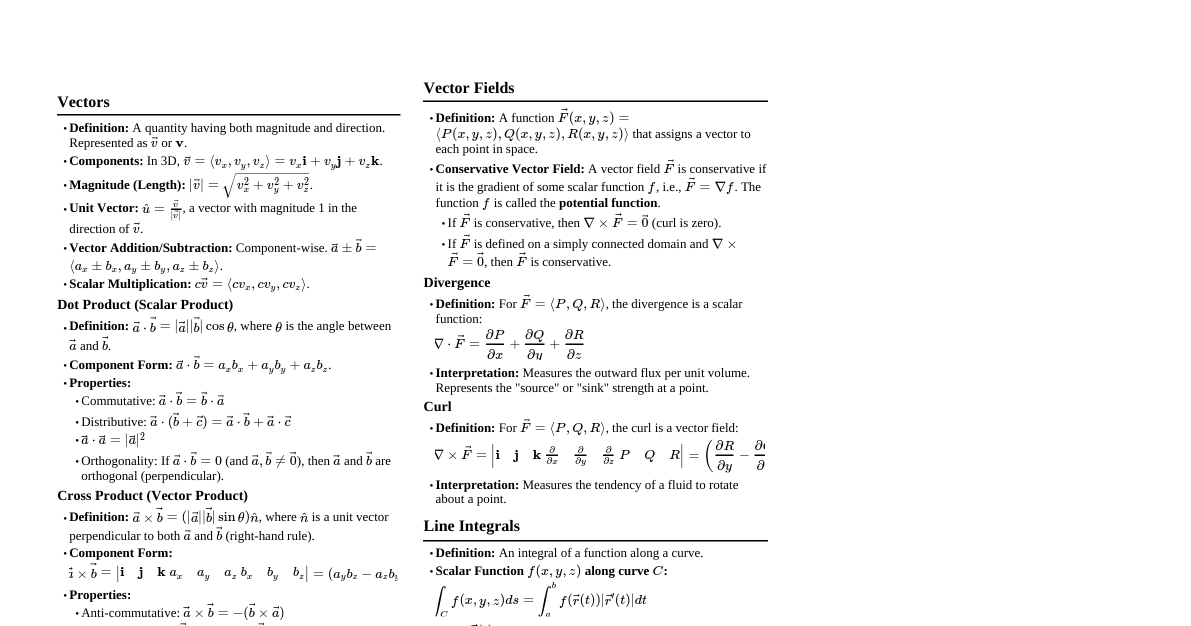
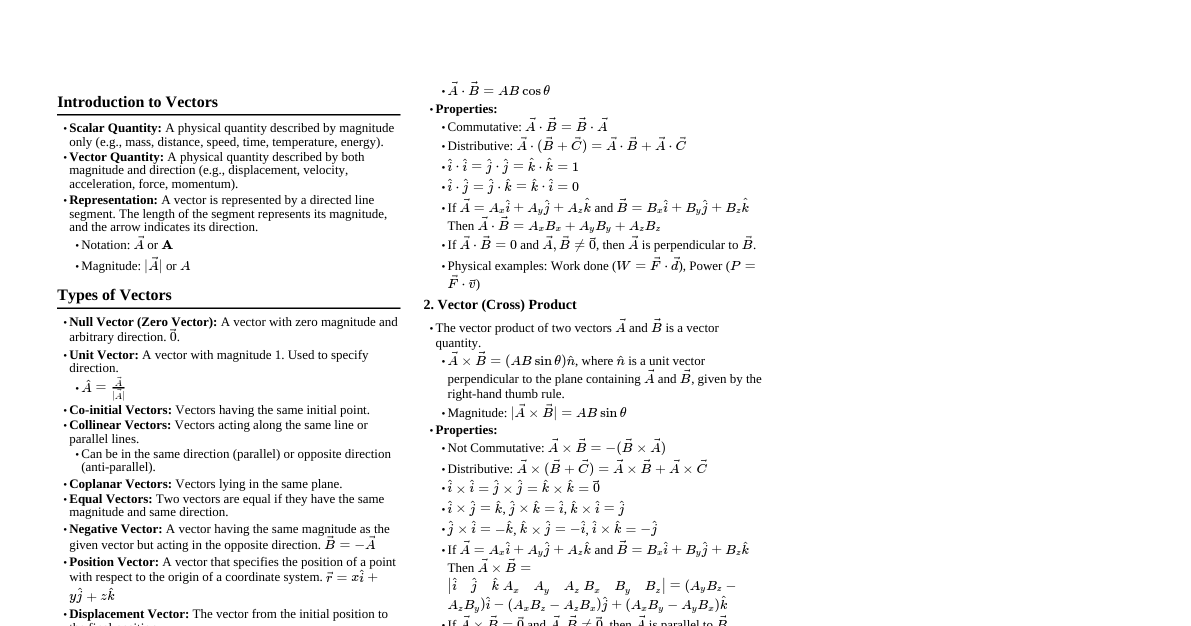
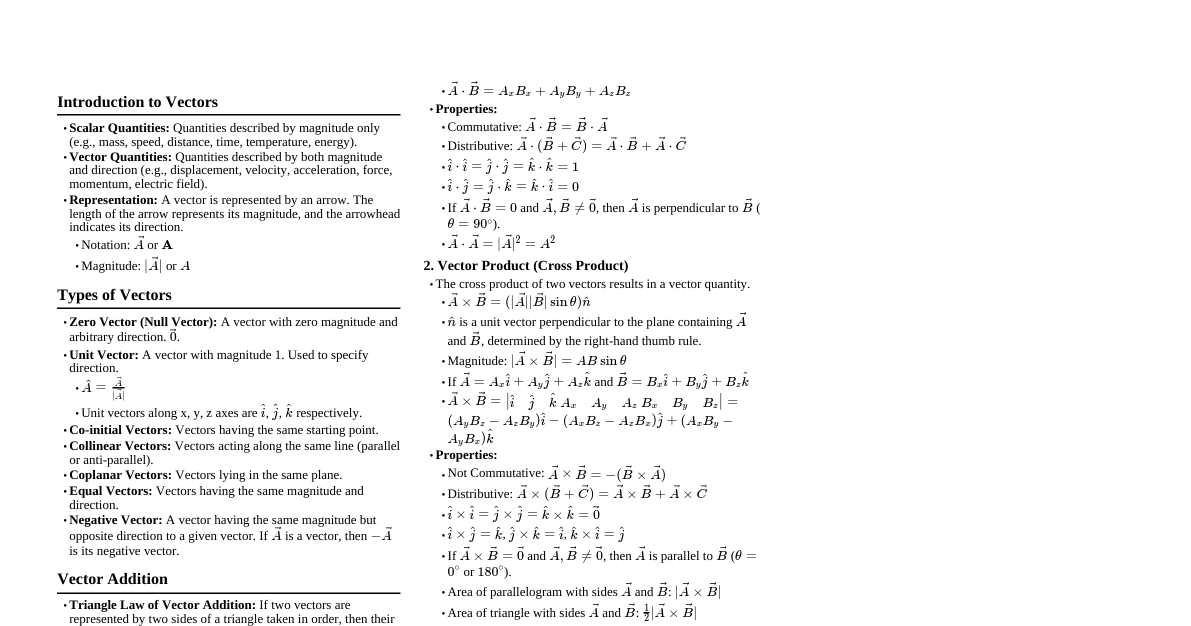
1. Vectors 1.1 Basic Concepts Scalar: Quantity with magnitude only (e.g., mass, length). Vector: Quantity with magnitude and direction (e.g., displacement, force). Representation: $\vec{a}$ or $\mathbf{a}$. Magnitude is $|\vec{a}|$. Position Vector: $\vec{OP}$ of point $P(x,y,z)$ is $x\hat{i} + y\hat{j} + z\hat{k}$. Direction Cosines (DCs): If $\vec{r} = x\hat{i} + y\hat{j} + z\hat{k}$, then $\cos\alpha = l = \frac{x}{|\vec{r}|}$, $\cos\beta = m = \frac{y}{|\vec{r}|}$, $\cos\gamma = n = \frac{z}{|\vec{r}|}$. $l^2 + m^2 + n^2 = 1$. Direction Ratios (DRs): Any numbers proportional to DCs $(a, b, c)$. If $(a,b,c)$ are DRs, then $l = \frac{a}{\sqrt{a^2+b^2+c^2}}$, $m = \frac{b}{\sqrt{a^2+b^2+c^2}}$, $n = \frac{c}{\sqrt{a^2+b^2+c^2}}$. 1.2 Types of Vectors Zero Vector: $\vec{0}$, magnitude 0. Unit Vector: $\hat{a} = \frac{\vec{a}}{|\vec{a}|}$, magnitude 1. Co-initial Vectors: Same initial point. Collinear Vectors: Parallel to the same line. $\vec{a} = \lambda\vec{b}$. Equal Vectors: Same magnitude and direction. Negative of a Vector: $-\vec{a}$, same magnitude, opposite direction. 1.3 Vector Operations Addition (Triangle Law): $\vec{a} + \vec{b}$. If $\vec{a} = a_1\hat{i}+a_2\hat{j}+a_3\hat{k}$ and $\vec{b} = b_1\hat{i}+b_2\hat{j}+b_3\hat{k}$, then $\vec{a}+\vec{b} = (a_1+b_1)\hat{i} + (a_2+b_2)\hat{j} + (a_3+b_3)\hat{k}$. Subtraction: $\vec{a} - \vec{b} = \vec{a} + (-\vec{b})$. Scalar Multiplication: $k\vec{a} = (ka_1)\hat{i} + (ka_2)\hat{j} + (ka_3)\hat{k}$. Vector joining two points: If $P_1(x_1, y_1, z_1)$ and $P_2(x_2, y_2, z_2)$, then $\vec{P_1P_2} = (x_2-x_1)\hat{i} + (y_2-y_1)\hat{j} + (z_2-z_1)\hat{k}$. 1.4 Scalar (Dot) Product $\vec{a} \cdot \vec{b} = |\vec{a}||\vec{b}|\cos\theta$, where $\theta$ is the angle between them. If $\vec{a} = a_1\hat{i}+a_2\hat{j}+a_3\hat{k}$ and $\vec{b} = b_1\hat{i}+b_2\hat{j}+b_3\hat{k}$, then $\vec{a} \cdot \vec{b} = a_1b_1 + a_2b_2 + a_3b_3$. $\vec{a} \cdot \vec{a} = |\vec{a}|^2$. If $\vec{a} \perp \vec{b}$, then $\vec{a} \cdot \vec{b} = 0$. $\hat{i} \cdot \hat{i} = \hat{j} \cdot \hat{j} = \hat{k} \cdot \hat{k} = 1$. $\hat{i} \cdot \hat{j} = \hat{j} \cdot \hat{k} = \hat{k} \cdot \hat{i} = 0$. Projection of $\vec{a}$ on $\vec{b}$: $\frac{\vec{a} \cdot \vec{b}}{|\vec{b}|}$. Projection of $\vec{b}$ on $\vec{a}$: $\frac{\vec{a} \cdot \vec{b}}{|\vec{a}|}$. Angle between two vectors: $\cos\theta = \frac{\vec{a} \cdot \vec{b}}{|\vec{a}||\vec{b}|}$. 1.5 Vector (Cross) Product $\vec{a} \times \vec{b} = |\vec{a}||\vec{b}|\sin\theta \hat{n}$, where $\hat{n}$ is a unit vector perpendicular to the plane containing $\vec{a}$ and $\vec{b}$. Direction of $\hat{n}$ is given by the right-hand thumb rule. $\vec{a} \times \vec{b} = -( \vec{b} \times \vec{a})$. If $\vec{a} \parallel \vec{b}$, then $\vec{a} \times \vec{b} = \vec{0}$. $\hat{i} \times \hat{i} = \hat{j} \times \hat{j} = \hat{k} \times \hat{k} = \vec{0}$. $\hat{i} \times \hat{j} = \hat{k}$, $\hat{j} \times \hat{k} = \hat{i}$, $\hat{k} \times \hat{i} = \hat{j}$. $\vec{a} \times \vec{b} = \begin{vmatrix} \hat{i} & \hat{j} & \hat{k} \\ a_1 & a_2 & a_3 \\ b_1 & b_2 & b_3 \end{vmatrix}$. Area of Parallelogram: $|\vec{a} \times \vec{b}|$. Area of Triangle: $\frac{1}{2} |\vec{a} \times \vec{b}|$. Area of Triangle with vertices $A, B, C$: $\frac{1}{2} |\vec{AB} \times \vec{AC}|$. 1.6 Scalar Triple Product $(\vec{a} \times \vec{b}) \cdot \vec{c}$ or $[\vec{a} \ \vec{b} \ \vec{c}]$. $[\vec{a} \ \vec{b} \ \vec{c}] = \begin{vmatrix} a_1 & a_2 & a_3 \\ b_1 & b_2 & b_3 \\ c_1 & c_2 & c_3 \end{vmatrix}$. Volume of Parallelepiped: $|(\vec{a} \times \vec{b}) \cdot \vec{c}|$. Volume of Tetrahedron: $\frac{1}{6} |(\vec{a} \times \vec{b}) \cdot \vec{c}|$. If $[\vec{a} \ \vec{b} \ \vec{c}] = 0$, the vectors are coplanar. 2. Three Dimensional Geometry 2.1 Direction Cosines and Direction Ratios Direction Cosines (DCs) of a line: $l, m, n$. $l^2+m^2+n^2=1$. Direction Ratios (DRs) of a line: Any three numbers $a, b, c$ proportional to $l, m, n$. DRs of a line joining $P_1(x_1, y_1, z_1)$ and $P_2(x_2, y_2, z_2)$: $(x_2-x_1, y_2-y_1, z_2-z_1)$. Angle between two lines: If $(l_1, m_1, n_1)$ and $(l_2, m_2, n_2)$ are DCs: $\cos\theta = l_1l_2 + m_1m_2 + n_1n_2$. If $(a_1, b_1, c_1)$ and $(a_2, b_2, c_2)$ are DRs: $\cos\theta = \frac{a_1a_2 + b_1b_2 + c_1c_2}{\sqrt{a_1^2+b_1^2+c_1^2}\sqrt{a_2^2+b_2^2+c_2^2}}$. Perpendicular lines: $l_1l_2 + m_1m_2 + n_1n_2 = 0$ or $a_1a_2 + b_1b_2 + c_1c_2 = 0$. Parallel lines: $l_1 = l_2, m_1 = m_2, n_1 = n_2$ or $\frac{a_1}{a_2} = \frac{b_1}{b_2} = \frac{c_1}{c_2}$. 2.2 Line in Space Equation of a line passing through a point $\vec{a}$ and parallel to $\vec{b}$: Vector form: $\vec{r} = \vec{a} + \lambda\vec{b}$. Cartesian form: $\frac{x-x_1}{a} = \frac{y-y_1}{b} = \frac{z-z_1}{c}$, where $(x_1, y_1, z_1)$ is the point and $(a,b,c)$ are DRs of $\vec{b}$. Equation of a line passing through two points $\vec{a}$ and $\vec{b}$: Vector form: $\vec{r} = \vec{a} + \lambda(\vec{b}-\vec{a})$. Cartesian form: $\frac{x-x_1}{x_2-x_1} = \frac{y-y_1}{y_2-y_1} = \frac{z-z_1}{z_2-z_1}$. Shortest distance between two skew lines: Vector form: $\frac{|(\vec{b_2}-\vec{b_1}) \cdot (\vec{a_1} \times \vec{a_2})|}{|\vec{a_1} \times \vec{a_2}|}$, where lines are $\vec{r} = \vec{b_1} + \lambda\vec{a_1}$ and $\vec{r} = \vec{b_2} + \mu\vec{a_2}$. If lines are parallel: $\frac{|(\vec{b_2}-\vec{b_1}) \times \vec{a}|}{|\vec{a}|}$, where lines are $\vec{r} = \vec{b_1} + \lambda\vec{a}$ and $\vec{r} = \vec{b_2} + \mu\vec{a}$. 2.3 Plane in Space Equation of a plane in normal form: Vector form: $\vec{r} \cdot \hat{n} = d$, where $d$ is perpendicular distance from origin. Cartesian form: $lx+my+nz=d$. Equation of a plane perpendicular to a given vector $\vec{n}$ and passing through a given point $\vec{a}$: Vector form: $(\vec{r}-\vec{a}) \cdot \vec{n} = 0$. Cartesian form: $A(x-x_1) + B(y-y_1) + C(z-z_1) = 0$, where $(A,B,C)$ are DRs of $\vec{n}$. Equation of a plane passing through three non-collinear points $A(\vec{a}), B(\vec{b}), C(\vec{c})$: Vector form: $(\vec{r}-\vec{a}) \cdot [(\vec{b}-\vec{a}) \times (\vec{c}-\vec{a})] = 0$. Cartesian form: $\begin{vmatrix} x-x_1 & y-y_1 & z-z_1 \\ x_2-x_1 & y_2-y_1 & z_2-z_1 \\ x_3-x_1 & y_3-y_1 & z_3-z_1 \end{vmatrix} = 0$. Equation of a plane in intercept form: $\frac{x}{a} + \frac{y}{b} + \frac{z}{c} = 1$. Angle between two planes: Vector form: $\cos\theta = \frac{|\vec{n_1} \cdot \vec{n_2}|}{|\vec{n_1}||\vec{n_2}|}$, where $\vec{n_1}, \vec{n_2}$ are normal vectors. Cartesian form: $\cos\theta = \frac{|A_1A_2 + B_1B_2 + C_1C_2|}{\sqrt{A_1^2+B_1^2+C_1^2}\sqrt{A_2^2+B_2^2+C_2^2}}$. Angle between a line and a plane: Vector form: $\sin\phi = \frac{|\vec{b} \cdot \vec{n}|}{|\vec{b}||\vec{n}|}$, where $\vec{b}$ is direction vector of line and $\vec{n}$ is normal to plane. Cartesian form: $\sin\phi = \frac{|Aa+Bb+Cc|}{\sqrt{A^2+B^2+C^2}\sqrt{a^2+b^2+c^2}}$. Distance of a point $P(x_1, y_1, z_1)$ from a plane $Ax+By+Cz+D=0$: $D = \frac{|Ax_1+By_1+Cz_1+D|}{\sqrt{A^2+B^2+C^2}}$. 2.4 Coplanarity of Two Lines Two lines $\vec{r} = \vec{a_1} + \lambda\vec{b_1}$ and $\vec{r} = \vec{a_2} + \mu\vec{b_2}$ are coplanar if $(\vec{a_2}-\vec{a_1}) \cdot (\vec{b_1} \times \vec{b_2}) = 0$. In Cartesian form, for lines $\frac{x-x_1}{a_1} = \frac{y-y_1}{b_1} = \frac{z-z_1}{c_1}$ and $\frac{x-x_2}{a_2} = \frac{y-y_2}{b_2} = \frac{z-z_2}{c_2}$: $\begin{vmatrix} x_2-x_1 & y_2-y_1 & z_2-z_1 \\ a_1 & b_1 & c_1 \\ a_2 & b_2 & c_2 \end{vmatrix} = 0$. 2.5 Equation of a Plane Passing Through the Intersection of Two Planes Vector form: $\vec{r} \cdot (\vec{n_1} + \lambda\vec{n_2}) = d_1 + \lambda d_2$. Cartesian form: $(A_1x+B_1y+C_1z-D_1) + \lambda(A_2x+B_2y+C_2z-D_2) = 0$.