Geometry Essentials (JEE)
Cheatsheet Content
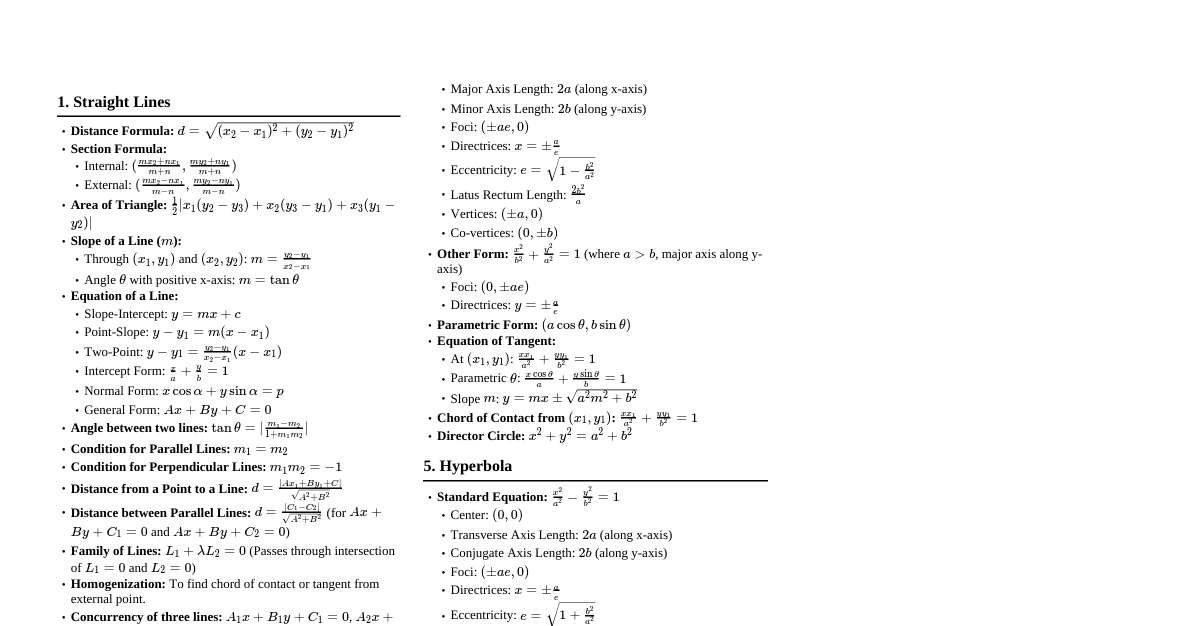
1. Straight Lines 1.1 Basic Concepts Distance Formula: Between $(x_1, y_1)$ and $(x_2, y_2)$ is $\sqrt{(x_2-x_1)^2 + (y_2-y_1)^2}$. Section Formula: Divides line segment joining $(x_1, y_1)$ and $(x_2, y_2)$ in ratio $m:n$. Internally: $\left(\frac{mx_2+nx_1}{m+n}, \frac{my_2+ny_1}{m+n}\right)$ Externally: $\left(\frac{mx_2-nx_1}{m-n}, \frac{my_2-ny_1}{m-n}\right)$ Mid-point Formula: $\left(\frac{x_1+x_2}{2}, \frac{y_1+y_2}{2}\right)$ Area of Triangle: Vertices $(x_1, y_1), (x_2, y_2), (x_3, y_3)$ is $\frac{1}{2}|x_1(y_2-y_3) + x_2(y_3-y_1) + x_3(y_1-y_2)|$. Collinearity: Three points are collinear if area of triangle formed by them is 0, or slope between any two pairs is equal. 1.2 Equation of a Straight Line Slope ($m$): $\frac{y_2-y_1}{x_2-x_1} = \tan\theta$ Forms: Slope-intercept: $y = mx + c$ Point-slope: $y - y_1 = m(x - x_1)$ Two-point: $y - y_1 = \frac{y_2-y_1}{x_2-x_1}(x - x_1)$ Intercept: $\frac{x}{a} + \frac{y}{b} = 1$ Normal: $x\cos\alpha + y\sin\alpha = p$ General: $Ax + By + C = 0$ 1.3 Angles, Distances, and Relationships Angle between two lines: $m_1, m_2$ are slopes. $\tan\theta = \left|\frac{m_1-m_2}{1+m_1m_2}\right|$ Parallel Lines: $m_1 = m_2$ Perpendicular Lines: $m_1m_2 = -1$ Distance from a point $(x_1, y_1)$ to line $Ax+By+C=0$: $d = \frac{|Ax_1+By_1+C|}{\sqrt{A^2+B^2}}$ Distance between two parallel lines $Ax+By+C_1=0$ and $Ax+By+C_2=0$: $d = \frac{|C_1-C_2|}{\sqrt{A^2+B^2}}$ Equation of line parallel to $Ax+By+C=0$: $Ax+By+k=0$ Equation of line perpendicular to $Ax+By+C=0$: $Bx-Ay+k=0$ Concurrent Lines: Three lines are concurrent if they intersect at a single point. Determinant of coefficients must be zero: $\begin{vmatrix} A_1 & B_1 & C_1 \\ A_2 & B_2 & C_2 \\ A_3 & B_3 & C_3 \end{vmatrix} = 0$ 1.4 Pair of Straight Lines Homogeneous Equation of 2nd Degree: $ax^2 + 2hxy + by^2 = 0$ represents two lines passing through the origin. Angle $\theta$ between them: $\tan\theta = \frac{2\sqrt{h^2-ab}}{a+b}$ If $h^2 > ab$: real distinct lines If $h^2 = ab$: coincident lines If $h^2 Perpendicular if $a+b=0$ Coincident if $h^2=ab$ General Equation of 2nd Degree: $ax^2 + 2hxy + by^2 + 2gx + 2fy + c = 0$ represents a pair of straight lines if $\Delta = abc + 2fgh - af^2 - bg^2 - ch^2 = 0$ (or $\begin{vmatrix} a & h & g \\ h & b & f \\ g & f & c \end{vmatrix} = 0$). Intersection Point: Solve $\frac{\partial F}{\partial x} = 0$ and $\frac{\partial F}{\partial y} = 0$. Angle between lines: $\tan\theta = \frac{2\sqrt{h^2-ab}}{a+b}$ (same as homogeneous equation). 2. Circles 2.1 Basic Equations Standard Form: $(x-h)^2 + (y-k)^2 = r^2$ (center $(h,k)$, radius $r$) General Form: $x^2 + y^2 + 2gx + 2fy + c = 0$ Center: $(-g, -f)$ Radius: $\sqrt{g^2+f^2-c}$ Condition for real circle: $g^2+f^2-c > 0$ Diameter Form: $(x-x_1)(x-x_2) + (y-y_1)(y-y_2) = 0$ (endpoints $(x_1, y_1), (x_2, y_2)$) 2.2 Tangents and Normals Equation of Tangent to $x^2+y^2=r^2$ at $(x_1, y_1)$: $xx_1 + yy_1 = r^2$ Equation of Tangent to $x^2+y^2+2gx+2fy+c=0$ at $(x_1, y_1)$: $xx_1 + yy_1 + g(x+x_1) + f(y+y_1) + c = 0$ Tangent in Slope Form to $x^2+y^2=r^2$: $y = mx \pm r\sqrt{1+m^2}$ Length of Tangent from $(x_1, y_1)$ to $x^2+y^2+2gx+2fy+c=0$: $\sqrt{x_1^2+y_1^2+2gx_1+2fy_1+c}$ (denoted as $\sqrt{S_1}$) Equation of Chord of Contact: $T=0$ (same as tangent equation, but for external point) Equation of Normal: Line passing through center and point of tangency. 2.3 Chord and Power of a Point Equation of Chord with Midpoint $(x_1, y_1)$: $T=S_1$ Power of a Point $(x_1, y_1)$ w.r.t Circle $S=0$: $S_1 = x_1^2+y_1^2+2gx_1+2fy_1+c$ Radical Axis of two circles $S_1=0, S_2=0$: $S_1 - S_2 = 0$. Perpendicular to line joining centers. Radical Centre: Intersection of radical axes of three circles. 2.4 Common Tangents to Two Circles Direct Common Tangents: Intersect at external center of similitude. Transverse Common Tangents: Intersect at internal center of similitude. Number of common tangents depends on relative positions of circles. $d > r_1+r_2$: 4 common tangents $d = r_1+r_2$: 3 common tangents (touch externally) $|r_1-r_2| $d = |r_1-r_2|$: 1 common tangent (touch internally) $d 3. Parabola 3.1 Basic Definitions and Equations Definition: Locus of a point equidistant from a fixed point (focus) and a fixed line (directrix). Standard Equation: $y^2 = 4ax$ Focus: $(a, 0)$ Directrix: $x = -a$ Vertex: $(0, 0)$ Axis: $y = 0$ (x-axis) Latus Rectum Length: $4a$ Other Forms: $y^2 = -4ax$: Focus $(-a, 0)$, Directrix $x=a$ $x^2 = 4ay$: Focus $(0, a)$, Directrix $y=-a$ $x^2 = -4ay$: Focus $(0, -a)$, Directrix $y=a$ Parametric Equations for $y^2=4ax$: $(at^2, 2at)$ V(0,0) F(a,0) x=-a 3.2 Tangents and Normals Tangent to $y^2=4ax$ at $(x_1, y_1)$: $yy_1 = 2a(x+x_1)$ Tangent in Slope Form: $y = mx + \frac{a}{m}$ Tangent in Parametric Form: $yt = x + at^2$ Normal to $y^2=4ax$ at $(x_1, y_1)$: $y-y_1 = -\frac{y_1}{2a}(x-x_1)$ Normal in Slope Form: $y = mx - 2am - am^3$ Normal in Parametric Form: $y+tx=2at+at^3$ 3.3 Chord and Properties Equation of Chord of Contact: $T=0$ Equation of Chord with Midpoint $(x_1, y_1)$: $T=S_1$ Focal Chord: A chord passing through the focus. Properties: Tangent at vertex is perpendicular to axis. Subtangent is bisected at the vertex. Reflection property: Light ray parallel to axis reflects through focus. 4. Properties of Triangle 4.1 Centers of a Triangle Centroid (G): Intersection of medians. Divides median in ratio $2:1$. Coordinates: $\left(\frac{x_1+x_2+x_3}{3}, \frac{y_1+y_2+y_3}{3}\right)$ Incenter (I): Intersection of angle bisectors. Equidistant from sides. Coordinates: $\left(\frac{ax_1+bx_2+cx_3}{a+b+c}, \frac{ay_1+by_2+cy_3}{a+b+c}\right)$ (where $a,b,c$ are side lengths opposite to vertices $A,B,C$) Radius of incircle ($r$): $\frac{\text{Area}}{s}$ (s is semi-perimeter) Circumcenter (O): Intersection of perpendicular bisectors of sides. Equidistant from vertices. Coordinates: Intersection of $x^2+y^2+2gx+2fy+c=0$ with vertices. Radius of circumcircle ($R$): $\frac{abc}{4 \cdot \text{Area}}$ Orthocenter (H): Intersection of altitudes. Coordinates: Use slopes of altitudes. Excenters ($I_A, I_B, I_C$): Intersection of one internal and two external angle bisectors. $I_A$: $\left(\frac{-ax_1+bx_2+cx_3}{-a+b+c}, \frac{-ay_1+by_2+cy_3}{-a+b+c}\right)$ Exradius ($r_a$): $\frac{\text{Area}}{s-a}$ Euler Line: For any non-equilateral triangle, the Orthocenter (H), Centroid (G), and Circumcenter (O) are collinear. G lies between H and O, and $HG:GO = 2:1$. 4.2 Important Theorems and Formulas Sine Rule: $\frac{a}{\sin A} = \frac{b}{\sin B} = \frac{c}{\sin C} = 2R$ Cosine Rule: $a^2 = b^2+c^2-2bc\cos A$ Projection Rule: $a = b\cos C + c\cos B$ Area of Triangle: $\frac{1}{2}bc\sin A$ $\sqrt{s(s-a)(s-b)(s-c)}$ (Heron's Formula) $\frac{abc}{4R}$ $rs$ Apollonius Theorem: In $\triangle ABC$, if $AD$ is a median to $BC$, then $AB^2+AC^2 = 2(AD^2+BD^2)$. 4.3 Advanced Theorems in Triangle Geometry Menelaus' Theorem: For a triangle $ABC$ and a transversal line that intersects lines $AB, BC, CA$ at points $D, E, F$ respectively, then $\frac{AD}{DB} \cdot \frac{BE}{EC} \cdot \frac{CF}{FA} = 1$. The points $D,E,F$ are on the lines $AB, BC, CA$ respectively, and the ratios are signed. Ceva's Theorem: For a triangle $ABC$ and points $D, E, F$ on lines $BC, CA, AB$ respectively, the cevians $AD, BE, CF$ are concurrent if and only if $\frac{BD}{DC} \cdot \frac{CE}{EA} \cdot \frac{AF}{FB} = 1$. The ratios are signed. Ptolemy's Theorem: For a cyclic quadrilateral $ABCD$, the sum of the products of the lengths of opposite sides is equal to the product of the lengths of the diagonals. $AB \cdot CD + BC \cdot DA = AC \cdot BD$. Stewart's Theorem: In a triangle $ABC$, if $D$ is a point on $BC$, let $AD = d$, $BD = m$, $CD = n$. Then $b^2m + c^2n = a(d^2 + mn)$. Cauchy-Schwarz Inequality (for vectors/coordinates): For real numbers $x_1, \dots, x_n$ and $y_1, \dots, y_n$, $(\sum_{i=1}^n x_iy_i)^2 \le (\sum_{i=1}^n x_i^2)(\sum_{i=1}^n y_i^2)$. In 2D geometry, for vectors $\vec{u}=(u_1, u_2)$ and $\vec{v}=(v_1, v_2)$, $|\vec{u} \cdot \vec{v}| \le ||\vec{u}|| \cdot ||\vec{v}||$, i.e., $|u_1v_1+u_2v_2| \le \sqrt{u_1^2+u_2^2}\sqrt{v_1^2+v_2^2}$. Descartes' Theorem (Four Circles Theorem): If four circles are mutually tangent, then $(k_1+k_2+k_3+k_4)^2 = 2(k_1^2+k_2^2+k_3^2+k_4^2)$, where $k_i = \pm 1/r_i$ are the curvatures (reciprocal of radii). A negative sign indicates tangency from the outside.