Organic Named Reactions (NCERT
Cheatsheet Content
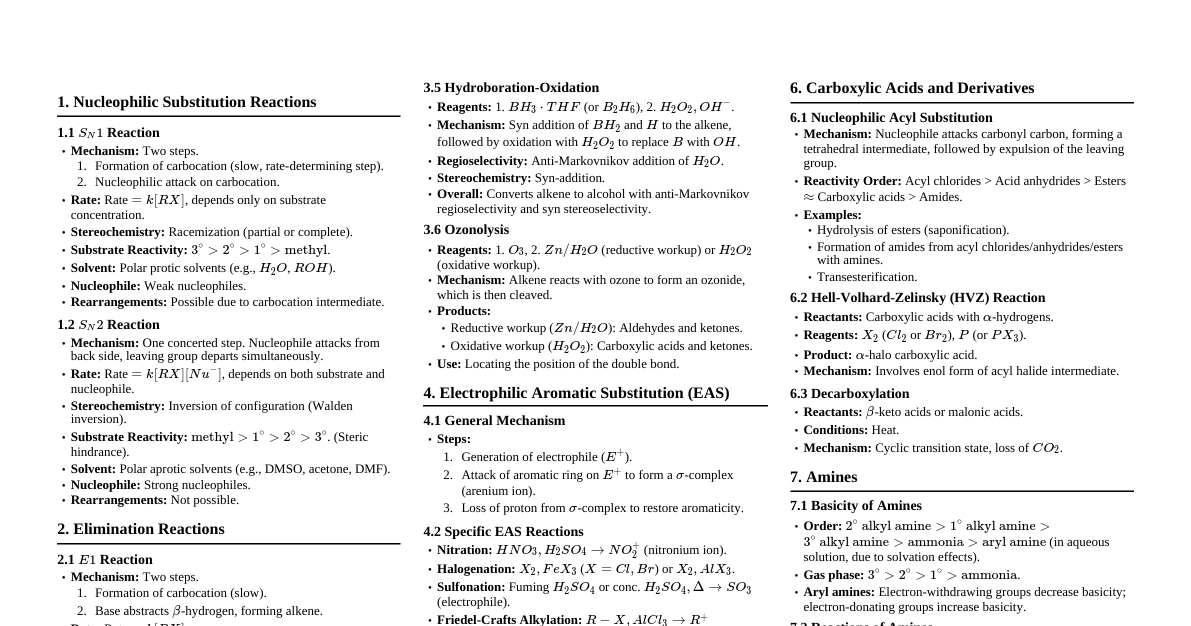
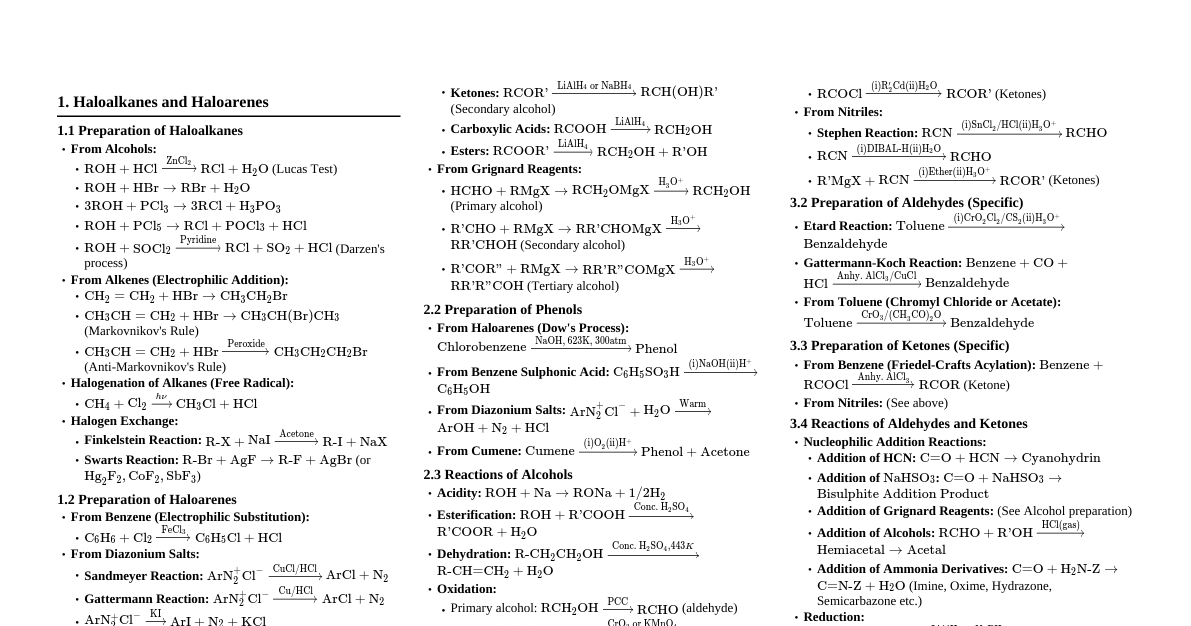
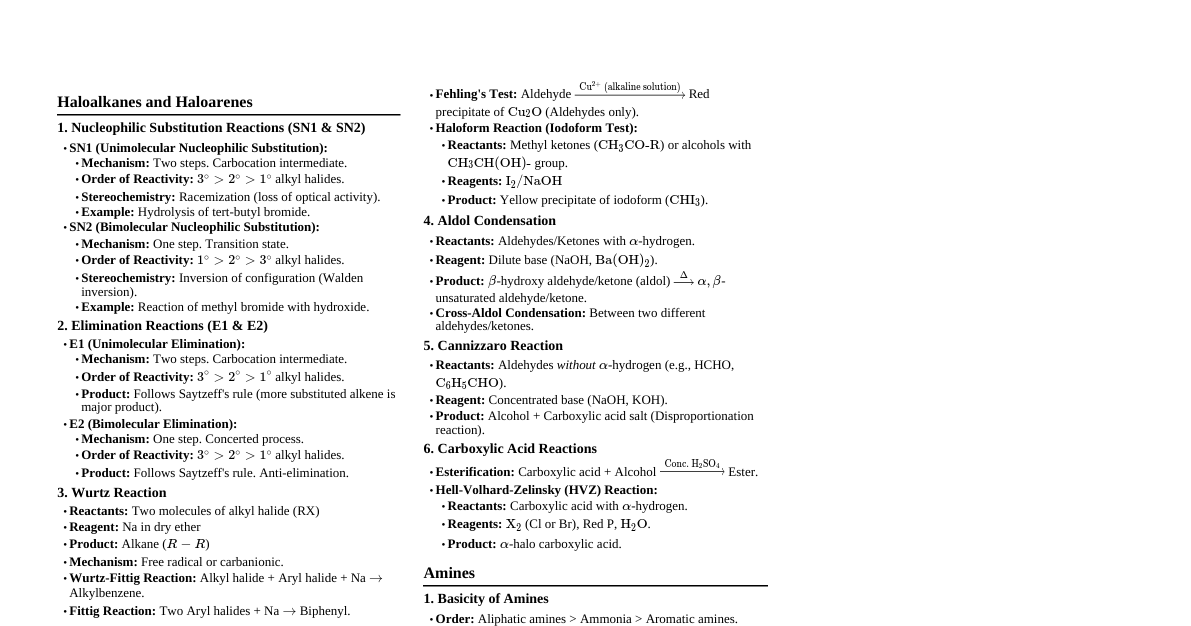
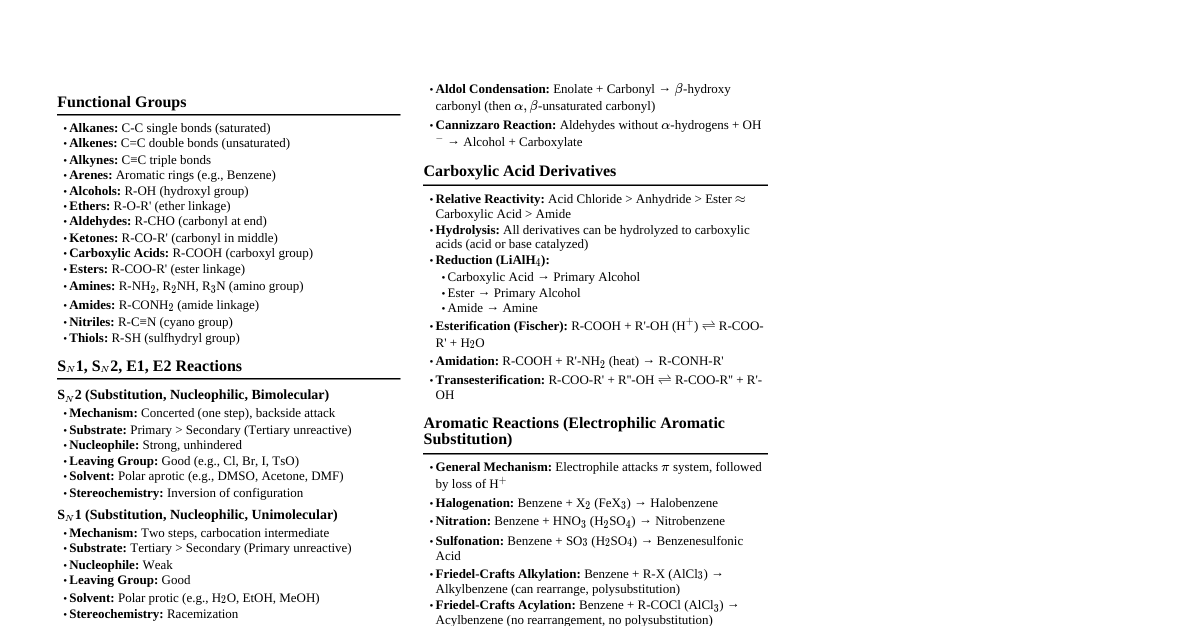
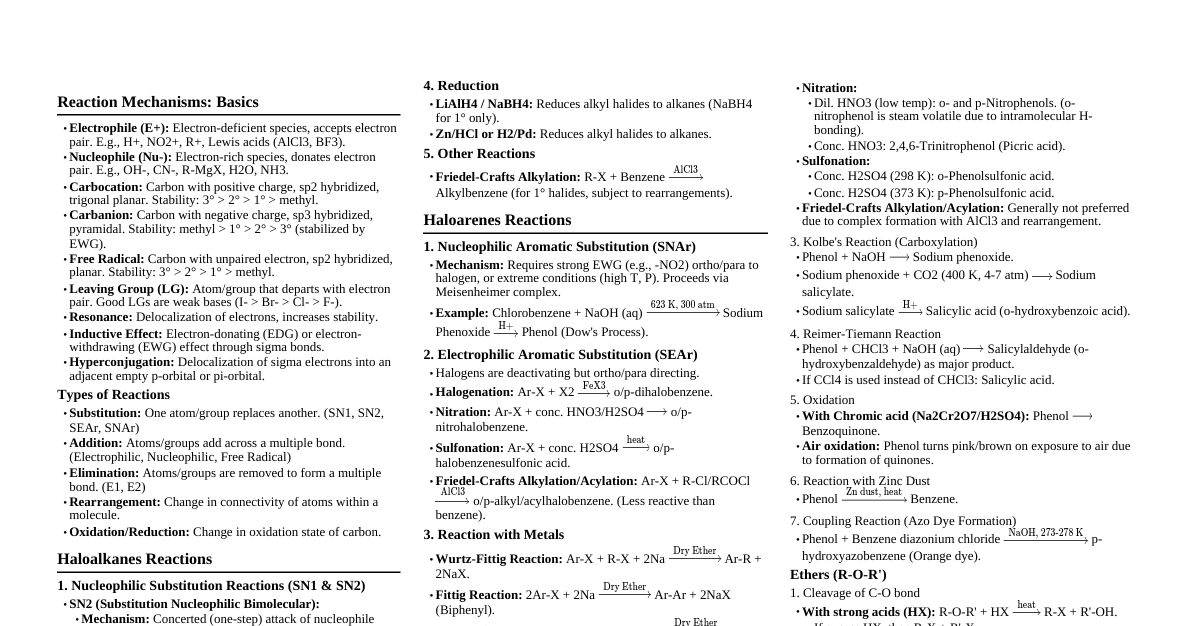
### Aldol Condensation - **Reaction:** Aldehydes or ketones containing at least one $\alpha$-hydrogen atom undergo a condensation reaction in the presence of a dilute base to form $\beta$-hydroxy aldehydes (aldols) or $\beta$-hydroxy ketones (ketols), respectively. Upon heating, these aldols/ketols readily lose a molecule of water to form $\alpha, \beta$-unsaturated carbonyl compounds. - **Example:** ``` CH3CHO + CH3CHO --(dil. NaOH)--> CH3CH(OH)CH2CHO --(Δ, -H2O)--> CH3CH=CHCHO (Acetaldehyde) (3-Hydroxybutanal) (But-2-enal) ``` ### Cannizzaro Reaction - **Reaction:** Aldehydes which do not have an $\alpha$-hydrogen atom undergo disproportionation reaction (self-oxidation and reduction) in the presence of concentrated alkali. One molecule of the aldehyde is reduced to an alcohol, and another is oxidized to a carboxylic acid salt. - **Example:** ``` 2HCHO --(conc. KOH)--> CH3OH + HCOOK (Formaldehyde) (Methanol) (Potassium formate) ``` ### Carbylamine Reaction (Isocyanide Test) - **Reaction:** Primary amines, when heated with chloroform and alcoholic potassium hydroxide, form isocyanides (carbylamines) which have a very offensive smell. Secondary and tertiary amines do not give this reaction. - **Example:** ``` R-NH2 + CHCl3 + 3KOH(alc) --(Δ)--> R-NC + 3KCl + 3H2O (Primary amine) (Alkyl isocyanide) ``` ### Clemmensen Reduction - **Reaction:** The carbonyl group of aldehydes and ketones is reduced to a methylene group ($>$C=O to $>$CH2) on treatment with zinc amalgam and concentrated hydrochloric acid. - **Example:** ``` R-CO-R' + Zn(Hg)/conc. HCl --> R-CH2-R' + H2O (Ketone/Aldehyde) ``` ### Diazotisation - **Reaction:** Aromatic primary amines react with nitrous acid (prepared in situ from NaNO2 and HCl) at low temperatures (0-5°C) to form arenediazonium salts. - **Example:** ``` Ar-NH2 + NaNO2 + 2HCl --(0-5°C)--> Ar-N2+Cl- + NaCl + 2H2O (Aniline) (Benzenediazonium chloride) ``` ### Etard Reaction - **Reaction:** Methyl group of toluene is oxidized to a chromyl acetate complex by chromyl chloride (CrO2Cl2), which upon hydrolysis gives benzaldehyde. - **Example:** ``` C6H5-CH3 --(CrO2Cl2 / CS2)--> Intermediate Complex --(H3O+)--> C6H5-CHO (Toluene) (Benzaldehyde) ``` ### Finkelstein Reaction - **Reaction:** Alkyl chlorides or bromides react with sodium iodide in dry acetone to produce alkyl iodides. This reaction is favored by the precipitation of NaCl or NaBr in dry acetone. - **Example:** ``` R-X + NaI --(dry acetone)--> R-I + NaX (X = Cl, Br) (Alkyl halide) ``` ### Friedel-Crafts Acylation - **Reaction:** Benzene and its derivatives react with an acyl halide or acid anhydride in the presence of a Lewis acid (e.g., anhydrous AlCl3) to form acylbenzenes (ketones). - **Example:** ``` C6H6 + CH3COCl --(anhyd. AlCl3)--> C6H5COCH3 + HCl (Benzene) (Acetyl chloride) (Acetophenone) ``` ### Friedel-Crafts Alkylation - **Reaction:** Benzene and its derivatives react with an alkyl halide in the presence of a Lewis acid (e.g., anhydrous AlCl3) to form alkylbenzenes. - **Example:** ``` C6H6 + CH3Cl --(anhyd. AlCl3)--> C6H5CH3 + HCl (Benzene) (Chloromethane) (Toluene) ``` ### Gattermann Reaction - **Reaction:** Arenediazonium salts react with copper powder and the corresponding halogen acid (HCl or HBr) to yield aryl halides. This is a modification of the Sandmeyer reaction. - **Example:** ``` Ar-N2+Cl- --(Cu/HCl)--> Ar-Cl + N2 (Benzenediazonium chloride) ``` ### Gattermann-Koch Reaction - **Reaction:** Benzene or its derivatives are treated with carbon monoxide and hydrogen chloride in the presence of anhydrous aluminium chloride and a small amount of cuprous chloride to form benzaldehyde. - **Example:** ``` C6H6 + CO + HCl --(anhyd. AlCl3/CuCl)--> C6H5CHO (Benzene) (Benzaldehyde) ``` ### Hell-Volhard-Zelinsky (HVZ) Reaction - **Reaction:** Carboxylic acids having an $\alpha$-hydrogen atom react with chlorine or bromine in the presence of a small amount of red phosphorus to give $\alpha$-halo carboxylic acids. - **Example:** ``` R-CH2-COOH --(X2/Red P)--> R-CH(X)-COOH (Carboxylic acid) ($\alpha$-Halo carboxylic acid) ``` ### Hoffmann Bromamide Degradation - **Reaction:** An amide is treated with bromine in an aqueous or alcoholic solution of sodium hydroxide to form a primary amine with one carbon atom less than the parent amide. - **Example:** ``` R-CO-NH2 + Br2 + 4NaOH --> R-NH2 + Na2CO3 + 2NaBr + 2H2O (Amide) (Primary amine) ``` ### Kolbe's Reaction (Kolbe-Schmitt Reaction) - **Reaction:** Phenol reacts with carbon dioxide in the presence of sodium hydroxide at high temperature and pressure to form salicylic acid (o-hydroxybenzoic acid). This is an electrophilic aromatic substitution. - **Example:** ``` Phenol --(i) NaOH, (ii) CO2, 4-7 atm, 398K, (iii) H3O+--> Salicylic Acid ``` ### Reimer-Tiemann Reaction - **Reaction:** Phenol reacts with chloroform in the presence of aqueous sodium hydroxide to form o-hydroxybenzaldehyde (salicylaldehyde) as the major product. An intermediate dichlorocarbene is involved. - **Example:** ``` Phenol + CHCl3 + aq. NaOH --(Δ)--> o-Hydroxybenzaldehyde ``` ### Rosenmund Reduction - **Reaction:** Acyl chlorides are hydrogenated over palladium on barium sulfate (partially poisoned with sulfur or quinoline) to form aldehydes. Barium sulfate reduces the activity of the catalyst, preventing further reduction of the aldehyde to alcohol. - **Example:** ``` R-COCl + H2 --(Pd/BaSO4)--> R-CHO + HCl (Acyl chloride) (Aldehyde) ``` ### Sandmeyer Reaction - **Reaction:** Arenediazonium salts react with cuprous chloride, cuprous bromide, or cuprous cyanide in the corresponding halogen acid or KCN to yield aryl halides or aryl cyanides. - **Example:** ``` Ar-N2+Cl- --(CuCl/HCl)--> Ar-Cl + N2 (Benzenediazonium chloride) ``` ### Saponification - **Reaction:** Esters react with sodium hydroxide (or other strong bases) to form alcohol and the sodium salt of the carboxylic acid (soap). This is essentially the hydrolysis of an ester under basic conditions. - **Example:** ``` R-COOR' + NaOH --(Δ)--> R-COONa + R'-OH (Ester) (Sodium carboxylate) (Alcohol) ``` ### Stephen Reaction - **Reaction:** Nitriles are reduced to imines with stannous chloride (SnCl2) and hydrochloric acid, which on hydrolysis give corresponding aldehydes. - **Example:** ``` R-C≡N + SnCl2 + 2HCl --> R-CH=NH.HCl --(H3O+)--> R-CHO (Nitrile) (Imine hydrochloride) (Aldehyde) ``` ### Swarts Reaction - **Reaction:** Alkyl chlorides or bromides are heated with metallic fluorides (e.g., AgF, Hg2F2, CoF2, SbF3) to synthesize fluoroalkanes. - **Example:** ``` R-X + AgF --(Δ)--> R-F + AgX (X = Cl, Br) (Alkyl halide) ``` ### Williamson's Ether Synthesis - **Reaction:** Alkyl halides react with sodium alkoxide or sodium phenoxide to form ethers. This is an SN2 reaction, so primary alkyl halides work best. - **Example:** ``` R-X + R'-ONa --> R-O-R' + NaX (Alkyl halide) (Sodium alkoxide) (Ether) ``` ### Wolff-Kishner Reduction - **Reaction:** The carbonyl group of aldehydes and ketones is reduced to a methylene group ($>$C=O to $>$CH2) by heating with hydrazine (NH2NH2) and a strong base (KOH or NaOH) in a high boiling solvent like ethylene glycol. - **Example:** ``` R-CO-R' + NH2NH2 --(KOH/Ethylene Glycol, Δ)--> R-CH2-R' + N2 + H2O (Ketone/Aldehyde) ``` ### Wurtz Reaction - **Reaction:** Alkyl halides react with sodium metal in dry ether to form higher alkanes containing an even number of carbon atoms. - **Example:** ``` 2R-X + 2Na --(dry ether)--> R-R + 2NaX (Alkyl halide) (Alkane) ``` ### Wurtz-Fittig Reaction - **Reaction:** A mixture of an alkyl halide and an aryl halide reacts with sodium metal in dry ether to yield an alkylarene. - **Example:** ``` Ar-X + R-X + 2Na --(dry ether)--> Ar-R + 2NaX (Aryl halide) (Alkyl halide) (Alkylarene) ```