Math & Science Compendium
Shared 4/5/2026•150 views
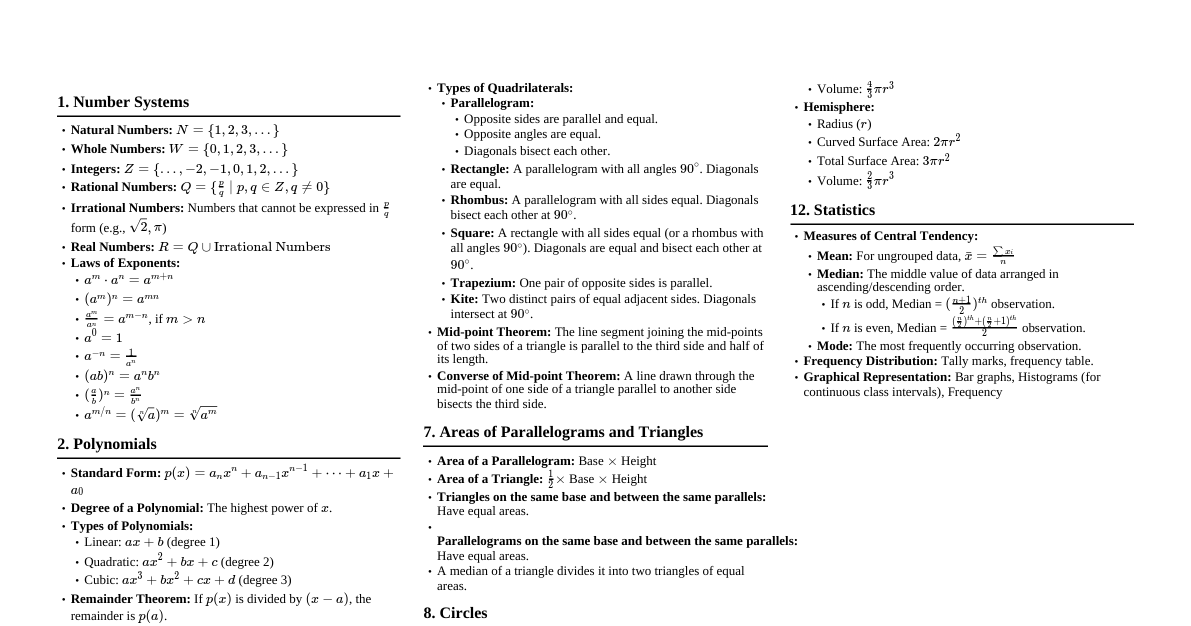
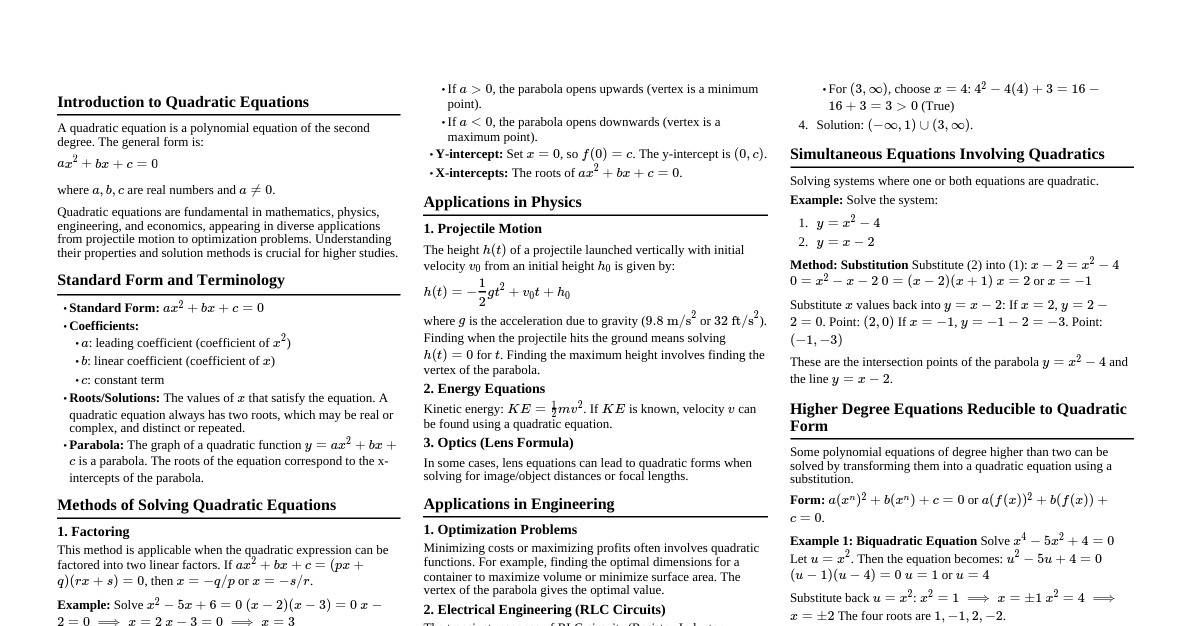
### Algebra Basics (Class 8-10) - **Identities:** - $(a+b)^2 = a^2 + 2ab + b^2$ - $(a-b)^2 = a^2 - 2ab + b^2$ - $a^2 - b^2 = (a-b)(a+b)$ - $(a+b)^3 = a^3 + b^3 + 3ab(a+b)$ - $(a-b)^3 = a^3 - b^3 - 3ab(a-b)$ - $a^3 + b^3 = (a+b)(a^2 - ab + b^2)$ - $a^3 - b^3 = (a-b)(a^2 + ab + b^2)$ - **Linear Equations:** $ax + b = 0 \Rightarrow x = -b/a$ - **Quadratic Equations:** $ax^2 + bx + c = 0$ - **Discriminant:** $\Delta = b^2 - 4ac$ - **Roots:** $x = \frac{-b \pm \sqrt{b^2 - 4ac}}{2a}$ - **Exponents & Powers:** - $a^m \cdot a^n = a^{m+n}$ - $a^m / a^n = a^{m-n}$ - $(a^m)^n = a^{mn}$ - $(ab)^m = a^m b^m$ - $(a/b)^m = a^m / b^m$ - $a^0 = 1$ - $a^{-n} = 1/a^n$ - $a^{m/n} = (\sqrt[n]{a})^m$ ### Geometry Theorems & Properties (Class 8-10) - **Lines & Angles:** - **Complementary Angles:** Sum = $90^\circ$ - **Supplementary Angles:** Sum = $180^\circ$ - **Vertically Opposite Angles:** Equal - **Parallel Lines & Transversal:** - Alternate Interior Angles: Equal - Corresponding Angles: Equal - Consecutive Interior Angles: Sum = $180^\circ$ - **Triangles:** - **Angle Sum Property:** Sum of angles = $180^\circ$ - **Exterior Angle Property:** Exterior angle = sum of two opposite interior angles - **Congruence Criteria:** SSS, SAS, ASA, AAS, RHS - **Similarity Criteria:** AAA, SSS, SAS - **Pythagoras Theorem:** In a right-angled triangle, $a^2 + b^2 = c^2$ - **Thales Theorem (Basic Proportionality Theorem):** If a line is drawn parallel to one side of a triangle intersecting the other two sides, then it divides the two sides proportionally. - **Area:** $\frac{1}{2} \times \text{base} \times \text{height}$ - **Quadrilaterals:** - **Parallelogram:** Opposite sides equal & parallel, opposite angles equal, diagonals bisect each other. Area = base $\times$ height. - **Rectangle:** Parallelogram with all angles $90^\circ$. Area = length $\times$ width. - **Square:** Rectangle with all sides equal. Area = side$^2$. - **Rhombus:** Parallelogram with all sides equal, diagonals bisect each other at $90^\circ$. Area = $\frac{1}{2} d_1 d_2$. - **Trapezium:** One pair of parallel sides. Area = $\frac{1}{2} (a+b)h$. - **Circles:** - **Angle subtended by arc at center:** Twice angle subtended at any point on remaining part of circle. - **Angles in same segment:** Equal. - **Angle in semicircle:** $90^\circ$. - **Tangent-Radius Property:** Tangent at any point is perpendicular to radius through point of contact. - **Length of tangents from external point:** Equal. - **Area:** $\pi r^2$ - **Circumference:** $2\pi r$ - **Area of Sector:** $\frac{\theta}{360^\circ} \pi r^2$ - **Length of Arc:** $\frac{\theta}{360^\circ} 2\pi r$ ### Mensuration Formulas (Class 8-10) - **2D Shapes:** - **Triangle:** Area = $\frac{1}{2}bh$, Perimeter = $a+b+c$ - **Square:** Area = $s^2$, Perimeter = $4s$ - **Rectangle:** Area = $lw$, Perimeter = $2(l+w)$ - **Parallelogram:** Area = $bh$, Perimeter = $2(a+b)$ - **Rhombus:** Area = $\frac{1}{2}d_1 d_2$, Perimeter = $4s$ - **Trapezium:** Area = $\frac{1}{2}(a+b)h$ - **Circle:** Area = $\pi r^2$, Circumference = $2\pi r$ - **3D Shapes:** - **Cube:** - Volume = $a^3$ - Lateral Surface Area (LSA) = $4a^2$ - Total Surface Area (TSA) = $6a^2$ - **Cuboid:** - Volume = $lbh$ - LSA = $2h(l+b)$ - TSA = $2(lb+bh+hl)$ - **Cylinder:** - Volume = $\pi r^2 h$ - Curved Surface Area (CSA) = $2\pi r h$ - TSA = $2\pi r(r+h)$ - **Cone:** - Volume = $\frac{1}{3}\pi r^2 h$ - CSA = $\pi r l$ (where $l = \sqrt{r^2 + h^2}$) - TSA = $\pi r(r+l)$ - **Sphere:** - Volume = $\frac{4}{3}\pi r^3$ - Surface Area = $4\pi r^2$ - **Hemisphere:** - Volume = $\frac{2}{3}\pi r^3$ - CSA = $2\pi r^2$ - TSA = $3\pi r^2$ ### Trigonometry (Class 10) - **Ratios:** - $\sin \theta = \frac{\text{Opposite}}{\text{Hypotenuse}}$ - $\cos \theta = \frac{\text{Adjacent}}{\text{Hypotenuse}}$ - $\tan \theta = \frac{\text{Opposite}}{\text{Adjacent}} = \frac{\sin \theta}{\cos \theta}$ - $\csc \theta = \frac{1}{\sin \theta}$ - $\sec \theta = \frac{1}{\cos \theta}$ - $\cot \theta = \frac{1}{\tan \theta} = \frac{\cos \theta}{\sin \theta}$ - **Identities:** - $\sin^2 \theta + \cos^2 \theta = 1$ - $1 + \tan^2 \theta = \sec^2 \theta$ - $1 + \cot^2 \theta = \csc^2 \theta$ - **Complementary Angles:** - $\sin(90^\circ - \theta) = \cos \theta$ - $\cos(90^\circ - \theta) = \sin \theta$ - $\tan(90^\circ - \theta) = \cot \theta$ - $\cot(90^\circ - \theta) = \tan \theta$ - $\sec(90^\circ - \theta) = \csc \theta$ - $\csc(90^\circ - \theta) = \sec \theta$ ### Statistics & Probability (Class 9-10) - **Mean:** - Ungrouped: $\bar{x} = \frac{\sum x_i}{n}$ - Grouped (Direct Method): $\bar{x} = \frac{\sum f_i x_i}{\sum f_i}$ - Grouped (Assumed Mean Method): $\bar{x} = A + \frac{\sum f_i d_i}{\sum f_i}$ - Grouped (Step Deviation Method): $\bar{x} = A + \left(\frac{\sum f_i u_i}{\sum f_i}\right) h$ - **Median:** - Ungrouped (n odd): Middle value after sorting. - Ungrouped (n even): Average of two middle values after sorting. - Grouped: Median $= L + \left(\frac{N/2 - cf}{f}\right) h$ - **Mode:** - Ungrouped: Most frequent value. - Grouped: Mode $= L + \left(\frac{f_1 - f_0}{2f_1 - f_0 - f_2}\right) h$ - **Empirical Relationship:** $3 \times \text{Median} = \text{Mode} + 2 \times \text{Mean}$ - **Probability:** $P(E) = \frac{\text{Number of favorable outcomes}}{\text{Total number of possible outcomes}}$ - $0 \le P(E) \le 1$ - $P(E) + P(\text{not } E) = 1$ ### Coordinate Geometry (Class 9-10) - **Distance Formula:** $D = \sqrt{(x_2-x_1)^2 + (y_2-y_1)^2}$ - **Section Formula:** - Internal division: $(x, y) = \left(\frac{m_1 x_2 + m_2 x_1}{m_1 + m_2}, \frac{m_1 y_2 + m_2 y_1}{m_1 + m_2}\right)$ - Midpoint: $(x, y) = \left(\frac{x_1 + x_2}{2}, \frac{y_1 + y_2}{2}\right)$ - **Area of Triangle:** $\frac{1}{2} |x_1(y_2-y_3) + x_2(y_3-y_1) + x_3(y_1-y_2)|$ ### Number Systems (Class 9-10) - **Real Numbers:** Rational and Irrational Numbers - **Rational Numbers:** Can be expressed as $p/q$ where $q \ne 0$. Terminating or non-terminating repeating decimals. - **Irrational Numbers:** Non-terminating, non-repeating decimals (e.g., $\sqrt{2}, \pi$). - **Euclid's Division Lemma:** For positive integers $a$ and $b$, there exist unique integers $q$ and $r$ such that $a = bq + r$, where $0 \le r ### Ions & Chemical Compounds (Class 9-10) - **Monoatomic Cations:** - Hydrogen: $\text{H}^+$ - Lithium: $\text{Li}^+$ - Sodium: $\text{Na}^+$ - Potassium: $\text{K}^+$ - Silver: $\text{Ag}^+$ - Magnesium: $\text{Mg}^{2+}$ - Calcium: $\text{Ca}^{2+}$ - Barium: $\text{Ba}^{2+}$ - Zinc: $\text{Zn}^{2+}$ - Iron(II): $\text{Fe}^{2+}$ (Ferrous) - Iron(III): $\text{Fe}^{3+}$ (Ferric) - Copper(I): $\text{Cu}^+$ (Cuprous) - Copper(II): $\text{Cu}^{2+}$ (Cupric) - Aluminum: $\text{Al}^{3+}$ - **Monoatomic Anions:** - Hydride: $\text{H}^-$ - Fluoride: $\text{F}^-$ - Chloride: $\text{Cl}^-$ - Bromide: $\text{Br}^-$ - Iodide: $\text{I}^-$ - Oxide: $\text{O}^{2-}$ - Sulfide: $\text{S}^{2-}$ - Nitride: $\text{N}^{3-}$ - Phosphide: $\text{P}^{3-}$ - **Polyatomic Cations:** - Ammonium: $\text{NH}_4^+$ - **Polyatomic Anions:** - Hydroxide: $\text{OH}^-$ - Nitrate: $\text{NO}_3^-$ - Nitrite: $\text{NO}_2^-$ - Carbonate: $\text{CO}_3^{2-}$ - Bicarbonate (Hydrogen Carbonate): $\text{HCO}_3^-$ - Sulfate: $\text{SO}_4^{2-}$ - Sulfite: $\text{SO}_3^{2-}$ - Thiosulfate: $\text{S}_2\text{O}_3^{2-}$ - Phosphate: $\text{PO}_4^{3-}$ - Phosphite: $\text{PO}_3^{3-}$ - Chlorate: $\text{ClO}_3^-$ - Chlorite: $\text{ClO}_2^-$ - Hypochlorite: $\text{ClO}^-$ - Perchlorate: $\text{ClO}_4^-$ - Acetate: $\text{CH}_3\text{COO}^-$ - Dichromate: $\text{Cr}_2\text{O}_7^{2-}$ - Permanganate: $\text{MnO}_4^-$ ### Common Chemical Formulas (Class 9-10) - Water: $\text{H}_2\text{O}$ - Carbon Dioxide: $\text{CO}_2$ - Ammonia: $\text{NH}_3$ - Methane: $\text{CH}_4$ - Glucose: $\text{C}_6\text{H}_{12}\text{O}_6$ - Ethanol: $\text{C}_2\text{H}_5\text{OH}$ - Sodium Chloride (Salt): $\text{NaCl}$ - Hydrochloric Acid: $\text{HCl}$ - Sulfuric Acid: $\text{H}_2\text{SO}_4$ - Nitric Acid: $\text{HNO}_3$ - Sodium Hydroxide: $\text{NaOH}$ - Calcium Carbonate (Limestone): $\text{CaCO}_3$ - Calcium Oxide (Quicklime): $\text{CaO}$ - Calcium Hydroxide (Slaked Lime): $\text{Ca(OH)}_2$ - Potassium Chloride: $\text{KCl}$ - Magnesium Oxide: $\text{MgO}$ - Iron(III) Oxide (Rust): $\text{Fe}_2\text{O}_3$ - Copper(II) Sulfate: $\text{CuSO}_4$ - Zinc Oxide: $\text{ZnO}$ - Silver Nitrate: $\text{AgNO}_3$ - Potassium Iodide: $\text{KI}$ - Baking Soda (Sodium Bicarbonate): $\text{NaHCO}_3$ - Washing Soda (Sodium Carbonate): $\text{Na}_2\text{CO}_3 \cdot 10\text{H}_2\text{O}$ - Bleaching Powder (Calcium Oxychloride): $\text{CaOCl}_2$ - Plaster of Paris (Calcium Sulfate Hemihydrate): $\text{CaSO}_4 \cdot \frac{1}{2}\text{H}_2\text{O}$ - Gypsum (Calcium Sulfate Dihydrate): $\text{CaSO}_4 \cdot 2\text{H}_2\text{O}$ ### Physics Formulas (Class 9-10) - **Motion:** - Speed = $\frac{\text{Distance}}{\text{Time}}$ ($v = d/t$) - Velocity = $\frac{\text{Displacement}}{\text{Time}}$ ($\vec{v} = \Delta \vec{x} / \Delta t$) - Acceleration = $\frac{\text{Change in Velocity}}{\text{Time}}$ ($a = \Delta v / \Delta t$) - **Equations of Motion (Constant Acceleration):** - $v = u + at$ - $s = ut + \frac{1}{2}at^2$ - $v^2 = u^2 + 2as$ - Average Velocity = $\frac{u+v}{2}$ - **Force & Laws of Motion:** - Force = Mass $\times$ Acceleration ($F = ma$) - Momentum = Mass $\times$ Velocity ($p = mv$) - Change in Momentum = Force $\times$ Time ($F \Delta t = \Delta p$) - Impulse = $F \Delta t$ - **Gravitation:** - Universal Law of Gravitation: $F = G \frac{m_1 m_2}{r^2}$ (where $G = 6.67 \times 10^{-11} \text{ Nm}^2/\text{kg}^2$) - Acceleration due to gravity: $g = G \frac{M}{R^2}$ - Weight = Mass $\times$ Acceleration due to gravity ($W = mg$) - **Work, Energy & Power:** - Work Done = Force $\times$ Displacement $\times \cos \theta$ ($W = Fs \cos \theta$) - Kinetic Energy = $\frac{1}{2}mv^2$ - Potential Energy (Gravitational) = $mgh$ - Power = $\frac{\text{Work Done}}{\text{Time}}$ ($P = W/t$) - Power = Force $\times$ Velocity ($P = Fv$) - Efficiency = $\frac{\text{Output Energy}}{\text{Input Energy}} \times 100\%$ - **Sound:** - Wave Speed = Frequency $\times$ Wavelength ($v = f\lambda$) - **Light (Reflection & Refraction):** - Mirror Formula: $\frac{1}{f} = \frac{1}{v} + \frac{1}{u}$ - Magnification: $M = \frac{h_i}{h_o} = -\frac{v}{u}$ - Refractive Index: $n = \frac{\text{Speed of light in vacuum}}{\text{Speed of light in medium}} = \frac{c}{v}$ - Snell's Law: $n_1 \sin i = n_2 \sin r$ - Power of Lens: $P = \frac{1}{f}$ (in dioptres, $f$ in meters) - **Electricity:** - Charge: $Q = ne$ (where $e = 1.6 \times 10^{-19} \text{ C}$) - Current = $\frac{\text{Charge}}{\text{Time}}$ ($I = Q/t$) - Potential Difference (Voltage) = $\frac{\text{Work Done}}{\text{Charge}}$ ($V = W/Q$) - Ohm's Law: $V = IR$ - Resistance: $R = \rho \frac{L}{A}$ (where $\rho$ is resistivity) - **Resistors in Series:** $R_{eq} = R_1 + R_2 + ...$ - **Resistors in Parallel:** $\frac{1}{R_{eq}} = \frac{1}{R_1} + \frac{1}{R_2} + ...$ - Power in Electric Circuits: $P = VI = I^2R = \frac{V^2}{R}$ - Heat Produced (Joule's Law of Heating): $H = I^2Rt$ ### Chemistry Formulas & Laws (Class 9-10) - **Mole Concept:** - Number of Moles = $\frac{\text{Given Mass}}{\text{Molar Mass}}$ - Number of Moles = $\frac{\text{Number of Particles}}{\text{Avogadro's Number}}$ (where $N_A = 6.022 \times 10^{23} \text{ particles/mol}$) - Number of Moles (for gases at STP) = $\frac{\text{Volume of Gas}}{\text{Molar Volume}}$ (Molar Volume at STP $\approx 22.4 \text{ L}$) - **Concentration:** - Mass by Mass % = $\frac{\text{Mass of Solute}}{\text{Mass of Solution}} \times 100$ - Volume by Volume % = $\frac{\text{Volume of Solute}}{\text{Volume of Solution}} \times 100$ - Mass by Volume % = $\frac{\text{Mass of Solute}}{\text{Volume of Solution}} \times 100$ - **Laws of Chemical Combination:** - **Law of Conservation of Mass:** Mass can neither be created nor destroyed in a chemical reaction. - **Law of Constant Proportions (Law of Definite Proportions):** In a chemical substance, the elements are always present in definite proportions by mass. - **pH Scale:** - $\text{pH} = -\log[\text{H}^+]$ - $\text{pH} + \text{pOH} = 14$ - **Rate of Reaction:** - Rate = $\frac{\text{Change in Concentration}}{\text{Change in Time}}$ - **Oxidation & Reduction:** - **Oxidation:** Gain of Oxygen, Loss of Hydrogen, Loss of Electrons - **Reduction:** Loss of Oxygen, Gain of Hydrogen, Gain of Electrons