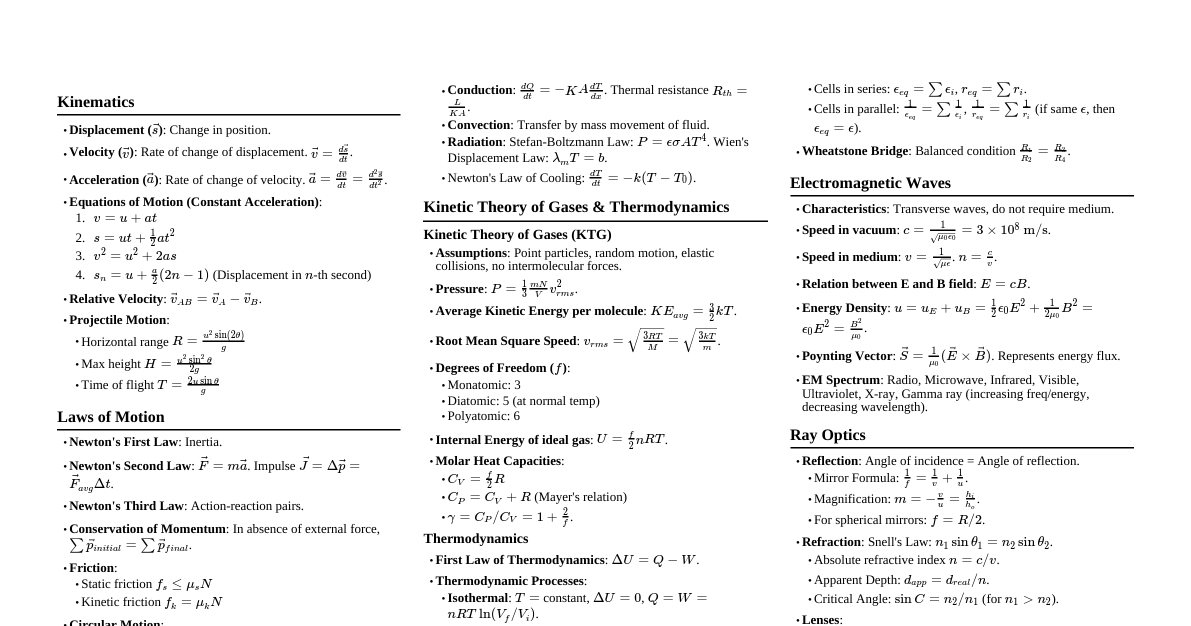
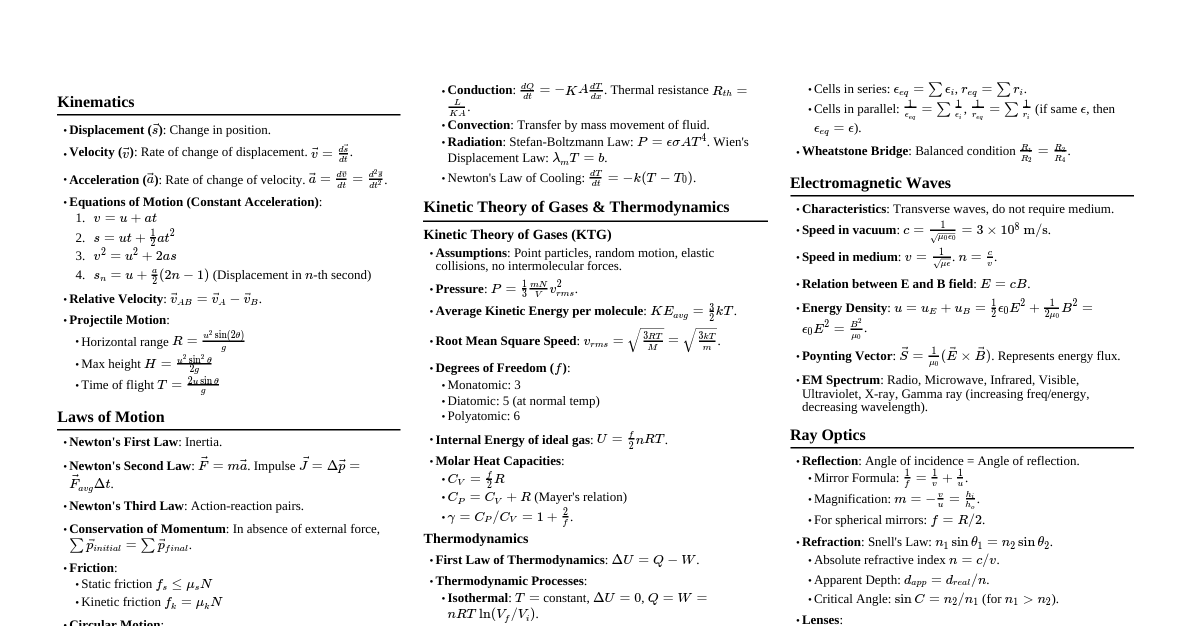
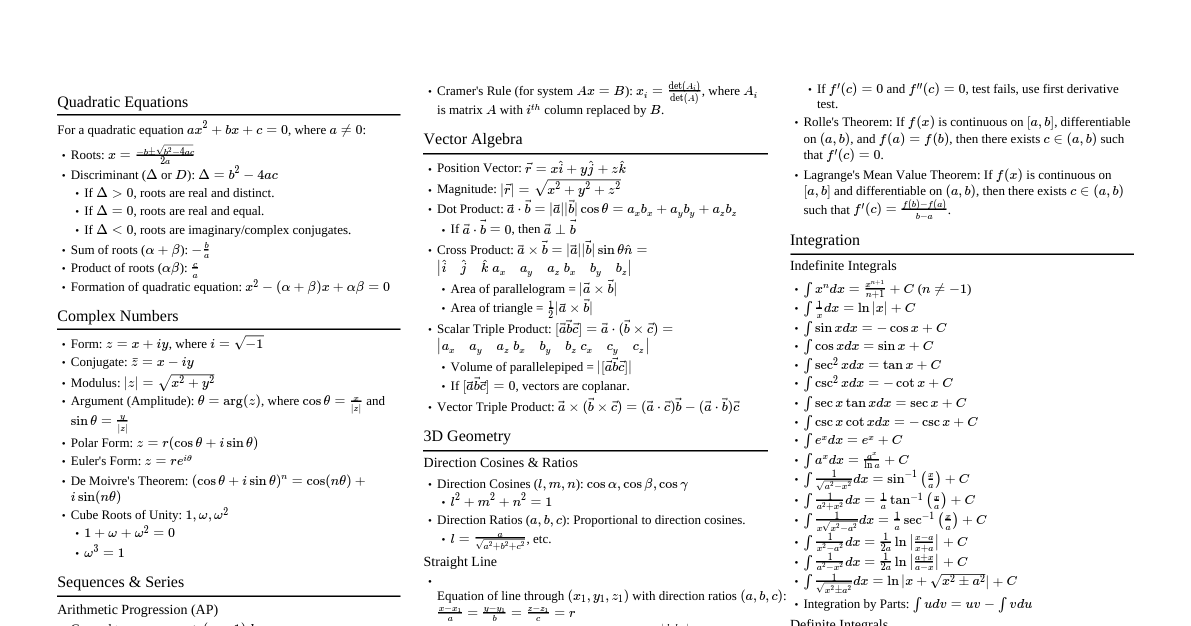
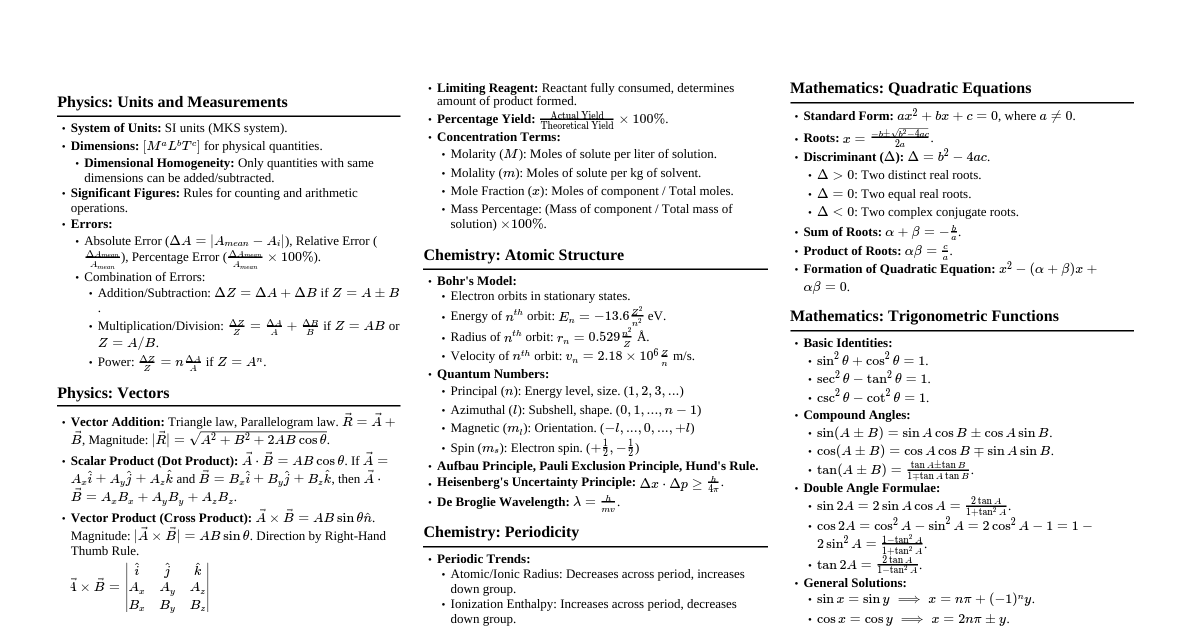
JEE Mains 2026 Math Cheatsheet
Cheatsheet Content
### Sets, Relations & Functions [H] #### A. FORMULAE & IDENTITIES - **Set Operations:** - $A \cup B = \{x | x \in A \text{ or } x \in B\}$ - $A \cap B = \{x | x \in A \text{ and } x \in B\}$ - $A - B = \{x | x \in A \text{ and } x \notin B\}$ - $A \Delta B = (A-B) \cup (B-A)$ (Symmetric Difference) - De Morgan's Laws: $(A \cup B)' = A' \cap B'$, $(A \cap B)' = A' \cup B'$ - **Cardinality:** - $|A \cup B| = |A| + |B| - |A \cap B|$ - $|A \cup B \cup C| = |A| + |B| + |C| - |A \cap B| - |B \cap C| - |C \cap A| + |A \cap B \cap C|$ - **Relations:** - Reflexive: $(a,a) \in R$ for all $a \in A$ - Symmetric: $(a,b) \in R \implies (b,a) \in R$ - Transitive: $(a,b) \in R \text{ and } (b,c) \in R \implies (a,c) \in R$ - Equivalence Relation: Reflexive, Symmetric, Transitive. [H] - **Functions:** - Domain, Codomain, Range. Range $\subseteq$ Codomain. - One-one (Injective): $f(x_1) = f(x_2) \implies x_1 = x_2$. (Horizontal line cuts graph at most once) - Onto (Surjective): Range = Codomain. (Every element in codomain has a pre-image). - Bijective: One-one and Onto. - Composite Function: $(f \circ g)(x) = f(g(x))$. Domain of $f \circ g$ is $\{x \in D_g | g(x) \in D_f\}$. [H] - Inverse Function: $f^{-1}(y) = x \iff f(x) = y$. Exists iff $f$ is bijective. $(f \circ f^{-1})(x) = x$, $(f^{-1} \circ f)(x) = x$. Graph of $f^{-1}$ is reflection of $f$ about $y=x$. [H] - Even Function: $f(-x) = f(x)$. Symmetric about y-axis. - Odd Function: $f(-x) = -f(x)$. Symmetric about origin. - Periodic Function: $f(x+T) = f(x)$ for smallest $T>0$. $T$ is fundamental period. #### B. STANDARD QUESTION PATTERNS - **Counting elements in sets:** Using inclusion-exclusion principle. [H] - **Identifying type of relation:** Check R, S, T properties. [M] - **Finding domain/range of complex functions:** - For $f(g(x))$, find domain of $g(x)$, then range of $g(x)$ becomes domain for $f(y)$. [H] - For $\sqrt{f(x)}$, $f(x) \ge 0$. For $\frac{1}{f(x)}$, $f(x) \ne 0$. For $\log(f(x))$, $f(x) > 0$. [H] - **Composition of functions:** Especially $(f \circ g)(x)$ and $(g \circ f)(x)$. [M] - **Inverse of functions:** Find $f^{-1}(x)$ by setting $y=f(x)$, solving for $x$ in terms of $y$, then swapping $x,y$. [H] #### C. METHOD SELECTION LOGIC - **Domain/Range:** Algebraic constraints first, then graph if applicable. - **Function Type (1-1/Onto):** Algebraic proof for 1-1 ($f(x_1)=f(x_2) \implies x_1=x_2$) or counterexample. For Onto, check if range = codomain, often by finding inverse or using calculus (max/min). - **Inverse function existence:** Check if bijective. If not, restrict domain/codomain to make it bijective. #### D. SHORT TRICKS & SPEED TECHNIQUES - **Graphing for 1-1/Onto:** Horizontal line test for 1-1. Check range for onto. - **Domain of $\arcsin(f(x))$ or $\arccos(f(x))$:** $-1 \le f(x) \le 1$. - **Periodicity:** If $f(x)$ has period $T_1$ and $g(x)$ has period $T_2$, then $f(x) \pm g(x)$ has period $\operatorname{LCM}(T_1, T_2)$ (if it exists). #### E. COMMON TRAPS & EXCEPTIONS - **Domain restrictions:** For $\frac{1}{\sqrt{f(x)}}$, $f(x) > 0$, not $f(x) \ge 0$. [H] - **Inverse function:** Only exists if bijective. If not, domain/codomain MUST be mentioned. - **$(f \circ g)(x) \ne (g \circ f)(x)$** in general. - **Composite function domain:** Always check inner function's range first. #### F. ASSERTION–REASONING CONTENT - **A:** If $f: A \to B$ and $g: B \to C$ are bijective, then $g \circ f: A \to C$ is bijective. **R:** The composite of two bijective functions is bijective. [Correct] - **A:** The domain of $f(x) = \frac{1}{\log x}$ is $(0, \infty)$. **R:** $\log x$ is defined for $x > 0$. [A is False, R is True. Domain is $(0,1) \cup (1, \infty)$ as $\log x \ne 0$ for $x \ne 1$] #### G. REPRESENTATIVE NUMERICAL TEMPLATES 1. **Given:** $f(x) = \frac{x}{x-1}$, $g(x) = \frac{1}{x-1}$. **Required:** $(f \circ g)(x)$. **Key idea:** Substitution. **Solving logic:** $f(g(x)) = \frac{g(x)}{g(x)-1} = \frac{1/(x-1)}{1/(x-1)-1} = \frac{1}{1-(x-1)} = \frac{1}{2-x}$. 2. **Given:** $f(x) = \sqrt{x-1} + \sqrt{6-x}$. **Required:** Domain of $f(x)$. **Key idea:** Intersection of individual domains. **Solving logic:** $x-1 \ge 0 \implies x \ge 1$. $6-x \ge 0 \implies x \le 6$. Domain is $[1, 6]$. ### Trigonometric Functions, Identities, Equations & Inverse Trigonometry [H] #### A. FORMULAE & IDENTITIES - **Basic Identities:** - $\sin^2\theta + \cos^2\theta = 1$ - $1 + \tan^2\theta = \sec^2\theta$ - $1 + \cot^2\theta = \csc^2\theta$ - **Compound Angles:** - $\sin(A \pm B) = \sin A \cos B \pm \cos A \sin B$ - $\cos(A \pm B) = \cos A \cos B \mp \sin A \sin B$ - $\tan(A \pm B) = \frac{\tan A \pm \tan B}{1 \mp \tan A \tan B}$ - **Multiple Angles:** - $\sin 2A = 2 \sin A \cos A = \frac{2 \tan A}{1+\tan^2 A}$ - $\cos 2A = \cos^2 A - \sin^2 A = 2\cos^2 A - 1 = 1 - 2\sin^2 A = \frac{1-\tan^2 A}{1+\tan^2 A}$ - $\tan 2A = \frac{2 \tan A}{1-\tan^2 A}$ - $\sin 3A = 3 \sin A - 4 \sin^3 A$ - $\cos 3A = 4 \cos^3 A - 3 \cos A$ - $\tan 3A = \frac{3 \tan A - \tan^3 A}{1 - 3 \tan^2 A}$ - **Sum/Product Transformation (CD/2C):** - $\sin C + \sin D = 2 \sin \frac{C+D}{2} \cos \frac{C-D}{2}$ - $\sin C - \sin D = 2 \cos \frac{C+D}{2} \sin \frac{C-D}{2}$ - $\cos C + \cos D = 2 \cos \frac{C+D}{2} \cos \frac{C-D}{2}$ - $\cos C - \cos D = -2 \sin \frac{C+D}{2} \sin \frac{C-D}{2}$ - $2 \sin A \cos B = \sin(A+B) + \sin(A-B)$ - $2 \cos A \sin B = \sin(A+B) - \sin(A-B)$ - $2 \cos A \cos B = \cos(A+B) + \cos(A-B)$ - $2 \sin A \sin B = \cos(A-B) - \cos(A+B)$ - **General Solutions of Trigonometric Equations:** - $\sin \theta = \sin \alpha \implies \theta = n\pi + (-1)^n \alpha$, $n \in \mathbb{Z}$ - $\cos \theta = \cos \alpha \implies \theta = 2n\pi \pm \alpha$, $n \in \mathbb{Z}$ - $\tan \theta = \tan \alpha \implies \theta = n\pi + \alpha$, $n \in \mathbb{Z}$ - $\sin^2 \theta = \sin^2 \alpha \implies \theta = n\pi \pm \alpha$ - $\cos^2 \theta = \cos^2 \alpha \implies \theta = n\pi \pm \alpha$ - $\tan^2 \theta = \tan^2 \alpha \implies \theta = n\pi \pm \alpha$ - **Inverse Trigonometric Functions (Principal Values):** - $\sin^{-1} x$: Domain $[-1,1]$, Range $[-\pi/2, \pi/2]$ - $\cos^{-1} x$: Domain $[-1,1]$, Range $[0, \pi]$ - $\tan^{-1} x$: Domain $(-\infty,\infty)$, Range $(-\pi/2, \pi/2)$ - $\csc^{-1} x$: Domain $(-\infty,-1] \cup [1,\infty)$, Range $[-\pi/2, \pi/2] - \{0\}$ - $\sec^{-1} x$: Domain $(-\infty,-1] \cup [1,\infty)$, Range $[0, \pi] - \{\pi/2\}$ - $\cot^{-1} x$: Domain $(-\infty,\infty)$, Range $(0, \pi)$ - **Inverse Trig Identities:** - $\sin^{-1} x + \cos^{-1} x = \pi/2$, for $x \in [-1,1]$ [H] - $\tan^{-1} x + \cot^{-1} x = \pi/2$, for $x \in \mathbb{R}$ - $\sec^{-1} x + \csc^{-1} x = \pi/2$, for $|x| \ge 1$ - $\tan^{-1} x + \tan^{-1} y = \tan^{-1} \left(\frac{x+y}{1-xy}\right)$ if $xy 1, x>0, y>0$ - $2 \tan^{-1} x = \tan^{-1} \left(\frac{2x}{1-x^2}\right)$ for $|x| 1$. [H] - **General solution:** Don't forget $n\pi$ or $2n\pi$. - **Division by $\sin x$ or $\cos x$:** May lose solutions if $\sin x=0$ or $\cos x=0$. Check separately. - **$\sqrt{1-\cos 2x}$ is NOT always $\sqrt{2}\sin x$**. It is $\sqrt{2}|\sin x|$. [H] #### F. ASSERTION–REASONING CONTENT - **A:** The number of solutions of $\sin x = x/10$ is 7. **R:** The graph of $\sin x$ and $x/10$ intersect at 7 points. [Both A and R are True, R is correct explanation] - **A:** $\sin^{-1} x + \cos^{-1} x = \pi/2$ for all $x \in \mathbb{R}$. **R:** The domain of $\sin^{-1} x$ is $[-1,1]$ and $\cos^{-1} x$ is $[-1,1]$. [A is False, R is True. A is only true for $x \in [-1,1]$] #### G. REPRESENTATIVE NUMERICAL TEMPLATES 1. **Given:** $\sin x + \sin y = a$, $\cos x + \cos y = b$. **Required:** $\cos(x-y)$. **Key idea:** Squaring and adding. **Solving logic:** $(2 \sin \frac{x+y}{2} \cos \frac{x-y}{2})^2 = a^2$, $(2 \cos \frac{x+y}{2} \cos \frac{x-y}{2})^2 = b^2$. Add them: $4 \cos^2 \frac{x-y}{2} (\sin^2 \frac{x+y}{2} + \cos^2 \frac{x+y}{2}) = a^2+b^2 \implies 4 \cos^2 \frac{x-y}{2} = a^2+b^2 \implies 2(1+\cos(x-y)) = a^2+b^2$. 2. **Given:** $\tan^{-1}(x-1) + \tan^{-1}(x+1) = \tan^{-1}(3x)$. **Required:** $x$. **Key idea:** Sum formula for $\tan^{-1}$. **Solving logic:** $\tan^{-1}\left(\frac{x-1+x+1}{1-(x-1)(x+1)}\right) = \tan^{-1}(3x) \implies \frac{2x}{1-(x^2-1)} = 3x \implies \frac{2x}{2-x^2} = 3x \implies 2x = 3x(2-x^2) \implies 2 = 3(2-x^2)$ (if $x \ne 0$). $2=6-3x^2 \implies 3x^2=4 \implies x=\pm \frac{2}{\sqrt{3}}$. Check $x=0$ separately: $\tan^{-1}(-1) + \tan^{-1}(1) = \tan^{-1}(0) \implies -\pi/4+\pi/4=0$, so $x=0$ is also a solution. Check conditions for $\tan^{-1}$ sum formula: $(x-1)(x+1) < 1 \implies x^2-1 < 1 \implies x^2 < 2$. So $x=0, \pm \frac{2}{\sqrt{3}}$ are solutions. ### Complex Numbers & Quadratic Equations [H] #### A. FORMULAE & IDENTITIES - **Complex Numbers:** $z = x+iy$, where $i=\sqrt{-1}$. - **Conjugate:** $\bar{z} = x-iy$. Properties: $\overline{z_1+z_2} = \bar{z_1}+\bar{z_2}$, $\overline{z_1z_2} = \bar{z_1}\bar{z_2}$, $z\bar{z} = |z|^2 = x^2+y^2$. - **Modulus:** $|z| = \sqrt{x^2+y^2}$. Properties: $|z_1z_2| = |z_1||z_2|$, $|\frac{z_1}{z_2}| = \frac{|z_1|}{|z_2|}$, $|z_1+z_2| \le |z_1|+|z_2|$ (Triangle Inequality) [H], $||z_1|-|z_2|| \le |z_1-z_2|$. - **Argument:** $\arg(z) = \theta$, where $\cos \theta = \frac{x}{|z|}$, $\sin \theta = \frac{y}{|z|}$. Principal argument: $\theta \in (-\pi, \pi]$. - **Polar Form:** $z = r(\cos \theta + i \sin \theta) = r e^{i\theta}$ (Euler's Form). - **De Moivre's Theorem:** $(r(\cos \theta + i \sin \theta))^n = r^n(\cos n\theta + i \sin n\theta)$. [H] - **Roots of Unity:** $n$-th roots of unity are $e^{i \frac{2k\pi}{n}}$ for $k=0,1,...,n-1$. Sum of roots = 0, Product of roots = $(-1)^{n-1}$. [H] - Cube roots of unity: $1, \omega, \omega^2$. $1+\omega+\omega^2=0$, $\omega^3=1$. - **Quadratic Equations:** $ax^2+bx+c=0$, $a \ne 0$. - **Roots:** $x = \frac{-b \pm \sqrt{b^2-4ac}}{2a}$. Discriminant $D = b^2-4ac$. - $D > 0$: Real & distinct roots. - $D = 0$: Real & equal roots. - $D k$: $D \ge 0$, $a f(k) > 0$, $-b/(2a) > k$. - Both roots $ 0$, $-b/(2a) k$: $a f(k) 0$, $a f(k_2) > 0$, $k_1 0$ (opens upwards), $a ### Permutations & Combinations [H] #### A. FORMULAE & IDENTITIES - **Factorial:** $n! = n \times (n-1) \times ... \times 1$. $0! = 1$. - **Permutations (Arrangement):** Order matters. - $P(n,r) = {}^nP_r = \frac{n!}{(n-r)!}$. Number of permutations of $n$ distinct items taken $r$ at a time. - $P(n,n) = n!$. - Permutations with repetition: If $n$ items with $p_1$ alike of one kind, $p_2$ alike of another, ..., $\frac{n!}{p_1! p_2! ...}$. - Circular Permutations: $(n-1)!$ for distinct items. If clockwise/anti-clockwise are same, $\frac{(n-1)!}{2}$. - **Combinations (Selection):** Order does not matter. - $C(n,r) = {}^nC_r = \frac{n!}{r!(n-r)!}$. Number of combinations of $n$ distinct items taken $r$ at a time. [H] - Properties: ${}^nC_r = {}^nC_{n-r}$. ${}^nC_r + {}^nC_{r-1} = {}^{n+1}C_r$ (Pascal's Identity). [H] - ${}^nC_0 + {}^nC_1 + ... + {}^nC_n = 2^n$. - **Stars and Bars (Combinations with Repetition):** Number of non-negative integer solutions to $x_1+x_2+...+x_k=n$ is ${}^{n+k-1}C_{k-1}$ or ${}^{n+k-1}C_n$. [H] - **Derangements:** Number of permutations of $n$ items such that no item is in its original position, $D_n = n! \sum_{k=0}^n \frac{(-1)^k}{k!}$. $D_1=0, D_2=1, D_3=2, D_4=9$. #### B. STANDARD QUESTION PATTERNS - **Arrangement of letters/digits:** With/without repetition, with/without fixed positions. [H] - **Forming committees/teams:** Pure combinations. [H] - **Arrangement with constraints:** E.g., specific items always together (treat as a block), specific items never together (Total - Always together, or Gap method). [H] - **Distribution problems:** Identical items into distinct boxes (Stars and Bars). Distinct items into distinct boxes (each item has $k$ choices). - **Geometrical problems:** Number of lines, triangles, diagonals from $n$ points. [M] - **Rank of a word:** Lexicographical order. [M] - **Division into groups:** Distributing $n$ distinct items into $k$ groups. #### C. METHOD SELECTION LOGIC - **Permutation or Combination?** If order matters (arrangement, positions, specific roles), use P. If order doesn't matter (selection, groups, committees), use C. [H] - **"At least" / "At most" problems:** Use complement principle (Total - None). - **Objects together:** Treat as a single block, permute the block and items within. - **Objects never together:** Use gap method (arrange others, then place these in gaps). - **Identical objects:** Use multinomial coefficient for permutations, Stars and Bars for combinations. #### D. SHORT TRICKS & SPEED TECHNIQUES - **${}^nC_r = {}^nC_{n-r}$:** Use the smaller $r$ for calculation. E.g., ${}^{10}C_8 = {}^{10}C_2 = \frac{10 \times 9}{2} = 45$. [H] - **Visualizing arrangements:** For small numbers, draw possibilities. - **Complementary counting:** Faster for "at least" problems. - **Pascal's triangle:** Useful for binomial coefficients up to $n=6-7$. #### E. COMMON TRAPS & EXCEPTIONS - **Overcounting:** Especially in circular permutations or when dividing identical items into groups. - **Distinct vs Identical objects/boxes:** Crucial distinction. - **"At least" vs "Exactly":** Misinterpreting the condition. - **Misuse of P vs C:** The most common error. - **$0! = 1$** is often forgotten. #### F. ASSERTION–REASONING CONTENT - **A:** The number of ways to arrange the letters of the word 'APPLE' is 60. **R:** The number of permutations of $n$ objects where $p$ objects are of one kind is $n!/p!$. [Both A and R are True, R is correct explanation. $5!/2! = 120/2 = 60$] - **A:** The number of ways to select 3 men and 2 women from 5 men and 4 women is ${}^5C_3 \times {}^4C_2$. **R:** The selection of men and women are independent events. [Both A and R are True, R is correct explanation] #### G. REPRESENTATIVE NUMERICAL TEMPLATES 1. **Given:** 5 boys and 4 girls. **Required:** Number of ways to arrange them in a row so that no two girls are together. **Key idea:** Gap method. **Solving logic:** Arrange boys: $5!$ ways. This creates 6 gaps (B B B B B). Place 4 girls in 6 gaps: ${}^6P_4$ ways. Total: $5! \times {}^6P_4 = 120 \times 360 = 43200$. 2. **Given:** 10 identical candies to be distributed among 3 children such that each child gets at least one candy. **Required:** Number of ways. **Key idea:** Stars and Bars for positive integer solutions. **Solving logic:** Let $x_1, x_2, x_3$ be candies for each child. $x_1+x_2+x_3=10$, $x_i \ge 1$. Let $y_i = x_i-1 \ge 0$. Then $(y_1+1)+(y_2+1)+(y_3+1)=10 \implies y_1+y_2+y_3=7$. Number of solutions: ${}^{7+3-1}C_{3-1} = {}^9C_2 = \frac{9 \times 8}{2} = 36$. ### Binomial Theorem [H] #### A. FORMULAE & IDENTITIES - **Binomial Expansion:** $(x+y)^n = \sum_{r=0}^n {}^nC_r x^{n-r} y^r = {}^nC_0 x^n y^0 + {}^nC_1 x^{n-1} y^1 + ... + {}^nC_n x^0 y^n$. [H] - **General Term:** $T_{r+1} = {}^nC_r x^{n-r} y^r$. [H] - **Middle Term:** - If $n$ is even, $T_{n/2+1}$ is the only middle term. - If $n$ is odd, $T_{(n+1)/2}$ and $T_{(n+3)/2}$ are the two middle terms. - **Term Independent of $x$:** Find $r$ such that power of $x$ is 0 in $T_{r+1}$. - **Greatest Binomial Coefficient:** ${}^nC_{n/2}$ (for even $n$), ${}^nC_{(n-1)/2}$ or ${}^nC_{(n+1)/2}$ (for odd $n$). - **Greatest Term (in magnitude):** For $(1+x)^n$, let $T_{r+1}$ be the greatest term. Then $\left|\frac{T_{r+1}}{T_r}\right| \ge 1$ and $\left|\frac{T_{r+1}}{T_{r+2}}\right| \ge 1$. - $\frac{T_{r+1}}{T_r} = \frac{n-r+1}{r} \frac{y}{x}$. Set $\left|\frac{n-r+1}{r} \frac{y}{x}\right| \ge 1$. - $r \le \frac{n+1}{1+|x/y|}$. Let $m = \lfloor \frac{n+1}{1+|x/y|} \rfloor$. Then $T_{m+1}$ is the greatest term. If $\frac{n+1}{1+|x/y|}$ is an integer, then $T_m$ and $T_{m+1}$ are equal and greatest. - **Binomial Theorem for Negative/Fractional Exponents:** - $(1+x)^n = 1 + nx + \frac{n(n-1)}{2!}x^2 + ...$ (valid for $|x| ### Sequences & Series [H] #### A. FORMULAE & IDENTITIES - **Arithmetic Progression (AP):** $a, a+d, a+2d, ...$ - $n$-th term: $a_n = a + (n-1)d$. - Sum of $n$ terms: $S_n = \frac{n}{2}(2a + (n-1)d) = \frac{n}{2}(a + a_n)$. [H] - Arithmetic Mean (AM) of $a,b$: $\frac{a+b}{2}$. If $a, A_1, A_2, ..., A_k, b$ are in AP, then $A_i = a + i \frac{b-a}{k+1}$. - **Geometric Progression (GP):** $a, ar, ar^2, ...$ - $n$-th term: $a_n = ar^{n-1}$. - Sum of $n$ terms: $S_n = \frac{a(r^n-1)}{r-1}$ (for $r \ne 1$). - Sum to infinity: $S_\infty = \frac{a}{1-r}$ (for $|r| ### Matrices [H] #### A. FORMULAE & IDENTITIES - **Order of a Matrix:** $m \times n$ (rows $\times$ columns). - **Types of Matrices:** - Square Matrix: $m=n$. - Diagonal Matrix: Square matrix with non-zero elements only on main diagonal. - Scalar Matrix: Diagonal matrix with all diagonal elements equal. - Identity Matrix ($I$): Scalar matrix with diagonal elements 1. $AI=IA=A$. - Symmetric Matrix: $A^T=A$. Skew-Symmetric Matrix: $A^T=-A$. ($a_{ii}=0$ for skew-symmetric). - Every square matrix can be uniquely expressed as sum of symmetric and skew-symmetric matrix: $A = \frac{1}{2}(A+A^T) + \frac{1}{2}(A-A^T)$. [H] - **Matrix Operations:** - Addition/Subtraction: Element-wise, same order. - Scalar Multiplication: $kA = (ka_{ij})$. - Matrix Multiplication: $AB$ exists if columns of $A$ = rows of $B$. $(AB)_{ij} = \sum_k A_{ik}B_{kj}$. Not commutative ($AB \ne BA$). Associative $(AB)C = A(BC)$. Distributive $A(B+C)=AB+AC$. - **Transpose ($A^T$):** $(A^T)_{ij} = A_{ji}$. Properties: $(A^T)^T = A$, $(A+B)^T = A^T+B^T$, $(kA)^T = kA^T$, $(AB)^T = B^TA^T$. [H] - **Determinant ($\det(A)$ or $|A|$):** Only for square matrices. - For $2 \times 2$: $\begin{vmatrix} a & b \\ c & d \end{vmatrix} = ad-bc$. - For $3 \times 3$: Use cofactor expansion. - Properties: - $|A^T| = |A|$. - $|kA| = k^n |A|$ where $n$ is order of $A$. [H] - $|AB| = |A||B|$. [H] - If row/column elements are 0, det=0. If two rows/columns are identical or proportional, det=0. - If two rows/columns are interchanged, det changes sign. - If a row/column is multiplied by $k$, det is multiplied by $k$. - If elements of a row/column are sum of two terms, det can be expressed as sum of two determinants. - Row/column operations $R_i \to R_i + kR_j$ do not change determinant. - **Adjoint of a Matrix ($\operatorname{adj}(A)$):** Transpose of the cofactor matrix. - $A (\operatorname{adj}(A)) = (\operatorname{adj}(A)) A = |A| I$. [H] - $|\operatorname{adj}(A)| = |A|^{n-1}$. [H] - $\operatorname{adj}(AB) = \operatorname{adj}(B) \operatorname{adj}(A)$. - $\operatorname{adj}(A^T) = (\operatorname{adj}(A))^T$. - **Inverse of a Matrix ($A^{-1}$):** Exists iff $|A| \ne 0$ (non-singular matrix). - $A^{-1} = \frac{1}{|A|} \operatorname{adj}(A)$. [H] - Properties: $(A^{-1})^{-1}=A$, $(AB)^{-1}=B^{-1}A^{-1}$, $(A^T)^{-1}=(A^{-1})^T$, $|A^{-1}|=1/|A|$. - **System of Linear Equations (Cramer's Rule / Matrix Method):** $AX=B$. - If $|A| \ne 0$: Unique solution $X = A^{-1}B$. (Consistent) [H] - If $|A| = 0$: - If $(\operatorname{adj}(A))B \ne 0$: No solution. (Inconsistent) [H] - If $(\operatorname{adj}(A))B = 0$: Infinitely many solutions. (Consistent) [H] - For homogeneous system $AX=0$: - If $|A| \ne 0$: Unique solution $X=0$ (trivial solution). - If $|A| = 0$: Infinitely many solutions (non-trivial solutions). #### B. STANDARD QUESTION PATTERNS - **Matrix operations:** Multiplication, transpose. - **Determinant evaluation:** Using properties to simplify calculations. [H] - **Finding inverse of $2 \times 2$ or $3 \times 3$ matrix.** [H] - **Solving system of linear equations:** Using Cramer's rule or matrix method. [H] - **Properties of adjoint and inverse:** Especially for higher powers or determinants. [H] - **Symmetric/Skew-symmetric matrices:** Expressing a matrix as sum of these. - **Characteristic equation:** $A-\lambda I = 0$, for eigenvalues (Mains usually doesn't ask for eigenvalues, but characteristic eqn is useful for Cayley-Hamilton). - **Cayley-Hamilton Theorem:** Every square matrix satisfies its own characteristic equation. $A^n + k_1 A^{n-1} + ... + k_n I = 0$. Useful for finding higher powers of A or $A^{-1}$. [M] #### C. METHOD SELECTION LOGIC - **Determinant of large matrix:** Use row/column operations to create zeros, then expand along that row/column. - **Solving system of equations:** - If unique solution is expected, use Cramer's rule or $A^{-1}B$. - If consistency/number of solutions is asked, check $|A|$ and $(\operatorname{adj}(A))B$. - **Finding $A^{-1}$ for large $n$ (not common in JEE):** Use Cayley-Hamilton for $A^{-1}$ if $A \cdot A^{n-1} + ... + k_n I = 0 \implies A^{-1} = -\frac{1}{k_n}(A^{n-1} + ...)$. #### D. SHORT TRICKS & SPEED TECHNIQUES - **Determinant of $2 \times 2$:** $ad-bc$ is instant. - **Inverse of $2 \times 2$:** $\begin{pmatrix} a & b \\ c & d \end{pmatrix}^{-1} = \frac{1}{ad-bc} \begin{pmatrix} d & -b \\ -c & a \end{pmatrix}$. [H] - **Determinant of triangular matrix:** Product of diagonal elements. - **Properties of determinants:** Use them to simplify before expanding. E.g., if $R_1 \to R_1+R_2+R_3$, then factor out common terms. - **Checking matrix multiplication:** Check order, then one or two elements for options. #### E. COMMON TRAPS & EXCEPTIONS - **Matrix multiplication is NOT commutative.** - **$(A+B)^2 \ne A^2+2AB+B^2$** (unless $AB=BA$). - **$AB=0$ does NOT imply $A=0$ or $B=0$.** - **Determinant of product is product of determinants, but sum is not.** - **Singular matrix:** $|A|=0$, inverse does not exist. - **Homogeneous system:** Always consistent (trivial solution $X=0$). #### F. ASSERTION–REASONING CONTENT - **A:** If $A$ is a square matrix such that $A^2=I$, then $A^{-1}=A$. **R:** For an invertible matrix $A$, $A A^{-1} = I$. [Both A and R are True, R is a correct explanation ($A \cdot A = I \implies A^{-1}=A$)] - **A:** If $A$ is a skew-symmetric matrix of odd order, then $\det(A)=0$. **R:** For any skew-symmetric matrix $A$, $\det(A^T) = (-1)^n \det(A)$. [Both A and R are True, R is correct explanation. $|A^T|=|A|$, so $|A|=(-1)^n|A|$. If $n$ is odd, $|A|=-|A| \implies 2|A|=0 \implies |A|=0$] #### G. REPRESENTATIVE NUMERICAL TEMPLATES 1. **Given:** $A = \begin{pmatrix} 2 & 3 \\ 1 & 2 \end{pmatrix}$. **Required:** $A^2 - 4A + I$. **Key idea:** Cayley-Hamilton Theorem. **Solving logic:** Characteristic equation: $\det(A-\lambda I) = \begin{vmatrix} 2-\lambda & 3 \\ 1 & 2-\lambda \end{vmatrix} = (2-\lambda)^2 - 3 = 4-4\lambda+\lambda^2-3 = \lambda^2-4\lambda+1 = 0$. By Cayley-Hamilton, $A^2-4A+I=0$. 2. **Given:** System of equations $x+y+z=1$, $2x+3y+2z=2$, $ax+ay+2az=4$. **Required:** Value of $a$ for which system has unique solution. **Key idea:** For unique solution, $\det(A) \ne 0$. **Solving logic:** $A = \begin{pmatrix} 1 & 1 & 1 \\ 2 & 3 & 2 \\ a & a & 2a \end{pmatrix}$. $\det(A) = 1(6a-2a) - 1(4a-2a) + 1(2a-3a) = 4a - 2a - a = a$. For unique solution, $a \ne 0$. ### Determinants [H] #### A. FORMULAE & IDENTITIES - **Determinant of a $2 \times 2$ matrix:** $\begin{vmatrix} a & b \\ c & d \end{vmatrix} = ad-bc$. - **Determinant of a $3 \times 3$ matrix:** Using Sarrus rule or cofactor expansion. - Sarrus Rule: $ \begin{vmatrix} a & b & c \\ d & e & f \\ g & h & i \end{vmatrix} = a(ei-fh) - b(di-fg) + c(dh-eg)$. - **Properties of Determinants:** (Refer to Matrices section for detailed properties) - $|A^T|=|A|$ - $|kA|=k^n|A|$ (for $n \times n$ matrix) - $|AB|=|A||B|$ - If any row/column is all zeros, $|A|=0$. - If two rows/columns are identical or proportional, $|A|=0$. - Interchanging two rows/columns changes sign. - Multiplying a row/column by $k$ multiplies determinant by $k$. - $R_i \to R_i + kR_j$ (or $C_i \to C_i + kC_j$) does not change determinant value. [H] - Sum property: If elements of a row/column are sum of two terms, determinant can be expressed as sum of two determinants. - **Area of Triangle:** With vertices $(x_1, y_1), (x_2, y_2), (x_3, y_3)$ is $\frac{1}{2} \left| \begin{vmatrix} x_1 & y_1 & 1 \\ x_2 & y_2 & 1 \\ x_3 & y_3 & 1 \end{vmatrix} \right|$. [H] - **Collinearity of three points:** If area of triangle is 0, i.e., $\begin{vmatrix} x_1 & y_1 & 1 \\ x_2 & y_2 & 1 \\ x_3 & y_3 & 1 \end{vmatrix} = 0$. - **Equation of a line passing through $(x_1, y_1)$ and $(x_2, y_2)$:** $\begin{vmatrix} x & y & 1 \\ x_1 & y_1 & 1 \\ x_2 & y_2 & 1 \end{vmatrix} = 0$. - **Cramer's Rule:** For system $a_1x+b_1y+c_1z=d_1$, etc. - $x = \frac{D_x}{D}$, $y = \frac{D_y}{D}$, $z = \frac{D_z}{D}$, where $D = \begin{vmatrix} a_1 & b_1 & c_1 \\ a_2 & b_2 & c_2 \\ a_3 & b_3 & c_3 \end{vmatrix}$, and $D_x$ is $D$ with column 1 replaced by $d_1,d_2,d_3$, etc. - Consistency conditions (refer to Matrices section). [H] #### B. STANDARD QUESTION PATTERNS - **Evaluating determinants:** Often requires using properties to simplify first. [H] - **Proving determinant identities:** Manipulate rows/columns. - **Solving equations involving determinants:** E.g., $\det(A) = 0$. - **Area of triangle / collinearity problems.** [H] - **Finding unknown values for consistent/inconsistent systems.** [H] - **Determinants involving special series or functions.** #### C. METHOD SELECTION LOGIC - **Evaluation:** Always look for row/column operations to create maximum number of zeros in a row/column, then expand along that. Factor out common terms. - **Proof:** Work on one side, apply properties to transform it into the other. - **System of equations:** Use Cramer's rule when coefficients are simple and unique solution is expected. For consistency, use determinant properties. #### D. SHORT TRICKS & SPEED TECHNIQUES - **$R_i \to R_i - R_j$ or $C_i \to C_i - C_j$** to create zeros or common factors. [H] - **If $\det(A)=0$ for $A$ with polynomial entries:** It implies some values of $x$ make rows/columns identical. - **Determinant of a skew-symmetric matrix of odd order is 0.** - **Determinant with entries $a, a+d, a+2d, ...$ (AP):** If $3 \times 3$, its value is 0. E.g., $\begin{vmatrix} 1 & 2 & 3 \\ 4 & 5 & 6 \\ 7 & 8 & 9 \end{vmatrix} = 0$. #### E. COMMON TRAPS & EXCEPTIONS - **Mistake in sign convention** for cofactors. - **Incorrectly applying properties:** E.g., adding a constant to a row does not add constant to determinant. $R_i \to kR_i$ multiplies det by $k$. - **Cramer's rule for $D=0$:** Need to check $(\operatorname{adj}(A))B = 0$ for infinite solutions. - **Determinant of sum:** $\det(A+B) \ne \det(A)+\det(B)$. #### F. ASSERTION–REASONING CONTENT - **A:** The determinant of a matrix $A = \begin{pmatrix} 1 & 2 & 3 \\ 4 & 5 & 6 \\ 7 & 8 & 9 \end{pmatrix}$ is zero. **R:** If elements of rows are in AP, the determinant is zero. [Both A and R are True, R is correct explanation] - **A:** If three points are collinear, the area of the triangle formed by them is zero. **R:** The condition for collinearity of three points $(x_1, y_1), (x_2, y_2), (x_3, y_3)$ is $\begin{vmatrix} x_1 & y_1 & 1 \\ x_2 & y_2 & 1 \\ x_3 & y_3 & 1 \end{vmatrix} = 0$. [Both A and R are True, R is correct explanation] #### G. REPRESENTATIVE NUMERICAL TEMPLATES 1. **Given:** $\begin{vmatrix} x & x^2 & 1+x^3 \\ y & y^2 & 1+y^3 \\ z & z^2 & 1+z^3 \end{vmatrix} = 0$ and $x,y,z$ are distinct. **Required:** $xyz$. **Key idea:** Split determinant, factor out common terms. **Solving logic:** $\begin{vmatrix} x & x^2 & 1 \\ y & y^2 & 1 \\ z & z^2 & 1 \end{vmatrix} + \begin{vmatrix} x & x^2 & x^3 \\ y & y^2 & y^3 \\ z & z^2 & z^3 \end{vmatrix} = 0$ $\begin{vmatrix} x & x^2 & 1 \\ y & y^2 & 1 \\ z & z^2 & 1 \end{vmatrix} + xyz \begin{vmatrix} 1 & x & x^2 \\ 1 & y & y^2 \\ 1 & z & z^2 \end{vmatrix} = 0$ Recognize Vandermonde determinant $\begin{vmatrix} 1 & a & a^2 \\ 1 & b & b^2 \\ 1 & c & c^2 \end{vmatrix} = (b-a)(c-a)(c-b)$. First det is $-(x-y)(y-z)(z-x)$. Second det is $(y-x)(z-x)(z-y)$. $-(x-y)(y-z)(z-x) + xyz (y-x)(z-x)(z-y) = 0$ $(x-y)(y-z)(z-x) (1-xyz) = 0$. Since $x,y,z$ are distinct, $(x-y)(y-z)(z-x) \ne 0$. So $1-xyz=0 \implies xyz=1$. 2. **Given:** $A = \begin{pmatrix} 1 & \omega & \omega^2 \\ \omega & \omega^2 & 1 \\ \omega^2 & 1 & \omega \end{pmatrix}$ where $\omega$ is cube root of unity. **Required:** $\det(A)$. **Key idea:** Use $1+\omega+\omega^2=0$. **Solving logic:** Apply $C_1 \to C_1+C_2+C_3$. $\det(A) = \begin{vmatrix} 1+\omega+\omega^2 & \omega & \omega^2 \\ \omega+\omega^2+1 & \omega^2 & 1 \\ \omega^2+1+\omega & 1 & \omega \end{vmatrix} = \begin{vmatrix} 0 & \omega & \omega^2 \\ 0 & \omega^2 & 1 \\ 0 & 1 & \omega \end{vmatrix} = 0$. ### Limits & Continuity [H] #### A. FORMULAE & IDENTITIES - **Limit Definition:** $\lim_{x \to a} f(x) = L$ if for every $\epsilon > 0$, there exists $\delta > 0$ such that $0 \pi/2 \end{cases}$. **Required:** Value of $k$ for continuity at $x=\pi/2$. **Key idea:** LHL = RHL = $f(\pi/2)$. **Solving logic:** $f(\pi/2) = k(\pi/2)+1$. LHL = $\lim_{x \to (\pi/2)^-} (kx+1) = k(\pi/2)+1$. RHL = $\lim_{x \to (\pi/2)^+} \sin x = \sin(\pi/2) = 1$. For continuity: $k(\pi/2)+1 = 1 \implies k\pi/2 = 0 \implies k=0$. ### Differentiability & Differentiation Techniques [H] #### A. FORMULAE & IDENTITIES - **Differentiability:** A function $f(x)$ is differentiable at $x=a$ if $\lim_{h \to 0} \frac{f(a+h) - f(a)}{h}$ exists. This limit is $f'(a)$. - Differentiability $\implies$ Continuity. (Continuity does NOT $\implies$ Differentiability). [H] - A function is not differentiable at points with sharp corners (e.g., $|x|$ at $x=0$), vertical tangents, or discontinuities. - Left Hand Derivative (LHD): $f'(a^-) = \lim_{h \to 0^-} \frac{f(a+h) - f(a)}{h}$. - Right Hand Derivative (RHD): $f'(a^+) = \lim_{h \to 0^+} \frac{f(a+h) - f(a)}{h}$. - Differentiable at $x=a \iff LHD = RHD$. - **Derivative Rules:** - $(u \pm v)' = u' \pm v'$ - $(uv)' = u'v + uv'$ (Product Rule) [H] - $(\frac{u}{v})' = \frac{u'v - uv'}{v^2}$ (Quotient Rule) [H] - Chain Rule: $\frac{dy}{dx} = \frac{dy}{du} \frac{du}{dx}$ (If $y=f(u), u=g(x)$). [H] - **Standard Derivatives:** - $\frac{d}{dx}(c) = 0$ - $\frac{d}{dx}(x^n) = nx^{n-1}$ - $\frac{d}{dx}(\sin x) = \cos x$ - $\frac{d}{dx}(\cos x) = -\sin x$ - $\frac{d}{dx}(\tan x) = \sec^2 x$ - $\frac{d}{dx}(\cot x) = -\csc^2 x$ - $\frac{d}{dx}(\sec x) = \sec x \tan x$ - $\frac{d}{dx}(\csc x) = -\csc x \cot x$ - $\frac{d}{dx}(e^x) = e^x$ - $\frac{d}{dx}(a^x) = a^x \ln a$ - $\frac{d}{dx}(\ln x) = 1/x$ - $\frac{d}{dx}(\log_a x) = \frac{1}{x \ln a}$ - $\frac{d}{dx}(\sin^{-1} x) = \frac{1}{\sqrt{1-x^2}}$ - $\frac{d}{dx}(\cos^{-1} x) = -\frac{1}{\sqrt{1-x^2}}$ - $\frac{d}{dx}(\tan^{-1} x) = \frac{1}{1+x^2}$ - $\frac{d}{dx}(\cot^{-1} x) = -\frac{1}{1+x^2}$ - $\frac{d}{dx}(\sec^{-1} x) = \frac{1}{|x|\sqrt{x^2-1}}$ - $\frac{d}{dx}(\csc^{-1} x) = -\frac{1}{|x|\sqrt{x^2-1}}$ - **Implicit Differentiation:** Differentiating both sides of an equation with respect to $x$, treating $y$ as a function of $x$. - **Parametric Differentiation:** If $x=f(t), y=g(t)$, then $\frac{dy}{dx} = \frac{dy/dt}{dx/dt}$. [H] - $\frac{d^2y}{dx^2} = \frac{d}{dx}(\frac{dy}{dx}) = \frac{d}{dt}(\frac{dy}{dx}) \cdot \frac{dt}{dx} = \frac{d}{dt}(\frac{dy}{dx}) / \frac{dx}{dt}$. [H] - **Logarithmic Differentiation:** For $y=(f(x))^{g(x)}$ or complex products/quotients, take $\ln$ on both sides. $\ln y = g(x) \ln f(x)$. Then $\frac{1}{y}\frac{dy}{dx} = g'(x)\ln f(x) + g(x)\frac{f'(x)}{f(x)}$. [H] - **Differentiation of Determinants:** If $\Delta(x) = \begin{vmatrix} f_1(x) & f_2(x) & f_3(x) \\ g_1(x) & g_2(x) & g_3(x) \\ h_1(x) & h_2(x) & h_3(x) \end{vmatrix}$, then $\Delta'(x)$ is sum of three determinants, where in each one row is differentiated and others remain same. [M] - **Higher Order Derivatives:** $y'', y'''$, etc. #### B. STANDARD QUESTION PATTERNS - **Checking differentiability of piecewise functions:** At boundary points. [H] - **Applying chain rule multiple times.** [H] - **Derivatives of implicit functions.** [H] - **Derivatives of parametric functions, including second derivatives.** [H] - **Logarithmic differentiation for complex functions.** [H] - **Derivatives of inverse trigonometric functions using substitution.** [M] - **Derivatives involving GIF/FPF:** Usually non-differentiable at integer points. - **Finding $f'(x)$ given $f(x)^y + y^x = C$ type problems.** #### C. METHOD SELECTION LOGIC - **Piecewise functions:** Check continuity first, then LHD and RHD. - **Composite functions:** Always use chain rule. - **$f(x)^{g(x)}$:** Use logarithmic differentiation. - **Implicit functions:** Differentiate term by term, remembering $\frac{dy}{dx}$. - **Parametric functions:** Use $\frac{dy}{dx} = \frac{dy/dt}{dx/dt}$. - **Inverse trig functions:** Often simplify the expression using substitution before differentiating (e.g., $x=\tan\theta$). #### D. SHORT TRICKS & SPEED TECHNIQUES - **Derivative of $|x|$:** $x/|x|$ for $x \ne 0$. - **Derivative of $\sqrt{f(x)}$:** $\frac{f'(x)}{2\sqrt{f(x)}}$. - **Standard substitutions for inverse trig derivatives:** - $\sin^{-1}(\frac{2x}{1+x^2}) \implies x=\tan\theta \implies \sin^{-1}(\sin 2\theta) = 2\theta = 2\tan^{-1}x$. Then differentiate. [H] - $\tan^{-1}(\frac{2x}{1-x^2}) \implies x=\tan\theta \implies \tan^{-1}(\tan 2\theta) = 2\theta = 2\tan^{-1}x$. - **Remember the domains for inverse trig identities.** E.g., $\sin^{-1}(\sin x)=x$ only for $x \in [-\pi/2, \pi/2]$. - **If $y=f(x)^y$ or $y=x^x$ etc.:** Logarithmic differentiation is key. #### E. COMMON TRAPS & EXCEPTIONS - **$|x|$ is continuous but not differentiable at $x=0$.** - **Chain rule errors:** Forgetting to multiply by the derivative of the inner function. - **Implicit differentiation:** Forgetting to treat $y$ as a function of $x$ when differentiating terms with $y$. - **Parametric second derivative:** Forgetting to multiply by $dt/dx$ in the final step. - **Domain restrictions for inverse trig functions:** Be careful when simplifying. #### F. ASSERTION–REASONING CONTENT - **A:** The function $f(x)=|x|$ is not differentiable at $x=0$. **R:** LHD $\ne$ RHD at $x=0$. [Both A and R are True, R is correct explanation] - **A:** If $y=x^x$, then $\frac{dy}{dx} = x^x(1+\ln x)$. **R:** Logarithmic differentiation is used for functions of the form $f(x)^{g(x)}$. [Both A and R are True, R is correct explanation] #### G. REPRESENTATIVE NUMERICAL TEMPLATES 1. **Given:** $y = \tan^{-1}\left(\frac{3x-x^3}{1-3x^2}\right)$. **Required:** $\frac{dy}{dx}$. **Key idea:** Substitution $x=\tan\theta$. **Solving logic:** Let $x=\tan\theta$. $y = \tan^{-1}\left(\frac{3\tan\theta-\tan^3\theta}{1-3\tan^2\theta}\right) = \tan^{-1}(\tan 3\theta)$. If $|x| ### Applications of Derivatives [H] #### A. FORMULAE & IDENTITIES - **Rate of Change:** If $y=f(x)$, then $\frac{dy}{dx}$ is the rate of change of $y$ with respect to $x$. If $x=g(t), y=h(t)$, then $\frac{dy}{dt}$ is rate of change of $y$ wrt $t$. - **Tangent & Normal to a Curve:** At point $(x_1, y_1)$ on $y=f(x)$. - Slope of tangent: $m_T = (\frac{dy}{dx})_{(x_1, y_1)}$. - Equation of tangent: $y-y_1 = m_T (x-x_1)$. - Slope of normal: $m_N = -1/m_T$ (if $m_T \ne 0$). - Equation of normal: $y-y_1 = m_N (x-x_1)$. - If $m_T=0$, tangent is horizontal ($y=y_1$), normal is vertical ($x=x_1$). - If $m_T$ is undefined, tangent is vertical ($x=x_1$), normal is horizontal ($y=y_1$). - **Angle between two curves:** Angle between their tangents at the point of intersection. $\tan\theta = \left|\frac{m_1-m_2}{1+m_1m_2}\right|$. - Orthogonal curves: $m_1m_2 = -1$. - **Monotonicity (Increasing/Decreasing Functions):** - $f'(x) > 0$ on $(a,b) \implies f(x)$ is strictly increasing on $(a,b)$. - $f'(x) 0 \implies$ local minimum at $x=c$. - $f''(c) = 0 \implies$ test fails, use first derivative test. - **Absolute Maxima & Minima (Global):** For continuous function on $[a,b]$, compare values of $f(x)$ at critical points (where $f'(x)=0$ or $f'(x)$ is undefined) and at endpoints $a,b$. - **Rolle's Theorem:** If $f(x)$ is continuous on $[a,b]$, differentiable on $(a,b)$, and $f(a)=f(b)$, then there exists at least one $c \in (a,b)$ such that $f'(c)=0$. [H] - **Lagrange's Mean Value Theorem (LMVT):** If $f(x)$ is continuous on $[a,b]$ and differentiable on $(a,b)$, then there exists at least one $c \in (a,b)$ such that $f'(c) = \frac{f(b)-f(a)}{b-a}$. [H] - **Approximation using Differentials:** $y \approx y_0 + dy = f(x_0) + f'(x_0)\Delta x$. [M] #### B. STANDARD QUESTION PATTERNS - **Finding intervals of increasing/decreasing:** Determine sign of $f'(x)$. [H] - **Finding local maxima/minima:** Use first or second derivative test. [H] - **Absolute maximum/minimum on a closed interval.** [H] - **Word problems involving optimization:** Maximize area/volume, minimize cost/time. [H] - **Tangent and Normal equations:** For various curves. [H] - **Rolle's/LMVT applications:** Proving existence of roots or specific values of derivative. [M] - **Approximation problems:** Using $\Delta y \approx f'(x)\Delta x$. [L] - **Rate of change problems:** Related rates (e.g., volume of sphere changing with radius). [H] #### C. METHOD SELECTION LOGIC - **Monotonicity/Extrema:** First derivative test is generally more robust (works even if $f''=0$ or $f'$ undefined). Second derivative test is faster if $f''(c) \ne 0$. - **Optimization:** 1. Identify quantity to be optimized (e.g., Area $A$). 2. Express it as a function of one variable (e.g., $A(x)$). 3. Find critical points by $A'(x)=0$. 4. Use first/second derivative test to confirm max/min. 5. Check endpoints if domain is closed. - **Tangent/Normal:** Calculate $\frac{dy}{dx}$ at the given point. - **Mean Value Theorems:** Verify conditions first. #### D. SHORT TRICKS & SPEED TECHNIQUES - **For $f(x)$ polynomial:** Roots of $f'(x)=0$ are potential extrema. - **Graphs for monotonicity:** Visualize $f'(x)$ graph to quickly find intervals. - **Symmetry in optimization:** Often, the optimal solution involves some form of symmetry. - **For $ax^2+b/x$ type functions:** $f'(x)=0 \implies 2ax - b/x^2 = 0 \implies 2ax^3=b$. Quick solution for minimum/maximum. #### E. COMMON TRAPS & EXCEPTIONS - **Critical points where $f'(x)$ is undefined:** These are also potential extrema (e.g., cusp). - **Global extrema:** Don't forget to check endpoints of the interval. - **Rolle's/LMVT:** Ensure all conditions (continuity, differentiability, $f(a)=f(b)$ for Rolle's) are met. - **Related rates:** Careful with chain rule and implicit differentiation. - **Maximum/Minimum:** $f'(c)=0$ does not guarantee an extremum (could be inflection point). #### F. ASSERTION–REASONING CONTENT - **A:** The function $f(x)=x^3$ has a local maximum at $x=0$. **R:** $f'(0)=0$. [A is False, R is True. $f(x)=x^3$ has a point of inflection at $x=0$, not a max/min.] - **A:** If $f(x)$ is continuous on $[a,b]$ and $f(a)=f(b)$, then there exists a $c \in (a,b)$ such that $f'(c)=0$. **R:** This is the statement of Rolle's Theorem. [Both A and R are True, R is correct explanation. (Assuming differentiability on $(a,b)$ for Rolle's)] #### G. REPRESENTATIVE NUMERICAL TEMPLATES 1. **Given:** $f(x) = x^3-6x^2+9x+1$. **Required:** Intervals of increasing and decreasing. **Key idea:** Sign of $f'(x)$. **Solving logic:** $f'(x) = 3x^2-12x+9 = 3(x^2-4x+3) = 3(x-1)(x-3)$. $f'(x) > 0$ for $x \in (-\infty, 1) \cup (3, \infty)$ (increasing). $f'(x) 0$). ### Indefinite Integrals [H] #### A. FORMULAE & IDENTITIES - **Definition:** If $\frac{d}{dx} F(x) = f(x)$, then $\int f(x) dx = F(x) + C$. - **Standard Integrals:** - $\int x^n dx = \frac{x^{n+1}}{n+1} + C$ (for $n \ne -1$) - $\int \frac{1}{x} dx = \ln|x| + C$ - $\int e^x dx = e^x + C$ - $\int a^x dx = \frac{a^x}{\ln a} + C$ - $\int \sin x dx = -\cos x + C$ - $\int \cos x dx = \sin x + C$ - $\int \sec^2 x dx = \tan x + C$ - $\int \csc^2 x dx = -\cot x + C$ - $\int \sec x \tan x dx = \sec x + C$ - $\int \csc x \cot x dx = -\csc x + C$ - $\int \tan x dx = \ln|\sec x| + C = -\ln|\cos x| + C$ - $\int \cot x dx = \ln|\sin x| + C$ - $\int \sec x dx = \ln|\sec x + \tan x| + C = \ln|\tan(\frac{\pi}{4}+\frac{x}{2})| + C$ - $\int \csc x dx = \ln|\csc x - \cot x| + C = \ln|\tan(x/2)| + C$ - $\int \frac{1}{\sqrt{a^2-x^2}} dx = \sin^{-1}(\frac{x}{a}) + C$ [H] - $\int \frac{1}{a^2+x^2} dx = \frac{1}{a} \tan^{-1}(\frac{x}{a}) + C$ [H] - $\int \frac{1}{x\sqrt{x^2-a^2}} dx = \frac{1}{a} \sec^{-1}(\frac{x}{a}) + C$ - **Special Integral Forms:** - $\int \frac{1}{x^2 \pm a^2} dx = \frac{1}{2a} \ln|\frac{x-a}{x+a}| + C$ for $\int \frac{1}{x^2-a^2} dx$ [H] - $\int \frac{1}{a^2-x^2} dx = \frac{1}{2a} \ln|\frac{a+x}{a-x}| + C$ [H] - $\int \frac{1}{\sqrt{x^2 \pm a^2}} dx = \ln|x + \sqrt{x^2 \pm a^2}| + C$ [H] - $\int \sqrt{a^2-x^2} dx = \frac{x}{2}\sqrt{a^2-x^2} + \frac{a^2}{2}\sin^{-1}(\frac{x}{a}) + C$ [H] - $\int \sqrt{x^2 \pm a^2} dx = \frac{x}{2}\sqrt{x^2 \pm a^2} \pm \frac{a^2}{2}\ln|x + \sqrt{x^2 \pm a^2}| + C$ [H] - **Integration by Substitution:** Let $u=g(x)$, then $du=g'(x)dx$. [H] - **Integration by Parts:** $\int u dv = uv - \int v du$. (LIATE rule for choosing $u$) [H] - Iterated by parts: $\int e^{ax} \sin(bx) dx = \frac{e^{ax}}{a^2+b^2}(a\sin(bx)-b\cos(bx)) + C$ [H] - $\int e^{ax} \cos(bx) dx = \frac{e^{ax}}{a^2+b^2}(a\cos(bx)+b\sin(bx)) + C$ [H] - **Partial Fractions:** For rational functions $\frac{P(x)}{Q(x)}$ where degree of $P(x) ### Definite Integrals [H] #### A. FORMULAE & IDENTITIES - **Definition:** $\int_a^b f(x) dx = F(b) - F(a)$, where $F(x)$ is antiderivative of $f(x)$. (Newton-Leibniz Formula) - **Properties of Definite Integrals:** 1. $\int_a^b f(x) dx = -\int_b^a f(x) dx$ 2. $\int_a^b f(x) dx = \int_a^c f(x) dx + \int_c^b f(x) dx$ (Chasles' Relation) 3. $\int_a^b f(x) dx = \int_a^b f(t) dt$ (Dummy variable property) 4. $\int_a^b f(x) dx = \int_a^b f(a+b-x) dx$ (King Property) [H] 5. $\int_0^a f(x) dx = \int_0^a f(a-x) dx$ (Special case of King Property) [H] 6. $\int_0^{2a} f(x) dx = \int_0^a f(x) dx + \int_0^a f(2a-x) dx$ - If $f(2a-x)=f(x)$, then $\int_0^{2a} f(x) dx = 2\int_0^a f(x) dx$. - If $f(2a-x)=-f(x)$, then $\int_0^{2a} f(x) dx = 0$. 7. $\int_{-a}^a f(x) dx$: - If $f(x)$ is even ($f(-x)=f(x)$), then $2\int_0^a f(x) dx$. [H] - If $f(x)$ is odd ($f(-x)=-f(x)$), then $0$. [H] 8. $\int_0^{na} f(x) dx = n \int_0^a f(x) dx$ if $f(x)$ is periodic with period $a$. [H] 9. $\int_a^b f(x)g(x) dx$: Not generally $\int f(x) dx \int g(x) dx$. - **Leibniz Rule for Differentiation under Integral Sign:** - If $G(x) = \int_{a(x)}^{b(x)} f(t) dt$, then $G'(x) = f(b(x))b'(x) - f(a(x))a'(x)$. [H] - **Wallis' Formula:** $\int_0^{\pi/2} \sin^n x \cos^m x dx = \frac{[(n-1)!!][(m-1)!!]}{(n+m)!!} K$ - where $K=1$ if both $n,m$ are even. $K=\pi/2$ if both $n,m$ are even. - $n!! = n(n-2)(n-4)...$ (until 1 or 2). #### B. STANDARD QUESTION PATTERNS - **Evaluating definite integrals using properties:** Most common way to simplify. [H] - **Integrals with modulus functions:** Split integral at points where argument of modulus changes sign. [H] - **Integrals with GIF/FPF:** Split integral at integer points. [M] - **Definite integrals as limits of sums (first principle):** $\lim_{n \to \infty} \frac{1}{n} \sum_{r=1}^n f(\frac{r}{n}) = \int_0^1 f(x) dx$. [M] - **Differentiation of definite integrals (Leibniz Rule).** [H] - **Proof of identities involving definite integrals.** - **Wallis' formula for specific trig integrals.** [M] #### C. METHOD SELECTION LOGIC - **Always check for properties first:** King property, even/odd function property, periodicity. These simplify greatly. - **Modulus/GIF:** Break the integral into parts where the function definition changes. - **Limits of sums:** Convert sum to definite integral form. - **Differentiation under integral sign:** Apply Leibniz rule. #### D. SHORT TRICKS & SPEED TECHNIQUES - **King Property (P4):** $\int_a^b f(x) dx = \int_a^b f(a+b-x) dx$. Add $I+I$ to solve many integrals. [H] - **Even/Odd functions:** Quick zero for odd functions over symmetric interval $(-a,a)$. [H] - **Graphs:** Visualize area for simple functions (e.g., area of circle quadrant for $\int_0^a \sqrt{a^2-x^2} dx$). - **If $f(x)$ is periodic with period $T$, then $\int_a^{a+nT} f(x) dx = n \int_0^T f(x) dx$.** #### E. COMMON TRAPS & EXCEPTIONS - **Sign errors** when applying properties. - **Incorrectly identifying even/odd functions.** - **Modulus function:** Forgetting to change sign of integrand when argument is negative. - **Leibniz rule:** Forgetting chain rule for limits of integration. - **Limits of sums:** Incorrectly setting the limits of integration or $f(x)$. - **Improper integrals:** These typically fall under advanced calculus, but sometimes a basic improper integral may appear (e.g., $\int_0^\infty e^{-x} dx$). #### F. ASSERTION–REASONING CONTENT - **A:** $\int_{-\pi/2}^{\pi/2} \sin^3 x dx = 0$. **R:** $\sin^3 x$ is an odd function. [Both A and R are True, R is correct explanation] - **A:** $\int_0^{\pi/2} \frac{\sin x}{\sin x + \cos x} dx = \pi/4$. **R:** $\int_a^b f(x) dx = \int_a^b f(a+b-x) dx$. [Both A and R are True, R is correct explanation] #### G. REPRESENTATIVE NUMERICAL TEMPLATES 1. **Given:** $\int_0^{\pi/2} \frac{\sqrt{\sin x}}{\sqrt{\sin x} + \sqrt{\cos x}} dx$. **Required:** Integral value. **Key idea:** King Property. **Solving logic:** Let $I = \int_0^{\pi/2} \frac{\sqrt{\sin x}}{\sqrt{\sin x} + \sqrt{\cos x}} dx$. Using $\int_0^a f(x) dx = \int_0^a f(a-x) dx$, $I = \int_0^{\pi/2} \frac{\sqrt{\sin(\pi/2-x)}}{\sqrt{\sin(\pi/2-x)} + \sqrt{\cos(\pi/2-x)}} dx = \int_0^{\pi/2} \frac{\sqrt{\cos x}}{\sqrt{\cos x} + \sqrt{\sin x}} dx$. Adding the two forms of $I$: $2I = \int_0^{\pi/2} \frac{\sqrt{\sin x} + \sqrt{\cos x}}{\sqrt{\sin x} + \sqrt{\cos x}} dx = \int_0^{\pi/2} 1 dx = [x]_0^{\pi/2} = \pi/2$. So $I = \pi/4$. [H] 2. **Given:** $\lim_{n \to \infty} \left[ \frac{1}{n+1} + \frac{1}{n+2} + ... + \frac{1}{2n} \right]$. **Required:** Limit value. **Key idea:** Limit of a sum. **Solving logic:** Rewrite as $\lim_{n \to \infty} \sum_{r=1}^n \frac{1}{n+r} = \lim_{n \to \infty} \frac{1}{n} \sum_{r=1}^n \frac{1}{1+r/n}$. This is in the form $\int_0^1 f(x) dx$ with $f(x)=\frac{1}{1+x}$. $\int_0^1 \frac{1}{1+x} dx = [\ln|1+x|]_0^1 = \ln(2) - \ln(1) = \ln 2$. ### Area Under Curves [H] #### A. FORMULAE & IDENTITIES - **Area bounded by $y=f(x)$, x-axis, $x=a$, $x=b$:** $\int_a^b |f(x)| dx$. - If $f(x) \ge 0$ on $[a,b]$, Area = $\int_a^b f(x) dx$. - If $f(x) \le 0$ on $[a,b]$, Area = $-\int_a^b f(x) dx$. - **Area bounded by $x=g(y)$, y-axis, $y=c$, $y=d$:** $\int_c^d |g(y)| dy$. - **Area between two curves $y=f(x)$ and $y=g(x)$ from $x=a$ to $x=b$:** $\int_a^b |f(x)-g(x)| dx$. - If $f(x) \ge g(x)$ on $[a,b]$, Area = $\int_a^b (f(x)-g(x)) dx$. - **Area between two curves $x=f(y)$ and $x=g(y)$ from $y=c$ to $y=d$:** $\int_c^d |f(y)-g(y)| dy$. - **Key Idea:** Always sketch the region to determine which function is "upper" and which is "lower", or which is "right" and which is "left". Find points of intersection to determine limits of integration. [H] #### B. STANDARD QUESTION PATTERNS - **Area bounded by a single curve and an axis:** E.g., parabola and x-axis. [H] - **Area bounded by two curves:** E.g., parabola and line, two parabolas. [H] - **Area bounded by multiple curves:** Breaking the region into simpler parts. [M] - **Area involving modulus functions.** [M] - **Area involving trigonometric functions.** [M] - **Finding the value of a parameter such that area is divided in a certain ratio.** [M] #### C. METHOD SELECTION LOGIC - **Sketch the region:** Absolutely essential to correctly set up the integral(s). - **Determine limits of integration:** Find intersection points of the curves. - **Choose integration variable:** Integrate with respect to $x$ if functions are easily expressible as $y=f(x)$. Integrate with respect to $y$ if $x=g(y)$ is simpler, or if the region is better described horizontally. - **If the region crosses the x-axis:** Split the integral into parts where $f(x)$ is positive and negative. #### D. SHORT TRICKS & SPEED TECHNIQUES - **Symmetry:** If the region is symmetric, calculate area of one symmetric part and multiply. [H] - **Standard areas:** - Area of ellipse $\frac{x^2}{a^2} + \frac{y^2}{b^2} = 1$ is $\pi ab$. [H] - Area bounded by $y^2=4ax$ and $x^2=4by$ is $\frac{16ab}{3}$. [H] - Area bounded by $y^2=4ax$ and $y=mx$ is $\frac{8a^2}{3m^3}$. - **Option Elimination:** Estimate the area from the graph. #### E. COMMON TRAPS & EXCEPTIONS - **Forgetting absolute value:** Area is always positive. $\int_a^b f(x) dx$ can be negative. - **Incorrect limits of integration:** Due to wrong intersection points or improper visualization. - **Choosing the wrong variable of integration ($dx$ vs $dy$).** - **Overlapping regions:** If multiple curves define boundaries, ensure correct upper/lower or right/left functions for each sub-region. - **Area of a loop:** Requires careful selection of limits and understanding of parameterization. #### F. ASSERTION–REASONING CONTENT - **A:** The area bounded by $y=x^2$ and $y=|x|$ is $1/3$. **R:** The area is calculated by $\int_{-1}^1 (|x|-x^2) dx$. [A is False, R is True. Area is $\int_{-1}^1 (|x|-x^2) dx = 2 \int_0^1 (x-x^2) dx = 2[x^2/2 - x^3/3]_0^1 = 2(1/2-1/3) = 2(1/6) = 1/3$. So A is True, R is correct explanation]. - **A:** The area of the region bounded by $y=x^2$ and $y=4$ is $32/3$. **R:** The points of intersection are $x=\pm 2$. [Both A and R are True, R is correct explanation. Area = $\int_{-2}^2 (4-x^2) dx = 2\int_0^2 (4-x^2)dx = 2[4x-x^3/3]_0^2 = 2(8-8/3) = 2(16/3) = 32/3$] #### G. REPRESENTATIVE NUMERICAL TEMPLATES 1. **Given:** Area bounded by $y=x^2$ and $y=2x$. **Required:** Area. **Key idea:** Area between two curves. **Solving logic:** Intersection points: $x^2=2x \implies x^2-2x=0 \implies x(x-2)=0 \implies x=0, 2$. From $x=0$ to $x=2$, $y=2x$ (line) is above $y=x^2$ (parabola). Area = $\int_0^2 (2x-x^2) dx = [x^2 - x^3/3]_0^2 = (4-8/3) - (0) = 4/3$. 2. **Given:** Area bounded by $y=\sin x$, $y=\cos x$, $x=0$, $x=\pi/2$. **Required:** Area. **Key idea:** Area between two curves, splitting integral where functions intersect. **Solving logic:** Intersection point in $[0, \pi/2]$ is $x=\pi/4$ where $\sin x = \cos x$. From $0$ to $\pi/4$, $\cos x \ge \sin x$. From $\pi/4$ to $\pi/2$, $\sin x \ge \cos x$. Area = $\int_0^{\pi/4} (\cos x - \sin x) dx + \int_{\pi/4}^{\pi/2} (\sin x - \cos x) dx$ $= [\sin x + \cos x]_0^{\pi/4} + [-\cos x - \sin x]_{\pi/4}^{\pi/2}$ $= (\frac{1}{\sqrt{2}}+\frac{1}{\sqrt{2}}) - (0+1) + (-0-1) - (-\frac{1}{\sqrt{2}}-\frac{1}{\sqrt{2}})$ $= \frac{2}{\sqrt{2}} - 1 - 1 + \frac{2}{\sqrt{2}} = 2\sqrt{2} - 2$. ### Differential Equations [H] #### A. FORMULAE & IDENTITIES - **Order:** Highest order of derivative. - **Degree:** Power of highest order derivative (when DE is polynomial in derivatives). - **Formation of DE:** Eliminate arbitrary constants from family of curves. - **Solution of First Order First Degree DE:** 1. **Variable Separable:** $\frac{dy}{dx} = f(x)g(y) \implies \int \frac{dy}{g(y)} = \int f(x) dx$. [H] 2. **Homogeneous DE:** $\frac{dy}{dx} = f(\frac{y}{x})$. Substitute $y=vx \implies \frac{dy}{dx} = v + x\frac{dv}{dx}$. Then variable separable. [H] 3. **Linear DE:** $\frac{dy}{dx} + Py = Q$, where $P, Q$ are functions of $x$ or constants. [H] - Integrating Factor (IF): $e^{\int P dx}$. - Solution: $y \cdot (\text{IF}) = \int Q \cdot (\text{IF}) dx + C$. 4. **Exact DE:** $M(x,y)dx + N(x,y)dy = 0$ if $\frac{\partial M}{\partial y} = \frac{\partial N}{\partial x}$. - Solution: $\int M dx$ (treating $y$ as constant) $+ \int (N \text{ terms not containing } x) dy = C$. [L] 5. **Bernoulli's Equation:** $\frac{dy}{dx} + Py = Qy^n$. Divide by $y^n$, substitute $z=y^{1-n}$. Converts to linear DE. [M] - **Orthogonal Trajectory:** Find the DE of the given family of curves, replace $\frac{dy}{dx}$ with $-\frac{dx}{dy}$, then solve the new DE. [M] #### B. STANDARD QUESTION PATTERNS - **Solving DEs using one of the standard methods:** Variable separable, homogeneous, linear. [H] - **Finding particular solutions:** Given initial conditions. [H] - **Formation of DEs:** Eliminating arbitrary constants. [M] - **Real-world applications:** Growth/decay, cooling, motion problems (often lead to DEs). [M] - **Orthogonal trajectories.** [M] #### C. METHOD SELECTION LOGIC - **First, check if variable separable.** Easiest method. - **If not, check for homogeneity:** Can $\frac{dy}{dx}$ be written as $f(y/x)$? - **If not, check for linearity:** Is it in the form $\frac{dy}{dx} + Py = Q$ or $\frac{dx}{dy} + P'x = Q'$? - **If none of the above:** Look for exact or Bernoulli (less frequent in JEE Mains). - **Formation:** Differentiate the given equation $n$ times (where $n$ is number of arbitrary constants), then eliminate the constants. #### D. SHORT TRICKS & SPEED TECHNIQUES - **For $y'=f(x)$:** Integrate directly. - **For $y'=g(y)$:** Separate variables and integrate. - **For $y'=k(y/x)$:** Homogeneous. Use $y=vx$. - **For $y'+Py=Q$:** Linear. Use IF. - **Option Elimination:** Plug solution options into the DE to check. #### E. COMMON TRAPS & EXCEPTIONS - **Forgetting the constant of integration $C$.** - **Errors in integration steps.** - **Homogeneous DE:** Incorrectly substituting $\frac{dy}{dx}$. - **Linear DE:** Errors in calculating IF or integrating $Q \cdot (\text{IF})$. - **Missing domain restrictions** for functions like $\ln|x|$ or $\sqrt{x}$. - **Order and Degree:** Degree is undefined if DE is not a polynomial in derivatives (e.g., $\sin(y'')$). #### F. ASSERTION–REASONING CONTENT - **A:** The differential equation $y dx + (x+y^2) dy = 0$ is homogeneous. **R:** A differential equation is homogeneous if $\frac{dy}{dx}$ can be expressed as a function of $y/x$. [A is False, R is True. It is not homogeneous.] - **A:** The integrating factor of $\frac{dy}{dx} + y \tan x = \sec x$ is $\sec x$. **R:** The integrating factor of $\frac{dy}{dx} + Py = Q$ is $e^{\int P dx}$. [Both A and R are True, R is correct explanation] #### G. REPRESENTATIVE NUMERICAL TEMPLATES 1. **Given:** $\frac{dy}{dx} = \frac{x+y}{x}$. **Required:** Solution. **Key idea:** Homogeneous DE. **Solving logic:** $\frac{dy}{dx} = 1 + \frac{y}{x}$. Let $y=vx \implies \frac{dy}{dx} = v + x\frac{dv}{dx}$. $v + x\frac{dv}{dx} = 1+v \implies x\frac{dv}{dx} = 1 \implies \int dv = \int \frac{1}{x} dx$. $v = \ln|x| + C \implies \frac{y}{x} = \ln|x| + C \implies y = x(\ln|x|+C)$. 2. **Given:** $\frac{dy}{dx} + y \cot x = 2x + x^2 \cot x$. **Required:** Solution. **Key idea:** Linear DE. **Solving logic:** $P=\cot x, Q=2x+x^2\cot x$. IF $= e^{\int \cot x dx} = e^{\ln|\sin x|} = \sin x$. Solution: $y \sin x = \int (2x+x^2\cot x) \sin x dx + C = \int (2x\sin x + x^2 \cos x) dx + C$. Recognize $2x\sin x + x^2 \cos x$ is derivative of $x^2 \sin x$ (product rule). $y \sin x = x^2 \sin x + C \implies y = x^2 + C \csc x$. ### Coordinate Geometry: Straight Lines [H] #### A. FORMULAE & IDENTITIES - **Distance Formula:** Between $(x_1, y_1)$ and $(x_2, y_2)$ is $\sqrt{(x_2-x_1)^2 + (y_2-y_1)^2}$. - **Section Formula:** - Internal division: $(x,y) = \left(\frac{m x_2 + n x_1}{m+n}, \frac{m y_2 + n y_1}{m+n}\right)$. - External division: $(x,y) = \left(\frac{m x_2 - n x_1}{m-n}, \frac{m y_2 - n y_1}{m-n}\right)$. - Midpoint: $\left(\frac{x_1+x_2}{2}, \frac{y_1+y_2}{2}\right)$. - **Area of Triangle:** $\frac{1}{2} |x_1(y_2-y_3) + x_2(y_3-y_1) + x_3(y_1-y_2)|$. (Also $\frac{1}{2} |\det(\text{matrix from Determinants section})|$). - **Slope of a Line:** $m = \tan\theta = \frac{y_2-y_1}{x_2-x_1}$. - **Equations of a Straight Line:** - **Slope-intercept form:** $y=mx+c$. - **Point-slope form:** $y-y_1 = m(x-x_1)$. - **Two-point form:** $y-y_1 = \frac{y_2-y_1}{x_2-x_1}(x-x_1)$. - **Intercept form:** $\frac{x}{a} + \frac{y}{b} = 1$. - **Normal form:** $x\cos\alpha + y\sin\alpha = p$. ($p$ is perpendicular distance from origin, $\alpha$ is angle of normal with x-axis). - **Parametric form:** $x=x_1+r\cos\theta, y=y_1+r\sin\theta$. ($r$ is distance from $(x_1, y_1)$). - **General form:** $Ax+By+C=0$. Slope $m=-A/B$. y-intercept $-C/B$. - **Angle between two lines:** $\tan\theta = \left|\frac{m_1-m_2}{1+m_1m_2}\right|$. - Parallel lines: $m_1=m_2$. - Perpendicular lines: $m_1m_2=-1$. - **Distance of a Point from a Line:** From $(x_1, y_1)$ to $Ax+By+C=0$ is $\frac{|Ax_1+By_1+C|}{\sqrt{A^2+B^2}}$. [H] - **Distance between two parallel lines:** $Ax+By+C_1=0$ and $Ax+By+C_2=0$ is $\frac{|C_1-C_2|}{\sqrt{A^2+B^2}}$. - **Concurrency of three lines:** If $L_1(x,y)=0, L_2(x,y)=0, L_3(x,y)=0$ are concurrent, then $\begin{vmatrix} A_1 & B_1 & C_1 \\ A_2 & B_2 & C_2 \\ A_3 & B_3 & C_3 \end{vmatrix} = 0$. - **Family of Lines:** Passing through intersection of $L_1=0$ and $L_2=0$ is $L_1 + \lambda L_2 = 0$. [H] - **Homogenization:** Making a second-degree equation homogeneous with the help of a line equation. E.g., $ax^2+2hxy+by^2+2gx+2fy+c=0$ and $Lx+My=1$. Combine to get $ax^2+2hxy+by^2+2g(Lx+My)+2f(Lx+My)+c(Lx+My)^2=0$. This gives pair of straight lines through origin. - **Pair of Straight Lines:** $ax^2+2hxy+by^2=0$ represents pair of lines through origin. Angle $\tan\theta = \left|\frac{2\sqrt{h^2-ab}}{a+b}\right|$. - If $h^2=ab$, lines are coincident. If $a+b=0$, lines are perpendicular. - **General equation of second degree:** $ax^2+2hxy+by^2+2gx+2fy+c=0$ represents a pair of straight lines if $abc+2fgh-af^2-bg^2-ch^2=0$ (or $\begin{vmatrix} a & h & g \\ h & b & f \\ g & f & c \end{vmatrix} = 0$). #### B. STANDARD QUESTION PATTERNS - **Finding equation of line:** Given points, slope, intercepts, or parallel/perpendicular conditions. [H] - **Distance problems:** Point-line, parallel lines. [H] - **Concurrency of lines.** [M] - **Family of lines applications:** Finding line passing through intersection of two lines and satisfying another condition. [H] - **Homogenization problems:** Finding angle between lines joining origin to intersection points of a line and a curve. [M] - **Properties of pair of straight lines.** [M] - **Centroid, Incenter, Orthocenter, Circumcenter:** Formulas for these points. [M] #### C. METHOD SELECTION LOGIC - **Equation of line:** Choose appropriate form based on given information. - **Concurrency:** Solve any two equations, check if third line passes through intersection, or use determinant condition. - **Family of lines:** Use $L_1+\lambda L_2=0$. - **Homogenization:** Use for lines joining origin to intersection of another line and a curve. - **Geometric properties:** Use distance, slope, section formulas. #### D. SHORT TRICKS & SPEED TECHNIQUES - **Slope check:** Parallel lines have same slope, perpendicular have $m_1m_2=-1$. - **Perpendicular line:** If $Ax+By+C=0$, perpendicular line is $Bx-Ay+K=0$. - **Parallel line:** If $Ax+By+C=0$, parallel line is $Ax+By+K=0$. - **Option Elimination:** Substitute points/slopes from options to check validity. - **Image/Reflection:** If $(x_1, y_1)$ is reflected across $Ax+By+C=0$ to $(x_2, y_2)$, then: - Midpoint of $(x_1, y_1)$ and $(x_2, y_2)$ lies on the line. - Line joining $(x_1, y_1)$ and $(x_2, y_2)$ is perpendicular to $Ax+By+C=0$. - Formula: $\frac{x_2-x_1}{A} = \frac{y_2-y_1}{B} = -2\frac{Ax_1+By_1+C}{A^2+B^2}$. [H] #### E. COMMON TRAPS & EXCEPTIONS - **Vertical/Horizontal lines:** Slope of vertical line is undefined, slope of horizontal line is 0. - **Distance formulas:** Forgetting absolute value or square root. - **Angle between lines:** Division by zero if $1+m_1m_2=0$ (perpendicular lines). - **Homogenization:** Incorrectly making the equation homogeneous. - **Concurrency:** If determinant is 0, lines could be parallel (if two lines are parallel). #### F. ASSERTION–REASONING CONTENT - **A:** The line $y=x+1$ is perpendicular to $y=-x+5$. **R:** Product of slopes of perpendicular lines is -1. [Both A and R are True, R is correct explanation] - **A:** The distance of the point $(1,2)$ from the line $3x+4y-5=0$ is $6/5$. **R:** The formula for distance is $\frac{|Ax_1+By_1+C|}{\sqrt{A^2+B^2}}$. [Both A and R are True, R is correct explanation. Distance = $\frac{|3(1)+4(2)-5|}{\sqrt{3^2+4^2}} = \frac{|3+8-5|}{\sqrt{9+16}} = \frac{6}{5}$] #### G. REPRESENTATIVE NUMERICAL TEMPLATES 1. **Given:** Line $L_1: x+2y-3=0$ and $L_2: 2x-3y+4=0$. **Required:** Equation of line passing through intersection of $L_1, L_2$ and parallel to $3x+4y=0$. **Key idea:** Family of lines. **Solving logic:** Line is $(x+2y-3) + \lambda(2x-3y+4) = 0$. $(1+2\lambda)x + (2-3\lambda)y + (-3+4\lambda) = 0$. Slope $m = -\frac{1+2\lambda}{2-3\lambda}$. Parallel to $3x+4y=0$, so slope is $-3/4$. $-\frac{1+2\lambda}{2-3\lambda} = -\frac{3}{4} \implies 4(1+2\lambda) = 3(2-3\lambda) \implies 4+8\lambda = 6-9\lambda \implies 17\lambda = 2 \implies \lambda = 2/17$. Substitute $\lambda$ back: $(1+4/17)x + (2-6/17)y + (-3+8/17) = 0 \implies \frac{21}{17}x + \frac{28}{17}y - \frac{43}{17} = 0 \implies 21x+28y-43=0$. 2. **Given:** Vertices of a triangle are $(1,1), (-1,-1), (\sqrt{3}, -\sqrt{3})$. **Required:** Type of triangle. **Key idea:** Distance formula. **Solving logic:** $AB^2 = (-1-1)^2+(-1-1)^2 = (-2)^2+(-2)^2 = 4+4=8$. $BC^2 = (\sqrt{3}-(-1))^2+(-\sqrt{3}-(-1))^2 = (\sqrt{3}+1)^2+(-\sqrt{3}+1)^2 = (3+1+2\sqrt{3})+(3+1-2\sqrt{3}) = 4+2\sqrt{3}+4-2\sqrt{3}=8$. $AC^2 = (\sqrt{3}-1)^2+(-\sqrt{3}-1)^2 = (3+1-2\sqrt{3})+(3+1+2\sqrt{3}) = 4-2\sqrt{3}+4+2\sqrt{3}=8$. Since $AB^2=BC^2=AC^2=8$, it is an equilateral triangle. ### Coordinate Geometry: Circles [H] #### A. FORMULAE & IDENTITIES - **Standard Equation of a Circle:** $(x-h)^2 + (y-k)^2 = r^2$. Center $(h,k)$, radius $r$. - **General Equation of a Circle:** $x^2+y^2+2gx+2fy+c=0$. Center $(-g,-f)$, radius $r=\sqrt{g^2+f^2-c}$. [H] - Conditions for a circle: Coeff of $x^2$ = Coeff of $y^2$ (and non-zero), no $xy$ term. $g^2+f^2-c > 0$. - **Equation of Circle passing through three non-collinear points:** Substitute points into general equation and solve for $g,f,c$. - **Equation of Circle with endpoints of diameter $(x_1, y_1)$ and $(x_2, y_2)$:** $(x-x_1)(x-x_2) + (y-y_1)(y-y_2) = 0$. [H] - **Parametric Equations of a Circle:** $x=h+r\cos\theta, y=k+r\sin\theta$. - **Intercepts on Axes:** - x-intercept length: $2\sqrt{g^2-c}$. - y-intercept length: $2\sqrt{f^2-c}$. - **Position of a Point w.r.t a Circle:** For $S \equiv x^2+y^2+2gx+2fy+c=0$. - $S_1 \equiv x_1^2+y_1^2+2gx_1+2fy_1+c$. - $S_1 > 0 \implies$ point is outside. - $S_1 = 0 \implies$ point is on the circle. - $S_1 0$ for a real circle. - **Condition for tangency:** $r^2(1+m^2)=c'^2$ is for $y=mx+c'$ and $x^2+y^2=r^2$. Adjust for general circle. - **Radical axis:** Only defined for two non-concentric circles. - **Family of circles:** Don't forget the case where $\lambda \to \infty$ for $S_1+\lambda S_2=0$ (gives $S_2=0$). - **Coefficients:** Ensure $x^2$ and $y^2$ have coefficient 1 before applying $g,f,c$ formulas. #### F. ASSERTION–REASONING CONTENT - **A:** The circles $x^2+y^2-2x-4y+1=0$ and $x^2+y^2+4x+2y+1=0$ intersect orthogonally. **R:** The condition for orthogonal intersection of two circles is $2g_1g_2+2f_1f_2=c_1+c_2$. [Both A and R are True, R is correct explanation. $g_1=-1, f_1=-2, c_1=1$; $g_2=2, f_2=1, c_2=1$. $2(-1)(2)+2(-2)(1) = -4-4=-8$. $c_1+c_2=1+1=2$. Since $-8 \ne 2$, A is False, R is True]. - **A:** The length of the tangent from origin to $x^2+y^2+2gx+2fy+c=0$ is $\sqrt{c}$. **R:** The power of a point $(x_1, y_1)$ w.r.t. a circle $S=0$ is $S_1$. [Both A and R are True, R is correct explanation. For origin $(0,0)$, power is $0^2+0^2+2g(0)+2f(0)+c=c$. Length of tangent is $\sqrt{c}$.] #### G. REPRESENTATIVE NUMERICAL TEMPLATES 1. **Given:** Circle $x^2+y^2-6x+4y-12=0$. **Required:** Center and radius. **Key idea:** General equation of circle. **Solving logic:** $2g=-6 \implies g=-3$. $2f=4 \implies f=2$. $c=-12$. Center $(-g,-f) = (3,-2)$. Radius $r = \sqrt{g^2+f^2-c} = \sqrt{(-3)^2+2^2-(-12)} = \sqrt{9+4+12} = \sqrt{25}=5$. 2. **Given:** Equation of circle passing through $(0,0)$ and intersection of $x+y=2$ and $x^2+y^2-4x = 0$. **Required:** Equation of circle. **Key idea:** Family of circles $S+\lambda L=0$. **Solving logic:** $S \equiv x^2+y^2-4x=0$, $L \equiv x+y-2=0$. Family is $x^2+y^2-4x + \lambda(x+y-2) = 0$. Since it passes through $(0,0)$: $0+0-0+\lambda(0+0-2)=0 \implies -2\lambda=0 \implies \lambda=0$. Substituting $\lambda=0$ back, the equation is $x^2+y^2-4x=0$. ### Coordinate Geometry: Parabola [H] #### A. FORMULAE & IDENTITIES - **Definition:** Locus of a point whose distance from a fixed point (focus) is equal to its distance from a fixed line (directrix). - **Standard Equation:** $y^2=4ax$. [H] - Vertex: $(0,0)$. - Focus: $(a,0)$. - Directrix: $x=-a$. - Axis: $y=0$ (x-axis). - Latus Rectum length: $4a$. Endpoints $(a, \pm 2a)$. - Parametric equations: $(at^2, 2at)$. - **Other Standard Forms:** - $y^2=-4ax$: Focus $(-a,0)$, Directrix $x=a$. - $x^2=4ay$: Focus $(0,a)$, Directrix $y=-a$. - $x^2=-4ay$: Focus $(0,-a)$, Directrix $y=a$. - **Tangent to $y^2=4ax$:** - At $(x_1, y_1)$: $yy_1=2a(x+x_1)$. (T=0) [H] - In terms of slope $m$: $y=mx+\frac{a}{m}$. Point of contact $(\frac{a}{m^2}, \frac{2a}{m})$. [H] - In terms of parameter $t$: $ty=x+at^2$. - **Normal to $y^2=4ax$:** - At $(x_1, y_1)$: $y-y_1 = -\frac{y_1}{2a}(x-x_1)$. - In terms of slope $m$: $y=mx-2am-am^3$. Point of contact $(am^2, -2am)$. - In terms of parameter $t$: $y+tx=2at+at^3$. - **Chord of Contact for tangents from $(x_1, y_1)$ to $y^2=4ax$:** $yy_1=2a(x+x_1)$. (Same as tangent at point on parabola). - **Chord with Midpoint $(x_1, y_1)$:** $T=S_1 \implies yy_1-2a(x+x_1) = y_1^2-4ax_1$. [H] - **Properties:** - Tangents at the extremities of a focal chord intersect on the directrix and are perpendicular. - Foot of perpendicular from focus to any tangent lies on the tangent at vertex. - Angle between tangents from $(x_1, y_1)$ to $y^2=4ax$: $\tan\theta = \frac{2\sqrt{y_1^2-4ax_1}}{x_1+a}$. #### B. STANDARD QUESTION PATTERNS - **Finding equation of parabola:** Given focus and directrix, vertex and focus, etc. [H] - **Properties of tangents and normals:** Finding equations, point of contact, intersection. [H] - **Locus problems:** Involving tangents, normals, focal chords. [M] - **Chord of contact, chord with given midpoint.** [H] - **Reflexion property:** Light ray parallel to axis reflects through focus. [M] #### C. METHOD SELECTION LOGIC - **Definition based:** If focus and directrix are given, use $PS=PM$. - **Tangents/Normals:** Use slope form for general tangents, $T=0$ for point of contact. Parametric form is often easier for proofs. - **Locus:** Start with general point $(h,k)$, apply conditions, then replace $(h,k)$ with $(x,y)$. #### D. SHORT TRICKS & SPEED TECHNIQUES - **Vertex shift:** For $(y-k)^2=4a(x-h)$, vertex is $(h,k)$, etc. - **$T=0$ shortcut:** For any conic $S=0$, tangent at $(x_1,y_1)$ on it is $T=0$. - **$S_1$ for position of point:** $y_1^2-4ax_1$. - **Perpendicular tangents from directrix.** - **Focal chord tangents meet on directrix.** #### E. COMMON TRAPS & EXCEPTIONS - **Sign of $a$:** Determines direction of opening. - **Axis of parabola:** $y=0$ for $y^2=4ax$, $x=0$ for $x^2=4ay$. - **Tangent/Normal equations:** Careful with signs and coefficients. - **Parametric equations:** $t$ can be any real number. - **Chord with midpoint:** $T=S_1$ is for external point $(x_1,y_1)$ as well, but gives equation of chord of contact if point is on the parabola. #### F. ASSERTION–REASONING CONTENT - **A:** The equation $y^2=4x$ represents a parabola with focus $(1,0)$. **R:** For $y^2=4ax$, focus is $(a,0)$. [Both A and R are True, R is correct explanation] - **A:** The tangent to $y^2=4x$ at $(1,2)$ is $y=x+1$. **R:** The equation of tangent at $(x_1,y_1)$ on $y^2=4ax$ is $yy_1=2a(x+x_1)$. [Both A and R are True, R is correct explanation. Here $a=1$, $(x_1,y_1)=(1,2)$. So $y(2)=2(1)(x+1) \implies 2y=2x+2 \implies y=x+1$] #### G. REPRESENTATIVE NUMERICAL TEMPLATES 1. **Given:** Focus $(2,0)$ and directrix $x=-2$. **Required:** Equation of parabola. **Key idea:** Definition of parabola $PS=PM$. **Solving logic:** Let $(x,y)$ be a point on parabola. $\sqrt{(x-2)^2 + (y-0)^2} = |x-(-2)|$. $(x-2)^2+y^2 = (x+2)^2$. $x^2-4x+4+y^2 = x^2+4x+4$. $y^2 = 8x$. 2. **Given:** A tangent to the parabola $y^2=8x$ has slope 2. **Required:** Equation of tangent. **Key idea:** Slope form of tangent. **Solving logic:** For $y^2=8x$, $4a=8 \implies a=2$. Slope $m=2$. Equation of tangent: $y=mx+\frac{a}{m} = 2x + \frac{2}{2} = 2x+1$. ### Coordinate Geometry: Ellipse [H] #### A. FORMULAE & IDENTITIES - **Definition:** Locus of a point such that sum of its distances from two fixed points (foci) is constant. $PS_1+PS_2=2a$. - **Standard Equation:** $\frac{x^2}{a^2} + \frac{y^2}{b^2} = 1$ (if $a>b$). [H] - Center: $(0,0)$. - Major axis length: $2a$ (along x-axis). Minor axis length: $2b$ (along y-axis). - Vertices: $(\pm a, 0)$. Co-vertices: $(0, \pm b)$. - Foci: $(\pm ae, 0)$, where $e$ is eccentricity. - Directrices: $x=\pm a/e$. - Eccentricity: $e = \sqrt{1-\frac{b^2}{a^2}}$, $0 a$):** $\frac{x^2}{a^2} + \frac{y^2}{b^2} = 1$. - Major axis length: $2b$ (along y-axis). Minor axis length: $2a$ (along x-axis). - Vertices: $(0, \pm b)$. Co-vertices: $(\pm a, 0)$. - Foci: $(0, \pm be)$, where $e = \sqrt{1-\frac{a^2}{b^2}}$. - Directrices: $y=\pm b/e$. - **Tangent to $\frac{x^2}{a^2} + \frac{y^2}{b^2} = 1$:** - At $(x_1, y_1)$: $\frac{xx_1}{a^2} + \frac{yy_1}{b^2} = 1$. (T=0) [H] - In terms of slope $m$: $y=mx \pm \sqrt{a^2m^2+b^2}$. Point of contact $(\mp \frac{a^2m}{\sqrt{a^2m^2+b^2}}, \pm \frac{b^2}{\sqrt{a^2m^2+b^2}})$. [H] - In terms of parameter $\phi$: $\frac{x\cos\phi}{a} + \frac{y\sin\phi}{b} = 1$. - **Normal to $\frac{x^2}{a^2} + \frac{y^2}{b^2} = 1$ at $(x_1, y_1)$:** $\frac{a^2x}{x_1} - \frac{b^2y}{y_1} = a^2-b^2 = a^2e^2$. - **Chord of Contact for tangents from $(x_1, y_1)$:** $T=0$. - **Chord with Midpoint $(x_1, y_1)$:** $T=S_1$. [H] - **Auxiliary Circle:** $x^2+y^2=a^2$. - **Director Circle:** Locus of point of intersection of perpendicular tangents. $x^2+y^2=a^2+b^2$. [H] - **Properties:** - Sum of focal distances of any point on ellipse is $2a$. - Reflection property: Tangent at any point makes equal angles with focal radii. - Product of perpendiculars from foci to any tangent is $b^2$. - Locus of foot of perpendicular from focus to any tangent is the auxiliary circle. #### B. STANDARD QUESTION PATTERNS - **Finding equation of ellipse:** Given foci and vertices, eccentricity, directrices, or points. [H] - **Properties of tangents and normals:** Equations, intersection points. [H] - **Locus problems:** Involving tangents, normals, foci. [M] - **Eccentricity related problems.** [H] - **Chord of contact, chord with given midpoint.** [M] - **Director circle problems.** [M] #### C. METHOD SELECTION LOGIC - **Definition based:** For locus problems or finding equation from foci. - **Tangents/Normals:** Use slope form for general tangents, $T=0$ for point on ellipse. Parametric form is elegant for proofs. - **Eccentricity:** Use $b^2=a^2(1-e^2)$ (if $a>b$) or $a^2=b^2(1-e^2)$ (if $b>a$). #### D. SHORT TRICKS & SPEED TECHNIQUES - **$T=0$ shortcut:** For any conic $S=0$, tangent at $(x_1,y_1)$ on it is $T=0$. - **Symmetry:** Utilize symmetry for simpler calculations. - **Memorize $e = \sqrt{1-b^2/a^2}$ (for $a>b$) and $e = \sqrt{1-a^2/b^2}$ (for $b>a$).** - **Director Circle radius $\sqrt{a^2+b^2}$.** #### E. COMMON TRAPS & EXCEPTIONS - **Major/Minor axis:** Confusing $a$ and $b$ if major axis is along y-axis. - **Eccentricity:** Always $0 b$). [Both A and R are True, R is correct explanation] - **A:** The equation $x^2/9+y^2/4=1$ has foci at $(\pm \sqrt{5}, 0)$. **R:** For $x^2/a^2+y^2/b^2=1$ with $a>b$, foci are $(\pm ae, 0)$ where $e=\sqrt{1-b^2/a^2}$. [Both A and R are True, R is correct explanation. $a^2=9, b^2=4 \implies e=\sqrt{1-4/9}=\sqrt{5/9}=\sqrt{5}/3$. Foci are $(\pm 3 \cdot \sqrt{5}/3, 0) = (\pm \sqrt{5}, 0)$] #### G. REPRESENTATIVE NUMERICAL TEMPLATES 1. **Given:** Foci $(\pm 4, 0)$ and eccentricity $e=2/3$. **Required:** Equation of ellipse. **Key idea:** Foci are $(\pm ae, 0)$, so $a>b$. **Solving logic:** $ae=4$. Given $e=2/3$, so $a(2/3)=4 \implies a=6$. $b^2 = a^2(1-e^2) = 6^2(1-(2/3)^2) = 36(1-4/9) = 36(5/9) = 20$. Equation: $\frac{x^2}{36} + \frac{y^2}{20} = 1$. 2. **Given:** Ellipse $x^2/16+y^2/9=1$. **Required:** Equation of tangent parallel to $x+y=1$. **Key idea:** Slope form of tangent. **Solving logic:** For $x^2/16+y^2/9=1$, $a^2=16, b^2=9$. Line $x+y=1$ has slope $m=-1$. Equation of tangent: $y=mx \pm \sqrt{a^2m^2+b^2} = (-1)x \pm \sqrt{16(-1)^2+9} = -x \pm \sqrt{16+9} = -x \pm \sqrt{25} = -x \pm 5$. So, $y=-x+5$ and $y=-x-5$. ### Coordinate Geometry: Hyperbola [H] #### A. FORMULAE & IDENTITIES - **Definition:** Locus of a point such that the absolute difference of its distances from two fixed points (foci) is constant. $|PS_1-PS_2|=2a$. - **Standard Equation:** $\frac{x^2}{a^2} - \frac{y^2}{b^2} = 1$. [H] - Center: $(0,0)$. - Transverse axis length: $2a$ (along x-axis). Conjugate axis length: $2b$ (along y-axis). - Vertices: $(\pm a, 0)$. Co-vertices: $(0, \pm b)$. - Foci: $(\pm ae, 0)$. - Directrices: $x=\pm a/e$. - Eccentricity: $e = \sqrt{1+\frac{b^2}{a^2}}$, $e > 1$. [H] - Latus Rectum length: $\frac{2b^2}{a}$. Endpoints $(\pm ae, \pm b^2/a)$. - Parametric equations: $(a\sec\phi, b\tan\phi)$. - **Conjugate Hyperbola:** $\frac{y^2}{b^2} - \frac{x^2}{a^2} = 1$. - Transverse axis along y-axis. Vertices $(0, \pm b)$, Foci $(0, \pm be)$. - **Rectangular Hyperbola:** $a=b$. Equation $x^2-y^2=a^2$. Eccentricity $e=\sqrt{2}$. - Also $xy=c^2$ (asymptotes are axes). - **Tangent to $\frac{x^2}{a^2} - \frac{y^2}{b^2} = 1$:** - At $(x_1, y_1)$: $\frac{xx_1}{a^2} - \frac{yy_1}{b^2} = 1$. (T=0) [H] - In terms of slope $m$: $y=mx \pm \sqrt{a^2m^2-b^2}$. Condition for tangency: $a^2m^2-b^2 > 0$. [H] - In terms of parameter $\phi$: $\frac{x\sec\phi}{a} - \frac{y\tan\phi}{b} = 1$. - **Normal to $\frac{x^2}{a^2} - \frac{y^2}{b^2} = 1$ at $(x_1, y_1)$:** $\frac{a^2x}{x_1} + \frac{b^2y}{y_1} = a^2+b^2 = a^2e^2$. - **Chord of Contact for tangents from $(x_1, y_1)$:** $T=0$. - **Chord with Midpoint $(x_1, y_1)$:** $T=S_1$. [H] - **Asymptotes:** $\frac{x}{a} \pm \frac{y}{b} = 0 \implies y = \pm \frac{b}{a}x$. - Combined equation: $\frac{x^2}{a^2} - \frac{y^2}{b^2} = 0$. - Hyperbola + its asymptotes: $\frac{x^2}{a^2} - \frac{y^2}{b^2} = 1$ and $\frac{x^2}{a^2} - \frac{y^2}{b^2} = 0$. - **Director Circle:** Locus of intersection of perpendicular tangents. $x^2+y^2=a^2-b^2$. (Only if $a^2>b^2$). [H] - **Properties:** - Difference of focal distances of any point on hyperbola is $2a$. - Reflection property: Tangent at any point bisects angle between focal radii. - Product of perpendiculars from foci to any tangent is $b^2$. #### B. STANDARD QUESTION PATTERNS - **Finding equation of hyperbola:** Given foci, vertices, eccentricity, directrices, or asymptotes. [H] - **Properties of tangents and normals:** Equations, intersection points. [H] - **Locus problems:** Involving tangents, normals, foci. [M] - **Eccentricity related problems.** [H] - **Asymptotes related problems.** [H] - **Chord of contact, chord with given midpoint.** [M] - **Rectangular hyperbola specific properties.** [M] #### C. METHOD SELECTION LOGIC - **Definition based:** For locus problems or finding equation from foci. - **Tangents/Normals:** Use slope form for general tangents, $T=0$ for point on hyperbola. Parametric form is elegant for proofs. - **Eccentricity:** Use $b^2=a^2(e^2-1)$. - **Asymptotes:** Use equations of asymptotes to determine $a,b$. #### D. SHORT TRICKS & SPEED TECHNIQUES - **$T=0$ shortcut:** For any conic $S=0$, tangent at $(x_1,y_1)$ on it is $T=0$. - **Symmetry:** Utilize symmetry for simpler calculations. - **Memorize $e = \sqrt{1+b^2/a^2}$.** Always $e>1$. - **Director Circle radius $\sqrt{a^2-b^2}$.** #### E. COMMON TRAPS & EXCEPTIONS - **Transverse/Conjugate axis:** Confusing $a$ and $b$ for which axis is transverse. - **Eccentricity:** Always $e>1$ for a hyperbola. - **Tangent equations:** Condition $a^2m^2-b^2 > 0$ for real tangents. - **Director circle:** Only exists if $a^2 > b^2$. If $a^2=b^2$ (rectangular hyperbola), director circle degenerates to origin. If $a^2 ### 3D Geometry [H] #### A. FORMULAE & IDENTITIES - **Distance Formula:** Between $(x_1, y_1, z_1)$ and $(x_2, y_2, z_2)$ is $\sqrt{(x_2-x_1)^2 + (y_2-y_1)^2 + (z_2-z_1)^2}$. - **Section Formula:** For point dividing line segment between $(x_1, y_1, z_1)$ and $(x_2, y_2, z_2)$ in ratio $m:n$. - Internal: $\left(\frac{mx_2+nx_1}{m+n}, \frac{my_2+ny_1}{m+n}, \frac{mz_2+nz_1}{m+n}\right)$. - External: $\left(\frac{mx_2-nx_1}{m-n}, \frac{my_2-ny_1}{m-n}, \frac{mz_2-nz_1}{m-n}\right)$. - **Direction Cosines (DCs):** If line makes angles $\alpha, \beta, \gamma$ with x,y,z axes, then DCs are $l=\cos\alpha, m=\cos\beta, n=\cos\gamma$. - $l^2+m^2+n^2=1$. [H] - **Direction Ratios (DRs):** Any three numbers proportional to DCs. If $a,b,c$ are DRs, then $l=\frac{a}{\sqrt{a^2+b^2+c^2}}$, etc. - **Equation of a Line:** - **Passing through $(x_1,y_1,z_1)$ with DRs $a,b,c$:** $\frac{x-x_1}{a} = \frac{y-y_1}{b} = \frac{z-z_1}{c} = r$. [H] - **Passing through two points $(x_1,y_1,z_1)$ and $(x_2,y_2,z_2)$:** $\frac{x-x_1}{x_2-x_1} = \frac{y-y_1}{y_2-y_1} = \frac{z-z_1}{z_2-z_1}$. - **Angle between two lines:** With DRs $(a_1,b_1,c_1)$ and $(a_2,b_2,c_2)$: $\cos\theta = \frac{a_1a_2+b_1b_2+c_1c_2}{\sqrt{a_1^2+b_1^2+c_1^2}\sqrt{a_2^2+b_2^2+c_2^2}}$. [H] - Perpendicular lines: $a_1a_2+b_1b_2+c_1c_2=0$. - Parallel lines: $a_1/a_2=b_1/b_2=c_1/c_2$. - **Shortest Distance between two skew lines:** Lines $\vec{r} = \vec{a_1} + \lambda \vec{b_1}$ and $\vec{r} = \vec{a_2} + \mu \vec{b_2}$. - $SD = \left| \frac{(\vec{a_2}-\vec{a_1}) \cdot (\vec{b_1} \times \vec{b_2})}{|\vec{b_1} \times \vec{b_2}|} \right|$. [H] - If $SD=0$, lines intersect. - **Equation of a Plane:** - **Normal form:** $\vec{r} \cdot \hat{n} = p$ ($p$ is distance from origin, $\hat{n}$ is unit normal vector). - **General form:** $Ax+By+Cz+D=0$. Normal vector $(A,B,C)$. - **Intercept form:** $\frac{x}{a} + \frac{y}{b} + \frac{z}{c} = 1$. - **Passing through $(x_1,y_1,z_1)$ and normal $(A,B,C)$:** $A(x-x_1)+B(y-y_1)+C(z-z_1)=0$. [H] - **Passing through three non-collinear points:** Use general form or vector method. - **Family of Planes:** Passing through intersection of $P_1=0$ and $P_2=0$ is $P_1+\lambda P_2=0$. [H] - **Distance of a Point from a Plane:** From $(x_1,y_1,z_1)$ to $Ax+By+Cz+D=0$ is $\frac{|Ax_1+By_1+Cz_1+D|}{\sqrt{A^2+B^2+C^2}}$. [H] - **Angle between two planes:** Angle between their normal vectors. $\cos\theta = \frac{A_1A_2+B_1B_2+C_1C_2}{\sqrt{A_1^2+B_1^2+C_1^2}\sqrt{A_2^2+B_2^2+C_2^2}}$. - **Angle between a line and a plane:** If $\phi$ is angle between line and plane, $\theta$ is angle between line and normal to plane. Then $\phi = 90^\circ-\theta$. $\sin\phi = \frac{Aa+Bb+Cc}{\sqrt{A^2+B^2+C^2}\sqrt{a^2+b^2+c^2}}$. - **Coplanarity of two lines:** Lines $\vec{r} = \vec{a_1} + \lambda \vec{b_1}$ and $\vec{r} = \vec{a_2} + \mu \vec{b_2}$ are coplanar if $(\vec{a_2}-\vec{a_1}) \cdot (\vec{b_1} \times \vec{b_2}) = 0$. (SD=0) [H] - Equation of plane containing them: $(\vec{r}-\vec{a_1}) \cdot (\vec{b_1} \times \vec{b_2}) = 0$. - **Image of a point in a plane/line:** Similar to 2D concept. #### B. STANDARD QUESTION PATTERNS - **Line equations:** Finding equations, converting between forms. [H] - **Angle between lines/planes/line and plane.** [H] - **Shortest distance between skew lines.** [H] - **Plane equations:** Finding equations, converting between forms. [H] - **Distance of a point from a plane.** [H] - **Coplanarity of lines.** [H] - **Image of a point in a plane.** [M] - **Intersection of line and plane.** [M] #### C. METHOD SELECTION LOGIC - **Line problems:** Use Cartesian form $\frac{x-x_1}{a} = \frac{y-y_1}{b} = \frac{z-z_1}{c}$ for most calculations. - **Plane problems:** Use $A(x-x_1)+B(y-y_1)+C(z-z_1)=0$ if point and normal are known. Use $P_1+\lambda P_2=0$ for family of planes. - **Shortest distance:** Always use the formula. Don't try to derive it during exam. - **Coplanarity:** Check if shortest distance is zero. This implies $(\vec{a_2}-\vec{a_1}) \cdot (\vec{b_1} \times \vec{b_2}) = 0$. #### D. SHORT TRICKS & SPEED TECHNIQUES - **DRs from two points:** $(x_2-x_1, y_2-y_1, z_2-z_1)$. - **Parallel/Perpendicular conditions:** Quick check using DRs/normal vectors. - **Equation of plane passing through origin:** $Ax+By+Cz=0$. - **Equation of plane parallel to $Ax+By+Cz+D=0$:** $Ax+By+Cz+K=0$. - **Option Elimination:** Substitute points/DRs/normal vectors from options to verify. #### E. COMMON TRAPS & EXCEPTIONS - **Order of vectors in cross product:** $\vec{b_1} \times \vec{b_2}$ vs $\vec{b_2} \times \vec{b_1}$ (changes sign, but absolute value is fine for SD). - **Distinguishing angle between lines vs line and plane.** - **Shortest distance between parallel lines:** Formula is different. $\vec{r} = \vec{a_1} + \lambda \vec{b}$ and $\vec{r} = \vec{a_2} + \mu \vec{b}$. $SD = \left| \frac{(\vec{a_2}-\vec{a_1}) \times \vec{b}}{|\vec{b}|} \right|$. [M] - **Normal vector of plane:** Coefficients of $x,y,z$. - **Image of point:** Foot of perpendicular is midpoint of point and its image. Line joining point and image is perpendicular to the plane. #### F. ASSERTION–REASONING CONTENT - **A:** The lines $\frac{x-1}{2}=\frac{y-2}{3}=\frac{z-3}{4}$ and $\frac{x-2}{3}=\frac{y-3}{4}=\frac{z-4}{5}$ are coplanar. **R:** Two lines are coplanar if the shortest distance between them is zero. [Both A and R are True, R is correct explanation. $(\vec{a_2}-\vec{a_1}) = (1,1,1)$. $\vec{b_1}=(2,3,4), \vec{b_2}=(3,4,5)$. $\vec{b_1} \times \vec{b_2} = (-1,2,-1)$. $(\vec{a_2}-\vec{a_1}) \cdot (\vec{b_1} \times \vec{b_2}) = (1)(-1)+(1)(2)+(1)(-1) = -1+2-1=0$. So coplanar.] - **A:** The distance of the point $(1,2,3)$ from the plane $x+2y-2z+5=0$ is $2/3$. **R:** The formula for distance of a point from a plane is $\frac{|Ax_1+By_1+Cz_1+D|}{\sqrt{A^2+B^2+C^2}}$. [Both A and R are True, R is correct explanation. Distance = $\frac{|1(1)+2(2)-2(3)+5|}{\sqrt{1^2+2^2+(-2)^2}} = \frac{|1+4-6+5|}{\sqrt{1+4+4}} = \frac{|4|}{3} = 4/3$. Wait, A is False! A is $2/3$. So A is False, R is True.] #### G. REPRESENTATIVE NUMERICAL TEMPLATES 1. **Given:** Line $\frac{x-1}{2} = \frac{y-2}{3} = \frac{z-3}{4}$ and plane $2x+3y-z=5$. **Required:** Point of intersection. **Key idea:** Substitute general point on line into plane equation. **Solving logic:** Let $\frac{x-1}{2} = \frac{y-2}{3} = \frac{z-3}{4} = \lambda$. Then $x=2\lambda+1, y=3\lambda+2, z=4\lambda+3$. Substitute into plane: $2(2\lambda+1)+3(3\lambda+2)-(4\lambda+3)=5$. $4\lambda+2+9\lambda+6-4\lambda-3=5$. $9\lambda+5=5 \implies 9\lambda=0 \implies \lambda=0$. Point of intersection is $(2(0)+1, 3(0)+2, 4(0)+3) = (1,2,3)$. 2. **Given:** Planes $x+y+z=1$ and $2x+3y+4z=5$. **Required:** Equation of plane through their intersection and passing through $(1,1,1)$. **Key idea:** Family of planes. **Solving logic:** Plane is $(x+y+z-1) + \lambda(2x+3y+4z-5) = 0$. Passes through $(1,1,1)$: $(1+1+1-1) + \lambda(2(1)+3(1)+4(1)-5) = 0$. $2 + \lambda(2+3+4-5) = 0 \implies 2 + \lambda(4) = 0 \implies 4\lambda = -2 \implies \lambda = -1/2$. Substitute $\lambda=-1/2$: $(x+y+z-1) - \frac{1}{2}(2x+3y+4z-5) = 0$. $2x+2y+2z-2 - 2x-3y-4z+5 = 0$. $-y-2z+3=0 \implies y+2z-3=0$. ### Vector Algebra [H] #### A. FORMULAE & IDENTITIES - **Vector Representation:** $\vec{a} = a_1\hat{i} + a_2\hat{j} + a_3\hat{k}$. - **Magnitude:** $|\vec{a}| = \sqrt{a_1^2+a_2^2+a_3^2}$. - **Unit Vector:** $\hat{a} = \frac{\vec{a}}{|\vec{a}|}$. - **Position Vector:** $\vec{OP} = x\hat{i}+y\hat{j}+z\hat{k}$ for point $P(x,y,z)$. - **Section Formula:** For point $R$ dividing $P_1(\vec{a})$ and $P_2(\vec{b})$ in ratio $m:n$. - Internal: $\vec{r} = \frac{m\vec{b}+n\vec{a}}{m+n}$. - External: $\vec{r} = \frac{m\vec{b}-n\vec{a}}{m-n}$. - **Dot Product (Scalar Product):** $\vec{a} \cdot \vec{b} = |\vec{a}||\vec{b}|\cos\theta = a_1b_1+a_2b_2+a_3b_3$. [H] - $\vec{a} \cdot \vec{a} = |\vec{a}|^2$. - Orthogonal vectors: $\vec{a} \cdot \vec{b} = 0$. - Projection of $\vec{a}$ on $\vec{b}$: $\frac{\vec{a} \cdot \vec{b}}{|\vec{b}|}$. - **Cross Product (Vector Product):** $\vec{a} \times \vec{b} = |\vec{a}||\vec{b}|\sin\theta \hat{n} = \begin{vmatrix} \hat{i} & \hat{j} & \hat{k} \\ a_1 & a_2 & a_3 \\ b_1 & b_2 & b_3 \end{vmatrix}$. [H] - $\vec{a} \times \vec{a} = \vec{0}$. - Magnitude $|\vec{a} \times \vec{b}|$ is area of parallelogram with sides $\vec{a}, \vec{b}$. [H] - Vector perpendicular to both $\vec{a}$ and $\vec{b}$ is $\vec{a} \times \vec{b}$. - Parallel vectors: $\vec{a} \times \vec{b} = \vec{0}$. - **Scalar Triple Product (Box Product):** $[\vec{a} \vec{b} \vec{c}] = \vec{a} \cdot (\vec{b} \times \vec{c}) = \begin{vmatrix} a_1 & a_2 & a_3 \\ b_1 & b_2 & b_3 \\ c_1 & c_2 & c_3 \end{vmatrix}$. [H] - Volume of parallelepiped with coterminous edges $\vec{a},\vec{b},\vec{c}$. - Coplanar vectors: $[\vec{a} \vec{b} \vec{c}] = 0$. [H] - Properties: $[\vec{a} \vec{b} \vec{c}] = [\vec{b} \vec{c} \vec{a}] = [\vec{c} \vec{a} \vec{b}] = -[\vec{b} \vec{a} \vec{c}]$. - **Vector Triple Product:** $\vec{a} \times (\vec{b} \times \vec{c}) = (\vec{a} \cdot \vec{c})\vec{b} - (\vec{a} \cdot \vec{b})\vec{c}$. (BAC-CAB rule) [H] - **Lagrange's Identity:** $|\vec{a} \times \vec{b}|^2 = |\vec{a}|^2|\vec{b}|^2 - (\vec{a} \cdot \vec{b})^2$. - **Geometric Applications:** - Area of triangle: $\frac{1}{2}|\vec{a} \times \vec{b}|$ (sides $\vec{a},\vec{b}$) or $\frac{1}{2}|\vec{AB} \times \vec{AC}|$. - Volume of tetrahedron: $\frac{1}{6}|[\vec{a} \vec{b} \vec{c}]|$ (coterminous edges). - Equation of plane (using vectors): $\vec{r} \cdot \vec{n} = d$. - Equation of line (using vectors): $\vec{r} = \vec{a} + \lambda \vec{b}$. #### B. STANDARD QUESTION PATTERNS - **Dot product applications:** Angle between vectors, projection, work done. [H] - **Cross product applications:** Area of parallelogram/triangle, vector perpendicular to two vectors, torque. [H] - **Scalar triple product applications:** Volume of parallelepiped/tetrahedron, coplanarity of vectors. [H] - **Vector triple product applications:** Simplifying vector identities. [M] - **Finding unknown components of vectors** using orthogonality, collinearity, or given magnitudes. [H] - **Problems involving position vectors:** Section formula, centroid, etc. - **Vector proof of geometric theorems.** [M] #### C. METHOD SELECTION LOGIC - **Angle/Projection:** Use dot product. - **Area/Perpendicular vector:** Use cross product. - **Volume/Coplanarity:** Use scalar triple product. - **Complex vector identities:** Use vector triple product (BAC-CAB rule). - **Geometric problems:** Convert to vector form, then use vector algebra. #### D. SHORT TRICKS & SPEED TECHNIQUES - **Orthogonal vectors:** Check if dot product is zero. - **Parallel vectors:** Check if cross product is zero or one is scalar multiple of other. - **Coplanar vectors:** Check if scalar triple product is zero. - **Cyclic permutation in STP:** $[\vec{a} \vec{b} \vec{c}] = [\vec{b} \vec{c} \vec{a}] = [\vec{c} \vec{a} \vec{b}]$. - **BAC-CAB rule:** $\vec{a} \times (\vec{b} \times \vec{c}) = (\vec{a} \cdot \vec{c})\vec{b} - (\vec{a} \cdot \vec{b})\vec{c}$. #### E. COMMON TRAPS & EXCEPTIONS - **Scalar vs Vector:** Dot product is scalar, cross product is vector. - **Non-commutative cross product:** $\vec{a} \times \vec{b} = -(\vec{b} \times \vec{a})$. - **Vector triple product:** $\vec{a} \times (\vec{b} \times \vec{c}) \ne (\vec{a} \times \vec{b}) \times \vec{c}$. - **Coplanarity:** If three vectors are coplanar, their scalar triple product is zero. If four points are coplanar, the three vectors formed by them are coplanar. - **Direction of $\hat{n}$ in cross product:** Right-hand rule. #### F. ASSERTION–REASONING CONTENT - **A:** If $\vec{a} \cdot \vec{b} = 0$, then $\vec{a}$ and $\vec{b}$ are perpendicular. **R:** The dot product of two non-zero vectors is zero if and only if they are perpendicular. [Both A and R are True, R is correct explanation] - **A:** The vectors $\hat{i}+2\hat{j}+3\hat{k}$, $2\hat{i}+\hat{j}+3\hat{k}$, and $\hat{i}+\hat{j}+\hat{k}$ are coplanar. **R:** Three vectors are coplanar if their scalar triple product is zero. [Both A and R are True, R is correct explanation. STP = $\begin{vmatrix} 1 & 2 & 3 \\ 2 & 1 & 3 \\ 1 & 1 & 1 \end{vmatrix} = 1(1-3)-2(2-3)+3(2-1) = -2 -2(-1) + 3(1) = -2+2+3=3 \ne 0$. So A is False, R is True.] #### G. REPRESENTATIVE NUMERICAL TEMPLATES 1. **Given:** $\vec{a} = 2\hat{i}+\hat{j}-\hat{k}$, $\vec{b} = \hat{i}-2\hat{j}+3\hat{k}$. **Required:** A vector perpendicular to both $\vec{a}$ and $\vec{b}$. **Key idea:** Cross product. **Solving logic:** $\vec{a} \times \vec{b} = \begin{vmatrix} \hat{i} & \hat{j} & \hat{k} \\ 2 & 1 & -1 \\ 1 & -2 & 3 \end{vmatrix} = \hat{i}(3-2) - \hat{j}(6-(-1)) + \hat{k}(-4-1) = \hat{i} - 7\hat{j} - 5\hat{k}$. 2. **Given:** Vertices of a triangle $A(1,1,1)$, $B(1,2,3)$, $C(2,3,1)$. **Required:** Area of triangle. **Key idea:** Area $= \frac{1}{2}|\vec{AB} \times \vec{AC}|$. **Solving logic:** $\vec{AB} = (1-1)\hat{i}+(2-1)\hat{j}+(3-1)\hat{k} = \hat{j}+2\hat{k}$. $\vec{AC} = (2-1)\hat{i}+(3-1)\hat{j}+(1-1)\hat{k} = \hat{i}+2\hat{j}$. $\vec{AB} \times \vec{AC} = \begin{vmatrix} \hat{i} & \hat{j} & \hat{k} \\ 0 & 1 & 2 \\ 1 & 2 & 0 \end{vmatrix} = \hat{i}(0-4) - \hat{j}(0-2) + \hat{k}(0-1) = -4\hat{i}+2\hat{j}-\hat{k}$. $|\vec{AB} \times \vec{AC}| = \sqrt{(-4)^2+2^2+(-1)^2} = \sqrt{16+4+1} = \sqrt{21}$. Area $= \frac{\sqrt{21}}{2}$. ### Probability & Statistics [H] #### A. FORMULAE & IDENTITIES - **Probability:** $P(E) = \frac{\text{Number of favorable outcomes}}{\text{Total number of outcomes}}$. $0 \le P(E) \le 1$. - **Complementary Event:** $P(E') = 1 - P(E)$. - **Addition Theorem:** $P(A \cup B) = P(A) + P(B) - P(A \cap B)$. - For mutually exclusive events ($A \cap B = \emptyset$): $P(A \cup B) = P(A) + P(B)$. - **Conditional Probability:** $P(A|B) = \frac{P(A \cap B)}{P(B)}$, for $P(B) \ne 0$. [H] - **Multiplication Theorem:** $P(A \cap B) = P(A) P(B|A) = P(B) P(A|B)$. - For independent events: $P(A \cap B) = P(A)P(B)$. [H] - **Total Probability Theorem:** If $E_1, E_2, ..., E_n$ are mutually exclusive and exhaustive events, then $P(A) = \sum_{i=1}^n P(E_i)P(A|E_i)$. [H] - **Bayes' Theorem:** $P(E_i|A) = \frac{P(E_i)P(A|E_i)}{\sum_{j=1}^n P(E_j)P(A|E_j)}$. [H] - **Random Variable & Probability Distribution:** - For discrete variable $X$, $\sum P(X=x_i)=1$. - Mean (Expectation) $E(X) = \sum x_i P(X=x_i)$. - Variance $\operatorname{Var}(X) = E(X^2) - (E(X))^2 = \sum x_i^2 P(X=x_i) - (\sum x_i P(X=x_i))^2$. - Standard Deviation $\sigma = \sqrt{\operatorname{Var}(X)}$. - **Binomial Distribution:** $P(X=k) = {}^nC_k p^k q^{n-k}$, where $q=1-p$. [H] - Mean $E(X) = np$. - Variance $\operatorname{Var}(X) = npq$. - **Mean, Median, Mode (for raw data):** - Mean: $\bar{x} = \frac{\sum x_i}{n}$. - Median: Middle value (for odd $n$) or average of two middle values (for even $n$) after sorting. - Mode: Most frequent value. - **Measures of Dispersion:** - Range: Max value - Min value. - Mean Deviation: $\frac{\sum |x_i-\bar{x}|}{n}$ (about mean) or $\frac{\sum |x_i-M|}{n}$ (about median). - Variance: $\sigma^2 = \frac{\sum (x_i-\bar{x})^2}{n} = \frac{\sum x_i^2}{n} - (\bar{x})^2$. [H] - Standard Deviation: $\sigma = \sqrt{\frac{\sum (x_i-\bar{x})^2}{n}}$. - Coefficient of variation (CV): $\frac{\sigma}{\bar{x}} \times 100$. (For comparing variability). #### B. STANDARD QUESTION PATTERNS - **Basic probability problems:** Cards, dice, coin tosses. [H] - **Conditional probability problems.** [H] - **Bayes' theorem problems:** Reverse probability. [H] - **Binomial distribution problems:** Fixed number of trials, two outcomes, independent trials. [H] - **Mean, variance, standard deviation of discrete probability distributions.** [H] - **Mean, variance, standard deviation of raw data or grouped data.** [H] - **Comparing two data sets using CV.** [M] - **Property based questions on mean, variance.** [M] #### C. METHOD SELECTION LOGIC - **"And" vs "Or":** Use multiplication for "and" (intersection), addition for "or" (union). - **"Given that":** Conditional probability. - **"Probability of cause given effect":** Bayes' Theorem. - **"Number of successes in $n$ trials":** Binomial distribution. - **Measures of central tendency/dispersion:** Apply formulas directly. - **For grouped data:** Use midpoints for $x_i$. - **Effect of scalar multiplication/addition on mean/variance:** - If $y = ax+b$, then $\bar{y} = a\bar{x}+b$. - $\sigma_y^2 = a^2 \sigma_x^2$. $\sigma_y = |a|\sigma_x$. #### D. SHORT TRICKS & SPEED TECHNIQUES - **Tree diagrams:** Visualize conditional probabilities and Bayes' theorem. - **Complementary events:** Often simpler to calculate $P(E')$ than $P(E)$ (e.g., "at least one"). - **For Binomial Distribution:** $P(X \ge k) = 1 - P(X ### Mathematical Reasoning [H] #### A. FORMULAE & IDENTITIES - **Statements:** A declarative sentence that is either true or false, but not both. - **Connectives:** - **And ($\land$):** Conjunction. $p \land q$ is true only if both $p$ and $q$ are true. - **Or ($\lor$):** Disjunction. $p \lor q$ is false only if both $p$ and $q$ are false. - **Not ($\neg$):** Negation. $\neg p$ is true if $p$ is false. - **If...then ($\implies$):** Implication/Conditional. $p \implies q$ (read "if $p$ then $q$") is false only if $p$ is true and $q$ is false. - Converse of $p \implies q$ is $q \implies p$. - Contrapositive of $p \implies q$ is $\neg q \implies \neg p$. [H] - Inverse of $p \implies q$ is $\neg p \implies \neg q$. - **$p \implies q$ is logically equivalent to $\neg q \implies \neg p$.** [H] - **If and only if ($\iff$):** Biconditional. $p \iff q$ is true if $p$ and $q$ have the same truth value. - **Tautology:** A statement that is always true. - **Contradiction (Fallacy):** A statement that is always false. - **Contingency:** A statement that is neither a tautology nor a contradiction. - **Quantifiers:** - **Universal Quantifier ($\forall$):** "For all", "For every". - **Existential Quantifier ($\exists$):** "There exists", "For some". - **Negation of Quantified Statements:** - $\neg(\forall x, P(x))$ is equivalent to $\exists x, \neg P(x)$. - $\neg(\exists x, P(x))$ is equivalent to $\forall x, \neg P(x)$. - **Laws of Logic (De Morgan's Laws):** - $\neg(p \land q) \equiv \neg p \lor \neg q$ [H] - $\neg(p \lor q) \equiv \neg p \land \neg q$ [H] - **Algebra of Statements (Identities):** - $p \lor T \equiv T$, $p \land F \equiv F$ (Identity Laws) - $p \land T \equiv p$, $p \lor F \equiv p$ (Identity Laws) - $p \lor \neg p \equiv T$, $p \land \neg p \equiv F$ (Complement Laws) - $p \lor p \equiv p$, $p \land p \equiv p$ (Idempotent Laws) - $p \lor (p \land q) \equiv p$, $p \land (p \lor q) \equiv p$ (Absorption Laws) - $p \lor (q \land r) \equiv (p \lor q) \land (p \lor r)$ (Distributive Laws) - $p \land (q \lor r) \equiv (p \land q) \lor (p \land r)$ (Distributive Laws) #### B. STANDARD QUESTION PATTERNS - **Identifying statements, tautologies, contradictions.** [H] - **Writing truth tables.** [H] - **Finding negation of statements:** Especially for compound statements, quantified statements. [H] - **Converting statements to logical symbols and vice-versa.** - **Finding converse, inverse, contrapositive of conditional statements.** [H] - **Checking logical equivalence of statements.** [H] #### C. METHOD SELECTION LOGIC - **Tautology/Contradiction:** Construct a truth table or use logical identities to simplify. - **Negation:** Apply De Morgan's laws and negation rules for quantifiers. - **Equivalence:** Show truth tables are identical or transform one statement into another using identities. - **Conditional statements:** Memorize definitions of converse, inverse, contrapositive. #### D. SHORT TRICKS & SPEED TECHNIQUES - **Contrapositive:** Always logically equivalent to original implication. Use this for proofs. - **Negation shortcuts:** - $\neg(p \implies q) \equiv p \land \neg q$. [H] - $\neg(p \iff q) \equiv (p \land \neg q) \lor (q \land \neg p)$. - **Truth table for $\implies$:** Only false when T $\implies$ F. Otherwise true. - **Truth table for $\land$:** Only true when T $\land$ T. - **Truth table for $\lor$:** Only false when F $\lor$ F. #### E. COMMON TRAPS & EXCEPTIONS - **Confusing converse, inverse, contrapositive.** - **Incorrectly applying De Morgan's laws.** - **Mistakes in negating quantified statements.** - **"Or" vs "Exclusive Or":** In logic, "or" is inclusive unless specified. - **Every statement is either true or false, not both.** Questions may include non-statements. #### F. ASSERTION–REASONING CONTENT - **A:** The negation of "All students can swim" is "Some students cannot swim". **R:** The negation of $\forall x, P(x)$ is $\exists x, \neg P(x)$. [Both A and R are True, R is correct explanation] - **A:** The statement $(p \land q) \implies p$ is a tautology. **R:** If $p \land q$ is true, then $p$ must be true. [Both A and R are True, R is correct explanation] #### G. REPRESENTATIVE NUMERICAL TEMPLATES 1. **Given:** Statement "If it rains, then the match is cancelled." **Required:** Its contrapositive. **Key idea:** Contrapositive is $\neg q \implies \neg p$. **Solving logic:** $p$: It rains. $q$: The match is cancelled. Contrapositive: "If the match is not cancelled, then it does not rain." 2. **Given:** Statement $(p \land \neg q) \implies (\neg p \lor q)$. **Required:** Check if it's a tautology. **Key idea:** Truth table or logical identities. **Solving logic:** $(p \land \neg q) \implies (\neg p \lor q)$ $\equiv \neg(p \land \neg q) \lor (\neg p \lor q)$ (using $A \implies B \equiv \neg A \lor B$) $\equiv (\neg p \lor \neg(\neg q)) \lor (\neg p \lor q)$ (De Morgan's) $\equiv (\neg p \lor q) \lor (\neg p \lor q)$ $\equiv \neg p \lor q$. This is not a tautology (it's a contingency). For example, if $p$ is True and $q$ is False, then $\neg p \lor q$ is False. ### FUNCTION & GRAPH INTELLIGENCE [H] #### 1. Transformations (Shifts, Scaling, Reflection) - **$f(x) \to f(x) \pm c$**: Vertical shift ($+c$ up, $-c$ down). - **$f(x) \to f(x \pm c)$**: Horizontal shift ($-c$ right, $+c$ left). - **$f(x) \to c f(x)$**: Vertical scaling ($|c|>1$ stretch, $|c| 1$ compress, $|c| 0$. - If $f(x)$ has period $T$, then $f(ax+b)$ has period $T/|a|$. - Sum/difference of periodic functions: Period is LCM of individual periods (if it exists). #### 3. Domain–Range Inference Without Full Solving - **Domain:** Look for restrictions: - Denominator $\ne 0$. - Under square root $\ge 0$. - Argument of logarithm $> 0$. - Argument of $\arcsin/\arccos$ in $[-1,1]$. - **Range:** - For quadratic $ax^2+bx+c$: Vertex based. - For $\sin x, \cos x$: $[-1,1]$. For $\tan x, \cot x$: $\mathbb{R}$. - For $e^x$: $(0,\infty)$. For $\ln x$: $\mathbb{R}$. - For inverse trig functions: Memorize ranges. - Use calculus (max/min) for complex functions. - For $f(g(x))$, range of $g(x)$ becomes domain for $f$. #### 4. Graph-based Option Elimination - **Check for symmetry:** Even/Odd. - **Check for periodicity.** - **Check intercepts:** Set $x=0$ (y-intercept), $y=0$ (x-intercept). - **Check asymptotes:** Vertical ($x=a$ where denominator is 0), Horizontal ($\lim_{x \to \pm \infty} f(x)$). - **Check end behavior:** $\lim_{x \to \pm \infty} f(x)$. - **Check monotonicity:** From $f'(x)$. - **Check concavity/convexity:** From $f''(x)$. - **Key points/values:** Evaluate function at specific points (e.g., $x=1, x=-1$). #### E. COMMON TRAPS & EXCEPTIONS - **Domain of $\sqrt{f(x)}$ vs $1/\sqrt{f(x)}$:** $f(x) \ge 0$ vs $f(x) > 0$. - **Graph of $\sin^{-1}(\sin x)$ is sawtooth wave.** - **Graph of $\{x\}$ (fractional part) is periodic with period 1.** #### G. REPRESENTATIVE NUMERICAL TEMPLATES 1. **Given:** Graph of $f(x)$. **Required:** Graph of $f(2x-1)$. **Key idea:** Transformations. **Solving logic:** $f(2(x-1/2))$. First shift right by $1/2$, then compress horizontally by factor of 2. 2. **Given:** $f(x) = \frac{x^2-1}{x-1}$. **Required:** Graph, domain, range. **Key idea:** Removable discontinuity. **Solving logic:** $f(x) = \frac{(x-1)(x+1)}{x-1} = x+1$ for $x \ne 1$. Domain: $\mathbb{R} - \{1\}$. Range: $\mathbb{R} - \{2\}$ (since $f(1)=2$ would be if continuous). Graph is a line $y=x+1$ with a hole at $(1,2)$. ### CALCULUS MASTER CORE [H] #### 1. Limit Tricks - **L'Hopital's Rule:** For $\frac{0}{0}$ or $\frac{\infty}{\infty}$. Repeated application if necessary. - **Standard Limits:** $\lim_{x \to 0} \frac{\sin x}{x}=1$, $\lim_{x \to 0} \frac{\tan x}{x}=1$, $\lim_{x \to 0} \frac{e^x-1}{x}=1$, $\lim_{x \to 0} \frac{\ln(1+x)}{x}=1$, $\lim_{x \to 0} \frac{1-\cos x}{x^2}=1/2$. - **Series Expansion:** For limits as $x \to 0$, replace functions with their Taylor series (e.g., $\sin x \approx x-x^3/6$, $e^x \approx 1+x+x^2/2$). - **Form $1^\infty$:** $e^{\lim (f(x)-1)g(x)}$. - **Rationalization:** For limits involving square roots. - **Algebraic manipulation:** Factoring, cancelling common terms. #### 2. Standard Derivatives & Integrals - **Derivatives:** Memorize all standard derivatives (power, trig, exp, log, inverse trig). - **Integrals:** Memorize all standard integral formulas (power, trig, exp, log, inverse trig, special forms like $\int \frac{dx}{x^2 \pm a^2}$, $\int \frac{dx}{\sqrt{x^2 \pm a^2}}$, $\int \sqrt{a^2 \pm x^2} dx$). - **Chain Rule:** Crucial for both differentiation and (reverse) integration by substitution. - **Product Rule & Integration by Parts (LIATE).** - **Quotient Rule & Partial Fractions.** #### 3. Indefinite → Definite Conversion Logic - **Properties:** Use King property ($\int_a^b f(x)dx = \int_a^b f(a+b-x)dx$), even/odd functions, periodicity. - **Modulus/GIF:** Break integrals at points where function definition changes. - **Limits of sums:** Convert $\lim_{n \to \infty} \sum \frac{1}{n} f(\frac{r}{n})$ to $\int_0^1 f(x) dx$. - **Fundamental Theorem of Calculus:** $\int_a^b f(x) dx = F(b)-F(a)$. #### 4. Parameter Differentiation (Leibniz Rule) - For $G(x) = \int_{a(x)}^{b(x)} f(t) dt$, then $G'(x) = f(b(x))b'(x) - f(a(x))a'(x)$. - **Applications:** Finding derivatives of functions defined by integrals, or solving complex limits. #### 5. Error-Prone Integration Cases - **$\int \frac{1}{x} dx = \ln|x| + C$ (not just $\ln x$).** - **$\int \frac{dx}{x^2+a^2} = \frac{1}{a} \tan^{-1}(\frac{x}{a})$ (not $\frac{1}{a^2}$).** - **$\int \frac{dx}{\sqrt{a^2-x^2}} = \sin^{-1}(\frac{x}{a})$ (not $\sec^{-1}$).** - **Trig identities:** For $\sin^2 x, \cos^2 x$, use half-angle formulas. For products $\sin A \cos B$, use sum-product formulas. - **Integration by parts:** Correctly choosing $u$ and $dv$. Careful with signs. - **Partial fractions:** Setting up correct forms for repeated/irreducible factors. - **Completing the square:** For quadratic in denominator/under root. ### COORDINATE GEOMETRY CORE [H] #### 1. Standard Forms - **Straight Lines:** $y=mx+c$, $y-y_1=m(x-x_1)$, $x/a+y/b=1$, $Ax+By+C=0$. - **Circles:** $(x-h)^2+(y-k)^2=r^2$, $x^2+y^2+2gx+2fy+c=0$. - **Parabola:** $y^2=4ax, x^2=4ay$. - **Ellipse:** $x^2/a^2+y^2/b^2=1$. - **Hyperbola:** $x^2/a^2-y^2/b^2=1$. - **Always shift origin to $(h,k)$ for general conics.** #### 2. Focus–Directrix Logic - **Definition of Conic:** $PS=ePM$. Point $P(x,y)$, Focus $S(x_0,y_0)$, Directrix $L: Ax+By+C=0$. - $(x-x_0)^2+(y-y_0)^2 = e^2 \frac{(Ax+By+C)^2}{A^2+B^2}$. - **Parabola:** $e=1$. - **Ellipse:** $0 1$. - **Eccentricity Formulas:** - Ellipse ($a>b$): $e=\sqrt{1-b^2/a^2}$. - Hyperbola: $e=\sqrt{1+b^2/a^2}$. #### 3. Tangent & Normal Shortcuts - **$T=0$ rule:** For any conic $S=0$, the tangent at a point $(x_1, y_1)$ on it is $T=0$. - $x^2 \to xx_1$, $y^2 \to yy_1$, $x \to (x+x_1)/2$, $y \to (y+y_1)/2$, $xy \to (xy_1+yx_1)/2$. - **Slope form of Tangents:** - Circle $x^2+y^2=r^2$: $y=mx \pm r\sqrt{1+m^2}$. - Parabola $y^2=4ax$: $y=mx+a/m$. - Ellipse $x^2/a^2+y^2/b^2=1$: $y=mx \pm \sqrt{a^2m^2+b^2}$. - Hyperbola $x^2/a^2-y^2/b^2=1$: $y=mx \pm \sqrt{a^2m^2-b^2}$. - **Chord with Midpoint $(x_1, y_1)$:** $T=S_1$. - **Director Circle:** Locus of intersection of perpendicular tangents. - Circle: $x^2+y^2=2r^2$. - Parabola: Directrix ($x=-a$). - Ellipse: $x^2+y^2=a^2+b^2$. - Hyperbola: $x^2+y^2=a^2-b^2$. #### 4. Condition-based Geometry Questions - **Collinearity:** Area of triangle is 0, or slope is same. - **Concurrency:** Lines $L_1+\lambda L_2=0$ or determinant method for 3 lines. - **Orthogonality:** Product of slopes is -1 (lines), or $2g_1g_2+2f_1f_2=c_1+c_2$ (circles). - **Image/Foot of Perpendicular:** Use midpoint and perpendicularity conditions. - **Family of Circles/Planes:** $S+\lambda L=0$, $S_1+\lambda S_2=0$, $P_1+\lambda P_2=0$. - **Homogenization:** To find lines from origin to intersection of a line and a conic. ### LINEAR ALGEBRA CORE [H] #### 1. Matrix Operations Shortcuts - **$2 \times 2$ Inverse:** $\begin{pmatrix} a & b \\ c & d \end{pmatrix}^{-1} = \frac{1}{ad-bc} \begin{pmatrix} d & -b \\ -c & a \end{pmatrix}$. - **Transpose of Product:** $(AB)^T = B^TA^T$. - **Inverse of Product:** $(AB)^{-1} = B^{-1}A^{-1}$. - **Distributivity:** $A(B+C)=AB+AC$. - **Non-commutativity:** $AB \ne BA$ generally. - **$(A+B)^2 = A^2+AB+BA+B^2$ (not $A^2+2AB+B^2$ unless $AB=BA$).** #### 2. Determinant Evaluation Tricks - **Properties:** Use row/column operations ($R_i \to R_i+kR_j$) to create zeros. Factor common elements. - **Vandermonde Determinant:** $\begin{vmatrix} 1 & a & a^2 \\ 1 & b & b^2 \\ 1 & c & c^2 \end{vmatrix} = (b-a)(c-a)(c-b)$. - **Determinant with AP elements:** If rows/columns are in AP, determinant is 0. - **Triangular Matrix:** Determinant is product of diagonal elements. - **$|kA|=k^n|A|$.** - **$|A^T|=|A|$.** - **$|AB|=|A||B|$.** #### 3. Rank & Consistency Logic (JEE Mains focuses on $3 \times 3$ systems) - **Homogeneous System $AX=0$:** - $|A| \ne 0 \implies$ Unique trivial solution ($X=0$). - $|A| = 0 \implies$ Infinitely many non-trivial solutions. - **Non-Homogeneous System $AX=B$:** - $|A| \ne 0 \implies$ Unique solution $X=A^{-1}B$. (Consistent) - $|A| = 0$: - If $(\operatorname{adj}(A))B = 0 \implies$ Infinitely many solutions. (Consistent) - If $(\operatorname{adj}(A))B \ne 0 \implies$ No solution. (Inconsistent) #### 4. System of Equations Inference Without Full Solving - **Parametric solutions:** If a system has infinite solutions, express variables in terms of one or more parameters. - **Geometric interpretation:** - 2D: Lines intersecting (unique), parallel (no solution), coincident (infinite). - 3D: Planes intersecting at a point (unique), parallel (no solution), coincident (infinite), or intersecting in a line (infinite solutions). - **Option Elimination:** Substitute given solutions into the equations. - **Cayley-Hamilton Theorem:** $A^2- (\operatorname{Tr}(A))A + |A|I = 0$ for $2 \times 2$. Useful for finding $A^{-1}$ or higher powers of $A$. ### PROBABILITY & STATISTICS CORE [H] #### 1. Conditional Probability Shortcuts - **$P(A|B) = \frac{P(A \cap B)}{P(B)}$.** - **For independent events:** $P(A|B) = P(A)$. - **Tree diagrams:** Highly effective for visualizing sequential events and conditional probabilities. - **"At least one" problems:** Use $1-P(\text{none})$. #### 2. Bayes Theorem Patterns - **$P(E_i|A) = \frac{P(E_i)P(A|E_i)}{\sum P(E_j)P(A|E_j)}$.** - **Recognize when to use:** When you need the probability of a "cause" given an "effect". - **Steps:** 1. Identify the partition events $E_i$ (causes). 2. Identify the event $A$ (effect). 3. Find $P(E_i)$ and $P(A|E_i)$. 4. Apply formula. #### 3. Mean/Variance Tricks - **Mean $\bar{x} = \frac{\sum x_i}{n}$ or $\frac{\sum f_i x_i}{\sum f_i}$.** - **Variance $\sigma^2 = \frac{\sum x_i^2}{n} - (\bar{x})^2$ or $\frac{\sum f_i x_i^2}{\sum f_i} - (\bar{x})^2$.** (Shortcut formula) - **Effect of change of origin and scale:** - If $y = ax+b$, then $\bar{y} = a\bar{x}+b$. - $\sigma_y^2 = a^2 \sigma_x^2$. $\sigma_y = |a|\sigma_x$. - **Mean of first $n$ natural numbers:** $(n+1)/2$. Variance: $(n^2-1)/12$. - **Mean of first $n$ odd numbers:** $n$. Variance: $(n^2-1)/3$. #### 4. Binomial Distribution Shortcuts - **$P(X=k) = {}^nC_k p^k q^{n-k}$.** - **Mean $np$, Variance $npq$.** - **Conditions:** Fixed number of trials, two outcomes, independent trials, constant probability of success. - **Most probable number of successes:** If $(n+1)p$ is an integer $m$, then $P(X=m)$ and $P(X=m-1)$ are max. If $(n+1)p$ is not an integer, let $m=\lfloor (n+1)p \rfloor$, then $P(X=m)$ is max. ### MOST REPEATED JEE MATHS TRAPS [H] 1. **Domain/Range Errors:** Forgetting implicit domain restrictions (e.g., $x \ne 0$, $x>0$, $x \ge 0$, $|x| \le 1$). Especially tricky with composite functions or inverse trig functions. 2. **Modulus Functions:** Incorrectly handling sign changes when solving equations, inequalities, or evaluating integrals. Always split cases based on the sign of the argument. 3. **Inverse Trigonometric Identities:** Misapplying formulas like $\tan^{-1}x + \tan^{-1}y$ without checking conditions ($xy 1$). Incorrectly simplifying $\sin^{-1}(\sin x)$ etc. outside principal value branch. 4. **$0/0$ and $\infty/\infty$:** Applying L'Hopital's rule when the form is not indeterminate. Forgetting to check if the new limit exists. 5. **Differentiability vs Continuity:** Assuming differentiability implies continuity (true) or continuity implies differentiability (false, e.g., $|x|$ at $x=0$). 6. **Chain Rule Errors:** Missing intermediate derivatives in complex functions or parametric differentiation. 7. **Constant of Integration:** Forgetting '+C' for indefinite integrals. 8. **Definite Integral Properties:** Not using properties like King's rule or even/odd function property to simplify. Errors in handling modulus or GIF in definite integrals. 9. **Area Under Curves:** Forgetting to use absolute value for area, or incorrect limits of integration due to not sketching the graph. 10. **Matrix Multiplication Non-Commutativity:** Assuming $AB=BA$ or $(A+B)^2 = A^2+2AB+B^2$. 11. **Determinant Properties:** Incorrectly applying properties like $|A+B| \ne |A|+|B|$ or $|kA|=k|A|$ (should be $k^n|A|$). 12. **Systems of Linear Equations:** Confusion between unique, no, and infinite solutions based on determinant and $(\operatorname{adj}A)B$. 13. **P & C vs Probability:** Misusing permutations (order matters) for combinations (order doesn't matter) and vice-versa. 14. **Mutually Exclusive vs Independent Events:** Confusing their definitions and rules. 15. **Binomial Theorem (General Term):** Errors in exponent of $x$ or $y$ in $T_{r+1}$. 16. **Vectors/3D Geometry:** Sign errors in dot/cross products. Confusing angle between lines vs line and plane. Forgetting $\lambda$ in line equations. 17. **Mathematical Reasoning Negation:** Incorrectly negating quantified statements or compound statements using De Morgan's laws. 18. **Conics:** Confusing $a,b$ for major/minor axis, especially in ellipse/hyperbola. Incorrectly applying tangent conditions. ### OPTION ELIMINATION PLAYBOOK [H] 1. **Unit/Dimensions/Magnitude Check:** For physical quantities or geometric calculations, check if the units/dimensions of the options match the required answer. For probabilities/likelihoods, check if values are within $[0,1]$. 2. **Substitution of Simple Values:** - **Algebra/Trigonometry:** Substitute $x=0,1,-1$ or simple angles like $0, \pi/2, \pi/4$. - **Sequences/Series:** Check for $n=1,2,3$. - **Limits:** If a limit can be easily evaluated for a specific $x$ (not the limit point), it might eliminate options. - **Integrals:** Check for $x=0$ or limits of integration. - **Matrices/Determinants:** Test with small $2 \times 2$ matrices or specific values. 3. **Check for Symmetry/Properties:** - **Even/Odd Functions:** If the function is even/odd, its graph must be symmetric. - **Periodicity:** Check if options respect the period. - **Monotonicity:** If the function is increasing/decreasing, check the options. - **Conics:** Check for symmetry, center, vertices, foci. 4. **Inequality/Range Check:** - **Trigonometric functions:** $\sin x, \cos x \in [-1,1]$. - **Inverse trig functions:** Check their respective ranges. - **AM-GM:** Options violating AM $\ge$ GM can be eliminated. 5. **Graphical Analysis (Quick Sketch):** - **Area under curves:** Estimate the area from a rough sketch. - **Roots of equations:** Visualize intersections. - **Monotonicity/Extrema:** Use rough graph of $f'(x)$. 6. **"All of the above" / "None of the above"**: If you find one option to be correct, and "All of the above" is not an option, you are done. If "None of the above" is an option, you must be sure. 7. **Extremes/Boundary Conditions:** - **Limits:** What happens as $x \to 0$ or $x \to \infty$? - **Optimization:** Check values at endpoints of intervals. 8. **Derivative/Integral Check:** If options are antiderivatives, differentiate them to see if you get the integrand. If options are derivatives, integrate them. 9. **Homogeneity Check:** In equations with parameters, if the equation is homogeneous, all terms should have the same "degree" in terms of parameters. 10. **Parity Check:** For integer answers, check if the parity (even/odd) matches. ### TIME MANAGEMENT HEURISTICS PER CHAPTER [H] - **Sets, Relations & Functions:** (2-3 min) Mostly theoretical or direct application of domain/range rules. - **Trigonometry:** (3-4 min) Requires quick recall of identities. Substitution in inverse trig. - **Complex Numbers & Quadratic Eqns:** (3-4 min) Modulus/argument properties, cube roots of unity, location of roots. - **P&C & Binomial Theorem:** (3-5 min) P&C can be tricky, needs careful reading. Binomial is formulaic. - **Sequences & Series:** (3-4 min) Identify type, apply formula. Method of differences can take longer. - **Matrices & Determinants:** (3-4 min) Determinant properties, Cramer's rule are key. $2 \times 2$ inverse is quick. - **Limits & Continuity:** (2-3 min) L'Hopital's (if applicable) or standard forms. Continuity is check LHL=RHL=f(a). - **Differentiability & Diff. Techniques:** (3-4 min) Chain rule is primary. Logarithmic diff, parametric diff are direct. - **Applications of Derivatives:** (4-5 min) Optimization problems are lengthy. Tangent/Normal are direct. Mean Value Theorems are theoretical. - **Indefinite Integrals:** (3-5 min) Recognize type (substitution, parts, partial fractions). Can be calculation intensive. - **Definite Integrals & Area:** (4-6 min) Properties are key for definite integrals. Area needs graph sketching and splitting. - **Differential Equations:** (3-4 min) Identify type (variable separable, homogeneous, linear). Direct application. - **Coordinate Geometry (Lines, Circles, Conics):** (4-6 min each) Formula-heavy. Sketching helps. Tangent/Normal conditions. - **3D Geometry & Vector Algebra:** (4-6 min each) Shortest distance, plane equations, dot/cross products. - **Probability & Statistics:** (3-4 min) Bayes, Binomial are common. Mean/Variance formulas. - **Mathematical Reasoning:** (1-2 min) Quickest scoring topic. Negation, truth tables, contrapositive. **Overall Strategy:** - **First Pass (1 hour):** Attempt all easy/direct questions (Mathematical Reasoning, Statistics, some Limits, Diff. Eqns, Matrices, Vectors, basic Coordinate Geo). Target ~15-20 questions. - **Second Pass (45-60 min):** Tackle medium difficulty questions (Calculus, complex P&C, advanced Coordinate Geo). Target ~5-10 questions. - **Third Pass (30-45 min):** Focus on remaining questions, especially those you know how to do but are calculation intensive. - **Last 15 min:** Review, check answers, attempt any untouched easy questions. ### WHAT TO SKIP UNDER PRESSURE [L] - **Lengthy Calculations:** If a question requires multiple steps of integration by parts, complex partial fractions, or solving a $4 \times 4$ system (rare in Mains), mark it for later or skip. - **Ambiguous Language:** Skip questions with unclear wording to avoid wasting time on interpretation. - **Geometric Proofs (if not multiple choice):** If a question asks to prove a theorem without options, it's usually time-consuming. - **Extremely Tricky P&C/Probability:** Some questions can be very hard to count correctly. If you don't see the method immediately, skip. - **Specific Conics Problems:** If a conic problem involves a lot of coordinate transformations or very complex loci, it might be a time sink. - **Very High Order Derivatives/Integrals:** Unless there's a clear pattern or shortcut, these can be tedious. - **Questions that "look easy but aren't":** E.g., a limit that seems straightforward but requires a very specific series expansion or substitution. - **New/Unfamiliar Concepts:** If you encounter a concept you haven't studied, don't waste time trying to derive it. **General Rule:** If a question takes more than 5 minutes and you're not making significant progress, move on. You can always return if time permits. ### TOPICS THAT LOOK LENGTHY BUT ARE SCORING [H] These topics often involve a structured approach, making them reliable for marks once you master the methods: 1. **Mathematical Reasoning:** Almost guaranteed marks with minimal effort. Direct application of rules. 2. **Statistics (Mean, Variance, SD):** Direct formula application. 3. **Matrices & Determinants:** Properties are key. System of equations (Cramer's rule) is usually straightforward. 4. **Differential Equations:** Identifying the type (variable separable, homogeneous, linear) is the main step; then it's standard integration. 5. **Vector Algebra & 3D Geometry:** Formula-based. Shortest distance, plane equations, dot/cross products are direct. 6. **Limits (using L'Hopital's or Standard Forms):** Once you recognize the form, the solution path is clear. 7. **Continuity & Differentiability (Piecewise Functions):** LHL=RHL=f(a) or LHD=RHD. Clear steps. 8. **Binomial Theorem (General Term, Sum of Coefficients):** Very formulaic. 9. **Sequences & Series (AP, GP, AGP):** Direct application of formulas once type is identified. 10. **Conics (Basic Properties & Tangents):** Standard forms and tangent equations are very systematic. **Key to Scoring:** Practice these topics thoroughly to build speed and accuracy. They are less prone to "trick questions" once the fundamental methods are understood. ### TOP FORMULAS TO MEMORIZE VERBATIM [H] - **Trigonometry:** All compound/multiple angle formulas ($\sin 2A, \cos 2A, \sin 3A, \cos 3A$), sum-to-product/product-to-sum, $\tan(A \pm B)$. General solutions for trig equations. - **Inverse Trigonometry:** Domain/Range of all inverse trig functions. $\tan^{-1}x + \tan^{-1}y$ (with conditions), $\sin^{-1}x + \cos^{-1}x = \pi/2$. - **Complex Numbers:** De Moivre's Theorem, cube roots of unity properties, Triangle Inequality. - **Quadratic Equations:** Discriminant conditions, location of roots. - **P&C:** ${}^nC_r$, ${}^nP_r$, ${}^nC_r + {}^nC_{r-1} = {}^{n+1}C_r$. Stars and Bars. - **Binomial Theorem:** General term $T_{r+1}$, $\sum {}^nC_r = 2^n$, $\sum r {}^nC_r = n 2^{n-1}$. - **Sequences & Series:** $S_n$ for AP/GP, $S_\infty$ for GP/AGP. AM-GM-HM relation. $\sum n, \sum n^2, \sum n^3$. - **Matrices & Determinants:** $|kA|=k^n|A|$, $|\operatorname{adj}(A)|=|A|^{n-1}$, $A^{-1}=\frac{1}{|A|}\operatorname{adj}(A)$. Consistency conditions. - **Limits:** All standard limits ($\sin x/x$, $e^x-1/x$, $\ln(1+x)/x$, $1-\cos x/x^2$, $1^\infty$ form). - **Derivatives:** All standard derivatives, chain rule, product rule, quotient rule. - **Integrals:** All standard integrals (power, trig, exp, log, inverse trig). Special forms ($\int \frac{dx}{x^2 \pm a^2}$, $\int \frac{dx}{\sqrt{x^2 \pm a^2}}$, $\int \sqrt{a^2 \pm x^2} dx$). Integration by parts, $\int e^x(f(x)+f'(x))dx$. - **Definite Integrals:** King Property, even/odd functions over symmetric interval, Leibniz Rule. - **Area under Curves:** Formulas for standard regions (parabola-line, ellipse). - **Differential Equations:** IF for linear DE. - **Straight Lines:** Distance point-line, angle between lines, image of point. Family of lines. - **Circles:** General equation (center, radius), tangent $T=0$, length of tangent, radical axis, orthogonal circles. - **Conics (Parabola, Ellipse, Hyperbola):** All definition-based elements (focus, directrix, vertex, LR, eccentricity). Tangent slope forms. Director circles. - **3D Geometry:** Line equation, plane equation (normal form, point-normal form), shortest distance between skew lines, coplanarity. - **Vector Algebra:** Dot product, cross product, scalar triple product, vector triple product (BAC-CAB). - **Probability & Statistics:** Conditional probability, Bayes' Theorem, Binomial distribution formulas (mean, variance), Mean, Variance, SD formulas for data. - **Mathematical Reasoning:** Negation rules, contrapositive. ### IDENTITIES THAT SOLVE MULTIPLE CHAPTERS [H] 1. **$a^2-b^2 = (a-b)(a+b)$:** Algebra, Limits (rationalization), Integration (partial fractions), Co-ordinate Geometry. 2. **Trigonometric Identities:** - $\sin^2\theta+\cos^2\theta=1$: Ubiquitous. - $\sin 2\theta = 2\sin\theta\cos\theta$, $\cos 2\theta = 2\cos^2\theta-1 = 1-2\sin^2\theta$: Integration, Differentiation, Inverse Trig. - $\tan(\alpha \pm \beta)$: Inverse Trig sums. 3. **$(1+x)^n$ Binomial Expansion:** Limits (approximations for small $x$), Series. 4. **$e^{\ln x} = x$ and $\ln(e^x)=x$:** Calculus (Logarithmic differentiation, limits $1^\infty$). 5. **$|z|^2 = z\bar{z}$:** Complex numbers (modulus properties, locus). 6. **$AM \ge GM \ge HM$:** Sequences & Series, Optimization (Applications of Derivatives). 7. **$f'(x)$ (derivative of $f(x)$):** Rate of change, Monotonicity, Maxima/Minima, Tangents/Normals. 8. **$\int f(x) dx = F(x)$ (antiderivative):** Integration (Indefinite, Definite), Area under curves, Differential Equations. 9. **$T=0$ (Tangent Equation):** All Conics (Parabola, Ellipse, Hyperbola), Circles. 10. **$S_1$ (Power of a Point):** Circles, Conics (for chord with midpoint). 11. **Determinant Properties (Row/Column Operations):** Determinants (simplification), Matrices (system of equations). 12. **Vector Dot Product ($\vec{a} \cdot \vec{b} = |\vec{a}||\vec{b}|\cos\theta$):** Angle between vectors, Projections, Work. Also used in 3D Geometry for angle between lines/planes. 13. **Vector Cross Product ($|\vec{a} \times \vec{b}|$):** Area of parallelogram/triangle. Also used in 3D Geometry for normal vectors to planes, shortest distance. 14. **Scalar Triple Product ($[\vec{a} \vec{b} \vec{c}]$):** Volume of parallelepiped, Coplanarity of vectors. Also used in 3D Geometry for coplanarity of lines. ### Appendix A: Ultra-representative JEE-style problems (concise solutions) [H] 1. **Problem (Limits):** $\lim_{x \to 0} \frac{x \tan 2x - 2x \tan x}{(1-\cos 2x)^2}$ **Key idea:** Series expansion for small $x$. **Solution Logic:** $\tan x \approx x+x^3/3$, $\cos 2x \approx 1-(2x)^2/2 + (2x)^4/24$. Numerator: $x(2x+\frac{(2x)^3}{3}) - 2x(x+\frac{x^3}{3}) = 2x^2 + \frac{8x^4}{3} - 2x^2 - \frac{2x^4}{3} = \frac{6x^4}{3} = 2x^4$. Denominator: $(1-(1-\frac{(2x)^2}{2}))^2 = (1-(1-2x^2))^2 = (2x^2)^2 = 4x^4$. Limit = $\lim_{x \to 0} \frac{2x^4}{4x^4} = \frac{1}{2}$. 2. **Problem (Matrices/System of Eqns):** For what value of $\lambda$ do the equations $x+y+z=1$, $x+2y+4z=\lambda$, $x+4y+10z=\lambda^2$ have a unique solution? **Key idea:** Unique solution means determinant of coefficient matrix $\ne 0$. **Solution Logic:** $D = \begin{vmatrix} 1 & 1 & 1 \\ 1 & 2 & 4 \\ 1 & 4 & 10 \end{vmatrix} = 1(20-16) - 1(10-4) + 1(4-2) = 4 - 6 + 2 = 0$. Since $D=0$, there is no unique solution. Thus, no value of $\lambda$ yields a unique solution. (This implies it either has no solution or infinite solutions). 3. **Problem (Definite Integrals):** $\int_0^{\pi/2} \ln(\sin x) dx$. **Key idea:** King property and properties of logarithms. **Solution Logic:** Let $I = \int_0^{\pi/2} \ln(\sin x) dx$. Using $\int_0^a f(x) dx = \int_0^a f(a-x) dx$, $I = \int_0^{\pi/2} \ln(\sin(\pi/2-x)) dx = \int_0^{\pi/2} \ln(\cos x) dx$. Adding the two forms of $I$: $2I = \int_0^{\pi/2} (\ln(\sin x) + \ln(\cos x)) dx = \int_0^{\pi/2} \ln(\sin x \cos x) dx$. $2I = \int_0^{\pi/2} \ln(\frac{\sin 2x}{2}) dx = \int_0^{\pi/2} (\ln(\sin 2x) - \ln 2) dx$. $2I = \int_0^{\pi/2} \ln(\sin 2x) dx - \int_0^{\pi/2} \ln 2 dx$. For the first term, let $2x=t \implies dx=dt/2$. Limits $0 \to \pi$. $\int_0^{\pi} \ln(\sin t) \frac{dt}{2} = \frac{1}{2} \int_0^{\pi} \ln(\sin t) dt$. Using $\int_0^{2a} f(t) dt = 2 \int_0^a f(t) dt$ if $f(2a-t)=f(t)$: $\sin(\pi-t)=\sin t$. So $\frac{1}{2} \int_0^{\pi} \ln(\sin t) dt = \frac{1}{2} \cdot 2 \int_0^{\pi/2} \ln(\sin t) dt = I$. Therefore, $2I = I - \ln 2 \cdot [\pi/2]_0^{\pi/2} \implies I = -\frac{\pi}{2} \ln 2 = \frac{\pi}{2} \ln(1/2)$. 4. **Problem (3D Geometry):** Find the shortest distance between the lines $\vec{r} = (\hat{i}+2\hat{j}+3\hat{k}) + \lambda(2\hat{i}+3\hat{j}+4\hat{k})$ and $\vec{r} = (2\hat{i}+4\hat{j}+5\hat{k}) + \mu(3\hat{i}+4\hat{j}+5\hat{k})$. **Key idea:** Shortest distance formula for skew lines. **Solution Logic:** $\vec{a_1} = \hat{i}+2\hat{j}+3\hat{k}$, $\vec{b_1} = 2\hat{i}+3\hat{j}+4\hat{k}$. $\vec{a_2} = 2\hat{i}+4\hat{j}+5\hat{k}$, $\vec{b_2} = 3\hat{i}+4\hat{j}+5\hat{k}$. $\vec{a_2}-\vec{a_1} = \hat{i}+2\hat{j}+2\hat{k}$. $\vec{b_1} \times \vec{b_2} = \begin{vmatrix} \hat{i} & \hat{j} & \hat{k} \\ 2 & 3 & 4 \\ 3 & 4 & 5 \end{vmatrix} = \hat{i}(15-16) - \hat{j}(10-12) + \hat{k}(8-9) = -\hat{i}+2\hat{j}-\hat{k}$. $|\vec{b_1} \times \vec{b_2}| = \sqrt{(-1)^2+2^2+(-1)^2} = \sqrt{1+4+1} = \sqrt{6}$. $(\vec{a_2}-\vec{a_1}) \cdot (\vec{b_1} \times \vec{b_2}) = (\hat{i}+2\hat{j}+2\hat{k}) \cdot (-\hat{i}+2\hat{j}-\hat{k}) = (1)(-1)+(2)(2)+(2)(-1) = -1+4-2 = 1$. $SD = \left| \frac{1}{\sqrt{6}} \right| = \frac{1}{\sqrt{6}}$. ### Appendix B: Assertion–Reasoning Rapid Drill (with logic) [H] 1. **A:** The function $f(x)=x-[x]$ is discontinuous at all integers. **R:** For $f(x)=x-[x]$, LHL $\ne$ RHL at integer points. **Logic:** A is True (fractional part function). R is True. R is a correct explanation for discontinuity at integers. (LHL=1, RHL=0 at $x=n$). **Ans: A** 2. **A:** If $A$ is an invertible matrix, then $A^{-1}$ is unique. **R:** For any matrix $A$, $A \cdot A^{-1} = I$. **Logic:** A is True (inverse, if it exists, is unique). R is True. R supports A but is not a direct explanation of uniqueness. (Uniqueness is proven by assuming two inverses and showing they are equal). **Ans: B** 3. **A:** The variance of a set of data is always non-negative. **R:** Variance is the average of the squares of the deviations from the mean. **Logic:** A is True (squares are non-negative, so sum and average are non-negative). R is True. R is a correct explanation. **Ans: A** 4. **A:** The equation of the tangent to $x^2+y^2=25$ at $(3,4)$ is $3x+4y=25$. **R:** The equation of the tangent to $x^2+y^2=r^2$ at $(x_1,y_1)$ is $xx_1+yy_1=r^2$. **Logic:** Both A and R are True. R provides the formula directly used in A. **Ans: A** 5. **A:** The value of $\int_{-1}^1 x|x| dx$ is 0. **R:** $x|x|$ is an odd function. **Logic:** A is True ($x|x|=x^2$ for $x \ge 0$, $-x^2$ for $x ### Appendix C: Last-hour Revision Checklist [L] - **Formula Recall:** Can I write down all key formulas for each chapter without looking? (Especially Trig, Inverse Trig, Limits, Differentiation, Integration, Co-ordinate Geometry, Vectors, P&C, Probability). - **Common Traps:** Did I review the "Most Repeated JEE Maths Traps" section? - **Standard Problem Types:** Can I identify the method for each standard question pattern quickly? - **Properties:** Do I remember all properties for Limits, Determinants, Definite Integrals, Vectors? - **Graphs:** Can I sketch basic graphs of functions and their transformations? (e.g., $|x|, [x], \{x\}, \sin x, \cos x, e^x, \ln x$). - **Special Cases:** What are the special conditions for formulas (e.g., $xy ### Appendix D: One-page Identity & Formula Memory Dump [H] **Trigonometry:** - $\sin(A \pm B) = \sin A \cos B \pm \cos A \sin B$ - $\cos(A \pm B) = \cos A \cos B \mp \sin A \sin B$ - $\tan(A \pm B) = \frac{\tan A \pm \tan B}{1 \mp \tan A \tan B}$ - $\sin 2A = 2 \sin A \cos A = \frac{2 \tan A}{1+\tan^2 A}$ - $\cos 2A = \cos^2 A - \sin^2 A = 2\cos^2 A - 1 = 1 - 2\sin^2 A = \frac{1-\tan^2 A}{1+\tan^2 A}$ - $\tan 2A = \frac{2 \tan A}{1-\tan^2 A}$ - $\sin 3A = 3 \sin A - 4 \sin^3 A$ - $\cos 3A = 4 \cos^3 A - 3 \cos A$ - $\tan^{-1} x + \tan^{-1} y = \tan^{-1} \left(\frac{x+y}{1-xy}\right)$ ($xy