9th Class Math Formulas
Cheatsheet Content
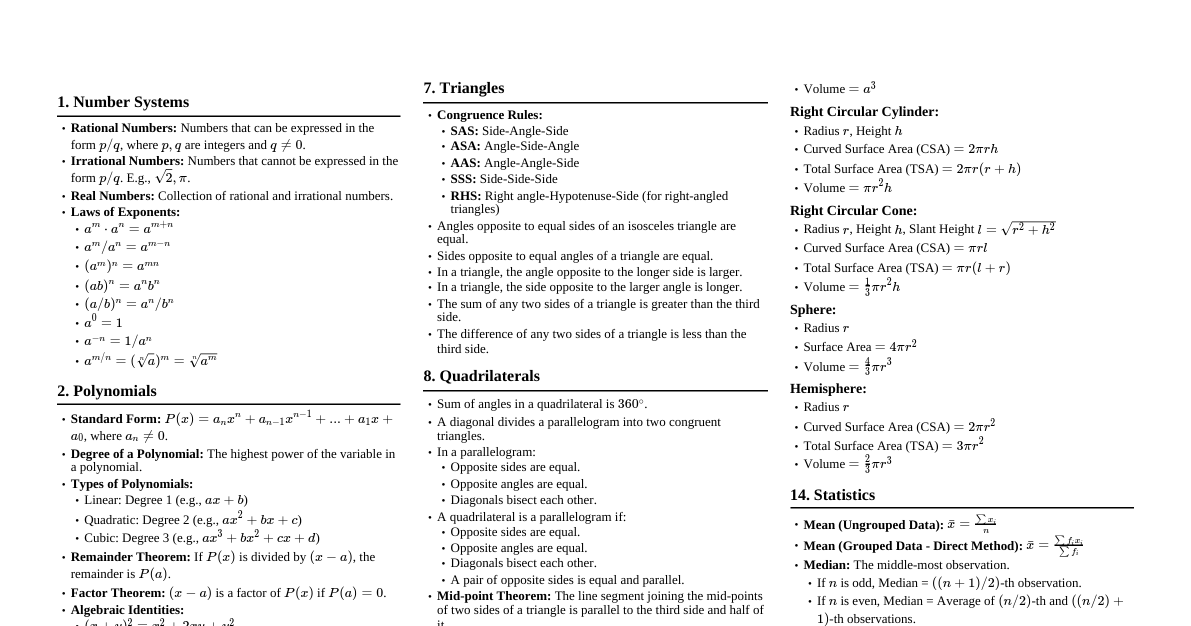
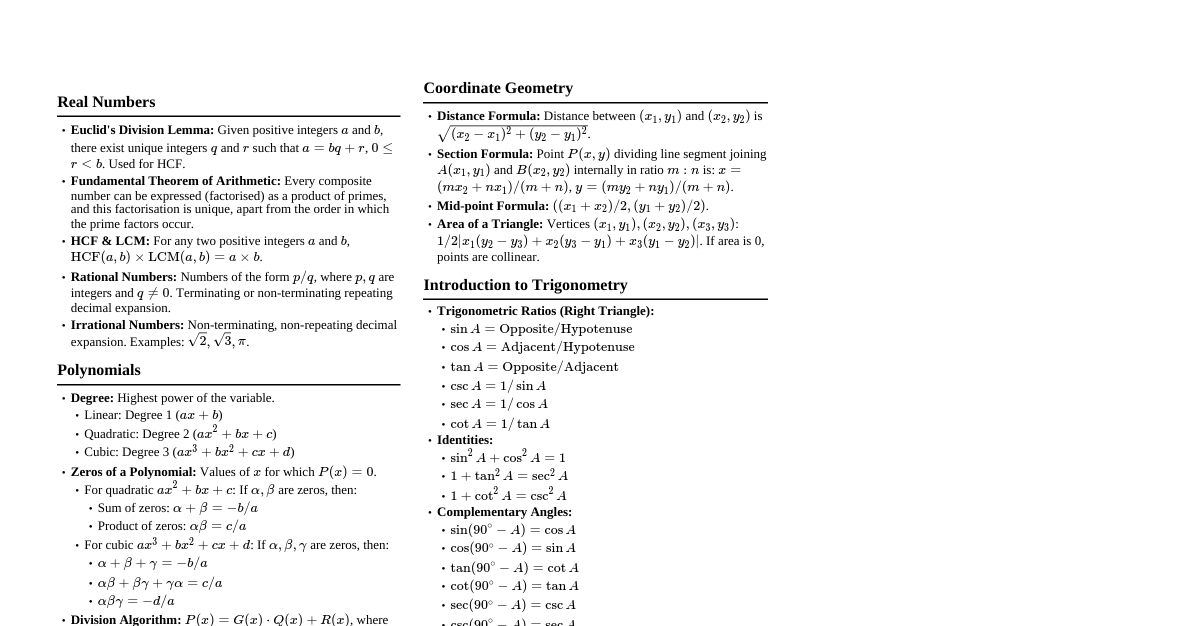
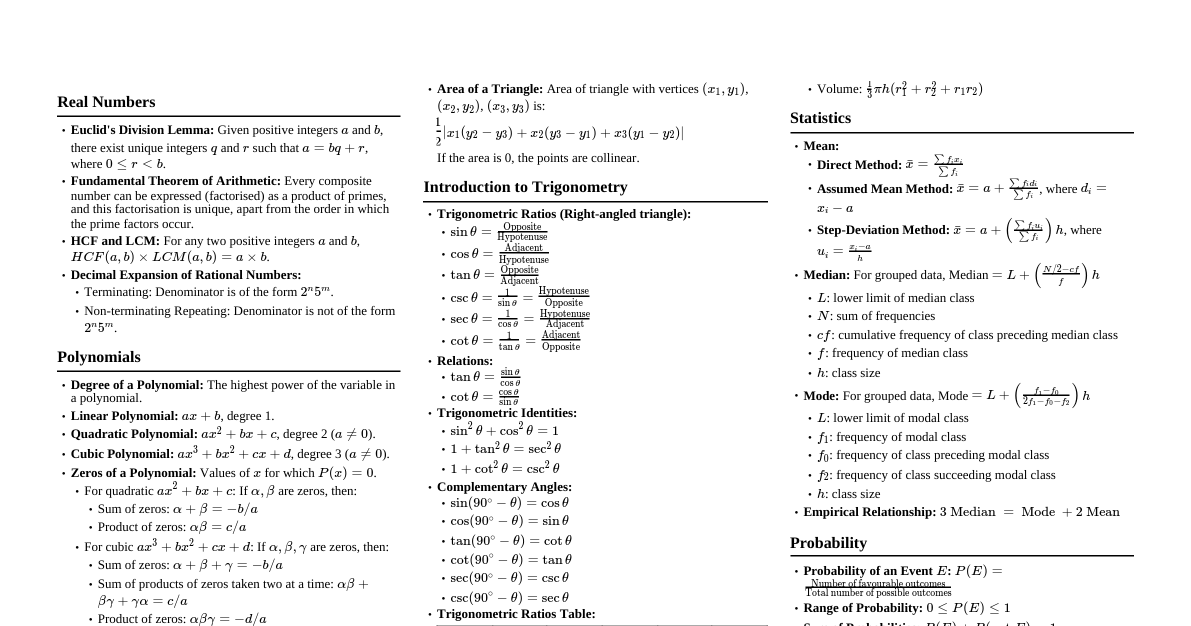
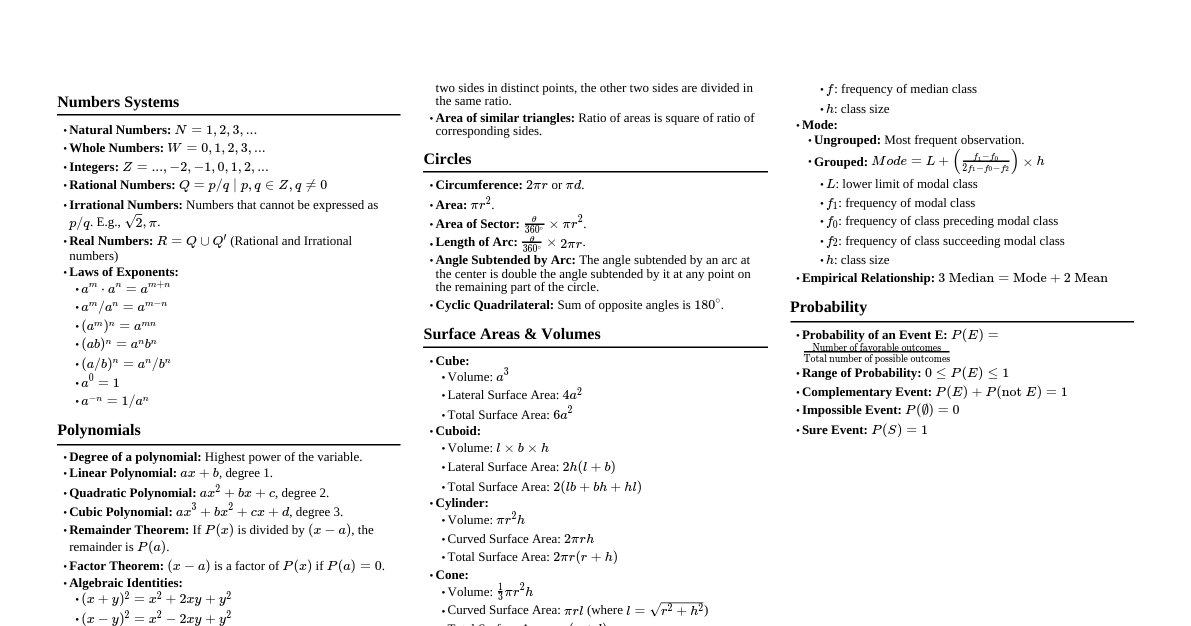
1. Number Systems Natural Numbers: $N = \{1, 2, 3, \dots\}$ Whole Numbers: $W = \{0, 1, 2, 3, \dots\}$ Integers: $Z = \{\dots, -2, -1, 0, 1, 2, \dots\}$ Rational Numbers: $Q = \{ \frac{p}{q} \mid p, q \in Z, q \neq 0 \}$ Irrational Numbers: Numbers that cannot be expressed in $\frac{p}{q}$ form (e.g., $\sqrt{2}, \pi$) Real Numbers: $R = Q \cup \text{Irrational Numbers}$ Laws of Exponents: $a^m \cdot a^n = a^{m+n}$ $(a^m)^n = a^{mn}$ $\frac{a^m}{a^n} = a^{m-n}$, if $m > n$ $a^0 = 1$ $a^{-n} = \frac{1}{a^n}$ $(ab)^n = a^n b^n$ $(\frac{a}{b})^n = \frac{a^n}{b^n}$ $a^{m/n} = (\sqrt[n]{a})^m = \sqrt[n]{a^m}$ 2. Polynomials Standard Form: $p(x) = a_n x^n + a_{n-1} x^{n-1} + \dots + a_1 x + a_0$ Degree of a Polynomial: The highest power of $x$. Types of Polynomials: Linear: $ax+b$ (degree 1) Quadratic: $ax^2+bx+c$ (degree 2) Cubic: $ax^3+bx^2+cx+d$ (degree 3) Remainder Theorem: If $p(x)$ is divided by $(x-a)$, the remainder is $p(a)$. Factor Theorem: $(x-a)$ is a factor of $p(x)$ if and only if $p(a)=0$. Algebraic Identities: $(a+b)^2 = a^2 + 2ab + b^2$ $(a-b)^2 = a^2 - 2ab + b^2$ $a^2 - b^2 = (a-b)(a+b)$ $(x+a)(x+b) = x^2 + (a+b)x + ab$ $(a+b+c)^2 = a^2+b^2+c^2+2ab+2bc+2ca$ $(a+b)^3 = a^3 + b^3 + 3ab(a+b) = a^3 + 3a^2b + 3ab^2 + b^3$ $(a-b)^3 = a^3 - b^3 - 3ab(a-b) = a^3 - 3a^2b + 3ab^2 - b^3$ $a^3 + b^3 = (a+b)(a^2 - ab + b^2)$ $a^3 - b^3 = (a-b)(a^2 + ab + b^2)$ $a^3+b^3+c^3-3abc = (a+b+c)(a^2+b^2+c^2-ab-bc-ca)$ If $a+b+c=0$, then $a^3+b^3+c^3 = 3abc$ 3. Coordinate Geometry Cartesian System: $(x,y)$ coordinates Quadrants: Q1: $(+,+)$ Q2: $(-,+)$ Q3: $(-,-)$ Q4: $(+,-)$ Origin: $(0,0)$ x-axis: Equation $y=0$ y-axis: Equation $x=0$ 4. Linear Equations in Two Variables Standard Form: $ax + by + c = 0$, where $a, b, c$ are real numbers, and $a, b \neq 0$. A linear equation has infinitely many solutions. The graph of a linear equation is a straight line. 5. Triangles Angle Sum Property: The sum of angles in a triangle is $180^\circ$. Exterior Angle Property: An exterior angle of a triangle is equal to the sum of the two opposite interior angles. Congruence Rules: SAS: Side-Angle-Side ASA: Angle-Side-Angle AAS: Angle-Angle-Side SSS: Side-Side-Side RHS: Right angle-Hypotenuse-Side (for right-angled triangles) Isosceles Triangle Properties: Angles opposite to equal sides are equal. Sides opposite to equal angles are equal. Inequalities in a Triangle: Side opposite to the larger angle is longer. Angle opposite to the longer side is larger. Sum of any two sides is greater than the third side. Difference of any two sides is less than the third side. 6. Quadrilaterals Angle Sum Property: Sum of angles in a quadrilateral is $360^\circ$. Types of Quadrilaterals: Parallelogram: Opposite sides are parallel and equal. Opposite angles are equal. Diagonals bisect each other. Rectangle: A parallelogram with all angles $90^\circ$. Diagonals are equal. Rhombus: A parallelogram with all sides equal. Diagonals bisect each other at $90^\circ$. Square: A rectangle with all sides equal (or a rhombus with all angles $90^\circ$). Diagonals are equal and bisect each other at $90^\circ$. Trapezium: One pair of opposite sides is parallel. Kite: Two distinct pairs of equal adjacent sides. Diagonals intersect at $90^\circ$. Mid-point Theorem: The line segment joining the mid-points of two sides of a triangle is parallel to the third side and half of its length. Converse of Mid-point Theorem: A line drawn through the mid-point of one side of a triangle parallel to another side bisects the third side. 7. Areas of Parallelograms and Triangles Area of a Parallelogram: Base $\times$ Height Area of a Triangle: $\frac{1}{2} \times$ Base $\times$ Height Triangles on the same base and between the same parallels: Have equal areas. Parallelograms on the same base and between the same parallels: Have equal areas. A median of a triangle divides it into two triangles of equal areas. 8. Circles Radius ($r$), Diameter ($d$): $d = 2r$ Circumference: $C = 2 \pi r = \pi d$ Area: $A = \pi r^2$ Chord: A line segment joining two points on the circle. Arc: A part of the circumference. Sector: Region bounded by two radii and an arc. Segment: Region bounded by a chord and an arc. The perpendicular from the center to a chord bisects the chord. Equal chords are equidistant from the center. Angles subtended by an arc at the center is double the angle subtended by it at any point on the remaining part of the circle. Angles in the same segment of a circle are equal. Angle in a semicircle is a right angle ($90^\circ$). Cyclic Quadrilateral: A quadrilateral whose all four vertices lie on a circle. Sum of opposite angles is $180^\circ$. 9. Constructions Basic constructions using ruler and compass: Bisecting an angle. Bisecting a line segment. Constructing angles ($60^\circ, 30^\circ, 90^\circ, 45^\circ, 15^\circ$, etc.). Constructing a triangle given specific conditions (e.g., base, base angle, sum/difference/perimeter of other sides). 10. Heron's Formula For a triangle with sides $a, b, c$: Semi-perimeter: $s = \frac{a+b+c}{2}$ Area of Triangle: $A = \sqrt{s(s-a)(s-b)(s-c)}$ Can be used to find the area of a quadrilateral by dividing it into two triangles. 11. Surface Areas and Volumes Cuboid: Length ($l$), Breadth ($b$), Height ($h$) Lateral Surface Area: $2h(l+b)$ Total Surface Area: $2(lb+bh+hl)$ Volume: $lbh$ Cube: Side ($a$) Lateral Surface Area: $4a^2$ Total Surface Area: $6a^2$ Volume: $a^3$ Right Circular Cylinder: Radius ($r$), Height ($h$) Curved Surface Area: $2\pi rh$ Total Surface Area: $2\pi r(r+h)$ Volume: $\pi r^2 h$ Right Circular Cone: Radius ($r$), Height ($h$), Slant Height ($l$) $l = \sqrt{r^2+h^2}$ Curved Surface Area: $\pi rl$ Total Surface Area: $\pi r(r+l)$ Volume: $\frac{1}{3}\pi r^2 h$ Sphere: Radius ($r$) Surface Area: $4\pi r^2$ Volume: $\frac{4}{3}\pi r^3$ Hemisphere: Radius ($r$) Curved Surface Area: $2\pi r^2$ Total Surface Area: $3\pi r^2$ Volume: $\frac{2}{3}\pi r^3$ 12. Statistics Measures of Central Tendency: Mean: For ungrouped data, $\bar{x} = \frac{\sum x_i}{n}$ Median: The middle value of data arranged in ascending/descending order. If $n$ is odd, Median = $(\frac{n+1}{2})^{th}$ observation. If $n$ is even, Median = $\frac{(\frac{n}{2})^{th} + (\frac{n}{2}+1)^{th}}{2}$ observation. Mode: The most frequently occurring observation. Frequency Distribution: Tally marks, frequency table. Graphical Representation: Bar graphs, Histograms (for continuous class intervals), Frequency Polygons. 13. Probability Probability of an Event E: $P(E) = \frac{\text{Number of favorable outcomes}}{\text{Total number of possible outcomes}}$ $0 \le P(E) \le 1$ Sum of probabilities of all elementary events is 1. $P(\text{event}) + P(\text{not event}) = 1$ An event that is impossible has probability 0. An event that is sure has probability 1.