NEET Practical Chemistry
Cheatsheet Content
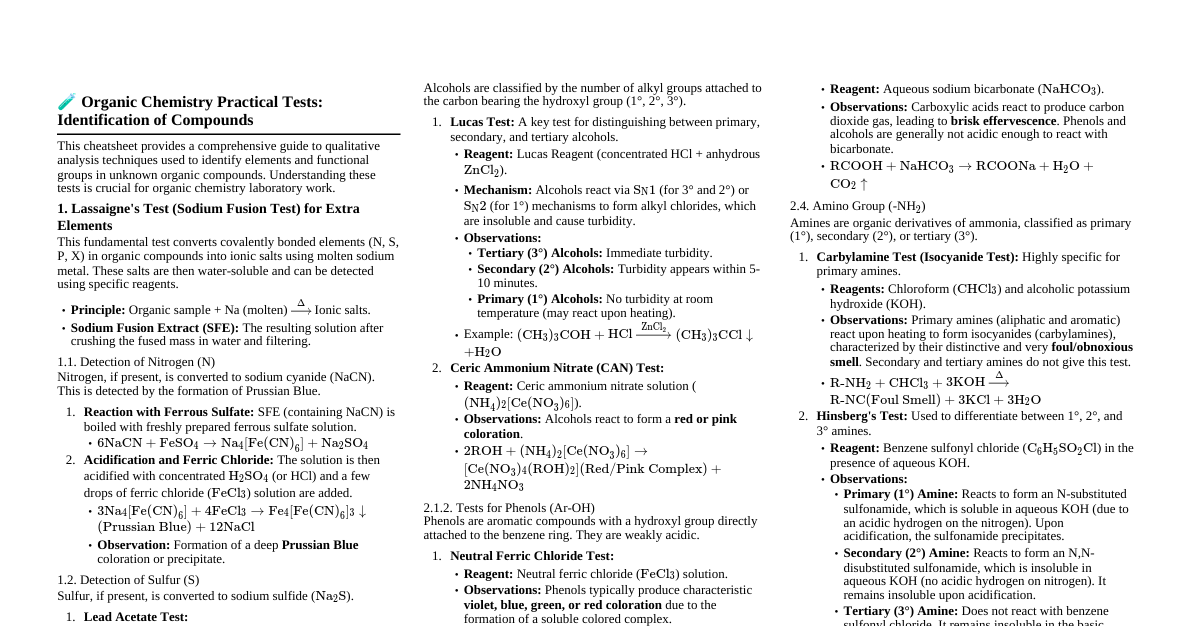
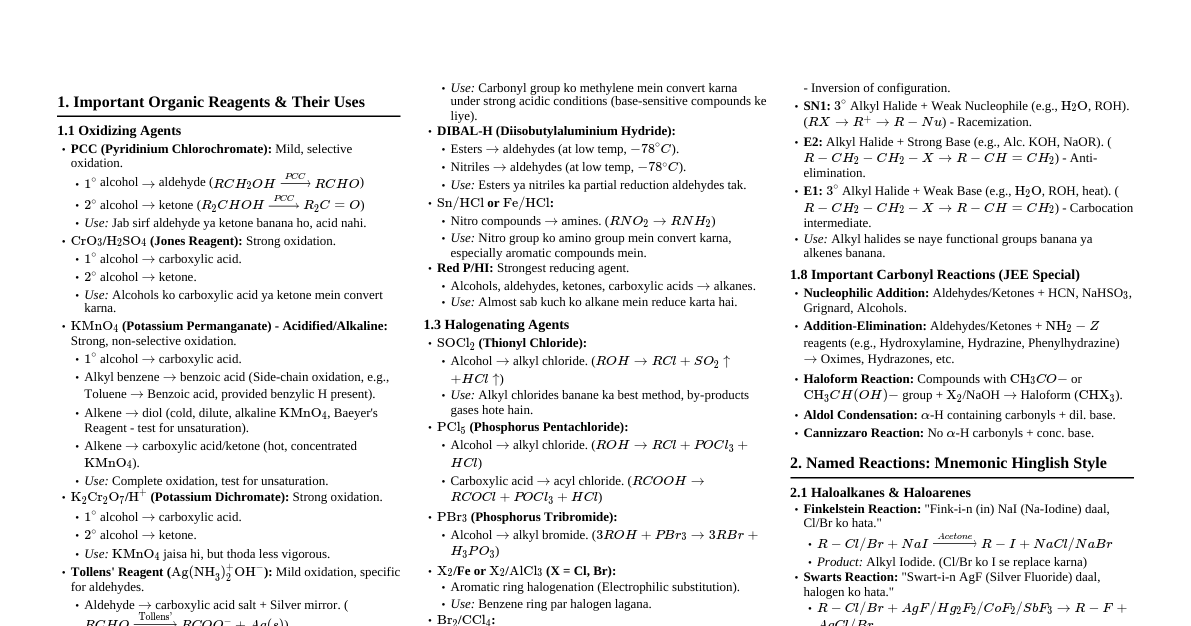
### Safety and Lab Practices - **General Rules:** - Always wear **lab coat** and **safety goggles**. - **Never taste** chemicals. - **Never return unused chemicals** to original bottles. - **Add acid to water slowly**, not water to acid. - Handle **flammable substances** away from open flames. - Dispose of waste properly. - **Heating Substances:** Use **test tube holder**, heat gently, keep mouth away from opening. - **Measuring Volumes:** Use **burette** for high precision titration, **pipette** for fixed volume transfer, **measuring cylinder** for approximate volumes. ### Qualitative Analysis (Inorganic) #### 1. Analysis of Cations (Group-wise Separation) - **Principle:** Differential solubility of their salts, mainly hydroxides and sulfides, in various media. - **Group Reagents:** - **Group 0 (Ammonium, NH₄⁺):** No specific group reagent. Identified by heating with NaOH. - **Reaction:** NH₄⁺ + NaOH $\xrightarrow{\Delta}$ NH₃↑ + Na⁺ + H₂O - **Test:** NH₃ gas turns **red litmus blue**, gives **white fumes with HCl** (NH₄Cl), and **brown precipitate with Nessler's reagent** ([Hg(NH₂)I] + NH₂I). - **Group I (Pb²⁺, Ag⁺, Hg₂²⁺):** Dilute HCl - **Precipitate:** Chlorides (PbCl₂, AgCl, Hg₂Cl₂) - **PbCl₂:** White ppt, soluble in hot water. Add K₂CrO₄ $\rightarrow$ Yellow ppt (PbCrO₄). - **AgCl:** White ppt, soluble in NH₄OH (forms [Ag(NH₃)₂]Cl). Add HNO₃ $\rightarrow$ regenerates AgCl. - **Hg₂Cl₂:** White ppt, turns black with NH₄OH (forms Hg + HgNH₂Cl). - **Group II (Pb²⁺, Cu²⁺, Cd²⁺, As³⁺, Sb³⁺, Sn²⁺/⁴⁺, Bi³⁺, Hg²⁺):** H₂S gas in acidic medium (dil. HCl) - **Precipitate:** Sulfides - **Subgroup IIA (insoluble in yellow ammonium sulfide - (NH₄)₂Sₓ):** CuS (black), CdS (yellow), HgS (black), PbS (black), Bi₂S₃ (black). - **CuS:** Black ppt. Soluble in HNO₃. Add NH₄OH $\rightarrow$ Blue solution ([Cu(NH₃)₄]²⁺). - **CdS:** Yellow ppt. Soluble in HNO₃. Add H₂S in presence of KCN $\rightarrow$ Yellow ppt. - **HgS:** Black ppt. Insoluble in HNO₃, soluble in Aqua Regia (HNO₃ + 3HCl). - **Subgroup IIB (soluble in yellow ammonium sulfide):** As₂S₃ (yellow), Sb₂S₃ (orange), SnS₂ (yellow). These are acid sulfides. - **As₂S₃:** Yellow ppt. Soluble in (NH₄)₂Sₓ. - **Sb₂S₃:** Orange ppt. Soluble in (NH₄)₂Sₓ. - **SnS₂:** Yellow ppt. Soluble in (NH₄)₂Sₓ. - **Group III (Al³⁺, Fe³⁺, Cr³⁺):** NH₄OH in presence of NH₄Cl - **Precipitate:** Hydroxides - **Al(OH)₃:** Gelatinous white ppt. Soluble in NaOH and excess NH₄OH, then reprecipitates on boiling. - **Fe(OH)₃:** Reddish-brown ppt. Insoluble in excess NH₄OH. - **Cr(OH)₃:** Green ppt. Soluble in excess NaOH (forms [Cr(OH)₄]⁻). - **Group IV (Zn²⁺, Mn²⁺, Ni²⁺, Co²⁺):** H₂S gas in ammoniacal medium (NH₄OH + NH₄Cl) - **Precipitate:** Sulfides - **ZnS:** White ppt. Soluble in dil. HCl. - **MnS:** Buff/flesh-colored ppt. Soluble in dil. HCl. - **NiS:** Black ppt. Soluble in hot dil. HCl/aqua regia. - **CoS:** Black ppt. Soluble in hot dil. HCl/aqua regia. - **Group V (Ba²⁺, Sr²⁺, Ca²⁺):** (NH₄)₂CO₃ in presence of NH₄OH + NH₄Cl - **Precipitate:** Carbonates - **BaCO₃:** White ppt. Soluble in acetic acid. Flame test: Apple green. - **SrCO₃:** White ppt. Soluble in acetic acid. Flame test: Crimson red. - **CaCO₃:** White ppt. Soluble in acetic acid. Flame test: Brick red. - **Group VI (Mg²⁺, K⁺, Na⁺):** No specific group reagent. - **Mg²⁺:** Precipitated as MgNH₄PO₄ (white ppt) with Na₂HPO₄ in ammoniacal medium. - **K⁺:** Flame test: Lilac. Precipitated by Sodium cobaltinitrite (yellow ppt) or Picric acid. - **Na⁺:** Flame test: Golden yellow. - **Lithium (Li⁺):** Flame test: Crimson red (often included here, but not a typical group VI). #### 2. Analysis of Anions - **Classification:** Based on reactions with dil. H₂SO₄ and conc. H₂SO₄. - **Group A (Evolved gas with dil. H₂SO₄):** CO₃²⁻, S²⁻, SO₃²⁻, NO₂⁻, CH₃COO⁻ - **CO₃²⁻:** CO₂ (colorless, odorless, turns limewater milky). - **S²⁻:** H₂S (rotten egg smell, turns lead acetate paper black). - **SO₃²⁻:** SO₂ (pungent, turns acidified K₂Cr₂O₇ green). - **NO₂⁻:** NO + NO₂ (brown fumes, turns FeSO₄ solution brown). - **CH₃COO⁻:** CH₃COOH (vinegar smell). - **Group B (Evolved gas with conc. H₂SO₄):** Cl⁻, Br⁻, I⁻, NO₃⁻, C₂O₄²⁻ - **Cl⁻:** HCl (pungent, white fumes with NH₃). Confirmatory: AgCl white ppt with AgNO₃. - **Br⁻:** HBr (colorless, turns reddish-brown with conc. H₂SO₄ due to Br₂). Confirmatory: AgBr pale yellow ppt. - **I⁻:** HI (colorless, turns violet with conc. H₂SO₄ due to I₂). Confirmatory: AgI yellow ppt. - **NO₃⁻:** NO₂ (reddish-brown fumes, brown ring test with FeSO₄/conc. H₂SO₄). - **C₂O₄²⁻ (Oxalate):** CO₂ + CO (CO₂ turns limewater milky, CO burns with blue flame). - **Group C (Special tests):** SO₄²⁻, PO₄³⁻, BO₃³⁻ - **SO₄²⁻:** BaSO₄ (white ppt) with BaCl₂ solution (insoluble in dil. HCl). - **PO₄³⁻:** Yellow ppt with Ammonium Molybdate (NH₄)₃PO₄.12MoO₃. - **BO₃³⁻:** Green edged flame test with conc. H₂SO₄/ethanol. #### 3. Flame Tests (for volatile salts of metals) - **Li⁺:** Crimson red - **Na⁺:** Golden yellow - **K⁺:** Lilac (violet) - **Rb⁺:** Red-violet - **Cs⁺:** Blue-violet - **Ca²⁺:** Brick red - **Sr²⁺:** Crimson red - **Ba²⁺:** Apple green - **Cu²⁺:** Blue/green (depending on halide/oxide) ### Qualitative Analysis (Organic) - **Lassaigne's Test (Detection of N, S, Halogens):** - **Principle:** Organic compounds are fused with Na metal to convert elements into ionic forms. - C, N, S, X $\xrightarrow{\text{Na fusion}}$ NaCN, Na₂S, NaX - **Procedure:** Heat organic compound with Na metal in fusion tube, plunge into distilled water, boil, filter (Lassaigne's extract). - **Detection of Nitrogen (N):** - **Reagents:** FeSO₄, FeCl₃, conc. H₂SO₄. - **Reaction:** NaCN + FeSO₄ $\rightarrow$ Na₄[Fe(CN)₆] (sodium ferrocyanide) - Na₄[Fe(CN)₆] + Fe³⁺ $\xrightarrow{\text{HCl}}$ Fe₄[Fe(CN)₆]₃ (Prussian Blue ppt). - **Result:** Prussian blue coloration/ppt. - **Detection of Sulfur (S):** - **Reagents:** Sodium nitroprusside solution. - **Reaction:** Na₂S + Na₂[Fe(CN)₅NO] $\rightarrow$ Na₄[Fe(CN)₅NOS] (Violet coloration). - **Result:** Violet coloration. - **Alternative:** Lead acetate test (black ppt of PbS). - **Detection of Halogens (X):** - **Reagents:** AgNO₃ solution, HNO₃. - **Reaction:** NaX + AgNO₃ $\rightarrow$ AgX (ppt). - **Cl:** White ppt of AgCl, soluble in NH₄OH. - **Br:** Pale yellow ppt of AgBr, sparingly soluble in NH₄OH. - **I:** Yellow ppt of AgI, insoluble in NH₄OH. - **Detection of Phosphorus (P):** - **Reagents:** Oxidize with Na₂O₂ to phosphate, then Ammonium Molybdate. - **Result:** Yellow ppt of ammonium phosphomolybdate. - **Detection of Oxygen (O):** No direct simple test like Lassaigne's. Inferred by difference or functional group tests. - **Functional Group Tests:** - **Unsaturation (C=C, C≡C):** - **Baeyer's Test:** Decolorizes cold, dilute, alkaline KMnO₄ (purple to colorless). - **Bromine Water Test:** Decolorizes bromine water (reddish-brown to colorless). - **Alcohols (R-OH):** - **Lucas Test (1°, 2°, 3° distinction):** - **Reagent:** Anhydrous ZnCl₂ + conc. HCl. - **3° alcohol:** Turbidity immediately (due to R-Cl formation). - **2° alcohol:** Turbidity within 5-10 minutes. - **1° alcohol:** No turbidity at room temperature. - **Esterification:** React with carboxylic acid in presence of conc. H₂SO₄ $\rightarrow$ fruity smell. - **Ceric Ammonium Nitrate Test:** Red color with alcohols. - **Phenols (Ar-OH):** - **Ferric Chloride Test:** Violet, green, or blue coloration. - **Bromine Water Test:** White ppt (substitution reaction). - **Aldehydes (R-CHO):** - **Tollens' Reagent (Ammoniacal AgNO₃):** Silver mirror formation. - **Fehling's Solution (Cu²⁺ complex):** Red ppt of Cu₂O. - **Schiff's Reagent:** Restores pink/magenta color. - **Ketones (R-CO-R'):** - **2,4-Dinitrophenylhydrazine (2,4-DNP) Test:** Forms yellow/orange ppt (characteristic of carbonyl compounds). - **Sodium Nitroprusside Test:** Red/orange color with ketones in alkaline medium. - **Carboxylic Acids (R-COOH):** - **Litmus Test:** Turns blue litmus red. - **Sodium Bicarbonate Test:** Effervescence (CO₂ gas) with NaHCO₃. - **Esterification:** With alcohol + conc. H₂SO₄ $\rightarrow$ fruity smell. - **Amines (R-NH₂, R₂NH, R₃N):** - **Hinsberg's Test (1°, 2°, 3° distinction):** - **Reagent:** Benzene sulfonyl chloride (C₆H₅SO₂Cl) + KOH. - **1° amine:** Forms N-alkylbenzenesulfonamide, soluble in KOH. Acidification regenerates insoluble sulfonamide. - **2° amine:** Forms N,N-dialkylbenzenesulfonamide, insoluble in KOH. - **3° amine:** No reaction with benzenesulfonyl chloride. - **Carbylamine Test (only for 1° aliphatic/aromatic amines):** Heat with CHCl₃ + alcoholic KOH $\rightarrow$ isocyanide (foul smell). - **Esters (R-COO-R'):** - **Hydrolysis:** Break down into carboxylic acid and alcohol. - **Ferric Hydroxamate Test:** Deep red color with FeCl₃ after hydroxamic acid formation. - **Carbohydrates:** - **Molisch's Test:** Purple ring at junction of two layers with α-naphthol/conc. H₂SO₄. - **Benedict's/Fehling's Test:** Red ppt with reducing sugars. - **Iodine Test:** Blue/black color with starch. ### Volumetric Analysis (Titrations) - **Principle:** Determining the concentration of an unknown solution by reacting it with a solution of known concentration (standard solution). - **Key Terms:** - **Titrant:** Solution of known concentration (in burette). - **Analyte/Titrand:** Solution of unknown concentration (in conical flask). - **Equivalence Point:** Stoichiometric completion of reaction. - **End Point:** Point where indicator changes color. - **Indicator:** Substance that changes color near equivalence point. - **Primary Standard:** High purity, stable, known molecular weight, non-hygroscopic substance used to prepare standard solutions directly. (e.g., K₂Cr₂O₇, Oxalic acid, Anhydrous Na₂CO₃). - **Secondary Standard:** Concentration determined by titration against a primary standard (e.g., NaOH, KMnO₄, HCl, H₂SO₄). - **Types of Titrations:** 1. **Acid-Base Titrations:** - **Principle:** Neutralization reaction. - **Indicators:** - **Strong Acid vs Strong Base:** Methyl Orange (red to yellow, pH 3.1-4.4), Phenolphthalein (colorless to pink, pH 8.2-10.0). Both work. - **Strong Acid vs Weak Base:** Methyl Orange (endpoint acidic). - **Weak Acid vs Strong Base:** Phenolphthalein (endpoint basic). - **Weak Acid vs Weak Base:** No suitable indicator, usually not done. - **Calculations:** N₁V₁ = N₂V₂ (for normalities), M₁V₁/n₁ = M₂V₂/n₂ (for molarities, n=stoichiometric coefficient). 2. **Redox Titrations:** - **Principle:** Electron transfer reactions. - **Common Oxidizing Agents:** KMnO₄, K₂Cr₂O₇. - **Common Reducing Agents:** Oxalic acid, FeSO₄, Na₂S₂O₃. - **KMnO₄ Titrations:** - **Self-indicator:** KMnO₄ is purple, its reduced form (Mn²⁺) is colorless. Endpoint is first persistent pink color. - **Medium:** Acidic (usually dil. H₂SO₄). Not HCl (Cl⁻ gets oxidized), not HNO₃ (oxidizing agent), not acetic acid (weak acid). - **Reaction with Oxalic acid:** 2KMnO₄ + 5(COOH)₂ + 3H₂SO₄ $\rightarrow$ K₂SO₄ + 2MnSO₄ + 10CO₂ + 8H₂O - **Reaction with FeSO₄:** 2KMnO₄ + 10FeSO₄ + 8H₂SO₄ $\rightarrow$ K₂SO₄ + 2MnSO₄ + 5Fe₂(SO₄)₃ + 8H₂O - **K₂Cr₂O₇ Titrations:** - **Indicator:** Diphenylamine (blue-violet color at endpoint). K₂Cr₂O₇ is orange, reduced form (Cr³⁺) is green. - **Medium:** Acidic (dil. H₂SO₄). 3. **Iodometric & Iodimetric Titrations:** - **Iodimetric:** I₂ is direct titrant. I₂ + 2Na₂S₂O₃ $\rightarrow$ 2NaI + Na₂S₄O₆. Starch indicator (blue to colorless). - **Iodometric:** I₂ is liberated by reaction, then titrated with Na₂S₂O₃. - e.g., 2CuSO₄ + 4KI $\rightarrow$ Cu₂I₂ + I₂ + 2K₂SO₄. Liberated I₂ is then titrated. - **Indicator:** Starch solution (added just before endpoint when solution turns pale yellow/straw color). - **Common Traps/Shortcuts:** - **Normality (N):** N = Molarity × n-factor. - **n-factor:** - **Acids:** Basicity (number of replaceable H⁺). - **Bases:** Acidity (number of replaceable OH⁻). - **Redox:** Total change in oxidation state per molecule. - e.g., KMnO₄: n=5 (acidic), n=3 (neutral), n=1 (alkaline). - **Dilution Formula:** M₁V₁ = M₂V₂ (for molarity). - **Percentage Purity:** (Mass of pure substance / Total mass of sample) × 100 - **Percentage Yield:** (Actual yield / Theoretical yield) × 100 ### Salt Analysis Flowchart (Visual Summary) ```mermaid graph TD A[Original Salt] --> B{Preliminary Tests}; B --> C{Dry Heating}; B --> D{Flame Test (for Group V/VI cations)}; B --> E{Charcoal Cavity Test (for Pb, Ag, Cu)}; B --> F{Borax Bead Test (for Co, Ni, Cr, Mn, Fe, Cu)}; G[Action with Dil. H₂SO₄] --> H{CO₃²⁻, S²⁻, SO₃²⁻, NO₂⁻, CH₃COO⁻}; H --> H1[CO₂ gas (Limewater milky)]; H --> H2[H₂S gas (Lead acetate black)]; H --> H3[SO₂ gas (K₂Cr₂O₇ green)]; H --> H4[NO + NO₂ (Brown fumes)]; H --> H5[CH₃COOH (Vinegar smell)]; I[Action with Conc. H₂SO₄] --> J{Cl⁻, Br⁻, I⁻, NO₃⁻, C₂O₄²⁻}; J --> J1[HCl gas (AgNO₃ white ppt)]; J --> J2[HBr + Br₂ (Reddish-brown fumes)]; J --> J3[HI + I₂ (Violet fumes)]; J --> J4[NO₂ (Brown ring test)]; J --> J5[CO₂ + CO (Oxalate)]; K[Special Tests for Anions] --> L{SO₄²⁻, PO₄³⁻, BO₃³⁻}; L --> L1[SO₄²⁻ (BaCl₂ white ppt)]; L --> L2[PO₄³⁻ (Ammonium Molybdate yellow ppt)]; L --> L3[BO₃³⁻ (Green edged flame)]; M[Cation Analysis (Group Separation)] --> M0{Group 0 (NH₄⁺)}; M0 --> M0a[NH₃ gas with NaOH]; M --> M1{Group I (Pb²⁺, Ag⁺, Hg₂²⁺)}; M1 --> M1a[Dil. HCl ppt (Chlorides)]; M --> M2{Group II (Pb²⁺, Cu²⁺, etc.)}; M2 --> M2a[H₂S/HCl ppt (Sulfides)]; M --> M3{Group III (Al³⁺, Fe³⁺, Cr³⁺)}; M3 --> M3a[NH₄OH/NH₄Cl ppt (Hydroxides)]; M --> M4{Group IV (Zn²⁺, Mn²⁺, Ni²⁺, Co²⁺)}; M4 --> M4a[H₂S/NH₄OH/NH₄Cl ppt (Sulfides)]; M --> M5{Group V (Ba²⁺, Sr²⁺, Ca²⁺)}; M5 --> M5a[(NH₄)₂CO₃ ppt (Carbonates)]; M --> M6{Group VI (Mg²⁺, K⁺, Na⁺)}; M6 --> M6a[Specific tests/Flame tests]; ``` ### Organic Functional Group Tests Flowchart (Visual Summary) ```mermaid graph TD A[Organic Compound] --> B{Lassaigne's Test}; B --> B1[N: Prussian Blue (FeSO₄/FeCl₃)]; B --> B2[S: Violet (Nitroprusside)]; B --> B3[X: AgX ppt (AgNO₃)]; C[Unsaturation] --> C1{Baeyer's Test: Decolorizes KMnO₄}; C --> C2{Bromine Water: Decolorizes Br₂}; D[Alcohols] --> D1{Lucas Test: Turbidity (3° > 2° > 1°)}; D --> D2{Ceric Ammonium Nitrate: Red Color}; E[Phenols] --> E1{FeCl₃ Test: Violet/Green/Blue color}; E --> E2{Bromine Water: White ppt}; F[Aldehydes] --> F1{Tollens' Test: Silver Mirror}; F --> F2{Fehling's Test: Red ppt}; F --> F3{Schiff's Reagent: Pink/Magenta color}; G[Ketones] --> G1{2,4-DNP Test: Yellow/Orange ppt}; G --> G2{Sodium Nitroprusside: Red/Orange color}; H[Carboxylic Acids] --> H1{Litmus: Blue to Red}; H --> H2{NaHCO₃: Effervescence (CO₂)}; I[Amines] --> I1{Hinsberg's Test: Differentiate 1°, 2°, 3°}; I --> I2{Carbylamine Test: Foul smell (1° only)}; J[Carbohydrates] --> J1{Molisch's Test: Purple Ring}; J --> J2{Benedict's/Fehling's: Red ppt (Reducing sugars)}; J --> J3{Iodine Test: Blue/Black (Starch)}; ``` ### Important Mnemonics & Tricks - **Cationic Groups:** - **0:** **N**o **H**ydrogen (**NH₄⁺**) - **1:** **P**lease **A**sk **H**im (**Pb²⁺, Ag⁺, Hg₂²⁺**) - **2:** **C**an **C**u **H**ave **B**right **A**pple **S**lices **S**oon **S**weet? (**Cu²⁺, Cd²⁺, Hg²⁺, Bi³⁺, As³⁺, Sb³⁺, Sn²⁺/⁴⁺** - *Note: Pb²⁺ also in Gp I & IIA*) - **3:** **A**ll **F**or **C**hristmas (**Al³⁺, Fe³⁺, Cr³⁺**) - **4:** **Z**oo **M**an **N**ever **C**ool (**Zn²⁺, Mn²⁺, Ni²⁺, Co²⁺**) - **5:** **B**ring **S**ome **C**abbage (**Ba²⁺, Sr²⁺, Ca²⁺**) - **6:** **M**any **K**ings **N**avigate (**Mg²⁺, K⁺, Na⁺**) - **Anions with Dil. H₂SO₄:** **C**ool **S**isters **S**ing **N**ice **A**lways (**CO₃²⁻, S²⁻, SO₃²⁻, NO₂⁻, CH₃COO⁻**) - **Anions with Conc. H₂SO₄:** **C**an **B**ring **I**n **N**ice **C**akes (**Cl⁻, Br⁻, I⁻, NO₃⁻, C₂O₄²⁻**) - **Flame Colors:** - **Li:** **Li**ght **C**rimson - **Na:** **Na**ked **Y**ellow - **K:** **K**ool **L**ilac - **Ca:** **Ca**lcium **B**rick **R**ed - **Sr:** **Sr**ong **C**rimson - **Ba:** **Ba**sic **A**pple **G**reen - **Cu:** **Cu**te **B**lue/Green - **Lucas Reagent:** "3° is fast, 2° is slow, 1° won't go." (Turbidity rate) - **Tollens' vs Fehling's:** - **Tollens' (Ammoniacal AgNO₃):** Mild oxidizing agent. Gives silver mirror with **aldehydes** and **alpha-hydroxy ketones**. - **Fehling's (Alkaline Cu²⁺ complex):** Stronger oxidizing agent. Gives red ppt with **aliphatic aldehydes** and **alpha-hydroxy ketones**. **Aromatic aldehydes** generally don't react. - **Oxalic Acid vs KMnO₄:** In redox, remember the stoichiometric ratio 2:5 for KMnO₄:Oxalic acid. ### Common Traps & Edge Cases - **Pb²⁺:** Present in both Group I (as PbCl₂) and Group II (as PbS). If group I ppt is soluble in hot water, it's PbCl₂. - **Hg₂²⁺ vs Hg²⁺:** Hg₂²⁺ (Group I) gives black ppt with NH₄OH. Hg²⁺ (Group II) gives black ppt of HgS. - **NH₄⁺:** Test should be done before adding any group reagents, as NH₄⁺ salts are added as reagents (NH₄Cl, NH₄OH). - **Interference of Oxalate/Phosphate:** If PO₄³⁻ or C₂O₄²⁻ are present, Group III precipitation might be incomplete or lead to false positives in later groups. Special procedures are needed to remove them. (e.g., adding conc. HNO₃ and boiling). - **SO₂ vs CO₂:** Both are colorless gases. SO₂ has pungent smell, turns acidified K₂Cr₂O₇ green. CO₂ is odorless, turns limewater milky. - **NO₂⁻ vs NO₃⁻:** NO₂⁻ gives brown fumes (NO + NO₂) with dil. H₂SO₄. NO₃⁻ gives brown ring with conc. H₂SO₄/FeSO₄. - **Distinguishing 1°, 2°, 3° alcohols:** Lucas test is key. - **Distinguishing Aldehydes and Ketones:** Tollens' and Fehling's are for aldehydes. 2,4-DNP is for all carbonyls. - **Phenols vs Alcohols:** Phenols give color with FeCl₃, alcohols don't. Phenols are acidic, alcohols are neutral. - **Lassaigne's Test Failures:** - If fusion is incomplete, elements may not convert to ionic form. - If excess Na is used, NaCN can react to form Na₂S or NaX, reducing N detection. - If S and N are both present, NaSCN is formed, which gives blood-red color with FeCl₃ (not Prussian blue). To detect N and S separately, decompose NaSCN by boiling with conc. HCl. - **Indicators:** Choose carefully based on the strength of acid and base. Wrong indicator leads to inaccurate endpoint. - **KMnO₄ as self-indicator:** Only in acidic medium. In neutral/alkaline, MnO₂ is formed, which is brown and obscures endpoint. - **Starch indicator:** Not added at beginning of iodometric/iodimetric titration, only near endpoint, as it forms stable blue complex with I₂ which is hard to break.