Diffraction Essentials
Cheatsheet Content
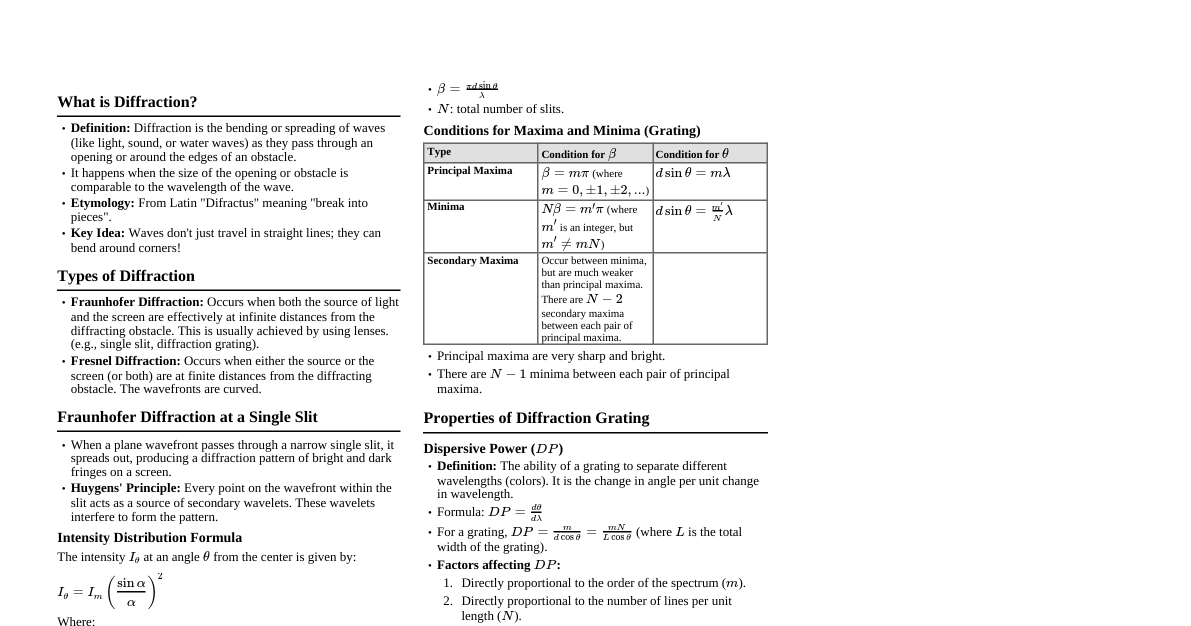
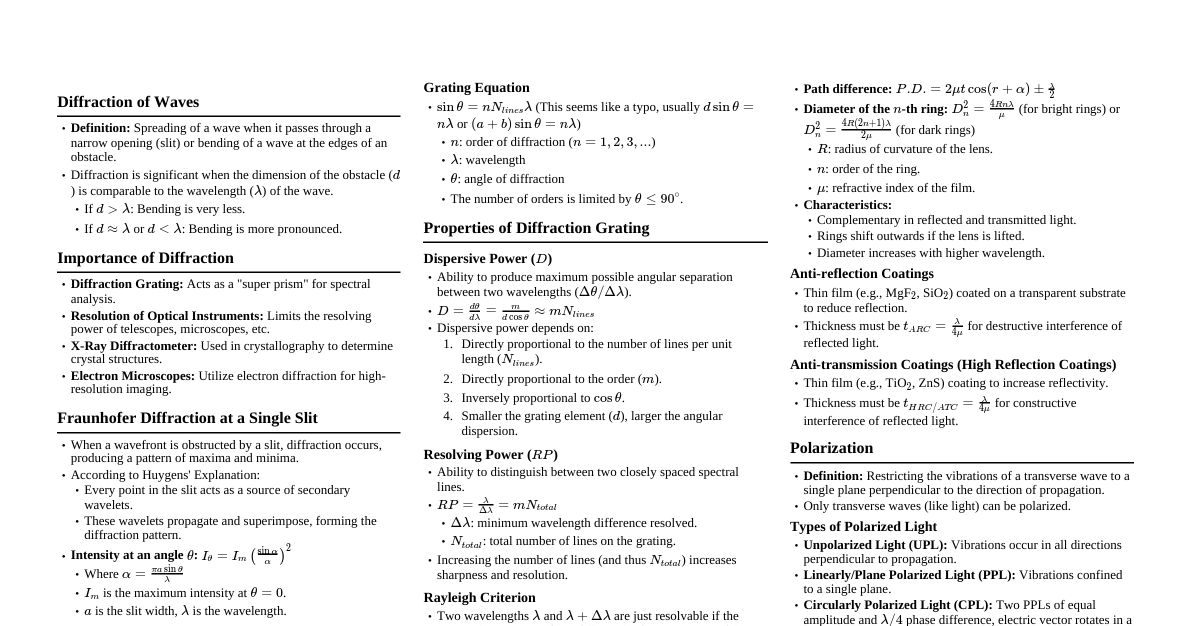
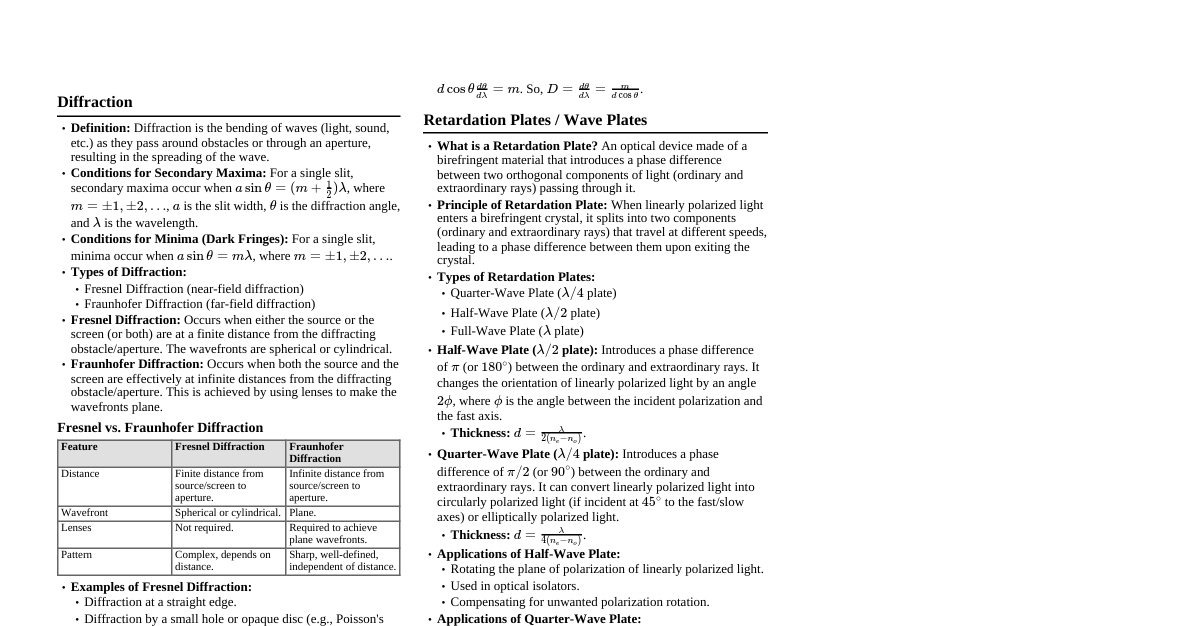
1. What is Diffraction? Definition: Diffraction is the spreading of waves when they pass through a narrow opening (slit) or bend around the edges of an obstacle. Key Condition: Diffraction is significant when the size of the obstacle or opening ($d$) is comparable to or smaller than the wavelength ($\lambda$) of the wave. If $d > \lambda$: Bending (diffraction) is very small. If $d \approx \lambda$ or $d Huygen's Explanation: Every point on a wavefront passing through a slit acts as a source of secondary wavelets, which superpose to create a diffraction pattern of maxima and minima. 2. Importance of Diffraction in Engineering & Technology Diffraction Grating: Acts as a "super prism" for separating light into its component wavelengths. Resolution of Optical Instruments: Diffraction limits the ability of telescopes, microscopes, etc., to distinguish between closely spaced objects. Bigger Telescopes are Better: Larger lenses reduce diffraction effects, leading to sharper images and better resolution. Electron Microscopes are Better: Electrons have much smaller wavelengths than light, allowing electron microscopes to achieve incredibly high resolution and magnification. X-Ray Diffractometer: Used in crystallography to study the atomic and molecular structure of crystals. Electron Microscopes: Utilize electron diffraction for imaging at very high magnifications. Radars: Precise control of diffraction effects in radar systems (e.g., with bigger or multi-antenna radars) leads to better resolution. 3. Fraunhofer Diffraction at a Single Slit Intensity at an angle $\theta$: $$I_{\theta} = I_m \left( \frac{\sin\alpha}{\alpha} \right)^2$$ where $\alpha = \frac{\pi a \sin\theta}{\lambda}$ $I_m$: Maximum intensity at $\theta = 0$ (center). $a$: Width of the single slit. $\lambda$: Wavelength of light. Conditions for Maxima and Minima (Single Slit) Type Condition for $\alpha$ Condition for $\theta$ Central Maximum $\alpha = 0$ $\theta = 0$ Minima $\alpha = m\pi$ (where $m = \pm1, \pm2, \dots$) $a \sin\theta = m\lambda$ Secondary Maxima $\alpha = (m + \frac{1}{2})\pi$ (where $m = \pm1, \pm2, \dots$) $a \sin\theta = (m + \frac{1}{2})\lambda$ Characteristics: Results in widening of images. Diffraction depends on the wavelength and size of the obstacle. Resolving power of electron microscopes is incredibly higher than optical microscopes. 4. Diffraction Grating Definition: An optical component with a large number of evenly spaced parallel slits. It disperses composite light into its component wavelengths (colors). Grating Element ($d$): The distance between the centers of two consecutive slits. $d = a + b = 1/N$ $a$: Width of the transparent portion (slit). $b$: Width of the opaque portion. $N$: Number of lines per unit length. Grating Equation: Relates the angle of diffraction to the wavelength and grating properties. $$d \sin\theta = n\lambda$$ $n$: Order of the spectrum ($n=0, 1, 2, \dots$). $\theta$: Angle of diffraction. Note: $\theta$ cannot exceed $90^\circ$, limiting the number of orders ($n$). Intensity at an angle $\theta$ for Multiple Slits (Grating): $$I_{\theta} = N^2 I_m \left( \frac{\sin\alpha}{\alpha} \right)^2 \left( \frac{\sin N\beta}{\sin\beta} \right)^2$$ where $\alpha = \frac{\pi a \sin\theta}{\lambda}$ and $\beta = \frac{\pi d \sin\theta}{\lambda}$ Conditions for Maxima and Minima (Diffraction Grating) Type Condition for $\beta$ Condition for $\theta$ Principal Maxima $\beta = m\pi$ (where $m=0, \pm1, \pm2, \dots$) $d \sin\theta = m\lambda$ Minima $N\beta = m'\pi$ (where $m' \neq mN$) $d \sin\theta = \frac{m'}{N}\lambda$ Benefits over Single Slit: Maxima are much sharper and brighter. Several secondary maxima are introduced between consecutive principal maxima. 5. Properties of Diffraction Grating Dispersive Power ($D$) Definition: The ability of a grating to produce a maximum possible angular separation between two closely spaced wavelengths ($\lambda$ and $\lambda + d\lambda$). $$D = \frac{d\theta}{d\lambda} = \frac{m}{d \cos\theta}$$ Factors Affecting Dispersive Power: Directly proportional to the number of lines per unit length ($N$) of the grating. Directly proportional to the order of the spectrum ($m$). Inversely proportional to $\cos\theta$. A smaller grating element ($d$) leads to larger angular dispersion. Resolving Power ($R$) Definition: The ability of an instrument to distinguish (resolve) between two wavelengths ($\lambda$ and $\lambda + d\lambda$) that are extremely close to each other. $$R = \frac{\lambda}{d\lambda}$$ For a Diffraction Grating: $$R = Nm$$ $N$: Total number of lines on the grating. $m$: Order of the spectrum. Rayleigh Criterion: Two spectral lines are just resolved when the principal maximum of one falls on the first minimum of the other. For Telescopes & Similar Instruments: $$R.P. = \frac{1}{\theta_R} = \frac{D}{1.22\lambda}$$ where $D$ is the diameter of the objective lens. Improving Resolution: Increasing the number of lines ($N$) or the order ($m$) increases the resolving power, leading to sharper and better-separated spectral lines.