Diffraction Essentials
Cheatsheet Content
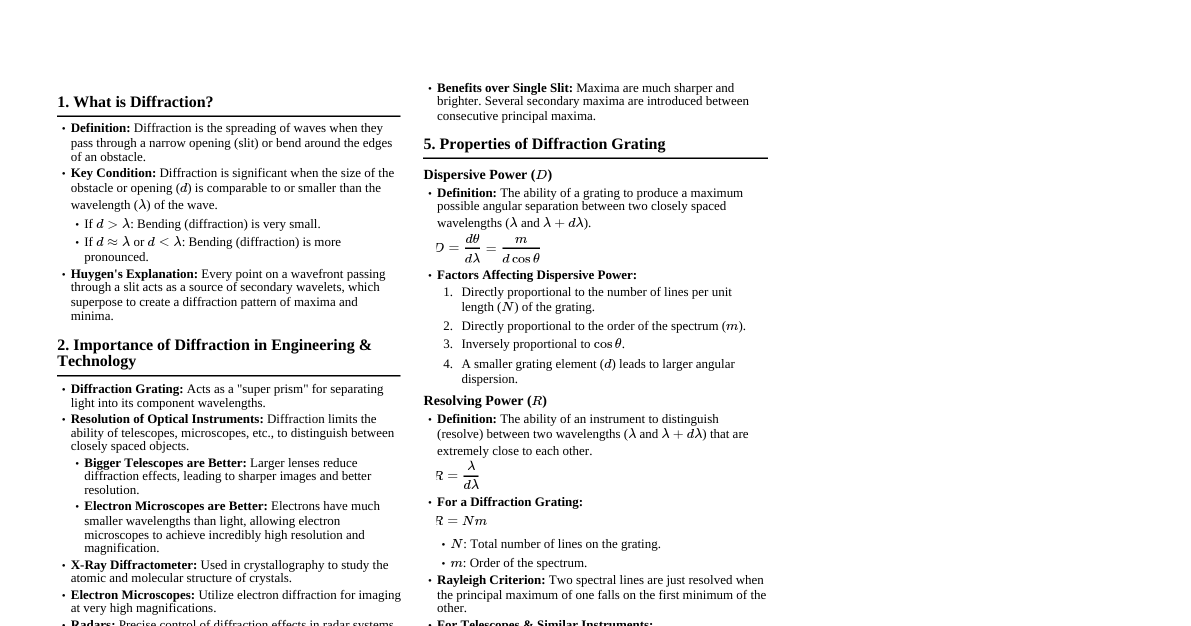
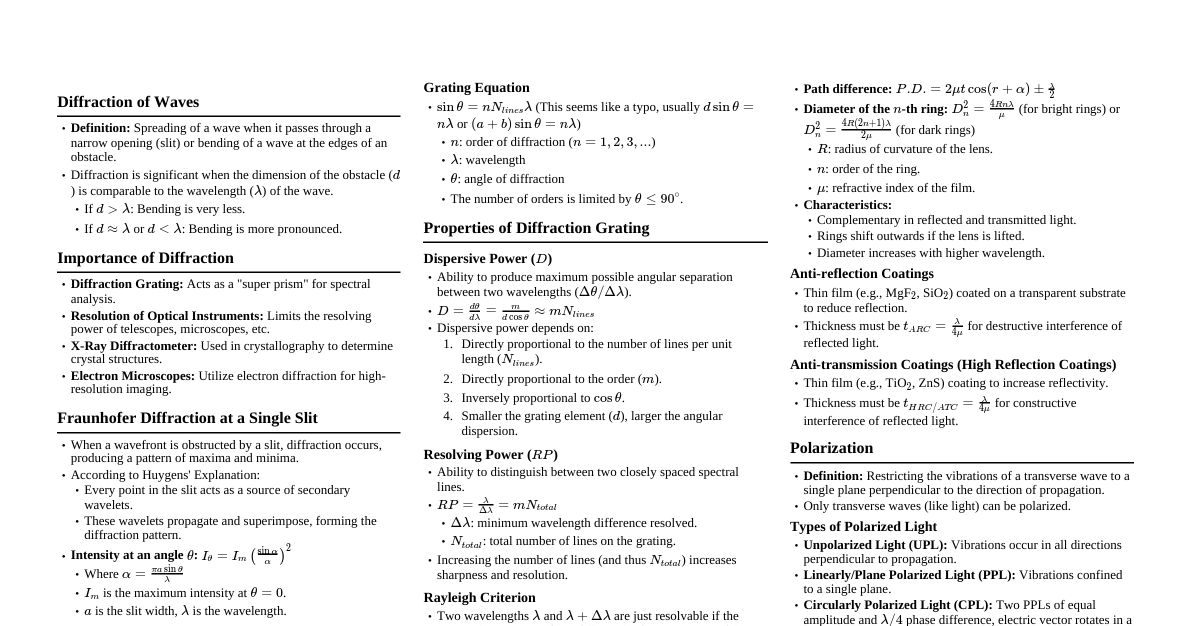
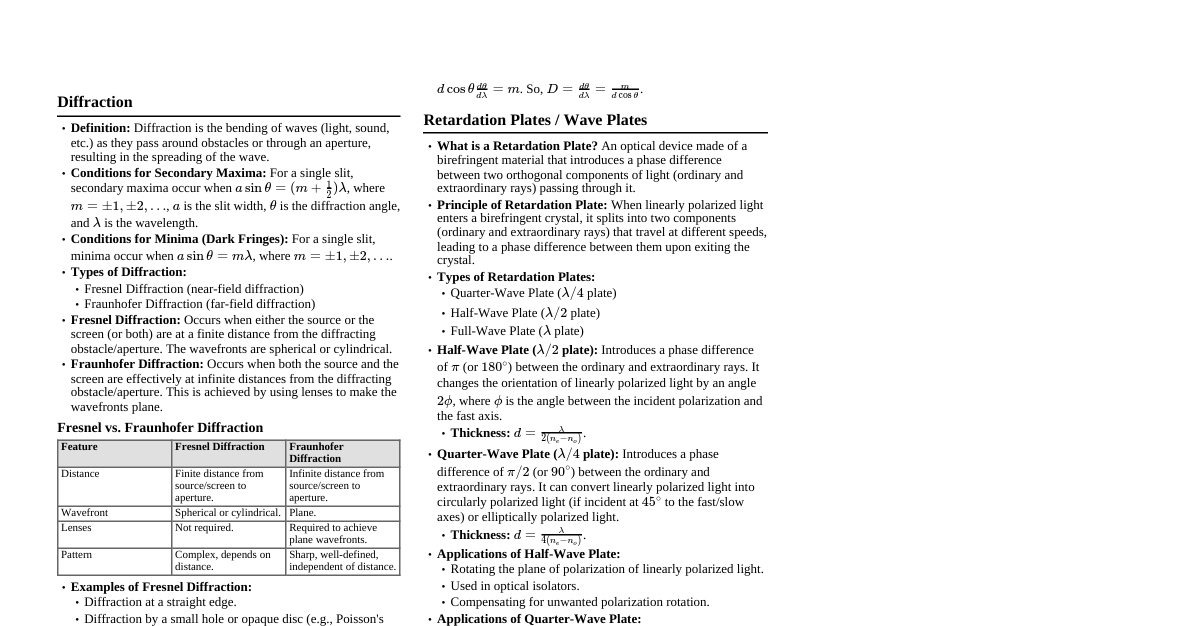
What is Diffraction? Definition: Diffraction is the bending or spreading of waves (like light, sound, or water waves) as they pass through an opening or around the edges of an obstacle. It happens when the size of the opening or obstacle is comparable to the wavelength of the wave. Etymology: From Latin "Difractus" meaning "break into pieces". Key Idea: Waves don't just travel in straight lines; they can bend around corners! Types of Diffraction Fraunhofer Diffraction: Occurs when both the source of light and the screen are effectively at infinite distances from the diffracting obstacle. This is usually achieved by using lenses. (e.g., single slit, diffraction grating). Fresnel Diffraction: Occurs when either the source or the screen (or both) are at finite distances from the diffracting obstacle. The wavefronts are curved. Fraunhofer Diffraction at a Single Slit When a plane wavefront passes through a narrow single slit, it spreads out, producing a diffraction pattern of bright and dark fringes on a screen. Huygens' Principle: Every point on the wavefront within the slit acts as a source of secondary wavelets. These wavelets interfere to form the pattern. Intensity Distribution Formula The intensity $I_\theta$ at an angle $\theta$ from the center is given by: $$I_\theta = I_m \left( \frac{\sin \alpha}{\alpha} \right)^2$$ Where: $I_m$ is the maximum intensity at the center ($\theta = 0$). $\alpha = \frac{\pi a \sin \theta}{\lambda}$ $a$ is the width of the slit. $\lambda$ is the wavelength of light. Conditions for Maxima and Minima (Single Slit) Type Condition for $\alpha$ Condition for $\theta$ Central Maximum $\alpha = 0$ $\theta = 0$ Minima (Dark Fringes) $\alpha = m\pi$ (where $m = \pm 1, \pm 2, ...$) $a \sin \theta = m\lambda$ Secondary Maxima (Bright Fringes) $\alpha = \left( m + \frac{1}{2} \right)\pi$ (where $m = \pm 1, \pm 2, ...$) $a \sin \theta = \left( m + \frac{1}{2} \right)\lambda$ The central maximum is the brightest and widest. Secondary maxima are much less intense and narrower. Characteristics of Single Slit Diffraction Results in widening of images. Diffraction depends on the wavelength of the wave and the size of the obstacle. Angular width of central maximum: $2\theta = \frac{2\lambda}{a}$ (for small $\theta$). Can be used to measure the thickness of a thin wire. Diffraction Grating An optical component with a large number of evenly spaced parallel slits (or lines). It acts like a "super prism." Made by ruling fine lines on a transparent material (transmission grating) or a reflecting surface (reflection grating). The ruled (scratched) parts are opaque, and the unruled (unscratched) parts are transparent, acting as slits. It disperses composite light into its component wavelengths (colors) much more effectively than a prism. Grating Element ($d$) The distance between the centers of two consecutive slits. $d = a + b = \frac{1}{N}$ $a$: width of the transparent portion (slit). $b$: width of the opaque portion. $N$: number of lines (slits) per unit length of the grating. Grating Equation (Condition for Principal Maxima) For a diffraction grating, the condition for constructive interference (bright fringes or principal maxima) is: $$d \sin \theta = n \lambda$$ Where: $d$: grating element. $\theta$: angle of diffraction. $n$: order of the maximum ($n=0, \pm 1, \pm 2, ...$). $\lambda$: wavelength of light. The number of orders ($n$) is limited by $\sin \theta \le 1$, so $n_{max} = \frac{d}{\lambda}$. Intensity Distribution for Multiple Slits (Grating) The intensity $I_\theta$ at an angle $\theta$ for $N$ slits is: $$I_\theta = N^2 I_m \left( \frac{\sin \alpha}{\alpha} \right)^2 \left( \frac{\sin N\beta}{\sin \beta} \right)^2$$ Where: $\alpha = \frac{\pi a \sin \theta}{\lambda}$ $\beta = \frac{\pi d \sin \theta}{\lambda}$ $N$: total number of slits. Conditions for Maxima and Minima (Grating) Type Condition for $\beta$ Condition for $\theta$ Principal Maxima $\beta = m\pi$ (where $m = 0, \pm 1, \pm 2, ...$) $d \sin \theta = m\lambda$ Minima $N\beta = m'\pi$ (where $m'$ is an integer, but $m' \ne mN$) $d \sin \theta = \frac{m'}{N}\lambda$ Secondary Maxima Occur between minima, but are much weaker than principal maxima. There are $N-2$ secondary maxima between each pair of principal maxima. Principal maxima are very sharp and bright. There are $N-1$ minima between each pair of principal maxima. Properties of Diffraction Grating Dispersive Power ($DP$) Definition: The ability of a grating to separate different wavelengths (colors). It is the change in angle per unit change in wavelength. Formula: $DP = \frac{d\theta}{d\lambda}$ For a grating, $DP = \frac{m}{d \cos \theta} = \frac{mN}{L \cos \theta}$ (where $L$ is the total width of the grating). Factors affecting $DP$: Directly proportional to the order of the spectrum ($m$). Directly proportional to the number of lines per unit length ($N$). Inversely proportional to $\cos \theta$. Smaller grating element ($d$) means larger dispersive power. Resolving Power ($RP$) Definition: The ability of an optical instrument to distinguish between two closely spaced wavelengths (or objects). Formula: $RP = \frac{\lambda}{d\lambda}$ (where $d\lambda$ is the minimum resolvable wavelength difference). For a grating, $RP = Nm$. Factors affecting $RP$: Directly proportional to the total number of lines ($N$) on the grating. Directly proportional to the order of the spectrum ($m$). Higher resolving power means sharper and better-separated spectral lines. Rayleigh Criterion Definition: Two nearby objects (or spectral lines) are said to be just resolved when the central maximum of the diffraction pattern of one falls on the first minimum of the diffraction pattern of the other. For a circular aperture (like a telescope or microscope lens), the minimum resolvable angle $\theta_R$ is: $$\theta_R = \frac{1.22 \lambda}{D}$$ Where $D$ is the diameter of the aperture. The Resolving Power for telescopes is $RP = \frac{1}{\theta_R} = \frac{D}{1.22 \lambda}$. Importance of Diffraction in Engineering and Technology Diffraction Gratings: Used in spectrometers to analyze the composition of light sources, in telecommunications for wavelength division multiplexing (WDM), and as "super prisms" for high-resolution spectroscopy. Optical Instruments Resolution: Diffraction limits the resolving power of telescopes, microscopes, and cameras. Understanding diffraction helps design instruments with higher resolution. Telescopes: Larger aperture ($D$) improves resolution ($RP \propto D$), allowing us to distinguish distant stars more clearly. Microscopes: Shorter wavelengths ($\lambda$) provide better resolution ($RP \propto 1/\lambda$). This is why electron microscopes offer much higher resolution than optical microscopes, as electrons have much smaller wavelengths. X-Ray Diffraction (XRD): Crucial for crystallography, determining the atomic and molecular structure of materials (e.g., metals, minerals, DNA). Electron Microscopes: Utilize the wave nature of electrons (with very small wavelengths) to achieve extremely high magnification and resolution, allowing us to visualize structures at the nanoscale. Radars: Diffraction effects are considered in antenna design for better signal reception and resolution, especially with multi-antenna systems. Holography: Diffraction is the fundamental principle behind holography, which records and reconstructs 3D images.