Cell and Cytoskeleton Essentials
Cheatsheet Content
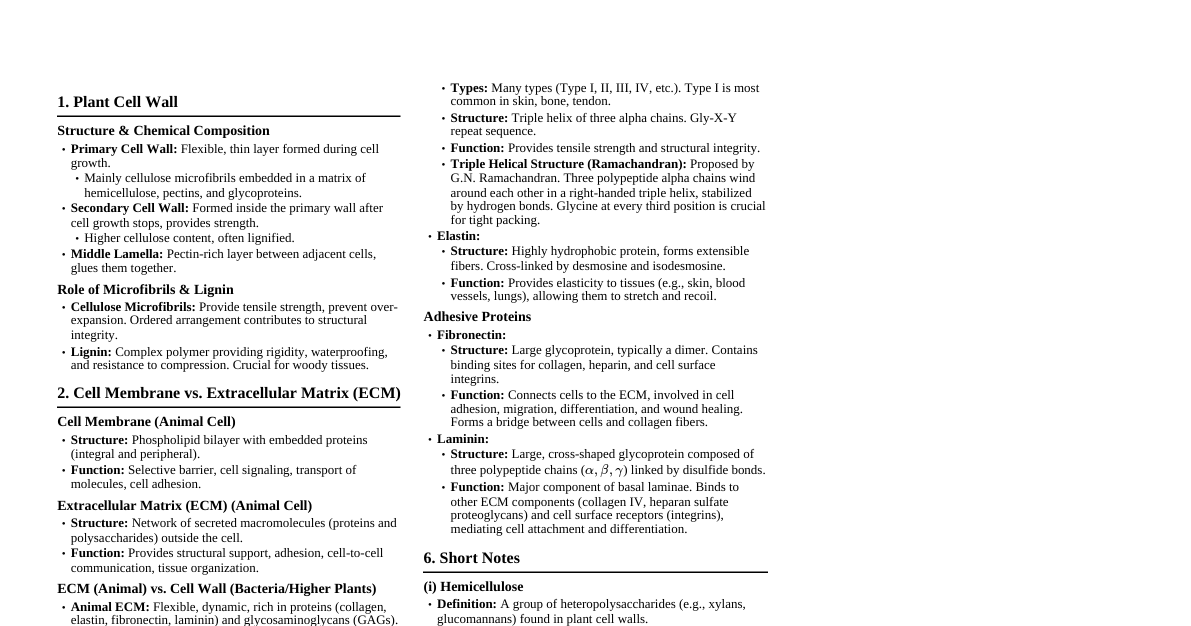
Cell as a Unit of Structure and Function Fundamental unit of life. All living organisms are composed of cells. Characteristics of Prokaryotic and Eukaryotic Cells Feature Prokaryotic Cells Eukaryotic Cells Size Smaller (0.1-5 $\mu m$) Larger (10-100 $\mu m$) Nucleus No true nucleus; nucleoid region True nucleus with nuclear envelope Organelles No membrane-bound organelles Membrane-bound organelles (e.g., mitochondria, ER, Golgi) DNA Circular, in cytoplasm Linear, in nucleus (chromosomes) Ribosomes 70S 80S Cell Wall Present (peptidoglycan) Present in plants/fungi (cellulose/chitin); absent in animals Plant and Animal Cells Plant Cells: Have cell wall, chloroplasts, large central vacuole. Animal Cells: Lack cell wall, chloroplasts, and large central vacuole. Have centrioles. Plant Cell Wall Chemistry: Primarily cellulose (polysaccharide). Structure: Primary cell wall (flexible), secondary cell wall (rigid, in some cells), middle lamella (pectin-rich layer between cells). Function: Provides structural support, protection, prevents excessive water uptake. Plasma Membrane: Fluid Mosaic Model Overview: Describes the plasma membrane as a fluid structure with a "mosaic" of various proteins embedded in or attached to a double layer (bilayer) of phospholipids. Fluidity: Phospholipids and proteins can move laterally. Mosaic: Diverse proteins scattered within the bilayer. Chemical Composition of Membranes Phospholipids: Amphipathic molecules forming the bilayer (hydrophilic head, hydrophobic tail). Proteins: Integral (transmembrane) and peripheral proteins; carry out most membrane functions. Carbohydrates: Glycolipids and glycoproteins for cell recognition and adhesion. Cholesterol: (In animal cells) Regulates membrane fluidity. Membrane Transport Passive Transport Movement down concentration gradient. No energy required. Diffusion: Movement of substances directly across the lipid bilayer (e.g., $O_2$, $CO_2$). Osmosis: Diffusion of water across a selectively permeable membrane. Facilitated Transport (Facilitated Diffusion) Movement down concentration gradient. No energy required. Requires transport proteins (channel proteins or carrier proteins) to help substances cross (e.g., glucose, ions). Active Transport Movement against concentration gradient. Requires energy (ATP). Uses specific carrier proteins (e.g., Sodium-Potassium pump). Endocytosis and Exocytosis Endocytosis: Cells take in substances by engulfing them in a vesicle. Phagocytosis: "Cell eating" (large particles). Pinocytosis: "Cell drinking" (extracellular fluid/solutes). Receptor-mediated endocytosis: Specific uptake of molecules. Exocytosis: Cells release substances by fusing vesicles with the plasma membrane. Nucleus Structure: Nuclear Envelope: Double membrane enclosing the nucleus, continuous with ER. Nuclear Pore Complex: Regulates passage of molecules between nucleus and cytoplasm. Nuclear Lamina: Net-like array of protein filaments maintaining nuclear shape and organizing chromatin. Molecular Organization of Chromatin: DNA and associated proteins (histones) packed into chromosomes. Nucleolus: Site of rRNA synthesis and ribosome assembly. Cytoskeleton Network of protein filaments extending throughout the cytoplasm. Provides structural support, maintains cell shape, facilitates cell motility, and plays roles in intracellular transport. Microtubules Role: Maintain cell shape, cell motility (cilia, flagella), chromosome movements in cell division, organelle movements. Structure: Hollow rods composed of tubulin protein dimers. Microfilaments (Actin Filaments) Role: Maintain cell shape, muscle contraction (with myosin), cell motility (amoeboid movement), cytoplasmic streaming, cell division (cleavage furrow). Structure: Solid rods formed from actin protein twisted into a double chain. Intermediary Filaments Role: Maintain cell shape, anchor nucleus and other organelles, form nuclear lamina. Structure: Fibrous proteins supercoiled into thicker cables; more permanent than microtubules and microfilaments. Examples include keratin.