Cell Biology Essentials
Cheatsheet Content
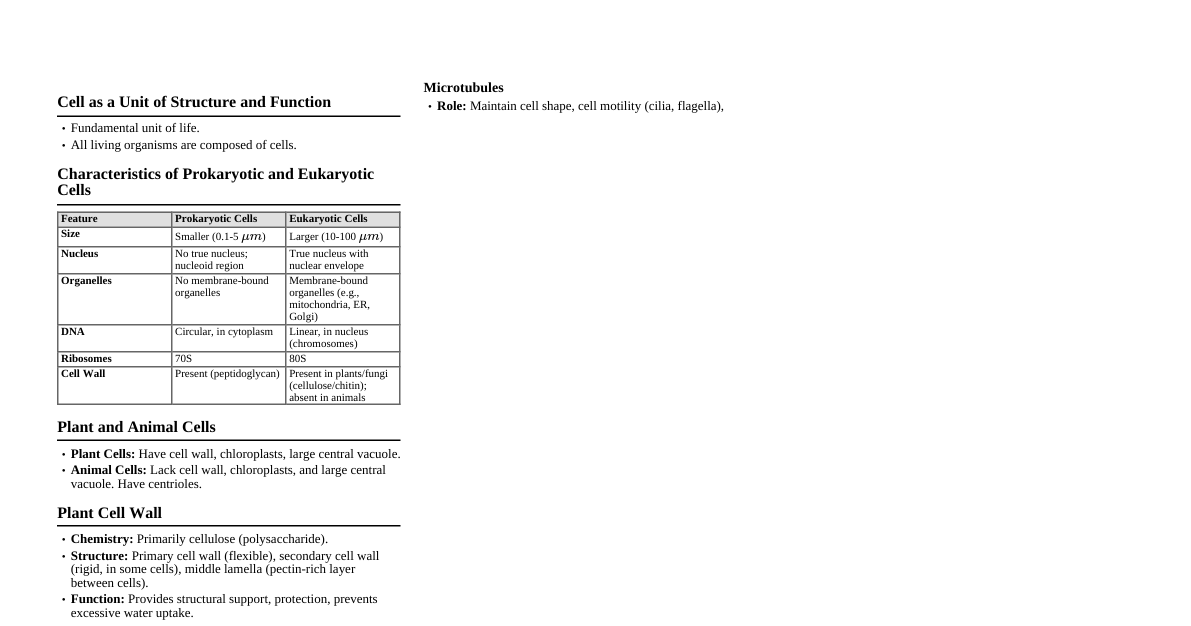
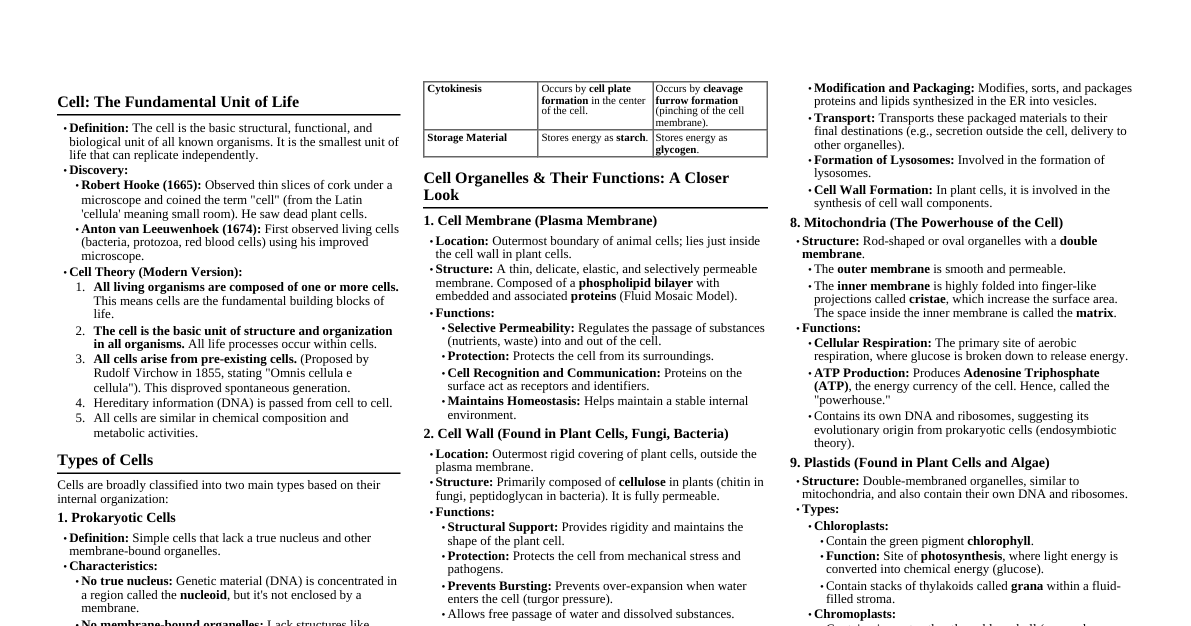
1. Plant Cell Wall Structure & Chemical Composition Primary Cell Wall: Flexible, thin layer formed during cell growth. Mainly cellulose microfibrils embedded in a matrix of hemicellulose, pectins, and glycoproteins. Secondary Cell Wall: Formed inside the primary wall after cell growth stops, provides strength. Higher cellulose content, often lignified. Middle Lamella: Pectin-rich layer between adjacent cells, glues them together. Role of Microfibrils & Lignin Cellulose Microfibrils: Provide tensile strength, prevent over-expansion. Ordered arrangement contributes to structural integrity. Lignin: Complex polymer providing rigidity, waterproofing, and resistance to compression. Crucial for woody tissues. 2. Cell Membrane vs. Extracellular Matrix (ECM) Cell Membrane (Animal Cell) Structure: Phospholipid bilayer with embedded proteins (integral and peripheral). Function: Selective barrier, cell signaling, transport of molecules, cell adhesion. Extracellular Matrix (ECM) (Animal Cell) Structure: Network of secreted macromolecules (proteins and polysaccharides) outside the cell. Function: Provides structural support, adhesion, cell-to-cell communication, tissue organization. ECM (Animal) vs. Cell Wall (Bacteria/Higher Plants) Animal ECM: Flexible, dynamic, rich in proteins (collagen, elastin, fibronectin, laminin) and glycosaminoglycans (GAGs). No rigid structural component like cellulose. Bacterial Cell Wall: Primarily peptidoglycan (murein) in bacteria. Provides structural integrity and protection from osmotic lysis. Plant Cell Wall: Primarily cellulose, hemicellulose, pectins, and lignin. Rigid structure for support and protection. 3. Extracellular Matrix (ECM) Formation & Functions Formation Cells synthesize and secrete components (e.g., collagen, proteoglycans, fibronectin) into the extracellular space. These components then self-assemble or are organized by cell-surface receptors into a complex network. Enzymes (e.g., lysyl oxidase for collagen cross-linking) can modify and strengthen the matrix. Functions Structural Support: Provides mechanical strength and elasticity to tissues (e.g., bone, cartilage, skin). Cell Adhesion: Integrins on cell surface bind to ECM components, anchoring cells. Cell Signaling: ECM components can bind growth factors, modulate receptor activity, and influence cell differentiation, proliferation, and survival. Tissue Organization: Guides cell migration during development and wound healing. Regulation of Cell Behavior: Influences gene expression and cell phenotype. 4. Proteoglycans & Glycosaminoglycans (GAGs) Proteoglycans Definition: Proteins covalently attached to one or more glycosaminoglycan (GAG) chains. Structure: Core protein with long, unbranched polysaccharide chains (GAGs) attached. Function: Provide hydration and resistance to compression due to their negatively charged GAGs attracting water. Act as molecular sieves and regulate passage of molecules. Classes of Glycosaminoglycans (GAGs) Hyaluronan (Hyaluronic Acid): Unique GAG, not sulfated, not covalently linked to protein (but can associate). Found in synovial fluid, vitreous humor, ECM. Lubricant, space filler. Chondroitin Sulfate: Most abundant GAG. Found in cartilage, bone, heart valves. Provides resistance to compression. Dermatan Sulfate: Found in skin, blood vessels, heart valves. Heparan Sulfate: Found on cell surfaces and basement membranes. Binds growth factors, involved in cell signaling. Keratan Sulfate: Found in cornea, cartilage, bone. Functions of Proteoglycans/GAGs Hydration & Turgor: Negatively charged groups attract water, forming a hydrated gel that resists compressive forces. Molecular Sieving: Regulate movement of molecules through the ECM. Lubrication: Hyaluronan in joints. Cell Signaling: Bind growth factors and cytokines, influencing cell behavior. Structural Integrity: Contribute to tissue architecture. 5. Fibrous Proteins of the ECM Structural Proteins Collagen: Most abundant protein in mammals. Types: Many types (Type I, II, III, IV, etc.). Type I is most common in skin, bone, tendon. Structure: Triple helix of three alpha chains. Gly-X-Y repeat sequence. Function: Provides tensile strength and structural integrity. Triple Helical Structure (Ramachandran): Proposed by G.N. Ramachandran. Three polypeptide alpha chains wind around each other in a right-handed triple helix, stabilized by hydrogen bonds. Glycine at every third position is crucial for tight packing. Elastin: Structure: Highly hydrophobic protein, forms extensible fibers. Cross-linked by desmosine and isodesmosine. Function: Provides elasticity to tissues (e.g., skin, blood vessels, lungs), allowing them to stretch and recoil. Adhesive Proteins Fibronectin: Structure: Large glycoprotein, typically a dimer. Contains binding sites for collagen, heparin, and cell surface integrins. Function: Connects cells to the ECM, involved in cell adhesion, migration, differentiation, and wound healing. Forms a bridge between cells and collagen fibers. Laminin: Structure: Large, cross-shaped glycoprotein composed of three polypeptide chains ($\alpha, \beta, \gamma$) linked by disulfide bonds. Function: Major component of basal laminae. Binds to other ECM components (collagen IV, heparan sulfate proteoglycans) and cell surface receptors (integrins), mediating cell attachment and differentiation. 6. Short Notes (i) Hemicellulose Definition: A group of heteropolysaccharides (e.g., xylans, glucomannans) found in plant cell walls. Structure: Branched, shorter chains than cellulose, and can be amorphous. Function: Cross-links cellulose microfibrils, providing structural support and increasing cell wall strength and rigidity. (ii) Hyaluronan (Hyaluronic Acid) Definition: A large, unsulfated glycosaminoglycan (GAG). Structure: Long, linear polysaccharide of repeating disaccharide units (D-glucuronic acid and N-acetylglucosamine). Not covalently linked to a core protein. Function: Highly hydrophilic, forms a hydrated gel. Acts as a lubricant (synovial fluid), shock absorber, space filler, and regulates water balance. Important in wound healing and tissue repair. (iii) Elastin Definition: A highly elastic protein found in the ECM. Structure: Rich in hydrophobic amino acids (glycine, proline, valine). Forms a network of cross-linked fibers via desmosine and isodesmosine cross-links, allowing for extensive stretching and recoil. Function: Confers elasticity to tissues such as skin, lungs, and arterial walls. (iv) Fibronectin Definition: A large, adhesive glycoprotein of the ECM. Structure: Typically a disulfide-linked dimer. Contains multiple binding domains for other ECM components (collagen, fibrin, heparan sulfate proteoglycans) and cell surface integrins. Function: Mediates cell attachment to the ECM, guides cell migration during development and wound healing, and plays a role in cell differentiation and growth. (v) Laminin Definition: A key adhesive glycoprotein primarily found in basal laminae. Structure: Heterotrimeric, typically $\alpha\beta\gamma$ chains linked by disulfide bonds, forming a cross-shaped molecule. Function: Critical for cell adhesion, differentiation, migration, and phenotype stabilization. Binds to integrins on cell surfaces and to other basal lamina components like Type IV collagen. (vi) Basal Lamina (Basement Membrane) Definition: A specialized, thin, dense layer of extracellular matrix that underlies epithelial cells and surrounds muscle cells, fat cells, and Schwann cells. Composition: Primarily composed of Type IV collagen, laminin, heparan sulfate proteoglycans (e.g., perlecan), and nidogen/entactin. Function: Provides structural support, acts as a selective filter (e.g., in kidney glomeruli), organizes cell polarity, influences cell differentiation and migration, and serves as a scaffold for tissue regeneration. (vii) Membrane Skeleton Definition: A network of cytoskeletal proteins located just beneath the plasma membrane. Structure: In red blood cells, it's primarily spectrin, ankyrin, band 3 protein, actin, and protein 4.1. In non-erythroid cells, it involves actin, spectrin, and associated proteins. Function: Provides mechanical support, maintains cell shape and integrity, restricts the lateral diffusion of membrane proteins, and anchors membrane proteins. Essential for cell flexibility and resilience.