Calculus: Limits
Cheatsheet Content
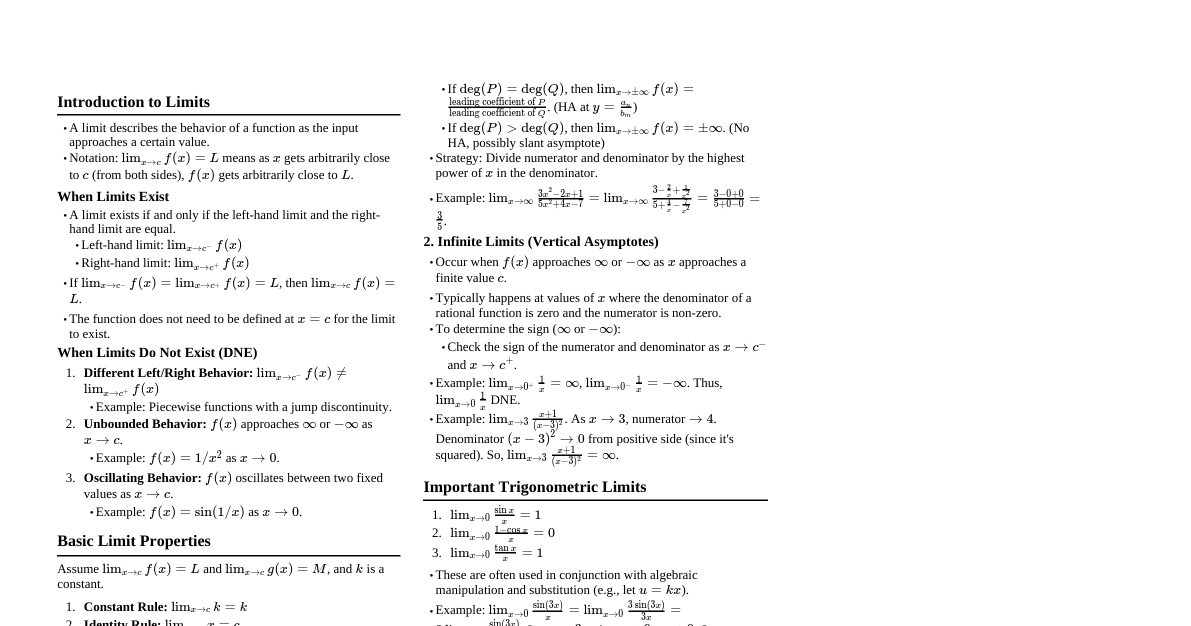
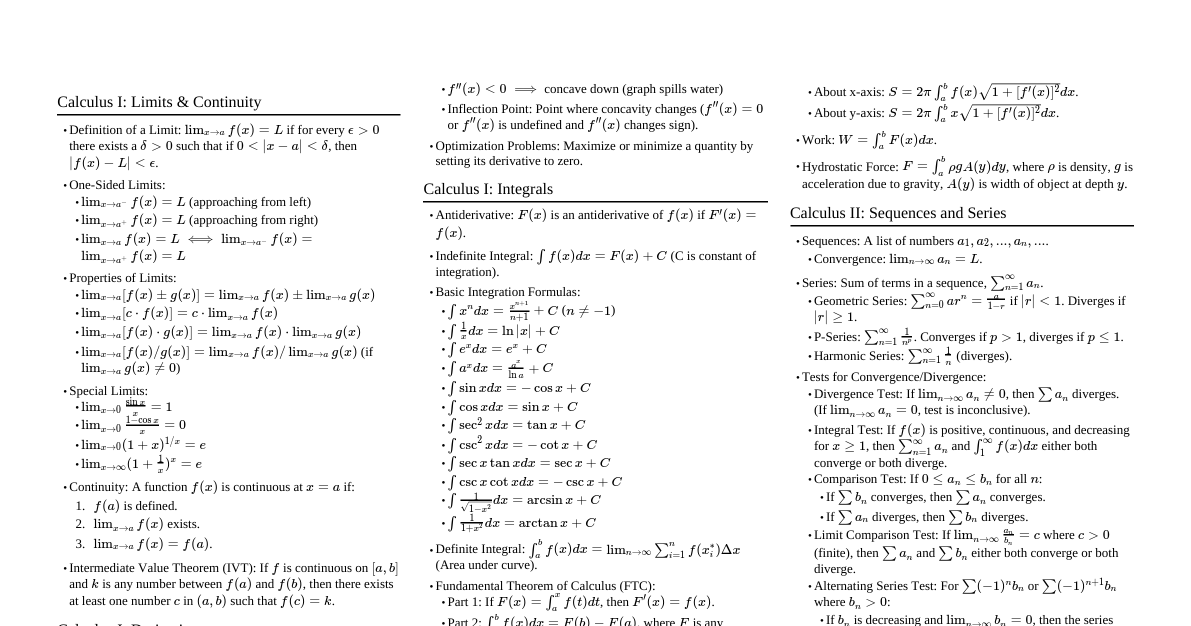
### Introduction to Limits - **Definition:** A limit describes the behavior of a function $f(x)$ as the input $x$ approaches a certain value, say $c$. It tells us what value $f(x)$ *approaches*, not necessarily what its value *is* at $c$. - **Notation:** $\lim_{x \to c} f(x) = L$ - This reads: "The limit of $f(x)$ as $x$ approaches $c$ is $L$." - **Key Idea:** We are interested in the function's value near $c$, but not necessarily *at* $c$. The function may not even be defined at $c$. ### One-Sided Limits - **Left-Hand Limit:** $\lim_{x \to c^-} f(x) = L_1$ - As $x$ approaches $c$ from values less than $c$. - **Right-Hand Limit:** $\lim_{x \to c^+} f(x) = L_2$ - As $x$ approaches $c$ from values greater than $c$. - **Existence of a Limit:** A two-sided limit $\lim_{x \to c} f(x)$ exists if and only if both one-sided limits exist and are equal: $$\lim_{x \to c} f(x) = L \iff \lim_{x \to c^-} f(x) = L \text{ and } \lim_{x \to c^+} f(x) = L$$ ### Properties of Limits Assume $\lim_{x \to c} f(x) = L$ and $\lim_{x \to c} g(x) = M$. - **Sum Rule:** $\lim_{x \to c} [f(x) + g(x)] = L + M$ - **Difference Rule:** $\lim_{x \to c} [f(x) - g(x)] = L - M$ - **Constant Multiple Rule:** $\lim_{x \to c} [k \cdot f(x)] = k \cdot L$ (where $k$ is a constant) - **Product Rule:** $\lim_{x \to c} [f(x) \cdot g(x)] = L \cdot M$ - **Quotient Rule:** $\lim_{x \to c} \left[\frac{f(x)}{g(x)}\right] = \frac{L}{M}$, provided $M \neq 0$ - **Power Rule:** $\lim_{x \to c} [f(x)]^n = L^n$ (where $n$ is an integer) - **Root Rule:** $\lim_{x \to c} \sqrt[n]{f(x)} = \sqrt[n]{L}$ (if $n$ is even, assume $L \ge 0$) ### Techniques for Finding Limits #### 1. Direct Substitution - If $f(x)$ is a polynomial, rational function (with non-zero denominator), or trigonometric function, simply substitute $c$ into $f(x)$. - Example: $\lim_{x \to 2} (x^2 + 3x - 1) = 2^2 + 3(2) - 1 = 4 + 6 - 1 = 9$ #### 2. Factoring and Canceling - Use when direct substitution results in an indeterminate form like $\frac{0}{0}$. - Example: $\lim_{x \to 1} \frac{x^2 - 1}{x - 1} = \lim_{x \to 1} \frac{(x-1)(x+1)}{x-1} = \lim_{x \to 1} (x+1) = 1+1 = 2$ #### 3. Rationalizing - Use for expressions involving square roots, often when $\frac{0}{0}$ occurs. Multiply by the conjugate. - Example: $\lim_{x \to 0} \frac{\sqrt{x+1} - 1}{x} = \lim_{x \to 0} \frac{\sqrt{x+1} - 1}{x} \cdot \frac{\sqrt{x+1} + 1}{\sqrt{x+1} + 1} = \lim_{x \to 0} \frac{(x+1) - 1}{x(\sqrt{x+1} + 1)} = \lim_{x \to 0} \frac{x}{x(\sqrt{x+1} + 1)} = \lim_{x \to 0} \frac{1}{\sqrt{x+1} + 1} = \frac{1}{\sqrt{0+1} + 1} = \frac{1}{2}$ #### 4. Common Trigonometric Limits - $\lim_{x \to 0} \frac{\sin x}{x} = 1$ - $\lim_{x \to 0} \frac{1 - \cos x}{x} = 0$ - $\lim_{x \to 0} \frac{\tan x}{x} = 1$ #### 5. Squeeze Theorem (Sandwich Theorem) - If $h(x) \le f(x) \le g(x)$ for all $x$ near $c$ (except possibly at $c$), and $\lim_{x \to c} h(x) = L$ and $\lim_{x \to c} g(x) = L$, then $\lim_{x \to c} f(x) = L$. ### Limits Involving Infinity #### 1. Limits as $x \to \pm \infty$ (Horizontal Asymptotes) - Describes the end behavior of a function. - For rational functions $\frac{P(x)}{Q(x)}$: - If $\text{deg}(P) \text{deg}(Q)$, then $\lim_{x \to \pm \infty} \frac{P(x)}{Q(x)} = \pm \infty$ (no horizontal asymptote). - **Rule of Thumb:** Divide every term by the highest power of $x$ in the denominator. - Example: $\lim_{x \to \infty} \frac{3x^2 + 2x}{x^2 - 4} = \lim_{x \to \infty} \frac{3 + 2/x}{1 - 4/x^2} = \frac{3+0}{1-0} = 3$ #### 2. Infinite Limits (Vertical Asymptotes) - Occurs when $f(x)$ approaches $\pm \infty$ as $x$ approaches $c$. - Notation: $\lim_{x \to c} f(x) = \infty$ or $\lim_{x \to c} f(x) = -\infty$. - Typically happens at values of $x$ where the denominator of a rational function is zero and the numerator is non-zero. - Example: $\lim_{x \to 0^+} \frac{1}{x} = \infty$, $\lim_{x \to 0^-} \frac{1}{x} = -\infty$. Therefore, $\lim_{x \to 0} \frac{1}{x}$ does not exist. ### Continuity - **Definition:** A function $f(x)$ is continuous at a point $c$ if all three conditions are met: 1. $f(c)$ is defined (i.e., $c$ is in the domain of $f$). 2. $\lim_{x \to c} f(x)$ exists. 3. $\lim_{x \to c} f(x) = f(c)$. - **Intuitive Idea:** A function is continuous if you can draw its graph without lifting your pencil. - **Types of Discontinuities:** - **Removable:** A hole in the graph (e.g., $\frac{x^2-1}{x-1}$ at $x=1$). - **Jump:** The one-sided limits exist but are not equal (e.g., piecewise functions). - **Infinite:** A vertical asymptote (e.g., $\frac{1}{x}$ at $x=0$).