Integral Calculus Cheatsheet
Cheatsheet Content
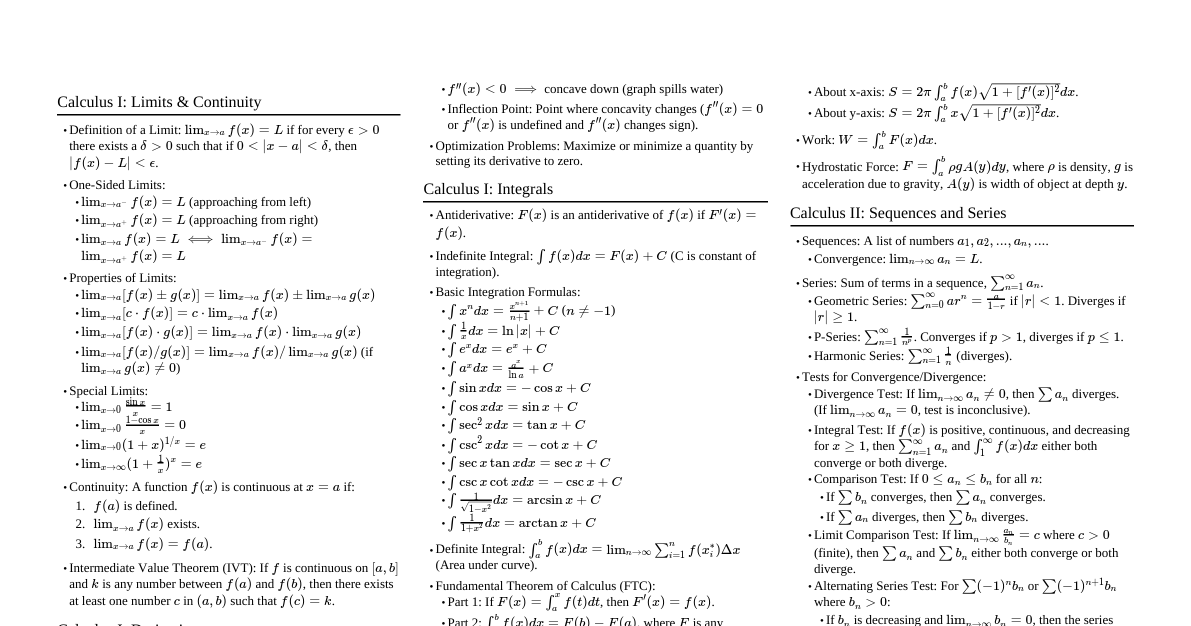
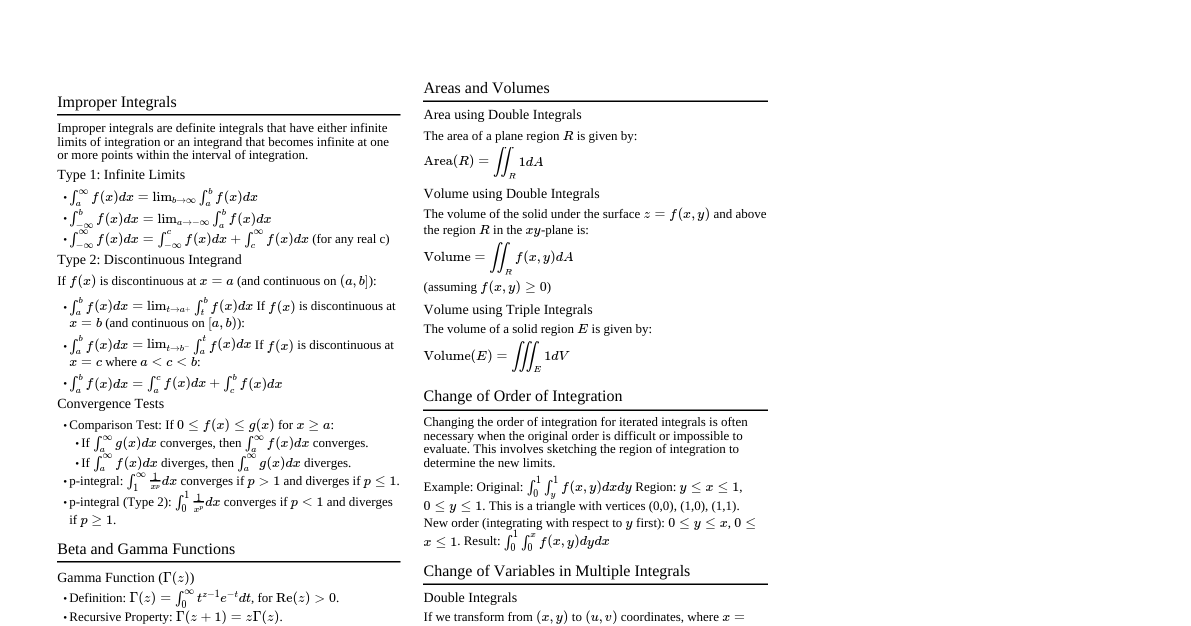
### Standard Integrals - $\int x^n dx = \frac{x^{n+1}}{n+1} + C$ (for $n \neq -1$) - $\int \frac{1}{x} dx = \ln|x| + C$ - $\int e^x dx = e^x + C$ - $\int a^x dx = \frac{a^x}{\ln a} + C$ (for $a > 0, a \neq 1$) - $\int \sin x dx = -\cos x + C$ - $\int \cos x dx = \sin x + C$ - $\int \sec^2 x dx = \tan x + C$ - $\int \csc^2 x dx = -\cot x + C$ - $\int \sec x \tan x dx = \sec x + C$ - $\int \csc x \cot x dx = -\csc x + C$ - $\int \tan x dx = \ln|\sec x| + C = -\ln|\cos x| + C$ - $\int \cot x dx = \ln|\sin x| + C$ - $\int \sec x dx = \ln|\sec x + \tan x| + C$ - $\int \csc x dx = \ln|\csc x - \cot x| + C$ - $\int \frac{1}{\sqrt{a^2 - x^2}} dx = \arcsin\left(\frac{x}{a}\right) + C$ - $\int \frac{1}{a^2 + x^2} dx = \frac{1}{a} \arctan\left(\frac{x}{a}\right) + C$ - $\int \frac{1}{x\sqrt{x^2 - a^2}} dx = \frac{1}{a} \operatorname{arcsec}\left(\frac{|x|}{a}\right) + C$ - $\int \sinh x dx = \cosh x + C$ - $\int \cosh x dx = \sinh x + C$ ### Integration by Substitution (u-substitution) - **Concept:** Simplifies integrals by changing the variable of integration. - **Steps:** 1. Choose a substitution $u = g(x)$. Look for a function whose derivative also appears in the integrand. 2. Compute $du = g'(x) dx$. 3. Rewrite the integral entirely in terms of $u$ and $du$. 4. Integrate with respect to $u$. 5. Substitute back $u = g(x)$ to express the result in terms of $x$. - **Example:** $\int x \sin(x^2) dx$ 1. Let $u = x^2$. 2. Then $du = 2x dx \implies x dx = \frac{1}{2} du$. 3. $\int \sin(u) \frac{1}{2} du = \frac{1}{2} \int \sin(u) du$. 4. $= \frac{1}{2} (-\cos u) + C = -\frac{1}{2} \cos u + C$. 5. $= -\frac{1}{2} \cos(x^2) + C$. - **Definite Integrals:** Change the limits of integration according to $u = g(x)$. - If $\int_a^b f(g(x))g'(x) dx$, then $\int_{g(a)}^{g(b)} f(u) du$. ### Integration by Parts - **Formula:** $\int u \, dv = uv - \int v \, du$ - **Mnemonic:** **LIATE** (Logarithmic, Inverse trig, Algebraic, Trigonometric, Exponential) helps choose $u$. The function higher on the list should be $u$. - **When to use:** Product of two different types of functions. - **Example:** $\int x e^x dx$ 1. Let $u = x$ (Algebraic) and $dv = e^x dx$ (Exponential). 2. Then $du = dx$ and $v = e^x$. 3. $\int x e^x dx = x e^x - \int e^x dx$ 4. $= x e^x - e^x + C$. - **Cyclic Integrals:** Sometimes, applying integration by parts twice returns the original integral, allowing you to solve for it algebraically (e.g., $\int e^x \sin x dx$). ### Trigonometric Integrals #### Powers of $\sin x$ and $\cos x$ - **Case 1: Odd power of $\sin x$ (or $\cos x$)**: - Save one factor of $\sin x$ (or $\cos x$) for $du$. - Convert remaining even powers using $\sin^2 x = 1 - \cos^2 x$ (or $\cos^2 x = 1 - \sin^2 x$). - Use $u = \cos x$ (or $u = \sin x$). - **Example:** $\int \sin^3 x dx = \int \sin^2 x \sin x dx = \int (1 - \cos^2 x) \sin x dx$. Let $u = \cos x, du = -\sin x dx$. $= \int (1 - u^2) (-du) = \int (u^2 - 1) du = \frac{u^3}{3} - u + C = \frac{\cos^3 x}{3} - \cos x + C$. - **Case 2: Even powers of $\sin x$ and $\cos x$**: - Use half-angle identities: - $\sin^2 x = \frac{1 - \cos(2x)}{2}$ - $\cos^2 x = \frac{1 + \cos(2x)}{2}$ - $\sin x \cos x = \frac{1}{2} \sin(2x)$ - **Example:** $\int \cos^2 x dx = \int \frac{1 + \cos(2x)}{2} dx = \frac{1}{2} \left(x + \frac{\sin(2x)}{2}\right) + C$. #### Powers of $\tan x$ and $\sec x$ - **Case 1: Even power of $\sec x$**: - Save $\sec^2 x$ for $du$. - Convert remaining $\sec^2 x$ to $\tan^2 x$ using $\sec^2 x = 1 + \tan^2 x$. - Use $u = \tan x$. - **Case 2: Odd power of $\tan x$**: - Save $\sec x \tan x$ for $du$. - Convert remaining $\tan^2 x$ to $\sec^2 x$ using $\tan^2 x = \sec^2 x - 1$. - Use $u = \sec x$. - **General Tips:** If no clear path, try converting everything to $\sin x$ and $\cos x$. ### Trigonometric Substitution - **When to use:** Integrands involving $\sqrt{a^2 - x^2}$, $\sqrt{a^2 + x^2}$, or $\sqrt{x^2 - a^2}$. - **Substitutions:** 1. For $\sqrt{a^2 - x^2}$: Let $x = a \sin\theta$, $dx = a \cos\theta d\theta$. $\sqrt{a^2 - x^2} = \sqrt{a^2 - a^2 \sin^2\theta} = \sqrt{a^2 \cos^2\theta} = a |\cos\theta|$. 2. For $\sqrt{a^2 + x^2}$: Let $x = a \tan\theta$, $dx = a \sec^2\theta d\theta$. $\sqrt{a^2 + x^2} = \sqrt{a^2 + a^2 \tan^2\theta} = \sqrt{a^2 \sec^2\theta} = a |\sec\theta|$. 3. For $\sqrt{x^2 - a^2}$: Let $x = a \sec\theta$, $dx = a \sec\theta \tan\theta d\theta$. $\sqrt{x^2 - a^2} = \sqrt{a^2 \sec^2\theta - a^2} = \sqrt{a^2 \tan^2\theta} = a |\tan\theta|$. - **Important:** After integrating, draw a right triangle to convert back from $\theta$ to $x$. - **Example:** $\int \frac{1}{\sqrt{4 - x^2}} dx$ 1. Let $x = 2 \sin\theta$, $dx = 2 \cos\theta d\theta$. 2. $\sqrt{4 - x^2} = \sqrt{4 - 4 \sin^2\theta} = \sqrt{4 \cos^2\theta} = 2 \cos\theta$. 3. $\int \frac{2 \cos\theta}{2 \cos\theta} d\theta = \int 1 d\theta = \theta + C$. 4. Since $x = 2 \sin\theta$, $\sin\theta = \frac{x}{2}$, so $\theta = \arcsin\left(\frac{x}{2}\right)$. 5. Result: $\arcsin\left(\frac{x}{2}\right) + C$. ### Partial Fractions - **When to use:** Rational functions $\frac{P(x)}{Q(x)}$ where $Q(x)$ can be factored. - **Steps:** 1. **Polynomial Long Division:** If $\deg(P(x)) \ge \deg(Q(x))$, perform division first. 2. **Factor Denominator:** Factor $Q(x)$ into linear and irreducible quadratic factors. 3. **Decomposition:** - **Linear Factor $(ax+b)$:** $\frac{A}{ax+b}$ - **Repeated Linear Factor $(ax+b)^k$:** $\frac{A_1}{ax+b} + \frac{A_2}{(ax+b)^2} + \dots + \frac{A_k}{(ax+b)^k}$ - **Irreducible Quadratic Factor $(ax^2+bx+c)$:** $\frac{Ax+B}{ax^2+bx+c}$ - **Repeated Irreducible Quadratic Factor $(ax^2+bx+c)^k$:** $\frac{A_1x+B_1}{ax^2+bx+c} + \dots + \frac{A_kx+B_k}{(ax^2+bx+c)^k}$ 4. **Solve for Coefficients:** Multiply by $Q(x)$ and equate coefficients or use strategic values of $x$. 5. **Integrate:** Integrate each partial fraction. - **Example:** $\int \frac{1}{x^2 - 1} dx$ 1. Denominator is $x^2 - 1 = (x-1)(x+1)$. 2. $\frac{1}{(x-1)(x+1)} = \frac{A}{x-1} + \frac{B}{x+1}$. 3. $1 = A(x+1) + B(x-1)$. 4. Set $x=1 \implies 1 = 2A \implies A = 1/2$. 5. Set $x=-1 \implies 1 = -2B \implies B = -1/2$. 6. $\int \left(\frac{1/2}{x-1} - \frac{1/2}{x+1}\right) dx = \frac{1}{2}\ln|x-1| - \frac{1}{2}\ln|x+1| + C = \frac{1}{2}\ln\left|\frac{x-1}{x+1}\right| + C$. ### General Tips & Tricks - **Simplify First:** Algebraic manipulation (expanding, factoring, common denominators) can often simplify the integrand. - **Recognize Derivatives:** Keep an eye out for functions and their derivatives, hinting at u-substitution. - **Complete the Square:** For quadratic expressions in denominators or under square roots (e.g., $x^2+bx+c$), completing the square can transform them into forms suitable for trigonometric substitution or standard inverse trig integrals. - Example: $\int \frac{1}{x^2+4x+5} dx = \int \frac{1}{(x+2)^2+1} dx$. Let $u=x+2$, then $\int \frac{1}{u^2+1} du = \arctan(u)+C = \arctan(x+2)+C$. - **Odd/Even Functions (for definite integrals on symmetric intervals $[-a, a]$):** - If $f(x)$ is **odd** ($f(-x) = -f(x)$), then $\int_{-a}^a f(x) dx = 0$. - If $f(x)$ is **even** ($f(-x) = f(x)$), then $\int_{-a}^a f(x) dx = 2 \int_0^a f(x) dx$. - **Fundamental Theorem of Calculus (Part 1):** If $F(x) = \int_a^x f(t) dt$, then $F'(x) = f(x)$. - **Fundamental Theorem of Calculus (Part 2):** $\int_a^b f(x) dx = F(b) - F(a)$, where $F'(x) = f(x)$. - **Avoid Common Mistakes:** - Don't forget the $+C$ for indefinite integrals. - Don't assume $\int f(x)g(x) dx = \int f(x) dx \int g(x) dx$. - Be careful with absolute values in logarithms (e.g., $\ln|x|$). ### Special Integrals & Patterns - **Integrals of Inverse Trig Functions (often by parts):** - $\int \arctan x dx = x \arctan x - \frac{1}{2}\ln(1+x^2) + C$ - $\int \arcsin x dx = x \arcsin x + \sqrt{1-x^2} + C$ - **Integrals involving $\ln x$ (often by parts):** - $\int \ln x dx = x \ln x - x + C$ - **Integrals of the form $\int e^{ax} \cos(bx) dx$ or $\int e^{ax} \sin(bx) dx$:** - Requires two applications of integration by parts, then solving for the integral algebraically. - Formula: $\int e^{ax} \sin(bx) dx = \frac{e^{ax}}{a^2+b^2}(a \sin(bx) - b \cos(bx)) + C$ - Formula: $\int e^{ax} \cos(bx) dx = \frac{e^{ax}}{a^2+b^2}(a \cos(bx) + b \sin(bx)) + C$ - **Euler Substitution (for specific irrational functions):** - For $\int R(x, \sqrt{ax^2+bx+c}) dx$: 1. If $a > 0$: $\sqrt{ax^2+bx+c} = \pm x\sqrt{a} + t$ 2. If $c > 0$: $\sqrt{ax^2+bx+c} = xt \pm \sqrt{c}$ 3. If $ax^2+bx+c = a(x-\alpha)(x-\beta)$: $\sqrt{ax^2+bx+c} = t(x-\alpha)$ - Converts the integral into a rational function of $t$. Less common in introductory calculus. - **Weierstrass Substitution (Tangent Half-Angle Substitution):** - For rational functions of $\sin x$ and $\cos x$. - Let $t = \tan(x/2)$. - Then $\sin x = \frac{2t}{1+t^2}$, $\cos x = \frac{1-t^2}{1+t^2}$, $dx = \frac{2}{1+t^2} dt$. - Transforms the integral into a rational function of $t$, which can be solved by partial fractions. - **Example:** $\int \frac{1}{1+\sin x} dx$ becomes $\int \frac{1}{1+\frac{2t}{1+t^2}} \frac{2}{1+t^2} dt = \int \frac{2}{(1+t)^2} dt = -\frac{2}{1+t} + C = -\frac{2}{1+\tan(x/2)} + C$.