Calculus: Limits
Cheatsheet Content
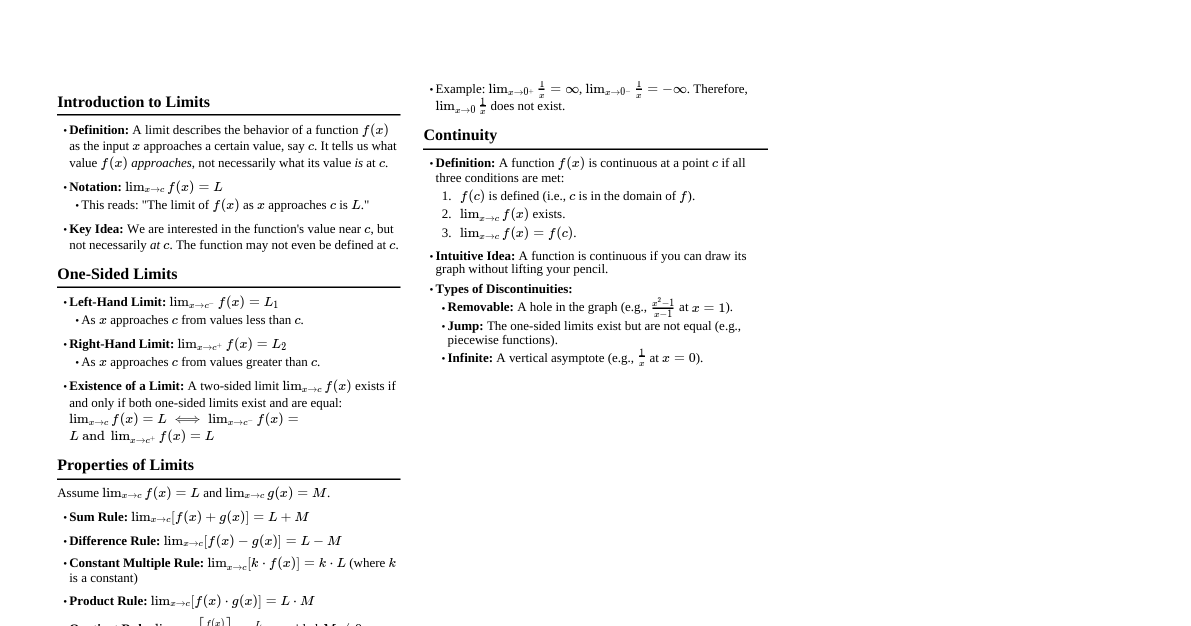
### Introduction to Limits - A limit describes the behavior of a function as the input approaches a certain value. - Notation: $\lim_{x \to c} f(x) = L$ means as $x$ gets arbitrarily close to $c$ (from both sides), $f(x)$ gets arbitrarily close to $L$. #### When Limits Exist - A limit exists if and only if the left-hand limit and the right-hand limit are equal. - Left-hand limit: $\lim_{x \to c^-} f(x)$ - Right-hand limit: $\lim_{x \to c^+} f(x)$ - If $\lim_{x \to c^-} f(x) = \lim_{x \to c^+} f(x) = L$, then $\lim_{x \to c} f(x) = L$. - The function does not need to be defined at $x=c$ for the limit to exist. #### When Limits Do Not Exist (DNE) 1. **Different Left/Right Behavior:** $\lim_{x \to c^-} f(x) \neq \lim_{x \to c^+} f(x)$ - Example: Piecewise functions with a jump discontinuity. 2. **Unbounded Behavior:** $f(x)$ approaches $\infty$ or $-\infty$ as $x \to c$. - Example: $f(x) = 1/x^2$ as $x \to 0$. 3. **Oscillating Behavior:** $f(x)$ oscillates between two fixed values as $x \to c$. - Example: $f(x) = \sin(1/x)$ as $x \to 0$. ### Basic Limit Properties Assume $\lim_{x \to c} f(x) = L$ and $\lim_{x \to c} g(x) = M$, and $k$ is a constant. 1. **Constant Rule:** $\lim_{x \to c} k = k$ 2. **Identity Rule:** $\lim_{x \to c} x = c$ 3. **Scalar Multiple:** $\lim_{x \to c} [k \cdot f(x)] = k \cdot L$ 4. **Sum/Difference:** $\lim_{x \to c} [f(x) \pm g(x)] = L \pm M$ 5. **Product Rule:** $\lim_{x \to c} [f(x) \cdot g(x)] = L \cdot M$ 6. **Quotient Rule:** $\lim_{x \to c} \frac{f(x)}{g(x)} = \frac{L}{M}$, provided $M \neq 0$. 7. **Power Rule:** $\lim_{x \to c} [f(x)]^n = L^n$, for any real number $n$. 8. **Root Rule:** $\lim_{x \to c} \sqrt[n]{f(x)} = \sqrt[n]{L}$, provided $\sqrt[n]{L}$ is a real number. 9. **Composition Rule:** If $\lim_{x \to c} g(x) = L$ and $\lim_{y \to L} f(y) = f(L)$, then $\lim_{x \to c} f(g(x)) = f(L)$. ### Strategies for Evaluating Limits #### 1. Direct Substitution - If $f(x)$ is a polynomial or rational function and $c$ is in the domain of $f(x)$, substitute $x=c$. - Example: $\lim_{x \to 2} (3x^2 - 5x + 1) = 3(2)^2 - 5(2) + 1 = 12 - 10 + 1 = 3$. #### 2. Factoring & Canceling - Use when direct substitution yields the indeterminate form $\frac{0}{0}$. - Factor the numerator and/or denominator, then cancel common factors. - Example: $\lim_{x \to 2} \frac{x^2 - 4}{x - 2} = \lim_{x \to 2} \frac{(x-2)(x+2)}{x-2} = \lim_{x \to 2} (x+2) = 2+2=4$. #### 3. Rationalizing - Use when expressions involve square roots (often yields $\frac{0}{0}$). - Multiply the numerator and denominator by the conjugate of the expression involving the root. - Example: $\lim_{x \to 0} \frac{\sqrt{x+1} - 1}{x} = \lim_{x \to 0} \frac{\sqrt{x+1} - 1}{x} \cdot \frac{\sqrt{x+1} + 1}{\sqrt{x+1} + 1} = \lim_{x \to 0} \frac{(x+1) - 1}{x(\sqrt{x+1} + 1)} = \lim_{x \to 0} \frac{x}{x(\sqrt{x+1} + 1)} = \lim_{x \to 0} \frac{1}{\sqrt{x+1} + 1} = \frac{1}{\sqrt{1}+1} = \frac{1}{2}$. #### 4. Common Denominators - Use for complex fractions (fractions within fractions) that yield $\frac{0}{0}$. - Combine fractions in the numerator/denominator, then simplify. - Example: $\lim_{x \to 0} \frac{\frac{1}{x+3} - \frac{1}{3}}{x} = \lim_{x \to 0} \frac{\frac{3 - (x+3)}{3(x+3)}}{x} = \lim_{x \to 0} \frac{-x}{3x(x+3)} = \lim_{x \to 0} \frac{-1}{3(x+3)} = \frac{-1}{9}$. #### 5. Squeeze Theorem (Sandwich Theorem) - If $h(x) \le f(x) \le g(x)$ for all $x$ in an open interval containing $c$ (except possibly at $c$ itself), and if $\lim_{x \to c} h(x) = L$ and $\lim_{x \to c} g(x) = L$, then $\lim_{x \to c} f(x) = L$. - Useful for limits involving trigonometric functions that oscillate. - Example: $\lim_{x \to 0} x^2 \sin(\frac{1}{x})$. Since $-1 \le \sin(\frac{1}{x}) \le 1$, we have $-x^2 \le x^2 \sin(\frac{1}{x}) \le x^2$. As $\lim_{x \to 0} -x^2 = 0$ and $\lim_{x \to 0} x^2 = 0$, by the Squeeze Theorem, $\lim_{x \to 0} x^2 \sin(\frac{1}{x}) = 0$. ### Limits Involving Infinity #### 1. Limits at Infinity (Horizontal Asymptotes) - Describes the behavior of $f(x)$ as $x \to \infty$ or $x \to -\infty$. - For rational functions $f(x) = \frac{P(x)}{Q(x)}$: - If $\deg(P) \deg(Q)$, then $\lim_{x \to \pm \infty} f(x) = \pm \infty$. (No HA, possibly slant asymptote) - Strategy: Divide numerator and denominator by the highest power of $x$ in the denominator. - Example: $\lim_{x \to \infty} \frac{3x^2 - 2x + 1}{5x^2 + 4x - 7} = \lim_{x \to \infty} \frac{3 - \frac{2}{x} + \frac{1}{x^2}}{5 + \frac{4}{x} - \frac{7}{x^2}} = \frac{3-0+0}{5+0-0} = \frac{3}{5}$. #### 2. Infinite Limits (Vertical Asymptotes) - Occur when $f(x)$ approaches $\infty$ or $-\infty$ as $x$ approaches a finite value $c$. - Typically happens at values of $x$ where the denominator of a rational function is zero and the numerator is non-zero. - To determine the sign ($\infty$ or $-\infty$): - Check the sign of the numerator and denominator as $x \to c^-$ and $x \to c^+$. - Example: $\lim_{x \to 0^+} \frac{1}{x} = \infty$, $\lim_{x \to 0^-} \frac{1}{x} = -\infty$. Thus, $\lim_{x \to 0} \frac{1}{x}$ DNE. - Example: $\lim_{x \to 3} \frac{x+1}{(x-3)^2}$. As $x \to 3$, numerator $\to 4$. Denominator $(x-3)^2 \to 0$ from positive side (since it's squared). So, $\lim_{x \to 3} \frac{x+1}{(x-3)^2} = \infty$. ### Important Trigonometric Limits 1. $\lim_{x \to 0} \frac{\sin x}{x} = 1$ 2. $\lim_{x \to 0} \frac{1 - \cos x}{x} = 0$ 3. $\lim_{x \to 0} \frac{\tan x}{x} = 1$ - These are often used in conjunction with algebraic manipulation and substitution (e.g., let $u=kx$). - Example: $\lim_{x \to 0} \frac{\sin(3x)}{x} = \lim_{x \to 0} \frac{3 \sin(3x)}{3x} = 3 \lim_{x \to 0} \frac{\sin(3x)}{3x}$. Let $u=3x$. As $x \to 0$, $u \to 0$. So, $3 \lim_{u \to 0} \frac{\sin u}{u} = 3 \cdot 1 = 3$. ### Continuity - A function $f(x)$ is **continuous at a point $c$** if all three conditions are met: 1. $f(c)$ is defined (c is in the domain of $f$). 2. $\lim_{x \to c} f(x)$ exists. 3. $\lim_{x \to c} f(x) = f(c)$. - If any of these conditions are not met, the function is **discontinuous** at $c$. #### Types of Discontinuities 1. **Removable Discontinuity (Hole):** Occurs when $\lim_{x \to c} f(x)$ exists, but $f(c)$ is undefined or $f(c) \neq \lim_{x \to c} f(x)$. Can be "removed" by redefining $f(c)$. - Example: $f(x) = \frac{x^2-4}{x-2}$ at $x=2$. 2. **Non-removable Discontinuity:** - **Jump Discontinuity:** $\lim_{x \to c^-} f(x) \neq \lim_{x \to c^+} f(x)$. (Typical for piecewise functions). - **Infinite Discontinuity:** $\lim_{x \to c} f(x) = \pm \infty$. (Vertical asymptotes). ### Intermediate Value Theorem (IVT) - If $f$ is a continuous function on the closed interval $[a, b]$, and $k$ is any number between $f(a)$ and $f(b)$ (inclusive), then there exists at least one number $c$ in $[a, b]$ such that $f(c) = k$. - **Applications:** Used to prove the existence of roots or specific function values within an interval. - Example: Show that $f(x) = x^3 + x - 1$ has a root in $[0, 1]$. - $f(x)$ is a polynomial, so it's continuous everywhere. - $f(0) = 0^3 + 0 - 1 = -1$. - $f(1) = 1^3 + 1 - 1 = 1$. - Since $f(0) ### L'Hôpital's Rule - Used to evaluate indeterminate forms of type $\frac{0}{0}$ or $\frac{\infty}{\infty}$. - If $\lim_{x \to c} \frac{f(x)}{g(x)}$ is of the form $\frac{0}{0}$ or $\frac{\infty}{\infty}$, then $\lim_{x \to c} \frac{f(x)}{g(x)} = \lim_{x \to c} \frac{f'(x)}{g'(x)}$, provided the latter limit exists or is $\pm \infty$. - Can be applied repeatedly if the indeterminate form persists. - **Other Indeterminate Forms:** - $0 \cdot \infty$: Rewrite as $\frac{0}{1/\infty}$ or $\frac{\infty}{1/0}$. - $\infty - \infty$: Combine terms (e.g., common denominator). - $1^\infty, 0^0, \infty^0$: Use logarithms. Let $y = f(x)^{g(x)}$, then $\ln y = g(x) \ln f(x)$, which becomes $0 \cdot \infty$. - Example: $\lim_{x \to 0} \frac{\sin x}{x}$. This is $\frac{0}{0}$. Applying L'Hôpital's: $\lim_{x \to 0} \frac{\cos x}{1} = \frac{\cos 0}{1} = \frac{1}{1} = 1$. - Example: $\lim_{x \to \infty} \frac{\ln x}{x}$. This is $\frac{\infty}{\infty}$. Applying L'Hôpital's: $\lim_{x \to \infty} \frac{1/x}{1} = \lim_{x \to \infty} \frac{1}{x} = 0$.