Calculus Essentials
Cheatsheet Content
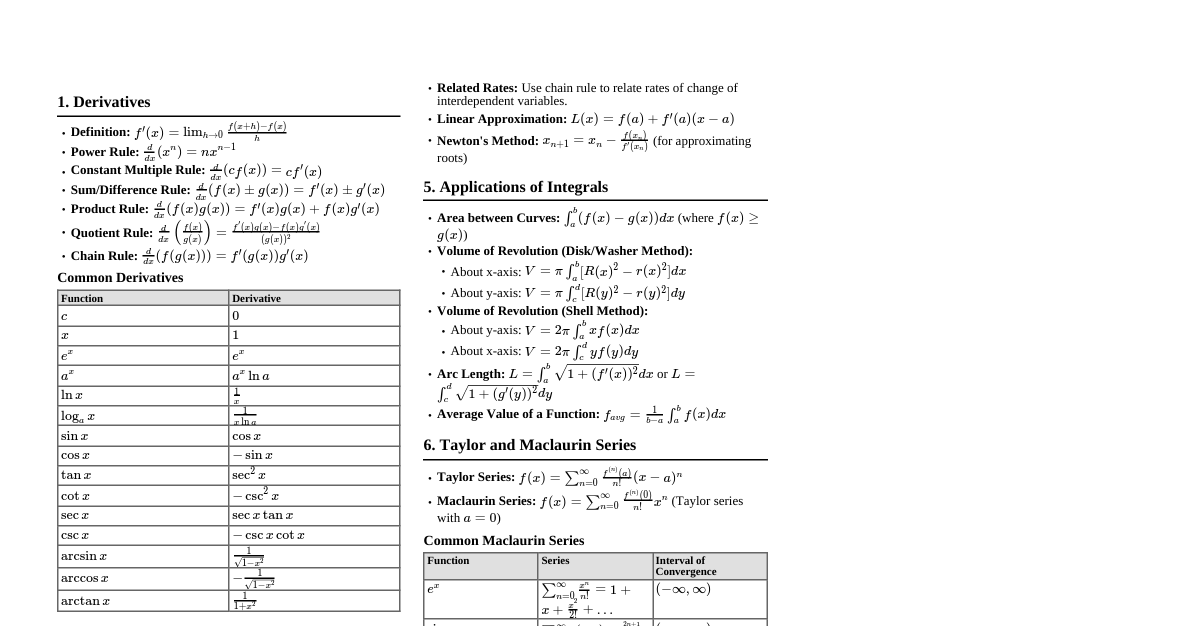
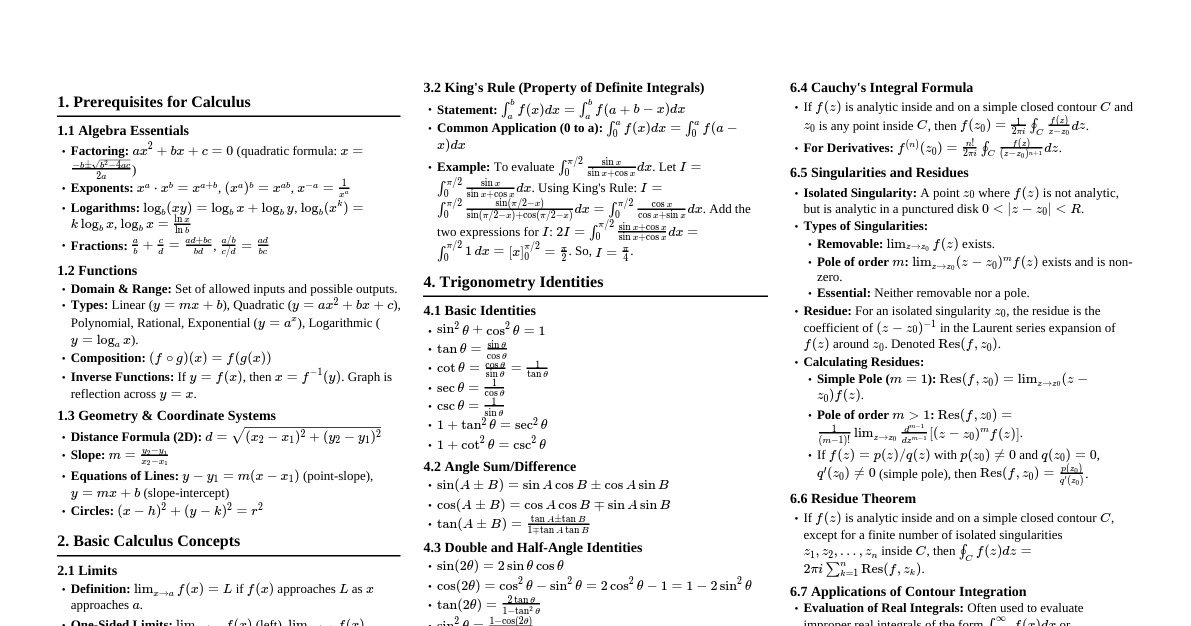
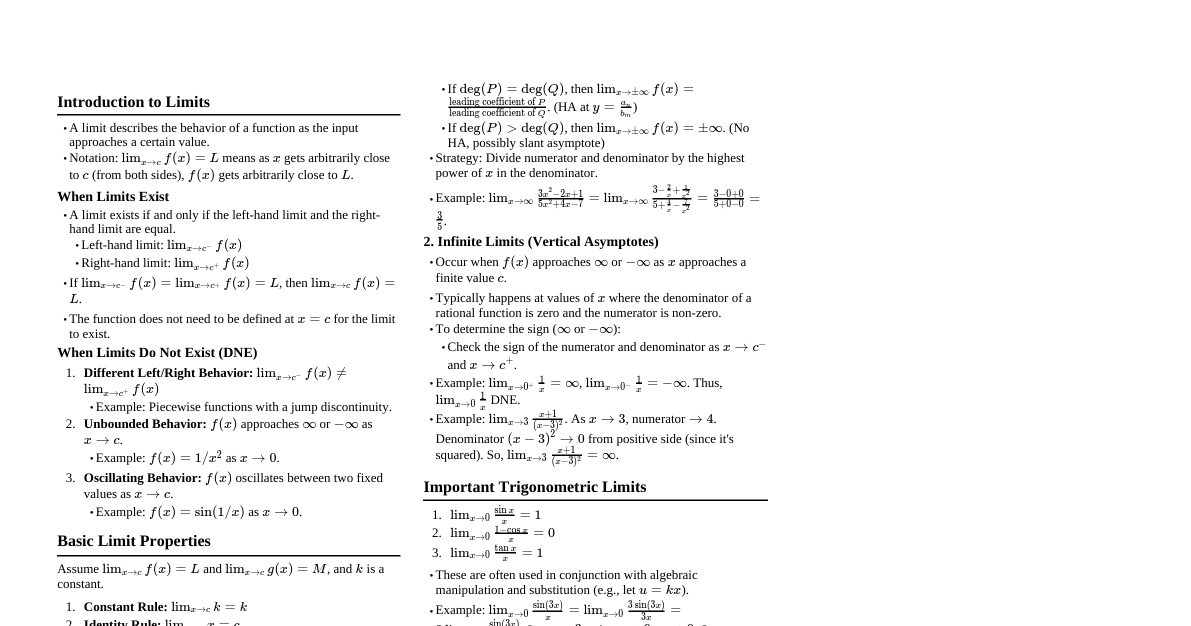
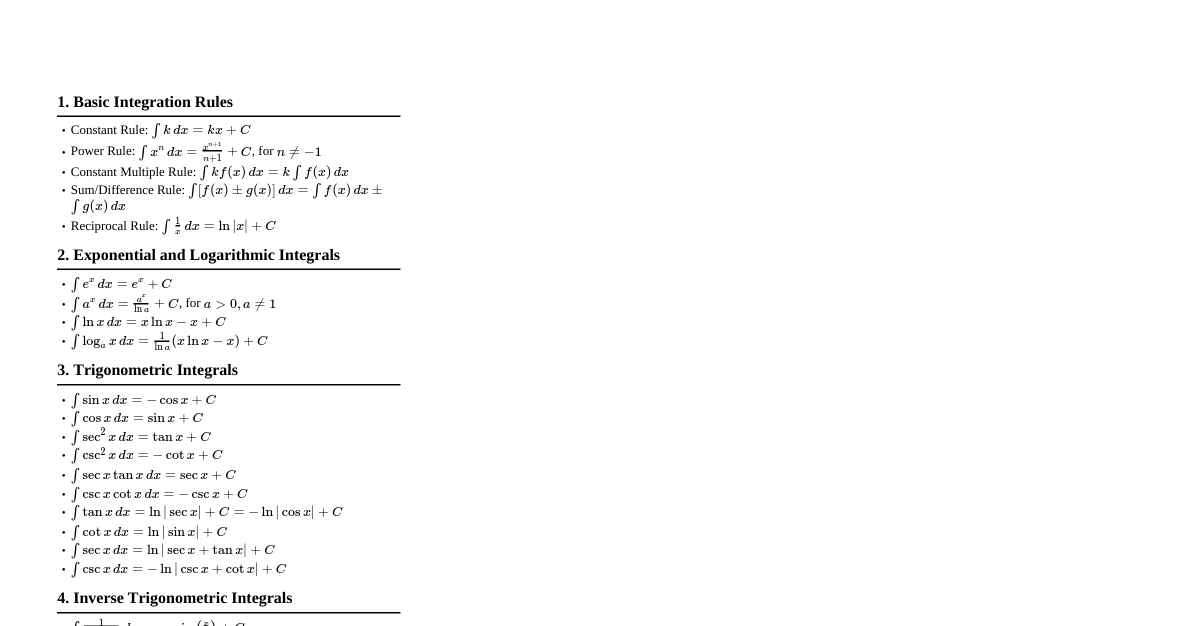
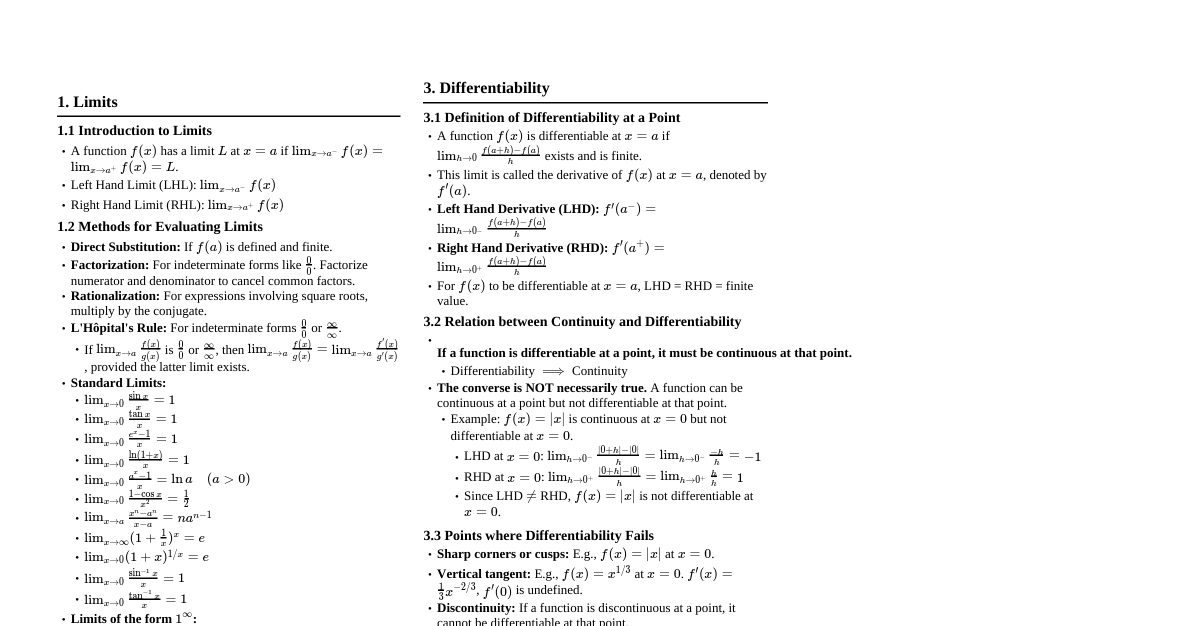
Limits Definition: $\lim_{x \to c} f(x) = L$ if for every $\epsilon > 0$, there exists a $\delta > 0$ such that if $0 One-Sided Limits: Left-hand: $\lim_{x \to c^-} f(x)$ Right-hand: $\lim_{x \to c^+} f(x)$ $\lim_{x \to c} f(x)$ exists if and only if $\lim_{x \to c^-} f(x) = \lim_{x \to c^+} f(x)$. Properties: Sum: $\lim (f+g) = \lim f + \lim g$ Product: $\lim (fg) = (\lim f)(\lim g)$ Quotient: $\lim (f/g) = (\lim f) / (\lim g)$ (if $\lim g \neq 0$) L'Hôpital's Rule: If $\lim_{x \to c} \frac{f(x)}{g(x)}$ is of the form $\frac{0}{0}$ or $\frac{\pm\infty}{\pm\infty}$, then $\lim_{x \to c} \frac{f(x)}{g(x)} = \lim_{x \to c} \frac{f'(x)}{g'(x)}$. Continuity A function $f(x)$ is continuous at $x=c$ if: $f(c)$ is defined. $\lim_{x \to c} f(x)$ exists. $\lim_{x \to c} f(x) = f(c)$. Intermediate Value Theorem (IVT): If $f$ is continuous on $[a,b]$ and $k$ is any number between $f(a)$ and $f(b)$, then there is at least one number $c$ in $[a,b]$ such that $f(c)=k$. Derivatives Definition: $f'(x) = \lim_{h \to 0} \frac{f(x+h) - f(x)}{h}$ Power Rule: $\frac{d}{dx}(x^n) = nx^{n-1}$ Product Rule: $\frac{d}{dx}(f(x)g(x)) = f'(x)g(x) + f(x)g'(x)$ Quotient Rule: $\frac{d}{dx}\left(\frac{f(x)}{g(x)}\right) = \frac{f'(x)g(x) - f(x)g'(x)}{(g(x))^2}$ Chain Rule: $\frac{d}{dx}(f(g(x))) = f'(g(x))g'(x)$ Common Derivatives Function Derivative $c$ (constant) $0$ $x^n$ $nx^{n-1}$ $e^x$ $e^x$ $a^x$ $a^x \ln a$ $\ln x$ $1/x$ $\log_a x$ $1/(x \ln a)$ $\sin x$ $\cos x$ $\cos x$ $-\sin x$ $\tan x$ $\sec^2 x$ $\sec x$ $\sec x \tan x$ $\csc x$ $-\csc x \cot x$ $\cot x$ $-\csc^2 x$ $\arcsin x$ $1/\sqrt{1-x^2}$ $\arctan x$ $1/(1+x^2)$ Applications of Derivatives Related Rates: Use implicit differentiation with respect to time $t$. Optimization: Find critical points ($f'(x)=0$ or $f'(x)$ undefined) and use First/Second Derivative Test. Mean Value Theorem (MVT): If $f$ is continuous on $[a,b]$ and differentiable on $(a,b)$, then there exists a $c$ in $(a,b)$ such that $f'(c) = \frac{f(b)-f(a)}{b-a}$. Increasing/Decreasing: $f'(x) > 0 \Rightarrow f(x)$ is increasing $f'(x) Concavity: $f''(x) > 0 \Rightarrow f(x)$ is concave up $f''(x) Inflection Point: Where $f''(x)$ changes sign. Integrals Antiderivative: $F(x)$ such that $F'(x) = f(x)$. Denoted $\int f(x) dx = F(x) + C$. Fundamental Theorem of Calculus (FTC): Part 1: $\frac{d}{dx} \int_a^x f(t) dt = f(x)$ Part 2: $\int_a^b f(x) dx = F(b) - F(a)$ Definite Integral: $\int_a^b f(x) dx = \lim_{n \to \infty} \sum_{i=1}^n f(x_i^*) \Delta x$ Common Integrals Function Integral $x^n$ ($n \neq -1$) $\frac{x^{n+1}}{n+1} + C$ $1/x$ $\ln|x| + C$ $e^x$ $e^x + C$ $a^x$ $\frac{a^x}{\ln a} + C$ $\sin x$ $-\cos x + C$ $\cos x$ $\sin x + C$ $\sec^2 x$ $\tan x + C$ $\sec x \tan x$ $\sec x + C$ $1/\sqrt{1-x^2}$ $\arcsin x + C$ $1/(1+x^2)$ $\arctan x + C$ Integration Techniques Substitution (u-substitution): $\int f(g(x))g'(x) dx = \int f(u) du$ where $u=g(x)$. Integration by Parts: $\int u dv = uv - \int v du$ Partial Fractions: For rational functions $\frac{P(x)}{Q(x)}$. Decompose into simpler fractions. Trigonometric Substitution: Use substitutions like $x=a\sin\theta$, $x=a\tan\theta$, $x=a\sec\theta$ for integrals involving $\sqrt{a^2-x^2}$, $\sqrt{a^2+x^2}$, $\sqrt{x^2-a^2}$. Applications of Integrals Area between curves: $\int_a^b |f(x)-g(x)| dx$ Volume of Revolution: Disk Method: $\int_a^b \pi [R(x)]^2 dx$ Washer Method: $\int_a^b \pi ([R(x)]^2 - [r(x)]^2) dx$ Shell Method: $\int_a^b 2\pi x h(x) dx$ Arc Length: $L = \int_a^b \sqrt{1 + (f'(x))^2} dx$ Surface Area of Revolution: $S = \int_a^b 2\pi y \sqrt{1+(f'(x))^2} dx$ (about x-axis) Average Value of a Function: $\frac{1}{b-a} \int_a^b f(x) dx$ Multivariable Calculus (Brief) Partial Derivatives: Differentiate with respect to one variable, treating others as constants. $f_x(x,y) = \frac{\partial f}{\partial x}$ $f_y(x,y) = \frac{\partial f}{\partial y}$ Gradient: $\nabla f = \left\langle \frac{\partial f}{\partial x}, \frac{\partial f}{\partial y}, \frac{\partial f}{\partial z} \right\rangle$ Directional Derivative: $D_{\mathbf{u}}f = \nabla f \cdot \mathbf{u}$ Double Integrals: $\iint_R f(x,y) dA$ Triple Integrals: $\iiint_E f(x,y,z) dV$