Work, Energy, Power (JEE Physics)
Cheatsheet Content
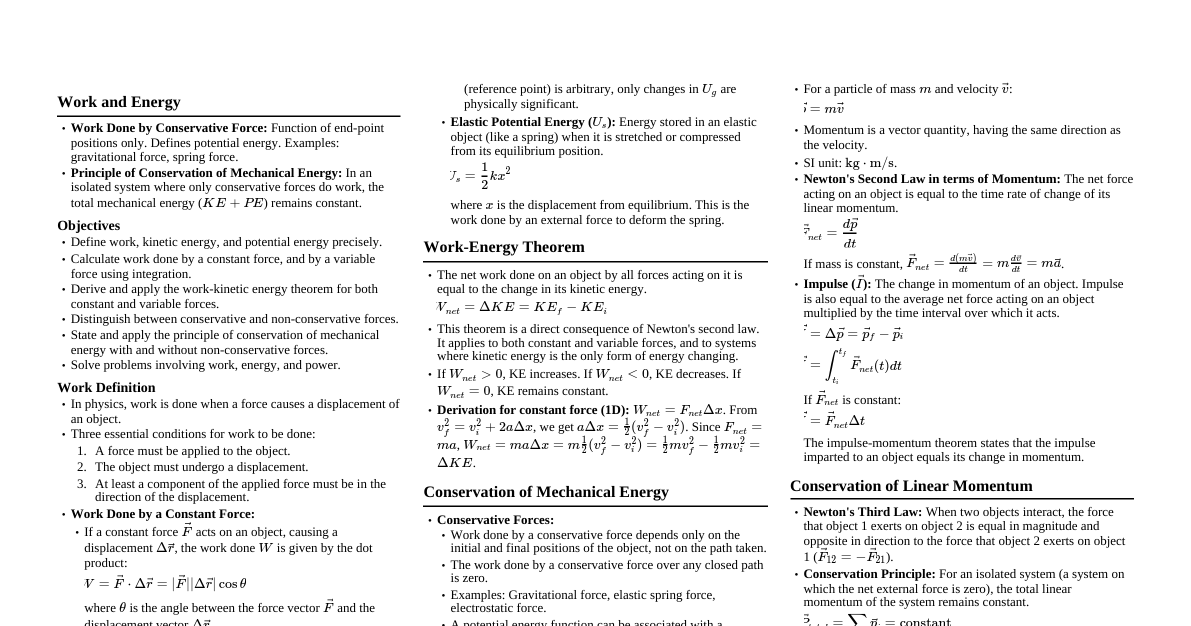
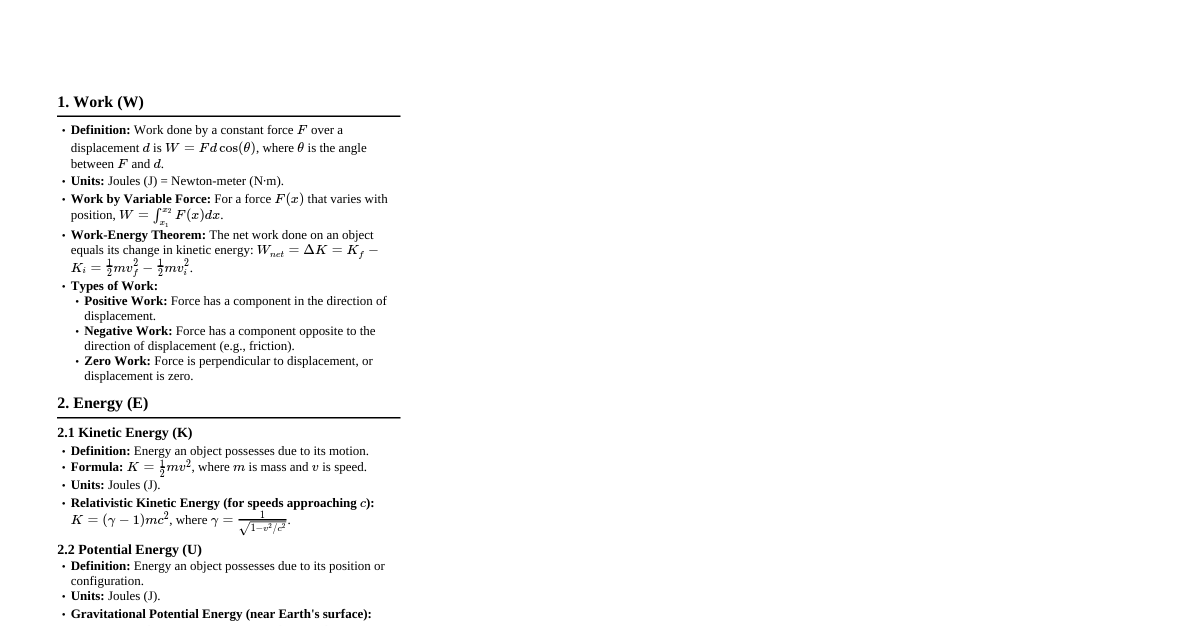
1. Work Definition: Work done ($W$) by a force $\vec{F}$ causing displacement $\vec{d}$. Constant Force: $W = \vec{F} \cdot \vec{d} = Fd \cos \theta$. $\theta$: angle between $\vec{F}$ and $\vec{d}$. Special Cases: $\theta = 0^\circ \implies W = Fd$ (Max positive work). $\theta = 90^\circ \implies W = 0$ (Force perpendicular to displacement). $\theta = 180^\circ \implies W = -Fd$ (Max negative work). Variable Force: $W = \int_{initial}^{final} \vec{F} \cdot d\vec{r}$. For 1D motion along x-axis: $W = \int_{x_i}^{x_f} F(x) dx$. Trick: Area under $F-x$ graph gives work done. Units: Joule (J) (SI), Erg (CGS), electron-volt (eV). $1 \text{ J} = 10^7 \text{ erg} = 6.242 \times 10^{18} \text{ eV}$. Nature: Scalar quantity. Work-Energy Theorem: $W_{net} = \Delta K = K_f - K_i$. $W_{net}$: Total work done by ALL forces (conservative & non-conservative). 2. Energy Definition: Capacity to do work. Units: Same as work (J, Erg, eV). Nature: Scalar quantity. 2.1 Kinetic Energy ($K$) Translational KE: $K = \frac{1}{2}mv^2$. $m$: mass, $v$: speed. Relation with Momentum ($p$): $K = \frac{p^2}{2m}$. $p = mv$. Trick: If $p$ is constant, $K \propto \frac{1}{m}$. If $K$ is constant, $p \propto \sqrt{m}$. 2.2 Potential Energy ($U$) Definition: Energy due to position or configuration. Defined only for conservative forces. Relation with Conservative Force: $\vec{F}_{cons} = -\nabla U = -\left( \frac{\partial U}{\partial x} \hat{i} + \frac{\partial U}{\partial y} \hat{j} + \frac{\partial U}{\partial z} \hat{k} \right)$. For 1D: $F_x = -\frac{dU}{dx}$. Also, $U_f - U_i = -\int_{initial}^{final} \vec{F}_{cons} \cdot d\vec{r}$. Reference Point: $U$ is relative. Usually $U=0$ at infinity or ground level. 2.2.1 Gravitational Potential Energy ($U_g$) Near Earth's Surface: $U_g = mgh$. $h$: height above chosen reference level. General (Universal Gravitation): $U_g = -\frac{GMm}{r}$. $G$: gravitational constant, $M, m$: masses, $r$: distance between centers. Reference: $U_g = 0$ at $r=\infty$. 2.2.2 Elastic Potential Energy ($U_s$) For a spring: $U_s = \frac{1}{2}kx^2$. $k$: spring constant, $x$: extension/compression from natural length. Condition: Applies for ideal springs obeying Hooke's Law ($F_s = -kx$). 3. Power Definition: Rate of doing work or transferring energy. Average Power: $P_{avg} = \frac{\Delta W}{\Delta t} = \frac{\text{Total work done}}{\text{Total time taken}}$. Instantaneous Power: $P = \frac{dW}{dt} = \vec{F} \cdot \vec{v}$. $F$: instantaneous force, $v$: instantaneous velocity. Trick: If force is parallel to velocity, $P = Fv$. Units: Watt (W) (SI). $1 \text{ W} = 1 \text{ J/s}$. Other units: horsepower (hp), $1 \text{ hp} \approx 746 \text{ W}$. Nature: Scalar quantity. Trick: Area under $P-t$ graph gives work done. 4. Conservation of Mechanical Energy (CME) Principle: If only conservative forces do work, total mechanical energy ($E = K + U$) remains constant. Formula: $K_i + U_i = K_f + U_f$. Condition: $W_{non-conservative} = 0$. General Work-Energy Theorem: $W_{total} = \Delta K$. $W_{cons} + W_{non-cons} = \Delta K$. $-\Delta U + W_{non-cons} = \Delta K$. $W_{non-cons} = \Delta K + \Delta U = \Delta E_{mech}$. Trick: If friction is present, $W_{friction}$ is negative and equals the loss in mechanical energy. Total Energy Conservation: In an isolated system, total energy (all forms) is always conserved. 5. Collisions Momentum Conservation: Always conserved in any collision (elastic or inelastic) if no external forces act. $m_1\vec{v}_{1i} + m_2\vec{v}_{2i} = m_1\vec{v}_{1f} + m_2\vec{v}_{2f}$. Coefficient of Restitution ($e$): $e = \frac{\text{relative speed of separation}}{\text{relative speed of approach}} = \frac{|\vec{v}_{2f} - \vec{v}_{1f}|}{|\vec{v}_{1i} - \vec{v}_{2i}|}$. For 1D: $e = \frac{v_{2f} - v_{1f}}{v_{1i} - v_{2i}}$. 5.1 Types of Collisions Elastic Collision: Momentum AND Kinetic Energy are conserved. $e = 1$. (Perfectly elastic). Trick: Relative velocity of approach = Relative velocity of separation. For 1D head-on elastic collision: $v_{1f} = \frac{(m_1-m_2)v_{1i} + 2m_2v_{2i}}{m_1+m_2}$ $v_{2f} = \frac{2m_1v_{1i} + (m_2-m_1)v_{2i}}{m_1+m_2}$ Special Case: If $m_1=m_2$, $v_{1f}=v_{2i}$ and $v_{2f}=v_{1i}$ (velocities exchange). Special Case: If $m_2 \gg m_1$ and $v_{2i}=0$, $v_{1f} \approx -v_{1i}$ and $v_{2f} \approx 0$. Special Case: If $m_1 \gg m_2$ and $v_{2i}=0$, $v_{1f} \approx v_{1i}$ and $v_{2f} \approx 2v_{1i}$. Inelastic Collision: Momentum conserved, Kinetic Energy NOT conserved ($K_{lost} > 0$). $0 Perfectly Inelastic Collision: Momentum conserved. Bodies stick together and move with common final velocity $V_f$. $e = 0$. $m_1\vec{v}_{1i} + m_2\vec{v}_{2i} = (m_1+m_2)\vec{V}_f$. Maximum possible kinetic energy loss. $K_{lost} = \frac{1}{2} \frac{m_1m_2}{m_1+m_2} (v_{1i}-v_{2i})^2$ (for 1D). 6. Vertical Circular Motion Minimum Speed for Looping (String/Rod): At Top (A): $v_A \ge \sqrt{gR}$ (for string, $T_A \ge 0$; for rod, $N_A \ge 0$). At Bottom (B): $v_B \ge \sqrt{5gR}$ (derived from CME between A & B, assuming $v_A = \sqrt{gR}$). Tension/Normal Force: At any point P (angle $\theta$ from bottom): $T \text{ or } N = \frac{mv^2}{R} + mg \cos\theta$. At top ($\theta=180^\circ$): $T \text{ or } N = \frac{mv_A^2}{R} - mg$. At bottom ($\theta=0^\circ$): $T \text{ or } N = \frac{mv_B^2}{R} + mg$. Condition for Leaving Circle (Projectile Motion): When $T=0$ (string) or $N=0$ (rod/track) at some angle $\theta 7. Spring-Mass System Hooke's Law: $F_s = -kx$. Elastic Potential Energy: $U_s = \frac{1}{2}kx^2$. Work done by spring: $W_s = -\Delta U_s = \frac{1}{2}k(x_i^2 - x_f^2)$. Equilibrium Position: Net force on mass is zero. $F_{net} = 0$. Trick: If a spring is cut into $n$ equal parts, the spring constant of each part is $nk$. 8. Efficiency ($\eta$) Definition: Ratio of useful output power to total input power. Formula: $\eta = \frac{P_{out}}{P_{in}} = \frac{\text{Energy output}}{\text{Energy input}}$. Expressed as a fraction or percentage. $\eta \le 1$. 9. Stable, Unstable, and Neutral Equilibrium Stable Equilibrium: If displaced slightly, an object tends to return to its original position. Condition: $U$ is minimum, $\frac{dU}{dx} = 0$, $\frac{d^2U}{dx^2} > 0$. Unstable Equilibrium: If displaced slightly, an object tends to move further away. Condition: $U$ is maximum, $\frac{dU}{dx} = 0$, $\frac{d^2U}{dx^2} Neutral Equilibrium: If displaced slightly, an object remains in its new position. Condition: $U$ is constant, $\frac{dU}{dx} = 0$, $\frac{d^2U}{dx^2} = 0$.