JEE Main Chemistry 2026 (Jan 28)
Cheatsheet Content
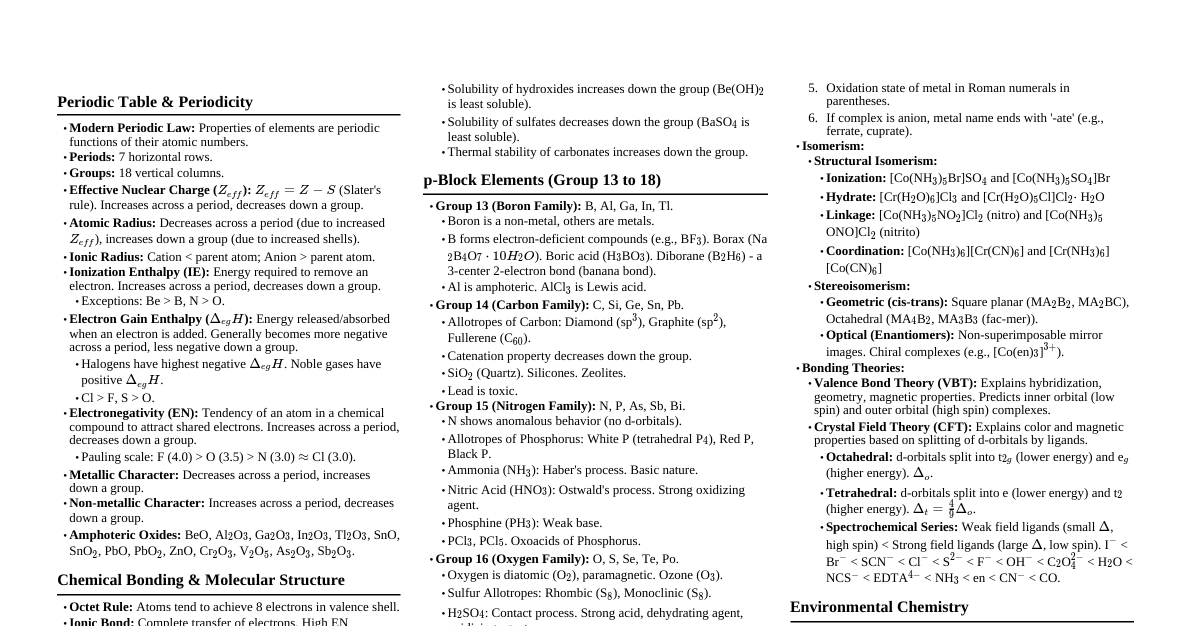
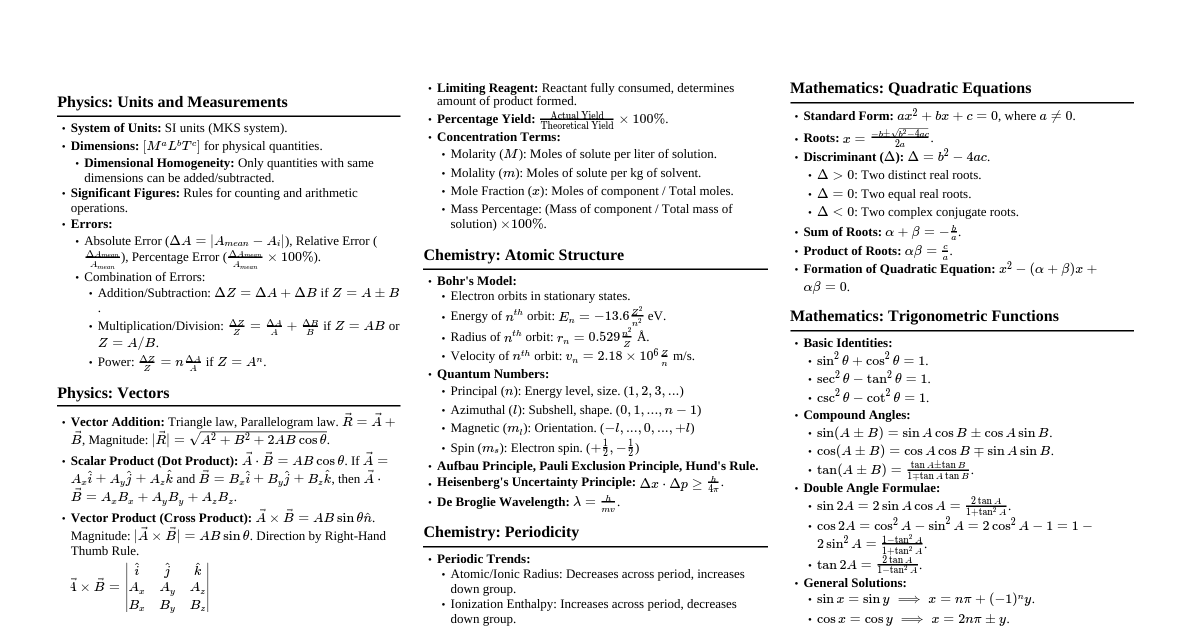
Physical Chemistry - Advanced Formulas & Concepts 1. Mole Concept & Stoichiometry Moles ($n$): $n = \frac{\text{mass (g)}}{\text{Molar Mass (g/mol)}}$ $n = \frac{\text{Number of Particles}}{N_A}$ ($N_A = 6.022 \times 10^{23}$ mol$^{-1}$) For gases at STP (0°C, 1 atm): $n = \frac{\text{Volume (L)}}{22.4 \text{ L/mol}}$ For gases at NTP (25°C, 1 atm): $n = \frac{\text{Volume (L)}}{24.46 \text{ L/mol}}$ (less common for direct calc, but know the temp) Concentration Terms: Molarity ($M$): $\frac{\text{moles of solute}}{\text{volume of solution (L)}}$. Temp dependent. $M_1V_1=M_2V_2$ for dilution. Molality ($m$): $\frac{\text{moles of solute}}{\text{mass of solvent (kg)}}$. Temp independent. Mole Fraction ($X_A$): $\frac{n_A}{n_A + n_B}$. Sum of mole fractions = 1. Mass %: $\frac{\text{mass of solute}}{\text{mass of solution}} \times 100$. Volume %: $\frac{\text{volume of solute}}{\text{volume of solution}} \times 100$. ppm (parts per million): $\frac{\text{mass of solute}}{\text{mass of solution}} \times 10^6$ (for solids/liquids); $\frac{\text{volume of solute}}{\text{volume of solution}} \times 10^6$ (for gases). Relationship: $M = \frac{1000 \times d \times X_B}{M_A}$ (for solute $B$, solvent $A$, density $d$). Approx: $M \approx m \times d$ for dilute aq. solutions. Equivalent Weight (E) and Normality (N): n-factor: Acid (basicity), Base (acidity), Salt (total cation charge), Redox (change in oxidation state per mole). $E = \frac{\text{Molar Mass}}{\text{n-factor}}$. $N = M \times \text{n-factor}$. For titrations: $N_1V_1 = N_2V_2$. Limiting Reagent: Reactant consumed first, determines max product yield. Percentage Yield: $\frac{\text{Actual Yield}}{\text{Theoretical Yield}} \times 100$. PYQ Example (Mole Concept): Q: $100$ mL of $0.1$ M $HCl$ is mixed with $100$ mL of $0.05$ M $NaOH$. The pH of the resulting solution is: Sol: Moles of HCl = $0.1 \times 0.1 = 0.01$ mol. Moles of NaOH = $0.1 \times 0.05 = 0.005$ mol. NaOH is limiting. Moles of HCl remaining = $0.01 - 0.005 = 0.005$ mol. Total volume = $200$ mL = $0.2$ L. $[H^+] = \frac{0.005}{0.2} = 0.025$ M. $pH = -\log(0.025) = -\log(\frac{1}{40}) = \log(40) = 1.6$. 2. Atomic Structure Bohr's Model (for H-like species): Radius: $r_n = 0.529 \frac{n^2}{Z}$ Å. Velocity: $v_n = 2.18 \times 10^6 \frac{Z}{n}$ m/s. Energy: $E_n = -13.6 \frac{Z^2}{n^2}$ eV/atom. Total Energy = -Kinetic Energy = $\frac{1}{2}$ Potential Energy. Frequency of revolution: $f = \frac{v_n}{2\pi r_n}$. Wavelength (Rydberg formula): $\frac{1}{\lambda} = R_H Z^2 (\frac{1}{n_1^2} - \frac{1}{n_2^2})$ ($R_H = 1.09677 \times 10^7$ m$^{-1}$). Spectral Series: Lyman ($n_1=1$), Balmer ($n_1=2$), Paschen ($n_1=3$), Brackett ($n_1=4$), Pfund ($n_1=5$). Quantum Numbers: $n$ (Principal): $1, 2, 3, ...$ (shell, energy, size). Max $2n^2$ electrons. $l$ (Azimuthal/Angular Momentum): $0, 1, ..., (n-1)$ (subshell, shape). Orbital angular momentum: $\sqrt{l(l+1)}\frac{h}{2\pi}$. $m_l$ (Magnetic): $-l, ..., 0, ..., +l$ (orientation). Number of orbitals in subshell: $2l+1$. $m_s$ (Spin): $+\frac{1}{2}, -\frac{1}{2}$. Spin angular momentum: $\sqrt{s(s+1)}\frac{h}{2\pi}$, where $s = \frac{1}{2}$. De Broglie Wavelength: $\lambda = \frac{h}{mv} = \frac{h}{p}$. For electron accelerated through potential $V$: $\lambda = \frac{12.27}{\sqrt{V}}$ Å. Heisenberg's Uncertainty Principle: $\Delta x \cdot \Delta p \ge \frac{h}{4\pi}$. Also $\Delta E \cdot \Delta t \ge \frac{h}{4\pi}$. Schrödinger Equation: (Qualitative) Describes wave nature of electron. $\psi^2$ gives probability density. Electronic Configuration: Aufbau (filling order), Hund's Rule (max unpaired electrons in degenerate orbitals), Pauli Exclusion Principle (no two electrons same 4 QN). Exceptions: Cr ($[Ar]3d^54s^1$), Cu ($[Ar]3d^{10}4s^1$). PYQ Example (Atomic Structure): Q: The angular momentum of an electron in a particular subshell is $\sqrt{2} \frac{h}{2\pi}$. What is the number of orbitals in this subshell? Sol: Orbital angular momentum $= \sqrt{l(l+1)}\frac{h}{2\pi}$. Given $\sqrt{l(l+1)}\frac{h}{2\pi} = \sqrt{2}\frac{h}{2\pi}$. So, $\sqrt{l(l+1)} = \sqrt{2}$. Squaring both sides, $l(l+1) = 2 \implies l^2 + l - 2 = 0 \implies (l+2)(l-1) = 0$. Since $l$ cannot be negative, $l=1$. For $l=1$ (p-subshell), the number of orbitals is $2l+1 = 2(1)+1 = 3$. 3. States of Matter (Gases & Liquids) Ideal Gas Law: $PV = nRT$. $R = 0.0821$ L atm mol$^{-1}$ K$^{-1}$ or $8.314$ J mol$^{-1}$ K$^{-1}$. Density of Gas: $d = \frac{PM}{RT}$, where $M$ is molar mass. Dalton's Law of Partial Pressures: $P_{total} = \sum P_i = P_A + P_B + ...$. $P_A = X_A P_{total}$. Graham's Law of Diffusion/Effusion: $\frac{r_1}{r_2} = \sqrt{\frac{M_2}{M_1}} = \sqrt{\frac{d_2}{d_1}}$. Kinetic Theory of Gases: Average KE per molecule: $\frac{3}{2}kT$. Per mole: $\frac{3}{2}RT$. RMS velocity ($u_{rms}$): $\sqrt{\frac{3RT}{M}}$. Average velocity ($u_{avg}$): $\sqrt{\frac{8RT}{\pi M}}$. Most probable velocity ($u_{mp}$): $\sqrt{\frac{2RT}{M}}$. Order: $u_{mp} Real Gases (Van der Waals Equation): $(P + \frac{an^2}{V^2})(V - nb) = nRT$. $a$: accounts for intermolecular forces (higher $a$, easier to liquefy). $b$: accounts for volume of gas molecules (volume excluded per mole). Compressibility Factor ($Z$): $Z = \frac{P V_{real}}{nRT}$. For ideal gas, $Z=1$. For real gas: $Z=1 + \frac{Pb}{RT} - \frac{a}{VRT}$ (at low P); $Z=1 + \frac{Pb}{RT}$ (at high P). If $Z If $Z>1$, repulsive forces dominate (harder to compress). Boyle temp ($T_B$): Temp at which real gas behaves ideally over range of P. $T_B = a/Rb$. Liquids: Vapor pressure, surface tension, viscosity (intermolecular forces play key role). PYQ Example (States of Matter): Q: If $Z$ is the compressibility factor, van der Waals equation at low pressure can be written as: Sol: $(P + \frac{a}{V^2})(V - b) = RT$. At low pressure, $V$ is large, so $V-b \approx V$. Thus, $(P + \frac{a}{V^2})V = RT \implies PV + \frac{a}{V} = RT$. Divide by $RT$: $\frac{PV}{RT} + \frac{a}{VRT} = 1 \implies Z + \frac{a}{VRT} = 1 \implies Z = 1 - \frac{a}{VRT}$. 4. Chemical Kinetics Rate Law: Rate $= k[A]^x[B]^y$. $x,y$ are partial orders, $x+y$ is overall order. $k$ is rate constant. Integrated Rate Laws: Zero Order: $[A]_t = [A]_0 - kt$. $t_{1/2} = \frac{[A]_0}{2k}$. Units of $k$: mol L$^{-1}$ s$^{-1}$. First Order: $\ln[A]_t = \ln[A]_0 - kt \implies k = \frac{1}{t} \ln(\frac{[A]_0}{[A]_t})$. $t_{1/2} = \frac{0.693}{k}$. Units of $k$: s$^{-1}$. Second Order: For $A \to$ products: $\frac{1}{[A]_t} = \frac{1}{[A]_0} + kt$. $t_{1/2} = \frac{1}{k[A]_0}$. Units of $k$: L mol$^{-1}$ s$^{-1}$. Arrhenius Equation: $k = Ae^{-E_a/RT}$. $E_a$: Activation energy. $A$: Pre-exponential factor. $\ln(\frac{k_2}{k_1}) = \frac{E_a}{R}(\frac{1}{T_1} - \frac{1}{T_2})$. Molecularity: Number of reacting species in an elementary step. Must be integer (1, 2, 3). Order: Experimentally determined, can be zero, integer, or fractional. Catalysis: Provides alternative pathway with lower $E_a$, increases rate. Does not affect $\Delta G$ or equilibrium position. PYQ Example (Chemical Kinetics): Q: For a first-order reaction, the time required for $99\%$ completion is $x$ times the time required for $90\%$ completion. The value of $x$ is: Sol: For a first-order reaction, $t = \frac{2.303}{k} \log(\frac{[A]_0}{[A]_t})$. For $90\%$ completion: $[A]_t = 0.1[A]_0$. So, $t_{90\%} = \frac{2.303}{k} \log(\frac{[A]_0}{0.1[A]_0}) = \frac{2.303}{k} \log(10) = \frac{2.303}{k}$. For $99\%$ completion: $[A]_t = 0.01[A]_0$. So, $t_{99\%} = \frac{2.303}{k} \log(\frac{[A]_0}{0.01[A]_0}) = \frac{2.303}{k} \log(100) = 2 \times \frac{2.303}{k}$. Therefore, $t_{99\%} = 2 \times t_{90\%}$. So, $x=2$. 5. Chemical Equilibrium Equilibrium Constant: $K_c = \frac{[C]^c[D]^d}{[A]^a[B]^b}$, $K_p = \frac{P_C^c P_D^d}{P_A^a P_B^b}$. Relationship: $K_p = K_c(RT)^{\Delta n_g}$, where $\Delta n_g = (\text{moles of gaseous products}) - (\text{moles of gaseous reactants})$. Reaction Quotient ($Q$): Same expression as $K_c/K_p$ but at non-equilibrium concentrations. $Q $Q > K$: Reaction proceeds backward. $Q = K$: Equilibrium. Le Chatelier's Principle: Concentration: Increase reactant, shift right; Increase product, shift left. Pressure: Increase P, shift to side with fewer gaseous moles. Decrease P, shift to side with more gaseous moles. (Inert gas at constant V, no effect). Temperature: Increase T, shift in endothermic direction. Decrease T, shift in exothermic direction. (Only T changes $K_{eq}$). Catalyst: No effect on equilibrium position or $K_{eq}$, only speeds up attainment of equilibrium. PYQ Example (Chemical Equilibrium): Q: For the reaction $N_2(g) + 3H_2(g) \rightleftharpoons 2NH_3(g)$, the standard Gibbs free energy change at $298K$ is $-33.2$ kJ mol$^{-1}$. The value of $K_p$ for the reaction is approximately: ($R = 8.314$ J K$^{-1}$ mol$^{-1}$) Sol: $\Delta G^\circ = -RT \ln K_p$. $-33.2 \times 10^3 = -8.314 \times 298 \times \ln K_p$. $\ln K_p = \frac{33200}{8.314 \times 298} \approx \frac{33200}{2477} \approx 13.4$. $K_p = e^{13.4} \approx 6.6 \times 10^5$. 6. Ionic Equilibrium Ionization of Water: $K_w = [H^+][OH^-] = 10^{-14}$ at 25°C. $pK_w = pH + pOH = 14$. pH of Strong Acids/Bases: $pH = -\log[H^+]$. For strong base, calc $pOH$, then $pH$. pH of Weak Acids/Bases: Weak acid HA: $[H^+] = \sqrt{K_a C_a}$ (if $\alpha 100$). Otherwise, use quadratic from $K_a = \frac{[H^+]^2}{C_a - [H^+]}$. Weak base B: $[OH^-] = \sqrt{K_b C_b}$ (similarly). Degree of dissociation ($\alpha$): $\alpha = \sqrt{K_a/C_a}$ or $\sqrt{K_b/C_b}$. $K_a \cdot K_b = K_w$ (for conjugate acid-base pairs). Salt Hydrolysis: Salt of strong acid & weak base ($NH_4Cl$): acidic, $pH = 7 - \frac{1}{2}pK_b - \frac{1}{2}\log C$. $K_h = K_w/K_b$. Salt of weak acid & strong base ($CH_3COONa$): basic, $pH = 7 + \frac{1}{2}pK_a + \frac{1}{2}\log C$. $K_h = K_w/K_a$. Salt of weak acid & weak base ($CH_3COONH_4$): $pH = 7 + \frac{1}{2}pK_a - \frac{1}{2}pK_b$. $K_h = K_w/(K_a K_b)$. Buffer Solutions: Resist pH change on adding small amounts of acid/base. Acidic Buffer: Weak acid + its salt with strong base ($CH_3COOH/CH_3COONa$). $pH = pK_a + \log(\frac{[\text{Salt}]}{[\text{Acid}]})$. Basic Buffer: Weak base + its salt with strong acid ($NH_4OH/NH_4Cl$). $pOH = pK_b + \log(\frac{[\text{Salt}]}{[\text{Base}]})$. Buffer capacity: Amount of acid/base a buffer can neutralize. Max at $[\text{Acid}] = [\text{Salt}]$. Solubility Product ($K_{sp}$): For $A_xB_y \rightleftharpoons xA^{y+} + yB^{x-}$, $K_{sp} = [A^{y+}]^x [B^{x-}]^y$. Solubility $S$. For $AB \to A^+ + B^-$, $K_{sp} = S^2$. For $AB_2 \to A^{2+} + 2B^-$, $K_{sp} = S(2S)^2 = 4S^3$. For $A_2B_3 \to 2A^{3+} + 3B^{2-}$, $K_{sp} = (2S)^2(3S)^3 = 108S^5$. Ionic Product ($Q_{sp}$): Calculated like $K_{sp}$ at any concentrations. $Q_{sp} $Q_{sp} = K_{sp}$: Saturated, equilibrium. $Q_{sp} > K_{sp}$: Supersaturated, precipitation occurs. Common Ion Effect: Decreases solubility of sparingly soluble salt. PYQ Example (Ionic Equilibrium): Q: The $K_{sp}$ of $Ag_2CrO_4$ is $1.1 \times 10^{-12}$. The solubility of $Ag_2CrO_4$ in $0.1$ M $AgNO_3$ solution is: Sol: $Ag_2CrO_4(s) \rightleftharpoons 2Ag^+(aq) + CrO_4^{2-}(aq)$. Let solubility be $S$. So, $[CrO_4^{2-}] = S$. From $AgNO_3$, $[Ag^+] = 0.1$ M. Total $[Ag^+] = (0.1 + 2S)$. Since $K_{sp}$ is very small, $2S$ is negligible compared to $0.1$. So, $[Ag^+] \approx 0.1$ M. $K_{sp} = [Ag^+]^2[CrO_4^{2-}] \implies 1.1 \times 10^{-12} = (0.1)^2 \times S$. $1.1 \times 10^{-12} = 0.01 \times S \implies S = \frac{1.1 \times 10^{-12}}{0.01} = 1.1 \times 10^{-10}$ M. 7. Thermodynamics First Law: $\Delta U = Q + W$. $Q$: Heat (positive if absorbed). $W$: Work (positive if done on system, i.e., compression; negative if done by system, i.e., expansion). $W = -P_{ext}\Delta V$. Enthalpy ($H$): $H = U + PV$. $\Delta H = Q_p$ (heat at constant pressure). $\Delta H = \Delta U + P\Delta V = \Delta U + \Delta n_g RT$ (for reactions involving gases). Standard enthalpy of formation ($\Delta H_f^\circ$): For 1 mole of compound from elements in their standard states. $\Delta H_f^\circ (\text{element}) = 0$. Standard enthalpy of reaction ($\Delta H_{rxn}^\circ$): $\sum \Delta H_f^\circ (\text{products}) - \sum \Delta H_f^\circ (\text{reactants})$. Bond Enthalpy: $\Delta H_{rxn}^\circ = \sum \text{Bond Enthalpies}(\text{reactants}) - \sum \text{Bond Enthalpies}(\text{products})$. Entropy ($S$): Measure of randomness/disorder. $\Delta S = \frac{Q_{rev}}{T}$. $\Delta S_{sys} + \Delta S_{surr} = \Delta S_{total}$. For spontaneous process, $\Delta S_{total} > 0$. Gibbs Free Energy ($G$): $G = H - TS$. $\Delta G = \Delta H - T\Delta S$ (Gibbs-Helmholtz equation). Spontaneity: $\Delta G $\Delta G = 0$: Equilibrium. $\Delta G > 0$: Non-spontaneous. Effect of $\Delta H$ and $\Delta S$ on $\Delta G$: $\Delta H$ $\Delta S$ $\Delta G$ Spontaneity $(-)$ $(+)$ $(-)$ Always $(+)$ $(-)$ $(+)$ Never $(-)$ $(-)$ $(-)$ at low T Spontaneous at low T $(+)$ $(+)$ $(-)$ at high T Spontaneous at high T Relation to Equilibrium Constant: $\Delta G^\circ = -RT \ln K_{eq}$. Non-standard conditions: $\Delta G = \Delta G^\circ + RT \ln Q$. PYQ Example (Thermodynamics): Q: For a reaction, $\Delta H = 30$ kJ mol$^{-1}$ and $\Delta S = 75$ J K$^{-1}$ mol$^{-1}$. At what temperature does the reaction become spontaneous? Sol: For spontaneity, $\Delta G So, $\Delta H - T\Delta S \frac{\Delta H}{\Delta S}$. Given $\Delta H = 30$ kJ mol$^{-1} = 30000$ J mol$^{-1}$ and $\Delta S = 75$ J K$^{-1}$ mol$^{-1}$. $T > \frac{30000 \text{ J mol}^{-1}}{75 \text{ J K}^{-1} \text{ mol}^{-1}} \implies T > 400$ K. The reaction becomes spontaneous above 400 K. 8. Solutions & Colligative Properties Raoult's Law: For volatile components: $P_A = X_A P_A^\circ$. $P_{total} = X_A P_A^\circ + X_B P_B^\circ$. For non-volatile solute: $\Delta P = P^\circ - P_s = X_{solute} P^\circ$. $\frac{P^\circ - P_s}{P^\circ} = X_{solute}$. Colligative Properties (depend on number of solute particles, not nature): Relative Lowering of Vapor Pressure (RLVP): $\frac{P^\circ - P_s}{P^\circ} = \frac{n_{solute}}{n_{solute} + n_{solvent}} \approx \frac{n_{solute}}{n_{solvent}}$ (for dilute solutions). Elevation in Boiling Point ($\Delta T_b$): $\Delta T_b = i K_b m$. $K_b$ (molal elevation constant). Depression in Freezing Point ($\Delta T_f$): $\Delta T_f = i K_f m$. $K_f$ (molal depression constant). Osmotic Pressure ($\Pi$): $\Pi = i CRT = i \frac{n}{V} RT$. $C$ is molar concentration. Van't Hoff factor ($i$): Accounts for dissociation/association. $i = \frac{\text{Observed Colligative Property}}{\text{Normal Colligative Property}}$. $i = \frac{\text{Total moles of particles after dissociation/association}}{\text{Moles of solute taken}}$. For dissociation: $i = 1 + (n-1)\alpha$. ($n$: number of ions produced, $\alpha$: degree of dissociation). For association: $i = 1 - (1-\frac{1}{n})\alpha$. ($n$: number of molecules associating, $\alpha$: degree of association). PYQ Example (Solutions): Q: If $0.1$ molal aqueous solution of $CaCl_2$ is $80\%$ dissociated, the freezing point of the solution is: ($K_f$ for water $= 1.86$ K kg mol$^{-1}$) Sol: $CaCl_2 \to Ca^{2+} + 2Cl^-$. So, $n=3$ ions. Degree of dissociation $\alpha = 0.8$. Van't Hoff factor $i = 1 + (n-1)\alpha = 1 + (3-1) \times 0.8 = 1 + 2 \times 0.8 = 1 + 1.6 = 2.6$. $\Delta T_f = i K_f m = 2.6 \times 1.86 \times 0.1 = 0.4836$ K. Freezing point of solution = $0 - \Delta T_f = -0.4836^\circ C$. 9. Electrochemistry Electrochemical Cells (Galvanic/Voltaic): Chemical energy to electrical energy. Anode: Oxidation (negative electrode). Cathode: Reduction (positive electrode). Salt bridge: Maintains electrical neutrality. Cell potential: $E_{cell} = E_{cathode} - E_{anode}$ (both as reduction potentials). For spontaneous reaction, $E_{cell} > 0$. Nernst Equation: For a reaction $aA + bB \to cC + dD$: $E_{cell} = E^\circ_{cell} - \frac{RT}{nF} \ln Q = E^\circ_{cell} - \frac{0.0592}{n} \log Q$ (at 298 K). $\Delta G = -nFE_{cell}$. $\Delta G^\circ = -nFE^\circ_{cell}$. At equilibrium, $E_{cell}=0$, $Q=K_{eq}$. So, $E^\circ_{cell} = \frac{0.0592}{n} \log K_{eq}$ (at 298 K). Electrolytic Cells: Electrical energy to chemical energy. Non-spontaneous reaction. Faraday's Laws of Electrolysis: 1st Law: Mass deposited $W = ZIt$, where $Z = \frac{E}{F}$ (E is equivalent weight, $F=96485$ C/mol). So, $W = \frac{EIt}{F}$. 2nd Law: For same current passed through different electrolytes, $\frac{W_1}{W_2} = \frac{E_1}{E_2}$. Conductance ($G$): $\frac{1}{R}$. Units: Siemens (S). Resistivity ($\rho$): $R = \rho \frac{l}{A}$. Units: Ohm-m. Conductivity ($\kappa$): $\frac{1}{\rho}$. $\kappa = G \frac{l}{A}$. Units: S m$^{-1}$ or S cm$^{-1}$. Cell constant $G^* = l/A$. Molar Conductivity ($\Lambda_m$): $\Lambda_m = \frac{\kappa \times 1000}{M}$ (if $\kappa$ in S cm$^{-1}$, $M$ in mol L$^{-1}$). Units: S cm$^2$ mol$^{-1}$. Kohlrausch's Law: $\Lambda_m^\circ = \nu_+ \lambda_+^\circ + \nu_- \lambda_-^\circ$ (for strong electrolytes at infinite dilution). For weak electrolyte: $\alpha = \frac{\Lambda_m}{\Lambda_m^\circ}$. PYQ Example (Electrochemistry): Q: The standard electrode potential for $Zn^{2+}|Zn$ is $-0.76$ V and for $Cu^{2+}|Cu$ is $+0.34$ V. The standard cell potential for the Daniel cell ($Zn|Zn^{2+}||Cu^{2+}|Cu$) is: Sol: In Daniel cell, Zn is anode (oxidation), Cu is cathode (reduction). $E^\circ_{cell} = E^\circ_{cathode} - E^\circ_{anode} = E^\circ_{Cu^{2+}|Cu} - E^\circ_{Zn^{2+}|Zn}$. $E^\circ_{cell} = (+0.34 \text{ V}) - (-0.76 \text{ V}) = 0.34 + 0.76 = 1.10$ V. Inorganic Chemistry - Key Concepts & Reactions 1. Classification of Elements & Periodicity Periodic Trends: Atomic/Ionic Radii: Decreases across period (due to increased $Z_{eff}$), increases down group (due to increased shells). Cation Ionization Enthalpy ($IE_1$): Energy to remove 1 electron. Increases across period, decreases down group. Exceptions: $IE_1(Be) > IE_1(B)$, $IE_1(N) > IE_1(O)$. Due to stable half/full-filled orbitals or penetration effect. Electron Gain Enthalpy ($\Delta H_{eg}$): Energy released when electron is added. Generally more negative across period, less negative down group. Exceptions: $\Delta H_{eg}(F) Electronegativity (Pauling scale): Tendency of atom to attract shared pair of electrons. Increases across period, decreases down group. F > O > N $\approx$ Cl. Metallic Character: Decreases across period, increases down group. Acidic nature of oxides: Increases across period ($Na_2O$ (basic) $\to SO_3$ (acidic)). Decreases down group (e.g., $N_2O_5$ > $P_2O_5$). Diagonal Relationship: Li-Mg, Be-Al, B-Si. Similar properties due to similar charge/radius ratio and polarizing power. Anomalous properties of 2nd Period Elements: (Li, Be, B, C, N, O, F). Small size, high $IE$, high $EN$, absence of d-orbitals. Max covalency of 4. PYQ Example (Periodicity): Q: Which of the following elements has the highest ionization energy? $(A) [Ne]3s^23p^1$ (Al) $(B) [Ne]3s^23p^3$ (P) $(C) [Ne]3s^23p^2$ (Si) $(D) [Ne]3s^23p^4$ (S) Sol: The elements are Al, Si, P, S in the 3rd period. Ionization energy generally increases across a period. However, there's an exception between Group 15 and Group 16 elements. Phosphorus (Group 15) has a half-filled p-subshell ($3p^3$), which is more stable than sulfur (Group 16) with $3p^4$. Thus, removing an electron from P requires more energy than from S. So, the order is $Al 2. Chemical Bonding & Molecular Structure Lewis Structures: Octet rule, formal charge ($FC = V - L - \frac{1}{2}B$). VSEPR Theory (Valence Shell Electron Pair Repulsion): Predicts molecular geometry based on minimizing repulsion between electron pairs (lone pairs & bond pairs) around central atom. Hybridization and Geometry: LP+BP Hybridization Geometry Examples 2 $sp$ Linear $BeCl_2, CO_2$ 3 $sp^2$ Trigonal Planar $BF_3, CO_3^{2-}$ 4 $sp^3$ Tetrahedral $CH_4, NH_4^+$ 5 $sp^3d$ Trigonal Bipyramidal $PCl_5, AsF_5$ 6 $sp^3d^2$ Octahedral $SF_6, [Co(NH_3)_6]^{3+}$ Shapes with Lone Pairs: LP+BP Lone Pairs Bond Pairs Shape Examples 3 1 2 Bent $SO_2, O_3$ 4 1 3 Trigonal Pyramidal $NH_3, PCl_3$ 4 2 2 Bent $H_2O, SCl_2$ 5 1 4 See-Saw $SF_4, TeCl_4$ 5 2 3 T-shaped $ClF_3, BrF_3$ 5 3 2 Linear $XeF_2, I_3^-$ 6 1 5 Square Pyramidal $BrF_5, IF_5$ 6 2 4 Square Planar $XeF_4, [Ni(CN)_4]^{2-}$ Molecular Orbital Theory (MOT): Bond Order (BO): $\frac{1}{2}(N_b - N_a)$. ($N_b$: electrons in bonding MOs, $N_a$: electrons in antibonding MOs). Magnetic Properties: Paramagnetic (unpaired electrons), Diamagnetic (all paired electrons). For $N_2$ and below (up to 14 electrons): $\sigma 1s, \sigma^* 1s, \sigma 2s, \sigma^* 2s, (\pi 2p_x = \pi 2p_y), \sigma 2p_z, (\pi^* 2p_x = \pi^* 2p_y), \sigma^* 2p_z$. For $O_2$ and above (more than 14 electrons): $\sigma 1s, \sigma^* 1s, \sigma 2s, \sigma^* 2s, \sigma 2p_z, (\pi 2p_x = \pi 2p_y), (\pi^* 2p_x = \pi^* 2p_y), \sigma^* 2p_z$. Order of stability: higher BO, more stable. Hydrogen Bonding: Occurs when H is bonded to F, O, N. Intramolecular: Within same molecule (e.g., o-nitrophenol, salicylaldehyde). Intermolecular: Between different molecules (e.g., water, alcohol, HF). Increases boiling point, viscosity. Dipole Moment ($\mu$): Vector sum of bond dipoles. $\mu = q \times d$. Non-zero for polar molecules. Zero for symmetric molecules ($CO_2, CCl_4, BF_3, PCl_5, SF_6, XeF_4$). PYQ Example (Chemical Bonding): Q: The number of lone pairs and shape of $XeF_4$ are: Sol: Central atom is Xe. Valence electrons = 8. Four F atoms form single bonds, using 4 electrons. Remaining electrons = $8-4=4$. These form 2 lone pairs. Total electron pairs = 4 (bond pairs) + 2 (lone pairs) = 6. This corresponds to $sp^3d^2$ hybridization (octahedral electron geometry). With 2 lone pairs, the shape is square planar. (Lone pairs occupy positions opposite to each other to minimize repulsion). So, 2 lone pairs, square planar shape. 3. s-Block Elements Group 1 (Alkali Metals): Highly reactive, strong reducing agents, low $IE$, form ionic compounds. Flame colors: Li (crimson red), Na (golden yellow), K (lilac), Rb (reddish violet), Cs (blue). Reactions: $4Li + O_2 \to 2Li_2O$ (monoxide) $2Na + O_2 \to Na_2O_2$ (peroxide) $K, Rb, Cs + O_2 \to MO_2$ (superoxide) Hydration enthalpy: $Li^+ > Na^+ > K^+$. $Li^+$ forms largest hydrated ion. Solution in liquid $NH_3$: Blue color (ammoniated electrons), highly conducting, paramagnetic. NaOH (Caustic Soda): Preparation by Castner-Kellner cell (electrolysis of brine). Na$_2$CO$_3$ (Washing Soda): Preparation by Solvay process ($NH_3 + H_2O + CO_2 \to NH_4HCO_3 \xrightarrow{NaCl} NaHCO_3 \downarrow \xrightarrow{\Delta} Na_2CO_3$). NaHCO$_3$ (Baking Soda): Less soluble than $Na_2CO_3$. Group 2 (Alkaline Earth Metals): Less reactive than Group 1. $Be$ shows covalent character. Flame colors: Ca (brick red), Sr (crimson), Ba (apple green). Mg does not give flame test. Solubility of hydroxides: Increases down group ($Mg(OH)_2$ sparingly soluble), basicity increases. Solubility of sulfates: Decreases down group ($BeSO_4$ to $BaSO_4$). Thermal stability of carbonates: Increases down group ($BeCO_3$ least stable). CaO (Quicklime): $CaCO_3 \xrightarrow{\Delta} CaO + CO_2$. $CaO + H_2O \to Ca(OH)_2$ (slaked lime). CaSO$_4 \cdot \frac{1}{2}H_2O$ (Plaster of Paris): Setting involves hydration to gypsum ($CaSO_4 \cdot 2H_2O$). 4. p-Block Elements Group 13 (Boron Family): Boron: Non-metal, forms covalent compounds. $B_2H_6$ (Diborane): electron deficient, 3-center-2-electron bonds (banana bonds). Boric Acid ($H_3BO_3$): Weak monobasic Lewis acid, accepts $OH^-$. Forms $B(OH)_4^-$. Borax ($Na_2B_4O_7 \cdot 10H_2O$): Borax bead test (transition metals). $BX_3$ are Lewis acids (order: $BI_3 > BBr_3 > BCl_3 > BF_3$ due to backbonding). Group 14 (Carbon Family): Carbon Allotropes: Diamond (sp$^3$, hard, insulator), Graphite (sp$^2$, soft, conductor), Fullerene (sp$^2$, cage-like). Oxides: $CO$ (neutral, toxic), $CO_2$ (acidic). Silicones: Polymers of organosilicon compounds. Silicates: Basic structural unit $SiO_4^{4-}$. Zeolites: Aluminosilicates, act as shape-selective catalysts. Group 15 (Nitrogen Family): Nitrogen: $N_2$ inert due to triple bond. Ammonia ($NH_3$): Haber process ($N_2 + 3H_2 \rightleftharpoons 2NH_3$). Basic nature (lone pair on N). Forms complex with transition metals. Nitric Acid ($HNO_3$): Ostwald process. Strong oxidizing agent. Reacts with metals differently based on concentration. Phosphorus: White P (tetrahedral $P_4$, reactive, glows in dark), Red P (polymeric, less reactive). Phosphine ($PH_3$): Weak base, highly poisonous. Oxoacids of Phosphorus: ($H_3PO_2$ - hypophosphorous acid, monobasic, reducing agent; $H_3PO_3$ - phosphorous acid, dibasic, reducing agent; $H_3PO_4$ - phosphoric acid, tribasic). Group 16 (Oxygen Family): Ozone ($O_3$): Allotrope of oxygen. Strong oxidizing agent. Decomposes to $O_2$. Sulfuric Acid ($H_2SO_4$): Contact process. Strong dehydrating and oxidizing agent. High viscosity, high boiling point due to H-bonding. Group 17 (Halogens): Oxidizing power: $F_2 > Cl_2 > Br_2 > I_2$. Acidic strength of HX: $HF Bond dissociation enthalpy: $Cl_2 > Br_2 > F_2 > I_2$ (exception for F due to lone pair repulsion). Interhalogen Compounds: $XX', XX'_3, XX'_5, XX'_7$. More reactive than halogens (except $F_2$). Oxoacids of Halogens: Hypohalous acids ($HOX$), Halous acids ($HOXO$), Halic acids ($HOXO_2$), Perhalic acids ($HOXO_3$). Acidic strength increases with oxidation state (e.g., $HClO_4 > HClO_3 > HClO_2 > HClO$). Group 18 (Noble Gases): Inert nature due to stable octet. Xenon Compounds: $XeF_2, XeF_4, XeF_6$. Preparation ($Xe + F_2 \xrightarrow{\text{Ni, 673K}} XeF_2$). Hydrolysis of $XeF_4$: $6XeF_4 + 12H_2O \to 4Xe + 2XeO_3 + 24HF + 3O_2$. Structures: $XeF_2$ (linear), $XeF_4$ (square planar), $XeF_6$ (distorted octahedral). 5. d & f-Block Elements Transition Elements (d-block): Variable oxidation states (due to participation of $(n-1)d$ and $ns$ electrons). Formation of colored ions (due to d-d transitions). Paramagnetic nature (due to unpaired d-electrons). Calculate magnetic moment: $\mu = \sqrt{n(n+2)}$ BM. Catalytic activity (variable oxidation states, large surface area). Formation of interstitial compounds (small atoms like H, C, N trapped in voids). Alloy formation (similar atomic radii). K$_2$Cr$_2$O$_7$ (Potassium Dichromate): Preparation: Chromite ore $\xrightarrow{Na_2CO_3/O_2} Na_2CrO_4 \xrightarrow{H^+} Na_2Cr_2O_7 \xrightarrow{KCl} K_2Cr_2O_7$. Oxidizing agent: In acidic medium, $Cr_2O_7^{2-} + 14H^+ + 6e^- \to 2Cr^{3+} + 7H_2O$. (n-factor = 6). pH dependent equilibrium: $Cr_2O_7^{2-}$ (orange) $\rightleftharpoons 2CrO_4^{2-}$ (yellow). (Acidic: orange; Basic: yellow). KMnO$_4$ (Potassium Permanganate): Preparation: Pyrolusite ore ($MnO_2$) $\xrightarrow{KOH/O_2} K_2MnO_4 \xrightarrow{electrolytic oxidation} KMnO_4$. Oxidizing agent: Acidic medium ($H_2SO_4$): $MnO_4^- + 8H^+ + 5e^- \to Mn^{2+} + 4H_2O$. (n-factor = 5). Neutral/Faintly alkaline medium: $MnO_4^- + 2H_2O + 3e^- \to MnO_2 + 4OH^-$. (n-factor = 3). Strongly alkaline medium: $MnO_4^- + e^- \to MnO_4^{2-}$. (n-factor = 1). Lanthanoids (4f-block): Lanthanoid Contraction: Steady decrease in atomic/ionic radii with increasing atomic number. Causes similar radii for 4d and 5d elements (e.g., Zr/Hf, Nb/Ta). Common oxidation state: +3. Some show +2 and +4 (e.g., $Ce^{4+}, Eu^{2+}$). Most ions are colored and paramagnetic. Actinoids (5f-block): Greater range of oxidation states (due to small energy difference between $5f, 6d, 7s$ orbitals). All are radioactive. 6. Coordination Compounds Nomenclature (IUPAC): Ligands (anionic ends in -o, neutral/cationic as is, e.g., aqua, ammine), central metal, oxidation state (Roman numeral), counter ion. Isomerism: Structural: Ionization: Different ions outside/inside coordination sphere (e.g., $[Co(NH_3)_5Br]SO_4$ vs $[Co(NH_3)_5SO_4]Br$). Hydrate: Water as ligand or solvent (e.g., $[Cr(H_2O)_6]Cl_3$ vs $[Cr(H_2O)_5Cl]Cl_2 \cdot H_2O$). Linkage: Ambidentate ligands (e.g., $NO_2^-$, $SCN^-$). Coordination: Exchange of ligands between cationic and anionic complexes (e.g., $[Co(NH_3)_6][Cr(CN)_6]$ vs $[Cr(NH_3)_6][Co(CN)_6]$). Stereoisomerism: Geometrical (cis-trans): For square planar ($MA_2B_2, MA_2BC$) and octahedral ($MA_4B_2, MA_3B_3$) complexes. $MA_2B_2$ (cis/trans), $MA_3B_3$ (fac/mer). Optical: Non-superimposable mirror images. Chiral complexes (e.g., $[Co(en)_3]^{3+}$). Square planar complexes generally do not show optical isomerism. Bonding Theories: Valence Bond Theory (VBT): Hybridization ($\text{e.g., } sp^3 (\text{tetrahedral}), dsp^2 (\text{square planar}), sp^3d^2 (\text{outer octahedral}), d^2sp^3 (\text{inner octahedral})$). Magnetic properties (paramagnetic if unpaired e-, diamagnetic if all paired). Limitations: Does not explain color, stability, quantitative magnetic properties. Crystal Field Theory (CFT): Ligands are point charges. Causes splitting of d-orbitals. Octahedral field: $t_{2g}$ (lower energy, $d_{xy}, d_{yz}, d_{zx}$) and $e_g$ (higher energy, $d_{x^2-y^2}, d_{z^2}$). Splitting energy $\Delta_o$. Tetrahedral field: $e$ (lower energy) and $t_2$ (higher energy). Splitting energy $\Delta_t = \frac{4}{9}\Delta_o$. Square planar field: Complex splitting pattern, generally $\Delta_{sp} > \Delta_o$. Spectrochemical Series: Order of ligand strength ($CO > CN^- > en > NH_3 > H_2O > OH^- > F^- > Cl^- > Br^- > I^-$). High Spin/Low Spin: Weak field ligands $\to$ high spin (max unpaired e-). Strong field ligands $\to$ low spin (pairing occurs if $\Delta_o > P$, where $P$ is pairing energy). Color: Due to d-d transitions (absorption of light, complementary color observed). Stability: Formation constant ($K_f$). Chelating ligands (e.g., $en$, $ox^{2-}$) form more stable complexes (chelate effect). PYQ Example (Coordination Compounds): Q: Which of the following complexes is diamagnetic? ($Atomic\ number:\ Ni=28, Co=27, Fe=26)$ $(A) [NiCl_4]^{2-}$ $(B) [CoF_6]^{3-}$ $(C) [Fe(CN)_6]^{4-}$ $(D) [Ni(CO)_4]$ Sol: For diamagnetism, all electrons must be paired. (A) $[NiCl_4]^{2-}$: Ni is in +2 state ($d^8$). $Cl^-$ is a weak field ligand. Tetrahedral geometry (sp$^3$). $d^8$ in weak field: $\uparrow\downarrow \uparrow\downarrow \uparrow\downarrow \uparrow \uparrow$. 2 unpaired electrons. Paramagnetic. (B) $[CoF_6]^{3-}$: Co is in +3 state ($d^6$). $F^-$ is a weak field ligand. Octahedral geometry (sp$^3d^2$). $d^6$ in weak field: $\uparrow\downarrow \uparrow \uparrow \uparrow \uparrow$. 4 unpaired electrons. Paramagnetic. (C) $[Fe(CN)_6]^{4-}$: Fe is in +2 state ($d^6$). $CN^-$ is a strong field ligand. Octahedral geometry ($d^2sp^3$). $d^6$ in strong field: $\uparrow\downarrow \uparrow\downarrow \uparrow\downarrow$. 0 unpaired electrons. Diamagnetic. (D) $[Ni(CO)_4]$: Ni is in 0 state ($d^{10}s^0$). CO is a strong field ligand. Tetrahedral geometry (sp$^3$). $d^{10}$: $\uparrow\downarrow \uparrow\downarrow \uparrow\downarrow \uparrow\downarrow \uparrow\downarrow$. 0 unpaired electrons. Diamagnetic. Both (C) and (D) are diamagnetic. The question likely expects one answer, but both fit the criteria. In JEE, if multiple options are correct, usually marks are awarded for any correct selection or it's considered a bonus. Assuming a single best choice, (D) is a common example of a diamagnetic complex with $d^{10}$ configuration after ligand field effects (backbonding). For (C), it's a classic low-spin $d^6$ case. (D) is perhaps 'more' diamagnetic as it has a completely filled d-orbital configuration from the start in the complex. 7. Metallurgy Ore Concentration: Hydraulic Washing (Gravity Separation): For heavier ore particles (e.g., oxide ores like Haematite ($Fe_2O_3$), Tinstone ($SnO_2$)). Froth Flotation: For sulfide ores (e.g., Galena (PbS), Zinc blende (ZnS), Copper pyrites ($CuFeS_2$)). Collectors (pine oil), Froth stabilizers (cresols, aniline), Depressants (NaCN for ZnS while floating PbS). Leaching: Chemical method. Cyanide Leaching: For Ag, Au ($4Au + 8CN^- + O_2 + 2H_2O \to 4[Au(CN)_2]^- + 4OH^-$). Metal retrieved by displacement with Zn ($2[Au(CN)_2]^- + Zn \to [Zn(CN)_4]^{2-} + 2Au$). Bayer's Process: For Bauxite ($Al_2O_3 \cdot 2H_2O$) to remove impurities like $Fe_2O_3, SiO_2$. Magnetic Separation: For ferromagnetic ores (e.g., Chromite, Pyrolusite, Wolframite). Extraction of Crude Metal: Calcination: Heating carbonate/hydroxide ores in absence of air ($MgCO_3 \xrightarrow{\Delta} MgO + CO_2$). Roasting: Heating sulfide ores in presence of air ($2ZnS + 3O_2 \xrightarrow{\Delta} 2ZnO + 2SO_2$). Reduction: Smelting (Carbon Reduction): For Fe, Zn, Cu, Sn. (e.g., $Fe_2O_3 + 3CO \xrightarrow{\Delta} 2Fe + 3CO_2$ in blast furnace). Self-Reduction: For less electropositive metals (Cu, Pb, Hg) whose sulfides are heated in air without additional reducing agent ($2Cu_2S + 3O_2 \to 2Cu_2O + 2SO_2$; $2Cu_2O + Cu_2S \to 6Cu + SO_2$). Electrolytic Reduction: For highly electropositive metals (Na, Mg, Al). (e.g., Hall-Heroult process for Al). Thermite Process: $Fe_2O_3 + 2Al \to Al_2O_3 + 2Fe$. For metals like Cr, Mn. Ellingham Diagram: Plots $\Delta G^\circ$ vs T for formation of oxides. Used to predict feasibility of reduction. A metal can reduce the oxide of another metal if its $\Delta G^\circ$ line is below the other metal's line at that temperature. Refining: Distillation: For low boiling metals (Zn, Cd, Hg). Liquation: For low melting metals (Sn, Pb, Bi). Electrolytic Refining: For Cu, Ag, Au, Zn, Ni. Impure metal as anode, pure metal as cathode. Zone Refining: For ultra-pure semiconductors (Ge, Si, Ga, In). Impurities more soluble in melt than solid. Vapour Phase Refining: Mond Process: For Ni ($Ni + 4CO \xrightarrow{330-350K} Ni(CO)_4 \xrightarrow{450-470K} Ni + 4CO$). Van Arkel Method: For Zr, Ti ($Zr + 2I_2 \xrightarrow{870K} ZrI_4 \xrightarrow{2075K} Zr + 2I_2$). Chromatographic Methods: For highly pure elements. Organic Chemistry - Advanced Concepts & Reactions 1. General Organic Chemistry (GOC) Nomenclature (IUPAC): Master rules for complex structures, polyfunctional groups, cyclic compounds, bicyclic compounds, spiro compounds. Isomerism: Structural: Chain, Position, Functional, Metamerism, Tautomerism (Keto-enol tautomerism: $\alpha$-hydrogens required, enol form is stabilized by conjugation/H-bonding). Stereoisomerism: Geometrical (cis-trans/E-Z): For alkenes ($R_1R_2C=CR_3R_4$) and cyclic compounds. E-Z system for more complex cases (priorities based on atomic number). Optical: Chirality: Molecule non-superimposable on its mirror image. Usually due to chiral carbon (4 different groups). Enantiomers: Stereoisomers that are non-superimposable mirror images. Rotate plane-polarized light equally but in opposite directions (dextro- (+), levo- (-)). Diastereomers: Stereoisomers that are not mirror images. Different physical properties. Meso Compounds: Contain chiral centers but are optically inactive due to internal plane of symmetry. Racemic Mixture: Equimolar mixture of enantiomers, optically inactive. Resolution: Separation of racemic mixture. Specific Rotation: $[\alpha]_D^T = \frac{\alpha}{l \times c}$ (observed rotation / (length of tube x concentration)). Configuration: R/S system (Cahn-Ingold-Prelog rules). Walden Inversion: Inversion of configuration at chiral center during $S_N2$ reaction. Electronic Effects (Influence on Reactivity & Stability): Inductive Effect (I): Permanent, through $\sigma$-bonds. Decreases with distance. (+I: alkyl groups; -I: -NO$_2$, -CN, -COOH, halogens). Resonance / Mesomeric Effect (R/M): Permanent, through $\pi$-bonds. Delocalization of $\pi$ electrons/lone pairs. (+M: -OH, -OR, -NH$_2$, -Cl (lone pair donation); -M: -NO$_2$, -CN, -CHO, -COOH (electron withdrawal)). Hyperconjugation: Delocalization of $\sigma$ electrons (C-H bond) into adjacent empty p-orbital or $\pi$-orbital. "No-bond resonance". Stabilizes carbocations, free radicals, alkenes. Number of $\alpha$-hydrogens determines extent. Acidity & Basicity of Organic Compounds: Acidity: Determined by stability of conjugate base. Factors: -I, -M (increase acidity), +I, +M (decrease acidity). Hybridization ($sp > sp^2 > sp^3$ for C-H acidity). Order: Carboxylic acids > Phenols > Alcohols > Alkynes (terminal) > Alkanes. Basicity: Determined by availability of lone pair. Factors: +I, +M (increase basicity), -I, -M (decrease basicity). Order (aqueous amines): $2^\circ > 1^\circ > 3^\circ > NH_3$ (small alkyls like $CH_3$); $2^\circ > 3^\circ > 1^\circ > NH_3$ (larger alkyls like $C_2H_5$). Aromatic amines are less basic than aliphatic due to resonance of lone pair with benzene ring. Reactive Intermediates: Carbocations: $3^\circ > 2^\circ > 1^\circ > CH_3^+$ (stabilized by +I, hyperconjugation, resonance). Undergo rearrangements (hydride, alkyl shifts) to form more stable carbocations. Free Radicals: $3^\circ > 2^\circ > 1^\circ > CH_3^+$ (stabilized by hyperconjugation, resonance). Carbanions: $CH_3^- > 1^\circ > 2^\circ > 3^\circ$ (destabilized by +I, stabilized by -I, -M). Reaction Types: Substitution, Addition, Elimination, Rearrangement, Oxidation, Reduction. PYQ Example (GOC): Q: Arrange the following in decreasing order of acidity: Phenol ($C_6H_5OH$), $o$-nitrophenol ($o-NO_2C_6H_4OH$), $p$-nitrophenol ($p-NO_2C_6H_4OH$), $m$-nitrophenol ($m-NO_2C_6H_4OH$). Sol: Acidity of phenols is increased by electron-withdrawing groups (-NO$_2$) and decreased by electron-donating groups. The -NO$_2$ group is electron-withdrawing by both -I and -M effects. - At para position, -NO$_2$ shows strong -M and -I effect, stabilizing the phenoxide ion significantly. - At ortho position, -NO$_2$ shows strong -M and -I effect, but also intramolecular H-bonding in $o$-nitrophenol somewhat stabilizes the neutral molecule, making the proton slightly harder to release compared to $p$-nitrophenol. - At meta position, -NO$_2$ shows only -I effect (no resonance effect). Therefore, the order of acidity is: $p$-nitrophenol > $o$-nitrophenol > $m$-nitrophenol > Phenol. (The subtle difference between ortho and para is often tested. Para is generally slightly more acidic than ortho due to less intramolecular H-bonding in the conjugate base or better -M effect in para for some cases, though the reverse can also be argued depending on the exact system and solvent effects. For JEE, $p$-nitrophenol > $o$-nitrophenol is the standard order for acidity). 2. Hydrocarbons Alkanes: Preparation: Wurtz Reaction: $2R-X + 2Na \xrightarrow{dry ether} R-R + 2NaX$. (For symmetrical alkanes, poor yield for unsymmetrical). Decarboxylation: $R-COONa + NaOH/CaO \xrightarrow{\Delta} R-H + Na_2CO_3$. (One carbon less). Hydrogenation of Alkenes/Alkynes: $R-CH=CH_2 + H_2 \xrightarrow{Ni/Pt/Pd} R-CH_2-CH_3$. (Syn addition). Kolbe's Electrolytic Method: $2R-COONa \xrightarrow{electrolysis} R-R + 2CO_2 + 2NaOH + H_2$. (Symmetrical alkanes, free radical mechanism). Reactions: Free Radical Halogenation: $CH_4 + Cl_2 \xrightarrow{h\nu} CH_3Cl + HCl$. Reactivity of H: $3^\circ > 2^\circ > 1^\circ$. Selectivity: $I_2 Combustion. Isomerization ($AlCl_3/HCl$). Alkenes: Preparation: Dehydration of Alcohols: $R-CH_2-CH_2-OH \xrightarrow{conc. H_2SO_4/\Delta} R-CH=CH_2 + H_2O$. (Follows Saytzeff's rule). Dehydrohalogenation of Alkyl Halides: $R-CH_2-CH_2-X \xrightarrow{alc. KOH} R-CH=CH_2 + KX + H_2O$. (Follows Saytzeff's rule, E2 mechanism). Dehalogenation of Vicinal Dihalides: $R-CHBr-CH_2Br + Zn \to R-CH=CH_2 + ZnBr_2$. Electrophilic Addition Reactions: (Characteristic reaction, forms carbocation intermediate). Addition of $H_2$ (Hydrogenation): Syn addition. Addition of HX: Markovnikov's Rule (H adds to C with more H, X to C with less H). Anti-Markovnikov's with HBr in presence of peroxide (free radical mechanism). Addition of $H_2O$ (Hydration): $R-CH=CH_2 \xrightarrow{H_2SO_4/H_2O} R-CH(OH)-CH_3$. (Markovnikov's, carbocation rearrangement possible). Oxymercuration-demercuration ($Hg(OAc)_2/H_2O$, then $NaBH_4$) is also Markovnikov's but without rearrangement. Hydroboration-oxidation ($BH_3/THF$, then $H_2O_2/OH^-$) is Anti-Markovnikov's and syn addition. Addition of X$_2$ (Halogenation): Anti addition, forms vicinal dihalide. (e.g., Bromine water test). Ozonolysis: $R-CH=CH_2 \xrightarrow{O_3} \text{ozonide} \xrightarrow{Zn/H_2O} R-CHO + HCHO$. Cleaves C=C bond. (Reductive). Oxidative ozonolysis ($H_2O_2$ instead of $Zn$) converts aldehydes to carboxylic acids. Baeyer's Test: $1\%$ cold alkaline $KMnO_4$. Converts alkene to vicinal diol (syn addition). Purple color of $KMnO_4$ disappears (positive test). Alkynes: Preparation: From vicinal/geminal dihalides by double dehydrohalogenation. $R-CHBr-CH_2Br \xrightarrow{alc. KOH} R-C\equiv CH$. Reactions: Similar addition reactions to alkenes (H$_2$, HX, H$_2O$, X$_2$). Can stop at alkene or proceed to alkane/dihalide. Hydration of terminal alkynes gives methyl ketones (Markovnikov's, e.g., $CH_3C\equiv CH \xrightarrow{H_2SO_4/HgSO_4} CH_3COCH_3$). Except ethyne, which gives acetaldehyde. Acidity of Terminal Alkynes: $R-C\equiv C-H + Na \to R-C\equiv C^- Na^+ + \frac{1}{2}H_2$. Can react with Tollens' reagent ($Ag(NH_3)_2OH$) or ammoniacal $CuCl$. Aromatic Compounds (Benzene): Aromaticity: Planar, cyclic, fully conjugated, $(4n+2)\pi$ electrons (Huckel's Rule). (e.g., Benzene (6$\pi$), Cyclopentadienyl anion (6$\pi$), Furan (6$\pi$), Pyrrole (6$\pi$)). Anti-aromatic (4n$\pi$). Electrophilic Aromatic Substitution (EAS): Nitration: Benzene $\xrightarrow{conc. HNO_3 + conc. H_2SO_4}$ Nitrobenzene. Electrophile: $NO_2^+$. Halogenation: Benzene $\xrightarrow{Cl_2/FeCl_3}$ Chlorobenzene. Electrophile: $Cl^+$. Sulfonation: Benzene $\xrightarrow{conc. H_2SO_4/\Delta}$ Benzenesulfonic acid. Electrophile: $SO_3$. (Reversible). Friedel-Crafts Alkylation: Benzene $\xrightarrow{R-Cl/AlCl_3 \text{(anhyd.)}}$ Alkylbenzene. Electrophile: $R^+$. (Carbocation rearrangement possible, polyalkylation a side product). Friedel-Crafts Acylation: Benzene $\xrightarrow{R-COCl/AlCl_3 \text{(anhyd.)}}$ Acylbenzene. Electrophile: Acylium ion ($R-C\equiv O^+$). (No rearrangement, no polyacylation). Directing Groups in EAS: Ortho/Para-directing & Activating: (electron-donating by +M or +I). -OH, -OR, -NH$_2$, -NHR, -NR$_2$, -R, -Ar. Ortho/Para-directing & Deactivating: (halogens, due to strong -I but +M effect). -F, -Cl, -Br, -I. Meta-directing & Deactivating: (electron-withdrawing by -M or -I). -NO$_2$, -CN, -CHO, -COOH, -SO$_3H$, -COR. Side-chain Oxidation: Alkylbenzenes $\xrightarrow{KMnO_4/H^+}$ Benzoic acid (regardless of alkyl chain length, as long as a benzylic H is present). 3. Haloalkanes & Haloarenes Preparation: From Alcohols: $R-OH + HX \xrightarrow{\text{anhyd. } ZnCl_2} R-X$. (Lucas Reagent). $PCl_3, PCl_5, SOCl_2$ are also used. From Hydrocarbons: Free radical halogenation (alkanes), Addition of HX/X$_2$ (alkenes/alkynes). Halogen Exchange: Finkelstein reaction ($R-Cl/Br + NaI \xrightarrow{acetone} R-I$). Swarts reaction ($R-Br/Cl + AgF/Hg_2F_2/CoF_2/SbF_3 \to R-F$). Reactions of Haloalkanes: Nucleophilic Substitution ($S_N1, S_N2$): $S_N1$: Two steps, carbocation intermediate, racemization (or partial racemization). Reactivity: $3^\circ > 2^\circ > 1^\circ$. Favored by polar protic solvents. $S_N2$: One step, transition state, inversion of configuration (Walden inversion). Reactivity: $1^\circ > 2^\circ > 3^\circ$. Favored by polar aprotic solvents. Elimination (E1, E2): Dehydrohalogenation. E1: Two steps, carbocation intermediate. Reactivity: $3^\circ > 2^\circ > 1^\circ$. Favored by weak base, polar protic solvent. E2: One step, concerted. Reactivity: $3^\circ > 2^\circ > 1^\circ$. Favored by strong base, polar aprotic solvent. Saytzeff's Rule: Major product is the more substituted alkene. (Hofmann product is less substituted alkene, formed with bulky bases). Reaction with Metals: Wurtz Reaction: $2R-X + 2Na \xrightarrow{dry ether} R-R$. Grignard Reagents: $R-X + Mg \xrightarrow{dry ether} R-MgX$. (Highly reactive, nucleophilic). Reactions of Haloarenes: Less reactive towards nucleophilic substitution due to: Resonance stabilization of C-X bond (partial double bond character). $sp^2$ hybridized carbon (stronger C-X bond). Instability of phenyl carbocation. Can undergo Nucleophilic Aromatic Substitution with strong EWG at o/p positions (e.g., $NO_2$) or under harsh conditions (e.g., Dow's Process for phenol from chlorobenzene). Electrophilic Substitution: Halogens are deactivating but o/p-directing (due to strong -I effect and +M effect). Wurtz-Fittig Reaction: $Ar-X + R-X + 2Na \to Ar-R$. Fittig Reaction: $2Ar-X + 2Na \to Ar-Ar$. 4. Alcohols, Phenols & Ethers Alcohols ($R-OH$): Preparation: From Carbonyl Compounds: Reduction (NaBH$_4$, LiAlH$_4$). Grignard reagents ($R-MgX$). Hydroboration-Oxidation of Alkenes: Anti-Markovnikov addition of water. Acidity: Alcohols are weaker acids than water. Acidity order: $CH_3OH > 1^\circ > 2^\circ > 3^\circ$ (due to +I effect). Reactions: Oxidation: $1^\circ \text{ alcohol } \xrightarrow{PCC} \text{Aldehyde} \xrightarrow{K_2Cr_2O_7} \text{Carboxylic Acid}$. $2^\circ \text{ alcohol } \xrightarrow{K_2Cr_2O_7} \text{Ketone}$. $3^\circ \text{ alcohol}$ resist oxidation under mild conditions. Dehydration: $R-OH \xrightarrow{H_2SO_4/\Delta} \text{Alkene}$ (E1 mechanism, carbocation rearrangement possible, Saytzeff's product). Reaction with HX: $R-OH + HX \xrightarrow{\text{anhyd. } ZnCl_2} R-X$. (Lucas test: $3^\circ > 2^\circ > 1^\circ$). Esterification: $R-OH + R'-COOH \xrightarrow{H^+} R'-COOR + H_2O$. (Fischer esterification). Reaction with active metals: $2ROH + 2Na \to 2RONa + H_2$. Phenols ($Ar-OH$): Preparation: Dow's Process (Chlorobenzene $\xrightarrow{NaOH/623K} $ Phenol). Cumene Process. From Diazonium salts. Acidity: More acidic than alcohols due to resonance stabilization of phenoxide ion. Electron-withdrawing groups increase acidity (esp. at o/p). Electron-donating groups decrease acidity. $p$-nitrophenol > $o$-nitrophenol > $m$-nitrophenol > Phenol. Reactions: Electrophilic Aromatic Substitution: -OH is strongly activating, o/p-directing. (Nitration, Halogenation, Sulfonation). Reimer-Tiemann Reaction: Phenol $\xrightarrow{CHCl_3/NaOH} $ Salicylaldehyde (o-hydroxybenzaldehyde). Kolbe's Reaction (Kolbe-Schmidt): Phenol $\xrightarrow{CO_2/NaOH} $ Salicylic acid (o-hydroxybenzoic acid). Oxidation: To quinones ($C_6H_4O_2$). With Zinc Dust: Phenol $\xrightarrow{Zn} $ Benzene. Ethers ($R-O-R'$): Preparation: Williamson Synthesis: $R-X + R'-O^-Na^+ \to R-O-R'$. Best for $1^\circ$ alkyl halides. If $3^\circ$ alkyl halide, elimination ($E2$) predominates. Dehydration of Alcohols (Intermolecular): $2R-OH \xrightarrow{conc. H_2SO_4/140^\circ C} R-O-R + H_2O$. (For symmetrical ethers). Reactions: Cleavage by HX: $R-O-R' + HI \to R-I + R'-OH$. If one alkyl group is $3^\circ$, $S_N1$ mechanism, $3^\circ$ alkyl iodide formed. If both are $1^\circ/2^\circ$, $S_N2$ mechanism, smaller alkyl group forms iodide. ($HI > HBr > HCl$). Electrophilic Substitution: Alkoxy group (-OR) is activating and o/p-directing. 5. Aldehydes, Ketones & Carboxylic Acids Aldehydes ($R-CHO$) & Ketones ($R-CO-R'$): Preparation: Oxidation of Alcohols: $1^\circ$ alcohol $\xrightarrow{PCC}$ aldehyde. $2^\circ$ alcohol $\xrightarrow{PCC/CrO_3}$ ketone. Ozonolysis of Alkenes: Reductive ozonolysis. Hydration of Alkynes: Terminal alkynes (except ethyne) give methyl ketones. Ethyne gives acetaldehyde. Rosenmund Reduction: $R-COCl + H_2 \xrightarrow{Pd/BaSO_4} R-CHO$. (For aldehydes). Stephen Reaction: $R-CN + SnCl_2/HCl \to R-CH=NH \xrightarrow{H_2O} R-CHO$. Gattermann-Koch Reaction: Benzene $\xrightarrow{CO/HCl/AlCl_3/CuCl} $ Benzaldehyde. Friedel-Crafts Acylation: For aromatic ketones. From Nitriles (Grignard Reagent): $R-C\equiv N + R'-MgX \to \text{imine salt} \xrightarrow{H_3O^+} R-CO-R'$. Nucleophilic Addition Reactions: (Characteristic reaction, aldehydes are more reactive than ketones due to steric hinderance and electronic effects). Addition of HCN: $\to$ Cyanohydrins. Addition of $NaHSO_3$: $\to$ Bisulfite adducts (crystalline, used for separation/purification). Addition of Grignard Reagents: $HCHO \to 1^\circ$ alcohol; $RCHO \to 2^\circ$ alcohol; $R_2CO \to 3^\circ$ alcohol. Addition of Alcohols: $\to$ Hemiacetals/Acetals (from aldehydes), Hemiketals/Ketals (from ketones). (Acid catalyzed). Addition of Ammonia Derivatives ($NH_2-Z$): Forms imines (with $NH_3$/$RNH_2$), oximes (with $NH_2OH$), hydrazones (with $NH_2NH_2$), phenylhydrazones (with $PhNHNH_2$), 2,4-DNP derivatives (with 2,4-dinitrophenylhydrazine - characteristic test). Reduction: To Alcohols: NaBH$_4$ (selective for aldehydes/ketones), LiAlH$_4$ (stronger, reduces many functional groups). To Hydrocarbons: Clemmensen reduction ($Zn-Hg/HCl$) for acid-stable groups. Wolff-Kishner reduction ($NH_2NH_2/KOH/\text{ethylene glycol}$) for base-stable groups. Oxidation: Aldehydes: Easily oxidized to carboxylic acids. Tollens' Reagent: $[Ag(NH_3)_2]^+OH^-$. Gives silver mirror (positive test for aldehydes). Fehling's Solution: Alkaline $CuSO_4$ with Rochelle salt. Gives red ppt of $Cu_2O$ (positive test for aliphatic aldehydes). Ketones: Resistant to mild oxidation. Require strong oxidizing agents and harsh conditions, leading to C-C bond cleavage (Popoff's Rule: C=O stays with smaller alkyl group, if unsymmetrical). Important Reactions (Alpha-Hydrogen Reactivity): Aldol Condensation: Carbonyl compounds with $\alpha$-hydrogens. Forms $\beta$-hydroxy carbonyl (aldol). On heating, dehydrates to $\alpha,\beta$-unsaturated carbonyl. Cross-aldol (between different carbonyls). Intramolecular aldol (for diketones/dialdehydes). Cannizzaro Reaction: Aldehydes *without* $\alpha$-hydrogens (e.g., HCHO, $C_6H_5CHO$). Disproportionation (self-oxidation and reduction) in conc. alkali. $2HCHO \xrightarrow{conc. NaOH} CH_3OH + HCOONa$. Haloform Reaction (Iodoform Test): For compounds with $CH_3CO-$ or $CH_3CH(OH)-$ group. Forms haloform ($CHX_3$, e.g., $CHI_3$ yellow ppt). (e.g., Ethanol, Acetaldehyde, Acetone). Perkin Reaction: For aromatic aldehydes with acetic anhydride/sodium acetate to form unsaturated acid. Carboxylic Acids ($R-COOH$): Preparation: Oxidation of $1^\circ$ alcohols/aldehydes. From Grignard Reagents: $R-MgX + CO_2 \to R-COOMgX \xrightarrow{H_3O^+} R-COOH$. Hydrolysis of Nitriles ($R-C\equiv N \xrightarrow{H_3O^+} R-COOH$). Hydrolysis of Acyl Halides/Anhydrides/Esters/Amides. Side-chain oxidation of alkylbenzenes. Acidity: Stronger acids than phenols. Electron-withdrawing groups (-I, -M) increase acidity. Electron-donating groups (+I, +M) decrease acidity. Effect of substituents: $FCH_2COOH > ClCH_2COOH > BrCH_2COOH > CH_3COOH$. Effect of position: F at $\alpha > \beta > \gamma$. Formic acid ($HCOOH$) is stronger than acetic acid ($CH_3COOH$). Reactions: Esterification: $R-COOH + R'-OH \xrightarrow{H^+} R-COOR' + H_2O$. (Reversible, acid-catalyzed). Reduction: To $1^\circ$ alcohols using LiAlH$_4$. (NaBH$_4$ does not reduce -COOH). Decarboxylation: $R-COOH \xrightarrow{NaOH/CaO/\Delta} R-H + Na_2CO_3$. ($\beta$-keto acids readily decarboxylate on heating). HVZ Reaction (Hell-Volhard-Zelinsky): $R-CH_2-COOH + X_2 \xrightarrow{Red P} R-CH(X)-COOH$. (Halogenation at $\alpha$-carbon). Formation of acid derivatives: Acyl halides ($PCl_5, SOCl_2$), Anhydrides ($\Delta$), Esters (alcohol), Amides ($NH_3$). 6. Nitrogen Containing Compounds Amines ($R-NH_2, R_2NH, R_3N$): Preparation: Reduction of Nitro Compounds: $R-NO_2 \xrightarrow{Fe/HCl \text{ or } Sn/HCl \text{ or } H_2/Pd} R-NH_2$. Reduction of Nitriles: $R-C\equiv N \xrightarrow{LiAlH_4 \text{ or } H_2/Ni} R-CH_2-NH_2$. Reduction of Amides: $R-CONH_2 \xrightarrow{LiAlH_4} R-CH_2-NH_2$. Hofmann Bromamide Degradation: $R-CONH_2 + Br_2 + 4NaOH \to R-NH_2 + Na_2CO_3 + 2NaBr + 2H_2O$. (One carbon less, $1^\circ$ amine only). Gabriel Phthalimide Synthesis: For preparing $1^\circ$ aliphatic amines. Phthalimide $\xrightarrow{KOH} \text{potassium phthalimide} \xrightarrow{R-X} N-\text{alkylphthalimide} \xrightarrow{H_2O/H^+\text{ or } NH_2NH_2} R-NH_2$. (Aromatic amines cannot be prepared). Reductive Amination: Carbonyl compound $\xrightarrow{NH_3 \text{ or } RNH_2 \text{ or } R_2NH, \text{ then } H_2/Ni} \text{amine}$. Basicity: (See GOC section for detailed order). Aromatic amines are weaker bases than aliphatic amines. Reactions: Alkylation: $R-NH_2 \xrightarrow{R-X} R_2NH \xrightarrow{R-X} R_3N \xrightarrow{R-X} R_4N^+X^-$ (Hofmann Ammonolysis, gives mixture). Acylation: Amines react with acid chlorides/anhydrides/esters to form amides. (Used to protect amino group). $R-NH_2 + CH_3COCl \to R-NHCOCH_3$. Carbylamine Reaction (Isocyanide Test): $1^\circ$ amine (aliphatic or aromatic) + $CHCl_3 + 3KOH \xrightarrow{\Delta} R-NC + 3KCl + 3H_2O$. (Foul smelling isocyanide, used to distinguish $1^\circ$ amines). Hinsberg Test: Reaction with Benzenesulfonyl chloride ($C_6H_5SO_2Cl$). $1^\circ$ amine: forms N-alkylbenzenesulfonamide, soluble in KOH. $2^\circ$ amine: forms N,N-dialkylbenzenesulfonamide, insoluble in KOH. $3^\circ$ amine: no reaction. Reaction with Nitrous Acid ($HNO_2$, from $NaNO_2/HCl$): $1^\circ$ aliphatic amine $\xrightarrow{HNO_2} \text{Alcohol} + N_2 \uparrow + H_2O$. (Unstable diazonium salt). $1^\circ$ aromatic amine $\xrightarrow{NaNO_2/HCl, 0-5^\circ C} Ar-N_2^+Cl^-$ (Diazonium salt, stable at low temp). $2^\circ$ amine (aliphatic/aromatic) $\xrightarrow{HNO_2} N-\text{nitrosoamine}$ (yellow oily product). $3^\circ$ aliphatic amine $\xrightarrow{HNO_2} \text{forms salt}$. $3^\circ$ aromatic amine $\xrightarrow{HNO_2} p-\text{nitroso derivative}$. Diazonium Salts ($Ar-N_2^+X^-$): Preparation: Diazotization ($Ar-NH_2 + NaNO_2 + HCl \xrightarrow{0-5^\circ C} Ar-N_2^+Cl^- + NaCl + 2H_2O$). Reactions (Replacement of Nitrogen): Sandmeyer Reaction: $Ar-N_2^+Cl^- \xrightarrow{CuCl/HCl \text{ or } CuBr/HBr \text{ or } CuCN/KCN} Ar-Cl, Ar-Br, Ar-CN$. Gattermann Reaction: $Ar-N_2^+Cl^- \xrightarrow{Cu/HCl \text{ or } Cu/HBr} Ar-Cl, Ar-Br$. Iodine: $Ar-N_2^+Cl^- \xrightarrow{KI} Ar-I$. Fluorine: $Ar-N_2^+Cl^- \xrightarrow{HBF_4, \Delta} Ar-F$ (Balz-Schiemann Reaction). Hydrogen: $Ar-N_2^+Cl^- \xrightarrow{H_3PO_2/H_2O \text{ or } CH_3CH_2OH} Ar-H$. Hydroxyl: $Ar-N_2^+Cl^- \xrightarrow{H_2O/\Delta} Ar-OH$. Coupling Reactions: $Ar-N_2^+Cl^- + \text{Phenol/Aniline} \to \text{Azo dyes}$ (e.g., $p$-hydroxyazobenzene, $p$-aminoazobenzene). Electrophilic substitution of diazonium cation on activated aromatic ring. 7. Biomolecules Carbohydrates: Classification: Monosaccharides (Glucose, Fructose, Ribose). Oligosaccharides (Sucrose, Lactose, Maltose). Polysaccharides (Starch, Cellulose, Glycogen). Glucose: Aldohexose, forms hemiacetal cyclic structures (pyranose form, $\alpha$-D-glucose & $\beta$-D-glucose). Mutarotation (interconversion between $\alpha$ and $\beta$ forms in solution). Reducing sugar (has free hemiacetal/aldehyde group). Fructose: Ketohexose, forms hemiketal cyclic structures (furanose form). Reducing sugar (isomerizes to glucose/mannose in basic medium). Sucrose: Non-reducing disaccharide ($Glucose (\alpha-D) + Fructose (\beta-D)$ via $\alpha, \beta$-glycosidic linkage). Hydrolysis gives invert sugar. Lactose: Reducing disaccharide ($Glucose (\beta-D) + Galactose (\beta-D)$). Maltose: Reducing disaccharide ($Glucose (\alpha-D) + Glucose (\alpha-D)$). Starch: Polymer of $\alpha$-glucose. Amylose (linear, $\alpha$-1,4-glycosidic linkage) & Amylopectin (branched, $\alpha$-1,4- and $\alpha$-1,6-glycosidic linkages). Cellulose: Polymer of $\beta$-glucose. Linear, $\beta$-1,4-glycosidic linkages. Proteins: Amino Acids: Building blocks. Contains -COOH and -NH$_2$ groups. Exist as zwitterions (dipolar ions) at isoelectric point. Classified as essential (from diet) and non-essential. Peptide Bond: Formed by condensation of -COOH of one amino acid with -NH$_2$ of another. Protein Structure: Primary: Sequence of amino acids. Secondary: $\alpha$-helix (intramolecular H-bonding), $\beta$-pleated sheet (intermolecular H-bonding). Tertiary: Overall 3D folding (disulfide bonds, H-bonds, van der Waals, ionic interactions). Quaternary: Arrangement of multiple polypeptide subunits. Denaturation: Loss of biological activity due to disruption of 2°, 3°, 4° structures (by heat, pH change, chemicals). Primary structure remains intact. Vitamins: Organic compounds required in small amounts. Fat-soluble: A, D, E, K. Stored in adipose tissue. Water-soluble: B complex, C. Excreted in urine. Nucleic Acids: DNA and RNA. Components: Pentose sugar (Ribose in RNA, Deoxyribose in DNA), Phosphate group, Nitrogenous bases (Purines: Adenine (A), Guanine (G); Pyrimidines: Cytosine (C), Thymine (T) in DNA, Uracil (U) in RNA). DNA: Double helix structure. A-T (2 H-bonds), G-C (3 H-bonds). Genetic information storage. RNA: Single strand. A-U, G-C. Protein synthesis (mRNA, tRNA, rRNA). 8. Polymers Classification: Source: Natural (starch, rubber, silk), Synthetic (plastics, fibers). Structure: Linear, Branched, Cross-linked. Mode of Polymerization: Addition Polymers: Formed by addition of monomers without elimination of small molecules. (e.g., polyethene, PVC, teflon, polyacrylonitrile). Condensation Polymers: Formed by condensation of monomers with elimination of small molecules (e.g., $H_2O, NH_3$). (e.g., Nylon-6,6, Polyester, Bakelite). Molecular Forces: Elastomers, Fibers, Thermoplastics, Thermosetting plastics. Important Polymers & Monomers: Polyethene: Ethene (LDPE, HDPE). PVC: Vinyl chloride. Teflon: Tetrafluoroethene. Polyacrylonitrile (PAN): Acrylonitrile. Natural Rubber: Isoprene (cis-1,4-polyisoprene). Vulcanization (with sulfur) improves properties. Buna-S: 1,3-butadiene + Styrene. Buna-N: 1,3-butadiene + Acrylonitrile. Nylon-6,6: Hexamethylenediamine + Adipic acid. Nylon-6: Caprolactam. Polyester (Dacron/Terylene): Ethylene glycol + Terephthalic acid. Bakelite: Phenol + Formaldehyde (thermosetting). Melamine-formaldehyde resin: Melamine + Formaldehyde. Biodegradable Polymers: PHBV (Poly-$\beta$-hydroxybutyrate-co-$\beta$-hydroxyvalerate), Nylon-2-Nylon-6. 9. Chemistry in Everyday Life Drugs: Antacids: Neutralize excess acid (e.g., $Mg(OH)_2$, $Al(OH)_3$, Cimetidine, Ranitidine). Antihistamines: Counter allergic reactions (e.g., Terfenadine (Seldane), Brompheniramine). Tranquilizers (Psychotherapeutic drugs): Treat anxiety, stress, mental illness (e.g., Equanil, Valium, Barbiturates). Analgesics: Reduce pain. Non-narcotic: Aspirin (anti-inflammatory, antipyretic), Paracetamol. Narcotic: Morphine, Heroin, Codeine. Antipyretics: Reduce fever (e.g., Aspirin, Paracetamol). Antiseptics: Applied to living tissues (e.g., Dettol (chloroxylenol + terpineol), Bithional in soaps, Tincture of Iodine). Disinfectants: Applied to inanimate objects (e.g., Phenol ($1\%$ soln), Chlorine). Antibiotics: Inhibit/kill microorganisms (e.g., Penicillin, Chloramphenicol, Ofloxacin). Broad spectrum (effective against many types) vs. narrow spectrum (specific). Antifertility drugs: Birth control (e.g., Norethindrone, Ethinylestradiol). Food Additives: Artificial Sweetening Agents: Saccharin, Aspartame, Sucralose, Alitame. (Alitame is high potency). Food Preservatives: Sodium benzoate, Sodium metabisulfite. Antioxidants: BHT (Butylated hydroxytoluene), BHA (Butylated hydroxyanisole). Cleansing Agents: Soaps: Sodium/potassium salts of long chain fatty acids. Hard water causes scum. Detergents: Synthetic, work in hard water. Anionic: Sodium alkyl sulfates, sodium alkylbenzenesulfonates. Cationic: Quaternary ammonium salts. Non-ionic: Esters of stearic acid with polyglycols. 10. Environmental Chemistry Pollution: Tropospheric Pollution: Gaseous pollutants: Oxides of S ($SO_2, SO_3$), N ($NO, NO_2$), C ($CO, CO_2$), Hydrocarbons. Particulate pollutants: Dust, smog, smoke, fumes, mist. Smog: Classical (London, reducing) vs. Photochemical (Los Angeles, oxidizing, from $NO_x$ and hydrocarbons). Components of photochemical smog: Ozone, PAN (Peroxyacetyl nitrate), Acrolein, Formaldehyde. Acid Rain: $pH Stratospheric Pollution: Ozone Depletion: By CFCs (chlorofluorocarbons). $CF_2Cl_2 \xrightarrow{h\nu} \cdot Cl + \cdot CF_2Cl$. $\cdot Cl + O_3 \to ClO\cdot + O_2$. $ClO\cdot + O \to \cdot Cl + O_2$. (Chain reaction). Ozone hole: Depletion over Antarctica. Water Pollution: Causes: Pathogens, organic waste, chemical pollutants (pesticides, heavy metals). BOD (Biochemical Oxygen Demand): Amount of oxygen consumed by bacteria in decomposing organic matter. High BOD indicates higher pollution. COD (Chemical Oxygen Demand): Amount of oxygen needed to oxidize all organic and inorganic compounds. Green Chemistry: Principle of designing chemical products and processes that reduce or eliminate the use and generation of hazardous substances. 11. Principles Related to Practical Chemistry Qualitative Analysis of Organic Compounds: Lassaigne's Test (Sodium Fusion Test): For N, S, Halogens, P. Converts covalent compounds to ionic salts. Tests for Functional Groups: Unsaturation: Bromine water test (decolorizes orange-brown Br$_2$), Baeyer's test (decolorizes purple $KMnO_4$). Alcohols: Ceric ammonium nitrate test (red color), Lucas test (for $1^\circ, 2^\circ, 3^\circ$). Phenols: Ferric chloride test (violet/blue/green color). Aldehydes: Tollens' test (silver mirror), Fehling's test (red ppt), 2,4-DNP test (orange/yellow ppt). Ketones: 2,4-DNP test. (No Tollens' or Fehling's). Carboxylic Acids: Sodium bicarbonate test ($CO_2$ effervescence). Amines: Carbylamine test ($1^\circ$), Hinsberg test ($1^\circ, 2^\circ, 3^\circ$), Azo dye test ($1^\circ$ aromatic). Haloform Test: For $CH_3CO-$ or $CH_3CH(OH)-$ groups (yellow ppt of $CHI_3$). Qualitative Analysis of Inorganic Salts: Acid Radicals (Anions): Divided into groups based on reaction with dilute $H_2SO_4$, conc. $H_2SO_4$, and specific tests. Dilute $H_2SO_4$ group: $CO_3^{2-}, S^{2-}, SO_3^{2-}, NO_2^-$. Conc. $H_2SO_4$ group: $Cl^-, Br^-, I^-, NO_3^-$. Special group: $SO_4^{2-}, PO_4^{3-}$. Basic Radicals (Cations): Divided into 6 groups based on selective precipitation. Group I: $Ag^+, Pb^{2+}, Hg_2^{2+}$ (precipitated as chlorides by dil. HCl). Group II: $Cu^{2+}, Cd^{2+}, Bi^{3+}, As^{3+}, Sb^{3+}, Sn^{2+}$ (precipitated as sulfides by $H_2S$ in acidic medium). Group III: $Fe^{3+}, Al^{3+}, Cr^{3+}$ (precipitated as hydroxides by $NH_4OH$ in presence of $NH_4Cl$). Group IV: $Ni^{2+}, Co^{2+}, Mn^{2+}, Zn^{2+}$ (precipitated as sulfides by $H_2S$ in alkaline medium). Group V: $Ba^{2+}, Sr^{2+}, Ca^{2+}$ (precipitated as carbonates by $(NH_4)_2CO_3$ in presence of $NH_4Cl, NH_4OH$). Group VI: $Mg^{2+}, Na^+, K^+, NH_4^+$ (no group reagent). Titrations: Acid-Base Titrations: Equivalence point, End point, Indicators (Phenolphthalein, Methyl orange). Redox Titrations: $KMnO_4$ vs Oxalic acid/Mohr's salt. ($KMnO_4$ is self-indicator). Iodometric/Iodimetric titrations.