JEE Inorganic Chemistry 2026
Cheatsheet Content
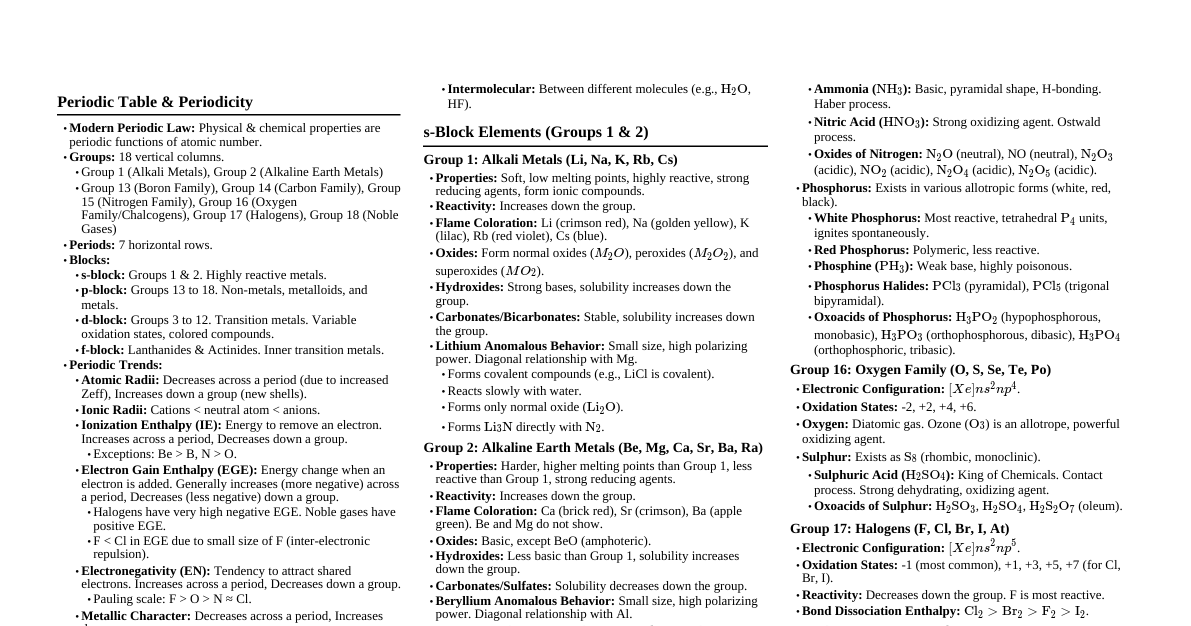
### Periodic Table & Periodicity - **Modern Periodic Law:** Properties of elements are periodic functions of their atomic numbers. - **Periods:** 7 horizontal rows. - **Groups:** 18 vertical columns. - **Effective Nuclear Charge ($Z_{eff}$):** $Z_{eff} = Z - S$ (Slater's rule). Increases across a period, decreases down a group. - **Atomic Radius:** Decreases across a period (due to increased $Z_{eff}$), increases down a group (due to increased shells). - **Ionic Radius:** Cation parent atom. - **Ionization Enthalpy (IE):** Energy required to remove an electron. Increases across a period, decreases down a group. - Exceptions: Be > B, N > O. - **Electron Gain Enthalpy ($\Delta_{eg}H$):** Energy released/absorbed when an electron is added. Generally becomes more negative across a period, less negative down a group. - Halogens have highest negative $\Delta_{eg}H$. Noble gases have positive $\Delta_{eg}H$. - Cl > F, S > O. - **Electronegativity (EN):** Tendency of an atom in a chemical compound to attract shared electrons. Increases across a period, decreases down a group. - Pauling scale: F (4.0) > O (3.5) > N (3.0) $\approx$ Cl (3.0). - **Metallic Character:** Decreases across a period, increases down a group. - **Non-metallic Character:** Increases across a period, decreases down a group. - **Amphoteric Oxides:** BeO, Al$_2$O$_3$, Ga$_2$O$_3$, In$_2$O$_3$, Tl$_2$O$_3$, SnO, SnO$_2$, PbO, PbO$_2$, ZnO, Cr$_2$O$_3$, V$_2$O$_5$, As$_2$O$_3$, Sb$_2$O$_3$. ### Chemical Bonding & Molecular Structure - **Octet Rule:** Atoms tend to achieve 8 electrons in valence shell. - **Ionic Bond:** Complete transfer of electrons. High EN difference. - **Covalent Bond:** Sharing of electrons. Low EN difference. - **Coordinate Bond:** One atom donates both shared electrons. - **Fajan's Rule:** - Small cation, large anion $\rightarrow$ more covalent character. - High charge on ion $\rightarrow$ more covalent character. - Pseudo noble gas configuration (e.g., Cu$^+$) $\rightarrow$ more covalent character. - **VSEPR Theory:** Predicts molecular geometry based on minimizing lone pair-lone pair > lone pair-bond pair > bond pair-bond pair repulsions. - Linear: BeCl$_2$, CO$_2$ - Trigonal Planar: BF$_3$, CO$_3^{2-}$ - Tetrahedral: CH$_4$, NH$_4^+$ - Trigonal Pyramidal: NH$_3$ (1 lone pair) - Bent/V-shaped: H$_2$O (2 lone pairs) - Trigonal Bipyramidal: PCl$_5$ - Octahedral: SF$_6$ - **Hybridization:** Mixing of atomic orbitals to form new hybrid orbitals. - $sp$: Linear (e.g., C$_2$H$_2$) - $sp^2$: Trigonal Planar (e.g., C$_2$H$_4$) - $sp^3$: Tetrahedral (e.g., CH$_4$) - $sp^3d$: Trigonal Bipyramidal - $sp^3d^2$: Octahedral - **Molecular Orbital Theory (MOT):** - Bond Order = 1/2 (No. of electrons in bonding MO - No. of electrons in anti-bonding MO). - If B.O. > 0, molecule exists. - If B.O. is half-integer, paramagnetic. If integer, diamagnetic. - For O$_2$ (16e-): $(\sigma_{1s})^2 (\sigma^*_{1s})^2 (\sigma_{2s})^2 (\sigma^*_{2s})^2 (\sigma_{2pz})^2 (\pi_{2px})^2 (\pi_{2py})^2 (\pi^*_{2px})^1 (\pi^*_{2py})^1$. B.O. = 2, paramagnetic. - For N$_2$ (14e-): $(\sigma_{1s})^2 (\sigma^*_{1s})^2 (\sigma_{2s})^2 (\sigma^*_{2s})^2 (\pi_{2px})^2 (\pi_{2py})^2 (\sigma_{2pz})^2$. B.O. = 3, diamagnetic. - **Hydrogen Bonding:** Strongest intermolecular force. H bonded to F, O, N. - Intramolecular (e.g., o-nitrophenol), Intermolecular (e.g., H$_2$O, HF). ### s-Block Elements (Group 1 & 2) - **Group 1 (Alkali Metals):** Li, Na, K, Rb, Cs, Fr. - Soft, low melting points, highly reactive, strong reducing agents. - Flame test: Li (Crimson Red), Na (Golden Yellow), K (Lilac), Rb (Red Violet), Cs (Blue). - React with water: $2M + 2H_2O \rightarrow 2MOH + H_2$. Reactivity increases down the group. - Li shows anomalous behavior (diagonal relationship with Mg). - Li forms normal oxide (Li$_2$O), Na forms peroxide (Na$_2$O$_2$), K, Rb, Cs form superoxides (MO$_2$). - **Group 2 (Alkaline Earth Metals):** Be, Mg, Ca, Sr, Ba, Ra. - Harder, higher melting points than Group 1. Less reactive than Group 1. Strong reducing agents. - Flame test: Ca (Brick Red), Sr (Crimson Red), Ba (Apple Green). Be, Mg do not show flame coloration due to high IE. - Be shows anomalous behavior (diagonal relationship with Al). - BeO is amphoteric. Other oxides are basic. - Solubility of hydroxides increases down the group (Be(OH)$_2$ is least soluble). - Solubility of sulfates decreases down the group (BaSO$_4$ is least soluble). - Thermal stability of carbonates increases down the group. ### p-Block Elements (Group 13 to 18) - **Group 13 (Boron Family):** B, Al, Ga, In, Tl. - Boron is a non-metal, others are metals. - B forms electron-deficient compounds (e.g., BF$_3$). Borax (Na$_2$B$_4$O$_7 \cdot 10H_2O$). Boric acid (H$_3$BO$_3$). Diborane (B$_2$H$_6$) - a 3-center 2-electron bond (banana bond). - Al is amphoteric. AlCl$_3$ is Lewis acid. - **Group 14 (Carbon Family):** C, Si, Ge, Sn, Pb. - Allotropes of Carbon: Diamond (sp$^3$), Graphite (sp$^2$), Fullerene (C$_{60}$). - Catenation property decreases down the group. - SiO$_2$ (Quartz). Silicones. Zeolites. - Lead is toxic. - **Group 15 (Nitrogen Family):** N, P, As, Sb, Bi. - N shows anomalous behavior (no d-orbitals). - Allotropes of Phosphorus: White P (tetrahedral P$_4$), Red P, Black P. - Ammonia (NH$_3$): Haber's process. Basic nature. - Nitric Acid (HNO$_3$): Ostwald's process. Strong oxidizing agent. - Phosphine (PH$_3$): Weak base. - PCl$_3$, PCl$_5$. Oxoacids of Phosphorus. - **Group 16 (Oxygen Family):** O, S, Se, Te, Po. - Oxygen is diatomic (O$_2$), paramagnetic. Ozone (O$_3$). - Sulfur Allotropes: Rhombic (S$_8$), Monoclinic (S$_8$). - H$_2$SO$_4$: Contact process. Strong acid, dehydrating agent, oxidizing agent. - **Group 17 (Halogens):** F, Cl, Br, I, At. - Highly reactive non-metals. Strong oxidizing agents (F$_2$ > Cl$_2$ > Br$_2$ > I$_2$). - EN: F > Cl > Br > I. - Oxidizing power: F$_2$ > Cl$_2$ > Br$_2$ > I$_2$. - Acidity of HX: HF ### d & f-Block Elements - **d-Block (Transition Elements):** Groups 3-12. - General electronic configuration: $(n-1)d^{1-10} ns^{0-2}$. - Variable oxidation states, formation of colored ions, paramagnetic behavior, catalytic properties, formation of interstitial compounds, alloy formation. - **Lanthanoid Contraction:** Poor shielding of 4f electrons causes decrease in atomic/ionic radii across lanthanoids, affecting subsequent d-block elements (e.g., Zr and Hf have similar radii). - **KMnO$_4$ (Potassium Permanganate):** Strong oxidizing agent. - Acidic medium: MnO$_4^-$ + 8H$^+$ + 5e$^-$ $\rightarrow$ Mn$^{2+}$ + 4H$_2$O - Neutral medium: MnO$_4^-$ + 2H$_2$O + 3e$^-$ $\rightarrow$ MnO$_2$ + 4OH$^-$ - Alkaline medium: MnO$_4^-$ + e$^-$ $\rightarrow$ MnO$_4^{2-}$ - **K$_2$Cr$_2$O$_7$ (Potassium Dichromate):** Strong oxidizing agent. - Acidic medium: Cr$_2$O$_7^{2-}$ + 14H$^+$ + 6e$^-$ $\rightarrow$ 2Cr$^{3+}$ + 7H$_2$O - Equilibrium: Cr$_2$O$_7^{2-}$ (orange) $\rightleftharpoons$ 2CrO$_4^{2-}$ (yellow) (pH dependent) - **f-Block (Inner Transition Elements):** Lanthanoids (4f) & Actinoids (5f). - **Lanthanoids:** Ce to Lu. Common oxidation state +3. Paramagnetic. - **Actinoids:** Th to Lr. Show variable oxidation states (+3, +4, +5, +6, +7). Radioactive. ### Coordination Compounds - **Definitions:** - **Central Metal Atom/Ion:** Lewis acid. - **Ligand:** Lewis base (donates electron pair). - **Coordination Number (CN):** Number of ligand donor atoms bonded to central metal. - **Coordination Sphere:** Central metal + ligands. - **Counter Ion:** Ion outside coordination sphere. - **Types of Ligands:** - Monodentate (e.g., H$_2$O, NH$_3$, Cl$^-$) - Bidentate (e.g., en (ethylenediamine), ox (oxalate)) - Polydentate (e.g., EDTA) - Ambidentate (e.g., NO$_2^-$, SCN$^-$) - **Werner's Theory:** Primary valency (ionizable, oxidation state), Secondary valency (non-ionizable, coordination number). - **Nomenclature (IUPAC):** 1. Cation named first, then anion. 2. Ligands named alphabetically before metal. 3. Anionic ligands end in '-o' (e.g., chloro, cyano). Neutral ligands are named as molecule (e.g., aqua, ammine). 4. Prefixes di-, tri-, tetra- for simple ligands. Bis-, tris-, tetrakis- for complex ligands. 5. Oxidation state of metal in Roman numerals in parentheses. 6. If complex is anion, metal name ends with '-ate' (e.g., ferrate, cuprate). - **Isomerism:** - **Structural Isomerism:** - **Ionization:** [Co(NH$_3$)$_5$Br]SO$_4$ and [Co(NH$_3$)$_5$SO$_4$]Br - **Hydrate:** [Cr(H$_2$O)$_6$]Cl$_3$ and [Cr(H$_2$O)$_5$Cl]Cl$_2 \cdot$ H$_2$O - **Linkage:** [Co(NH$_3$)$_5$NO$_2$]Cl$_2$ (nitro) and [Co(NH$_3$)$_5$ONO]Cl$_2$ (nitrito) - **Coordination:** [Co(NH$_3$)$_6$][Cr(CN)$_6$] and [Cr(NH$_3$)$_6$][Co(CN)$_6$] - **Stereoisomerism:** - **Geometric (cis-trans):** Square planar (MA$_2$B$_2$, MA$_2$BC), Octahedral (MA$_4$B$_2$, MA$_3$B$_3$ (fac-mer)). - **Optical (Enantiomers):** Non-superimposable mirror images. Chiral complexes (e.g., [Co(en)$_3$]$^{3+}$). - **Bonding Theories:** - **Valence Bond Theory (VBT):** Explains hybridization, geometry, magnetic properties. Predicts inner orbital (low spin) and outer orbital (high spin) complexes. - **Crystal Field Theory (CFT):** Explains color and magnetic properties based on splitting of d-orbitals by ligands. - **Octahedral:** d-orbitals split into t$_{2g}$ (lower energy) and e$_g$ (higher energy). $\Delta_o$. - **Tetrahedral:** d-orbitals split into e (lower energy) and t$_2$ (higher energy). $\Delta_t = \frac{4}{9}\Delta_o$. - **Spectrochemical Series:** Weak field ligands (small $\Delta$, high spin) ### Environmental Chemistry - **Atmospheric Pollution:** - **Tropospheric Pollution:** Gaseous pollutants (Oxides of S, N, C, H$_2$S, hydrocarbons), Particulate pollutants (dust, smoke, mist). - **Acid Rain:** SO$_2$, NO$_2$ react with water to form H$_2$SO$_4$, HNO$_3$. pH ### Qualitative Analysis - **Cations:** - **Group I (Pb$^{2+}$, Ag$^+$, Hg$_2^{2+}$):** Precipitated as chlorides (HCl). - **Group II (Pb$^{2+}$, Cu$^{2+}$, Cd$^{2+}$, Bi$^{3+}$, As$^{3+}$, Sb$^{3+}$, Sn$^{2+/4+}$):** Precipitated as sulfides (H$_2$S in acidic medium). - **Group III (Al$^{3+}$, Fe$^{3+}$, Cr$^{3+}$):** Precipitated as hydroxides (NH$_4$OH in presence of NH$_4$Cl). - **Group IV (Ni$^{2+}$, Co$^{2+}$, Mn$^{2+}$, Zn$^{2+}$):** Precipitated as sulfides (H$_2$S in basic medium). - **Group V (Ba$^{2+}$, Sr$^{2+}$, Ca$^{2+}$):** Precipitated as carbonates ((NH$_4$)$_2$CO$_3$ in presence of NH$_4$Cl, NH$_4$OH). - **Group VI (Mg$^{2+}$, K$^+$, Na$^+$, NH$_4^+$):** No group reagent. - **Anions:** - **Dilute H$_2$SO$_4$ group (CO$_3^{2-}$, SO$_3^{2-}$, S$^{2-}$, NO$_2^-$):** Evolve gases. - **Concentrated H$_2$SO$_4$ group (Cl$^-$, Br$^-$, I$^-$, NO$_3^-$):** Evolve characteristic gases/vapors. - **Special group (SO$_4^{2-}$, PO$_4^{3-}$):** No gas evolution with H$_2$SO$_4$. - **Flame Test (for specific cations):** - Li$^+$: Crimson red - Na$^+$: Golden yellow - K$^+$: Lilac (pale violet) - Ca$^{2+}$: Brick red - Sr$^{2+}$: Crimson red - Ba$^{2+}$: Apple green - Cu$^{2+}$: Blue/Green