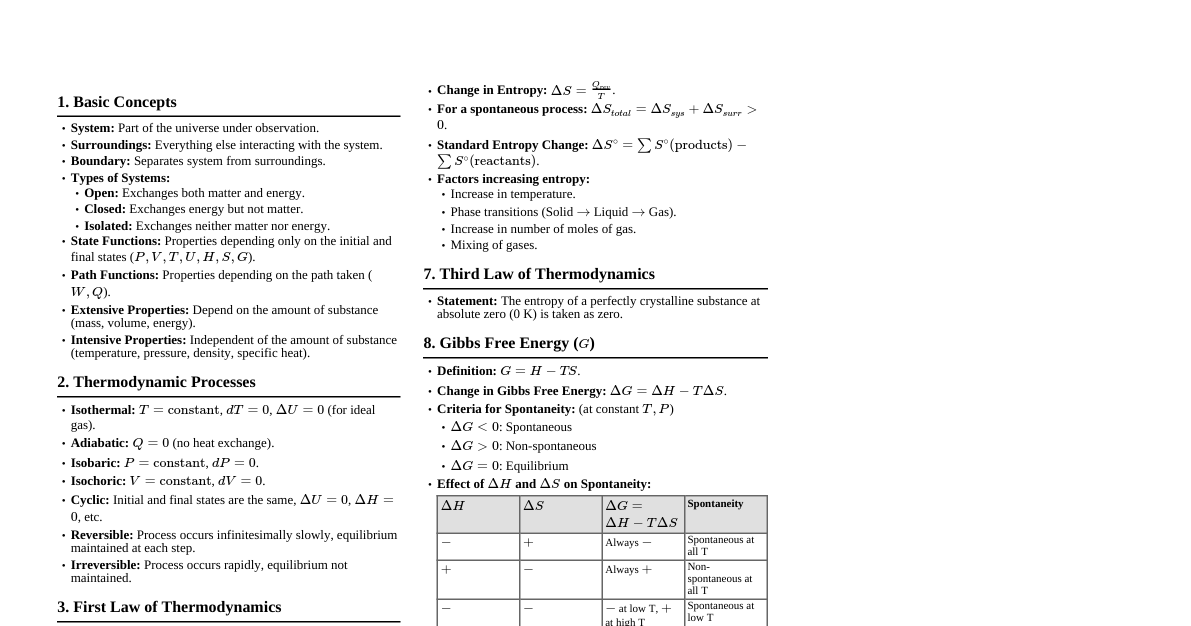
Thermodynamics Cheatsheet
Cheatsheet Content
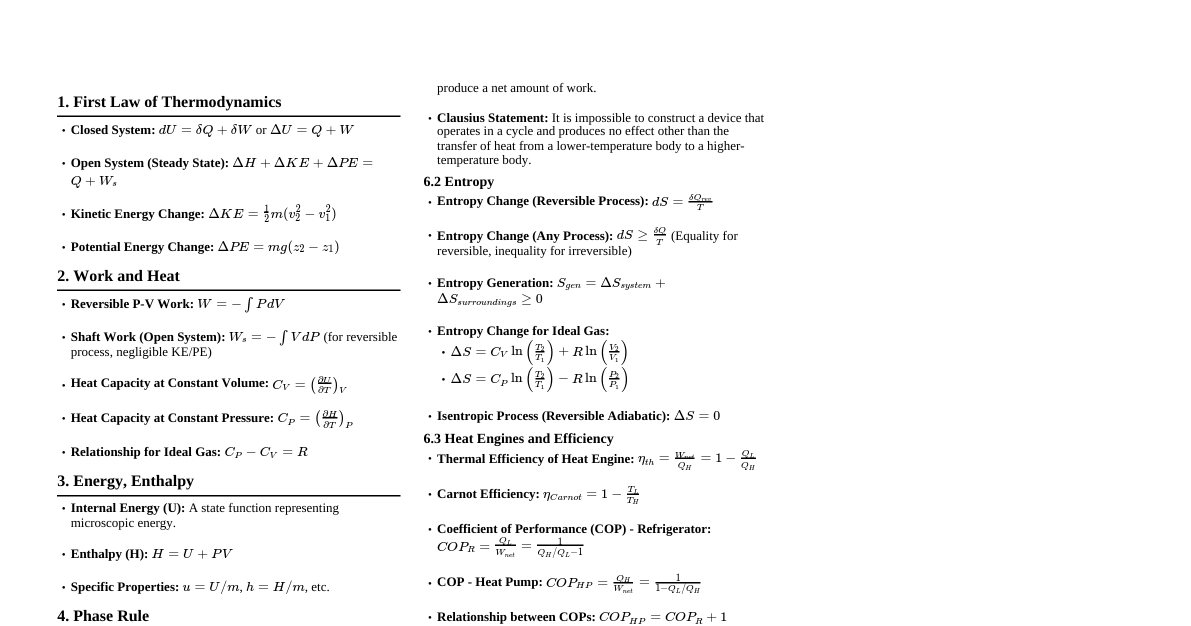
1. Introduction to Thermodynamics 1.1 Basic Concepts Thermodynamics: Science dealing with energy and its transformation. Microscopic Approach (Statistical Thermodynamics): Considers behavior of individual molecules. Macroscopic Approach (Classical Thermodynamics): No need to consider individual molecular behavior. 1.2 Units and Dimensions Primary Dimensions: Length (m), Time (s), Mass (kg). Derived Dimensions: Force, Pressure, Energy, Work, Heat. Force: $F = ma$ ($N = kg \cdot m/s^2$) Pressure: $P = F/A$ Work: $dW = Fdl$ ($J = N \cdot m$) Heat: Form of energy transfer due to temperature difference. Energy: Property transformable into or produced from work. Kinetic Energy: $K.E. = \frac{1}{2}mV^2$ Potential Energy: $P.E. = mgZ$ Internal Energy ($U$): Sum of all microscopic forms of energy. Total Energy ($E$): $E = K.E. + P.E. + U$ Power: Rate at which work is done, $Power = \frac{Work \, done}{Time}$. 1.3 Systems and Boundaries System: Quantity of matter or region of space under study. Surroundings: Area external to the system. Universe: System + Surroundings. Boundary: Real or imaginary surface separating system from surroundings. Fixed Boundary: Immovable (e.g., cylinder walls). Moving Boundary: Movable (e.g., piston). Permeable Wall: Allows passage of matter and energy. Impermeable Wall: Prevents passage of matter. Rigid Wall: Fixed shape and position. Adiabatic Wall: Prevents heat and matter flow. Diathermal Wall: Prevents matter flow, allows energy flow. Types of Systems: Open System (Control Volume): Exchanges mass and energy with surroundings. Closed System (Control Mass): Exchanges only energy with surroundings (fixed mass). Isolated System: Exchanges neither mass nor energy with surroundings. 1.4 State and Equilibrium State of a System: Condition defined by observable properties (T, P, V, composition). Steady State: Properties do not vary with time. Homogeneous System: Uniform properties throughout (single phase). Heterogeneous System: Non-uniform properties (multiple phases). Thermodynamic Equilibrium: State of balance, no tendency for further change. Thermal Equilibrium: Uniform temperature. Mechanical Equilibrium: Uniform pressure. Chemical Equilibrium: Constant composition. Properties of a System: Extensive Property: Depends on mass/quantity (mass, volume, internal energy). Intensive Property: Independent of mass/quantity (T, P, density, specific heat). 1.5 Processes Process: Change from one equilibrium state to another. Isothermal Process: $T = \text{constant}$ ($dT = 0$). Isobaric Process: $P = \text{constant}$ ($dP = 0$). Isochoric Process: $V = \text{constant}$ ($dV = 0$). Adiabatic Process: No heat exchange ($Q = \text{constant}$ or $dQ = 0$). Cyclic Process: System returns to initial state. Quasi-static Process: Very slow, infinitesimally close to equilibrium at all times. Reversible Process: Both system and surroundings can be restored to original states. Irreversible Process: Cannot restore system and surroundings to original states (e.g., friction, mixing, heat transfer across $\Delta T$). 1.6 Zeroth Law and Temperature Scales Zeroth Law of Thermodynamics: If two bodies are in thermal equilibrium with a third body, they are also in thermal equilibrium with each other. ($T_A = T_B = T_C$). Ideal Gas Temperature Scale (Kelvin Scale): Based on ideal fluid behavior. $T(K) = T(^\circ C) + 273.15$ $T(R) = 1.8 \cdot T(K)$ $T(^\circ F) = T(R) - 459.67$ $T(^\circ F) = 1.8 \cdot T(^\circ C) + 32$ 1.7 Phase Rule Phase Rule (Gibbs): $F = C - P + 2$ $F$: Degrees of freedom $C$: Number of components $P$: Number of phases Example (Water): For ice, liquid water, vapor in equilibrium: $P=3, C=1 \Rightarrow F=0$. 2. First Law of Thermodynamics 2.1 Statement of First Law Joule's Experiment: Demonstrated mechanical equivalence of heat. Conservation of Energy: Energy cannot be created or destroyed, only transformed. For a system: $E_{system} + E_{surroundings} = \text{Constant}$ or $dE_{system} + dE_{surroundings} = 0$. First Law for Closed System: $\Delta E = Q - W$ $\Delta E$: Change in total energy. $Q$: Heat added to system. $W$: Work done by system. Differential Form (Closed System, negligible KE/PE): $dU = dQ - dW$ Sign Convention: $Q_{in} = +ve$, $Q_{out} = -ve$ $W_{by \, system} = +ve$, $W_{on \, system} = -ve$ First Law for Cyclic Process: $\oint dQ = \oint dW$ 2.2 Heat Capacity Specific Heat: Heat required to raise $1g$ of substance by $1K$. Molar Heat Capacity ($C$): Heat required to raise $1\,mol$ of substance by $1K$. $dQ = CdT$ At Constant Volume ($C_V$): $dQ_V = C_VdT \Rightarrow C_V = \left(\frac{\partial U}{\partial T}\right)_V$ At Constant Pressure ($C_P$): $dQ_P = C_PdT \Rightarrow C_P = \left(\frac{\partial H}{\partial T}\right)_P$ Relation between $C_P$ and $C_V$: For ideal gas: $C_P - C_V = R$ Heat Capacity Ratio: $\gamma = C_P/C_V$ 2.3 Enthalpy ($H$) Definition: $H = U + PV$ Differential Form: $dH = dU + PdV + VdP$ Change at Constant Pressure: $\Delta H = \Delta U + P\Delta V = Q_P$ For ideal gas, internal energy $U$ and enthalpy $H$ are functions of temperature only. 2.4 Adiabatic Processes No heat transfer ($dQ = 0$). First Law: $dU = -dW$ Reversible Adiabatic Expansion of Ideal Gas: Work Done: $W_{ad} = C_V(T_1 - T_2)$ Relation between T and V: $TV^{\gamma-1} = \text{Constant}$ Relation between P and V: $PV^\gamma = \text{Constant}$ Relation between T and P: $T^{\gamma}P^{1-\gamma} = \text{Constant}$ 3. Properties of Pure Substances 3.1 Phases and Phase Changes Pure Substance: Fixed chemical composition throughout. Phases: Solid, Liquid, Gas (Vapor). Compressed (Sub-cooled) Liquid: Liquid at $T Saturated Liquid: Liquid at boiling point, about to vaporize. Saturated Vapor: Vapor at condensing point, about to condense. Superheated Vapor: Vapor at $T > T_{sat}$ for a given $P$. Saturation Temperature ($T_{sat}$): Temperature at which a pure substance changes phase for a given pressure. Saturation Pressure ($P_{sat}$): Pressure at which a pure substance changes phase for a given temperature. Latent Heat of Fusion: Heat absorbed during melting. Latent Heat of Vaporization: Heat absorbed during vaporization. Triple Point: State where solid, liquid, and vapor coexist in equilibrium. $F=0$. Critical Point: Highest temperature and pressure where liquid and vapor phases are indistinguishable. 3.2 P-V-T Behavior (Equations of State) Equation of State: Relates $P, V, T$ of a substance ($f(P,V,T)=0$). Isothermal Compressibility ($\alpha$): $\alpha = -\frac{1}{V}\left(\frac{\partial V}{\partial P}\right)_T$ Volume Expansivity ($\beta$): $\beta = \frac{1}{V}\left(\frac{\partial V}{\partial T}\right)_P$ Ideal Gas Equation: $PV = nRT$ Boyle's Law: $P \propto 1/V$ (T constant) Charles' Law: $V \propto T$ (P constant) Avogadro's Law: $V \propto n$ (T, P constant) Van der Waals Equation: $\left(P + \frac{a}{V^2}\right)(V - b) = RT$ Redlich-Kwong Equation: $P = \frac{RT}{V-b} - \frac{a}{T^{0.5}V(V+b)}$ Peng-Robinson Equation: $P = \frac{RT}{V-b} - \frac{\alpha a}{V(V+b)+b(V-b)}$ Benedict-Webb-Rubin Equation: (Multi-parameter for hydrocarbons) Beattie-Bridgeman Equation: (Five-constant model) Virial Equation of State: $PV/RT = Z = 1 + B/V + C/V^2 + D/V^3 + \dots$ 3.3 Compressibility Factor ($Z$) Definition: $Z = PV/RT = V_{real}/V_{ideal}$ Measures deviation from ideal gas behavior. For ideal gas, $Z=1$. 3.4 Law of Corresponding States All gases exhibit similar behavior at the same reduced temperature ($T_r = T/T_c$) and reduced pressure ($P_r = P/P_c$). Acentric Factor ($\omega$): $\omega = -1 - \log_{10}(P_{r}^{sat})_{T_r=0.7}$ 3.5 Fugacity ($f$) and Fugacity Coefficient ($\phi$) Fugacity: "Escaping tendency," idealized pressure for real gases. Fugacity Coefficient: $\phi = f/P$. For ideal gas, $\phi=1$. 4. Heat Effects (Thermochemistry) 4.1 Reaction Types Exothermic Reaction: Releases heat ($\Delta H Endothermic Reaction: Absorbs heat ($\Delta H > 0$). 4.2 Heat of Reaction Heat of Reaction ($\Delta H_{reaction}$): $\Delta H_{reaction} = \sum \Delta H_{products} - \sum \Delta H_{reactants}$ At Constant Pressure: $Q_P = \Delta H$ At Constant Volume: $Q_V = \Delta U$ Relation between $Q_P$ and $Q_V$: $Q_P - Q_V = \Delta n_{gas}RT$ 4.3 Hess's Law of Constant Heat Summation Net heat change for a chemical process is the same whether it occurs in one or several stages. 4.4 Standard Heat of Formation ($\Delta H_f^0$) Enthalpy change when 1 mol of substance is formed from its elements at standard state ($25^\circ C$, $1\,atm$). $\Delta H_f^0 = 0$ for elements in their standard state. 4.5 Standard Heat of Combustion ($\Delta H_c^0$) Enthalpy change when 1 mol of substance undergoes complete combustion at standard state. Higher Heating Value (HHV) / Gross Heating Value (GHV): Water in products is liquid. Lower Heating Value (LHV) / Net Heating Value (NHV): Water in products is vapor. $HHV = LHV + (h_{fg})_{25^\circ C}$ 4.6 Adiabatic Flame Temperature Maximum temperature attained by products if reaction occurs adiabatically (no heat loss/gain) and completely. 4.7 Kirchhoff's Equation Effect of temperature on heat of reaction: $\left(\frac{\partial \Delta H}{\partial T}\right)_P = \Delta C_P$ $\Delta H_{T_2} = \Delta H_{T_1} + \int_{T_1}^{T_2} \Delta C_P dT$ 5. Second Law of Thermodynamics 5.1 Limitations of First Law Does not predict direction of process or extent of transformation. 5.2 Heat Engines, Pumps, and Refrigerators Thermal Reservoir: Hypothetical body with large heat capacity (e.g., ocean, atmosphere). Source: High-temperature reservoir supplying heat. Sink: Low-temperature reservoir absorbing heat. Heat Engine: Device converting heat into work in a cycle. Absorbs $Q_H$ from hot source, rejects $Q_L$ to cold sink, produces net work $W_{net}$. Thermal Efficiency ($\eta$): $\eta = \frac{W_{net}}{Q_H} = 1 - \frac{Q_L}{Q_H}$ Heat Pump: Device transferring heat from low to high temperature for heating. Coefficient of Performance (COP): $COP_{HP} = \frac{Q_H}{W_{net}} = \frac{Q_H}{Q_H - Q_L}$ Refrigerator: Device transferring heat from low to high temperature for cooling. Coefficient of Performance (COP): $COP_R = \frac{Q_L}{W_{net}} = \frac{Q_L}{Q_H - Q_L}$ $COP_{HP} = COP_R + 1$ Ton of Refrigeration: $1\,ton = 200\,BTU/min = 3.517\,kW$ 5.3 Statements of Second Law Kelvin-Planck Statement: Impossible for a heat engine operating in a cycle to convert all heat absorbed into net work. (Requires at least two thermal reservoirs). Clausius Statement: Impossible to construct a device operating in a cycle that produces no effect other than transferring heat from a colder body to a hotter body. (Requires work input). Equivalence: Violation of one implies violation of the other. 5.4 Carnot Cycle Most efficient reversible cycle (ideal standard for comparison). Isothermal expansion ($T_H$) Adiabatic expansion Isothermal compression ($T_L$) Adiabatic compression Carnot Efficiency: $\eta_{Carnot} = 1 - \frac{T_L}{T_H}$ Carnot COP (Refrigerator): $COP_{Carnot,R} = \frac{T_L}{T_H - T_L}$ Carnot COP (Heat Pump): $COP_{Carnot,HP} = \frac{T_H}{T_H - T_L}$ 5.5 Entropy ($S$) Definition: Measure of disorder or randomness of a system. State function. Differential Change (Reversible): $dS = \frac{dQ_{rev}}{T}$ Second Law (Isolated System): $\Delta S_{isolated} \ge 0$ (Entropy never decreases). $\Delta S = 0$ for reversible processes. $\Delta S > 0$ for irreversible processes. Relation between $S$ and $U$: $dU = TdS - PdV$ (Combined First and Second Law) Relation between $S$ and $H$: $dH = TdS + VdP$ Entropy Change for Phase Transition: $\Delta S = \frac{\Delta H_{phase \, change}}{T_{phase \, change}}$ (e.g., $\Delta S_{fusion} = \frac{\Delta H_{fusion}}{T_{fusion}}$) Entropy Change for Ideal Gas: $\Delta S = C_V \ln\left(\frac{T_2}{T_1}\right) + R \ln\left(\frac{V_2}{V_1}\right)$ $\Delta S = C_P \ln\left(\frac{T_2}{T_1}\right) - R \ln\left(\frac{P_2}{P_1}\right)$ Isothermal: $\Delta S = R \ln\left(\frac{V_2}{V_1}\right) = -R \ln\left(\frac{P_2}{P_1}\right)$ Isobaric: $\Delta S = C_P \ln\left(\frac{T_2}{T_1}\right)$ Isochoric: $\Delta S = C_V \ln\left(\frac{T_2}{T_1}\right)$ Entropy Change of Mixing (Ideal Gases): $\Delta S_{mix} = -R \sum x_i \ln x_i$ Microscopic Definition (Boltzmann): $S = k_B \ln \Omega$ ($\Omega$: number of microstates) 5.6 Irreversibility and Lost Work Lost Work ($W_{lost}$): Due to irreversibilities, $W_{lost} = T_L \Delta S_{total}$ 6. Thermodynamic Property Relations 6.1 Free Energy Functions Helmholtz Free Energy ($A$): $A = U - TS$ For isothermal reversible process: $\Delta A = -W_{max}$ For constant $T, V$: $\Delta A_{T,V} \le 0$ (minimum at equilibrium) Gibbs Free Energy ($G$): $G = H - TS$ For isothermal reversible process: $\Delta G = -W_{useful,max}$ (max useful work) For constant $T, P$: $\Delta G_{T,P} \le 0$ (minimum at equilibrium) 6.2 Maxwell's Relations From $dU = TdS - PdV \Rightarrow \left(\frac{\partial T}{\partial V}\right)_S = -\left(\frac{\partial P}{\partial S}\right)_V$ From $dH = TdS + VdP \Rightarrow \left(\frac{\partial T}{\partial P}\right)_S = \left(\frac{\partial V}{\partial S}\right)_P$ From $dA = -PdV - SdT \Rightarrow \left(\frac{\partial P}{\partial T}\right)_V = \left(\frac{\partial S}{\partial V}\right)_T$ From $dG = VdP - SdT \Rightarrow \left(\frac{\partial V}{\partial T}\right)_P = -\left(\frac{\partial S}{\partial P}\right)_T$ 6.3 Clapeyron Equation For phase change: $\frac{dP}{dT} = \frac{\Delta H}{T\Delta V}$ Clausius-Clapeyron Equation (Vaporization, low P): $\frac{d(\ln P)}{dT} = \frac{\Delta H_{vap}}{RT^2}$ 6.4 TdS Equations $TdS = C_VdT + T\left(\frac{\partial P}{\partial T}\right)_VdV$ $TdS = C_PdT - T\left(\frac{\partial V}{\partial T}\right)_PdP$ $C_P - C_V = T\left(\frac{\partial P}{\partial T}\right)_V\left(\frac{\partial V}{\partial T}\right)_P = \frac{TV\beta^2}{\alpha}$ 6.5 Joule-Thomson Coefficient ($\mu_{JT}$) $\mu_{JT} = \left(\frac{\partial T}{\partial P}\right)_H$ Cooling effect if $\mu_{JT} > 0$, heating effect if $\mu_{JT} Inversion Temperature: Temperature at which $\mu_{JT} = 0$. 6.6 Residual Properties Difference between actual property and ideal gas property at same $T, P$. $M^R = M - M^{ideal}$ $H^R = H - H^{ideal}$ $S^R = S - S^{ideal}$ $G^R = G - G^{ideal}$ $G^R = RT \ln \phi$ 7. Thermodynamics to Flow Processes 7.1 Steady-Flow Processes Continuity Equation (Mass Balance): $\dot{m}_{in} - \dot{m}_{out} = \frac{dm_{CV}}{dt}$ For steady-flow: $\sum \dot{m}_{in} = \sum \dot{m}_{out}$ (constant mass in control volume) For single stream: $\rho_1 U_1 A_1 = \rho_2 U_2 A_2$ Energy Balance (First Law for Open System): $\dot{Q} - \dot{W}_s = \frac{dE_{CV}}{dt} + \Delta\left(\dot{m}\left(h + \frac{U^2}{2} + gZ\right)\right)$ For steady-flow: $\dot{Q} - \dot{W}_s = \Delta\left(\dot{m}\left(h + \frac{U^2}{2} + gZ\right)\right)$ For single stream: $Q - W_s = \Delta h + \frac{\Delta U^2}{2} + g\Delta Z$ (per unit mass) Negligible KE, PE change: $Q - W_s = \Delta h$ Mechanical Energy Balance: $\frac{\Delta U^2}{2} + g\Delta Z + \frac{\Delta P}{\rho} + W_s + W_f = 0$ (per unit mass) Bernoulli's Equation: For incompressible, non-viscous fluid, no work/heat exchange: $\frac{U^2}{2} + gZ + \frac{P}{\rho} = \text{Constant}$ 7.2 Common Steady-Flow Devices Throttling Device: Isenthalpic expansion ($h_1 = h_2$). Significant pressure drop, temperature change (Joule-Thomson effect). Compressor: Increases pressure of gas (reduces volume). Adiabatic Compression (ideal gas): $W_s = C_P(T_1 - T_2)$ Isothermal Compression (ideal gas): $W_s = RT \ln\left(\frac{P_2}{P_1}\right)$ Multistage compression with inter-cooling reduces work. Nozzles: Increases fluid velocity at expense of pressure drop. $U_2 = \sqrt{U_1^2 + 2(h_1 - h_2)}$. Diffusers: Increases fluid pressure at expense of velocity. Heat Exchangers: Transfers heat between fluids. For adiabatic heat exchanger: $\dot{m}_A (h_{A,in} - h_{A,out}) = \dot{m}_B (h_{B,out} - h_{B,in})$. 8. Refrigeration and Liquefaction Processes 8.1 Refrigeration Cycles Refrigeration: Process of removing heat from low-temperature region and rejecting it to high-temperature region, requiring work input. Reversed Carnot Cycle: Ideal refrigeration cycle. Isothermal compression ($T_H$) Adiabatic expansion Isothermal expansion ($T_L$) Adiabatic compression Vapor-Compression Cycle: Most common. Involves compression, condensation, expansion (throttling), and vaporization (evaporation). Absorption Refrigeration Cycle: Uses heat source instead of mechanical work for compression. Air Refrigeration Cycle (Bell-Coleman): Uses air as refrigerant, useful for very low temperatures. 8.2 Liquefaction Processes Liquefaction: Cooling gas to below its critical temperature to condense it into liquid. Isentropic Expansion (work-producing device) Joule-Thomson Expansion (isenthalpic expansion) Exchanging Heat at Constant Pressure Linde-Hampson Cycle: Uses Joule-Thomson expansion. Claude Cycle: Uses isentropic expansion (expander) and Joule-Thomson expansion. 9. Solution Thermodynamics: Properties 9.1 Partial Molar Properties Partial Molar Property ($\bar{X}_i$): Contribution of component $i$ to an extensive property of a mixture. $\bar{X}_i = \left(\frac{\partial X}{\partial n_i}\right)_{T,P,n_j}$ Molar Volume of Mixture: $V = \sum x_i \bar{V}_i$ 9.2 Chemical Potential ($\mu_i$) Definition: $\mu_i = \left(\frac{\partial G}{\partial n_i}\right)_{T,P,n_j}$ (partial molar Gibbs free energy). Equilibrium Condition: Chemical potential of component $i$ is the same in all phases at equilibrium. $\mu_i^\alpha = \mu_i^\beta$ Relation to Fugacity: $\mu_i = \mu_i^0 + RT \ln f_i$ Influence of Temperature: $\left(\frac{\partial \mu_i}{\partial T}\right)_{P,n_j} = -\bar{S}_i$ Influence of Pressure: $\left(\frac{\partial \mu_i}{\partial P}\right)_{T,n_j} = \bar{V}_i$ 9.3 Activity ($a_i$) and Activity Coefficient ($\gamma_i$) Activity: Effective concentration of a component. $a_i = f_i/f_i^0$. Activity Coefficient: Measures deviation from ideal behavior. $\gamma_i = a_i/x_i = f_i/(x_i f_i^0)$. Temperature Dependence: $\left(\frac{\partial \ln \gamma_i}{\partial T}\right)_P = \frac{\bar{H}_i - H_i^0}{RT^2}$ Pressure Dependence: $\left(\frac{\partial \ln \gamma_i}{\partial P}\right)_T = \frac{\bar{V}_i - V_i^0}{RT}$ 9.4 Gibbs-Duhem Equation $\sum n_i d\mu_i = 0$ (at constant $T, P$) $\sum x_i d(\ln \gamma_i) = 0$ (at constant $T, P$) 9.5 Ideal Solution Model (Lewis-Randall Rule) For ideal solution: $f_i = x_i f_i^0$ (fugacity of component $i$ is proportional to its mole fraction). Implies $\gamma_i = 1$. No change in volume or enthalpy on mixing. Entropy Change of Mixing: $\Delta S_{mix} = -R \sum x_i \ln x_i$ Gibbs Free Energy Change of Mixing: $\Delta G_{mix} = RT \sum x_i \ln x_i$ 9.6 Raoult's Law For volatile components in ideal solution: $P_i = x_i P_i^{sat}$ (partial pressure is mole fraction times vapor pressure). Applicable for dilute solutions. 9.7 Henry's Law For solute in dilute solution: $f_i = x_i H_i$ (fugacity is proportional to mole fraction with Henry's constant). 9.8 Excess Properties $M^E = M - M^{ideal}$ (difference between actual and ideal solution properties). $G^E = RT \sum x_i \ln \gamma_i$ 9.9 Activity Coefficient Models Wohl's Equation (Three-Suffix): Relates $G^E/RT$ to compositions and empirical constants. Margules Equation (Two-Suffix, Three-Suffix): Empirical models for activity coefficients. Van Laar Equation: Empirical model for activity coefficients, often for non-polar systems. Wilson Equation: Based on local compositions, for miscible binary solutions. NRTL Equation (Non-Random Two-Liquid): For miscible or partially miscible systems. UNIQUAC Equation (Universal Quasi-Chemical): Group contribution method for activity coefficients. 10. Vapour-Liquid Equilibrium (VLE) 10.1 Criteria for Equilibrium For phase equilibrium at constant $T, P$: $\Delta G_{T,P} = 0$ Chemical potential of each component must be equal in all phases. $\mu_i^\alpha = \mu_i^\beta$ 10.2 Phase Rule for Non-Reacting Systems $F = C - P + 2$ 10.3 VLE Diagrams T-x-y Diagram (Boiling Point Diagram): Temperature vs. composition at constant pressure. Bubble Point Curve: Saturated liquid line. Dew Point Curve: Saturated vapor line. Two-phase region under the curves. P-x-y Diagram: Pressure vs. composition at constant temperature. P-T Diagram: Pressure vs. temperature, showing phase boundaries. Maxcondenbar: Max pressure on phase boundary. Maxcondentherm: Max temperature on phase boundary. Retrograde Condensation: Condensation upon pressure reduction or temperature increase. 10.4 Modified Raoult's Law For component $i$: $y_i P = x_i \gamma_i P_i^{sat}$ 10.5 VLE Calculations K-Factor: $K_i = y_i / x_i$ Relative Volatility: $\alpha_{ij} = K_i / K_j$ Bubble Point Calculation: Given $T$, find $P_{bubble}$. $\sum K_i x_i = 1$. Dew Point Calculation: Given $T$, find $P_{dew}$. $\sum y_i/K_i = 1$. Flash Calculations: Determines liquid and vapor compositions and amounts at equilibrium. Overall mass balance: $F = L + V$ Component balance: $F z_i = L x_i + V y_i$ 10.6 Thermodynamic Consistency Tests (VLE Data) Using Gibbs-Duhem equation, e.g., $\int \ln(\gamma_1/\gamma_2) dx_1 = 0$. 11. Additional Topics in Phase Equilibrium 11.1 Liquid-Liquid Equilibrium (LLE) Equilibrium criteria: $\mu_i^\alpha = \mu_i^\beta \Rightarrow x_i^\alpha \gamma_i^\alpha = x_i^\beta \gamma_i^\beta$ Critical Solution Temperature (CST): Temperature at which two partially miscible liquids become completely miscible. Upper CST (UCST): Miscibility increases with temperature. Lower CST (LCST): Miscibility decreases with temperature. 11.2 Solid-Liquid Equilibrium (SLE) Eutectic Point: Point where two solid components and a liquid phase coexist at lowest possible temperature. Freezing Point Depression: $\Delta T_f = K_f m$ (Van't Hoff's law) Boiling Point Elevation: $\Delta T_b = K_b m$ (Van't Hoff's law) 11.3 Solid-Vapor Equilibrium (SVE) Fugacity of solid equals fugacity of vapor. 11.4 Osmotic Pressure Pressure to prevent osmosis across a semi-permeable membrane. $\Pi = \frac{RTx_2}{\bar{V}_1}$ 12. Chemical Reaction Equilibria 12.1 Reaction Coordinate ($\epsilon$) Represents extent of reaction. $n_i = n_{i0} + \nu_i \epsilon$ Total moles: $n = n_0 + \epsilon \sum \nu_i$ Mole fraction: $x_i = \frac{n_{i0} + \nu_i \epsilon}{n_0 + \epsilon \sum \nu_i}$ 12.2 Equilibrium Criterion For a chemical reaction at constant $T, P$: $\Delta G_{T,P} = 0$ at equilibrium. $\sum \nu_i \mu_i = 0$ 12.3 Equilibrium Constant ($K$) Relation to $\Delta G^0$: $\Delta G^0 = -RT \ln K$ For Gaseous Reactions: $K_a = \prod a_i^{\nu_i}$ (activity-based) $K_P = \prod P_i^{\nu_i}$ (partial pressure-based) $K_x = \prod x_i^{\nu_i}$ (mole fraction-based) $K = K_P = K_x P^{\sum \nu_i}$ (for ideal gases) Effect of Temperature (Van't Hoff Equation): $\left(\frac{\partial \ln K}{\partial T}\right)_P = \frac{\Delta H^0}{RT^2}$ Effect of Pressure: No effect on $K$, but affects equilibrium composition ($\Delta V \ne 0$). Effect of Inert Gases: Shifts equilibrium composition. Effect of Excess Reactants: Increases conversion of limiting reactant. Effect of Products in Initial Mixture: Reduces conversion of reactants. 12.4 Homogeneous Liquid-Phase Reaction $K_a = \prod (\gamma_i x_i)^{\nu_i} = K_\gamma K_x$ 12.5 Heterogeneous Reaction (Solid-Gas) Activities of pure solids are unity ($a_i = 1$). $K_P = P_{gas}$ 12.6 Simultaneous Reactions Apply equilibrium criterion to each independent reaction. 12.7 Fuel Cells Electrochemical device converting chemical energy directly into electrical energy.