Thermodynamics & Equilibrium
Cheatsheet Content
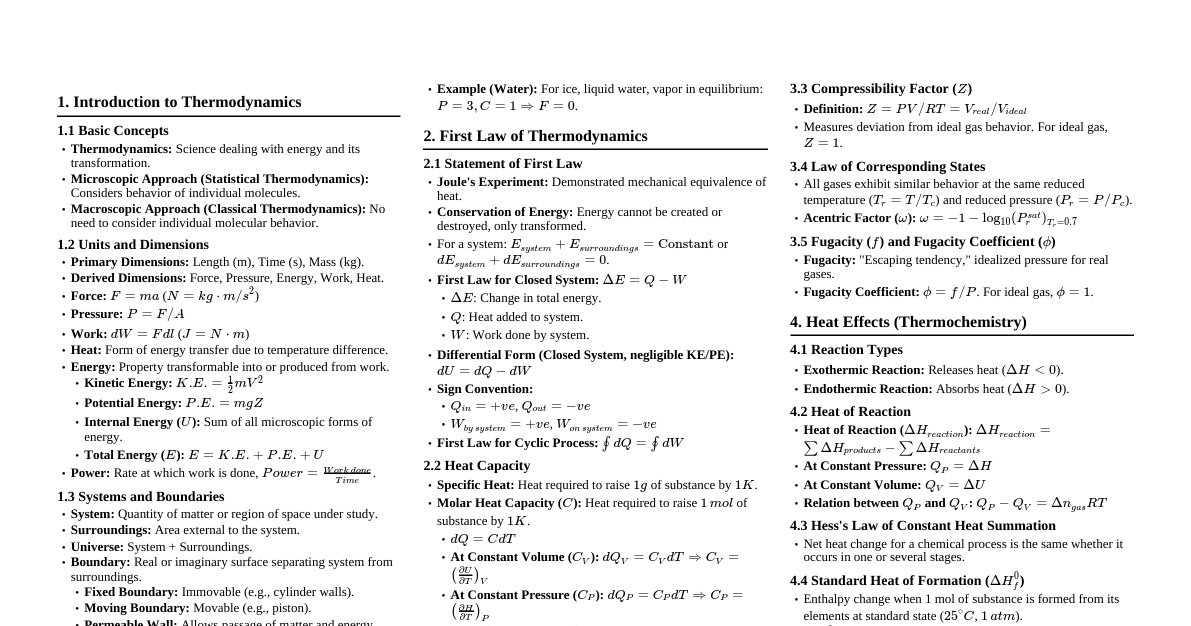
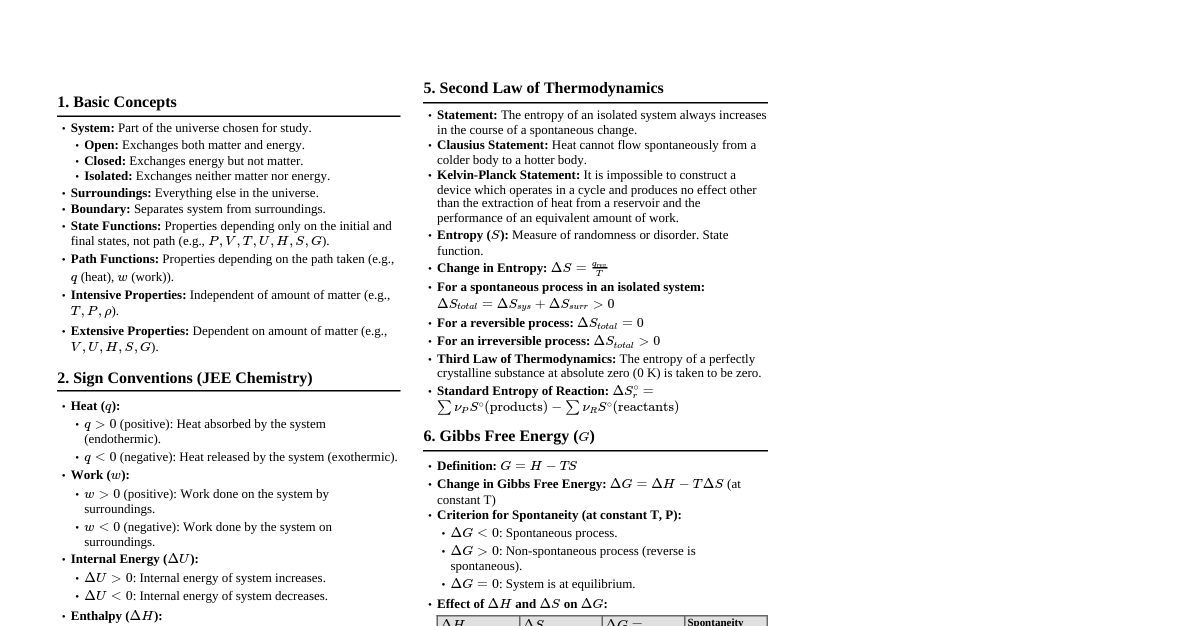
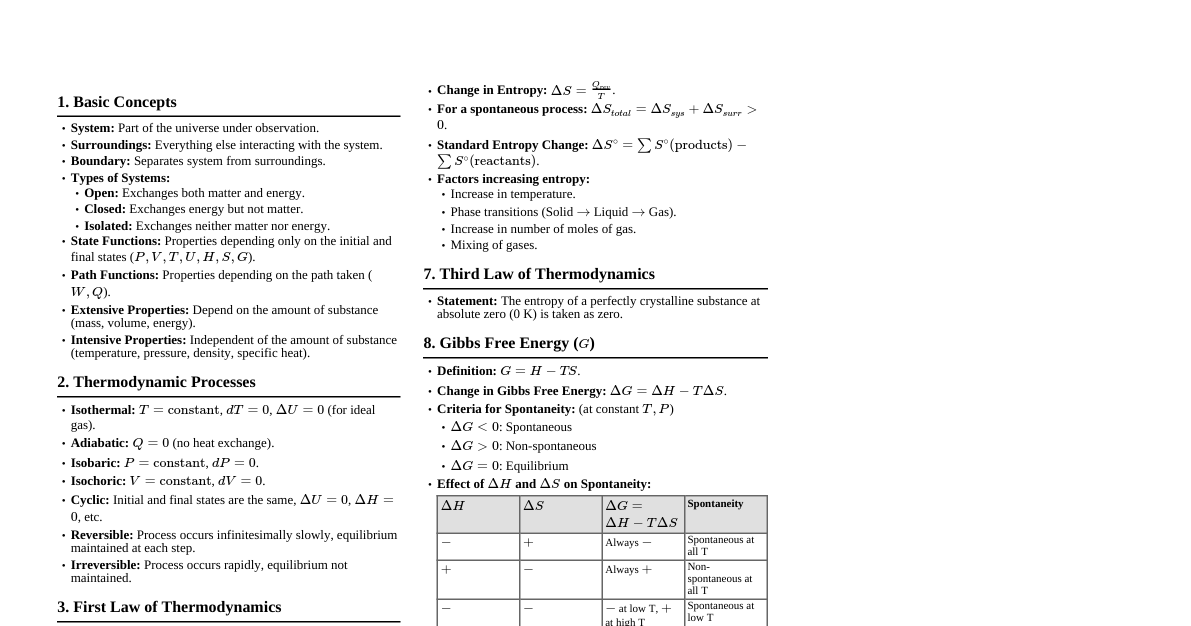
Thermodynamics Systems and Equilibrium 1.1.1 Scope and Limitations of Thermodynamics Definition: Thermodynamics is the branch of science dealing with energy conversion and its relation to properties of matter. It is a macroscopic science, concerned with the relations between heat and other forms of energy accompanying physical and chemical processes. 1.1.1.1 Introduction to Thermodynamics Studies the flow of heat, energy, or other forms of energy into or out of a system undergoing a physical or chemical process. Deals with energy changes associated with physical or chemical processes. Macroscopic Systems: Focuses on the collective behavior of a large number of molecules (e.g., a gas mixture), not individual atoms or molecules. Based on four laws: zeroth, first, second, and third laws of thermodynamics. Provides direct benefit in the analysis of industrial problems. Mathematical proofs are not provided; based on experimental observations. 1.1.1.2 Scope of Thermodynamics Provides information regarding how far a given process may proceed (the maximum possible extent to which a given process can proceed) and the degree to which that energy present in a system can be utilized to cause a given process to occur / take place. Helps make a preliminary choice of the process variables, their effect on the extent of a process and to find out thermal/heat effects associated/involved in a given process. Renewable Energy: An important area of thermodynamics that involves study of feasibility of using different types of energy sources for domestic and industrial use. Used for performing energy balances in unit operations such as distillation, etc., chemical reactors, heating, cooling, compression and expansion operations, steam power plants. Used for calculating energy requirement of a process. Used for determining various physical properties which in turn are required in energy balances. Used to determine the conditions of equilibrium: temperature, pressure, and composition required to produce the desired effect in a phase transformation operation and chemical reactions. Used for measurement of the heat evolved during the combustion of all types of fuels – it has practical significance in the fuel technologies. Used to predict the effect of changes in the condition on the equilibrium state. 1.1.1.3 Limitations of Thermodynamics It does not tell us about how fast a given process/reaction will occur. It does not give us an idea regarding resistance to flow of energy or transfer of energy. It says nothing about reaction mechanism. It gives idea regarding the minimum work required to carry out a process but it does not tell us about the actual work requirement of the process. It does not provide deep insight into physical and chemical phenomena that is provided by microscopic models and theories. It does not give any idea regarding the character of the process by which the change in state takes place though it provides a quantitative description of the overall change in the state. 1.1.2 Basic Concepts Essential to understand certain terms related to thermodynamics. 1.1.2.1 System The specified portion of the universe containing a definite quantity/amount of a specific substance or group of substances under thermodynamic study is called a system (thermodynamic system). 1.1.2.2 Surroundings The part of the universe other than the system which is separated from the system by a boundary is called the surroundings. Everything external to the system is called the surroundings. Usually the region of the universe in the immediate vicinity of the system and getting affected by changes occurring in the system is taken/considered as its surroundings. Example: In a jacketed reactor, the steam condensing in the jacket may be treated as its surroundings. If we consider a certain amount of water in a beaker as the system, then the beaker and the air in contact are the surroundings. A system may be as simple as a certain amount of water contained in a beaker, a certain amount of liquid contained in a vessel or it can be as complex as a petrochemical plant or thermal power plant. A gas enclosed in a cylinder fitted with a piston, a beaker or vessel containing liquid, a distillation column, a reaction vessel are some examples of system. The combination of a system and its surroundings is called the universe. 1.1.2.3 Boundary A system may be separated from its surroundings by a real or imaginary boundary through which energy (either as heat or some form of work) and/or mass may pass. The boundary may be either fixed or moving. The real or imaginary surface separating the system from the surroundings is called the boundary. A vessel containing liquid forms a system with the walls of the vessel forming a real boundary. The boundary of a system may change in shape as well as in size during a given process. Example: For a treatable gas contained in a piston-cylinder assembly as our system and if this is brought in contact with a hot body, the temperature as well as the volume of the system increases – one boundary surface moves as the gas expands (due to rise in temperature) and the volume increases.