Organic Reactions Cheatsheet
Cheatsheet Content
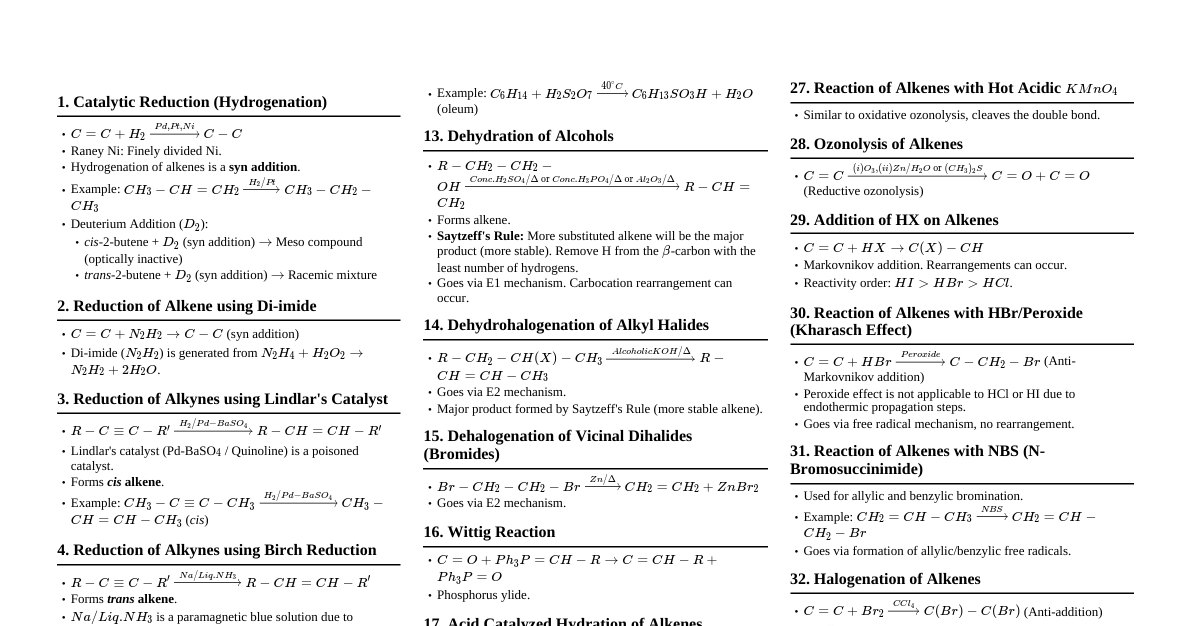
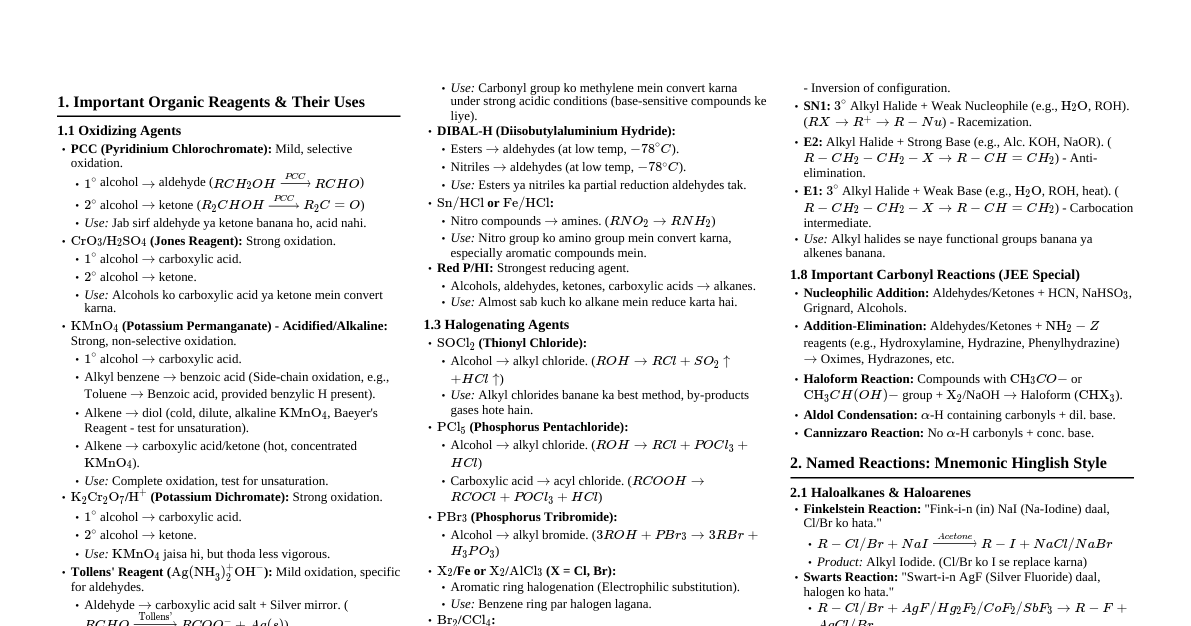
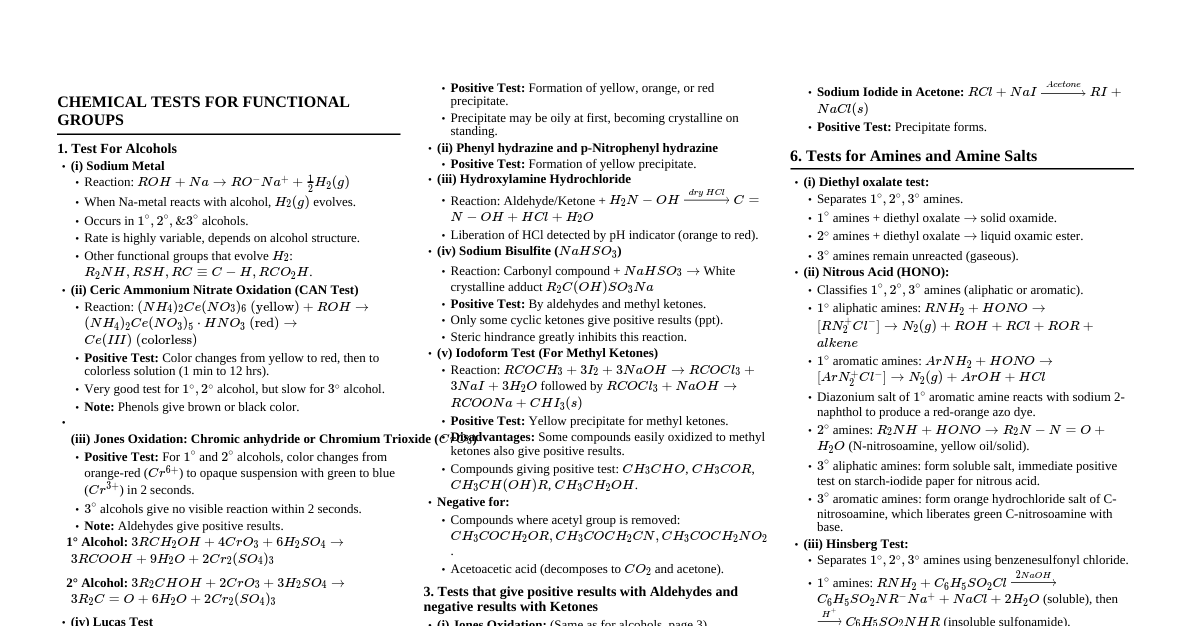
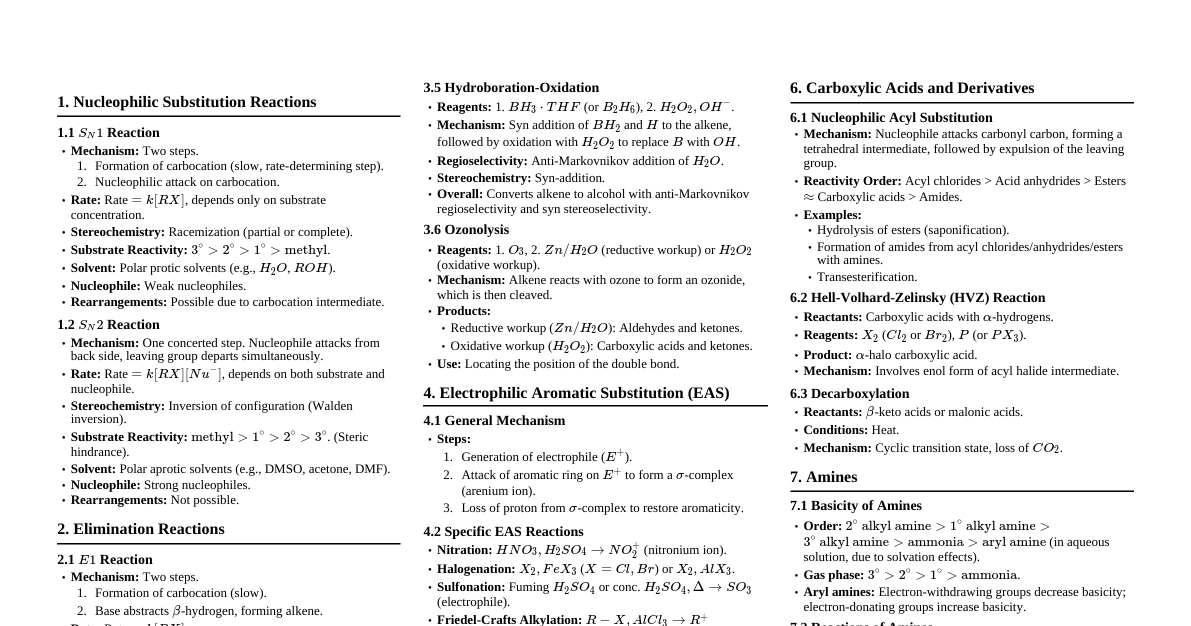
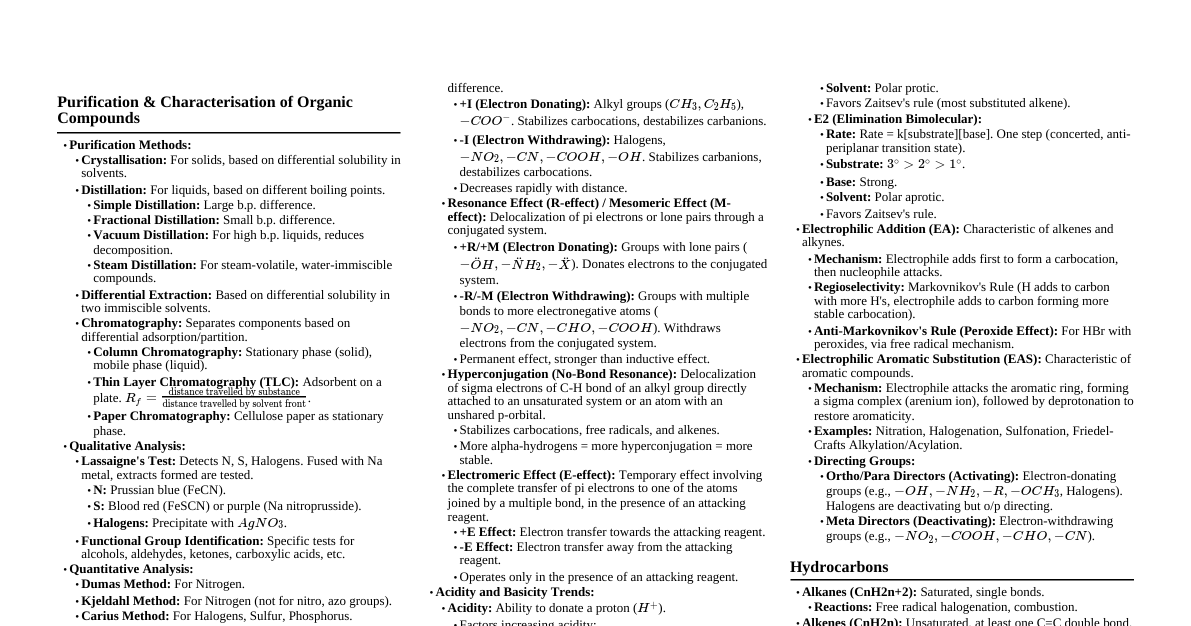
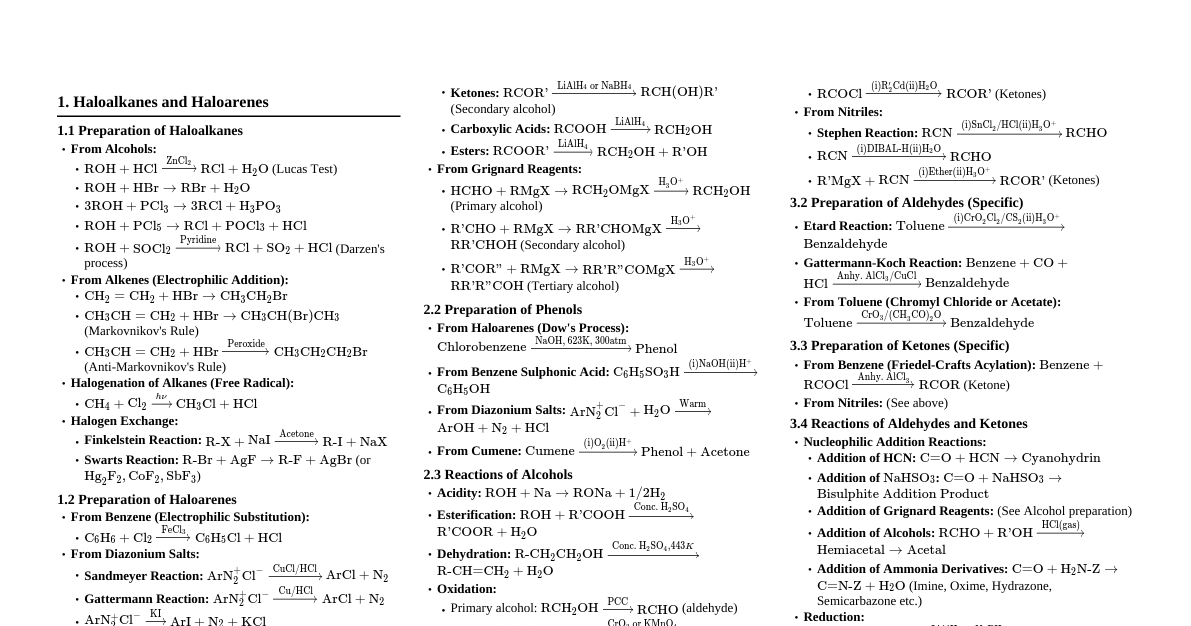
### Reaction Mechanisms: Basics - **Electrophile (E+):** Electron-deficient species, accepts electron pair. E.g., H+, NO2+, R+, Lewis acids (AlCl3, BF3). - **Nucleophile (Nu-):** Electron-rich species, donates electron pair. E.g., OH-, CN-, R-MgX, H2O, NH3. - **Carbocation:** Carbon with positive charge, sp2 hybridized, trigonal planar. Stability: 3° > 2° > 1° > methyl. - **Carbanion:** Carbon with negative charge, sp3 hybridized, pyramidal. Stability: methyl > 1° > 2° > 3° (stabilized by EWG). - **Free Radical:** Carbon with unpaired electron, sp2 hybridized, planar. Stability: 3° > 2° > 1° > methyl. - **Leaving Group (LG):** Atom/group that departs with electron pair. Good LGs are weak bases (I- > Br- > Cl- > F-). - **Resonance:** Delocalization of electrons, increases stability. - **Inductive Effect:** Electron-donating (EDG) or electron-withdrawing (EWG) effect through sigma bonds. - **Hyperconjugation:** Delocalization of sigma electrons into an adjacent empty p-orbital or pi-orbital. #### Types of Reactions - **Substitution:** One atom/group replaces another. (SN1, SN2, SEAr, SNAr) - **Addition:** Atoms/groups add across a multiple bond. (Electrophilic, Nucleophilic, Free Radical) - **Elimination:** Atoms/groups are removed to form a multiple bond. (E1, E2) - **Rearrangement:** Change in connectivity of atoms within a molecule. - **Oxidation/Reduction:** Change in oxidation state of carbon. ### Haloalkanes Reactions #### 1. Nucleophilic Substitution Reactions (SN1 & SN2) - **SN2 (Substitution Nucleophilic Bimolecular):** - **Mechanism:** Concerted (one-step) attack of nucleophile from backside, simultaneous departure of LG. - **Stereochemistry:** Inversion of configuration (Walden inversion). - **Rate:** Rate = k[R-X][Nu-]. Second order. - **Substrate Reactivity:** CH3X > 1° > 2° >> 3° (steric hindrance). - **Solvent:** Polar aprotic solvents (DMSO, acetone, DMF) favor SN2. - **Nucleophile:** Strong nucleophiles favor SN2. - **SN1 (Substitution Nucleophilic Unimolecular):** - **Mechanism:** Two-step. 1. Formation of carbocation (rate-determining step). 2. Nucleophilic attack on carbocation. - **Stereochemistry:** Racemization (formation of both enantiomers) due to planar carbocation intermediate. - **Rate:** Rate = k[R-X]. First order. - **Substrate Reactivity:** 3° > 2° > 1° (carbocation stability). Allylic and benzylic halides also undergo SN1 due to resonance stabilization. - **Solvent:** Polar protic solvents (H2O, EtOH, MeOH) stabilize carbocation. - **Nucleophile:** Weak nucleophiles (often solvent) can participate. | Reaction with | Product | Mechanism (Primary/Secondary/Tertiary) | |---|---|---| | Aqueous KOH/NaOH | Alcohol (R-OH) | SN2 (1°, 2°), SN1 (3°) | | Alcoholic KCN/NaCN | Alkyl cyanide (R-CN) | SN2 | | Alcoholic AgCN | Alkyl isocyanide (R-NC) | SN2 (ambident nucleophile) | | Alcoholic KNO2/NaNO2 | Alkyl nitrite (R-ONO) | SN2 (ambident nucleophile) | | Alcoholic AgNO2 | Nitroalkane (R-NO2) | SN2 (ambident nucleophile) | | R'-ONa (Sodium alkoxide) | Ether (R-O-R') (Williamson Synthesis) | SN2 | | R'-COOAg (Silver carboxylate) | Ester (R-COO-R') | SN2 | | NH3 (excess) | Primary amine (R-NH2) | SN2 (Ammonolysis) | | R'-NH2 | Secondary amine (R-NH-R') | SN2 | | LiAlH4 (or NaBH4 for 1°) | Alkane (R-H) | Reduction | #### 2. Elimination Reactions (E1 & E2) - **E2 (Elimination Bimolecular):** - **Mechanism:** Concerted removal of H and LG, forming a pi bond. Anti-periplanar geometry required. - **Rate:** Rate = k[R-X][Base]. Second order. - **Substrate Reactivity:** 3° > 2° > 1°. - **Base:** Strong base favors E2. - **Product:** Saytzeff product (more substituted alkene) is major, unless bulky base (e.g., t-BuOK) forms Hofmann product (less substituted alkene). - **E1 (Elimination Unimolecular):** - **Mechanism:** Two-step. 1. Formation of carbocation. 2. Removal of H by weak base. - **Rate:** Rate = k[R-X]. First order. - **Substrate Reactivity:** 3° > 2°. - **Base:** Weak base, often solvent (solvolysis). - **Product:** Saytzeff product is major. - **Dehydrohalogenation:** Elimination of HX using alcoholic KOH. #### 3. Reaction with Metals - **Wurtz Reaction:** 2R-X + 2Na $\xrightarrow{\text{Dry Ether}}$ R-R + 2NaX (For symmetrical alkanes, 1° halides). - **Wurtz-Fittig Reaction:** Ar-X + R-X + 2Na $\xrightarrow{\text{Dry Ether}}$ Ar-R + 2NaX. - **Grignard Reagent Formation:** R-X + Mg $\xrightarrow{\text{Dry Ether}}$ R-MgX. #### 4. Reduction - **LiAlH4 / NaBH4:** Reduces alkyl halides to alkanes (NaBH4 for 1° only). - **Zn/HCl or H2/Pd:** Reduces alkyl halides to alkanes. #### 5. Other Reactions - **Friedel-Crafts Alkylation:** R-X + Benzene $\xrightarrow{\text{AlCl3}}$ Alkylbenzene (for 1° halides, subject to rearrangements). ### Haloarenes Reactions #### 1. Nucleophilic Aromatic Substitution (SNAr) - **Mechanism:** Requires strong EWG (e.g., -NO2) ortho/para to halogen, or extreme conditions (high T, P). Proceeds via Meisenheimer complex. - **Example:** Chlorobenzene + NaOH (aq) $\xrightarrow{\text{623 K, 300 atm}}$ Sodium Phenoxide $\xrightarrow{\text{H+}}$ Phenol (Dow's Process). #### 2. Electrophilic Aromatic Substitution (SEAr) - Halogens are deactivating but ortho/para directing. - **Halogenation:** Ar-X + X2 $\xrightarrow{\text{FeX3}}$ o/p-dihalobenzene. - **Nitration:** Ar-X + conc. HNO3/H2SO4 $\xrightarrow{}$ o/p-nitrohalobenzene. - **Sulfonation:** Ar-X + conc. H2SO4 $\xrightarrow{\text{heat}}$ o/p-halobenzenesulfonic acid. - **Friedel-Crafts Alkylation/Acylation:** Ar-X + R-Cl/RCOCl $\xrightarrow{\text{AlCl3}}$ o/p-alkyl/acylhalobenzene. (Less reactive than benzene). #### 3. Reaction with Metals - **Wurtz-Fittig Reaction:** Ar-X + R-X + 2Na $\xrightarrow{\text{Dry Ether}}$ Ar-R + 2NaX. - **Fittig Reaction:** 2Ar-X + 2Na $\xrightarrow{\text{Dry Ether}}$ Ar-Ar + 2NaX (Biphenyl). - **Grignard Reagent Formation:** Ar-X + Mg $\xrightarrow{\text{Dry Ether}}$ Ar-MgX. #### 4. Reduction - **Ni/Al alloy + NaOH:** Reduces haloarenes to benzene. - **LiAlH4 / NaBH4:** Generally ineffective for haloarenes. ### Alcohols, Phenols, Ethers Reactions #### Alcohols (R-OH) ##### 1. Reactions involving O-H bond cleavage (Acidity) - **Reaction with active metals:** 2R-OH + 2Na $\xrightarrow{}$ 2R-ONa + H2. Acidity: 1° > 2° > 3°. - **Esterification:** R-OH + R'-COOH $\xrightarrow{\text{H+, heat}}$ R'-COOR + H2O. - **Reaction with Grignard Reagent:** R-OH + R'-MgX $\xrightarrow{}$ R'-H + ROMgX. ##### 2. Reactions involving C-O bond cleavage (Nucleophilic Substitution) - **Reaction with HX:** R-OH + HX $\xrightarrow{}$ R-X + H2O. (Reactivity: HI > HBr > HCl). Lucas test (HCl/ZnCl2). - 3° > 2° > 1° (SN1 for 3°, SN2 for 1°). - **Reaction with PCl3:** 3R-OH + PCl3 $\xrightarrow{}$ 3R-Cl + H3PO3. - **Reaction with PCl5:** R-OH + PCl5 $\xrightarrow{}$ R-Cl + POCl3 + HCl. - **Reaction with SOCl2 (Thionyl chloride):** R-OH + SOCl2 $\xrightarrow{\text{Pyridine}}$ R-Cl + SO2 + HCl (Darzens process, SNi mechanism, retention). ##### 3. Dehydration (Elimination) - **Mechanism:** E1 (with H2SO4/H3PO4, high temp) to form alkenes. - 3° > 2° > 1° reactivity. Follows Saytzeff rule. - Example: CH3CH2OH $\xrightarrow{\text{conc. H2SO4, 443 K}}$ CH2=CH2. ##### 4. Oxidation - **Primary Alcohols (1°):** - To Aldehyde: R-CH2-OH $\xrightarrow{\text{PCC/CrO3 (anhydrous)}}$ R-CHO. - To Carboxylic Acid: R-CH2-OH $\xrightarrow{\text{KMnO4/K2Cr2O7/HNO3 (strong oxidizing agents)}}$ R-COOH. - **Secondary Alcohols (2°):** - To Ketone: R2-CH-OH $\xrightarrow{\text{PCC/CrO3/KMnO4/K2Cr2O7}}$ R2-C=O. - **Tertiary Alcohols (3°):** Resistant to oxidation under mild conditions. Under vigorous conditions, C-C bond cleavage occurs, forming a mixture of acids and ketones with fewer carbons. - **Catalytic Dehydrogenation:** - 1° Alcohol: R-CH2-OH $\xrightarrow{\text{Cu, 573 K}}$ R-CHO. - 2° Alcohol: R2-CH-OH $\xrightarrow{\text{Cu, 573 K}}$ R2-C=O. - 3° Alcohol: R3-C-OH $\xrightarrow{\text{Cu, 573 K}}$ Alkene (dehydration). #### Phenols (Ar-OH) ##### 1. Acidity - **More acidic than alcohols:** Due to resonance stabilization of phenoxide ion. - **Reacts with Na, NaOH:** Ar-OH + NaOH $\xrightarrow{}$ Ar-ONa + H2O. - **Does not react with NaHCO3:** Weaker acid than carbonic acid. - **Effect of substituents:** EWG (NO2, CHO, COOH) increase acidity; EDG (CH3, OCH3) decrease acidity. - o-Nitrophenol m-Nitrophenol. ##### 2. Electrophilic Aromatic Substitution (SEAr) - -OH group is strongly activating and ortho/para directing. - **Halogenation:** - With Br2/CS2 (low temp): Monobromophenols (o- and p-). - With Br2/H2O (aqueous): 2,4,6-Tribromophenol (white ppt). - **Nitration:** - Dil. HNO3 (low temp): o- and p-Nitrophenols. (o-nitrophenol is steam volatile due to intramolecular H-bonding). - Conc. HNO3: 2,4,6-Trinitrophenol (Picric acid). - **Sulfonation:** - Conc. H2SO4 (298 K): o-Phenolsulfonic acid. - Conc. H2SO4 (373 K): p-Phenolsulfonic acid. - **Friedel-Crafts Alkylation/Acylation:** Generally not preferred due to complex formation with AlCl3 and rearrangement. ##### 3. Kolbe's Reaction (Carboxylation) - Phenol + NaOH $\xrightarrow{}$ Sodium phenoxide. - Sodium phenoxide + CO2 (400 K, 4-7 atm) $\xrightarrow{}$ Sodium salicylate. - Sodium salicylate $\xrightarrow{\text{H+}}$ Salicylic acid (o-hydroxybenzoic acid). ##### 4. Reimer-Tiemann Reaction - Phenol + CHCl3 + NaOH (aq) $\xrightarrow{}$ Salicylaldehyde (o-hydroxybenzaldehyde) as major product. - If CCl4 is used instead of CHCl3: Salicylic acid. ##### 5. Oxidation - **With Chromic acid (Na2Cr2O7/H2SO4):** Phenol $\xrightarrow{}$ Benzoquinone. - **Air oxidation:** Phenol turns pink/brown on exposure to air due to formation of quinones. ##### 6. Reaction with Zinc Dust - Phenol $\xrightarrow{\text{Zn dust, heat}}$ Benzene. ##### 7. Coupling Reaction (Azo Dye Formation) - Phenol + Benzene diazonium chloride $\xrightarrow{\text{NaOH, 273-278 K}}$ p-hydroxyazobenzene (Orange dye). #### Ethers (R-O-R') ##### 1. Cleavage of C-O bond - **With strong acids (HX):** R-O-R' + HX $\xrightarrow{\text{heat}}$ R-X + R'-OH. - If excess HX, then R-X + R'-X. - Reactivity: HI > HBr > HCl. - **Order of cleavage:** For unsymmetrical ethers, the smaller alkyl group forms alkyl halide (SN2 attack on less hindered carbon). Exception: If one group is 3° or allylic/benzylic, it forms carbocation (SN1). - Example: CH3-O-C(CH3)3 + HI $\xrightarrow{}$ CH3-I + (CH3)3C-OH (SN2 on methyl, SN1 on tertiary). - Phenol ethers: Ar-O-R + HX $\xrightarrow{}$ Ar-OH + R-X (SN2 on alkyl group). ##### 2. Electrophilic Substitution (for Aromatic Ethers, e.g., Anisole) - -OCH3 is strongly activating and ortho/para directing. - **Halogenation:** Anisole + Br2/CH3COOH $\xrightarrow{}$ o/p-Bromoanisole. - **Nitration:** Anisole + conc. HNO3/H2SO4 $\xrightarrow{}$ o/p-Nitroanisole. - **Friedel-Crafts Alkylation/Acylation:** Anisole + R-Cl/RCOCl $\xrightarrow{\text{AlCl3}}$ o/p-alkyl/acyl anisole. ### Aldehydes, Ketones, Carboxylic Acids Reactions #### Aldehydes (R-CHO) & Ketones (R-CO-R') ##### 1. Nucleophilic Addition Reactions (Characteristic of C=O) - **Mechanism:** Nucleophile attacks electrophilic carbon, pi bond breaks, O becomes O-. Protonation follows. - **Reactivity:** Aldehydes > Ketones (due to steric hindrance and electronic effect of alkyl groups). - **Examples:** - **Addition of HCN:** R-CHO/R-CO-R' + HCN $\xrightarrow{}$ Cyanohydrin. - **Addition of NaHSO3:** R-CHO/R-CO-R' + NaHSO3 $\xrightarrow{}$ Bisulphite Addition Product (crystalline solid, used for separation). - **Addition of Grignard Reagent:** - Formaldehyde + R-MgX $\xrightarrow{\text{H2O/H+}}$ 1° Alcohol. - Aldehyde + R-MgX $\xrightarrow{\text{H2O/H+}}$ 2° Alcohol. - Ketone + R-MgX $\xrightarrow{\text{H2O/H+}}$ 3° Alcohol. - **Addition of Alcohols:** - Aldehyde + R'-OH $\xrightarrow{\text{dry HCl}}$ Hemiacetal $\xrightarrow{\text{R'-OH}}$ Acetal. - Ketone + R'-OH $\xrightarrow{\text{dry HCl}}$ Hemiketal $\xrightarrow{\text{R'-OH}}$ Ketal. - **Addition of Ammonia Derivatives (Condensation Reactions):** - R-CHO/R-CO-R' + H2N-Z $\xrightarrow{\text{H+}}$ C=N-Z + H2O (Imine, Oxime, Hydrazone, Semicarbazone etc.). ##### 2. Reduction - **To Alcohols:** - Aldehyde $\xrightarrow{\text{LiAlH4/NaBH4/H2-Ni}}$ 1° Alcohol. - Ketone $\xrightarrow{\text{LiAlH4/NaBH4/H2-Ni}}$ 2° Alcohol. - **To Hydrocarbons (Alkanes):** - **Clemmensen Reduction:** R-CHO/R-CO-R' $\xrightarrow{\text{Zn-Hg/conc. HCl}}$ R-CH2-R' (or R-CH3). - **Wolff-Kishner Reduction:** R-CHO/R-CO-R' $\xrightarrow{\text{NH2NH2, KOH/Ethylene Glycol, heat}}$ R-CH2-R'. ##### 3. Oxidation - **Aldehydes:** Easily oxidized to carboxylic acids. - R-CHO $\xrightarrow{\text{KMnO4/K2Cr2O7/HNO3}}$ R-COOH. - **Tollens' Test:** R-CHO + Ag(NH3)2+OH- $\xrightarrow{}$ R-COO- + Ag (Silver mirror). - **Fehling's Test:** R-CHO + Cu2+ (Fehling's solution) $\xrightarrow{}$ R-COO- + Cu2O (Red ppt). - **Benedict's Test:** Similar to Fehling's, uses citrate complex. - **Ketones:** Generally resistant to oxidation under mild conditions. Vigorous oxidation (strong oxidising agents, high T) leads to C-C bond cleavage, forming a mixture of carboxylic acids with fewer carbon atoms (Popoff's Rule). ##### 4. Reactions involving α-Hydrogen - **Aldol Condensation:** - Aldehyde/Ketone with α-H + Dil. NaOH $\xrightarrow{}$ β-hydroxyaldehyde/ketone (Aldol). - Aldol $\xrightarrow{\text{heat}}$ α,β-unsaturated aldehyde/ketone. - **Cross-Aldol Condensation:** Between two different aldehydes/ketones (at least one with α-H). - **Cannizzaro Reaction:** - Aldehyde **without** α-H + Conc. NaOH $\xrightarrow{}$ Alcohol + Carboxylate salt. - Example: Formaldehyde, Benzaldehyde. - **Cross-Cannizzaro:** Between two different aldehydes without α-H. - **Haloform Reaction (Iodoform Test):** - Compounds containing CH3CHO- or CH3CHOH- group (or CH3CO- in ketones) + X2/NaOH $\xrightarrow{}$ Haloform (CHX3) + Carboxylate salt. - Iodoform (CHI3) is yellow ppt. ##### 5. Other Reactions - **Electrophilic Substitution (for Aromatic Aldehydes/Ketones):** - -CHO and -COR are deactivating and meta-directing. - Benzaldehyde $\xrightarrow{\text{Nitration}}$ m-Nitrobenzaldehyde. - **Benzoin Condensation:** 2 Benzaldehyde $\xrightarrow{\text{alcoholic KCN}}$ Benzoin ($\alpha$-hydroxyketone). - **Perkin Reaction:** Aromatic aldehyde + Anhydride + Sodium salt of acid $\xrightarrow{}$ $\alpha$,$\beta$-unsaturated acid. - **Wittig Reaction:** R-CHO/R-CO-R' + Phosphonium ylide $\xrightarrow{}$ Alkene + Triphenylphosphine oxide. #### Carboxylic Acids (R-COOH) ##### 1. Acidity - **Stronger acids than phenols and alcohols.** - **Reaction with active metals:** 2R-COOH + 2Na $\xrightarrow{}$ 2R-COONa + H2. - **Reaction with bases:** R-COOH + NaOH/Na2CO3/NaHCO3 $\xrightarrow{}$ R-COONa + H2O/CO2. - **Effect of substituents:** EWG increase acidity (e.g., F3C-COOH > Cl3C-COOH), EDG decrease acidity. - F > Cl > Br > I (Inductive effect). - Benzoic acid: o-nitro > m-nitro > p-nitro > benzoic acid (for nitro group). ##### 2. Formation of Derivatives - **Esters:** R-COOH + R'-OH $\xrightarrow{\text{H+, heat}}$ R-COOR' + H2O (Esterification). - **Acid Chlorides:** R-COOH + PCl3/PCl5/SOCl2 $\xrightarrow{}$ R-COCl. - **Anhydrides:** 2R-COOH $\xrightarrow{\text{P2O5, heat}}$ (R-CO)2O + H2O. - **Amides:** R-COOH + NH3 $\xrightarrow{\text{heat}}$ R-CONH2 + H2O (via ammonium salt). ##### 3. Reduction - **To Primary Alcohols:** R-COOH $\xrightarrow{\text{LiAlH4, H2O}}$ R-CH2-OH. (NaBH4 does not reduce -COOH). - **To Alkanes (Decarboxylation):** - **Soda-lime Decarboxylation:** R-COONa + NaOH/CaO $\xrightarrow{\text{heat}}$ R-H + Na2CO3. - **Kolbe's Electrolytic Reaction:** 2R-COONa $\xrightarrow{\text{Electrolysis}}$ R-R + 2CO2 + 2NaOH + H2. ##### 4. Hell-Volhard-Zelinsky (HVZ) Reaction - Carboxylic acid with $\alpha$-H + X2 (Cl2/Br2) $\xrightarrow{\text{Red P}}$ $\alpha$-halo carboxylic acid. ##### 5. Ring Substitution (for Aromatic Carboxylic Acids) - -COOH is deactivating and meta-directing. - Benzoic acid $\xrightarrow{\text{Nitration}}$ m-Nitrobenzoic acid. ### Amines Reactions (R-NH2, R2NH, R3N) #### 1. Basicity - **Aliphatic Amines:** More basic than NH3 due to +I effect of alkyl groups. - Gas phase: 3° > 2° > 1° > NH3. - Aqueous phase: 2° > 1° > 3° > NH3 (due to solvation and steric effects). (For CH3: 2° > 1° > 3° > NH3; For C2H5: 2° > 3° > 1° > NH3). - **Aromatic Amines (Aniline):** Less basic than NH3 due to resonance stabilization of lone pair on N with benzene ring. - **Effect of substituents on Aniline:** EDG increase basicity, EWG decrease basicity. ##### 2. Alkylation (Hofmann Ammonolysis) - R-NH2 + R-X $\xrightarrow{}$ R2NH (2°) $\xrightarrow{R-X}$ R3N (3°) $\xrightarrow{R-X}$ R4N+X- (Quaternary Ammonium Salt). ##### 3. Acylation - **With Acid Chlorides/Anhydrides:** - R-NH2 + R'-COCl $\xrightarrow{\text{Pyridine}}$ R-NH-CO-R' (Amide) + HCl. - R-NH2 + (R'-CO)2O $\xrightarrow{}$ R-NH-CO-R' + R'-COOH. - **With Esters:** Amide formation. - **Schotten-Baumann Reaction:** Aniline + Benzoyl chloride $\xrightarrow{\text{NaOH}}$ Benzamide derivative. ##### 4. Carbylamine Reaction (Isocyanide Test) - 1° Amine (aliphatic or aromatic) + CHCl3 + KOH (alc.) $\xrightarrow{\text{heat}}$ Isocyanide (R-NC / Ar-NC) (Foul smell). - Not given by 2° or 3° amines. ##### 5. Reaction with Nitrous Acid (NaNO2 + HCl) - **Primary Aliphatic Amine:** R-NH2 $\xrightarrow{\text{NaNO2/HCl, 0-5°C}}$ R-N2+Cl- (Diazonium Salt, highly unstable) $\xrightarrow{\text{H2O}}$ R-OH + N2 + HCl. - **Primary Aromatic Amine (Aniline):** Ar-NH2 $\xrightarrow{\text{NaNO2/HCl, 0-5°C}}$ Ar-N2+Cl- (Benzene Diazonium Chloride, stable at low temp). - **Sandmeyer Reaction:** Ar-N2+Cl- $\xrightarrow{\text{CuCl/HCl or CuBr/HBr or CuCN/KCN}}$ Ar-Cl/Ar-Br/Ar-CN. - **Gattermann Reaction:** Ar-N2+Cl- $\xrightarrow{\text{Cu/HCl or Cu/HBr}}$ Ar-Cl/Ar-Br. - **Coupling Reactions:** Ar-N2+Cl- + Phenol/Aniline $\xrightarrow{}$ Azo Dyes. - **Secondary Amine:** R2NH $\xrightarrow{\text{NaNO2/HCl}}$ R2N-N=O (N-Nitrosamine, yellow oily liquid). - **Tertiary Amine:** R3N $\xrightarrow{\text{NaNO2/HCl}}$ R3N+H (Salt) (Aromatic 3° amines give p-nitroso derivative). ##### 6. Hinsberg's Test (Distinction of 1°, 2°, 3° Amines) - **Reagent:** Benzene Sulphonyl Chloride (C6H5SO2Cl). - **1° Amine:** Forms N-alkylbenzenesulphonamide (soluble in KOH due to acidic H on N). - **2° Amine:** Forms N,N-dialkylbenzenesulphonamide (insoluble in KOH, no acidic H on N). - **3° Amine:** Does not react with Hinsberg's reagent. Forms salt with HCl which is soluble. ##### 7. Electrophilic Substitution (for Aromatic Amines) - -NH2 group is strongly activating and ortho/para directing. - **Bromination:** Aniline $\xrightarrow{\text{Br2/H2O}}$ 2,4,6-Tribromoaniline (white ppt). - To get monobrominated product: First acetylate (protect -NH2) $\xrightarrow{\text{Ac2O/Pyridine}}$ Acetanilide. Then brominate, then hydrolyse. - **Nitration:** Direct nitration leads to oxidation and tar formation. - Acetanilide $\xrightarrow{\text{conc. HNO3/H2SO4}}$ p-Nitroacetanilide (major) $\xrightarrow{\text{H+/H2O}}$ p-Nitroaniline. - Some m-nitroaniline also formed due to anilineium ion (meta-directing). - **Sulfonation:** Aniline + conc. H2SO4 $\xrightarrow{}$ Anilinium hydrogen sulphate $\xrightarrow{\text{heat 453-473 K}}$ Sulphanilic acid (zwitterion). - **Friedel-Crafts Reaction:** Not possible due to salt formation between AlCl3 (Lewis acid) and amine (Lewis base). ##### 8. Oxidation - **Primary Amines:** Oxidized to various products depending on reagent (nitroso, nitro, azo compounds). - **Aniline:** Oxidizes readily on exposure to air to give dark colored products.