Organic Chemistry Cheatsheet
Cheatsheet Content
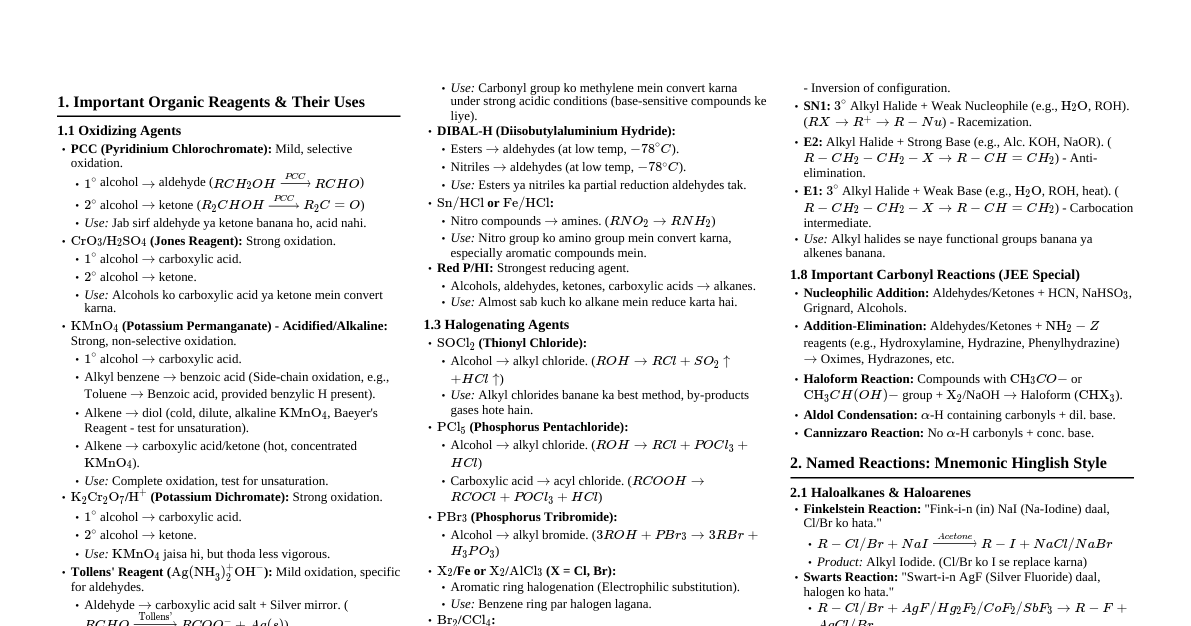
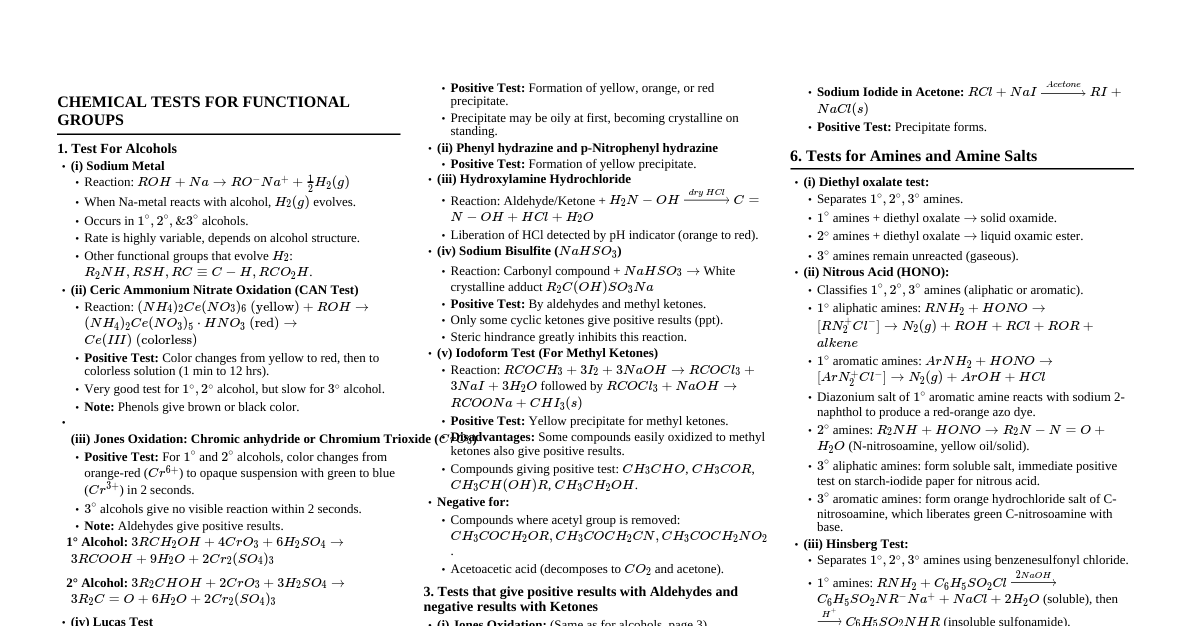
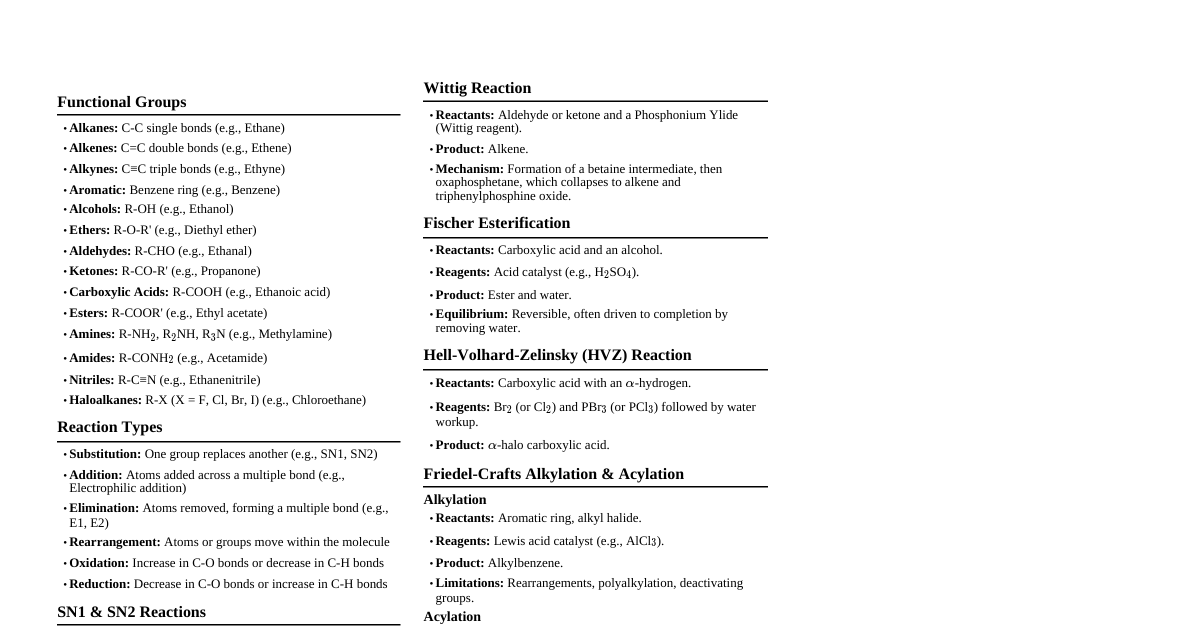
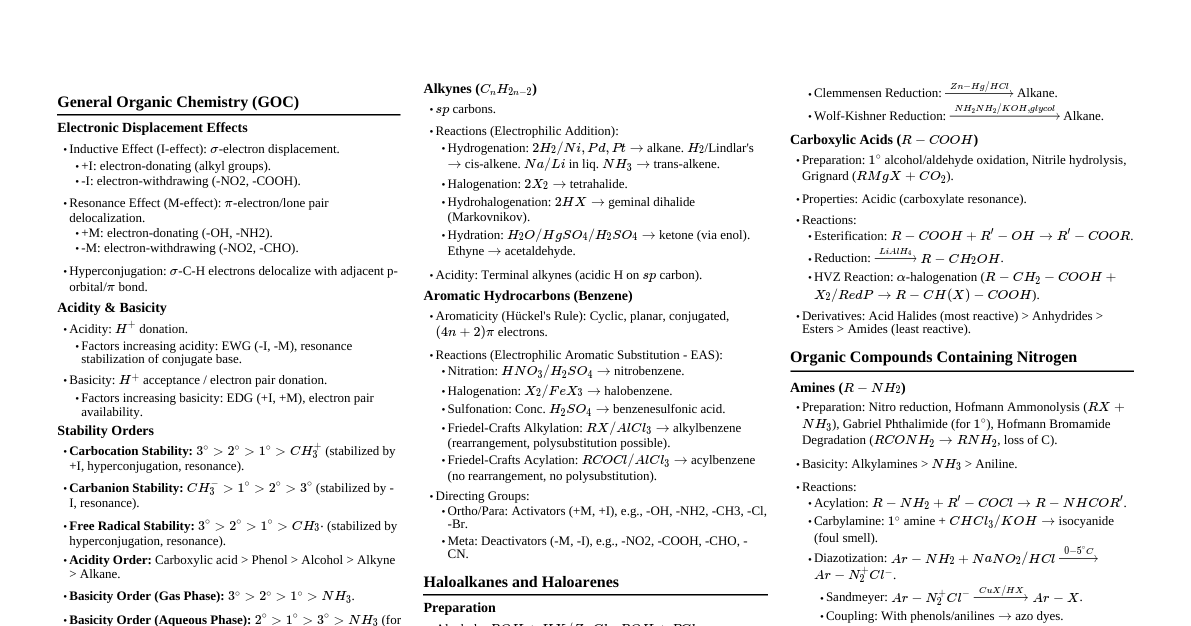
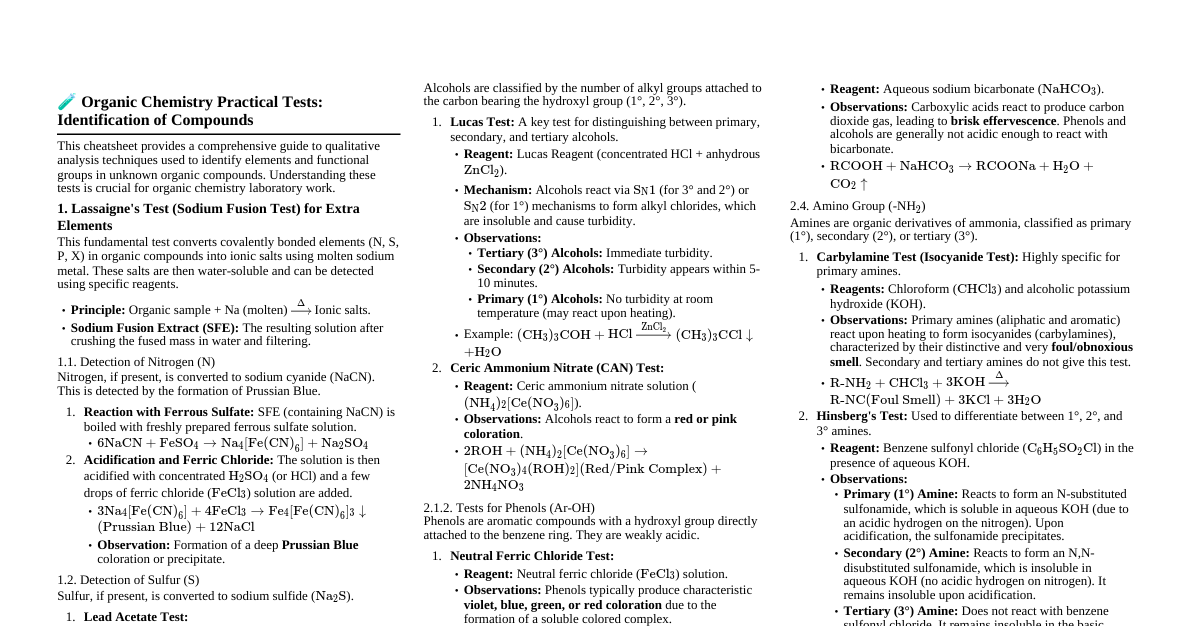
### Purification & Characterisation of Organic Compounds - **Purification Methods:** - **Crystallisation:** For solids, based on differential solubility in solvents. - **Distillation:** For liquids, based on different boiling points. - **Simple Distillation:** Large b.p. difference. - **Fractional Distillation:** Small b.p. difference. - **Vacuum Distillation:** For high b.p. liquids, reduces decomposition. - **Steam Distillation:** For steam-volatile, water-immiscible compounds. - **Differential Extraction:** Based on differential solubility in two immiscible solvents. - **Chromatography:** Separates components based on differential adsorption/partition. - **Column Chromatography:** Stationary phase (solid), mobile phase (liquid). - **Thin Layer Chromatography (TLC):** Adsorbent on a plate. $R_f = \frac{\text{distance travelled by substance}}{\text{distance travelled by solvent front}}$. - **Paper Chromatography:** Cellulose paper as stationary phase. - **Qualitative Analysis:** - **Lassaigne's Test:** Detects N, S, Halogens. Fused with Na metal, extracts formed are tested. - **N:** Prussian blue (FeCN). - **S:** Blood red (FeSCN) or purple (Na nitroprusside). - **Halogens:** Precipitate with $AgNO_3$. - **Functional Group Identification:** Specific tests for alcohols, aldehydes, ketones, carboxylic acids, etc. - **Quantitative Analysis:** - **Dumas Method:** For Nitrogen. - **Kjeldahl Method:** For Nitrogen (not for nitro, azo groups). - **Carius Method:** For Halogens, Sulfur, Phosphorus. - **Liebig's Method:** For Carbon and Hydrogen. ### IUPAC Nomenclature - **Basic Rules:** 1. **Longest Chain:** Identify the longest continuous carbon chain (parent chain). 2. **Numbering:** Number the chain to give substituents the lowest possible locants. 3. **Alphabetical Order:** List substituents alphabetically (di, tri, tetra are ignored). 4. **Functional Group Priority:** - Carboxylic Acid > Sulfonic Acid > Ester > Acyl Halide > Amide > Nitrile > Aldehyde > Ketone > Alcohol > Amine > Alkene > Alkyne > Alkane > Ether > Halo. - **Examples:** - `CH₃CH₂OH`: Ethanol - `CH₃COCH₃`: Propan-2-one - `CH₃CH(Cl)CH₂CH₃`: 2-Chlorobutane ### Isomerism - **Definition:** Compounds with the same molecular formula but different structures or spatial arrangements. - **1. Structural Isomerism:** Different connectivity of atoms. - **Chain Isomerism:** Different carbon skeleton. (e.g., n-butane vs isobutane) - **Position Isomerism:** Different position of functional group/substituent. (e.g., 1-propanol vs 2-propanol) - **Functional Isomerism:** Different functional groups. (e.g., ethanol vs dimethyl ether) - **Metamerism:** Different alkyl groups around a polyvalent functional group. (e.g., diethyl ether vs methyl propyl ether) - **Tautomerism:** Rapid equilibrium between two structural isomers. (e.g., keto-enol tautomerism) - **2. Stereoisomerism:** Same connectivity, different spatial arrangement. - **Geometrical (cis-trans) Isomerism:** Restricted rotation around a double bond or in a cyclic structure. Requires two different groups on each carbon of the double bond. - **E/Z Nomenclature:** For tri/tetra-substituted alkenes. E (entgegen - opposite), Z (zusammen - together). - **Optical Isomerism:** Non-superimposable mirror images (enantiomers). Requires chiral center(s). - **Chiral Center:** Carbon atom bonded to four different groups. - **Enantiomers:** Stereoisomers that are non-superimposable mirror images. Rotate plane-polarized light in opposite directions. - **Diastereomers:** Stereoisomers that are not mirror images. - **Meso Compound:** Has chiral centers but is achiral due to internal plane of symmetry. - **Racemic Mixture:** 50:50 mixture of enantiomers, optically inactive. - **Specific Rotation:** $[\alpha]_D^T = \frac{\alpha}{l \times c}$ (observed rotation / path length x concentration). - **R/S Configuration:** Cahn-Ingold-Prelog rules for assigning absolute configuration. - **Conformational Isomerism:** Different spatial arrangements due to rotation around single bonds. - **Ethane:** Staggered (more stable), Eclipsed (less stable). - **Butane:** Anti (most stable), Gauche, Eclipsed, Fully Eclipsed (least stable). Represented by Newman projections. ### General Organic Chemistry (GOC) - **Electronic Effects:** - **Inductive Effect (I-effect):** Permanent displacement of sigma electrons along a carbon chain due to electronegativity difference. - **+I (Electron Donating):** Alkyl groups ($CH_3, C_2H_5$), $-COO^-$. Stabilizes carbocations, destabilizes carbanions. - **-I (Electron Withdrawing):** Halogens, $-NO_2, -CN, -COOH, -OH$. Stabilizes carbanions, destabilizes carbocations. - Decreases rapidly with distance. - **Resonance Effect (R-effect) / Mesomeric Effect (M-effect):** Delocalization of pi electrons or lone pairs through a conjugated system. - **+R/+M (Electron Donating):** Groups with lone pairs ($-\ddot{O}H, -\ddot{N}H_2, -\ddot{X}$). Donates electrons to the conjugated system. - **-R/-M (Electron Withdrawing):** Groups with multiple bonds to more electronegative atoms ($-NO_2, -CN, -CHO, -COOH$). Withdraws electrons from the conjugated system. - Permanent effect, stronger than inductive effect. - **Hyperconjugation (No-Bond Resonance):** Delocalization of sigma electrons of C-H bond of an alkyl group directly attached to an unsaturated system or an atom with an unshared p-orbital. - Stabilizes carbocations, free radicals, and alkenes. - More alpha-hydrogens = more hyperconjugation = more stable. - **Electromeric Effect (E-effect):** Temporary effect involving the complete transfer of pi electrons to one of the atoms joined by a multiple bond, in the presence of an attacking reagent. - **+E Effect:** Electron transfer towards the attacking reagent. - **-E Effect:** Electron transfer away from the attacking reagent. - Operates only in the presence of an attacking reagent. - **Acidity and Basicity Trends:** - **Acidity:** Ability to donate a proton ($H^+$). - Factors increasing acidity: - Stability of conjugate base (electron-withdrawing groups, resonance stabilization). - Electronegativity (stronger acid: $HF > H_2O > NH_3 > CH_4$). - Hybridization (sp > $sp^2$ > $sp^3$ for C-H bonds). - **Basicity:** Ability to accept a proton ($H^+$) or donate a lone pair. - Factors increasing basicity: - Availability of lone pair (less delocalized lone pair = more basic). - Electron-donating groups (increase electron density). - Less steric hindrance for protonation. ### Reaction Intermediates - **Definition:** Short-lived, high-energy species formed during a reaction, not isolated. - **Carbocations:** Positively charged carbon with 6 valence electrons ($sp^2$ hybridized, planar). - **Stability:** $3^\circ > 2^\circ > 1^\circ > CH_3^+$ (due to +I and hyperconjugation). - Undergo rearrangements (hydride/alkyl shifts) to form more stable carbocations. - **Carbanions:** Negatively charged carbon with 8 valence electrons (lone pair, $sp^3$ hybridized, pyramidal). - **Stability:** $CH_3^- > 1^\circ > 2^\circ > 3^\circ$ (due to -I and less steric hindrance). - Stabilized by -I/-R groups. - **Free Radicals:** Neutral carbon with an unpaired electron (7 valence electrons, $sp^2$ hybridized, planar or pyramidal). - **Stability:** $3^\circ > 2^\circ > 1^\circ > CH_3^+$ (due to hyperconjugation). - **Nitrenes ($R-\ddot{N}$):** Nitrogen analogue of carbenes, neutral, monovalent nitrogen with 6 valence electrons. - **Carbenes ($:CH_2$):** Neutral carbon with two unshared valence electrons (6 valence electrons). - **Singlet Carbene:** Paired electrons, $sp^2$ hybridized, bent. - **Triplet Carbene:** Unpaired electrons, sp hybridized, linear. ### Reaction Mechanisms - **Nucleophilic Substitution Reactions:** - **$S_N1$ (Substitution Nucleophilic Unimolecular):** - **Rate:** Rate = k[substrate]. Two steps (carbocation formation is rate-determining). - **Substrate:** $3^\circ > 2^\circ > 1^\circ$ (due to carbocation stability). - **Nucleophile:** Weak or strong. - **Solvent:** Polar protic (stabilizes carbocation). - **Stereochemistry:** Racemization (attack from both sides of planar carbocation). - **$S_N2$ (Substitution Nucleophilic Bimolecular):** - **Rate:** Rate = k[substrate][nucleophile]. One step (concerted, transition state). - **Substrate:** $1^\circ > 2^\circ > 3^\circ$ (due to steric hindrance). $CH_3X$ is fastest. - **Nucleophile:** Strong. - **Solvent:** Polar aprotic (doesn't solvate nucleophile). - **Stereochemistry:** Inversion of configuration (Walden inversion). - **Elimination Reactions:** - **E1 (Elimination Unimolecular):** - **Rate:** Rate = k[substrate]. Two steps (carbocation formation). - **Substrate:** $3^\circ > 2^\circ$. - **Base:** Weak. - **Solvent:** Polar protic. - Favors Zaitsev's rule (most substituted alkene). - **E2 (Elimination Bimolecular):** - **Rate:** Rate = k[substrate][base]. One step (concerted, anti-periplanar transition state). - **Substrate:** $3^\circ > 2^\circ > 1^\circ$. - **Base:** Strong. - **Solvent:** Polar aprotic. - Favors Zaitsev's rule. - **Electrophilic Addition (EA):** Characteristic of alkenes and alkynes. - **Mechanism:** Electrophile adds first to form a carbocation, then nucleophile attacks. - **Regioselectivity:** Markovnikov's Rule (H adds to carbon with more H's, electrophile adds to carbon forming more stable carbocation). - **Anti-Markovnikov's Rule (Peroxide Effect):** For HBr with peroxides, via free radical mechanism. - **Electrophilic Aromatic Substitution (EAS):** Characteristic of aromatic compounds. - **Mechanism:** Electrophile attacks the aromatic ring, forming a sigma complex (arenium ion), followed by deprotonation to restore aromaticity. - **Examples:** Nitration, Halogenation, Sulfonation, Friedel-Crafts Alkylation/Acylation. - **Directing Groups:** - **Ortho/Para Directors (Activating):** Electron-donating groups (e.g., $-OH, -NH_2, -R, -OCH_3$, Halogens). Halogens are deactivating but o/p directing. - **Meta Directors (Deactivating):** Electron-withdrawing groups (e.g., $-NO_2, -COOH, -CHO, -CN$). ### Hydrocarbons - **Alkanes (CnH2n+2):** Saturated, single bonds. - **Reactions:** Free radical halogenation, combustion. - **Alkenes (CnH2n):** Unsaturated, at least one C=C double bond. - **Reactions:** Electrophilic addition (HBr, $H_2O$, $X_2$, $H_2$), oxidation (Baeyer's reagent, $KMnO_4$), ozonolysis. - **Alkynes (CnH2n-2):** Unsaturated, at least one C≡C triple bond. - **Reactions:** Electrophilic addition (HX, $H_2O$, $X_2$, $H_2$), acidity of terminal alkynes. - **Aromatic Hydrocarbons (Arenes):** Compounds containing benzene ring or other aromatic systems. - **Benzene:** Planar, cyclic, conjugated, $(4n+2)\pi$ electrons (Hückel's Rule). - **Reactions:** Electrophilic aromatic substitution (nitration, halogenation, sulfonation, Friedel-Crafts). - **Side-chain oxidation:** Alkyl benzenes oxidized to benzoic acid. ### Haloalkanes and Haloarenes - **Haloalkanes (R-X):** Halogen attached to $sp^3$ carbon. - **Preparation:** From alcohols (HX, $PCl_3, PCl_5, SOCl_2$), from alkanes (free radical halogenation), from alkenes (HX, $X_2$). - **Reactions:** Nucleophilic substitution ($S_N1, S_N2$), elimination (E1, E2), Wurtz reaction, Reduction. - **Haloarenes (Ar-X):** Halogen attached to $sp^2$ carbon of aromatic ring. - **Preparation:** Direct halogenation of benzene (with Lewis acid), Sandmeyer reaction (from diazonium salts). - **Reactions:** Nucleophilic substitution (difficult due to resonance stabilization of C-X bond), Wurtz-Fittig reaction, Fittig reaction. ### Alcohols, Phenols and Ethers - **Alcohols (R-OH):** Hydroxyl group attached to an alkyl group. - **Preparation:** From alkenes (hydration), reduction of aldehydes/ketones/carboxylic acids, Grignard reagents. - **Reactions:** Oxidation ($1^\circ \to$ aldehyde $\to$ acid, $2^\circ \to$ ketone), dehydration ($\to$ alkene), esterification, reaction with HX. - **Acidity:** Weaker than water. $1^\circ > 2^\circ > 3^\circ$ (due to +I effect). - **Phenols (Ar-OH):** Hydroxyl group attached directly to benzene ring. - **Preparation:** From haloarenes (Dow's process), from diazonium salts, from cumene. - **Acidity:** More acidic than alcohols (resonance stabilization of phenoxide ion). Electron-withdrawing groups increase acidity. - **Reactions:** Electrophilic aromatic substitution (o/p directing, activating), Kolbe's reaction, Reimer-Tiemann reaction, oxidation. - **Ethers (R-O-R'):** Oxygen atom bonded to two alkyl/aryl groups. - **Preparation:** Williamson synthesis ($R-X + NaOR' \to R-O-R'$). - **Reactions:** Cleavage by HX (HI > HBr > HCl), electrophilic substitution (if aryl ether). ### Aldehydes and Ketones - **Carbonyl Compounds:** Contain C=O group. - **Aldehydes (R-CHO):** Carbonyl carbon bonded to at least one H. - **Ketones (R-CO-R'):** Carbonyl carbon bonded to two alkyl/aryl groups. - **Preparation:** - **Aldehydes:** Oxidation of $1^\circ$ alcohols, Rosenmund reduction, Stephen reduction, Etard reaction, Gattermann-Koch reaction. - **Ketones:** Oxidation of $2^\circ$ alcohols, Wacker process, Friedel-Crafts acylation. - **Reactions (Nucleophilic Addition):** - **Addition of HCN:** Cyanohydrins. - **Addition of NaHSO₃:** Bisulfite addition product. - **Addition of Grignard Reagents:** Alcohols. - **Addition of Alcohols:** Hemiacetals/Acetals (from aldehydes), Hemiketals/Ketals (from ketones). - **Addition of Ammonia Derivatives:** Imines, oximes, hydrazones, semicarbazones. - **Reduction:** - **To Alcohols:** $NaBH_4, LiAlH_4$. - **To Hydrocarbons:** Clemmensen reduction (Zn-Hg/HCl), Wolff-Kishner reduction ($NH_2NH_2/KOH$). - **Oxidation:** - **Aldehydes:** Easily oxidized to carboxylic acids (Tollens' reagent, Fehling's solution, Benedict's solution, $KMnO_4$). - **Ketones:** Resist oxidation under mild conditions, require strong conditions (C-C bond cleavage). - **Other Reactions:** Aldol condensation, Cannizzaro reaction (for aldehydes without alpha-H), Haloform reaction (for methyl ketones). ### Carboxylic Acids and their Derivatives - **Carboxylic Acids (R-COOH):** Contains carboxyl group. - **Preparation:** Oxidation of $1^\circ$ alcohols/aldehydes, hydrolysis of nitriles, Grignard reagents with $CO_2$. - **Acidity:** More acidic than alcohols/phenols. Increased by -I/-R groups, decreased by +I/+R groups. - **Reactions:** Esterification, reaction with $PCl_5, SOCl_2$, reduction ($LiAlH_4$). - **Derivatives:** - **Acid Anhydrides (RCO-O-COR):** Formed from two carboxylic acid molecules. - **Esters (RCOOR'):** Formed from carboxylic acid and alcohol. - **Reactions:** Hydrolysis, transesterification. - **Acid Chlorides (RCOCl):** Most reactive derivative. - **Preparation:** From carboxylic acid with $SOCl_2$. - **Reactions:** Hydrolysis, alcoholysis, ammonolysis, reaction with Grignard. - **Amides (RCONH₂):** Least reactive derivative. - **Preparation:** From acid chlorides/esters with ammonia. - **Reactions:** Hydrolysis, reduction ($LiAlH_4$), Hofmann bromamide degradation. - **Relative Reactivity:** Acid Chloride > Anhydride > Ester > Amide. ### Nitrogen Containing Compounds - **Amines (R-NH₂):** Derivatives of ammonia. - **Classification:** $1^\circ, 2^\circ, 3^\circ$. - **Basicity:** $2^\circ > 1^\circ > 3^\circ > NH_3$ (in gaseous phase). In aqueous solution, $2^\circ > 1^\circ > 3^\circ$ (alkyl amines) due to solvation effects. Aromatic amines are weaker bases due to resonance. - **Preparation:** Reduction of nitro compounds, nitriles, amides; Hofmann ammonolysis of alkyl halides; Gabriel phthalimide synthesis. - **Reactions:** Acylation, carbylamine reaction, reaction with nitrous acid (distinguishes $1^\circ, 2^\circ, 3^\circ$), Hinsberg test. - **Diazonium Salts ($ArN_2^+X^-$):** Formed from $1^\circ$ aromatic amines with $NaNO_2/HCl$ at $0-5^\circ C$. - **Reactions:** Sandmeyer reaction, Gattermann reaction, coupling reactions (azo dyes). - **Cyanides (R-CN) / Nitriles:** - **Preparation:** From alkyl halides ($S_N2$), from amides (dehydration). - **Reactions:** Hydrolysis ($\to$ carboxylic acid), reduction ($\to$ amine). - **Isocyanides (R-NC):** - **Preparation:** Carbylamine reaction (distinguishes $1^\circ$ amines). ### Biomolecules - **Carbohydrates:** Polyhydroxy aldehydes or ketones. - **Monosaccharides:** Glucose, Fructose. - **Disaccharides:** Sucrose (glucose + fructose), Maltose (glucose + glucose), Lactose (glucose + galactose). - **Polysaccharides:** Starch, Cellulose, Glycogen. - **Reducing Sugars:** Have free aldehyde/ketone group (all monosaccharides, most disaccharides except sucrose). - **Amino Acids:** Building blocks of proteins. Contain both amino and carboxyl groups. - **Zwitterionic Form:** Exist as dipolar ions. - **Peptide Bond:** Amide linkage between amino acids. - **Proteins:** Polymers of amino acids. - **Structure:** Primary (sequence), Secondary ($\alpha$-helix, $\beta$-pleated sheet), Tertiary (3D folding), Quaternary (multiple subunits). - **Denaturation:** Loss of biological activity due to disruption of secondary, tertiary, quaternary structures. - **Nucleic Acids:** DNA (deoxyribonucleic acid) and RNA (ribonucleic acid). - **Components:** Pentose sugar, nitrogenous base (A, T/U, C, G), phosphate group. - **DNA:** Double helix, stores genetic information. - **RNA:** Single strand, involved in protein synthesis. ### Polymers - **Definition:** Large molecules formed by the repeated linking of small molecules (monomers). - **Classification:** - **Natural:** Starch, Cellulose, Proteins, Rubber. - **Synthetic:** Polyethylene, PVC, Nylon, Bakelite. - **Polymerization:** - **Addition Polymerization:** Monomers add to each other without loss of any molecules (e.g., polyethene from ethene). - **Condensation Polymerization:** Monomers react with loss of small molecules like water (e.g., Nylon-6,6 from hexamethylenediamine and adipic acid). - **Examples:** - **Polyethylene:** From ethene. Used in bags, bottles. - **PVC (Polyvinyl chloride):** From vinyl chloride. Used in pipes, flooring. - **Teflon:** From tetrafluoroethene. Non-stick coatings. - **Nylon-6,6:** Polyamide. Used in fibers, ropes. - **Bakelite:** Phenol-formaldehyde resin. Thermosetting plastic. - **Natural Rubber:** Isoprene monomer. Elastomer. ### Chemistry in Everyday Life - **Drugs:** - **Analgesics:** Pain relievers (Aspirin, Paracetamol). - **Antipyretics:** Reduce fever (Aspirin, Paracetamol). - **Antiseptics:** Applied to living tissues (Dettol, Savlon). - **Disinfectants:** Applied to non-living objects (Chlorine, Phenol 1%). - **Antibiotics:** Inhibit or kill microorganisms (Penicillin, Tetracycline). - **Antacids:** Neutralize excess stomach acid (Mg(OH)₂, Al(OH)₃). - **Tranquilizers:** Reduce anxiety, stress (Valium, Equanil). - **Food Chemistry:** - **Artificial Sweeteners:** Saccharin, Aspartame, Sucralose. - **Food Preservatives:** Sodium benzoate, sodium metabisulphite. - **Antioxidants:** BHT (Butylated Hydroxytoluene), BHA (Butylated Hydroxyanisole). - **Cleansing Agents:** - **Soaps:** Sodium/Potassium salts of long-chain fatty acids. - **Detergents:** Synthetic cleansing agents. - **Anionic:** Sodium alkyl sulphates. - **Cationic:** Quaternary ammonium salts. - **Non-ionic:** Esters of polyethylene glycol. ### Principles Related to Practical Organic Chemistry - **Lassaigne’s Test:** (See Purification & Characterisation) - **Functional Group Identification:** - **Unsaturation:** Bromine water test, Baeyer's test ($KMnO_4$). - **Alcohols:** Esterification, Ceric ammonium nitrate test, Lucas test. - **Phenols:** Ferric chloride test (violet color), Bromine water test (white ppt). - **Aldehydes/Ketones:** 2,4-DNP test, Schiff's test. - **Aldehydes (only):** Tollens' test (silver mirror), Fehling's test (red ppt). - **Carboxylic Acids:** Litmus test, $NaHCO_3$ test (effervescence). - **Amines:** Carbylamine test ($1^\circ$), Hinsberg test. - **Titrations:** - **Acid-Base Titration:** To determine unknown concentration of acid/base. - **Redox Titration:** Involving oxidation-reduction reactions. - **Iodometric/Iodimetric Titrations:** Using iodine. - **Chromatography:** (See Purification & Characterisation)