Cell - Class 9 Biology
Cheatsheet Content
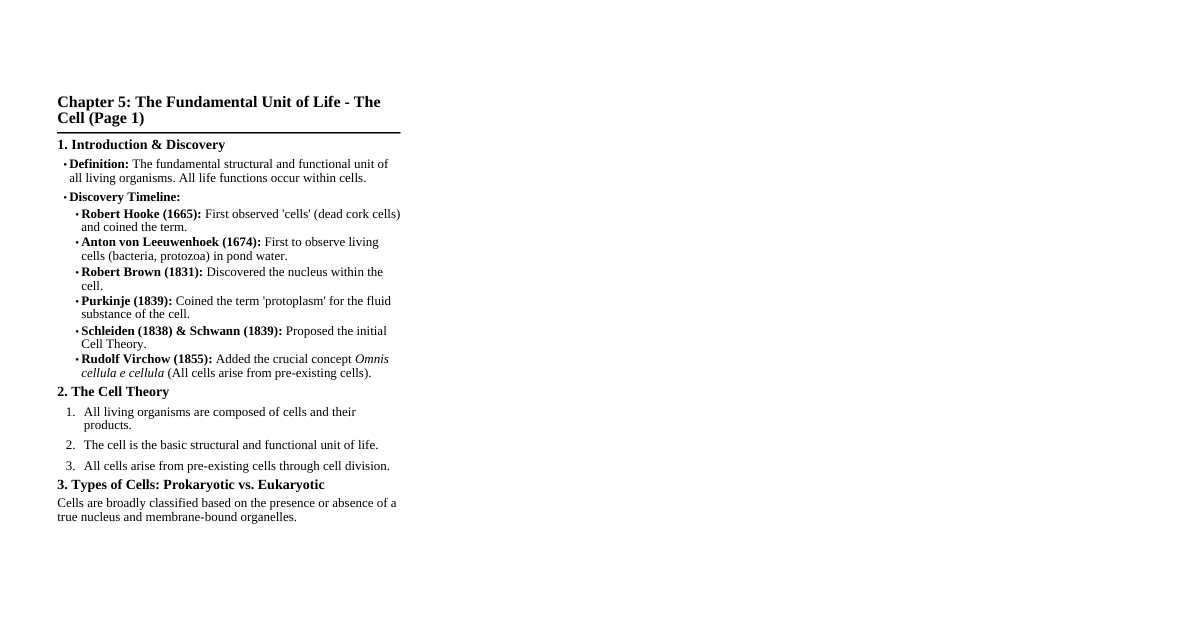
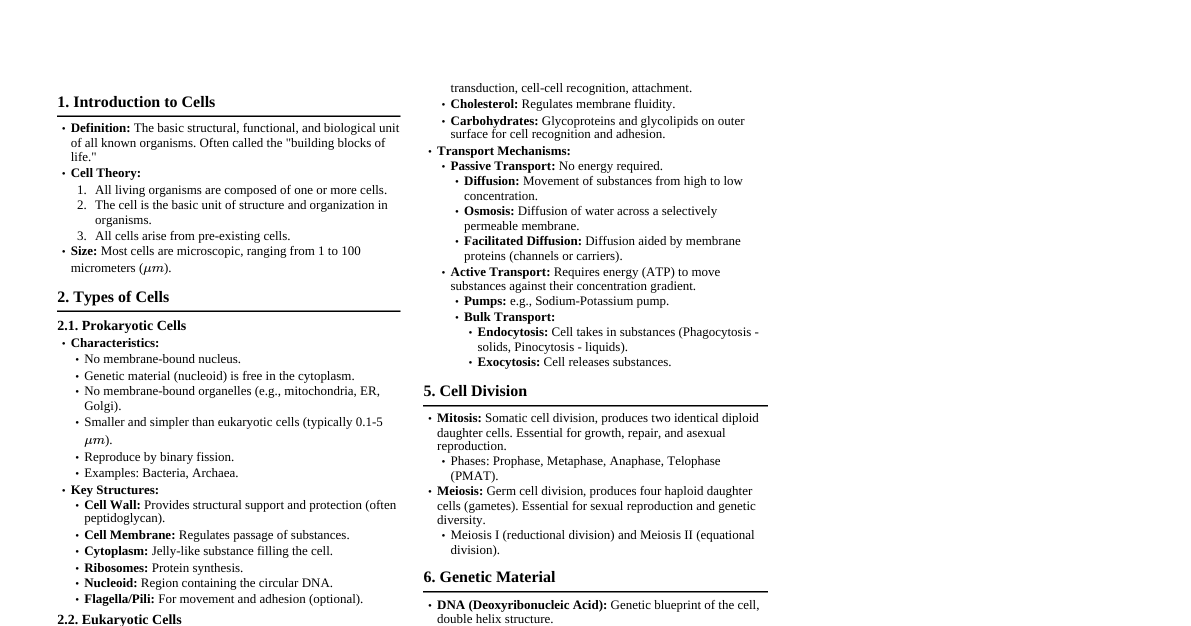
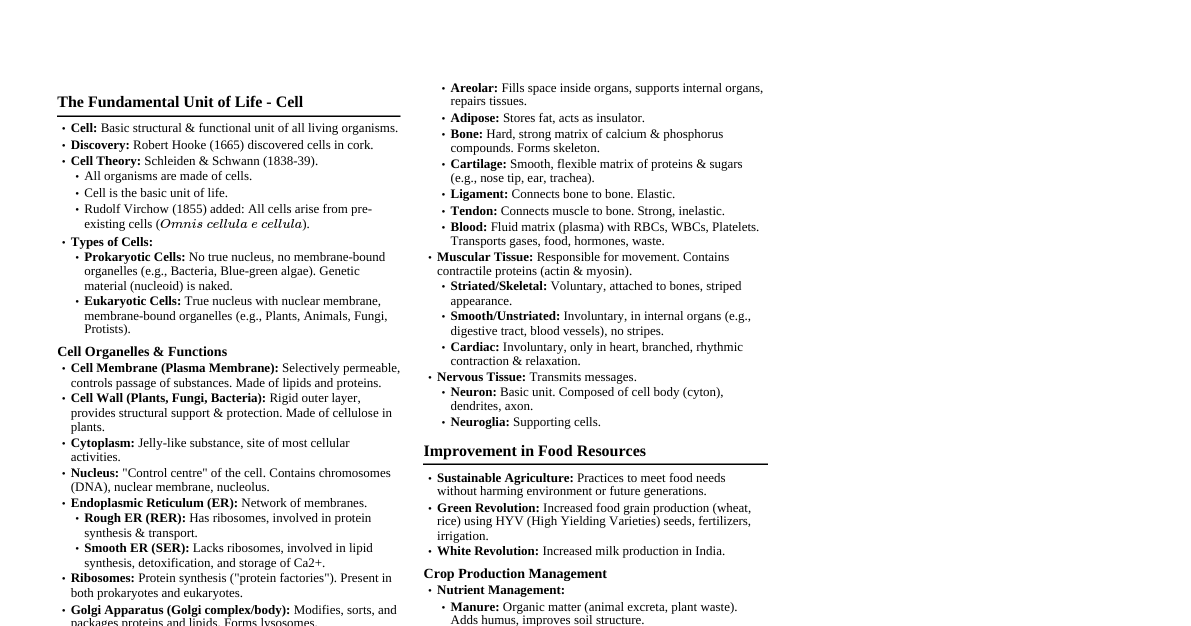
### Cell: The Fundamental Unit of Life - **Definition:** The cell is the basic structural, functional, and biological unit of all known organisms. It is the smallest unit of life that can replicate independently. - **Discovery:** - **Robert Hooke (1665):** Observed thin slices of cork under a microscope and coined the term "cell" (from the Latin 'cellula' meaning small room). He saw dead plant cells. - **Anton van Leeuwenhoek (1674):** First observed living cells (bacteria, protozoa, red blood cells) using his improved microscope. - **Cell Theory (Modern Version):** 1. **All living organisms are composed of one or more cells.** This means cells are the fundamental building blocks of life. 2. **The cell is the basic unit of structure and organization in all organisms.** All life processes occur within cells. 3. **All cells arise from pre-existing cells.** (Proposed by Rudolf Virchow in 1855, stating "Omnis cellula e cellula"). This disproved spontaneous generation. 4. Hereditary information (DNA) is passed from cell to cell. 5. All cells are similar in chemical composition and metabolic activities. ### Types of Cells Cells are broadly classified into two main types based on their internal organization: #### 1. Prokaryotic Cells - **Definition:** Simple cells that lack a true nucleus and other membrane-bound organelles. - **Characteristics:** - **No true nucleus:** Genetic material (DNA) is concentrated in a region called the **nucleoid**, but it's not enclosed by a membrane. - **No membrane-bound organelles:** Lack structures like mitochondria, endoplasmic reticulum, Golgi apparatus, lysosomes, and vacuoles. - **Ribosomes:** Present, but are smaller (70S type) and are the only non-membrane bound organelles. - **Cell Wall:** Usually present, made of peptidoglycan (in bacteria). - **Capsule:** An additional protective layer outside the cell wall in some bacteria. - **Flagella:** May be present for locomotion. - **Size:** Typically smaller (0.1-5.0 µm in diameter). - **Examples:** Bacteria and Archaea (e.g., E. coli, Cyanobacteria/blue-green algae). - **Reproduction:** Primarily by binary fission. #### 2. Eukaryotic Cells - **Definition:** Complex cells that possess a true nucleus and various membrane-bound organelles. - **Characteristics:** - **True Nucleus:** Contains the cell's genetic material (DNA) enclosed within a double membrane called the nuclear envelope. - **Membrane-bound organelles:** Possess specialized structures like mitochondria, endoplasmic reticulum, Golgi apparatus, lysosomes, peroxisomes, and vacuoles. - **Ribosomes:** Present, larger (80S type), found free in the cytoplasm or attached to the ER. - **Cell Wall:** Present in plant and fungal cells (made of cellulose in plants, chitin in fungi), but absent in animal cells. - **Size:** Typically larger (10-100 µm in diameter). - **Examples:** Cells of plants, animals, fungi, and protists. - **Reproduction:** Primarily by mitosis and meiosis. ### Plant Cell vs. Animal Cell: A Detailed Comparison Both are eukaryotic cells but have distinct features reflecting their different functions and lifestyles. | Feature | Plant Cell | Animal Cell | |----------------------------|----------------------------------------------------------------|-----------------------------------------------------------------| | **Cell Wall** | **Present** outside the plasma membrane, made primarily of **cellulose**. Provides rigid support and protection. | **Absent**. The outermost layer is the plasma membrane. | | **Cell Shape** | Typically **fixed and rectangular/square** due to the rigid cell wall. | Usually **irregular or round** due to the absence of a cell wall. | | **Chloroplasts** | **Present** (contain chlorophyll) for photosynthesis. | **Absent**. Animals obtain food by consumption. | | **Plastids** | **Present** (e.g., chloroplasts, chromoplasts, leucoplasts). | **Absent**. | | **Vacuole** | **Large, single, central, and permanent vacuole** (up to 90% of cell volume). Stores water, nutrients, waste, and maintains turgor pressure. | **Small, numerous, temporary, or absent vacuoles**. Function mainly in storage and transport. | | **Centrioles** | **Absent** in higher plants (present in some lower plants like algae). | **Present** within the centrosome, involved in cell division. | | **Lysosomes** | Generally **absent** or very rare; their digestive function is often performed by the large vacuole. | **Present**, contain digestive enzymes. | | **Glyoxysomes** | **Present** in some plant seeds, convert fats to carbohydrates. | **Absent**. | | **Cytokinesis** | Occurs by **cell plate formation** in the center of the cell. | Occurs by **cleavage furrow formation** (pinching of the cell membrane). | | **Storage Material** | Stores energy as **starch**. | Stores energy as **glycogen**. | ### Cell Organelles & Their Functions: A Closer Look #### 1. Cell Membrane (Plasma Membrane) - **Location:** Outermost boundary of animal cells; lies just inside the cell wall in plant cells. - **Structure:** A thin, delicate, elastic, and selectively permeable membrane. Composed of a **phospholipid bilayer** with embedded and associated **proteins** (Fluid Mosaic Model). - **Functions:** - **Selective Permeability:** Regulates the passage of substances (nutrients, waste) into and out of the cell. - **Protection:** Protects the cell from its surroundings. - **Cell Recognition and Communication:** Proteins on the surface act as receptors and identifiers. - **Maintains Homeostasis:** Helps maintain a stable internal environment. #### 2. Cell Wall (Found in Plant Cells, Fungi, Bacteria) - **Location:** Outermost rigid covering of plant cells, outside the plasma membrane. - **Structure:** Primarily composed of **cellulose** in plants (chitin in fungi, peptidoglycan in bacteria). It is fully permeable. - **Functions:** - **Structural Support:** Provides rigidity and maintains the shape of the plant cell. - **Protection:** Protects the cell from mechanical stress and pathogens. - **Prevents Bursting:** Prevents over-expansion when water enters the cell (turgor pressure). - Allows free passage of water and dissolved substances. #### 3. Cytoplasm (Protoplasm excluding the nucleus) - **Location:** The jelly-like substance that fills the cell, enclosed by the cell membrane, and surrounds the nucleus. - **Composition:** Consists of **cytosol** (the fluid portion) and various **organelles** suspended within it. - **Functions:** - **Site of Metabolic Reactions:** Many vital biochemical reactions (e.g., glycolysis) occur here. - **Transport:** Facilitates the movement of substances within the cell. - **Holds Organelles:** Provides a medium for organelles to be suspended. #### 4. Nucleus (The Control Center) - **Location:** Usually the largest and most prominent organelle, generally centrally located in animal cells and pushed to the periphery in mature plant cells. - **Structure:** - **Nuclear Envelope (Nuclear Membrane):** A double-layered membrane with **nuclear pores** that regulate the passage of molecules between the nucleus and cytoplasm. - **Nucleoplasm:** The jelly-like substance inside the nucleus. - **Chromatin:** Network of thread-like structures composed of **DNA** and proteins. During cell division, chromatin condenses to form **chromosomes**, which carry genetic information. - **Nucleolus:** A small, dense, spherical body within the nucleoplasm. It is involved in the synthesis of ribosomal RNA (rRNA) and the assembly of ribosomes. - **Functions:** - **Controls Cell Activities:** Contains the cell's genetic material (DNA) and directs all cellular processes. - **Heredity:** Stores and transmits hereditary information from one generation to the next. - **Regulates Gene Expression:** Controls which proteins are made and when. #### 5. Endoplasmic Reticulum (ER) - **Structure:** A vast network of interconnected membrane-bound tubules and flattened sacs (cisternae) that extends throughout the cytoplasm, continuous with the nuclear envelope. - **Two Types:** - **Rough Endoplasmic Reticulum (RER):** - Has **ribosomes** attached to its surface, giving it a "rough" appearance. - **Functions:** Involved in the synthesis, folding, modification, and transport of **proteins** destined for secretion or insertion into membranes. - **Smooth Endoplasmic Reticulum (SER):** - Lacks ribosomes, giving it a "smooth" appearance. - **Functions:** - Synthesis of **lipids** (fats), phospholipids, and steroids. - **Detoxification** of drugs and poisons (especially in liver cells). - Storage of **calcium ions** (important for muscle contraction). #### 6. Ribosomes (Protein Factories) - **Structure:** Small, granular particles composed of ribosomal RNA (rRNA) and proteins. Not membrane-bound. - **Location:** Found freely in the cytoplasm or attached to the RER. - **Functions:** - **Protein Synthesis:** The primary site where amino acids are assembled into proteins, following instructions from mRNA. #### 7. Golgi Apparatus (Golgi Complex/Body) - **Structure:** Consists of a stack of flattened, membrane-bound sacs called **cisternae**, along with associated vesicles. - **Functions:** - **Modification and Packaging:** Modifies, sorts, and packages proteins and lipids synthesized in the ER into vesicles. - **Transport:** Transports these packaged materials to their final destinations (e.g., secretion outside the cell, delivery to other organelles). - **Formation of Lysosomes:** Involved in the formation of lysosomes. - **Cell Wall Formation:** In plant cells, it is involved in the synthesis of cell wall components. #### 8. Mitochondria (The Powerhouse of the Cell) - **Structure:** Rod-shaped or oval organelles with a **double membrane**. - The **outer membrane** is smooth and permeable. - The **inner membrane** is highly folded into finger-like projections called **cristae**, which increase the surface area. The space inside the inner membrane is called the **matrix**. - **Functions:** - **Cellular Respiration:** The primary site of aerobic respiration, where glucose is broken down to release energy. - **ATP Production:** Produces **Adenosine Triphosphate (ATP)**, the energy currency of the cell. Hence, called the "powerhouse." - Contains its own DNA and ribosomes, suggesting its evolutionary origin from prokaryotic cells (endosymbiotic theory). #### 9. Plastids (Found in Plant Cells and Algae) - **Structure:** Double-membraned organelles, similar to mitochondria, and also contain their own DNA and ribosomes. - **Types:** - **Chloroplasts:** - Contain the green pigment **chlorophyll**. - **Function:** Site of **photosynthesis**, where light energy is converted into chemical energy (glucose). - Contain stacks of thylakoids called **grana** within a fluid-filled stroma. - **Chromoplasts:** - Contain pigments other than chlorophyll (e.g., red, orange, yellow). - **Function:** Give color to flowers and fruits, attracting pollinators and seed dispersers. - **Leucoplasts:** - Colorless plastids. - **Function:** Primarily involved in the storage of food materials (e.g., **amyloplasts** store starch, elaioplasts store oils, proteinoplasts store proteins). #### 10. Vacuoles (Storage Sacs) - **Structure:** Membrane-bound sacs filled with fluid. - **Location & Size:** - **Plant Cells:** Typically a single, large, central vacuole that can occupy up to 90% of the cell volume. - **Animal Cells:** Usually small, temporary, numerous, or sometimes absent. - **Functions:** - **Storage:** Stores water, nutrients, ions, waste products, and pigments. - **Turgor Pressure (Plant Cells):** Maintains turgidity, providing support to the cell and plant. - **Waste Disposal:** Helps in isolating and disposing of waste products. - **Digestion:** In some single-celled organisms, food vacuoles form to digest food. #### 11. Lysosomes (Suicidal Bags) - **Structure:** Small, spherical, membrane-bound sacs containing powerful **hydrolytic (digestive) enzymes**. - **Location:** Found mainly in animal cells, rare or absent in plant cells (where the vacuole performs similar functions). - **Functions:** - **Waste Disposal and Recycling:** Break down worn-out cell organelles, foreign materials (bacteria, viruses), and cellular debris. - **Autolysis:** In case of cell damage, lysosomes may burst and digest their own cell, hence called "suicidal bags." #### 12. Centrosome and Centrioles (Found in Animal Cells, some lower plants) - **Location:** Near the nucleus in animal cells. - **Structure:** The **centrosome** is an organelle that contains two small, cylindrical structures called **centrioles**, arranged perpendicular to each other. Each centriole is made up of nine sets of triplet microtubules. - **Functions:** - **Cell Division:** Organize the spindle fibers during cell division in animal cells. - **Formation of Cilia and Flagella:** Involved in the formation of basal bodies of cilia and flagella. ### Cell Division: How Cells Reproduce - **Definition:** The process by which a parent cell divides into two or more daughter cells. It is essential for growth, repair, reproduction, and development. #### 1. Mitosis (Somatic Cell Division) - **Purpose:** Growth, repair of damaged tissues, replacement of old cells, and asexual reproduction in some organisms. - **Occurs In:** Somatic (body) cells. - **Outcome:** Produces **two genetically identical diploid (2n)** daughter cells from a single diploid parent cell. - **Phases:** - **Interphase:** The cell grows, duplicates its DNA, and prepares for division (G1, S, G2 phases). This is not technically a phase of mitosis but precedes it. - **Prophase:** Chromatin condenses into visible chromosomes; nuclear envelope breaks down; spindle fibers begin to form. - **Metaphase:** Chromosomes align at the metaphase plate (equator of the cell). - **Anaphase:** Sister chromatids separate and move to opposite poles of the cell. - **Telophase:** Chromosomes decondense; nuclear envelopes reform around the two sets of chromosomes; spindle fibers disappear. - **Cytokinesis:** Division of the cytoplasm, resulting in two separate daughter cells. In animal cells, a cleavage furrow forms. In plant cells, a cell plate forms. #### 2. Meiosis (Reproductive Cell Division) - **Purpose:** Sexual reproduction, production of gametes (sperm and egg) or spores, and introducing genetic variation. - **Occurs In:** Germline (sex) cells in sexually reproducing organisms. - **Outcome:** Produces **four genetically non-identical haploid (n)** daughter cells from a single diploid parent cell. - **Process:** Involves two successive divisions: Meiosis I and Meiosis II. - **Meiosis I (Reductional Division):** - Separates homologous chromosomes. - Results in two haploid cells, each with duplicated chromosomes. - **Crossing Over:** Occurs during Prophase I, leading to genetic recombination and variation. - **Meiosis II (Equational Division):** - Separates sister chromatids (similar to mitosis). - Results in four haploid cells, each with unduplicated chromosomes. - **Significance:** Ensures that the chromosome number remains constant from generation to generation in sexually reproducing organisms and generates genetic diversity.