Chemical Equilibrium
Cheatsheet Content
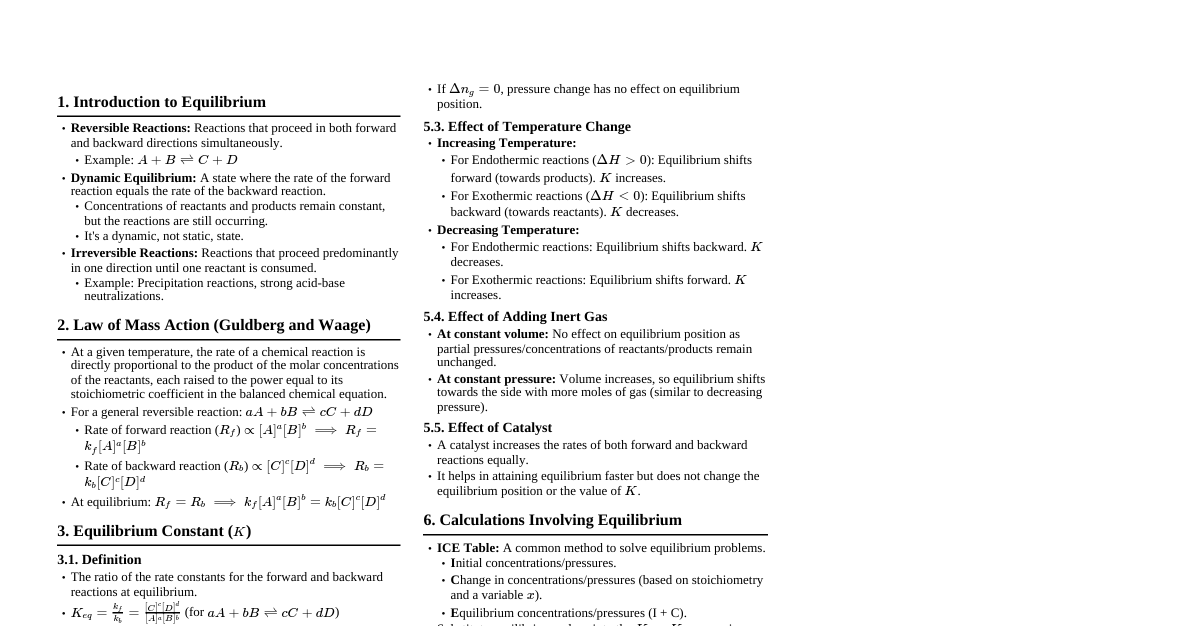
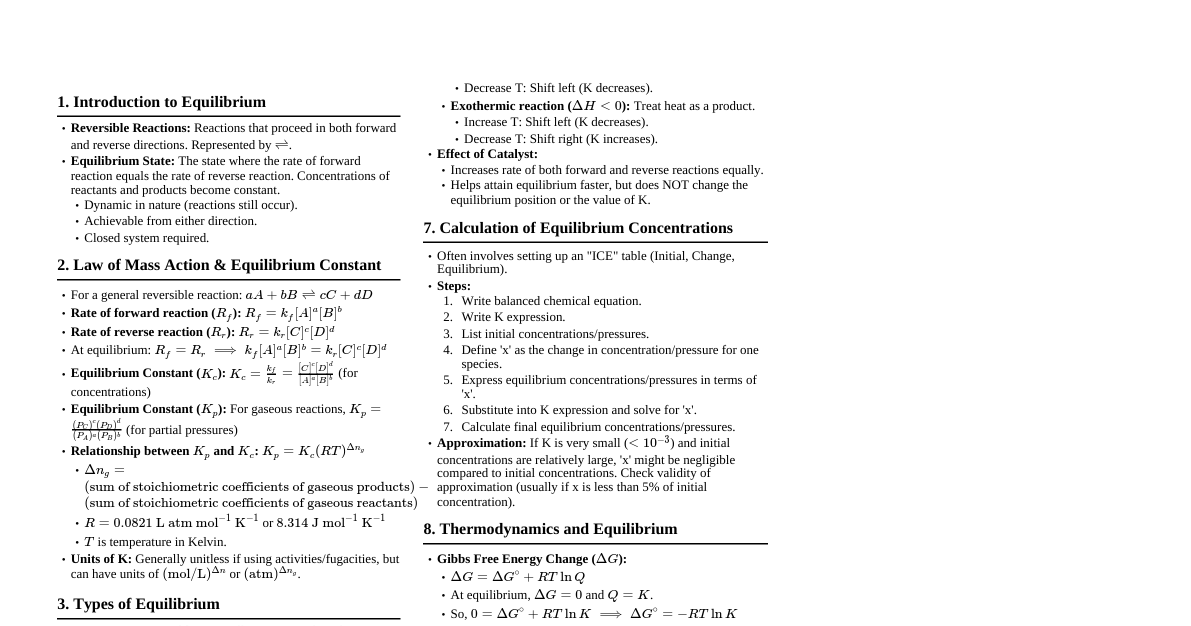
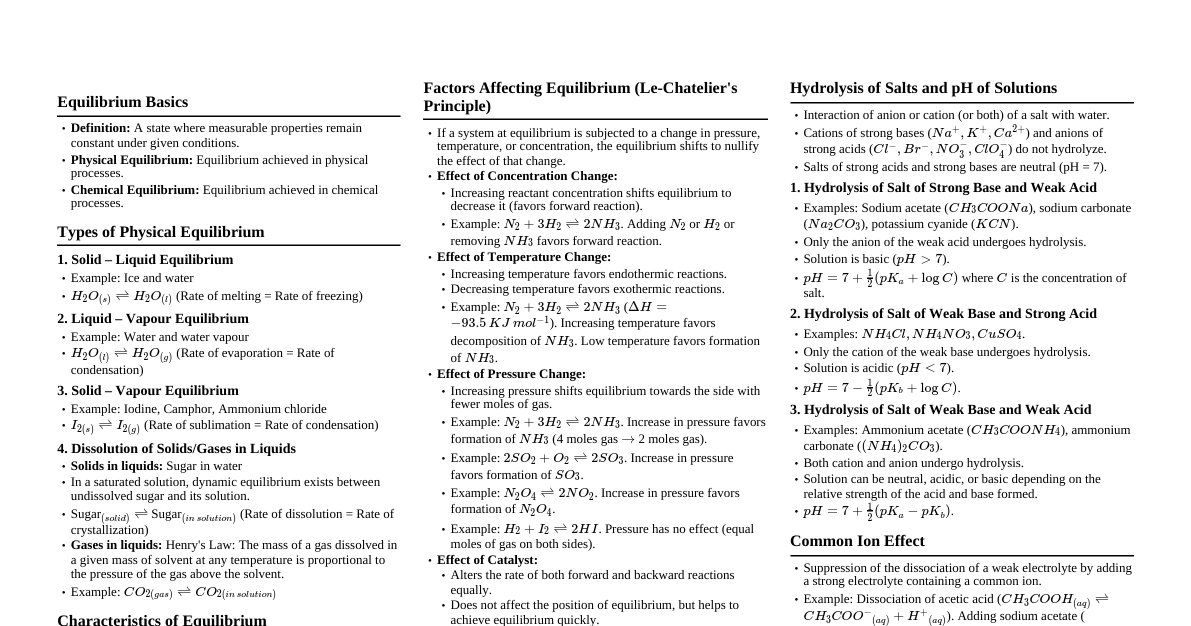
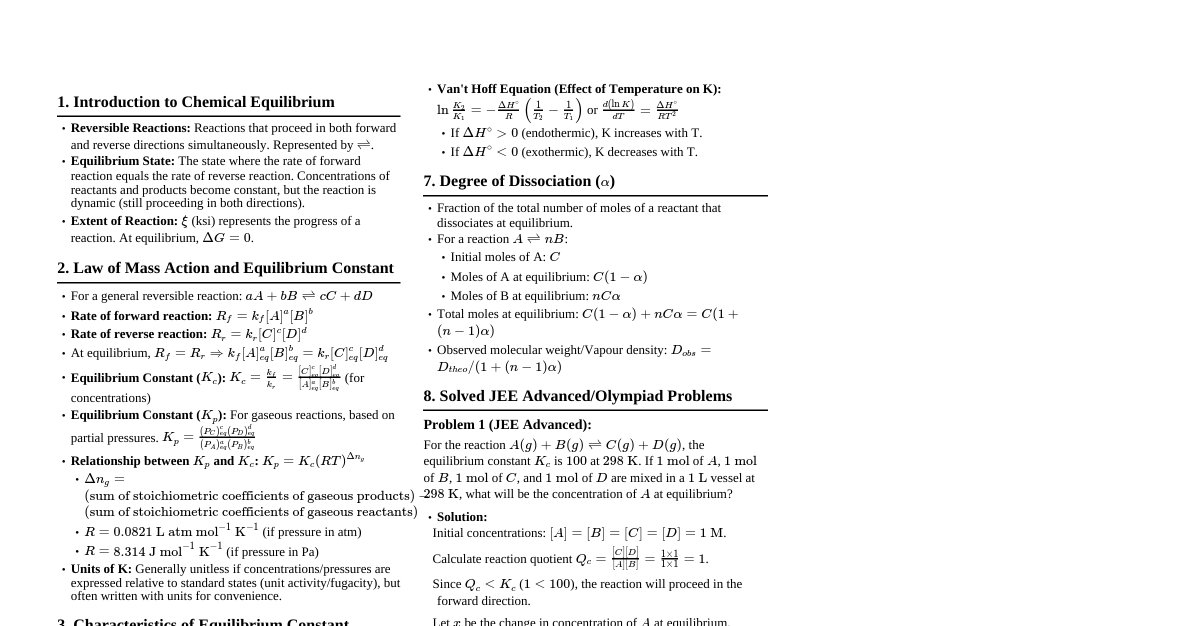
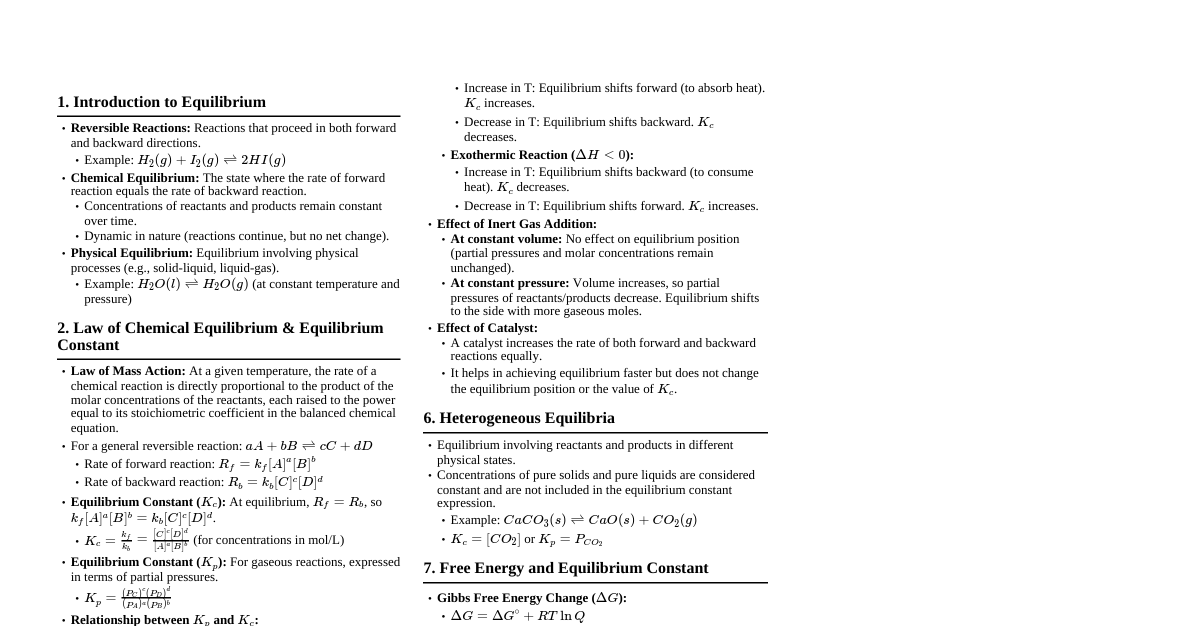
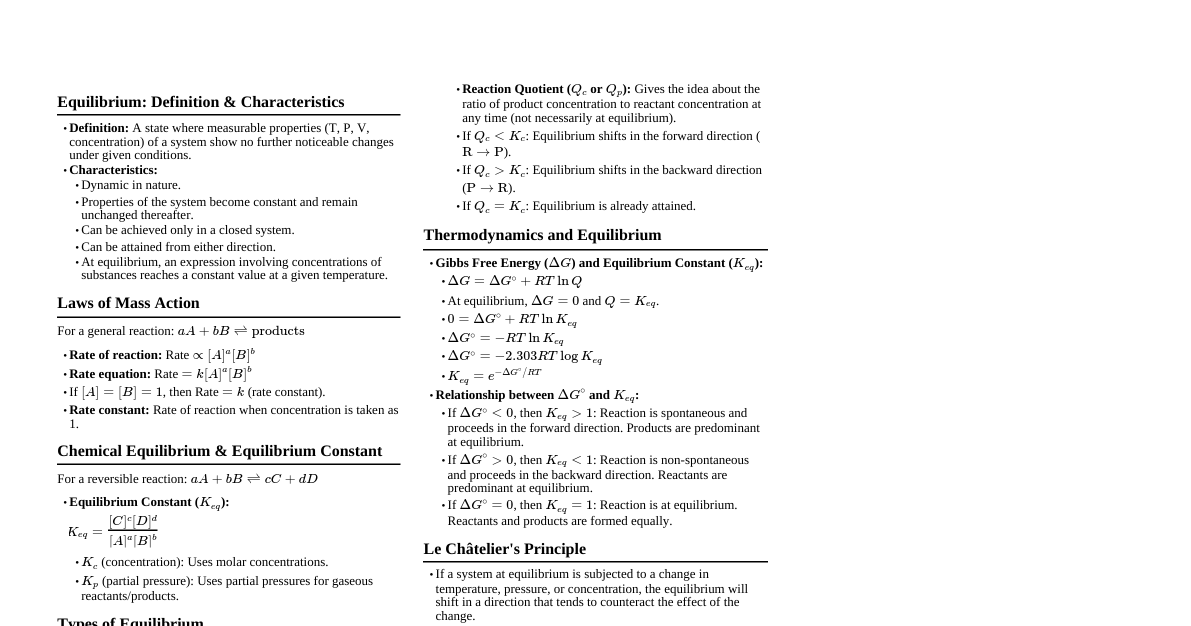
### 1. Equilibrium Basics - **Definition:** A state where the rate of forward reaction equals the rate of reverse reaction, and the net concentrations of reactants and products remain constant. - **Dynamic Process:** Reactions are still occurring, but there's no net change. - **Reversible Reactions:** Denoted by $\rightleftharpoons$ (e.g., $A + B \rightleftharpoons C + D$). - **Equilibrium Constant ($K$):** A ratio of product concentrations to reactant concentrations at equilibrium, each raised to the power of their stoichiometric coefficients. - For $aA + bB \rightleftharpoons cC + dD$: $$K_c = \frac{[C]^c[D]^d}{[A]^a[B]^b}$$ $$K_p = \frac{(P_C)^c(P_D)^d}{(P_A)^a(P_B)^b}$$ - $K_c$ uses molar concentrations (mol/L). - $K_p$ uses partial pressures (atm). - Pure solids and liquids are excluded from $K$ expressions. - **Relationship between $K_c$ and $K_p$:** $$K_p = K_c(RT)^{\Delta n}$$ Where: - $R = 0.08206 \text{ L atm/mol K}$ - $T$ = temperature in Kelvin - $\Delta n$ = (moles of gaseous products) - (moles of gaseous reactants) - **Magnitude of K:** - $K > 1$: Products are favored at equilibrium. - $K ### 2. Reaction Quotient (Q) - **Definition:** Similar to $K$, but uses non-equilibrium concentrations/pressures. $$Q_c = \frac{[C]^c[D]^d}{[A]^a[B]^b} \text{ (at any given time)}$$ - **Predicting Reaction Direction:** - If $Q K$: The reaction will proceed to the left (towards reactants) to reach equilibrium. - If $Q = K$: The system is already at equilibrium. ### 3. Le Châtelier's Principle - **Statement:** If a change of condition is applied to a system in equilibrium, the system will shift in a direction that relieves the stress. - **Stresses and Shifts:** - **Change in Concentration:** - Adding reactant: Shifts right (towards products). - Removing reactant: Shifts left (towards reactants). - Adding product: Shifts left (towards reactants). - Removing product: Shifts right (towards products). - **Change in Pressure/Volume (for gaseous reactions):** - Increasing pressure (decreasing volume): Shifts towards the side with fewer moles of gas. - Decreasing pressure (increasing volume): Shifts towards the side with more moles of gas. - If $\Delta n = 0$: No shift due to pressure/volume change. - **Change in Temperature:** - **Endothermic Reaction (absorbs heat, $\Delta H > 0$):** Treat heat as a reactant. - Increasing temperature: Shifts right (favors products). - Decreasing temperature: Shifts left (favors reactants). - **Exothermic Reaction (releases heat, $\Delta H ### 4. Solving Equilibrium Problems (ICE Tables) - **ICE Table Method:** Used to calculate equilibrium concentrations/pressures. - **I**nitial: Write down initial concentrations/pressures. - **C**hange: Define the change in concentration/pressure using 'x' based on stoichiometry. - **E**quilibrium: Express equilibrium concentrations/pressures in terms of initial values and 'x'. - **Steps:** 1. Write the balanced chemical equation. 2. Write the $K_c$ or $K_p$ expression. 3. Set up the ICE table. 4. Substitute equilibrium expressions into the $K$ expression. 5. Solve for 'x'. 6. Calculate equilibrium concentrations/pressures. - **Approximation Rule:** If $K$ is very small ($ ### 5. Acid-Base Equilibrium - **Brønsted-Lowry Definition:** - **Acid:** Proton ($\text{H}^+$) donor. - **Base:** Proton acceptor. - **Conjugate Acid-Base Pairs:** An acid and a base that differ by one proton. - Example: $\text{HCl}$ (acid) / $\text{Cl}^-$ (conjugate base); $\text{NH}_3$ (base) / $\text{NH}_4^+$ (conjugate acid). - **Strong Acids/Bases:** Ionize completely in water. - Strong Acids: $\text{HCl}, \text{HBr}, \text{HI}, \text{HNO}_3, \text{H}_2\text{SO}_4, \text{HClO}_4$. - Strong Bases: Group 1 hydroxides ($\text{LiOH}, \text{NaOH}, \text{KOH}$, etc.), heavy Group 2 hydroxides ($\text{Ca(OH)}_2, \text{Sr(OH)}_2, \text{Ba(OH)}_2$). - **Weak Acids/Bases:** Partially ionize in water, establishing equilibrium. - **Acid Dissociation Constant ($K_a$):** For $\text{HA}(aq) + \text{H}_2\text{O}(l) \rightleftharpoons \text{H}_3\text{O}^+(aq) + \text{A}^-(aq)$ $$K_a = \frac{[\text{H}_3\text{O}^+][\text{A}^-]}{[\text{HA}]}$$ - **Base Dissociation Constant ($K_b$):** For $\text{B}(aq) + \text{H}_2\text{O}(l) \rightleftharpoons \text{BH}^+(aq) + \text{OH}^-(aq)$ $$K_b = \frac{[\text{BH}^+][\text{OH}^-]}{[\text{B}]}$$ - **Autoionization of Water:** $\text{H}_2\text{O}(l) + \text{H}_2\text{O}(l) \rightleftharpoons \text{H}_3\text{O}^+(aq) + \text{OH}^-(aq)$ - **Ion-Product Constant of Water ($K_w$):** $$K_w = [\text{H}_3\text{O}^+][\text{OH}^-] = 1.0 \times 10^{-14} \text{ at } 25^\circ\text{C}$$ - **Relationship between $K_a$ and $K_b$ for a conjugate pair:** $$K_a \times K_b = K_w$$ - **pH Scale:** - $\text{pH} = -\log[\text{H}_3\text{O}^+]$ - $\text{pOH} = -\log[\text{OH}^-]$ - $\text{pH} + \text{pOH} = 14 \text{ at } 25^\circ\text{C}$ - Acidic: pH 7. ### 6. Buffers - **Definition:** A solution that resists changes in pH upon the addition of small amounts of acid or base. - **Composition:** Consists of a weak acid and its conjugate base, or a weak base and its conjugate acid. - Example: $\text{CH}_3\text{COOH}$ (weak acid) and $\text{CH}_3\text{COO}^-$ (conjugate base). - **How Buffers Work:** - Add acid ($\text{H}^+$): Conjugate base reacts with $\text{H}^+$. $\text{A}^-(aq) + \text{H}^+(aq) \rightarrow \text{HA}(aq)$ - Add base ($\text{OH}^-$): Weak acid reacts with $\text{OH}^-$. $\text{HA}(aq) + \text{OH}^-(aq) \rightarrow \text{A}^-(aq) + \text{H}_2\text{O}(l)$ - **Henderson-Hasselbalch Equation:** Used to calculate the pH of a buffer solution. $$\text{pH} = \text{p}K_a + \log\left(\frac{[\text{A}^-]}{[\text{HA}]}\right)$$ or $$\text{pH} = \text{p}K_a + \log\left(\frac{[\text{Base}]}{[\text{Acid}]}\right)$$ - **Buffer Capacity:** The amount of acid or base a buffer can neutralize before its pH changes significantly. Depends on the concentrations of the weak acid and its conjugate base. - **Buffer Range:** Effective pH range is typically $\text{p}K_a \pm 1$. ### 7. Titration Curves - **Definition:** A plot of pH vs. volume of titrant added. - **Key Points:** - **Equivalence Point:** The point where the moles of acid equal the moles of base. - Strong Acid-Strong Base: pH = 7 at equivalence point. - Weak Acid-Strong Base: pH > 7 at equivalence point. - Strong Acid-Weak Base: pH ### 8. Solubility Equilibrium (Ksp) - **Definition:** Describes the equilibrium between a sparingly soluble ionic solid and its dissolved ions in a saturated solution. - **Solubility Product Constant ($K_{sp}$):** For a generic sparingly soluble salt $\text{M}_x\text{A}_y(s) \rightleftharpoons x\text{M}^{y+}(aq) + y\text{A}^{x-}(aq)$ $$K_{sp} = [\text{M}^{y+}]^x[\text{A}^{x-}]^y$$ - **Molar Solubility (s):** The concentration (in mol/L) of the metal cation in a saturated solution. - **Relationship between $K_{sp}$ and 's':** - Example: $\text{AgCl}(s) \rightleftharpoons \text{Ag}^+(aq) + \text{Cl}^-(aq)$ $K_{sp} = [\text{Ag}^+][\text{Cl}^-] = s \times s = s^2 \implies s = \sqrt{K_{sp}}$ - Example: $\text{PbI}_2(s) \rightleftharpoons \text{Pb}^{2+}(aq) + 2\text{I}^-(aq)$ $K_{sp} = [\text{Pb}^{2+}][\text{I}^-]^2 = s \times (2s)^2 = 4s^3 \implies s = \sqrt[3]{K_{sp}/4}$ - **Predicting Precipitation (Ion Product, Q):** - $Q_{sp} K_{sp}$: Solution is supersaturated, precipitate will form. - $Q_{sp} = K_{sp}$: Solution is saturated, equilibrium exists. - **Common Ion Effect:** The solubility of a sparingly soluble salt decreases when a common ion (an ion already present in the solution) is added. This shifts the equilibrium to the left, according to Le Châtelier's Principle. - **Effect of pH on Solubility:** - If the anion of the sparingly soluble salt is the conjugate base of a weak acid (e.g., $\text{CO}_3^{2-}, \text{F}^-, \text{OH}^-$), its solubility increases in acidic solutions. The $\text{H}^+$ reacts with the anion, reducing its concentration and shifting the equilibrium to the right. - If the anion is the conjugate base of a strong acid (e.g., $\text{Cl}^-, \text{Br}^-, \text{I}^-$), pH has little to no effect on solubility.