Postpartum Hemorrhage Cheatsheet
Cheatsheet Content
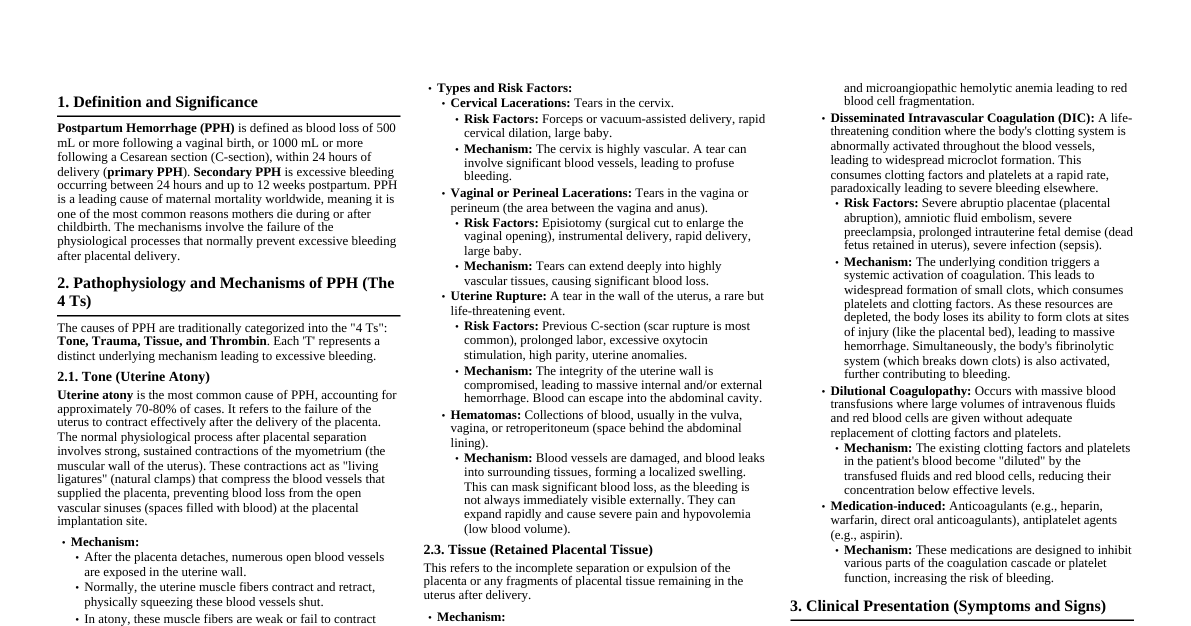
Postpartum Hemorrhage (PPH) Definition: Postpartum hemorrhage (PPH) is defined as blood loss of 500 mL or more after a vaginal birth, or 1000 mL or more after a Cesarean section. It can also be defined as any blood loss that causes hemodynamic instability (changes in blood pressure, heart rate, or consciousness due to insufficient blood volume) or requires a transfusion. PPH is a leading cause of maternal morbidity (illness or complications related to pregnancy) and mortality (death) worldwide. Physiology of Normal Postpartum Hemostasis Hemostasis: The process of stopping bleeding. After delivery of the baby and placenta, the uterus normally contracts strongly. This contraction is crucial because the placenta was attached to the inner wall of the uterus, and when it detaches, numerous blood vessels are exposed. The uterine muscle fibers act like a "living ligature," compressing these blood vessels and preventing excessive bleeding. This process is called uterine atony (lack of uterine tone or contraction) in reverse. Additionally, the body's clotting system (coagulation cascade) forms clots in these vessels, further aiding hemostasis. Oxytocin, a hormone naturally released after birth, plays a key role in stimulating these uterine contractions. Causes of Postpartum Hemorrhage (The 4 T's) The causes of PPH are commonly categorized into the "4 T's": Tone, Trauma, Tissue, and Thrombin. Understanding these helps in systematically identifying the underlying problem. 1. Tone (Uterine Atony) Mechanism: This is the most common cause, accounting for about 70-80% of PPH cases. Uterine atony means the uterus fails to contract adequately after birth. Without proper contraction, the blood vessels at the placental site remain open and bleed freely, leading to significant blood loss. The "living ligatures" (uterine muscle fibers compressing vessels) are not effective. Overdistension of the Uterus: Pathophysiology: When the uterus is stretched too much during pregnancy, its muscle fibers become overextended and lose their ability to contract effectively after delivery. Causes: Multiple gestation: Carrying twins, triplets, etc., significantly stretches the uterus. Polyhydramnios: Excess amniotic fluid (the fluid surrounding the baby), which also overstretches the uterine walls. Macrosomia: A very large baby (usually weighing over 4000g or 8.8 lbs), leading to a larger uterus. Prolonged or Rapid Labor: Pathophysiology: Extremely long labor can exhaust the uterine muscles, making them less effective at contracting postpartum. Conversely, very rapid labor (precipitous labor) might not allow the uterus enough time to coordinate its contractions properly after birth. High Parity: Pathophysiology: Women who have had many previous pregnancies (multiparous) may have uterine muscles that are less toned and less efficient at contracting due to repeated stretching and recovery. Infection (Chorioamnionitis): Pathophysiology: Infection of the amniotic fluid and membranes (chorion and amnion) can lead to inflammation within the uterine muscle, impairing its ability to contract. Medications: Pathophysiology: Certain medications can relax the uterine muscles. Examples: Magnesium sulfate: Used for pre-eclampsia or eclampsia (pregnancy-induced high blood pressure with seizures); it's a smooth muscle relaxant. General anesthetics (especially halogenated agents): Can depress uterine contractility. Uterine Fibroids: Pathophysiology: Benign (non-cancerous) growths in the uterine wall can interfere with the normal contraction pattern of the muscle fibers. Placental problems: Placenta previa: Placenta covers the cervix. The lower uterine segment where the placenta is attached has fewer muscle fibers and contracts less effectively. Placental abruption: Premature detachment of the placenta. The uterus may have trouble contracting uniformly. 2. Trauma (Genital Tract Trauma) Mechanism: Lacerations (tears) or hematomas (collections of blood) in the birth canal that continue to bleed after delivery, despite a well-contracted uterus. The bleeding here is from damaged blood vessels in the torn tissue. Vaginal Lacerations: Pathophysiology: Tears in the vaginal walls, often occurring during delivery, especially with rapid delivery, large baby, or instrumental delivery (forceps or vacuum). These tears can involve blood vessels that continue to bleed if not repaired. Cervical Lacerations: Pathophysiology: Tears in the cervix (the opening of the uterus). These can be deep and involve significant blood vessels, leading to brisk bleeding. Often occurs with rapid dilation or instrumental delivery. Perineal Lacerations: Pathophysiology: Tears in the perineum (the area between the vagina and anus). While usually less severe, deep tears (third or fourth-degree involving anal sphincter or rectum) can cause significant bleeding. Uterine Rupture: Pathophysiology: A rare but life-threatening tearing of the uterine wall. This allows blood to escape into the abdominal cavity and can lead to severe hemorrhage and shock. More common in women with previous uterine surgery (e.g., C-section scar) or in cases of strong uterine contractions against an obstruction. Mechanism of bleeding: Direct tearing of large uterine blood vessels. Hematomas: Pathophysiology: Collections of blood in the tissues of the vulva, vagina, or retroperitoneum (space behind the abdominal lining). Blood vessels can rupture underneath intact skin/mucosa, leading to a swelling mass of blood that continues to expand and bleed internally. Often associated with trauma during delivery or inadequate repair of lacerations. 3. Tissue (Retained Placental Tissue) Mechanism: Any part of the placenta or fetal membranes that remains inside the uterus after delivery. The retained tissue prevents the uterus from contracting effectively, similar to atony, because it acts as an obstruction, keeping the blood vessels at the placental site open. Retained Placental Fragments: Pathophysiology: Small pieces of the placenta might break off and remain in the uterus. These fragments prevent the uterine muscle from clamping down completely on the blood vessels, leading to persistent bleeding. Abnormal Placental Adherence (Placenta Accreta Spectrum): Pathophysiology: These are conditions where the placenta grows too deeply into the uterine wall. Placenta Accreta: Placenta attaches directly to the myometrium (uterine muscle) without the usual decidual layer (inner uterine lining). Placenta Increta: Placenta invades into the myometrium. Placenta Percreta: Placenta penetrates through the entire uterine wall, potentially invading other organs like the bladder. Mechanism of bleeding: When attempts are made to remove the placenta, it cannot detach cleanly, leaving large portions embedded and bleeding profusely from the uterine wall. This is often associated with previous C-sections or uterine surgeries. 4. Thrombin (Coagulopathy) Mechanism: Disorders of the blood clotting system that prevent the blood from clotting effectively. Even if the uterus contracts well and there are no tears, the blood itself cannot form a stable clot, leading to continuous oozing or bleeding. Pre-existing Coagulopathies: Pathophysiology: Inherited or acquired conditions that impair blood clotting. Examples: Von Willebrand disease: A genetic disorder causing a deficiency or defect in von Willebrand factor, a protein essential for platelet adhesion and protecting Factor VIII. Hemophilia: Genetic disorders causing deficiency in specific clotting factors (e.g., Factor VIII or IX). Idiopathic Thrombocytopenic Purpura (ITP): An autoimmune condition where the body attacks its own platelets, leading to low platelet count. Anticoagulant therapy: Medications like heparin or warfarin that thin the blood, used for conditions like deep vein thrombosis. Acquired Coagulopathies: Pathophysiology: Conditions that develop during pregnancy or immediately postpartum and consume or deplete clotting factors. Examples: Severe PPH itself: Massive blood loss can dilute clotting factors and platelets (dilutional coagulopathy) and deplete them from the body, creating a vicious cycle where bleeding worsens clotting, and poor clotting worsens bleeding. Disseminated Intravascular Coagulation (DIC): A severe condition where the clotting system is abnormally activated throughout the body, leading to widespread formation of tiny blood clots. This consumes all clotting factors and platelets, eventually leading to a paradoxical state of uncontrolled bleeding. Causes of DIC in obstetrics: Severe pre-eclampsia/eclampsia, placental abruption, amniotic fluid embolism (amniotic fluid enters maternal circulation), severe infection (sepsis), fetal demise (baby dies in utero). HELLP Syndrome: A severe form of pre-eclampsia characterized by H emolysis (destruction of red blood cells), E levated L iver enzymes, and L ow P latelet count. The low platelet count impairs clotting. Differential Diagnoses of PPH The "4 T's" essentially cover the differential diagnoses for primary PPH (bleeding within 24 hours of birth). Secondary PPH (bleeding from 24 hours up to 12 weeks postpartum) mostly involves retained placental tissue or infection. History from Patient (Subjective Information) Gathering a detailed history helps identify risk factors and potential causes. Current Symptoms: "How much blood have you passed?" (Quantity, e.g., "soaking pads," "passing clots the size of a lemon/golf ball"). Reasoning: Helps estimate blood loss. "Are you feeling dizzy, lightheaded, or weak?" Reasoning: Symptoms of hypovolemia (low blood volume) and anemia (low red blood cell count) due to blood loss. "Do you have any pain? Where is it?" Reasoning: Severe pain might indicate uterine rupture, large hematoma, or retained tissue. Atony is often painless. "Are you passing clots? What size?" Reasoning: Large clots suggest significant ongoing bleeding and poor uterine contraction (atony) or retained tissue. Obstetric History: Gravidity and Parity: "How many pregnancies have you had (gravida) and how many live births (para)?" Reasoning: High parity increases risk of uterine atony. Previous PPH: "Did you have heavy bleeding after your previous deliveries?" Reasoning: History of PPH is a strong predictor for recurrence. Previous C-sections or uterine surgeries: "Have you had any previous C-sections or other surgeries on your uterus?" Reasoning: Increases risk of placenta accreta spectrum and uterine rupture. Current Pregnancy and Labor History: Antenatal complications: "Were there any issues during this pregnancy, like high blood pressure (pre-eclampsia), gestational diabetes, or bleeding?" Reasoning: Pre-eclampsia can lead to HELLP and coagulopathy. Placenta previa/abruption are risk factors. Type of delivery: "Was it a vaginal birth or C-section? Was it assisted (forceps/vacuum)?" Reasoning: C-section increases blood loss. Instrumental delivery increases risk of trauma. Duration of labor: "How long was your labor?" Reasoning: Prolonged or precipitous labor increases risk of atony. Size of baby/multiples/fluid: "Was your baby very large? Did you have twins or triplets? Were you told you had too much amniotic fluid?" Reasoning: Overdistension risks atony. Placental delivery: "Did the placenta come out easily and completely? Was it inspected?" Reasoning: Retained tissue is a major cause. Medications during labor: "Did you receive any medications like magnesium sulfate or general anesthesia?" Reasoning: Can cause atony. Medical History: Bleeding disorders: "Do you or anyone in your family have a history of bleeding disorders (e.g., easy bruising, nosebleeds, prolonged bleeding after cuts/surgery)?" Reasoning: Suggests pre-existing coagulopathy. Other chronic conditions: "Do you have any other medical conditions, like liver disease or kidney disease?" Reasoning: Liver disease can impair clotting factor production. Medications: "Are you on any blood thinners or other regular medications?" Reasoning: Anticoagulants increase bleeding risk. Signs of Postpartum Hemorrhage (Objective Information) These are what the healthcare provider observes and measures. Visible Blood Loss: Observation: Soaked perineal pads, blood pooling under the buttocks, large clots. Reasoning: Direct evidence of bleeding. Visual estimation is often inaccurate and underestimates actual loss. Uterine Assessment: Palpation: A boggy (soft, poorly contracted) and enlarged uterus felt on abdominal examination. Reasoning: Classic sign of uterine atony. A well-contracted uterus should feel firm and be at or below the level of the umbilicus (belly button) immediately postpartum. Vital Signs (Indications of Hypovolemic Shock): Tachycardia: Heart rate greater than 100 beats per minute. Pathophysiology: The body's initial compensatory mechanism for decreased blood volume. The heart beats faster to try and maintain cardiac output (amount of blood pumped per minute). Hypotension: Blood pressure lower than normal (e.g., systolic BP less than 90 mmHg or a drop of 15-20% from baseline). Pathophysiology: Occurs as blood volume continues to decrease, and the heart can no longer compensate. Reduced blood pressure means less perfusion (blood flow) to vital organs. Tachypnea: Rapid breathing. Pathophysiology: Body's attempt to increase oxygen delivery to tissues as blood loss reduces oxygen-carrying capacity. Pallor: Paleness of skin and mucous membranes. Pathophysiology: Reduced blood flow to the skin and less hemoglobin (oxygen-carrying protein in red blood cells) due to blood loss. Cool, clammy skin: Pathophysiology: Peripheral vasoconstriction (narrowing of blood vessels in the extremities) is another compensatory mechanism to shunt blood to vital organs. Altered mental status: Anxiety, confusion, lethargy, loss of consciousness. Pathophysiology: Reduced blood flow and oxygen delivery to the brain. Genital Tract Examination: Inspection: Visualizing lacerations of the perineum, vagina, cervix, or expanding hematomas. Reasoning: Direct evidence of trauma. Urinary Output: Measurement: Decreased or absent urine output (oliguria or anuria). Pathophysiology: As blood volume decreases, blood flow to the kidneys is reduced, leading to decreased urine production as the body tries to conserve fluid. This is a sign of worsening shock. Complications of PPH If not promptly recognized and managed, PPH can lead to severe and life-threatening complications. Hypovolemic Shock: Pathophysiology: A medical emergency where severe blood loss leads to insufficient blood volume to perfuse (supply blood to) the body's organs. This results in inadequate oxygen delivery to tissues and can lead to organ damage and death. Anemia: Pathophysiology: A reduction in the number of red blood cells or the amount of hemoglobin, leading to reduced oxygen-carrying capacity of the blood. Can cause fatigue, weakness, shortness of breath. Acute Kidney Injury (AKI): Pathophysiology: Prolonged hypovolemic shock leads to reduced blood flow to the kidneys (renal ischemia), damaging the kidney cells and impairing their ability to filter waste products from the blood. Adult Respiratory Distress Syndrome (ARDS): Pathophysiology: A severe lung condition where fluid builds up in the air sacs (alveoli), making breathing difficult. Can be triggered by massive transfusion, severe shock, or DIC. Disseminated Intravascular Coagulation (DIC): Pathophysiology: As described above, severe blood loss can trigger a consumption coagulopathy where clotting factors are used up, leading to further uncontrolled bleeding. Sheehan's Syndrome: Pathophysiology: A rare but severe complication. Massive PPH can cause severe hypotension, leading to ischemia (lack of blood flow) and necrosis (tissue death) of the pituitary gland (a gland at the base of the brain that produces many hormones regulating other glands). This can result in permanent deficiency of pituitary hormones, causing symptoms like inability to lactate (produce milk), amenorrhea (absence of menstruation), and hypothyroidism. Infection (Puerperal Sepsis): Pathophysiology: Blood is an excellent medium for bacterial growth. If there is retained tissue or a large hematoma, it can become infected, leading to a severe systemic infection. Need for Hysterectomy: Pathophysiology: In severe, uncontrollable PPH, removal of the uterus (hysterectomy) may be necessary as a life-saving measure to stop the bleeding. Maternal Death: Pathophysiology: The ultimate complication if PPH is not effectively managed, leading to irreversible shock and multi-organ failure. Investigations for PPH These tests help quantify blood loss, identify the cause, and guide management. Initial Rapid Assessment: Quantification of Blood Loss (QBL): Method: Weighing blood-soaked pads/drapes, using calibrated collection bags. Reasoning: More accurate than visual estimation, which often underestimates actual loss. 1 gram of blood-soaked material is approximately 1 mL of blood. Fundal Massage: Method: Manual massage of the uterus through the abdomen. Reasoning: To stimulate uterine contractions. If the uterus remains boggy and bleeding continues, it points towards atony. Genital Tract Examination: Method: Visual inspection of the perineum, vagina, and cervix. Reasoning: To identify lacerations or hematomas. Laboratory Tests (Blood Work): Complete Blood Count (CBC): Components: Hemoglobin (Hb), Hematocrit (Hct), Platelet count. Reasoning: Hb/Hct: Measures the oxygen-carrying capacity of blood. A drop indicates blood loss and anemia. Note: Initial Hb/Hct may not reflect acute blood loss due to hemodilution (fluid shifts). Platelets: Assess for thrombocytopenia (low platelet count), which impairs clotting and can indicate DIC or HELLP. Coagulation Profile: Components: Prothrombin Time (PT), Activated Partial Thromboplastin Time (aPTT), Fibrinogen, D-dimer. Reasoning: PT/aPTT: Measure how long it takes for blood to clot. Prolonged times indicate deficiency in clotting factors, suggesting coagulopathy (e.g., DIC, pre-existing bleeding disorder). Fibrinogen: A key clotting protein. Low levels suggest severe PPH or DIC. D-dimer: A product of fibrin degradation. Elevated levels indicate significant clot formation and breakdown, seen in DIC. Blood Type and Cross-match: Reasoning: Essential for immediate blood transfusion. Determines the patient's blood group and screens for antibodies to ensure compatibility with donor blood. Renal Function Tests (Creatinine, Urea): Reasoning: To monitor for acute kidney injury, a complication of severe hypovolemic shock. Liver Function Tests (LFTs): Reasoning: To assess for liver involvement, especially in HELLP syndrome, which can cause coagulopathy. Imaging: Ultrasound (Pelvic): Reasoning: To identify retained placental fragments, uterine hematomas, or to assess for placenta accreta spectrum if suspected. Treatment of PPH (The 4 R's: Resuscitate, Restore, Repair, Remove) PPH management requires a rapid, coordinated, multidisciplinary approach. The goal is to stop the bleeding and restore the patient's hemodynamic stability. 1. Resuscitate (Fluid Resuscitation and Hemodynamic Support) Goal: Replenish blood volume and support vital organ function. Call for Help: Activate emergency protocols (e.g., "PPH Code"). Reasoning: PPH is a team emergency; early involvement of multiple specialties (obstetrics, anesthesia, blood bank, nursing) improves outcomes. Establish IV Access: Insert two large-bore intravenous catheters (14-16 gauge). Reasoning: Allows rapid administration of fluids and blood products. Large bore ensures faster flow rates. Fluid Administration: Rapid infusion of crystalloids (e.g., normal saline or lactated Ringer's solution) 2-3 liters initially. Reasoning: Replaces lost blood volume to maintain blood pressure and organ perfusion. Crystalloids expand the intravascular volume. Oxygen Administration: Provide supplemental oxygen via face mask. Reasoning: Increases oxygen delivery to vital tissues, which are experiencing hypoxia (low oxygen) due to blood loss and reduced red blood cell count. Monitor Vital Signs: Continuous monitoring of blood pressure, heart rate, respiratory rate, oxygen saturation. Reasoning: To assess response to treatment and detect worsening shock. Foley Catheter Insertion: Reasoning: To monitor urine output, an indicator of kidney perfusion and overall hemodynamic status. Also keeps the bladder empty, which helps the uterus to contract. 2. Restore (Identify and Address the Cause - Targeting the 4 T's) Goal: Stop the bleeding by targeting the underlying cause. Tone (Uterine Atony): Uterine Massage: Vigorous external fundal massage. Mechanism: Manually stimulates the uterine muscles to contract, compressing blood vessels. Uterotonic Medications: Medications that cause uterine contractions. Oxytocin (Syntocinon): Mechanism: First-line uterotonic. Administered intravenously. It acts on oxytocin receptors in the uterine muscle, causing strong, sustained contractions. Reasoning: Rapid onset of action, highly effective for atony. Methylergonovine (Methergine): Mechanism: An ergot alkaloid that causes strong, sustained uterine contractions. Administered intramuscularly. Reasoning: Effective for atony. Contraindication: Should not be used in patients with hypertension (high blood pressure) due to its vasoconstrictive effects. Carboprost (Hemabate): Mechanism: A prostaglandin F2-alpha analog that causes intense uterine contractions. Administered intramuscularly. Reasoning: Effective for atony. Contraindication: Should be used with caution in patients with asthma (can cause bronchoconstriction) or severe cardiac disease. Misoprostol (Cytotec): Mechanism: A prostaglandin E1 analog that causes uterine contractions. Can be administered orally, sublingually (under the tongue), or rectally. Reasoning: Can be used when other agents are unavailable or as an adjunct. Intrauterine Balloon Tamponade: Method: Insertion of a balloon (e.g., Bakri balloon) into the uterus and inflating it with saline. Mechanism: The inflated balloon exerts direct pressure on the uterine walls, compressing the bleeding vessels from within the uterus. Reasoning: A mechanical method to achieve hemostasis when uterotonics are insufficient. Trauma (Genital Tract Trauma): Repair of Lacerations: Surgical repair (suturing) of identified tears in the cervix, vagina, or perineum. Mechanism: Directly closes the bleeding vessels and brings torn tissue edges together to promote healing. Evacuation of Hematomas: Surgical incision and drainage of large, expanding hematomas. Mechanism: Removes the accumulated blood and allows identification and ligation (tying off) of the bleeding vessel. Tissue (Retained Placental Tissue): Manual Exploration of the Uterus/Manual Removal of Placenta: Method: The obstetrician inserts a hand into the uterus to feel for and remove any retained placental fragments. Mechanism: Directly removes the physical obstruction that prevents uterine contraction. Reasoning: Performed under sterile conditions and usually with adequate analgesia/anesthesia. Curettage: Method: Surgical scraping of the uterine lining using a curette. Mechanism: To remove any remaining small fragments of placental tissue. Reasoning: Used after manual removal if fragments are still suspected or for secondary PPH. Management of Placenta Accreta Spectrum: Method: Often requires planned Cesarean hysterectomy (removal of the uterus at the time of C-section) or other complex surgical management. Mechanism: Since the placenta cannot be separated, removal of the uterus is the definitive way to stop the bleeding. Reasoning: These cases are highly complex and managed by experienced teams. Thrombin (Coagulopathy): Blood Component Transfusion: Packed Red Blood Cells (PRBCs): Mechanism: Replaces oxygen-carrying capacity. Fresh Frozen Plasma (FFP): Mechanism: Replaces clotting factors. Cryoprecipitate: Mechanism: Replaces fibrinogen and Factor VIII. Platelets: Mechanism: Replaces platelets to improve clotting function. Reasoning: Guided by laboratory results (CBC, coagulation profile) and clinical assessment to correct specific clotting deficiencies. Tranexamic Acid (TXA): Mechanism: An antifibrinolytic agent. It inhibits the breakdown of blood clots (fibrinolysis), thereby stabilizing existing clots and reducing bleeding. Reasoning: Should be given within 3 hours of birth for PPH; has been shown to reduce mortality. Specific Factor Replacement: For pre-existing conditions like hemophilia or von Willebrand disease, specific factor concentrates may be given. 3. Repair (Surgical Interventions for Refractory Bleeding) Goal: More invasive procedures when initial measures fail. Uterine Artery Embolization: Method: A radiologist inserts a catheter into the femoral artery and guides it to the uterine arteries, then injects particles to block (embolize) the blood flow. Mechanism: Reduces blood supply to the uterus, thereby stopping the hemorrhage. Reasoning: Preserves the uterus, useful for persistent or recurrent bleeding, especially from placental bed. Surgical Ligation of Uterine or Internal Iliac Arteries: Method: Open abdominal surgery to surgically tie off the uterine or internal iliac arteries. Mechanism: Reduces blood flow to the uterus, similar to embolization. Reasoning: Performed when embolization is not available or unsuccessful. B-Lynch Suture or Other Compression Sutures: Method: Surgical sutures placed around and through the uterus to mechanically compress it, similar to the action of uterine contractions. Mechanism: Provides direct compression of the uterine muscle and blood vessels. Reasoning: Uterus-sparing surgical technique for atonic PPH. 4. Remove (Hysterectomy - Last Resort) Goal: Definitive cessation of bleeding when all other measures have failed. Hysterectomy: Method: Surgical removal of the uterus. Mechanism: The source of bleeding (the uterus) is removed entirely, definitively stopping the hemorrhage. Reasoning: A life-saving procedure reserved for cases of massive, uncontrollable PPH where all other medical and surgical interventions have failed, or in cases like placenta percreta where the uterus is extensively invaded.