Vector Calculus Theorems
Cheatsheet Content
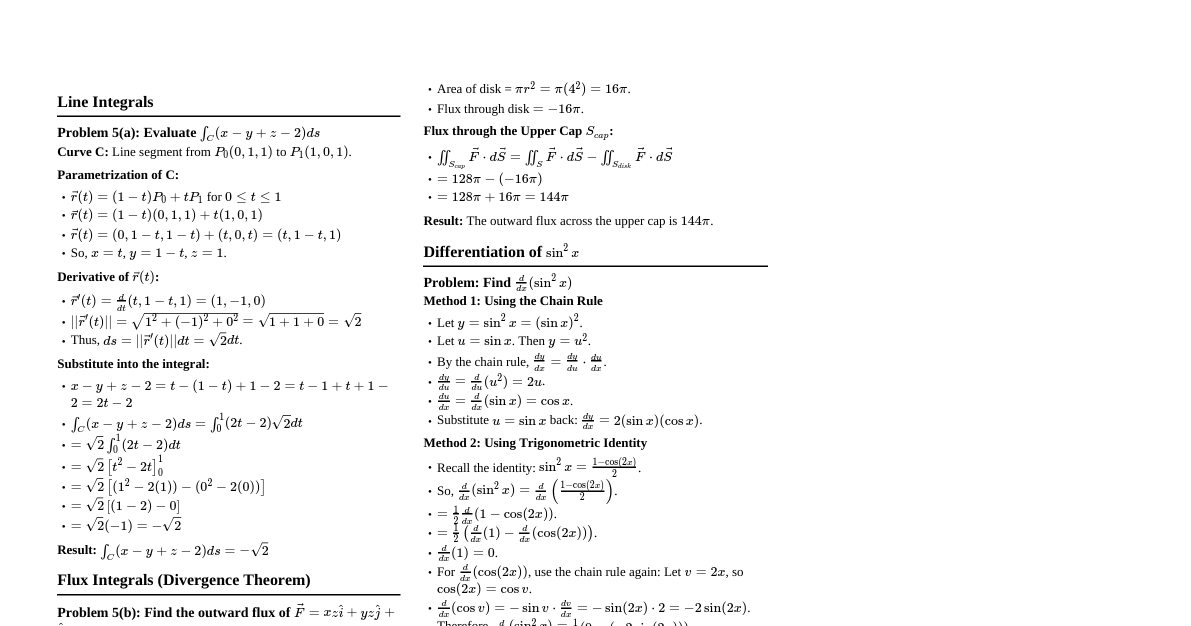
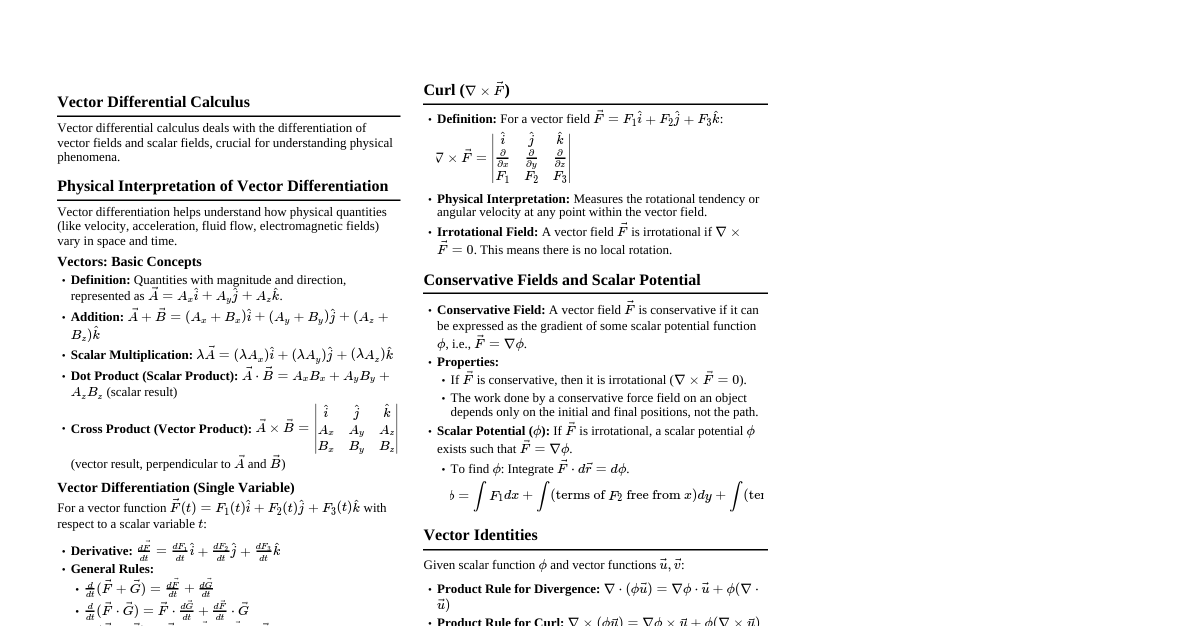
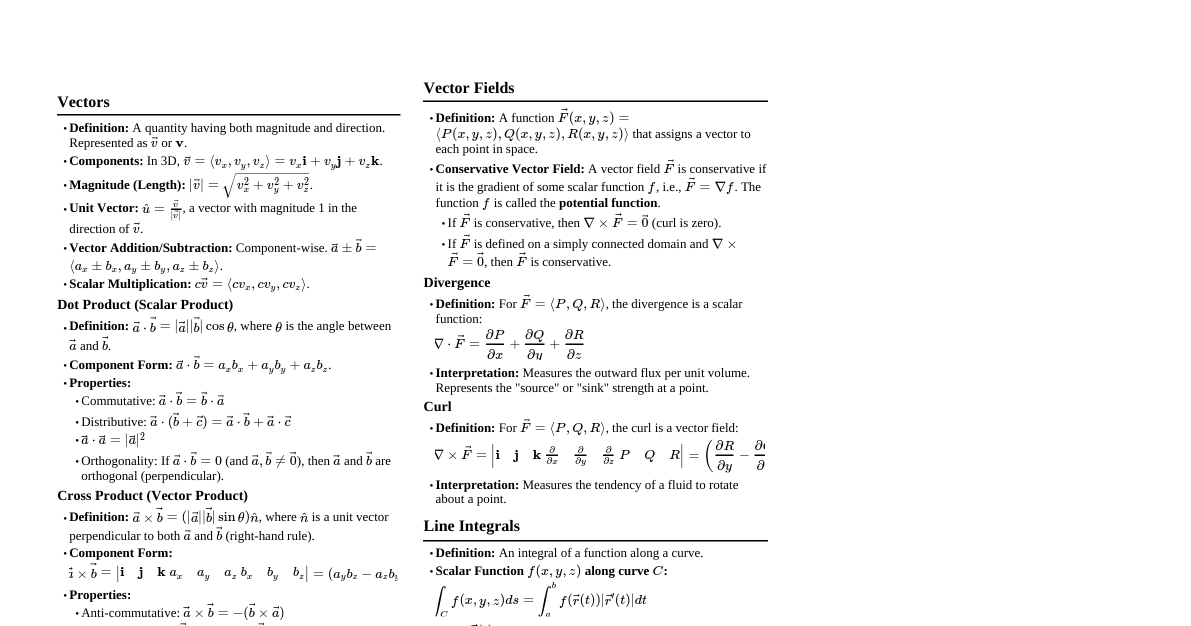
Vector Fields & Operators Scalar Function: $f(x, y, z)$ Vector Field: $\vec{F}(x, y, z) = P(x, y, z)\,\hat{i} + Q(x, y, z)\,\hat{j} + R(x, y, z)\,\hat{k}$ Del Operator: $\nabla = \frac{\partial}{\partial x}\hat{i} + \frac{\partial}{\partial y}\hat{j} + \frac{\partial}{\partial z}\hat{k}$ Gradient of Scalar Field: $\nabla f = \frac{\partial f}{\partial x}\hat{i} + \frac{\partial f}{\partial y}\hat{j} + \frac{\partial f}{\partial z}\hat{k}$ (vector, points in direction of max increase) Divergence of Vector Field: $\nabla \cdot \vec{F} = \frac{\partial P}{\partial x} + \frac{\partial Q}{\partial y} + \frac{\partial R}{\partial z}$ (scalar, measures outward flux per unit volume) Curl of Vector Field: $\nabla \times \vec{F} = \left(\frac{\partial R}{\partial y} - \frac{\partial Q}{\partial z}\right)\hat{i} + \left(\frac{\partial P}{\partial z} - \frac{\partial R}{\partial x}\right)\hat{j} + \left(\frac{\partial Q}{\partial x} - \frac{\partial P}{\partial y}\right)\hat{k}$ (vector, measures rotation) Line Integrals Definition: Integral of a function along a curve $C$. Parametric Curve: $\vec{r}(t) = x(t)\hat{i} + y(t)\hat{j} + z(t)\hat{k}$, for $a \le t \le b$. Arc Length Element: $ds = |\vec{r}'(t)|\,dt = \sqrt{\left(\frac{dx}{dt}\right)^2 + \left(\frac{dy}{dt}\right)^2 + \left(\frac{dz}{dt}\right)^2}\,dt$ Line Integral of Scalar Function: $\int_C f(x,y,z)\,ds = \int_a^b f(\vec{r}(t)) |\vec{r}'(t)|\,dt$ Line Integral of Vector Field (Work): $\int_C \vec{F} \cdot d\vec{r} = \int_C (P\,dx + Q\,dy + R\,dz) = \int_a^b \vec{F}(\vec{r}(t)) \cdot \vec{r}'(t)\,dt$ Fundamental Theorem for Line Integrals: If $\vec{F} = \nabla f$ (i.e., $\vec{F}$ is conservative), then $\int_C \vec{F} \cdot d\vec{r} = f(\vec{r}(b)) - f(\vec{r}(a))$. Condition for Conservative Field: $\nabla \times \vec{F} = \vec{0}$ (in simply connected regions). Surface Integrals Definition: Integral of a function over a surface $S$. Parametric Surface: $\vec{r}(u,v) = x(u,v)\hat{i} + y(u,v)\hat{j} + z(u,v)\hat{k}$ over a region $D$ in the $uv$-plane. Surface Normal Vector: $\vec{N} = \vec{r}_u \times \vec{r}_v = \left|\begin{matrix}\hat{i} & \hat{j} & \hat{k} \\ \frac{\partial x}{\partial u} & \frac{\partial y}{\partial u} & \frac{\partial z}{\partial u} \\ \frac{\partial x}{\partial v} & \frac{\partial y}{\partial v} & \frac{\partial z}{\partial v}\end{matrix}\right|$ Surface Area Element: $dS = |\vec{N}|\,dA = |\vec{r}_u \times \vec{r}_v|\,dA$ Surface Integral of Scalar Function: $\iint_S f(x,y,z)\,dS = \iint_D f(\vec{r}(u,v)) |\vec{r}_u \times \vec{r}_v|\,dA$ Surface Integral of Vector Field (Flux): $\iint_S \vec{F} \cdot d\vec{S} = \iint_S \vec{F} \cdot \vec{n}\,dS = \iint_D \vec{F}(\vec{r}(u,v)) \cdot (\vec{r}_u \times \vec{r}_v)\,dA$ For surface $z=g(x,y)$: $\vec{N} = -\frac{\partial g}{\partial x}\hat{i} - \frac{\partial g}{\partial y}\hat{j} + \hat{k}$, so $dS = \sqrt{1 + \left(\frac{\partial g}{\partial x}\right)^2 + \left(\frac{\partial g}{\partial y}\right)^2}\,dA$. Volume Integrals (Triple Integrals) Definition: Integral of a function over a 3D region $V$. $\iiint_V f(x,y,z)\,dV$ Cartesian Coordinates: $dV = dx\,dy\,dz$ (or any order) Cylindrical Coordinates: $x=r\cos\theta, y=r\sin\theta, z=z$. $dV = r\,dz\,dr\,d\theta$. Spherical Coordinates: $x=\rho\sin\phi\cos\theta, y=\rho\sin\phi\sin\theta, z=\rho\cos\phi$. $dV = \rho^2\sin\phi\,d\rho\,d\phi\,d\theta$. Major Theorems Green's Theorem Relates: Line integral around a plane curve to a double integral over the region it encloses. $\oint_C (P\,dx + Q\,dy) = \iint_D \left(\frac{\partial Q}{\partial x} - \frac{\partial P}{\partial y}\right)\,dA$ Conditions: $C$ is a simple closed, piecewise smooth curve, positively oriented. $D$ is the region bounded by $C$. $P, Q$ have continuous first partial derivatives. Vector Form (Flux): $\oint_C \vec{F} \cdot \vec{n}\,ds = \iint_D (\nabla \cdot \vec{F})\,dA$ (where $\vec{F} = P\hat{i} + Q\hat{j}$) Vector Form (Circulation): $\oint_C \vec{F} \cdot d\vec{r} = \iint_D (\nabla \times \vec{F}) \cdot \hat{k}\,dA$ Stokes' Theorem (Curl Theorem) Relates: Line integral of a vector field around a closed curve to the surface integral of the curl of the field over any surface bounded by the curve. $\oint_C \vec{F} \cdot d\vec{r} = \iint_S (\nabla \times \vec{F}) \cdot d\vec{S}$ $\oint_C \vec{F} \cdot d\vec{r} = \iint_S (\nabla \times \vec{F}) \cdot \vec{n}\,dS$ Conditions: $S$ is an oriented smooth surface with boundary $C$ (simple, closed, piecewise smooth, positively oriented). $\vec{F}$ has continuous partial derivatives. Gauss's Divergence Theorem Relates: Flux of a vector field out of a closed surface to the triple integral of the divergence of the field over the volume enclosed by the surface. $\iint_S \vec{F} \cdot d\vec{S} = \iiint_V (\nabla \cdot \vec{F})\,dV$ $\iint_S \vec{F} \cdot \vec{n}\,dS = \iiint_V \left(\frac{\partial P}{\partial x} + \frac{\partial Q}{\partial y} + \frac{\partial R}{\partial z}\right)\,dV$ Conditions: $V$ is a solid region bounded by a closed, oriented, piecewise smooth surface $S$. $\vec{F}$ has continuous partial derivatives. Identities & Properties $\nabla \times (\nabla f) = \vec{0}$ (Curl of a gradient is zero) $\nabla \cdot (\nabla \times \vec{F}) = 0$ (Divergence of a curl is zero) $\nabla \cdot (f\vec{F}) = (\nabla f) \cdot \vec{F} + f(\nabla \cdot \vec{F})$ $\nabla \times (f\vec{F}) = (\nabla f) \times \vec{F} + f(\nabla \times \vec{F})$