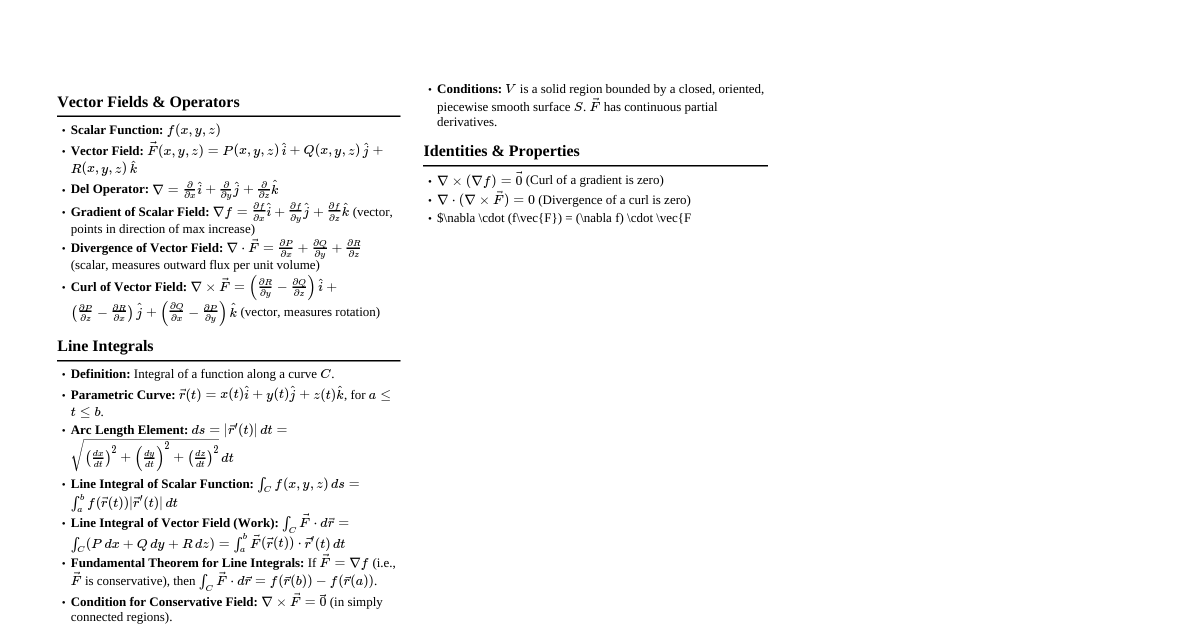
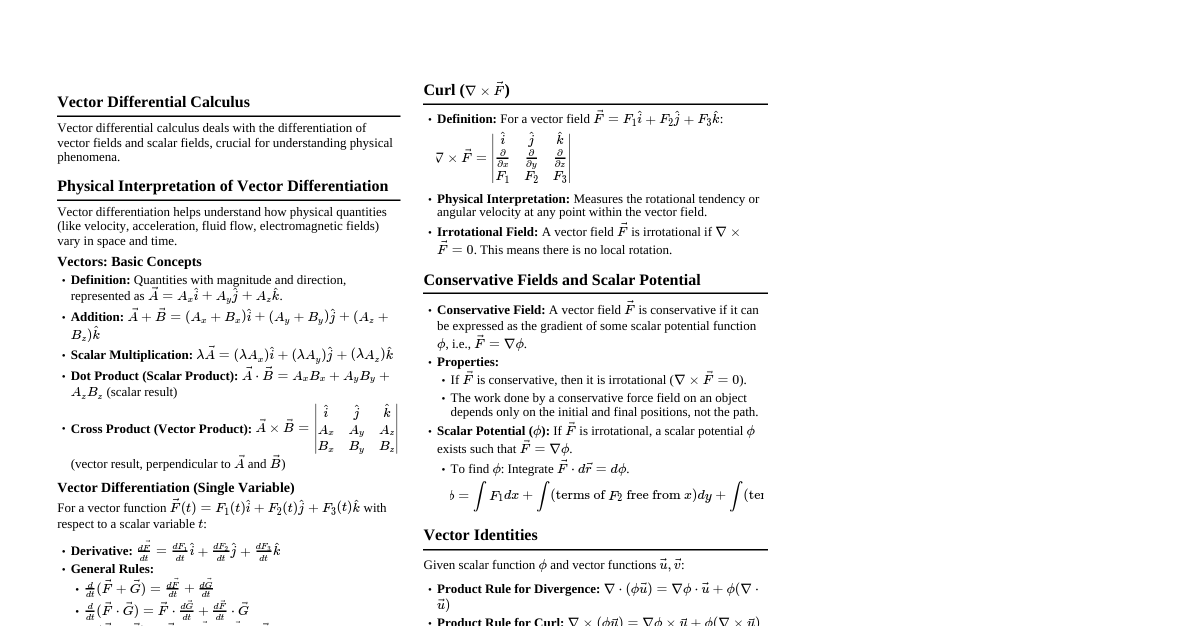
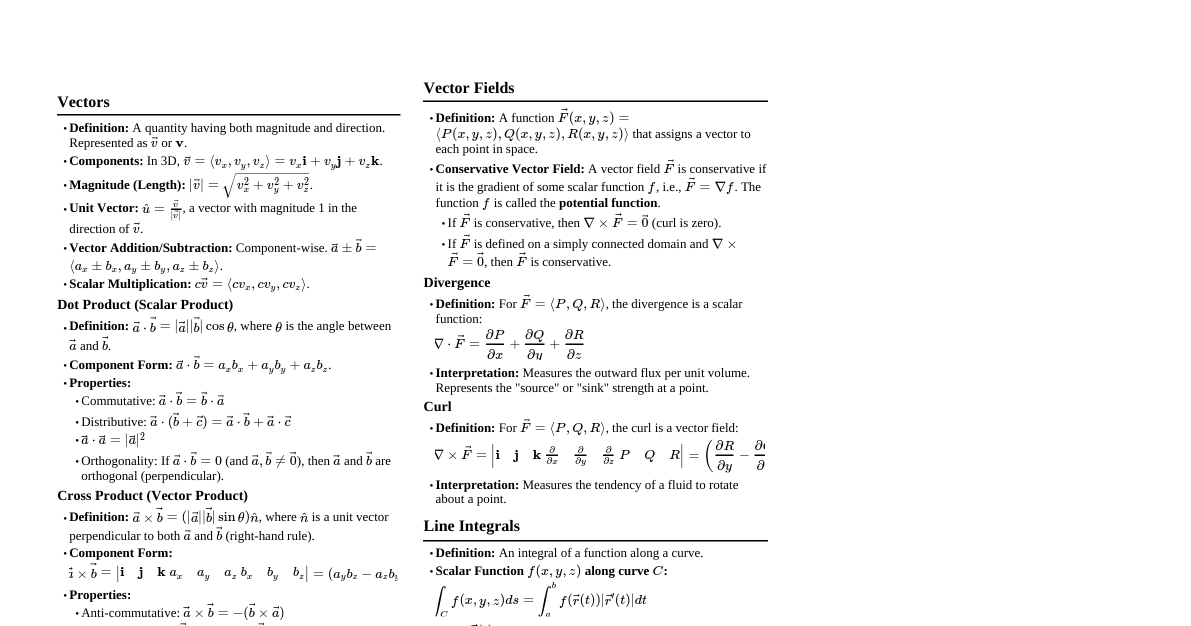
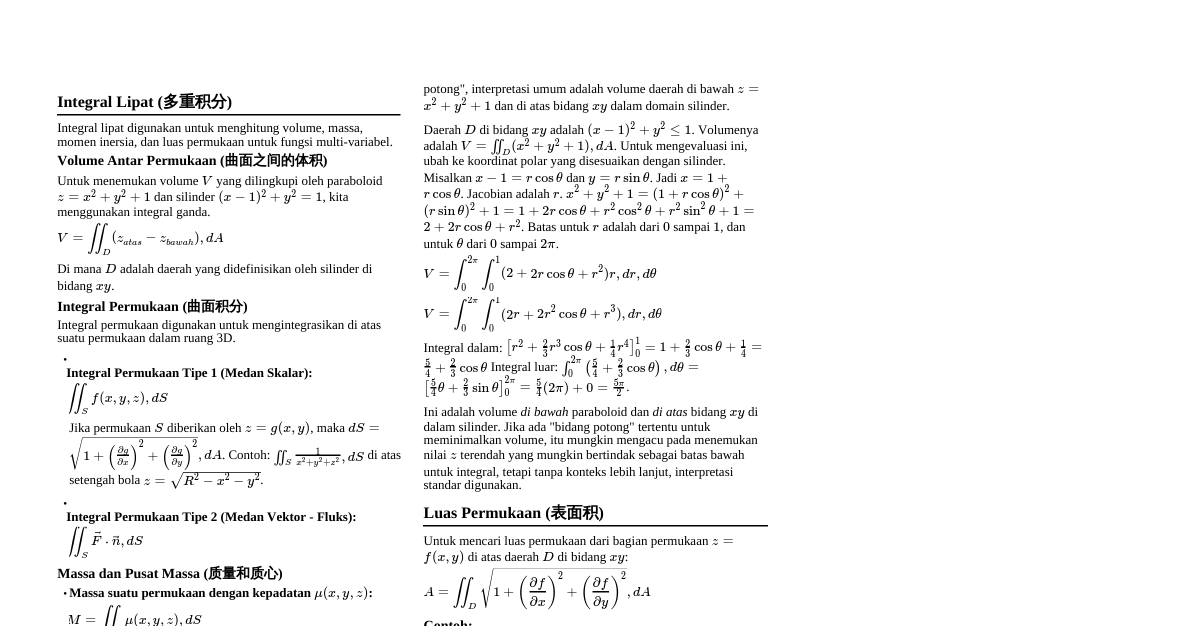
Vector Calculus
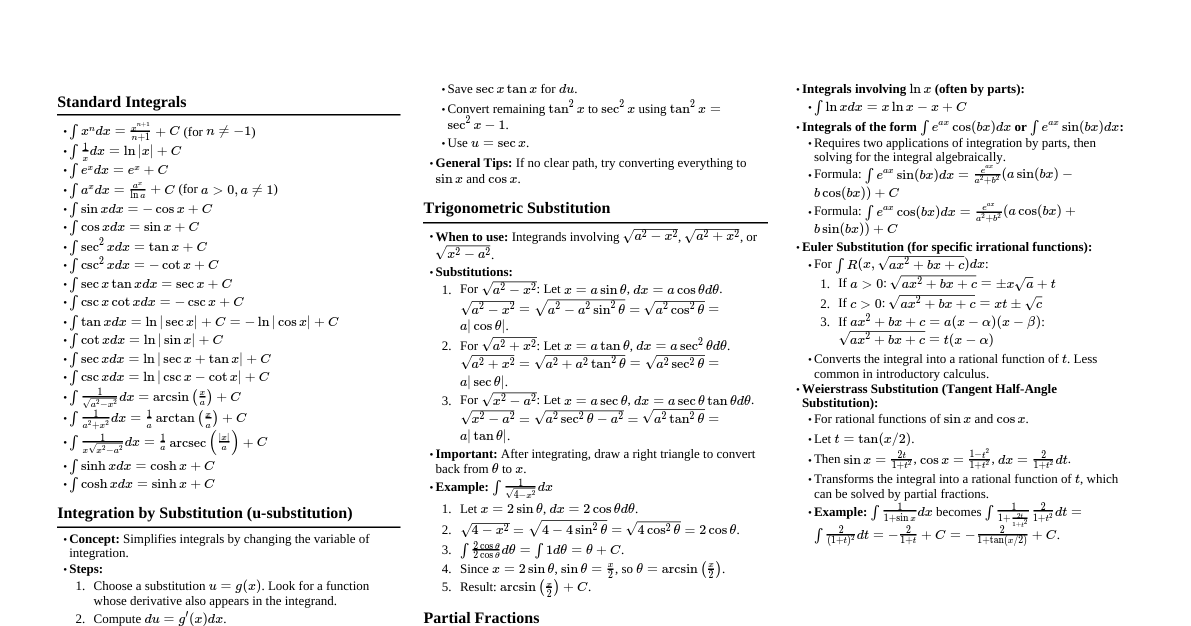
Cheatsheet Content
### UNIT–I: Scalars and Vectors - Overview This unit establishes the fundamental mathematical entities required for vector calculus: scalars and vectors. It begins by defining these quantities, distinguishing them based on their physical properties. Subsequent sections detail the algebraic operations applicable to vectors, such as addition, subtraction, and multiplication (scalar and vector products), which are crucial for manipulating these quantities in higher-dimensional spaces. The unit also introduces the concept of resolving vectors into components and the utility of unit vectors and position vectors as foundational tools for describing location and direction in space. Mastery of these concepts is prerequisite for understanding fields and differentiation in subsequent units. #### Logical Flow within Unit–I The unit progresses from defining basic quantities to their algebraic manipulation and representation. It starts with the fundamental distinction between scalars and vectors, then builds upon this by introducing vector addition and subtraction. This naturally leads to defining scalar and vector products, which are two distinct forms of vector multiplication. The practical representation of vectors is then covered through components and unit vectors, culminating in the concept of a position vector, which provides a coordinate-system-dependent description of a point in space. ### Scalar Quantities #### Definition A scalar quantity is a physical quantity that is completely described by its magnitude alone. It has no associated direction. #### Intuition Consider measurements such as temperature or mass. Knowing that a substance has a mass of 5 kilograms is a complete description; specifying a direction for this mass is nonsensical. Similarly, a temperature of 25 degrees Celsius requires no directional information. #### Examples Mass, length, time, temperature, density, volume, speed, energy, work. #### Properties - Scalars obey the rules of ordinary algebra. - They can be added, subtracted, multiplied, and divided like real numbers. - Their values are independent of the coordinate system chosen. ### Vector Quantities #### Definition A vector quantity is a physical quantity that is completely described by both its magnitude and its direction. #### Intuition Consider the motion of an object. To fully describe its movement, one must specify not only how fast it is moving (speed, which is a scalar) but also in which direction it is moving. This combined information constitutes velocity, a vector. #### Representation Graphically, a vector is represented by a directed line segment (an arrow) where the length of the arrow indicates the magnitude and the arrowhead indicates the direction. Analytically, a vector $\vec{A}$ in three-dimensional Cartesian coordinates can be written as $\vec{A} = A_x \hat{i} + A_y \hat{j} + A_z \hat{k}$ or as an ordered triplet $(A_x, A_y, A_z)$. #### Examples Displacement, velocity, acceleration, force, momentum, electric field, magnetic field. #### Properties - Vectors do not obey ordinary algebra; they have their own set of algebraic rules. - Their magnitude is independent of the coordinate system, but their components are dependent. ### Addition and Subtraction of Vectors #### Definition Vector addition is the process of combining two or more vectors to produce a single resultant vector. Vector subtraction is a special case of addition, where a vector is added to the negative of another vector. #### Intuition If an object undergoes two successive displacements, the net displacement is the vector sum of the individual displacements. If a force acts on an object, and then another force acts, the net effect is the sum of the forces. #### Formula (Graphical Method: Triangle Law) If two vectors $\vec{A}$ and $\vec{B}$ are represented by two sides of a triangle taken in order, their sum $\vec{R} = \vec{A} + \vec{B}$ is represented by the third side of the triangle taken in the opposite order. If $\vec{A}$ is from point P to Q, and $\vec{B}$ is from Q to R, then $\vec{A} + \vec{B}$ is from P to R. #### Formula (Graphical Method: Parallelogram Law) If two vectors $\vec{A}$ and $\vec{B}$ are represented by the two adjacent sides of a parallelogram originating from a common point, their sum $\vec{R} = \vec{A} + \vec{B}$ is represented by the diagonal of the parallelogram originating from the same common point. #### Formula (Component Method) Given $\vec{A} = A_x \hat{i} + A_y \hat{j} + A_z \hat{k}$ and $\vec{B} = B_x \hat{i} + B_y \hat{j} + B_z \hat{k}$: $\vec{A} + \vec{B} = (A_x + B_x) \hat{i} + (A_y + B_y) \hat{j} + (A_z + B_z) \hat{k}$ $\vec{A} - \vec{B} = (A_x - B_x) \hat{i} + (A_y - B_y) \hat{j} + (A_z - B_z) \hat{k}$ #### Properties - **Commutative Law:** $\vec{A} + \vec{B} = \vec{B} + \vec{A}$ - **Associative Law:** $(\vec{A} + \vec{B}) + \vec{C} = \vec{A} + (\vec{B} + \vec{C})$ - **Zero Vector:** $\vec{A} + \vec{0} = \vec{A}$ - **Negative Vector:** $\vec{A} + (-\vec{A}) = \vec{0}$ #### Derivation (Component Method) The component method for addition arises from considering the geometric interpretation of vectors in a coordinate system. Each component acts independently along its respective axis. For instance, adding the x-components of two vectors yields the x-component of the resultant vector. This applies similarly to y and z components. #### Physical Meaning Vector addition represents the superposition of physical effects. For example, if multiple forces act on an object, the resultant force is the vector sum of all individual forces. Vector subtraction can represent the difference between two states, such as a change in position (displacement). #### Example Let $\vec{A} = 2\hat{i} + 3\hat{j} - \hat{k}$ and $\vec{B} = \hat{i} - 2\hat{j} + 4\hat{k}$. $\vec{A} + \vec{B} = (2+1)\hat{i} + (3-2)\hat{j} + (-1+4)\hat{k} = 3\hat{i} + \hat{j} + 3\hat{k}$ $\vec{A} - \vec{B} = (2-1)\hat{i} + (3-(-2))\hat{j} + (-1-4)\hat{k} = \hat{i} + 5\hat{j} - 5\hat{k}$ ### Scalar and Vector Products #### Definition There are two primary ways to multiply two vectors: the scalar product (or dot product), which yields a scalar, and the vector product (or cross product), which yields a vector. #### Intuition (Scalar Product) The scalar product quantifies the extent to which two vectors point in the same direction. If they are parallel, the product is maximal. If they are perpendicular, the product is zero. It is related to concepts like work done by a force. #### Formula (Scalar Product / Dot Product) Given two vectors $\vec{A}$ and $\vec{B}$ with angle $\theta$ between them: $\vec{A} \cdot \vec{B} = |\vec{A}| |\vec{B}| \cos\theta$ In component form: $\vec{A} \cdot \vec{B} = A_x B_x + A_y B_y + A_z B_z$ #### Derivation (Scalar Product in Component Form) Using orthonormal unit vectors $\hat{i}, \hat{j}, \hat{k}$: $\hat{i} \cdot \hat{i} = \hat{j} \cdot \hat{j} = \hat{k} \cdot \hat{k} = 1$ (angle is 0, $\cos 0 = 1$) $\hat{i} \cdot \hat{j} = \hat{j} \cdot \hat{k} = \hat{k} \cdot \hat{i} = 0$ (angle is 90, $\cos 90 = 0$) $\vec{A} \cdot \vec{B} = (A_x \hat{i} + A_y \hat{j} + A_z \hat{k}) \cdot (B_x \hat{i} + B_y \hat{j} + B_z \hat{k})$ Expanding this product and using the properties of unit vector dot products yields the component form. #### Physical Meaning (Scalar Product) - **Work:** Work $W$ done by a constant force $\vec{F}$ causing a displacement $\vec{d}$ is $W = \vec{F} \cdot \vec{d}$. - **Power:** Power $P$ is the scalar product of force $\vec{F}$ and velocity $\vec{v}$: $P = \vec{F} \cdot \vec{v}$. - **Angle between vectors:** $\cos\theta = \frac{\vec{A} \cdot \vec{B}}{|\vec{A}| |\vec{B}|}$. #### Properties (Scalar Product) - **Commutative:** $\vec{A} \cdot \vec{B} = \vec{B} \cdot \vec{A}$ - **Distributive:** $\vec{A} \cdot (\vec{B} + \vec{C}) = \vec{A} \cdot \vec{B} + \vec{A} \cdot \vec{C}$ - $\vec{A} \cdot \vec{A} = |\vec{A}|^2$ - If $\vec{A} \cdot \vec{B} = 0$ and $\vec{A}, \vec{B}$ are non-zero, then $\vec{A}$ is perpendicular to $\vec{B}$. #### Intuition (Vector Product) The vector product quantifies the "perpendicularity" or "turning effect" of two vectors. The resulting vector is perpendicular to the plane containing the two original vectors. It is related to concepts like torque. #### Formula (Vector Product / Cross Product) Given two vectors $\vec{A}$ and $\vec{B}$ with angle $\theta$ between them: $\vec{A} \times \vec{B} = (|\vec{A}| |\vec{B}| \sin\theta) \hat{n}$ where $\hat{n}$ is a unit vector perpendicular to the plane containing $\vec{A}$ and $\vec{B}$, defined by the right-hand rule. In component form: $\vec{A} \times \vec{B} = \begin{vmatrix} \hat{i} & \hat{j} & \hat{k} \\ A_x & A_y & A_z \\ B_x & B_y & B_z \end{vmatrix} = (A_y B_z - A_z B_y)\hat{i} - (A_x B_z - A_z B_x)\hat{j} + (A_x B_y - A_y B_x)\hat{k}$ #### Derivation (Vector Product in Component Form) Using orthonormal unit vectors $\hat{i}, \hat{j}, \hat{k}$ and the right-hand rule: $\hat{i} \times \hat{j} = \hat{k}$, $\hat{j} \times \hat{k} = \hat{i}$, $\hat{k} \times \hat{i} = \hat{j}$ $\hat{j} \times \hat{i} = -\hat{k}$, $\hat{k} \times \hat{j} = -\hat{i}$, $\hat{i} \times \hat{k} = -\hat{j}$ $\hat{i} \times \hat{i} = \hat{j} \times \hat{j} = \hat{k} \times \hat{k} = \vec{0}$ $\vec{A} \times \vec{B} = (A_x \hat{i} + A_y \hat{j} + A_z \hat{k}) \times (B_x \hat{i} + B_y \hat{j} + B_z \hat{k})$ Expanding this product and using the properties of unit vector cross products yields the component form (determinant expansion is a convenient mnemonic). #### Physical Meaning (Vector Product) - **Torque:** Torque $\vec{\tau}$ produced by a force $\vec{F}$ acting at a position $\vec{r}$ from the pivot point is $\vec{\tau} = \vec{r} \times \vec{F}$. - **Angular Momentum:** Angular momentum $\vec{L}$ of a particle with position $\vec{r}$ and linear momentum $\vec{p}$ is $\vec{L} = \vec{r} \times \vec{p}$. - **Area of Parallelogram:** The magnitude $|\vec{A} \times \vec{B}|$ represents the area of the parallelogram formed by vectors $\vec{A}$ and $\vec{B}$. #### Properties (Vector Product) - **Anti-commutative:** $\vec{A} \times \vec{B} = -(\vec{B} \times \vec{A})$ - **Distributive:** $\vec{A} \times (\vec{B} + \vec{C}) = \vec{A} \times \vec{B} + \vec{A} \times \vec{C}$ - If $\vec{A} \times \vec{B} = \vec{0}$ and $\vec{A}, \vec{B}$ are non-zero, then $\vec{A}$ is parallel to $\vec{B}$. - **Lagrange's Identity:** $|\vec{A} \times \vec{B}|^2 = |\vec{A}|^2 |\vec{B}|^2 - (\vec{A} \cdot \vec{B})^2$ #### Examples Let $\vec{A} = 2\hat{i} + \hat{j}$ and $\vec{B} = 3\hat{i} - 2\hat{j}$. $\vec{A} \cdot \vec{B} = (2)(3) + (1)(-2) = 6 - 2 = 4$. $\vec{A} \times \vec{B} = \begin{vmatrix} \hat{i} & \hat{j} & \hat{k} \\ 2 & 1 & 0 \\ 3 & -2 & 0 \end{vmatrix} = (1 \cdot 0 - 0 \cdot (-2))\hat{i} - (2 \cdot 0 - 0 \cdot 3)\hat{j} + (2 \cdot (-2) - 1 \cdot 3)\hat{k} = 0\hat{i} - 0\hat{j} - 7\hat{k} = -7\hat{k}$. ### Components of a Vector #### Definition The components of a vector are its projections along the axes of a chosen coordinate system. #### Intuition Any vector in 2D space can be thought of as the sum of a vector along the x-axis and a vector along the y-axis. In 3D, it's the sum of three vectors along the x, y, and z axes. These individual directed segments are the components. #### Formula For a vector $\vec{A}$ in 3D Cartesian coordinates: $\vec{A} = A_x \hat{i} + A_y \hat{j} + A_z \hat{k}$. Here, $A_x, A_y, A_z$ are the scalar components of $\vec{A}$ along the x, y, and z axes, respectively. The vector components are $A_x \hat{i}$, $A_y \hat{j}$, $A_z \hat{k}$. If a vector $\vec{A}$ makes angles $\alpha, \beta, \gamma$ with the positive x, y, z axes respectively: $A_x = |\vec{A}| \cos\alpha$ $A_y = |\vec{A}| \cos\beta$ $A_z = |\vec{A}| \cos\gamma$ where $\cos\alpha, \cos\beta, \cos\gamma$ are the direction cosines. #### Magnitude of a vector from its components $|\vec{A}| = \sqrt{A_x^2 + A_y^2 + A_z^2}$ #### Physical Meaning Components allow for the analytical treatment of vectors, simplifying vector operations into scalar operations along orthogonal axes. This is particularly useful for solving physics problems where forces or velocities are resolved into their effects along specific directions. #### Example A force $\vec{F}$ has a magnitude of 10 N and acts at an angle of 30 degrees above the positive x-axis in the xy-plane. $F_x = 10 \cos(30^\circ) = 10 \frac{\sqrt{3}}{2} = 5\sqrt{3}$ N $F_y = 10 \sin(30^\circ) = 10 \frac{1}{2} = 5$ N So, $\vec{F} = 5\sqrt{3}\hat{i} + 5\hat{j}$ N. ### Unit Vectors #### Definition A unit vector is a vector with a magnitude of one. It is used solely to indicate direction. #### Intuition A unit vector is like a pure direction pointer. It tells you "which way" without specifying "how much." #### Formula For any non-zero vector $\vec{A}$, the unit vector in the direction of $\vec{A}$, denoted $\hat{A}$, is given by: $\hat{A} = \frac{\vec{A}}{|\vec{A}|}$ #### Orthonormal Unit Vectors In Cartesian coordinate systems, the unit vectors along the positive x, y, and z axes are denoted by $\hat{i}, \hat{j}, \hat{k}$ respectively. They are mutually orthogonal and have unit magnitude. $|\hat{i}| = |\hat{j}| = |\hat{k}| = 1$ $\hat{i} \cdot \hat{j} = \hat{j} \cdot \hat{k} = \hat{k} \cdot \hat{i} = 0$ $\hat{i} \times \hat{j} = \hat{k}$, etc. #### Physical Meaning Unit vectors are fundamental for expressing any vector in terms of its components. For example, $\vec{A} = A_x \hat{i} + A_y \hat{j} + A_z \hat{k}$ explicitly uses unit vectors to define the direction of each component. They provide a standardized way to describe direction, independent of the magnitude of the vector itself. #### Example Find the unit vector in the direction of $\vec{V} = 3\hat{i} - 4\hat{j} + 12\hat{k}$. $|\vec{V}| = \sqrt{3^2 + (-4)^2 + 12^2} = \sqrt{9 + 16 + 144} = \sqrt{169} = 13$. $\hat{V} = \frac{3\hat{i} - 4\hat{j} + 12\hat{k}}{13} = \frac{3}{13}\hat{i} - \frac{4}{13}\hat{j} + \frac{12}{13}\hat{k}$. ### Position Vector #### Definition A position vector (or radius vector) is a vector that describes the position of a point in space relative to a specified origin. #### Intuition Think of it as an arrow starting from the origin of a coordinate system and pointing directly to the location of an object. It gives the "address" of the point in vector form. #### Formula For a point P with coordinates $(x, y, z)$ in a Cartesian system with origin O $(0, 0, 0)$, the position vector $\vec{r}$ of P is: $\vec{r} = x\hat{i} + y\hat{j} + z\hat{k}$ #### Displacement Vector The displacement vector between two points $P_1(x_1, y_1, z_1)$ and $P_2(x_2, y_2, z_2)$ is given by the difference of their position vectors: $\vec{r}_{12} = \vec{r}_2 - \vec{r}_1 = (x_2 - x_1)\hat{i} + (y_2 - y_1)\hat{j} + (z_2 - z_1)\hat{k}$ #### Physical Meaning The position vector is fundamental in kinematics and dynamics for describing the location of particles and the paths they trace. It serves as the basis for defining displacement, velocity, and acceleration. #### Example A point P is located at $(3, -2, 5)$. Its position vector is $\vec{r} = 3\hat{i} - 2\hat{j} + 5\hat{k}$. #### Common Mistakes (Unit–I) - **Confusing scalar and vector products:** Using dot product when cross product is required, or vice versa. - **Incorrect direction for cross product:** Not applying the right-hand rule correctly. - **Treating vectors as scalars:** Assuming commutative property for cross product ($\vec{A} \times \vec{B} \neq \vec{B} \times \vec{A}$). - **Forgetting vector nature of cross product:** The result of a cross product is a vector, not a scalar. - **Incorrectly calculating magnitude from components:** Omitting the square root, or forgetting to square components. - **Misinterpreting unit vectors:** Using them for magnitude or adding/subtracting them without considering their directionality. #### Concept Connections (Unit–I) This unit lays the groundwork for all subsequent vector calculus. Vectors provide the language to describe physical quantities in space. The operations (addition, subtraction, products) are directly applied when defining vector fields (Unit II), and differentiation of these vectors (Unit III) will build upon the component representation and position vector framework. The scalar product is crucial for understanding concepts like work and flux, while the vector product is essential for torque and circulation. #### Structured Formula Summary (Unit–I) - **Vector Addition (Component Form):** $\vec{A} + \vec{B} = (A_x + B_x) \hat{i} + (A_y + B_y) \hat{j} + (A_z + B_z) \hat{k}$ - **Vector Subtraction (Component Form):** $\vec{A} - \vec{B} = (A_x - B_x) \hat{i} + (A_y - B_y) \hat{j} + (A_z - B_z) \hat{k}$ - **Magnitude of a Vector:** $|\vec{A}| = \sqrt{A_x^2 + A_y^2 + A_z^2}$ - **Unit Vector:** $\hat{A} = \frac{\vec{A}}{|\vec{A}|}$ - **Position Vector:** $\vec{r} = x\hat{i} + y\hat{j} + z\hat{k}$ - **Scalar Product (Dot Product):** $\vec{A} \cdot \vec{B} = |\vec{A}| |\vec{B}| \cos\theta$ $\vec{A} \cdot \vec{B} = A_x B_x + A_y B_y + A_z B_z$ - **Vector Product (Cross Product):** $\vec{A} \times \vec{B} = (|\vec{A}| |\vec{B}| \sin\theta) \hat{n}$ $\vec{A} \times \vec{B} = \begin{vmatrix} \hat{i} & \hat{j} & \hat{k} \\ A_x & A_y & A_z \\ B_x & B_y & B_z \end{vmatrix}$ ### UNIT–II: Scalar and Vector Fields - Overview This unit introduces the concept of fields, which are functions that assign a scalar or vector quantity to every point in space. Understanding fields is crucial because many physical phenomena (e.g., temperature distribution, fluid flow, gravitational forces) are best described in this manner. The unit differentiates between scalar and vector fields, provides illustrative examples, and discusses the properties of continuous fields. It also introduces level surfaces and equipotential surfaces, which are geometric representations of scalar fields, offering a visual and conceptual tool for analyzing field behavior. #### Logical Flow within Unit–II The unit begins with the general concept of a field, then systematically defines and exemplifies scalar and vector fields. It then moves to the properties of functions that define these fields, specifically continuity. The final part of the unit focuses on the geometric interpretation of scalar fields through level surfaces, with equipotential surfaces as a specific and important application. ### Concept of Field #### Definition A field is a region in space where every point is associated with a physical quantity (either scalar or vector). This quantity can vary from point to point. #### Intuition Imagine a map. At every point on the map, you can associate a temperature reading (scalar field) or a wind velocity (vector field). The "field" is the entire collection of these values over the region. It describes how a physical quantity is distributed in space. #### Physical Meaning Fields are fundamental to physics for describing quantities that have a value at every point in a region, rather than just at discrete locations. Examples include gravitational fields, electric fields, temperature distributions, and fluid velocity. ### Scalar Field #### Definition A scalar field is a function that assigns a scalar value to every point in a region of space. Mathematically, a scalar field $\phi(\vec{r})$ or $\phi(x, y, z)$ is a scalar function of position. #### Intuition If you walk across a room, the temperature at each point is a scalar value. Mapping these temperatures across the entire room creates a scalar temperature field. Similarly, the atmospheric pressure at different altitudes forms a scalar pressure field. #### Examples of Scalar Fields - **Temperature Distribution:** $T(x, y, z)$ - **Atmospheric Pressure:** $P(x, y, z)$ - **Density of a fluid:** $\rho(x, y, z)$ - **Gravitational Potential:** $\Phi(x, y, z)$ - **Electric Potential:** $V(x, y, z)$ #### Important Properties - The value of a scalar field at a point is independent of the coordinate system chosen. - Scalar fields can be added, subtracted, and multiplied by scalars. ### Vector Field #### Definition A vector field is a function that assigns a vector quantity to every point in a region of space. Mathematically, a vector field $\vec{F}(\vec{r})$ or $\vec{F}(x, y, z)$ is a vector function of position, typically expressed as $\vec{F}(x, y, z) = P(x, y, z)\hat{i} + Q(x, y, z)\hat{j} + R(x, y, z)\hat{k}$, where $P, Q, R$ are scalar functions. #### Intuition Imagine a river. At every point in the river, the water has a certain velocity and direction. If you draw an arrow at each point representing the water's velocity, you are visualizing a vector velocity field. Similarly, a magnetic field shows the direction and strength of the magnetic force at every point. #### Examples of Vector Fields - **Gravitational Field:** $\vec{g}(x, y, z)$ (force per unit mass) - **Electric Field:** $\vec{E}(x, y, z)$ (force per unit charge) - **Fluid Velocity Field:** $\vec{v}(x, y, z)$ - **Magnetic Field:** $\vec{B}(x, y, z)$ - **Wind Velocity:** (magnitude and direction of wind at each point) #### Important Properties - The components of a vector field change with the coordinate system, but the vector itself remains invariant. - Vector fields can be added and subtracted (component-wise). ### Continuous Scalar and Vector Functions #### Definition A scalar function $\phi(x, y, z)$ is continuous at a point $(x_0, y_0, z_0)$ if $\lim_{(x,y,z) \to (x_0,y_0,z_0)} \phi(x, y, z) = \phi(x_0, y_0, z_0)$. A vector function $\vec{F}(x, y, z) = P(x, y, z)\hat{i} + Q(x, y, z)\hat{j} + R(x, y, z)\hat{k}$ is continuous at a point if and only if each of its component functions $P, Q, R$ are continuous at that point. #### Intuition Continuity implies that there are no abrupt jumps or breaks in the field's values as you move from one point to an infinitesimally close point. For example, a continuous temperature field means the temperature doesn't suddenly change from 20°C to 100°C without passing through intermediate values. #### Physical Meaning In physics, most realistic fields (e.g., temperature, pressure, fluid velocity, electromagnetic fields) are considered continuous, as abrupt discontinuities are often unphysical or require special mathematical treatment (e.g., shock waves). Continuity is a prerequisite for differentiation and integration of fields, which are central to vector calculus. ### Level Surfaces #### Definition For a scalar field $\phi(x, y, z)$, a level surface is a surface on which the scalar field has a constant value. Mathematically, a level surface is defined by the equation $\phi(x, y, z) = c$, where $c$ is a constant. #### Intuition Imagine a topographical map. The contour lines on the map connect points of equal altitude. If you extend this to three dimensions, these contour lines become level surfaces (e.g., surfaces of constant altitude in a mountain range). #### Examples - **Isothermal surfaces:** Surfaces of constant temperature $T(x, y, z) = c$. - **Isobaric surfaces:** Surfaces of constant pressure $P(x, y, z) = c$. - **Surfaces of constant density:** $\rho(x, y, z) = c$. - For the scalar field $\phi(x, y, z) = x^2 + y^2 + z^2$, the level surfaces are spheres centered at the origin ($x^2 + y^2 + z^2 = c^2$). #### Important Properties - Level surfaces for different constant values $c$ generally do not intersect. If they did, it would imply the scalar field has two different values at the same point, which contradicts the definition of a function. - The gradient of a scalar field (introduced in Unit IV) is always normal to its level surfaces. This is a crucial connection. #### Physical Meaning Level surfaces provide a powerful visualization tool for scalar fields. For example, in meteorology, isotherms help visualize temperature patterns, and isobars show pressure distributions. In fluid dynamics, isosurfaces of density or pressure are used. ### Equipotential Surfaces #### Definition An equipotential surface is a specific type of level surface for a scalar potential field (e.g., gravitational potential, electric potential). It is a surface on which the potential has a constant value. #### Intuition In an electric field, if you move a charge along an equipotential surface, no work is done because the potential energy of the charge remains constant. It's like moving an object horizontally on a flat plane under gravity – no work is done against gravity. #### Formula For an electric potential field $V(x, y, z)$, an equipotential surface is given by $V(x, y, z) = c$. For a gravitational potential field $\Phi(x, y, z)$, an equipotential surface is given by $\Phi(x, y, z) = c$. #### Important Properties - The electric field lines (or gravitational field lines) are always perpendicular to the equipotential surfaces. - No work is done in moving a test charge (or mass) along an equipotential surface. - Equipotential surfaces never intersect. #### Physical Meaning Equipotential surfaces are vital in electromagnetism and gravity. They help visualize the distribution of potential and understand the behavior of forces. For example, in electrostatics, conductors are always equipotential surfaces. #### Common Mistakes (Unit–II) - **Confusing scalar and vector fields:** Incorrectly associating direction with a scalar field or magnitude only with a vector field. - **Misinterpreting continuity:** Assuming a field is continuous without explicit conditions or checking its component functions. - **Drawing intersecting level surfaces:** This is physically impossible for a single-valued field. - **Not recognizing equipotential surfaces as a subset of level surfaces:** All equipotential surfaces are level surfaces, but not all level surfaces are equipotential (only those of potential functions). #### Concept Connections (Unit–II) Unit I provided the fundamental building blocks (scalars and vectors). Unit II uses these to construct the concept of fields, which are functions that map points in space to scalar or vector values. This sets the stage for Unit III, where the differentiation of these vector functions (fields) is introduced. The geometric concepts of level and equipotential surfaces will be directly linked to the gradient (Unit IV), which provides a vector normal to these surfaces. The concept of continuous functions is essential for the differentiability of fields. #### Structured Formula Summary (Unit–II) - **Scalar Field:** $\phi(\vec{r}) = \phi(x, y, z)$ - **Vector Field:** $\vec{F}(\vec{r}) = P(x, y, z)\hat{i} + Q(x, y, z)\hat{j} + R(x, y, z)\hat{k}$ - **Level Surface:** $\phi(x, y, z) = c$ (where $c$ is a constant) - **Equipotential Surface:** $V(x, y, z) = c$ (for a potential field $V$) ### UNIT–III: Vector Differentiation - Overview This unit extends the familiar concept of differentiation from scalar functions to vector functions. It focuses on how vector quantities change with respect to a scalar variable, typically time or position along a curve. This is crucial for describing motion and dynamic systems. The unit covers the differentiation of sums and products of vectors, the specific case of differentiating a position vector to obtain velocity and acceleration, and provides a physical interpretation for these differential operations, connecting mathematical concepts to observable physical phenomena. #### Logical Flow within Unit–III The unit begins by defining the derivative of a vector function with respect to a scalar variable, building directly on the concept of limits. It then establishes the rules for differentiating sums and products of vectors, mirroring scalar calculus rules. The concept of a position vector from Unit I is then differentiated to derive velocity and acceleration, which are key kinematic quantities. Finally, the unit provides a physical context for these mathematical operations. ### Differentiation of a Vector with Respect to a Scalar Variable #### Definition If $\vec{A}(t)$ is a vector function of a scalar variable $t$, its derivative with respect to $t$ is defined as: $$\frac{d\vec{A}}{dt} = \lim_{\Delta t \to 0} \frac{\vec{A}(t + \Delta t) - \vec{A}(t)}{\Delta t}$$ Provided the limit exists. If $\vec{A}(t) = A_x(t)\hat{i} + A_y(t)\hat{j} + A_z(t)\hat{k}$ and $\hat{i}, \hat{j}, \hat{k}$ are constant unit vectors: $$\frac{d\vec{A}}{dt} = \frac{dA_x}{dt}\hat{i} + \frac{dA_y}{dt}\hat{j} + \frac{dA_z}{dt}\hat{k}$$ #### Intuition Just as the derivative of a scalar function gives the instantaneous rate of change of that scalar, the derivative of a vector function gives the instantaneous rate of change of the vector. This change can be in magnitude, direction, or both. For a position vector, it represents the instantaneous velocity. #### Derivation (Component Form) $$\frac{\vec{A}(t + \Delta t) - \vec{A}(t)}{\Delta t} = \frac{(A_x(t+\Delta t)\hat{i} + A_y(t+\Delta t)\hat{j} + A_z(t+\Delta t)\hat{k}) - (A_x(t)\hat{i} + A_y(t)\hat{j} + A_z(t)\hat{k})}{\Delta t}$$ $$= \frac{A_x(t+\Delta t) - A_x(t)}{\Delta t}\hat{i} + \frac{A_y(t+\Delta t) - A_y(t)}{\Delta t}\hat{j} + \frac{A_z(t+\Delta t) - A_z(t)}{\Delta t}\hat{k}$$ Taking the limit as $\Delta t \to 0$ for each component yields the component form of the derivative, assuming $\hat{i}, \hat{j}, \hat{k}$ are constant vectors (as in Cartesian coordinates). #### Physical Meaning This derivative describes how a vector quantity evolves over time or space. For example, if $\vec{A}$ is a position vector, its derivative is velocity. If $\vec{A}$ is velocity, its derivative is acceleration. It is a tangent vector to the curve traced by the vector function. #### Example Let $\vec{A}(t) = (t^2)\hat{i} + (3t)\hat{j} - (\cos t)\hat{k}$. $$\frac{d\vec{A}}{dt} = \frac{d}{dt}(t^2)\hat{i} + \frac{d}{dt}(3t)\hat{j} - \frac{d}{dt}(\cos t)\hat{k} = 2t\hat{i} + 3\hat{j} + (\sin t)\hat{k}$$ ### Derivative of Sum and Product of Vectors #### Definition The rules for differentiating sums and products of vector functions largely parallel those for scalar functions. #### Formulas Let $\vec{A}(t)$ and $\vec{B}(t)$ be differentiable vector functions, and $\phi(t)$ be a differentiable scalar function. 1. **Sum Rule:** $$\frac{d}{dt}(\vec{A} + \vec{B}) = \frac{d\vec{A}}{dt} + \frac{d\vec{B}}{dt}$$ 2. **Scalar Multiplication Rule:** $$\frac{d}{dt}(\phi \vec{A}) = \frac{d\phi}{dt}\vec{A} + \phi\frac{d\vec{A}}{dt}$$ 3. **Scalar Product (Dot Product) Rule:** $$\frac{d}{dt}(\vec{A} \cdot \vec{B}) = \frac{d\vec{A}}{dt} \cdot \vec{B} + \vec{A} \cdot \frac{d\vec{B}}{dt}$$ 4. **Vector Product (Cross Product) Rule:** $$\frac{d}{dt}(\vec{A} \times \vec{B}) = \frac{d\vec{A}}{dt} \times \vec{B} + \vec{A} \times \frac{d\vec{B}}{dt}$$ (Note: The order of vectors in the cross product must be maintained due to anti-commutativity.) #### Derivation (Dot Product Rule Example) Let $P = \vec{A} \cdot \vec{B}$. $P(t+\Delta t) - P(t) = (\vec{A}(t+\Delta t) \cdot \vec{B}(t+\Delta t)) - (\vec{A}(t) \cdot \vec{B}(t))$ Add and subtract $\vec{A}(t+\Delta t) \cdot \vec{B}(t)$: $= \vec{A}(t+\Delta t) \cdot \vec{B}(t+\Delta t) - \vec{A}(t+\Delta t) \cdot \vec{B}(t) + \vec{A}(t+\Delta t) \cdot \vec{B}(t) - \vec{A}(t) \cdot \vec{B}(t)$ $= \vec{A}(t+\Delta t) \cdot (\vec{B}(t+\Delta t) - \vec{B}(t)) + (\vec{A}(t+\Delta t) - \vec{A}(t)) \cdot \vec{B}(t)$ Divide by $\Delta t$ and take the limit: $$\lim_{\Delta t \to 0} \frac{P(t+\Delta t) - P(t)}{\Delta t} = \lim_{\Delta t \to 0} \left( \vec{A}(t+\Delta t) \cdot \frac{\vec{B}(t+\Delta t) - \vec{B}(t)}{\Delta t} + \frac{\vec{A}(t+\Delta t) - \vec{A}(t)}{\Delta t} \cdot \vec{B}(t) \right)$$ $$= \vec{A}(t) \cdot \frac{d\vec{B}}{dt} + \frac{d\vec{A}}{dt} \cdot \vec{B}$$ Similar derivations apply to the other rules. #### Physical Meaning These rules allow for the differentiation of complex vector expressions composed of sums and products, enabling the analysis of systems where multiple vector quantities interact and change over time. For instance, the rate of change of kinetic energy ($\frac{1}{2}m\vec{v}\cdot\vec{v}$) can be found using the dot product rule. #### Example Let $\vec{A}(t) = \cos t \hat{i} + \sin t \hat{j}$ and $\vec{B}(t) = t \hat{i} + t^2 \hat{j}$. $\frac{d\vec{A}}{dt} = -\sin t \hat{i} + \cos t \hat{j}$ $\frac{d\vec{B}}{dt} = \hat{i} + 2t \hat{j}$ $\frac{d}{dt}(\vec{A} \cdot \vec{B}) = \frac{d\vec{A}}{dt} \cdot \vec{B} + \vec{A} \cdot \frac{d\vec{B}}{dt}$ $= (-\sin t \hat{i} + \cos t \hat{j}) \cdot (t \hat{i} + t^2 \hat{j}) + (\cos t \hat{i} + \sin t \hat{j}) \cdot (\hat{i} + 2t \hat{j})$ $= (-t\sin t + t^2\cos t) + (\cos t + 2t\sin t)$ $= (t\sin t + t^2\cos t + \cos t)$ ### Derivative of Position Vector #### Definition The derivative of the position vector of a particle with respect to time yields its instantaneous velocity. The second derivative yields its instantaneous acceleration. #### Intuition If you track the position of a moving object over time, the rate at which its position vector changes tells you how fast it's moving and in what direction (velocity). How quickly this velocity changes tells you its acceleration. #### Formula Let the position vector of a particle be $\vec{r}(t) = x(t)\hat{i} + y(t)\hat{j} + z(t)\hat{k}$. - **Velocity:** $$\vec{v}(t) = \frac{d\vec{r}}{dt} = \frac{dx}{dt}\hat{i} + \frac{dy}{dt}\hat{j} + \frac{dz}{dt}\hat{k}$$ - **Acceleration:** $$\vec{a}(t) = \frac{d\vec{v}}{dt} = \frac{d^2\vec{r}}{dt^2} = \frac{d^2x}{dt^2}\hat{i} + \frac{d^2y}{dt^2}\hat{j} + \frac{d^2z}{dt^2}\hat{k}$$ #### Physical Meaning - **Velocity vector:** Always tangent to the path of the particle. Its magnitude is the speed. - **Acceleration vector:** Indicates the rate of change of velocity. It can change both the speed and the direction of motion. #### Example A particle's position is given by $\vec{r}(t) = (t^3)\hat{i} + (2t^2)\hat{j} + (5t)\hat{k}$. Velocity: $\vec{v}(t) = \frac{d\vec{r}}{dt} = 3t^2\hat{i} + 4t\hat{j} + 5\hat{k}$. Acceleration: $\vec{a}(t) = \frac{d\vec{v}}{dt} = 6t\hat{i} + 4\hat{j}$. At $t=1$: $\vec{v}(1) = 3\hat{i} + 4\hat{j} + 5\hat{k}$ $\vec{a}(1) = 6\hat{i} + 4\hat{j}$ Speed at $t=1$: $|\vec{v}(1)| = \sqrt{3^2 + 4^2 + 5^2} = \sqrt{9+16+25} = \sqrt{50} = 5\sqrt{2}$. ### Velocity and Acceleration #### Definition - **Velocity:** The rate of change of position with respect to time. It is a vector quantity. - **Acceleration:** The rate of change of velocity with respect to time. It is a vector quantity. #### Intuition Velocity tells you how fast and in what direction an object is moving. Acceleration tells you how quickly its velocity is changing (speeding up, slowing down, or changing direction). #### Formulas (reiteration from previous section) - $\vec{v}(t) = \frac{d\vec{r}}{dt}$ - $\vec{a}(t) = \frac{d\vec{v}}{dt} = \frac{d^2\vec{r}}{dt^2}$ #### Physical Interpretation of Vector Differentiation - **Geometric Interpretation:** The derivative $\frac{d\vec{A}}{dt}$ is a vector tangent to the curve traced by the tip of $\vec{A}(t)$ in space. Its magnitude represents the speed at which the tip of $\vec{A}$ moves. - **Rate of Change:** Fundamentally, vector differentiation provides the instantaneous rate at which a vector quantity is changing. This change can involve both magnitude and direction. For example, in uniform circular motion, the speed is constant, but the velocity vector is continuously changing direction, resulting in a non-zero (centripetal) acceleration. - **Kinematics:** Velocity and acceleration are the cornerstones of kinematics, describing the motion of particles. - **Conservation Laws:** Differentiation is used to express conservation laws. For example, if a vector $\vec{A}$ has constant magnitude, then $\vec{A} \cdot \frac{d\vec{A}}{dt} = 0$, implying $\frac{d\vec{A}}{dt}$ is perpendicular to $\vec{A}$. This is pertinent for objects moving in a circle, where velocity is perpendicular to the position vector (if the origin is the center) and acceleration is perpendicular to velocity at some points. - **Tangent Vector to a Curve:** If $\vec{r}(t)$ describes a curve, then $\frac{d\vec{r}}{dt}$ is a tangent vector to that curve. #### Example Consider a particle moving in a circle of radius $R$ in the xy-plane with constant angular speed $\omega$. Position vector: $\vec{r}(t) = R\cos(\omega t)\hat{i} + R\sin(\omega t)\hat{j}$ Velocity: $\vec{v}(t) = \frac{d\vec{r}}{dt} = -R\omega\sin(\omega t)\hat{i} + R\omega\cos(\omega t)\hat{j}$ Acceleration: $\vec{a}(t) = \frac{d\vec{v}}{dt} = -R\omega^2\cos(\omega t)\hat{i} - R\omega^2\sin(\omega t)\hat{j} = -\omega^2 \vec{r}(t)$ This shows that for uniform circular motion, acceleration is always directed towards the center (centripetal acceleration). Also, notice that $\vec{r}(t) \cdot \vec{v}(t) = (R\cos(\omega t))(-R\omega\sin(\omega t)) + (R\sin(\omega t))(R\omega\cos(\omega t)) = -R^2\omega\cos(\omega t)\sin(\omega t) + R^2\omega\sin(\omega t)\cos(\omega t) = 0$. This confirms that the position vector and velocity vector are perpendicular, as expected for circular motion centered at the origin. #### Common Mistakes (Unit–III) - **Forgetting the chain rule:** When differentiating vector functions of a function (e.g., $\vec{A}(f(t))$). - **Incorrectly applying product rules for cross products:** Not maintaining the order of vectors (e.g., $\frac{d}{dt}(\vec{A} \times \vec{B}) \neq \frac{d\vec{A}}{dt} \times \vec{B} - \vec{A} \times \frac{d\vec{B}}{dt}$). - **Assuming unit vectors are always constant:** While $\hat{i}, \hat{j}, \hat{k}$ are constant in Cartesian systems, unit vectors in other coordinate systems (e.g., cylindrical $\hat{\rho}, \hat{\phi}$ or spherical $\hat{r}, \hat{\theta}, \hat{\phi}$) are functions of position and thus have non-zero derivatives. - **Confusing speed with velocity:** Speed is the magnitude of velocity. - **Confusing magnitude of acceleration with rate of change of speed:** Acceleration can be non-zero even if speed is constant (e.g., uniform circular motion). #### Concept Connections (Unit–III) Building on the definitions of vectors and fields from Units I and II, this unit introduces the analytical tool of differentiation to describe how these quantities change. The concept of a position vector (Unit I) is directly used to define velocity and acceleration. The rules for differentiating vector products are essential for later understanding integral theorems. This unit sets the mathematical foundation for analyzing motion and the instantaneous behavior of fields, which will be further developed in Unit IV with the gradient and subsequent units with divergence and curl. #### Structured Formula Summary (Unit–III) - **Vector Derivative:** $\frac{d\vec{A}}{dt} = \lim_{\Delta t \to 0} \frac{\vec{A}(t + \Delta t) - \vec{A}(t)}{\Delta t}$ If $\vec{A}(t) = A_x(t)\hat{i} + A_y(t)\hat{j} + A_z(t)\hat{k}$: $\frac{d\vec{A}}{dt} = \frac{dA_x}{dt}\hat{i} + \frac{dA_y}{dt}\hat{j} + \frac{dA_z}{dt}\hat{k}$ - **Derivative of Sum:** $\frac{d}{dt}(\vec{A} + \vec{B}) = \frac{d\vec{A}}{dt} + \frac{d\vec{B}}{dt}$ - **Derivative of Scalar Product:** $\frac{d}{dt}(\phi \vec{A}) = \frac{d\phi}{dt}\vec{A} + \phi\frac{d\vec{A}}{dt}$ - **Derivative of Dot Product:** $\frac{d}{dt}(\vec{A} \cdot \vec{B}) = \frac{d\vec{A}}{dt} \cdot \vec{B} + \vec{A} \cdot \frac{d\vec{B}}{dt}$ - **Derivative of Cross Product:** $\frac{d}{dt}(\vec{A} \times \vec{B}) = \frac{d\vec{A}}{dt} \times \vec{B} + \vec{A} \times \frac{d\vec{B}}{dt}$ - **Velocity:** $\vec{v}(t) = \frac{d\vec{r}}{dt}$ - **Acceleration:** $\vec{a}(t) = \frac{d\vec{v}}{dt} = \frac{d^2\vec{r}}{dt^2}$ ### UNIT–IV: Gradient and Directional Derivative - Overview This unit introduces the gradient, a fundamental operator in vector calculus that transforms a scalar field into a vector field. The gradient quantifies the spatial rate of change of a scalar field and, importantly, points in the direction of the maximum increase of the field. Closely related is the directional derivative, which measures the rate of change of a scalar field along a specific direction. The unit explores the properties of the gradient, its physical interpretation, and its crucial relationship to level surfaces, demonstrating its geometric significance as a normal vector. #### Logical Flow within Unit–IV The unit starts by defining the gradient operator and its application to scalar fields. This naturally leads to discussing its key properties and physical meaning. The directional derivative is then introduced as a generalization of the rate of change in an arbitrary direction, showing its direct relation to the gradient. Finally, the geometric property of the gradient being normal to level surfaces, a concept introduced in Unit II, is formalized and proven. ### Gradient of a Scalar Field #### Definition The gradient of a scalar field $\phi(x, y, z)$, denoted $\nabla\phi$ (read as "del phi" or "gradient of phi"), is a vector field that points in the direction of the greatest rate of increase of $\phi$, and its magnitude is this maximum rate of increase. #### Intuition Imagine you are on a hilly terrain (a scalar field where height is $\phi$). The gradient at your position tells you which direction is the steepest uphill and how steep that path is. #### Formula In Cartesian coordinates, the gradient operator $\nabla$ (nabla or del operator) is defined as: $$\nabla = \frac{\partial}{\partial x}\hat{i} + \frac{\partial}{\partial y}\hat{j} + \frac{\partial}{\partial z}\hat{k}$$ The gradient of a scalar field $\phi(x, y, z)$ is: $$\nabla\phi = \frac{\partial\phi}{\partial x}\hat{i} + \frac{\partial\phi}{\partial y}\hat{j} + \frac{\partial\phi}{\partial z}\hat{k}$$ #### Derivation (Conceptual) Consider a small displacement $d\vec{r} = dx\hat{i} + dy\hat{j} + dz\hat{k}$. The change in the scalar field $d\phi$ for this displacement is given by the total differential: $d\phi = \frac{\partial\phi}{\partial x}dx + \frac{\partial\phi}{\partial y}dy + \frac{\partial\phi}{\partial z}dz$ This can be written as a dot product: $d\phi = \left(\frac{\partial\phi}{\partial x}\hat{i} + \frac{\partial\phi}{\partial y}\hat{j} + \frac{\partial\phi}{\partial z}\hat{k}\right) \cdot (dx\hat{i} + dy\hat{j} + dz\hat{k}) = \nabla\phi \cdot d\vec{r}$ From this, it can be shown that $d\phi$ is maximized when $d\vec{r}$ is in the same direction as $\nabla\phi$. #### Physical Meaning - **Rate of change:** $\nabla\phi$ indicates the direction and magnitude of the steepest ascent of $\phi$. - **Force fields:** If $\phi$ represents a potential energy, then the force $\vec{F}$ is given by $\vec{F} = -\nabla\phi$. This means force acts in the direction of decreasing potential energy. - **Heat flow:** In a temperature field $T$, heat flows in the direction of $-\nabla T$ (from hotter to colder). - **Fluid flow:** The pressure gradient drives fluid flow. #### Example Find the gradient of the scalar field $\phi(x, y, z) = x^2 y + yz^3$. $$\nabla\phi = \frac{\partial}{\partial x}(x^2 y + yz^3)\hat{i} + \frac{\partial}{\partial y}(x^2 y + yz^3)\hat{j} + \frac{\partial}{\partial z}(x^2 y + yz^3)\hat{k}$$ $$= (2xy)\hat{i} + (x^2 + z^3)\hat{j} + (3yz^2)\hat{k}$$ At the point $(1, 2, 1)$: $\nabla\phi|_{(1,2,1)} = (2(1)(2))\hat{i} + (1^2 + 1^3)\hat{j} + (3(2)(1^2))\hat{k} = 4\hat{i} + 2\hat{j} + 6\hat{k}$ ### Properties of Gradient #### Formulas Let $\phi$ and $\psi$ be scalar fields, and $c$ be a constant. 1. **Linearity:** $\nabla(c\phi) = c\nabla\phi$ 2. **Sum Rule:** $\nabla(\phi + \psi) = \nabla\phi + \nabla\psi$ 3. **Product Rule:** $\nabla(\phi\psi) = \psi\nabla\phi + \phi\nabla\psi$ 4. **Power Rule (for radial coordinate):** $\nabla(r^n) = nr^{n-2}\vec{r}$ where $r = |\vec{r}| = \sqrt{x^2+y^2+z^2}$ and $\vec{r} = x\hat{i} + y\hat{j} + z\hat{k}$. #### Derivations (Product Rule Example) $\nabla(\phi\psi) = \frac{\partial(\phi\psi)}{\partial x}\hat{i} + \frac{\partial(\phi\psi)}{\partial y}\hat{j} + \frac{\partial(\phi\psi)}{\partial z}\hat{k}$ Using the scalar product rule for partial derivatives: $= \left(\psi\frac{\partial\phi}{\partial x} + \phi\frac{\partial\psi}{\partial x}\right)\hat{i} + \left(\psi\frac{\partial\phi}{\partial y} + \phi\frac{\partial\psi}{\partial y}\right)\hat{j} + \left(\psi\frac{\partial\phi}{\partial z} + \phi\frac{\partial\psi}{\partial z}\right)\hat{k}$ $= \psi\left(\frac{\partial\phi}{\partial x}\hat{i} + \frac{\partial\phi}{\partial y}\hat{j} + \frac{\partial\phi}{\partial z}\hat{k}\right) + \phi\left(\frac{\partial\psi}{\partial x}\hat{i} + \frac{\partial\psi}{\partial y}\hat{j} + \frac{\partial\psi}{\partial z}\hat{k}\right)$ $= \psi\nabla\phi + \phi\nabla\psi$ #### Physical Meaning These properties allow for the manipulation and simplification of gradient calculations in complex scalar fields, much like the rules of ordinary differentiation. They confirm that the gradient operator behaves linearly and follows a product rule consistent with expectations. ### Directional Derivative #### Definition The directional derivative of a scalar field $\phi(x, y, z)$ at a point P in the direction of a unit vector $\hat{u}$ is the rate of change of $\phi$ per unit distance in that direction. #### Intuition While the gradient gives the direction of *maximum* increase, the directional derivative tells you how $\phi$ changes if you move in *any specific* direction. If you're on the hilly terrain, the directional derivative tells you the slope if you walk in a particular compass direction. #### Formula The directional derivative of $\phi$ in the direction of $\hat{u}$ is denoted $D_{\hat{u}}\phi$ or $\frac{d\phi}{ds}|_{\hat{u}}$: $$D_{\hat{u}}\phi = \nabla\phi \cdot \hat{u}$$ where $\hat{u}$ is a unit vector. If $\vec{A}$ is a vector in the desired direction, then $\hat{u} = \frac{\vec{A}}{|\vec{A}|}$. #### Derivation Recall $d\phi = \nabla\phi \cdot d\vec{r}$. If $d\vec{r} = ds \hat{u}$, where $ds$ is an infinitesimal displacement in the direction of $\hat{u}$, then: $d\phi = \nabla\phi \cdot (ds \hat{u}) = (\nabla\phi \cdot \hat{u}) ds$ Dividing by $ds$ gives the rate of change per unit distance in the direction $\hat{u}$: $\frac{d\phi}{ds} = \nabla\phi \cdot \hat{u}$ #### Physical Meaning - **Rate of change in arbitrary direction:** Quantifies how quickly a scalar quantity changes as one moves in a specific direction. - **Applications:** Used in meteorology to determine how temperature or pressure changes along a specific path, or in fluid dynamics to understand how scalar properties change along streamlines. #### Example Find the directional derivative of $\phi(x, y, z) = x^2 y + yz^3$ at the point $(1, 2, 1)$ in the direction of $\vec{A} = \hat{i} - \hat{j} + 2\hat{k}$. From the previous example, $\nabla\phi|_{(1,2,1)} = 4\hat{i} + 2\hat{j} + 6\hat{k}$. First, find the unit vector $\hat{u}$ in the direction of $\vec{A}$: $|\vec{A}| = \sqrt{1^2 + (-1)^2 + 2^2} = \sqrt{1+1+4} = \sqrt{6}$ $\hat{u} = \frac{\hat{i} - \hat{j} + 2\hat{k}}{\sqrt{6}}$ Now, calculate the directional derivative: $D_{\hat{u}}\phi = \nabla\phi \cdot \hat{u} = (4\hat{i} + 2\hat{j} + 6\hat{k}) \cdot \left(\frac{1}{\sqrt{6}}\hat{i} - \frac{1}{\sqrt{6}}\hat{j} + \frac{2}{\sqrt{6}}\hat{k}\right)$ $= \frac{1}{\sqrt{6}}(4(1) + 2(-1) + 6(2)) = \frac{1}{\sqrt{6}}(4 - 2 + 12) = \frac{14}{\sqrt{6}}$ ### Relation between Gradient and Directional Derivative #### Definition The directional derivative is the projection of the gradient vector onto the direction of interest. The gradient itself is the direction of the maximum directional derivative. #### Intuition The gradient is the "master direction" of change. Any other direction's rate of change is just a component of this master change. #### Formula $D_{\hat{u}}\phi = \nabla\phi \cdot \hat{u} = |\nabla\phi| |\hat{u}| \cos\theta = |\nabla\phi| \cos\theta$ where $\theta$ is the angle between $\nabla\phi$ and $\hat{u}$. #### Physical Meaning - **Maximum Rate of Change:** The maximum value of $D_{\hat{u}}\phi$ occurs when $\cos\theta = 1$, i.e., when $\hat{u}$ is in the same direction as $\nabla\phi$. In this case, $D_{\hat{u}}\phi = |\nabla\phi|$. This confirms that the magnitude of the gradient is the maximum rate of change of the scalar field. - **Zero Rate of Change:** The directional derivative is zero when $\cos\theta = 0$, i.e., when $\hat{u}$ is perpendicular to $\nabla\phi$. This means there is no change in the scalar field along directions perpendicular to the gradient. #### Example (Continuing from previous examples) The magnitude of the gradient at $(1,2,1)$ is $|\nabla\phi| = |4\hat{i} + 2\hat{j} + 6\hat{k}| = \sqrt{4^2 + 2^2 + 6^2} = \sqrt{16+4+36} = \sqrt{56}$. The maximum rate of change of $\phi$ at $(1,2,1)$ is $\sqrt{56}$. It occurs in the direction of $4\hat{i} + 2\hat{j} + 6\hat{k}$. ### Gradient as Normal to Level Surfaces #### Definition The gradient vector $\nabla\phi$ at any point $(x_0, y_0, z_0)$ on a level surface $\phi(x, y, z) = c$ is normal (perpendicular) to that surface at that point. #### Intuition If you're walking on a level surface (e.g., a contour line on a map), your altitude isn't changing. The direction of steepest ascent (the gradient) must therefore be perpendicular to your path on the level surface. #### Derivation Consider a level surface defined by $\phi(x, y, z) = c$. Let $\vec{r}(t) = x(t)\hat{i} + y(t)\hat{j} + z(t)\hat{k}$ be a curve lying entirely on this level surface. Then $\phi(x(t), y(t), z(t)) = c$ for all $t$. Differentiating with respect to $t$ using the chain rule: $$\frac{d\phi}{dt} = \frac{\partial\phi}{\partial x}\frac{dx}{dt} + \frac{\partial\phi}{\partial y}\frac{dy}{dt} + \frac{\partial\phi}{\partial z}\frac{dz}{dt} = 0$$ This can be written as a dot product: $$\left(\frac{\partial\phi}{\partial x}\hat{i} + \frac{\partial\phi}{\partial y}\hat{j} + \frac{\partial\phi}{\partial z}\hat{k}\right) \cdot \left(\frac{dx}{dt}\hat{i} + \frac{dy}{dt}\hat{j} + \frac{dz}{dt}\hat{k}\right) = 0$$ $$\nabla\phi \cdot \frac{d\vec{r}}{dt} = 0$$ Since $\frac{d\vec{r}}{dt}$ is a tangent vector to the curve (and thus to the level surface) at the point, and its dot product with $\nabla\phi$ is zero, it implies that $\nabla\phi$ is perpendicular (normal) to the tangent vector, and therefore normal to the level surface itself. #### Physical Meaning This property is extremely important in physics and engineering. - **Electrostatics:** Electric field lines ($\vec{E} = -\nabla V$) are always perpendicular to equipotential surfaces ($V=c$). - **Fluid dynamics:** In an incompressible fluid, the velocity field is often perpendicular to surfaces of constant pressure in certain scenarios. - **Surface normals:** The gradient provides a direct method to find the normal vector to a surface defined implicitly by $\phi(x, y, z) = c$. This is crucial in geometry and computer graphics. #### Example Consider the level surface $x^2 + y^2 + z^2 = 25$ (a sphere of radius 5). Let $\phi(x, y, z) = x^2 + y^2 + z^2$. $\nabla\phi = \frac{\partial}{\partial x}(x^2 + y^2 + z^2)\hat{i} + \frac{\partial}{\partial y}(x^2 + y^2 + z^2)\hat{j} + \frac{\partial}{\partial z}(x^2 + y^2 + z^2)\hat{k}$ $= 2x\hat{i} + 2y\hat{j} + 2z\hat{k} = 2\vec{r}$ At any point $(x, y, z)$ on the sphere, the gradient vector $2\vec{r}$ points radially outward from the origin, which is indeed normal to the spherical surface at that point. #### Common Mistakes (Unit–IV) - **Calculating gradient of a vector field:** The gradient operator $\nabla$ acts only on scalar fields to produce a vector field. Applying it to a vector field is an incorrect operation in this context (it leads to a tensor). - **Forgetting to normalize the direction vector for directional derivative:** The vector $\hat{u}$ must be a unit vector, otherwise the result is not a rate of change per unit distance. - **Confusing direction of gradient:** Gradient points in the direction of *maximum increase*, not decrease. For maximum decrease, it's $-\nabla\phi$. - **Misinterpreting the magnitude of the gradient:** It is the *maximum* rate of change, not just *any* rate of change. - **Incorrectly stating the relationship between electric field and potential:** $\vec{E} = -\nabla V$, not $\nabla V$. #### Concept Connections (Unit–IV) The gradient and directional derivative are powerful applications of vector differentiation (Unit III) to scalar fields (Unit II). The concept of level surfaces (Unit II) is directly linked to the gradient's property of being a normal vector. The definition of dot product (Unit I) is essential for calculating the directional derivative. This unit provides the first instance of applying the $\nabla$ operator, which will be extended to vector fields in Units V (Divergence) and VI (Curl). #### Structured Formula Summary (Unit–IV) - **Gradient Operator:** $\nabla = \frac{\partial}{\partial x}\hat{i} + \frac{\partial}{\partial y}\hat{j} + \frac{\partial}{\partial z}\hat{k}$ - **Gradient of a Scalar Field $\phi$:** $\nabla\phi = \frac{\partial\phi}{\partial x}\hat{i} + \frac{\partial\phi}{\partial y}\hat{j} + \frac{\partial\phi}{\partial z}\hat{k}$ - **Properties of Gradient:** - $\nabla(c\phi) = c\nabla\phi$ - $\nabla(\phi + \psi) = \nabla\phi + \nabla\psi$ - $\nabla(\phi\psi) = \psi\nabla\phi + \phi\nabla\psi$ - $\nabla(r^n) = nr^{n-2}\vec{r}$ (where $r = |\vec{r}|$) - **Directional Derivative of $\phi$ in direction $\hat{u}$:** $D_{\hat{u}}\phi = \nabla\phi \cdot \hat{u}$ - **Relation to Level Surfaces:** $\nabla\phi$ is normal to the level surface $\phi(x,y,z)=c$. ### UNIT–V: Divergence - Overview This unit introduces the divergence of a vector field, another fundamental operation involving the $\nabla$ operator. Divergence is a scalar quantity that measures the "outward flux" or "source strength" of a vector field at a given point. It quantifies how much a vector field is expanding or contracting at that point. The unit explores the physical interpretation of divergence, identifies special types of fields (solenoidal and irrotational), provides methods for its calculation, and lists important identities involving the divergence operator. #### Logical Flow within Unit–V The unit begins by defining divergence of a vector field using the $\nabla$ operator. This is immediately followed by a robust physical interpretation, which is crucial for understanding its applications. Specific field types (solenoidal and irrotational) are then introduced based on their divergence properties. The calculation method is presented, followed by important vector identities that govern the behavior of the divergence operator. ### Divergence of a Vector Field #### Definition The divergence of a vector field $\vec{F}(x, y, z)$, denoted $\nabla \cdot \vec{F}$ (read as "del dot F" or "divergence of F"), is a scalar field that represents the net outward flux per unit volume at any point. It measures the "source" or "sink" strength of the field at that point. #### Intuition Imagine a fluid flowing. If you place a tiny sphere in the fluid, and more fluid flows out of the sphere than flows in, the divergence is positive (a source). If more flows in than out, it's negative (a sink). If the inflow equals the outflow, the divergence is zero. #### Formula In Cartesian coordinates, if $\vec{F}(x, y, z) = P(x, y, z)\hat{i} + Q(x, y, z)\hat{j} + R(x, y, z)\hat{k}$: $$\nabla \cdot \vec{F} = \left(\frac{\partial}{\partial x}\hat{i} + \frac{\partial}{\partial y}\hat{j} + \frac{\partial}{\partial z}\hat{k}\right) \cdot (P\hat{i} + Q\hat{j} + R\hat{k})$$ $$\nabla \cdot \vec{F} = \frac{\partial P}{\partial x} + \frac{\partial Q}{\partial y} + \frac{\partial R}{\partial z}$$ The result is a scalar quantity. #### Derivation (Conceptual) The divergence can be derived from Gauss's Divergence Theorem (introduced later in integral calculus) by considering the flux of a vector field through an infinitesimal closed surface and dividing by the enclosed volume. The limit as the volume shrinks to a point yields the partial derivative sum. #### Physical Interpretation of Divergence - **Positive Divergence ($\nabla \cdot \vec{F} > 0$):** Indicates a "source" of the field at that point. For a fluid, it means fluid is expanding or being created there. For an electric field, it means there is positive charge. - **Negative Divergence ($\nabla \cdot \vec{F} ### Solenoidal and Irrotational Fields #### Solenoidal Fields ##### Definition A vector field $\vec{F}$ is said to be solenoidal (or incompressible, or divergence-free) if its divergence is zero everywhere in a region. Mathematically: $\nabla \cdot \vec{F} = 0$. ##### Intuition No sources or sinks within the region. What flows in must flow out. The field lines are continuous, forming closed loops or extending to infinity. ##### Physical Meaning - **Magnetic Fields:** Maxwell's equations state $\nabla \cdot \vec{B} = 0$, meaning magnetic fields are always solenoidal (no magnetic monopoles). - **Incompressible Fluid Flow:** For an incompressible fluid, the velocity field $\vec{v}$ must satisfy $\nabla \cdot \vec{v} = 0$. This means there is no change in volume for any fluid element. - **Current Density:** For steady currents, $\nabla \cdot \vec{J} = 0$. #### Irrotational Fields ##### Definition A vector field $\vec{F}$ is said to be irrotational (or conservative, or curl-free) if its curl is zero everywhere in a region. Mathematically: $\nabla \times \vec{F} = \vec{0}$. (Note: Curl is introduced in Unit VI, but the concept of irrotationality is often grouped with solenoidal fields.) ##### Intuition An irrotational field has no "swirling" or "vortex" tendency. If you put a tiny paddlewheel in an irrotational fluid, it won't rotate. ##### Physical Meaning - **Conservative Force Fields:** A force field $\vec{F}$ is conservative if $\nabla \times \vec{F} = \vec{0}$. This implies that the work done by the force in moving a particle between two points is independent of the path taken, and can be expressed as the negative gradient of a scalar potential, i.e., $\vec{F} = -\nabla\phi$. (See Unit VII for $\nabla\times(\nabla\phi)=0$). - **Electrostatic Fields:** Static electric fields are irrotational ($\nabla \times \vec{E} = \vec{0}$), allowing them to be derived from a scalar electric potential $V$ as $\vec{E} = -\nabla V$. #### Example Is $\vec{F}(x, y, z) = y\hat{i} - x\hat{j} + 2z\hat{k}$ solenoidal? $\nabla \cdot \vec{F} = \frac{\partial}{\partial x}(y) + \frac{\partial}{\partial y}(-x) + \frac{\partial}{\partial z}(2z) = 0 + 0 + 2 = 2$. Since $\nabla \cdot \vec{F} = 2 \neq 0$, the field is not solenoidal. ### Important Identities (Divergence) #### Formulas Let $\phi$ be a scalar field and $\vec{A}, \vec{B}$ be vector fields. 1. **Divergence of a scalar times a vector:** $$\nabla \cdot (\phi \vec{A}) = (\nabla\phi) \cdot \vec{A} + \phi(\nabla \cdot \vec{A})$$ 2. **Divergence of a cross product:** $$\nabla \cdot (\vec{A} \times \vec{B}) = \vec{B} \cdot (\nabla \times \vec{A}) - \vec{A} \cdot (\nabla \times \vec{B})$$ 3. **Divergence of a gradient (Laplacian of a scalar):** $$\nabla \cdot (\nabla\phi) = \nabla^2\phi = \frac{\partial^2\phi}{\partial x^2} + \frac{\partial^2\phi}{\partial y^2} + \frac{\partial^2\phi}{\partial z^2}$$ This is known as the Laplacian operator. #### Derivations (Divergence of $\phi\vec{A}$ Example) Let $\vec{A} = A_x\hat{i} + A_y\hat{j} + A_z\hat{k}$. $\nabla \cdot (\phi\vec{A}) = \nabla \cdot (\phi A_x\hat{i} + \phi A_y\hat{j} + \phi A_z\hat{k})$ $= \frac{\partial}{\partial x}(\phi A_x) + \frac{\partial}{\partial y}(\phi A_y) + \frac{\partial}{\partial z}(\phi A_z)$ Using the product rule for partial derivatives: $= \left(\frac{\partial\phi}{\partial x}A_x + \phi\frac{\partial A_x}{\partial x}\right) + \left(\frac{\partial\phi}{\partial y}A_y + \phi\frac{\partial A_y}{\partial y}\right) + \left(\frac{\partial\phi}{\partial z}A_z + \phi\frac{\partial A_z}{\partial z}\right)$ Rearranging terms: $= \left(\frac{\partial\phi}{\partial x}A_x + \frac{\partial\phi}{\partial y}A_y + \frac{\partial\phi}{\partial z}A_z\right) + \phi\left(\frac{\partial A_x}{\partial x} + \frac{\partial A_y}{\partial y} + \frac{\partial A_z}{\partial z}\right)$ $= (\nabla\phi) \cdot \vec{A} + \phi(\nabla \cdot \vec{A})$ #### Physical Meaning These identities are crucial for simplifying calculations and for deriving fundamental equations in physics. - The identity $\nabla \cdot (\phi \vec{A})$ is used in deriving the continuity equation in fluid dynamics and electromagnetism. - The identity $\nabla \cdot (\vec{A} \times \vec{B})$ is useful in electromagnetism for manipulating vector potentials. - The Laplacian $\nabla^2\phi$ appears in many fundamental equations, such as Laplace's equation ($\nabla^2\phi = 0$) and Poisson's equation ($\nabla^2\phi = \rho/\epsilon_0$), which describe potentials in electrostatics and gravitation. #### Common Mistakes (Unit–V) - **Calculating divergence of a scalar field:** Divergence operates only on vector fields, yielding a scalar. Applying it to a scalar field is incorrect. - **Confusing divergence with gradient:** Gradient yields a vector from a scalar field; divergence yields a scalar from a vector field. - **Misinterpreting the sign of divergence:** Positive means source, negative means sink. - **Assuming solenoidal implies irrotational:** These are distinct properties. A field can be solenoidal but not irrotational (e.g., $\vec{F} = y\hat{i} - x\hat{j}$ is solenoidal but not irrotational). #### Concept Connections (Unit–V) This unit extends the application of the $\nabla$ operator beyond scalar fields (Unit IV) to vector fields (Unit II), yielding a scalar measure of expansion/contraction. The dot product (Unit I) is inherently part of the divergence operation. Understanding divergence is critical for later integral theorems, particularly Gauss's Divergence Theorem. The concept of solenoidal fields provides a direct link to fundamental physical laws like the absence of magnetic monopoles. #### Structured Formula Summary (Unit–V) - **Divergence of a Vector Field $\vec{F} = P\hat{i} + Q\hat{j} + R\hat{k}$:** $\nabla \cdot \vec{F} = \frac{\partial P}{\partial x} + \frac{\partial Q}{\partial y} + \frac{\partial R}{\partial z}$ - **Solenoidal Field Condition:** $\nabla \cdot \vec{F} = 0$ - **Irrotational Field Condition:** $\nabla \times \vec{F} = \vec{0}$ (Curl from Unit VI) - **Important Identities:** - $\nabla \cdot (\phi \vec{A}) = (\nabla\phi) \cdot \vec{A} + \phi(\nabla \cdot \vec{A})$ - $\nabla \cdot (\vec{A} \times \vec{B}) = \vec{B} \cdot (\nabla \times \vec{A}) - \vec{A} \cdot (\nabla \times \vec{B})$ - $\nabla \cdot (\nabla\phi) = \nabla^2\phi = \frac{\partial^2\phi}{\partial x^2} + \frac{\partial^2\phi}{\partial y^2} + \frac{\partial^2\phi}{\partial z^2}$ ### UNIT–VI: Curl - Overview This unit introduces the curl of a vector field, the third fundamental operation involving the $\nabla$ operator. Curl is a vector quantity that measures the "rotation" or "circulation" of a vector field at a given point. It quantifies the tendency of the field to produce a rotation around an axis. The unit explores the physical interpretation of curl, provides methods for its calculation, and discusses its relationship to rotation and important vector identities. Understanding curl is essential for analyzing phenomena like fluid vortices and electromagnetism. #### Logical Flow within Unit–VI The unit begins by defining the curl of a vector field using the $\nabla$ operator and the cross product. This is immediately followed by a robust physical interpretation, crucial for understanding its applications. The calculation method is presented using the determinant form, and the relationship between curl and physical rotation is clarified. Finally, important vector identities involving the curl operator are listed. ### Curl of a Vector Field #### Definition The curl of a vector field $\vec{F}(x, y, z)$, denoted $\nabla \times \vec{F}$ (read as "del cross F" or "curl of F"), is a vector field that represents the "circulation" or "rotation" per unit area at any point. Its direction is the axis of rotation, and its magnitude is the maximum circulation density. #### Intuition Imagine placing a tiny paddlewheel in a fluid flow. If the paddlewheel rotates, the fluid has a non-zero curl at that point. The axis of rotation of the paddlewheel aligns with the direction of the curl vector, and the speed of rotation is related to the magnitude of the curl. #### Formula In Cartesian coordinates, if $\vec{F}(x, y, z) = P(x, y, z)\hat{i} + Q(x, y, z)\hat{j} + R(x, y, z)\hat{k}$: $$\nabla \times \vec{F} = \left(\frac{\partial}{\partial x}\hat{i} + \frac{\partial}{\partial y}\hat{j} + \frac{\partial}{\partial z}\hat{k}\right) \times (P\hat{i} + Q\hat{j} + R\hat{k})$$ This can be conveniently calculated as a determinant: $$\nabla \times \vec{F} = \begin{vmatrix} \hat{i} & \hat{j} & \hat{k} \\ \frac{\partial}{\partial x} & \frac{\partial}{\partial y} & \frac{\partial}{\partial z} \\ P & Q & R \end{vmatrix}$$ $$= \left(\frac{\partial R}{\partial y} - \frac{\partial Q}{\partial z}\right)\hat{i} - \left(\frac{\partial R}{\partial x} - \frac{\partial P}{\partial z}\right)\hat{j} + \left(\frac{\partial Q}{\partial x} - \frac{\partial P}{\partial y}\right)\hat{k}$$ The result is a vector quantity. #### Derivation (Conceptual) The curl can be derived from Stokes' Theorem (introduced later in integral calculus) by considering the circulation of a vector field around an infinitesimal closed loop and dividing by the enclosed area. The limit as the area shrinks to a point yields the components of the curl. #### Physical Interpretation of Curl - **Non-zero Curl ($\nabla \times \vec{F} \neq \vec{0}$):** Indicates a "rotation" or "vortex" in the field. For a fluid, it implies swirling motion. For an electric field, it indicates a time-varying magnetic field (Faraday's Law). - **Zero Curl ($\nabla \times \vec{F} = \vec{0}$):** Indicates an "irrotational" (or conservative) field. For a fluid, it means no swirling motion. For a force field, it means it is a conservative force field (work done is path-independent). #### Examples 1. Find the curl of $\vec{F}(x, y, z) = x^2 y \hat{i} + yz \hat{j} + xz^2 \hat{k}$. $P = x^2 y$, $Q = yz$, $R = xz^2$ $\nabla \times \vec{F} = \left(\frac{\partial}{\partial y}(xz^2) - \frac{\partial}{\partial z}(yz)\right)\hat{i} - \left(\frac{\partial}{\partial x}(xz^2) - \frac{\partial}{\partial z}(x^2 y)\right)\hat{j} + \left(\frac{\partial}{\partial x}(yz) - \frac{\partial}{\partial y}(x^2 y)\right)\hat{k}$ $= (0 - y)\hat{i} - (z^2 - 0)\hat{j} + (0 - x^2)\hat{k}$ $= -y\hat{i} - z^2\hat{j} - x^2\hat{k}$ 2. Consider the field $\vec{F}(x, y, z) = -y\hat{i} + x\hat{j}$. This represents a two-dimensional rotation around the z-axis. $P = -y$, $Q = x$, $R=0$ $\nabla \times \vec{F} = \left(\frac{\partial}{\partial y}(0) - \frac{\partial}{\partial z}(x)\right)\hat{i} - \left(\frac{\partial}{\partial x}(0) - \frac{\partial}{\partial z}(-y)\right)\hat{j} + \left(\frac{\partial}{\partial x}(x) - \frac{\partial}{\partial y}(-y)\right)\hat{k}$ $= (0 - 0)\hat{i} - (0 - 0)\hat{j} + (1 - (-1))\hat{k}$ $= 2\hat{k}$ The curl is a vector pointing in the positive z-direction, indicating a counter-clockwise rotation in the xy-plane. ### Relation between Curl and Rotation #### Definition The curl of a vector field is directly related to the angular velocity of an infinitesimal element of fluid or medium described by the field. Specifically, if $\vec{v}$ is the velocity field of a fluid, then the angular velocity $\vec{\omega}$ of a fluid particle is given by $\vec{\omega} = \frac{1}{2}(\nabla \times \vec{v})$. #### Intuition When a fluid is rotating, different parts of it move with different velocities. The curl captures this differential motion that leads to a net rotation. A particle experiencing zero curl will translate but not rotate. #### Physical Meaning - **Fluid Dynamics:** Curl is crucial for understanding vortices and turbulence in fluid flow. Regions with high curl indicate strong rotational motion. - **Electromagnetism:** Faraday's law of induction states $\nabla \times \vec{E} = -\frac{\partial\vec{B}}{\partial t}$, linking a time-varying magnetic field to an electric field's curl (which drives currents in a loop). Ampere's law (with Maxwell's correction) states $\nabla \times \vec{B} = \mu_0\vec{J} + \mu_0\epsilon_0\frac{\partial\vec{E}}{\partial t}$, relating the curl of the magnetic field to current density and time-varying electric fields. #### Example If a fluid velocity field is $\vec{v} = -y\hat{i} + x\hat{j}$, we found $\nabla \times \vec{v} = 2\hat{k}$. The angular velocity of fluid particles is $\vec{\omega} = \frac{1}{2}(\nabla \times \vec{v}) = \frac{1}{2}(2\hat{k}) = \hat{k}$. This means the fluid particles are rotating with an angular velocity of 1 rad/s around the z-axis. ### Important Vector Identities (Curl) #### Formulas Let $\phi$ be a scalar field and $\vec{A}, \vec{B}$ be vector fields. 1. **Curl of a scalar times a vector:** $$\nabla \times (\phi \vec{A}) = (\nabla\phi) \times \vec{A} + \phi(\nabla \times \vec{A})$$ 2. **Curl of a gradient:** $$\nabla \times (\nabla\phi) = \vec{0}$$ (The curl of a gradient of any scalar field is always the zero vector. This means that any conservative field $\vec{F} = -\nabla\phi$ is irrotational.) 3. **Curl of a curl:** $$\nabla \times (\nabla \times \vec{A}) = \nabla(\nabla \cdot \vec{A}) - \nabla^2\vec{A}$$ where $\nabla^2\vec{A} = \nabla^2 A_x \hat{i} + \nabla^2 A_y \hat{j} + \nabla^2 A_z \hat{k}$ is the vector Laplacian. #### Derivations (Curl of a Gradient Example) Let $\phi(x, y, z)$ be a scalar field. $\nabla\phi = \frac{\partial\phi}{\partial x}\hat{i} + \frac{\partial\phi}{\partial y}\hat{j} + \frac{\partial\phi}{\partial z}\hat{k}$ Then $\nabla \times (\nabla\phi) = \begin{vmatrix} \hat{i} & \hat{j} & \hat{k} \\ \frac{\partial}{\partial x} & \frac{\partial}{\partial y} & \frac{\partial}{\partial z} \\ \frac{\partial\phi}{\partial x} & \frac{\partial\phi}{\partial y} & \frac{\partial\phi}{\partial z} \end{vmatrix}$ $= \left(\frac{\partial}{\partial y}\left(\frac{\partial\phi}{\partial z}\right) - \frac{\partial}{\partial z}\left(\frac{\partial\phi}{\partial y}\right)\right)\hat{i} - \left(\frac{\partial}{\partial x}\left(\frac{\partial\phi}{\partial z}\right) - \frac{\partial}{\partial z}\left(\frac{\partial\phi}{\partial x}\right)\right)\hat{j} + \left(\frac{\partial}{\partial x}\left(\frac{\partial\phi}{\partial y}\right) - \frac{\partial}{\partial y}\left(\frac{\partial\phi}{\partial x}\right)\right)\hat{k}$ Assuming $\phi$ is twice continuously differentiable (Schwarz's theorem), the mixed partial derivatives are equal: $\frac{\partial^2\phi}{\partial y\partial z} = \frac{\partial^2\phi}{\partial z\partial y}$, etc. Thus, each component becomes zero: $= (0)\hat{i} - (0)\hat{j} + (0)\hat{k} = \vec{0}$ #### Physical Meaning These identities are fundamental in electromagnetism and fluid dynamics. - $\nabla \times (\nabla\phi) = \vec{0}$ is a key reason why conservative force fields can always be expressed as the negative gradient of a scalar potential. - $\nabla \times (\nabla \times \vec{A})$ is used in deriving wave equations for electromagnetic fields in vacuum and in conducting media. It relates the double curl of a vector potential to its divergence and Laplacian. #### Common Mistakes (Unit–VI) - **Calculating curl of a scalar field:** Curl operates only on vector fields, yielding a vector. Applying it to a scalar field is incorrect. - **Confusing curl with divergence:** Curl yields a vector (rotational effect); divergence yields a scalar (source/sink effect). - **Incorrectly applying the right-hand rule for the direction of curl:** The curl vector points along the axis of rotation. - **Errors in determinant expansion:** Careful calculation of partial derivatives and signs is crucial. - **Assuming irrotational implies solenoidal:** These are distinct properties. A field can be irrotational but not solenoidal (e.g., $\vec{F} = x\hat{i}$ is irrotational but not solenoidal). #### Concept Connections (Unit–VI) This unit completes the set of fundamental differential operators by introducing the curl, which is another application of the $\nabla$ operator to vector fields (Unit II), yielding a vector measure of rotation. The cross product (Unit I) is inherently part of the curl operation. The concept of irrotational fields provides a direct link to conservative force fields and scalar potentials (Unit IV). Understanding curl is critical for later integral theorems, particularly Stokes' Theorem. #### Structured Formula Summary (Unit–VI) - **Curl of a Vector Field $\vec{F} = P\hat{i} + Q\hat{j} + R\hat{k}$:** $\nabla \times \vec{F} = \begin{vmatrix} \hat{i} & \hat{j} & \hat{k} \\ \frac{\partial}{\partial x} & \frac{\partial}{\partial y} & \frac{\partial}{\partial z} \\ P & Q & R \end{vmatrix}$ $= \left(\frac{\partial R}{\partial y} - \frac{\partial Q}{\partial z}\right)\hat{i} - \left(\frac{\partial R}{\partial x} - \frac{\partial P}{\partial z}\right)\hat{j} + \left(\frac{\partial Q}{\partial x} - \frac{\partial P}{\partial y}\right)\hat{k}$ - **Irrotational Field Condition:** $\nabla \times \vec{F} = \vec{0}$ - **Relation to Angular Velocity:** $\vec{\omega} = \frac{1}{2}(\nabla \times \vec{v})$ - **Important Identities:** - $\nabla \times (\phi \vec{A}) = (\nabla\phi) \times \vec{A} + \phi(\nabla \times \vec{A})$ - $\nabla \times (\nabla\phi) = \vec{0}$ - $\nabla \times (\nabla \times \vec{A}) = \nabla(\nabla \cdot \vec{A}) - \nabla^2\vec{A}$ ### UNIT–VII: Vector Identities - Overview This unit consolidates and expands upon the vector identities encountered in previous units, specifically focusing on those involving combinations of the $\nabla$ operator (gradient, divergence, and curl). These identities are not merely mathematical curiosities but serve as powerful tools for simplifying complex vector expressions, proving theorems, and deriving fundamental equations in various branches of physics and engineering. Mastery of these identities is crucial for advanced work in electromagnetism, fluid dynamics, and other field theories. #### Logical Flow within Unit–VII This unit systematically presents a collection of key vector identities. It starts with the two fundamental identities involving the composition of differential operators, followed by product rules for the gradient, divergence, and curl involving scalar and vector fields. The unit primarily focuses on the explicit presentation and understanding of these identities, rather than deriving each one in full detail, as the methods for derivation are consistent with those shown for specific identities in Units IV, V, and VI. ### $\nabla \cdot (\nabla \times \vec{A}) = 0$ #### Definition The divergence of the curl of any vector field $\vec{A}$ is always zero. #### Intuition The curl of a vector field represents rotational flow. A purely rotational flow, by its nature, has no net "sources" or "sinks." Therefore, the divergence (source/sink strength) of such a field must be zero. #### Derivation (Conceptual) This identity follows from the fact that the mixed partial derivatives are equal for sufficiently smooth functions. Let $\vec{A} = A_x\hat{i} + A_y\hat{j} + A_z\hat{k}$. $\nabla \times \vec{A} = \left(\frac{\partial A_z}{\partial y} - \frac{\partial A_y}{\partial z}\right)\hat{i} + \left(\frac{\partial A_x}{\partial z} - \frac{\partial A_z}{\partial x}\right)\hat{j} + \left(\frac{\partial A_y}{\partial x} - \frac{\partial A_x}{\partial y}\right)\hat{k}$ Then, $\nabla \cdot (\nabla \times \vec{A}) = \frac{\partial}{\partial x}\left(\frac{\partial A_z}{\partial y} - \frac{\partial A_y}{\partial z}\right) + \frac{\partial}{\partial y}\left(\frac{\partial A_x}{\partial z} - \frac{\partial A_z}{\partial x}\right) + \frac{\partial}{\partial z}\left(\frac{\partial A_y}{\partial x} - \frac{\partial A_x}{\partial y}\right)$ $= \frac{\partial^2 A_z}{\partial x\partial y} - \frac{\partial^2 A_y}{\partial x\partial z} + \frac{\partial^2 A_x}{\partial y\partial z} - \frac{\partial^2 A_z}{\partial y\partial x} + \frac{\partial^2 A_y}{\partial z\partial x} - \frac{\partial^2 A_x}{\partial z\partial y}$ Assuming second partial derivatives are continuous, the mixed partials are equal (e.g., $\frac{\partial^2 A_z}{\partial x\partial y} = \frac{\partial^2 A_z}{\partial y\partial x}$), causing all terms to cancel out, resulting in zero. #### Physical Meaning - **Magnetic Fields:** In electromagnetism, the magnetic field $\vec{B}$ can always be expressed as the curl of a magnetic vector potential, $\vec{B} = \nabla \times \vec{A}$. The identity then implies $\nabla \cdot \vec{B} = \nabla \cdot (\nabla \times \vec{A}) = 0$, which is one of Maxwell's equations and represents the physical law that there are no magnetic monopoles (magnetic field lines form closed loops). ### $\nabla \times (\nabla\phi) = \vec{0}$ #### Definition The curl of the gradient of any scalar field $\phi$ is always the zero vector. #### Intuition The gradient of a scalar field points in the direction of steepest ascent. Such a field has no "swirling" or "rotational" component. Therefore, its curl must be zero. If you move along a path where the potential changes, there's no inherent rotation associated with that change. #### Derivation (Conceptual) This identity was derived in Unit VI (Important Vector Identities) and relies on the equality of mixed partial derivatives. #### Physical Meaning - **Conservative Fields:** Any vector field $\vec{F}$ that can be expressed as the gradient of a scalar potential (i.e., $\vec{F} = -\nabla\phi$) is guaranteed to be irrotational, since $\nabla \times \vec{F} = \nabla \times (-\nabla\phi) = -\nabla \times (\nabla\phi) = \vec{0}$. This is the defining characteristic of a conservative force field (e.g., gravity, electrostatic force). For such fields, the work done in moving a particle between two points is independent of the path taken. ### $\nabla(\phi\psi)$ #### Definition The gradient of the product of two scalar fields $\phi$ and $\psi$. #### Formula $$\nabla(\phi\psi) = \psi\nabla\phi + \phi\nabla\psi$$ #### Derivation This identity was derived in Unit IV (Properties of Gradient). #### Physical Meaning This identity is a direct extension of the product rule from single-variable calculus to multivariable scalar fields. It is used when analyzing the rate of change of a product of scalar quantities (e.g., energy density, product of temperature and pressure). ### $\nabla \cdot (\phi\vec{A})$ #### Definition The divergence of the product of a scalar field $\phi$ and a vector field $\vec{A}$. #### Formula $$\nabla \cdot (\phi\vec{A}) = (\nabla\phi) \cdot \vec{A} + \phi(\nabla \cdot \vec{A})$$ #### Derivation This identity was derived in Unit V (Important Identities). #### Physical Meaning This identity is frequently used in continuum mechanics and electromagnetism. For example, in deriving the continuity equation, which expresses the conservation of mass or charge, where $\phi$ might be density or charge density and $\vec{A}$ might be velocity or current. It describes how the "source strength" changes when a vector field is scaled by a spatially varying scalar. ### $\nabla \times (\phi\vec{A})$ #### Definition The curl of the product of a scalar field $\phi$ and a vector field $\vec{A}$. #### Formula $$\nabla \times (\phi\vec{A}) = (\nabla\phi) \times \vec{A} + \phi(\nabla \times \vec{A})$$ #### Derivation (Conceptual) Let $\vec{F} = \phi\vec{A} = \phi A_x\hat{i} + \phi A_y\hat{j} + \phi A_z\hat{k}$. The $\hat{i}$ component of $\nabla \times (\phi\vec{A})$ is: $\frac{\partial}{\partial y}(\phi A_z) - \frac{\partial}{\partial z}(\phi A_y)$ Using the product rule for partial derivatives: $= \left(\frac{\partial\phi}{\partial y}A_z + \phi\frac{\partial A_z}{\partial y}\right) - \left(\frac{\partial\phi}{\partial z}A_y + \phi\frac{\partial A_y}{\partial z}\right)$ $= \left(\frac{\partial\phi}{\partial y}A_z - \frac{\partial\phi}{\partial z}A_y\right) + \phi\left(\frac{\partial A_z}{\partial y} - \frac{\partial A_y}{\partial z}\right)$ The first term in parentheses is the $\hat{i}$ component of $(\nabla\phi) \times \vec{A}$. The second term in parentheses is the $\hat{i}$ component of $\phi(\nabla \times \vec{A})$. Repeating for other components confirms the identity. #### Physical Meaning This identity describes how the "rotational tendency" changes when a vector field is scaled by a spatially varying scalar. It's used in fluid dynamics for analyzing flows where parameters like density or temperature vary, and in electromagnetism for analyzing fields in media. #### Common Mistakes (Unit–VII) - **Misremembering signs or order in cross products:** Especially important for $\nabla \cdot (\vec{A} \times \vec{B})$ and $\nabla \times (\phi\vec{A})$. - **Assuming the vector Laplacian $\nabla^2\vec{A}$ is simply $\nabla^2 A_x + \nabla^2 A_y + \nabla^2 A_z$ without the unit vectors:** Remember $\nabla^2\vec{A} = (\nabla^2 A_x)\hat{i} + (\nabla^2 A_y)\hat{j} + (\nabla^2 A_z)\hat{k}$. - **Incorrectly applying identities to fields that are not sufficiently smooth:** These identities rely on continuous second partial derivatives. #### Concept Connections (Unit–VII) This unit draws upon all previous units, combining the definitions of scalars, vectors, and fields (Units I & II) with the differential operators (Units III, IV, V, VI). The identities $\nabla \cdot (\nabla \times \vec{A}) = 0$ and $\nabla \times (\nabla\phi) = \vec{0}$ are particularly significant as they link directly to the fundamental properties of solenoidal and irrotational fields (Unit V & VI) and conservative force fields (Unit IV). These identities are foundational for understanding and manipulating integral theorems in advanced vector calculus. #### Structured Formula Summary (Unit–VII) - **Divergence of Curl:** $\nabla \cdot (\nabla \times \vec{A}) = 0$ - **Curl of Gradient:** $\nabla \times (\nabla\phi) = \vec{0}$ - **Gradient of Scalar Product:** $\nabla(\phi\psi) = \psi\nabla\phi + \phi\nabla\psi$ - **Divergence of Scalar-Vector Product:** $\nabla \cdot (\phi\vec{A}) = (\nabla\phi) \cdot \vec{A} + \phi(\nabla \cdot \vec{A})$ - **Curl of Scalar-Vector Product:** $\nabla \times (\phi\vec{A}) = (\nabla\phi) \times \vec{A} + \phi(\nabla \times \vec{A})$ - **Curl of Curl:** $\nabla \times (\nabla \times \vec{A}) = \nabla(\nabla \cdot \vec{A}) - \nabla^2\vec{A}$ ### Complete Formula Sheet (Unit-wise Organized) #### UNIT–I: Scalars and Vectors - **Vector Addition (Component Form):** $\vec{A} + \vec{B} = (A_x + B_x) \hat{i} + (A_y + B_y) \hat{j} + (A_z + B_z) \hat{k}$ - **Magnitude of a Vector:** $|\vec{A}| = \sqrt{A_x^2 + A_y^2 + A_z^2}$ - **Unit Vector:** $\hat{A} = \frac{\vec{A}}{|\vec{A}|}$ - **Position Vector:** $\vec{r} = x\hat{i} + y\hat{j} + z\hat{k}$ - **Scalar Product (Dot Product):** $\vec{A} \cdot \vec{B} = |\vec{A}| |\vec{B}| \cos\theta$ $\vec{A} \cdot \vec{B} = A_x B_x + A_y B_y + A_z B_z$ - **Vector Product (Cross Product):** $\vec{A} \times \vec{B} = (|\vec{A}| |\vec{B}| \sin\theta) \hat{n}$ $\vec{A} \times \vec{B} = \begin{vmatrix} \hat{i} & \hat{j} & \hat{k} \\ A_x & A_y & A_z \\ B_x & B_y & B_z \end{vmatrix}$ #### UNIT–II: Scalar and Vector Fields - **Scalar Field:** $\phi(\vec{r}) = \phi(x, y, z)$ - **Vector Field:** $\vec{F}(\vec{r}) = P(x, y, z)\hat{i} + Q(x, y, z)\hat{j} + R(x, y, z)\hat{k}$ - **Level Surface:** $\phi(x, y, z) = c$ - **Equipotential Surface:** $V(x, y, z) = c$ #### UNIT–III: Vector Differentiation - **Vector Derivative:** $\frac{d\vec{A}}{dt} = \frac{dA_x}{dt}\hat{i} + \frac{dA_y}{dt}\hat{j} + \frac{dA_z}{dt}\hat{k}$ - **Derivative of Sum:** $\frac{d}{dt}(\vec{A} + \vec{B}) = \frac{d\vec{A}}{dt} + \frac{d\vec{B}}{dt}$ - **Derivative of Scalar Product:** $\frac{d}{dt}(\phi \vec{A}) = \frac{d\phi}{dt}\vec{A} + \phi\frac{d\vec{A}}{dt}$ - **Derivative of Dot Product:** $\frac{d}{dt}(\vec{A} \cdot \vec{B}) = \frac{d\vec{A}}{dt} \cdot \vec{B} + \vec{A} \cdot \frac{d\vec{B}}{dt}$ - **Derivative of Cross Product:** $\frac{d}{dt}(\vec{A} \times \vec{B}) = \frac{d\vec{A}}{dt} \times \vec{B} + \vec{A} \times \frac{d\vec{B}}{dt}$ - **Velocity:** $\vec{v}(t) = \frac{d\vec{r}}{dt}$ - **Acceleration:** $\vec{a}(t) = \frac{d^2\vec{r}}{dt^2}$ #### UNIT–IV: Gradient and Directional Derivative - **Gradient Operator:** $\nabla = \frac{\partial}{\partial x}\hat{i} + \frac{\partial}{\partial y}\hat{j} + \frac{\partial}{\partial z}\hat{k}$ - **Gradient of a Scalar Field $\phi$:** $\nabla\phi = \frac{\partial\phi}{\partial x}\hat{i} + \frac{\partial\phi}{\partial y}\hat{j} + \frac{\partial\phi}{\partial z}\hat{k}$ - **Properties of Gradient:** - $\nabla(c\phi) = c\nabla\phi$ - $\nabla(\phi + \psi) = \nabla\phi + \nabla\psi$ - $\nabla(\phi\psi) = \psi\nabla\phi + \phi\nabla\psi$ - $\nabla(r^n) = nr^{n-2}\vec{r}$ - **Directional Derivative of $\phi$ in direction $\hat{u}$:** $D_{\hat{u}}\phi = \nabla\phi \cdot \hat{u}$ #### UNIT–V: Divergence - **Divergence of a Vector Field $\vec{F} = P\hat{i} + Q\hat{j} + R\hat{k}$:** $\nabla \cdot \vec{F} = \frac{\partial P}{\partial x} + \frac{\partial Q}{\partial y} + \frac{\partial R}{\partial z}$ - **Solenoidal Field Condition:** $\nabla \cdot \vec{F} = 0$ - **Important Identities:** - $\nabla \cdot (\phi \vec{A}) = (\nabla\phi) \cdot \vec{A} + \phi(\nabla \cdot \vec{A})$ - $\nabla \cdot (\vec{A} \times \vec{B}) = \vec{B} \cdot (\nabla \times \vec{A}) - \vec{A} \cdot (\nabla \times \vec{B})$ - $\nabla \cdot (\nabla\phi) = \nabla^2\phi = \frac{\partial^2\phi}{\partial x^2} + \frac{\partial^2\phi}{\partial y^2} + \frac{\partial^2\phi}{\partial z^2}$ (Laplacian of scalar) #### UNIT–VI: Curl - **Curl of a Vector Field $\vec{F} = P\hat{i} + Q\hat{j} + R\hat{k}$:** $\nabla \times \vec{F} = \begin{vmatrix} \hat{i} & \hat{j} & \hat{k} \\ \frac{\partial}{\partial x} & \frac{\partial}{\partial y} & \frac{\partial}{\partial z} \\ P & Q & R \end{vmatrix}$ - **Irrotational Field Condition:** $\nabla \times \vec{F} = \vec{0}$ - **Relation to Angular Velocity:** $\vec{\omega} = \frac{1}{2}(\nabla \times \vec{v})$ - **Important Identities:** - $\nabla \times (\phi \vec{A}) = (\nabla\phi) \times \vec{A} + \phi(\nabla \times \vec{A})$ - $\nabla \times (\nabla\phi) = \vec{0}$ - $\nabla \times (\nabla \times \vec{A}) = \nabla(\nabla \cdot \vec{A}) - \nabla^2\vec{A}$ (Curl of Curl) #### UNIT–VII: Vector Identities - **Divergence of Curl:** $\nabla \cdot (\nabla \times \vec{A}) = 0$ - **Curl of Gradient:** $\nabla \times (\nabla\phi) = \vec{0}$ - **Gradient of Scalar Product:** $\nabla(\phi\psi) = \psi\nabla\phi + \phi\nabla\psi$ - **Divergence of Scalar-Vector Product:** $\nabla \cdot (\phi\vec{A}) = (\nabla\phi) \cdot \vec{A} + \phi(\nabla \cdot \vec{A})$ - **Curl of Scalar-Vector Product:** $\nabla \times (\phi\vec{A}) = (\nabla\phi) \times \vec{A} + \phi(\nabla \times \vec{A})$ - **Curl of Curl:** $\nabla \times (\nabla \times \vec{A}) = \nabla(\nabla \cdot \vec{A}) - \nabla^2\vec{A}$ ### Concept Dependency Map ``` UNIT-I: Scalars and Vectors ├── Scalar quantities ├── Vector quantities ├── Addition and Subtraction of Vectors ├── Scalar and Vector Products ├── Components of a Vector ├── Unit Vectors └── Position Vector UNIT-II: Scalar and Vector Fields ├── Concept of Field (builds on Unit-I: Scalars, Vectors) ├── Scalar Field (builds on Scalar quantities) ├── Vector Field (builds on Vector quantities) ├── Examples of Scalar and Vector Fields ├── Continuous Scalar and Vector Functions (prerequisite for Unit-III, IV, V, VI) ├── Level Surfaces (applies to Scalar fields) └── Equipotential Surfaces (special case of Level Surfaces) UNIT-III: Vector Differentiation ├── Differentiation of a Vector w.r.t. a Scalar (builds on Unit-I: Vectors, Unit-II: Continuous Vector Functions) ├── Derivative of Sum and Product of Vectors (builds on Unit-I: Vector operations) ├── Derivative of Position Vector (builds on Unit-I: Position Vector) ├── Velocity and Acceleration (direct application of derivative of Position Vector) └── Physical Interpretation of Vector Differentiation UNIT-IV: Gradient and Directional Derivative ├── Gradient of a Scalar Field (first application of ∇ operator, builds on Unit-II: Scalar Field, Unit-III: Partial Derivatives) ├── Properties of Gradient ├── Physical Meaning of Gradient ├── Directional Derivative (builds on Unit-I: Dot Product, Unit-IV: Gradient, Unit-I: Unit Vectors) ├── Relation between Gradient and Directional Derivative └── Gradient as Normal to Level Surfaces (connects Unit-IV: Gradient with Unit-II: Level Surfaces) UNIT-V: Divergence ├── Divergence of a Vector Field (second application of ∇ operator, builds on Unit-II: Vector Field, Unit-I: Dot Product) ├── Physical Interpretation of Divergence ├── Solenoidal and Irrotational Fields (introduces properties, Curl part cross-references Unit-VI) ├── Calculation of Divergence └── Important Identities (builds on Unit-IV: Gradient, Unit-VI: Curl, Unit-I: Dot/Cross Products) UNIT-VI: Curl ├── Curl of a Vector Field (third application of ∇ operator, builds on Unit-II: Vector Field, Unit-I: Cross Product) ├── Physical Interpretation of Curl ├── Calculation of Curl ├── Relation between Curl and Rotation └── Important Vector Identities (builds on Unit-IV: Gradient, Unit-V: Divergence, Unit-I: Dot/Cross Products) UNIT-VII: Vector Identities ├── ∇·(∇×A) = 0 (builds on Unit-V: Divergence, Unit-VI: Curl) ├── ∇×(∇φ) = 0 (builds on Unit-VI: Curl, Unit-IV: Gradient) ├── ∇(φψ) (builds on Unit-IV: Gradient) ├── ∇·(φA) (builds on Unit-V: Divergence) └── ∇×(φA) (builds on Unit-VI: Curl) ``` ### 10 Deep Conceptual Questions 1. Explain why a scalar field cannot have a curl and a vector field cannot have a gradient. What fundamental properties of the operators and fields prevent these operations? 2. In what scenarios can a vector have a constant magnitude but a non-zero derivative with respect to a scalar variable? Provide a physical example and explain the implications for velocity and acceleration. 3. Discuss the difference between a level surface and an equipotential surface. Are all equipotential surfaces also level surfaces? Are all level surfaces also equipotential surfaces? Justify your answer. 4. A vector field $\vec{F}$ is both solenoidal and irrotational. What can you infer about the nature of this field? Provide an example of such a field. 5. Explain the physical intuition behind the identity $\nabla \cdot (\nabla \times \vec{A}) = 0$. How does this identity relate to fundamental laws in electromagnetism? 6. Consider a scalar temperature field $T(x,y,z)$. If you stand at a point $(x_0,y_0,z_0)$, in which direction would you move to experience the most rapid decrease in temperature? How is this direction related to the direction of heat flow? 7. A force field is given by $\vec{F} = -\nabla\phi$. What does the identity $\nabla \times (\nabla\phi) = \vec{0}$ tell us about such a force field? What are the physical consequences of this property? 8. Compare and contrast the physical interpretations of divergence and curl. How do they describe different aspects of a vector field's behavior? 9. If $\vec{r}$ is the position vector, explain why $\nabla \cdot \vec{r} = 3$. What does this positive divergence imply about the vector field $\vec{F}(\vec{r}) = \vec{r}$? 10. Derive the product rule for the curl of a scalar times a vector, i.e., $\nabla \times (\phi \vec{A}) = (\nabla\phi) \times \vec{A} + \phi(\nabla \times \vec{A})$, starting from the definition of the curl in component form. ### 10 Mixed Numerical Practice Questions 1. Given vectors $\vec{A} = 3\hat{i} - \hat{j} + 2\hat{k}$ and $\vec{B} = \hat{i} + 2\hat{j} - 4\hat{k}$. a. Calculate $\vec{A} + \vec{B}$ and $\vec{A} - \vec{B}$. b. Find the magnitude of $\vec{A}$ and $\vec{B}$. c. Compute $\vec{A} \cdot \vec{B}$. d. Compute $\vec{A} \times \vec{B}$. e. Find the unit vector in the direction of $\vec{A}$. 2. A particle's position is given by $\vec{r}(t) = (t^2+1)\hat{i} + (e^{2t})\hat{j} + (\sin(3t))\hat{k}$. a. Determine its velocity $\vec{v}(t)$ and acceleration $\vec{a}(t)$. b. Find the velocity and acceleration at $t=0$. 3. Consider the scalar field $\phi(x, y, z) = x^3 y + y^2 z - z^2 x$. a. Find the gradient of $\phi$, i.e., $\nabla\phi$. b. Evaluate $\nabla\phi$ at the point $P(1, -1, 2)$. c. Find the directional derivative of $\phi$ at $P(1, -1, 2)$ in the direction of the vector $\vec{D} = 2\hat{i} - 2\hat{j} + \hat{k}$. 4. For the scalar field $\phi(x, y, z) = x^2 + y^2 - z$, describe the level surface passing through the point $(1, 1, 2)$. Find a unit normal vector to this surface at the point $(1, 1, 2)$. 5. Determine if the vector field $\vec{F}(x, y, z) = (y^2 z)\hat{i} + (2xyz)\hat{j} + (xy^2)\hat{k}$ is irrotational. If it is, find a scalar potential $\phi$ such that $\vec{F} = \nabla\phi$. 6. Calculate the divergence of the vector field $\vec{F}(x, y, z) = (xz^2)\hat{i} + (2xyz)\hat{j} + (y^2 z)\hat{k}$. Is this field solenoidal? 7. Given $\vec{A} = x^2\hat{i} + yz\hat{j} + xz\hat{k}$ and $\phi = xyz$. a. Calculate $\nabla \cdot (\phi\vec{A})$. b. Calculate $\nabla \times (\phi\vec{A})$. 8. For $\vec{A} = (x^2y)\hat{i} - (xy^2)\hat{j} + (2z^3)\hat{k}$, calculate $\nabla \cdot (\nabla \times \vec{A})$. Verify the identity. 9. For $\phi = x^2 yz$, calculate $\nabla \times (\nabla\phi)$. Verify the identity. 10. If $\vec{r} = x\hat{i} + y\hat{j} + z\hat{k}$ is the position vector, and $r = |\vec{r}|$. a. Show that $\nabla r = \frac{\vec{r}}{r}$. b. Show that $\nabla \cdot (r^2 \vec{r}) = 5r^2$.