Calculus III Problem Solutions
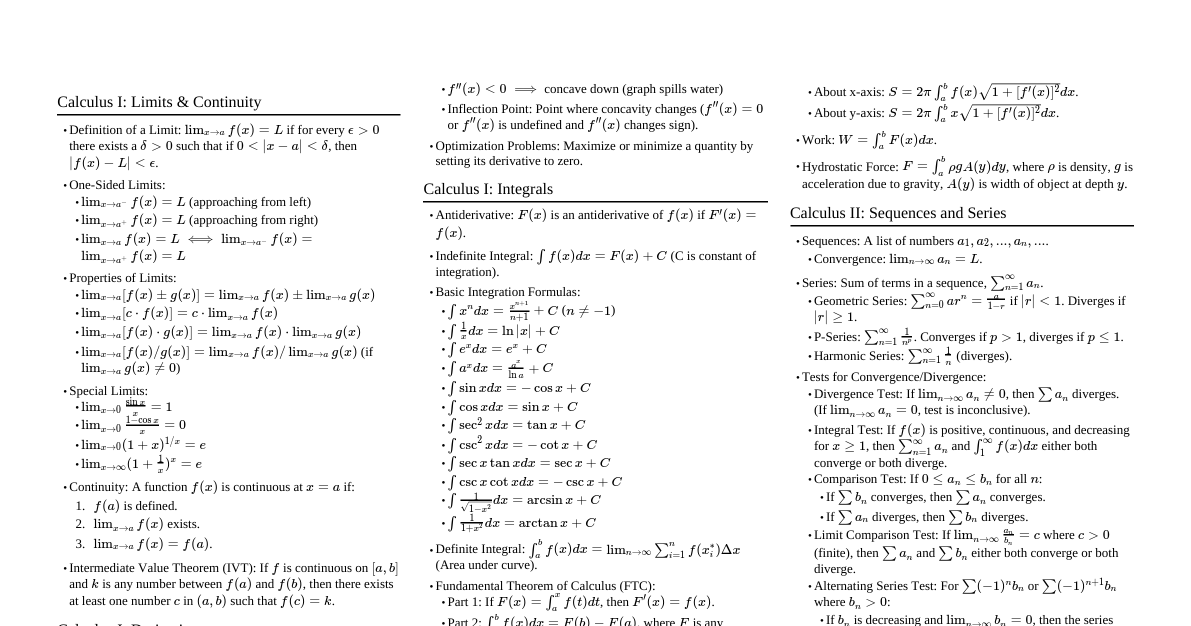
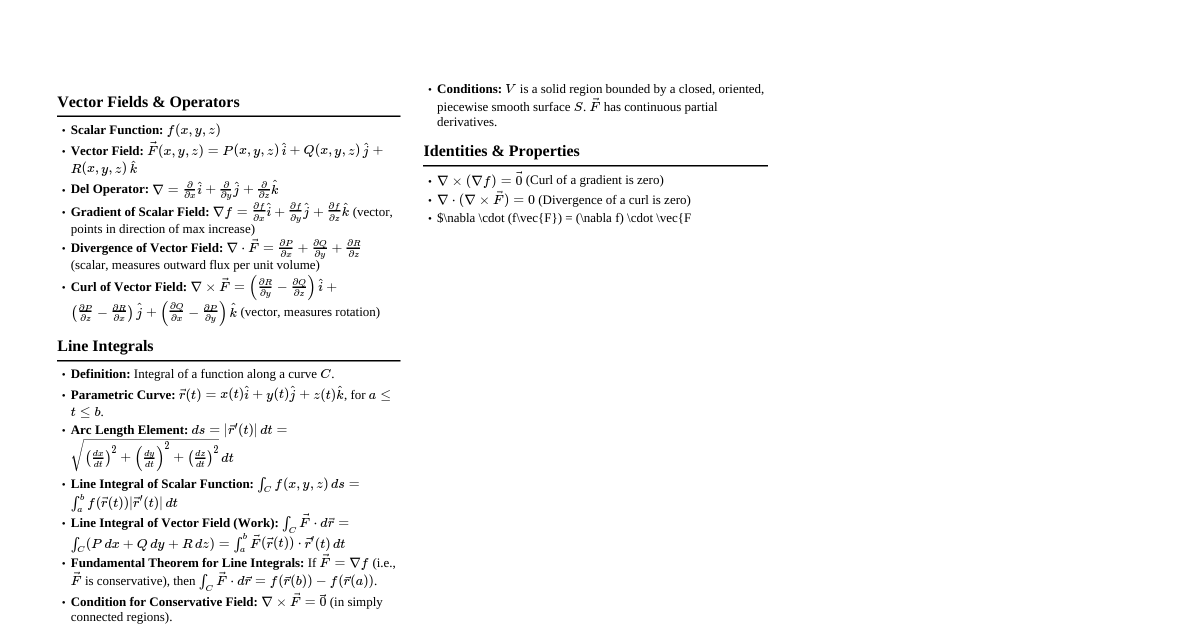
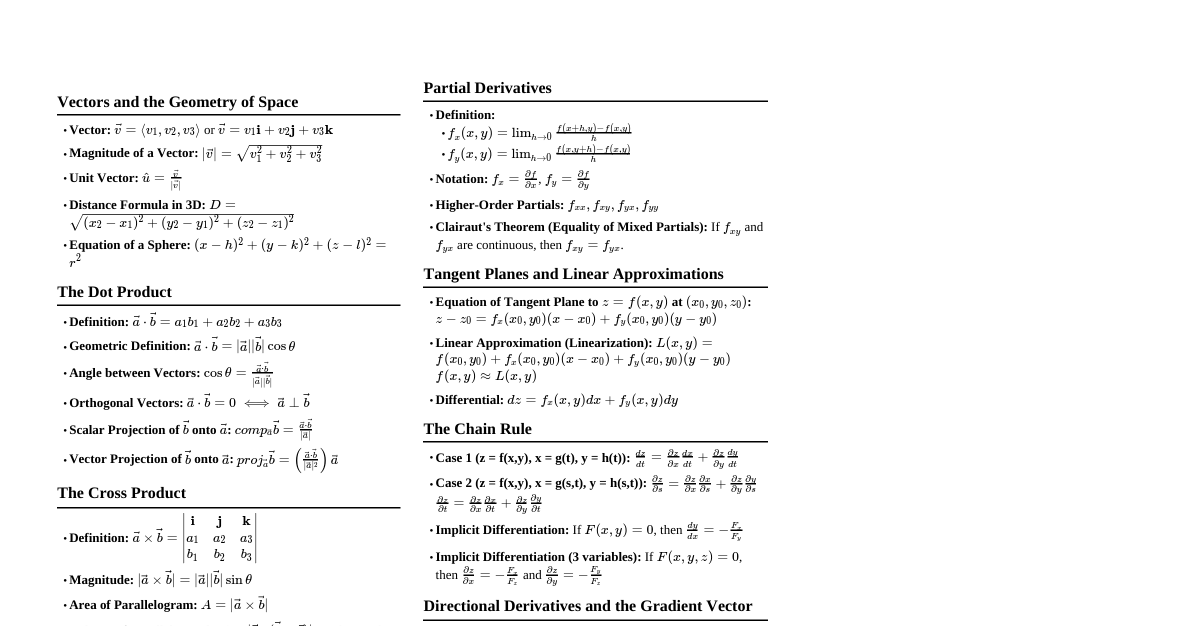
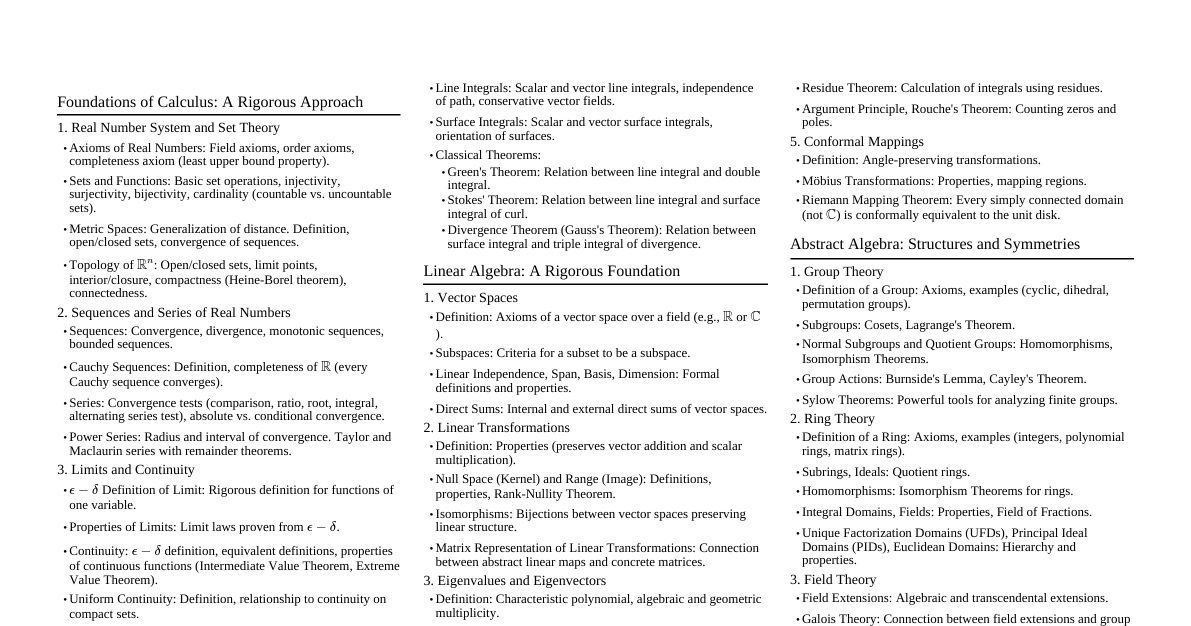
Cheatsheet Content
Line Integrals Problem 5(a): Evaluate $\int_C (x - y + z - 2) ds$ Curve C: Line segment from $P_0(0, 1, 1)$ to $P_1(1, 0, 1)$. Parametrization of C: $\vec{r}(t) = (1-t)P_0 + tP_1$ for $0 \le t \le 1$ $\vec{r}(t) = (1-t)(0, 1, 1) + t(1, 0, 1)$ $\vec{r}(t) = (0, 1-t, 1-t) + (t, 0, t) = (t, 1-t, 1)$ So, $x = t$, $y = 1-t$, $z = 1$. Derivative of $\vec{r}(t)$: $\vec{r}'(t) = \frac{d}{dt}(t, 1-t, 1) = (1, -1, 0)$ $||\vec{r}'(t)|| = \sqrt{1^2 + (-1)^2 + 0^2} = \sqrt{1 + 1 + 0} = \sqrt{2}$ Thus, $ds = ||\vec{r}'(t)|| dt = \sqrt{2} dt$. Substitute into the integral: $x - y + z - 2 = t - (1-t) + 1 - 2 = t - 1 + t + 1 - 2 = 2t - 2$ $\int_C (x - y + z - 2) ds = \int_0^1 (2t - 2)\sqrt{2} dt$ $= \sqrt{2} \int_0^1 (2t - 2) dt$ $= \sqrt{2} \left[ t^2 - 2t \right]_0^1$ $= \sqrt{2} \left[ (1^2 - 2(1)) - (0^2 - 2(0)) \right]$ $= \sqrt{2} \left[ (1 - 2) - 0 \right]$ $= \sqrt{2} (-1) = -\sqrt{2}$ Result: $\int_C (x - y + z - 2) ds = -\sqrt{2}$ Flux Integrals (Divergence Theorem) Problem 5(b): Find the outward flux of $\vec{F} = xz\hat{i} + yz\hat{j} + \hat{k}$ Surface: Upper cap of sphere $x^2 + y^2 + z^2 \le 25$ cut by plane $z=3$. The solid is $D = \{(x,y,z) | x^2+y^2+z^2 \le 25, z \ge 3\}$. Divergence Theorem: $\iint_S \vec{F} \cdot d\vec{S} = \iiint_D \nabla \cdot \vec{F} dV$ Calculate Divergence: $\vec{F} = \langle xz, yz, 1 \rangle$ $\nabla \cdot \vec{F} = \frac{\partial}{\partial x}(xz) + \frac{\partial}{\partial y}(yz) + \frac{\partial}{\partial z}(1)$ $\nabla \cdot \vec{F} = z + z + 0 = 2z$ Set up the Triple Integral: The region $D$ is defined by $x^2+y^2+z^2 \le 25$ and $z \ge 3$. This means $3 \le z \le \sqrt{25 - x^2 - y^2}$. The projection onto the $xy$-plane is a disk where $x^2+y^2+3^2 \le 25$, so $x^2+y^2 \le 16$. This is a disk of radius $R=4$. It's simpler to integrate using cylindrical coordinates or by considering the surface integral directly if only the cap is involved. The question asks for flux across the "upper cap". This usually implies the curved surface only, not the flat disk at $z=3$. However, if we use the Divergence Theorem, it calculates flux through the *entire closed surface* bounding the solid $D$. Let's assume the question means the *entire surface* of the volume described, which includes the cap and the disk at $z=3$. If it's just the cap, we must subtract the flux through the disk. Let $S$ be the entire boundary surface of $D$. $S = S_{cap} \cup S_{disk}$. $\iint_S \vec{F} \cdot d\vec{S} = \iiint_D 2z \, dV$ Evaluate the Triple Integral (Cylindrical Coordinates): $x = r\cos\theta$, $y = r\sin\theta$, $z=z$, $dV = r \, dr \, d\theta \, dz$. Bounds for $r$ and $\theta$: $0 \le r \le 4$, $0 \le \theta \le 2\pi$. Bounds for $z$: $3 \le z \le \sqrt{25 - r^2}$. $\iiint_D 2z \, dV = \int_0^{2\pi} \int_0^4 \int_3^{\sqrt{25-r^2}} 2z \, r \, dz \, dr \, d\theta$ $= \int_0^{2\pi} \int_0^4 r \left[ z^2 \right]_3^{\sqrt{25-r^2}} dr \, d\theta$ $= \int_0^{2\pi} \int_0^4 r ( (25-r^2) - 3^2 ) dr \, d\theta$ $= \int_0^{2\pi} \int_0^4 r (25 - r^2 - 9) dr \, d\theta$ $= \int_0^{2\pi} \int_0^4 (16r - r^3) dr \, d\theta$ $= \int_0^{2\pi} \left[ 8r^2 - \frac{r^4}{4} \right]_0^4 d\theta$ $= \int_0^{2\pi} \left[ 8(4^2) - \frac{4^4}{4} \right] d\theta$ $= \int_0^{2\pi} \left[ 8(16) - \frac{256}{4} \right] d\theta$ $= \int_0^{2\pi} (128 - 64) d\theta$ $= \int_0^{2\pi} 64 \, d\theta = 64 \left[ \theta \right]_0^{2\pi} = 64(2\pi) = 128\pi$ This is the flux through the entire closed surface $S$. If the question *only* asks for the flux through the "upper cap", we need to subtract the flux through the bottom disk $S_{disk}$. Flux through the Disk $S_{disk}$: The disk is at $z=3$, with $x^2+y^2 \le 16$. The outward normal vector for the bottom disk is $\vec{n} = -\hat{k} = \langle 0, 0, -1 \rangle$. $\vec{F} = \langle xz, yz, 1 \rangle \implies \vec{F}(x,y,3) = \langle 3x, 3y, 1 \rangle$. $\vec{F} \cdot \vec{n} = \langle 3x, 3y, 1 \rangle \cdot \langle 0, 0, -1 \rangle = -1$. $\iint_{S_{disk}} \vec{F} \cdot d\vec{S} = \iint_{S_{disk}} (\vec{F} \cdot \vec{n}) dA = \iint_{S_{disk}} (-1) dA$ $= -1 \times (\text{Area of the disk})$ Area of disk = $\pi r^2 = \pi (4^2) = 16\pi$. Flux through disk $= -16\pi$. Flux through the Upper Cap $S_{cap}$: $\iint_{S_{cap}} \vec{F} \cdot d\vec{S} = \iint_S \vec{F} \cdot d\vec{S} - \iint_{S_{disk}} \vec{F} \cdot d\vec{S}$ $= 128\pi - (-16\pi)$ $= 128\pi + 16\pi = 144\pi$ Result: The outward flux across the upper cap is $144\pi$. Differentiation of $\sin^2 x$ Problem: Find $\frac{d}{dx}(\sin^2 x)$ Method 1: Using the Chain Rule Let $y = \sin^2 x = (\sin x)^2$. Let $u = \sin x$. Then $y = u^2$. By the chain rule, $\frac{dy}{dx} = \frac{dy}{du} \cdot \frac{du}{dx}$. $\frac{dy}{du} = \frac{d}{du}(u^2) = 2u$. $\frac{du}{dx} = \frac{d}{dx}(\sin x) = \cos x$. Substitute $u = \sin x$ back: $\frac{dy}{dx} = 2(\sin x)(\cos x)$. Method 2: Using Trigonometric Identity Recall the identity: $\sin^2 x = \frac{1 - \cos(2x)}{2}$. So, $\frac{d}{dx}(\sin^2 x) = \frac{d}{dx}\left(\frac{1 - \cos(2x)}{2}\right)$. $= \frac{1}{2} \frac{d}{dx}(1 - \cos(2x))$. $= \frac{1}{2} \left( \frac{d}{dx}(1) - \frac{d}{dx}(\cos(2x)) \right)$. $\frac{d}{dx}(1) = 0$. For $\frac{d}{dx}(\cos(2x))$, use the chain rule again: Let $v = 2x$, so $\cos(2x) = \cos v$. $\frac{d}{dx}(\cos v) = -\sin v \cdot \frac{dv}{dx} = -\sin(2x) \cdot 2 = -2\sin(2x)$. Therefore, $\frac{d}{dx}(\sin^2 x) = \frac{1}{2} (0 - (-2\sin(2x))) = \frac{1}{2}(2\sin(2x)) = \sin(2x)$. Comparing Results: From Method 1: $2\sin x \cos x$. From Method 2: $\sin(2x)$. These are equivalent due to the double angle identity: $\sin(2x) = 2\sin x \cos x$. Result: $\frac{d}{dx}(\sin^2 x) = 2\sin x \cos x = \sin(2x)$