Class 10 Electricity
Cheatsheet Content
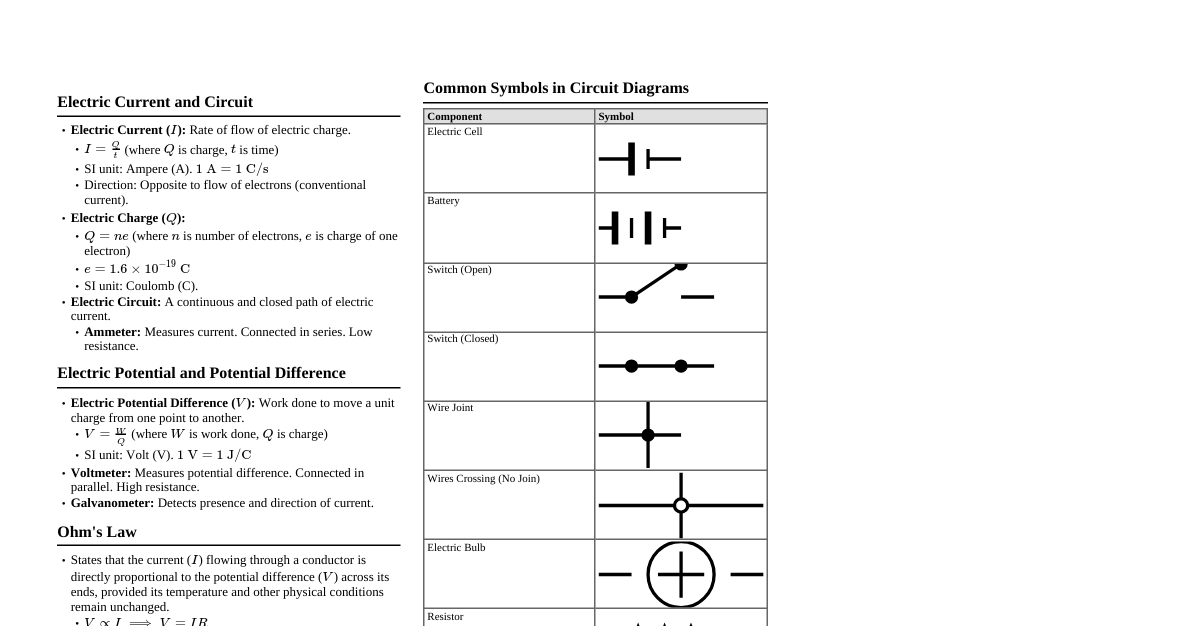
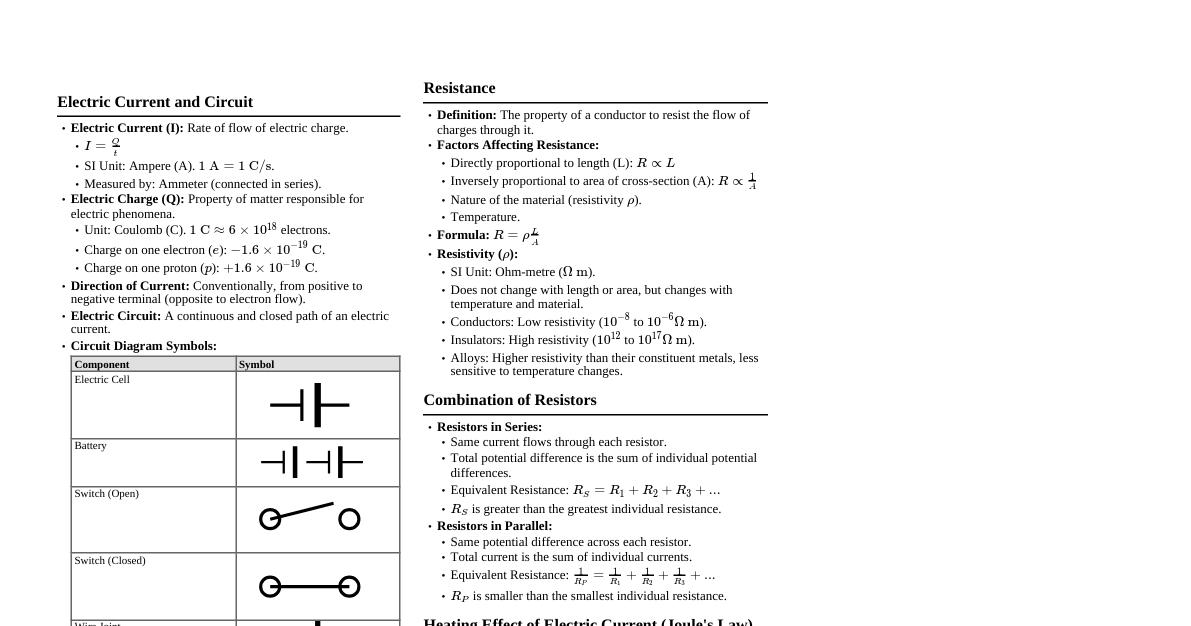
### Electric Current & Circuit - **Electric Current (I):** Rate of flow of electric charge. $$I = \frac{Q}{t}$$ - $Q$: Charge (Coulombs, C) - $t$: Time (seconds, s) - **Unit:** Ampere (A). 1 A = 1 C/s. - Measured by an **Ammeter** (connected in series). - **Electric Charge (Q):** - Quantized: $Q = ne$, where $n$ is integer, $e = 1.6 \times 10^{-19}$ C (charge of one electron). - Like charges repel, unlike charges attract. - **Electric Circuit:** A continuous and closed path of electric current. - **Circuit Diagram Symbols:** - Cell: `+|-` - Battery: `+|-+|-` - Switch (Open): `---o / o---` - Switch (Closed): `---o-o---` - Wire Joint: `---o---` (dot) - Wires Crossing (no joint): `---^---` - Electric Bulb: `---(x)---` - Resistor: `---/\/\/---` - Variable Resistor (Rheostat): `---/\/\/>---` (arrow diagonally across) - Ammeter: `---(A)---` - Voltmeter: `---(V)---` ### Electric Potential & Potential Difference - **Electric Potential (V):** Work done per unit charge in moving a charge from infinity to a point. - **Potential Difference (V):** Work done per unit charge in moving a charge from one point to another in an electric field. $$V = \frac{W}{Q}$$ - $W$: Work done (Joules, J) - $Q$: Charge (Coulombs, C) - **Unit:** Volt (V). 1 V = 1 J/C. - Measured by a **Voltmeter** (connected in parallel). ### Ohm's Law - States that the current (I) flowing through a conductor is directly proportional to the potential difference (V) across its ends, provided the temperature and other physical conditions remain constant. $$V \propto I \implies V = IR$$ - $R$: Resistance (Ohms, $\Omega$) - **Graph:** V vs I graph is a straight line passing through the origin. ### Resistance (R) - **Definition:** The opposition offered by a conductor to the flow of electric current. - **Unit:** Ohm ($\Omega$). 1 $\Omega$ = 1 V/A. - **Factors affecting Resistance:** 1. **Length (L):** $R \propto L$ 2. **Area of Cross-section (A):** $R \propto \frac{1}{A}$ 3. **Nature of Material:** (Resistivity $\rho$) 4. **Temperature:** (Increases with temp for metals, decreases for semiconductors) - **Resistivity ($\rho$):** $$R = \rho \frac{L}{A}$$ - **Unit:** Ohm-meter ($\Omega \cdot m$). - **Conductors:** Low resistivity (e.g., Copper: $1.6 \times 10^{-8} \Omega \cdot m$) - **Alloys:** Higher resistivity than pure metals (e.g., Nichrome: $100 \times 10^{-6} \Omega \cdot m$) - **Insulators:** Very high resistivity (e.g., Glass: $10^{10}$ to $10^{14} \Omega \cdot m$) ### Resistors in Series - **Arrangement:** End-to-end connection. - **Current:** Same current flows through each resistor. - **Potential Difference:** Divides across each resistor ($V = V_1 + V_2 + ...$). - **Equivalent Resistance ($R_S$):** Sum of individual resistances. $$R_S = R_1 + R_2 + R_3 + ...$$ - $R_S$ is always greater than the greatest individual resistance. ### Resistors in Parallel - **Arrangement:** Connected between the same two points. - **Current:** Divides among resistors ($I = I_1 + I_2 + ...$). - **Potential Difference:** Same across each resistor. - **Equivalent Resistance ($R_P$):** Reciprocal of $R_P$ is sum of reciprocals of individual resistances. $$\frac{1}{R_P} = \frac{1}{R_1} + \frac{1}{R_2} + \frac{1}{R_3} + ...$$ - $R_P$ is always less than the smallest individual resistance. - For two resistors: $R_P = \frac{R_1 R_2}{R_1 + R_2}$ ### Heating Effect of Electric Current (Joule's Law) - When current flows through a resistor, electrical energy is converted into heat energy. - **Work Done (W):** $$W = VQ = VIT = I^2RT = \frac{V^2}{R}t$$ - **Heat Produced (H):** $$H = I^2RT$$ - $I$: Current (A) - $R$: Resistance ($\Omega$) - $t$: Time (s) - **Unit:** Joule (J). - **Applications:** Electric heater, electric iron, electric bulb (filament heats up and glows), electric fuse. - **Electric Fuse:** Safety device, short length of wire made of an alloy of lead and tin, low melting point. Melts and breaks the circuit when current exceeds a safe limit. Always connected in series. ### Electric Power (P) - **Definition:** The rate at which electrical energy is consumed or dissipated. $$P = \frac{W}{t} = VI = I^2R = \frac{V^2}{R}$$ - **Unit:** Watt (W). 1 W = 1 J/s. - **Commercial Unit of Energy:** Kilowatt-hour (kWh). - 1 kWh = $1000 \text{ W} \times 3600 \text{ s} = 3.6 \times 10^6 \text{ J}$ - Often called "1 unit" of electricity. ### Example Calculations - **Problem 1:** A current of 0.5 A flows through a resistor of 10 $\Omega$ for 2 minutes. Calculate the heat produced. - $I = 0.5 \text{ A}$ - $R = 10 \Omega$ - $t = 2 \text{ min} = 2 \times 60 = 120 \text{ s}$ - $H = I^2RT = (0.5)^2 \times 10 \times 120 = 0.25 \times 10 \times 120 = 300 \text{ J}$ - **Problem 2:** An electric bulb is rated 220 V, 100 W. What is its resistance? - $V = 220 \text{ V}$ - $P = 100 \text{ W}$ - $P = V^2/R \implies R = V^2/P$ - $R = (220)^2 / 100 = 48400 / 100 = 484 \Omega$