Class 10 Electricity Formulae
Cheatsheet Content
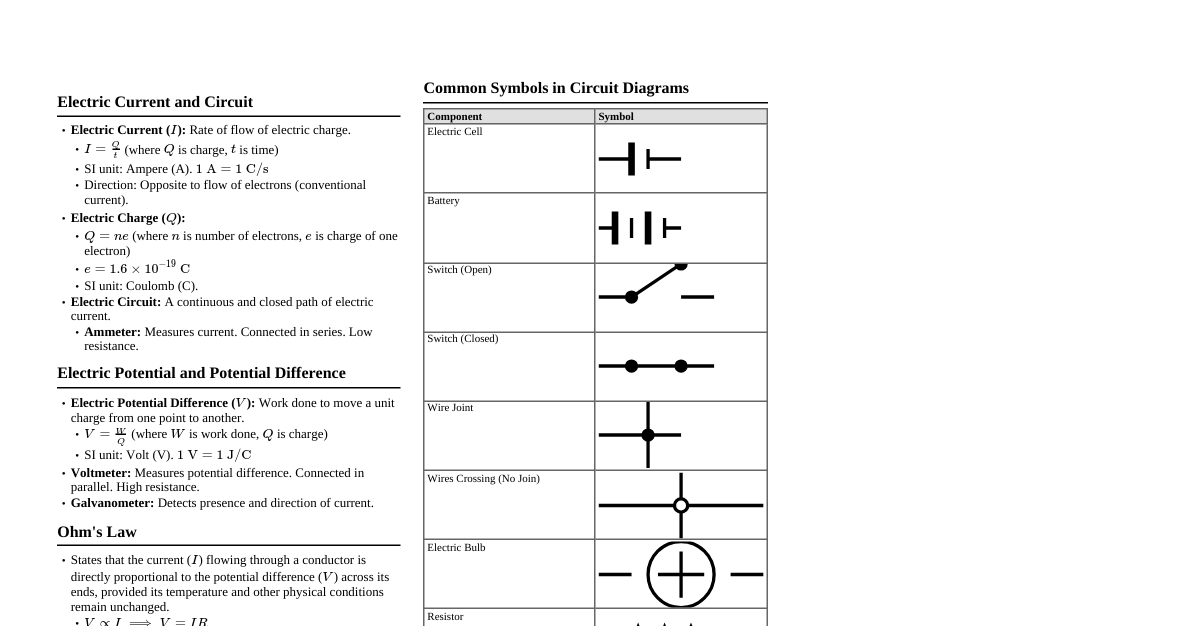
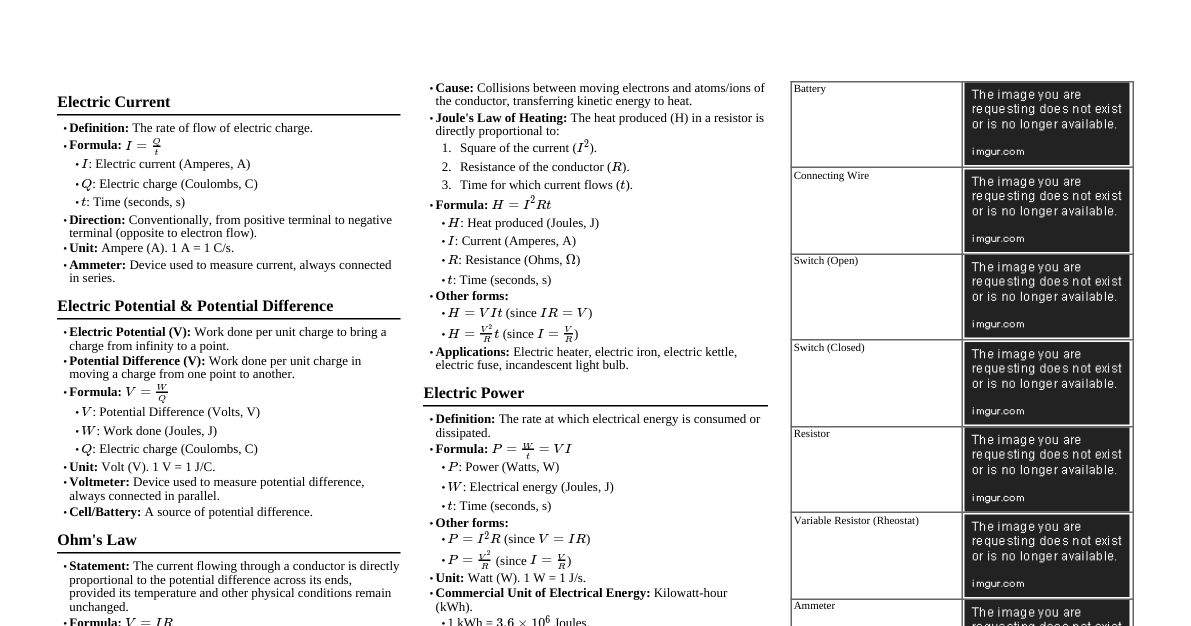
### Electric Current (전류) - **Definition:** Rate of flow of charge. $$I = \frac{Q}{t}$$ Where: - $I$ = Electric Current (Amperes, A) - $Q$ = Charge (Coulombs, C) - $t$ = Time (seconds, s) - **Unit Conversion:** 1 mA = $10^{-3}$ A, 1 µA = $10^{-6}$ A ### Electric Potential & Potential Difference (전위 및 전위차) - **Definition:** Work done per unit charge to move it from one point to another. $$V = \frac{W}{Q}$$ Where: - $V$ = Potential Difference (Volts, V) - $W$ = Work Done (Joules, J) - $Q$ = Charge (Coulombs, C) - **Unit:** Volt (V) = Joule/Coulomb (J/C) ### Ohm's Law (옴의 법칙) - **Statement:** The potential difference across the ends of a metallic conductor is directly proportional to the current flowing through it, provided its temperature remains the same. $$V = IR$$ Where: - $V$ = Potential Difference (Volts, V) - $I$ = Current (Amperes, A) - $R$ = Resistance (Ohms, Ω) - **Resistance:** $R = \frac{V}{I}$ ### Factors Affecting Resistance (저항에 영향을 미치는 요인) - **Formula:** $$R = \rho \frac{L}{A}$$ Where: - $R$ = Resistance (Ohms, Ω) - $\rho$ = Resistivity (Ohm-meter, Ωm) - material property - $L$ = Length of the conductor (meters, m) - $A$ = Area of cross-section (square meters, $m^2$) - **Resistivity ($\rho$):** - Unit: Ohm-meter (Ωm) - Independent of length and area, depends on material and temperature. ### Resistors in Series (직렬 저항) - **Total Resistance ($R_S$):** Sum of individual resistances. $$R_S = R_1 + R_2 + R_3 + ...$$ - **Current:** Same through each resistor. - **Voltage:** Divides across each resistor ($V = V_1 + V_2 + V_3 + ...$). ### Resistors in Parallel (병렬 저항) - **Total Resistance ($R_P$):** Reciprocal of the sum of reciprocals of individual resistances. $$\frac{1}{R_P} = \frac{1}{R_1} + \frac{1}{R_2} + \frac{1}{R_3} + ...$$ - **Current:** Divides among parallel branches ($I = I_1 + I_2 + I_3 + ...$). - **Voltage:** Same across each resistor. ### Electric Power (전력) - **Definition:** Rate at which electrical energy is consumed or dissipated. - **Formulae:** 1. $$P = VI$$ 2. $$P = I^2R$$ (using Ohm's Law $V=IR$) 3. $$P = \frac{V^2}{R}$$ (using Ohm's Law $I=V/R$) Where: - $P$ = Power (Watts, W) - $V$ = Potential Difference (Volts, V) - $I$ = Current (Amperes, A) - $R$ = Resistance (Ohms, Ω) - **Unit Conversion:** 1 kW = 1000 W ### Electrical Energy (전기 에너지) - **Definition:** Total work done or energy consumed over a period of time. - **Formulae:** 1. $$E = P \times t$$ 2. $$E = VIt$$ 3. $$E = I^2Rt$$ 4. $$E = \frac{V^2}{R}t$$ Where: - $E$ = Electrical Energy (Joules, J) - $P$ = Power (Watts, W) - $t$ = Time (seconds, s) - **Commercial Unit:** Kilowatt-hour (kWh) - 1 kWh = 3.6 × $10^6$ J ### Heating Effect of Electric Current (전류의 열 효과 - Joule's Law) - **Statement:** The heat produced in a resistor is directly proportional to the square of the current, the resistance, and the time for which the current flows. - **Formula:** $$H = I^2Rt$$ Where: - $H$ = Heat Produced (Joules, J) - $I$ = Current (Amperes, A) - $R$ = Resistance (Ohms, Ω) - $t$ = Time (seconds, s) - **Alternative Forms:** - $H = VIt$ - $H = \frac{V^2}{R}t$