Vectors & Vector Calculus
Shared 4/6/2026•143 views
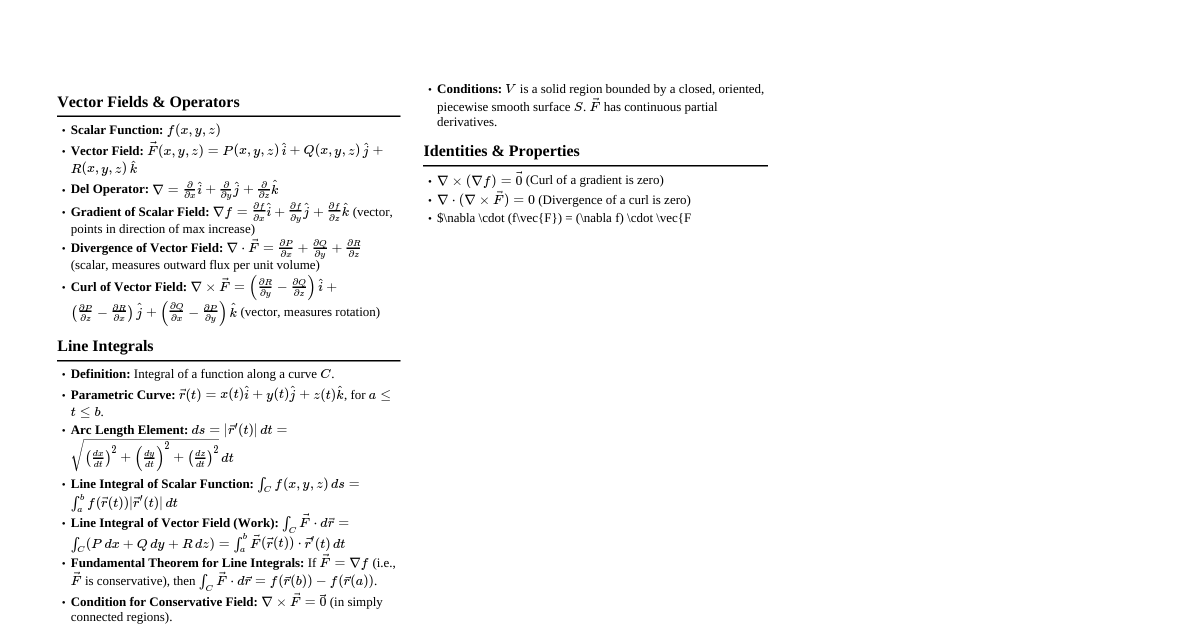
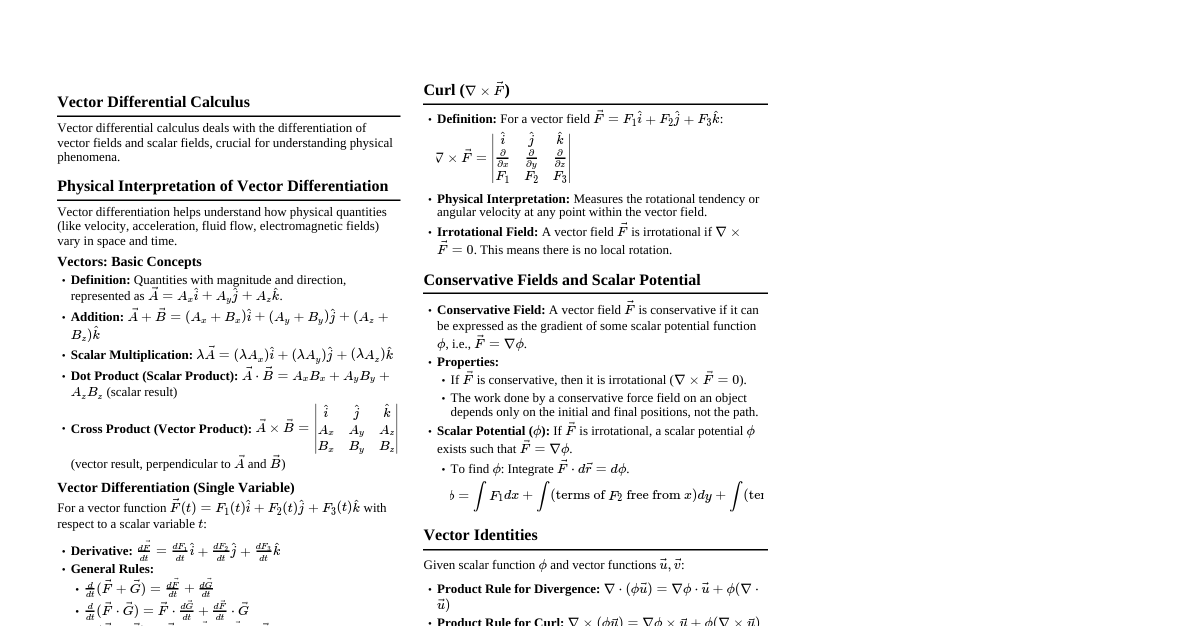
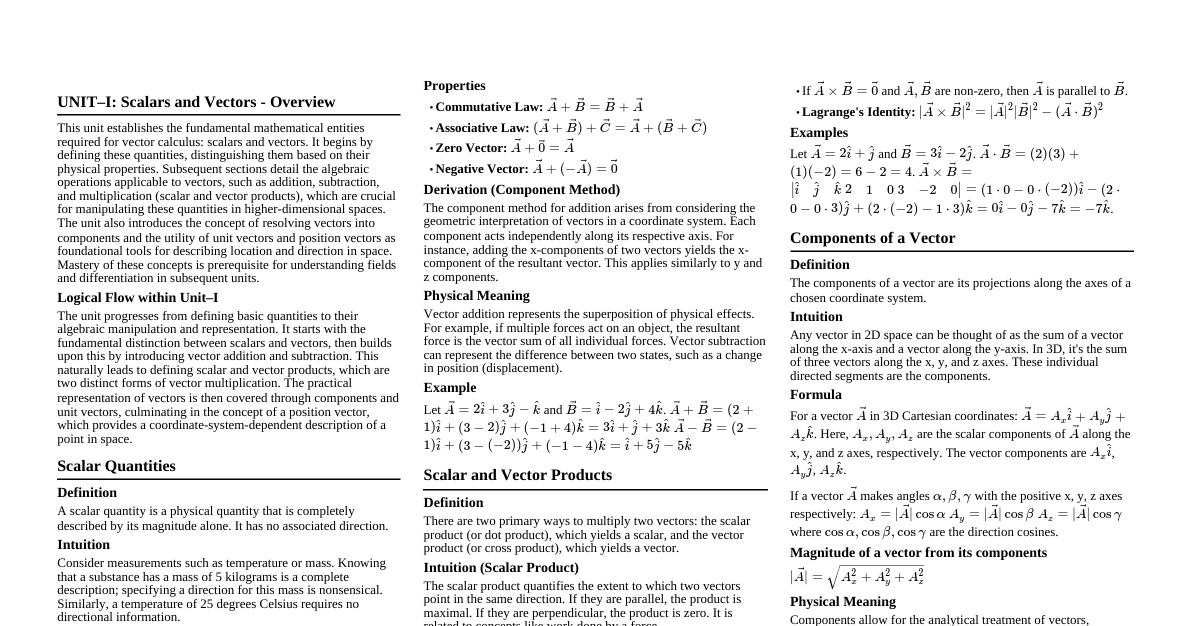
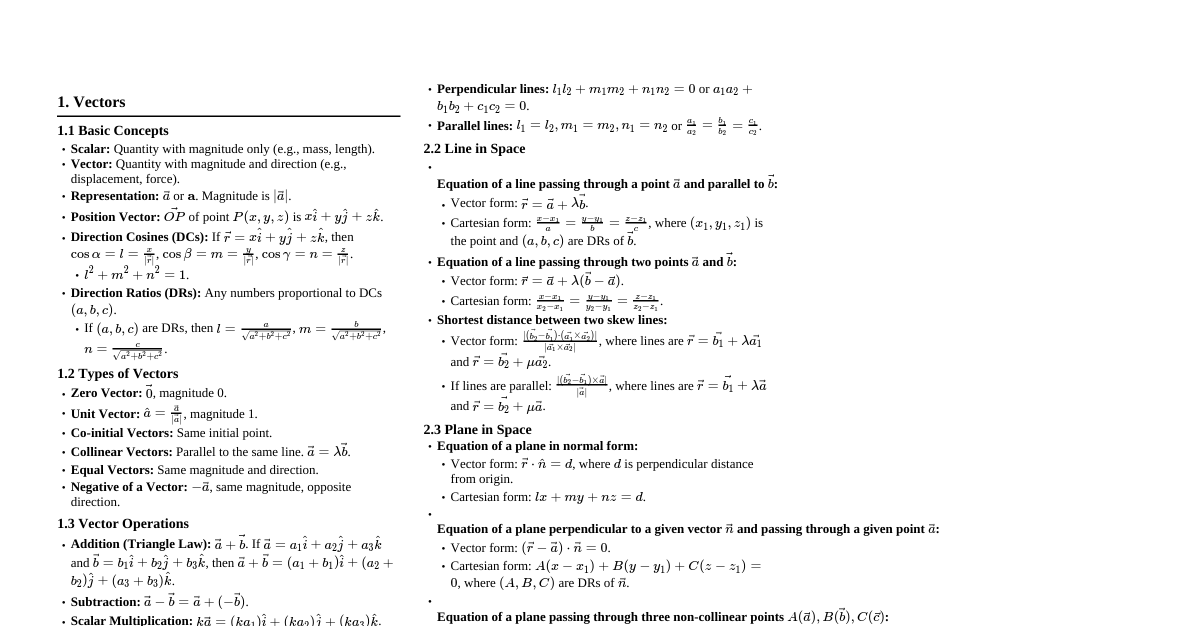
### Vectors - **Definition:** A quantity having both magnitude and direction. Represented as $\vec{v}$ or $\mathbf{v}$. - **Components:** In 3D, $\vec{v} = \langle v_x, v_y, v_z \rangle = v_x\mathbf{i} + v_y\mathbf{j} + v_z\mathbf{k}$. - **Magnitude (Length):** $|\vec{v}| = \sqrt{v_x^2 + v_y^2 + v_z^2}$. - **Unit Vector:** $\hat{u} = \frac{\vec{v}}{|\vec{v}|}$, a vector with magnitude 1 in the direction of $\vec{v}$. - **Vector Addition/Subtraction:** Component-wise. $\vec{a} \pm \vec{b} = \langle a_x \pm b_x, a_y \pm b_y, a_z \pm b_z \rangle$. - **Scalar Multiplication:** $c\vec{v} = \langle cv_x, cv_y, cv_z \rangle$. #### Dot Product (Scalar Product) - **Definition:** $\vec{a} \cdot \vec{b} = |\vec{a}||\vec{b}|\cos\theta$, where $\theta$ is the angle between $\vec{a}$ and $\vec{b}$. - **Component Form:** $\vec{a} \cdot \vec{b} = a_x b_x + a_y b_y + a_z b_z$. - **Properties:** - Commutative: $\vec{a} \cdot \vec{b} = \vec{b} \cdot \vec{a}$ - Distributive: $\vec{a} \cdot (\vec{b} + \vec{c}) = \vec{a} \cdot \vec{b} + \vec{a} \cdot \vec{c}$ - $\vec{a} \cdot \vec{a} = |\vec{a}|^2$ - Orthogonality: If $\vec{a} \cdot \vec{b} = 0$ (and $\vec{a}, \vec{b} \neq \vec{0}$), then $\vec{a}$ and $\vec{b}$ are orthogonal (perpendicular). #### Cross Product (Vector Product) - **Definition:** $\vec{a} \times \vec{b} = (|\vec{a}||\vec{b}|\sin\theta)\hat{n}$, where $\hat{n}$ is a unit vector perpendicular to both $\vec{a}$ and $\vec{b}$ (right-hand rule). - **Component Form:** $$\vec{a} \times \vec{b} = \begin{vmatrix} \mathbf{i} & \mathbf{j} & \mathbf{k} \\ a_x & a_y & a_z \\ b_x & b_y & b_z \end{vmatrix} = (a_y b_z - a_z b_y)\mathbf{i} - (a_x b_z - a_z b_x)\mathbf{j} + (a_x b_y - a_y b_x)\mathbf{k}$$ - **Properties:** - Anti-commutative: $\vec{a} \times \vec{b} = -(\vec{b} \times \vec{a})$ - Distributive: $\vec{a} \times (\vec{b} + \vec{c}) = \vec{a} \times \vec{b} + \vec{a} \times \vec{c}$ - Parallelism: If $\vec{a} \times \vec{b} = \vec{0}$ (and $\vec{a}, \vec{b} \neq \vec{0}$), then $\vec{a}$ and $\vec{b}$ are parallel. - $|\vec{a} \times \vec{b}|$ is the area of the parallelogram formed by $\vec{a}$ and $\vec{b}$. #### Scalar Triple Product - **Definition:** $\vec{a} \cdot (\vec{b} \times \vec{c})$ - **Geometric Meaning:** Volume of the parallelepiped formed by $\vec{a}, \vec{b}, \vec{c}$. - **Component Form:** $$\vec{a} \cdot (\vec{b} \times \vec{c}) = \begin{vmatrix} a_x & a_y & a_z \\ b_x & b_y & b_z \\ c_x & c_y & c_z \end{vmatrix}$$ ### Vector Functions - **Definition:** A function $\vec{r}(t) = \langle x(t), y(t), z(t) \rangle$ that maps a real number $t$ (scalar) to a vector. - **Derivative:** $\vec{r}'(t) = \langle x'(t), y'(t), z'(t) \rangle$. Represents the tangent vector to the curve. - **Integral:** $\int \vec{r}(t) dt = \langle \int x(t) dt, \int y(t) dt, \int z(t) dt \rangle$. - **Arc Length:** For $t \in [a, b]$, $L = \int_a^b |\vec{r}'(t)| dt = \int_a^b \sqrt{(x'(t))^2 + (y'(t))^2 + (z'(t))^2} dt$. - **Velocity:** $\vec{v}(t) = \vec{r}'(t)$. - **Acceleration:** $\vec{a}(t) = \vec{v}'(t) = \vec{r}''(t)$. - **Speed:** $|\vec{v}(t)| = |\vec{r}'(t)|$. #### Curvature and Normal Vectors - **Unit Tangent Vector:** $\vec{T}(t) = \frac{\vec{r}'(t)}{|\vec{r}'(t)|}$. - **Curvature:** $\kappa = \frac{|\vec{T}'(t)|}{|\vec{r}'(t)|} = \frac{|\vec{r}'(t) \times \vec{r}''(t)|}{|\vec{r}'(t)|^3}$. Measures how sharply a curve bends. - **Principal Unit Normal Vector:** $\vec{N}(t) = \frac{\vec{T}'(t)}{|\vec{T}'(t)|}$. Points in the direction the curve is bending. - **Binormal Vector:** $\vec{B}(t) = \vec{T}(t) \times \vec{N}(t)$. ### Multivariable Functions - **Definition:** A function $f(x, y)$ or $f(x, y, z)$ that takes multiple variables as input and outputs a scalar. - **Partial Derivatives:** - $\frac{\partial f}{\partial x}$: Treat $y$ (and $z$) as constant, differentiate with respect to $x$. - $\frac{\partial f}{\partial y}$: Treat $x$ (and $z$) as constant, differentiate with respect to $y$. - **Chain Rule:** - If $z = f(x, y)$ and $x=x(t), y=y(t)$, then $\frac{dz}{dt} = \frac{\partial f}{\partial x}\frac{dx}{dt} + \frac{\partial f}{\partial y}\frac{dy}{dt}$. - If $z = f(x, y)$ and $x=x(s, t), y=y(s, t)$, then $\frac{\partial z}{\partial s} = \frac{\partial f}{\partial x}\frac{\partial x}{\partial s} + \frac{\partial f}{\partial y}\frac{\partial y}{\partial s}$. #### Gradient - **Definition:** The gradient of a scalar function $f(x, y, z)$ is a vector field: $$\nabla f = \left\langle \frac{\partial f}{\partial x}, \frac{\partial f}{\partial y}, \frac{\partial f}{\partial z} \right\rangle = \frac{\partial f}{\partial x}\mathbf{i} + \frac{\partial f}{\partial y}\mathbf{j} + \frac{\partial f}{\partial z}\mathbf{k}$$ - **Properties:** - Points in the direction of the greatest rate of increase of $f$. - Its magnitude $|\nabla f|$ is the maximum rate of increase. - Is orthogonal to the level curves/surfaces of $f$. - **Directional Derivative:** $D_{\vec{u}}f = \nabla f \cdot \vec{u}$, where $\vec{u}$ is a unit vector. Gives the rate of change of $f$ in the direction of $\vec{u}$. ### Vector Fields - **Definition:** A function $\vec{F}(x, y, z) = \langle P(x, y, z), Q(x, y, z), R(x, y, z) \rangle$ that assigns a vector to each point in space. - **Conservative Vector Field:** A vector field $\vec{F}$ is conservative if it is the gradient of some scalar function $f$, i.e., $\vec{F} = \nabla f$. The function $f$ is called the **potential function**. - If $\vec{F}$ is conservative, then $\nabla \times \vec{F} = \vec{0}$ (curl is zero). - If $\vec{F}$ is defined on a simply connected domain and $\nabla \times \vec{F} = \vec{0}$, then $\vec{F}$ is conservative. #### Divergence - **Definition:** For $\vec{F} = \langle P, Q, R \rangle$, the divergence is a scalar function: $$\nabla \cdot \vec{F} = \frac{\partial P}{\partial x} + \frac{\partial Q}{\partial y} + \frac{\partial R}{\partial z}$$ - **Interpretation:** Measures the outward flux per unit volume. Represents the "source" or "sink" strength at a point. #### Curl - **Definition:** For $\vec{F} = \langle P, Q, R \rangle$, the curl is a vector field: $$\nabla \times \vec{F} = \begin{vmatrix} \mathbf{i} & \mathbf{j} & \mathbf{k} \\ \frac{\partial}{\partial x} & \frac{\partial}{\partial y} & \frac{\partial}{\partial z} \\ P & Q & R \end{vmatrix} = \left( \frac{\partial R}{\partial y} - \frac{\partial Q}{\partial z} \right)\mathbf{i} - \left( \frac{\partial R}{\partial x} - \frac{\partial P}{\partial z} \right)\mathbf{j} + \left( \frac{\partial Q}{\partial x} - \frac{\partial P}{\partial y} \right)\mathbf{k}$$ - **Interpretation:** Measures the tendency of a fluid to rotate about a point. ### Line Integrals - **Definition:** An integral of a function along a curve. - **Scalar Function $f(x, y, z)$ along curve $C$:** $$\int_C f(x, y, z) ds = \int_a^b f(\vec{r}(t)) |\vec{r}'(t)| dt$$ where $\vec{r}(t)$ parametrizes $C$. - **Vector Field $\vec{F}(x, y, z)$ along curve $C$ (Work):** $$\int_C \vec{F} \cdot d\vec{r} = \int_a^b \vec{F}(\vec{r}(t)) \cdot \vec{r}'(t) dt$$ If $\vec{F} = \langle P, Q, R \rangle$, then $\int_C P dx + Q dy + R dz$. - **Fundamental Theorem for Line Integrals:** If $\vec{F} = \nabla f$ (conservative field), then $$\int_C \vec{F} \cdot d\vec{r} = f(\vec{r}(b)) - f(\vec{r}(a))$$ This means the integral is path-independent. #### Green's Theorem (2D) - Relates a line integral around a simple closed curve $C$ to a double integral over the region $D$ it encloses. - Let $C$ be a positively oriented, piecewise smooth, simple closed curve in the plane and let $D$ be the region bounded by $C$. If $P$ and $Q$ have continuous partial derivatives on $D$, then: $$\oint_C P dx + Q dy = \iint_D \left( \frac{\partial Q}{\partial x} - \frac{\partial P}{\partial y} \right) dA$$ ### Surface Integrals - **Definition:** An integral of a function over a surface. - **Parametric Surface:** $\vec{r}(u, v) = \langle x(u, v), y(u, v), z(u, v) \rangle$. - **Surface Area:** $A(S) = \iint_D |\vec{r}_u \times \vec{r}_v| dA$. - **Scalar Function $f(x, y, z)$ over surface $S$:** $$\iint_S f(x, y, z) dS = \iint_D f(\vec{r}(u, v)) |\vec{r}_u \times \vec{r}_v| dA$$ - **Vector Field $\vec{F}(x, y, z)$ over surface $S$ (Flux):** $$\iint_S \vec{F} \cdot d\vec{S} = \iint_D \vec{F}(\vec{r}(u, v)) \cdot (\vec{r}_u \times \vec{r}_v) dA$$ where $\vec{r}_u \times \vec{r}_v$ is the normal vector to the surface. Alternatively, for $d\vec{S} = \mathbf{n} dS$ where $\mathbf{n}$ is the unit normal vector: $$\iint_S \vec{F} \cdot \mathbf{n} dS$$ #### Stokes' Theorem - Relates a line integral around a closed curve $C$ to a surface integral over a surface $S$ that has $C$ as its boundary. - Let $S$ be an oriented piecewise-smooth surface bounded by a simple, closed, piecewise-smooth curve $C$ with positive orientation. If $\vec{F}$ is a vector field whose components have continuous partial derivatives on an open region in $\mathbb{R}^3$ containing $S$, then: $$\oint_C \vec{F} \cdot d\vec{r} = \iint_S (\nabla \times \vec{F}) \cdot d\vec{S}$$ #### Divergence Theorem (Gauss's Theorem) - Relates a surface integral over a closed surface $S$ to a triple integral over the solid region $E$ it encloses. - Let $E$ be a simple solid region whose boundary surface $S$ is a closed, oriented, piecewise-smooth surface whose outer normal $\mathbf{n}$ is positive. Let $\vec{F}$ be a vector field whose components have continuous partial derivatives on an open region containing $E$. Then: $$\iint_S \vec{F} \cdot d\vec{S} = \iiint_E (\nabla \cdot \vec{F}) dV$$