Parts of Speech
Cheatsheet Content
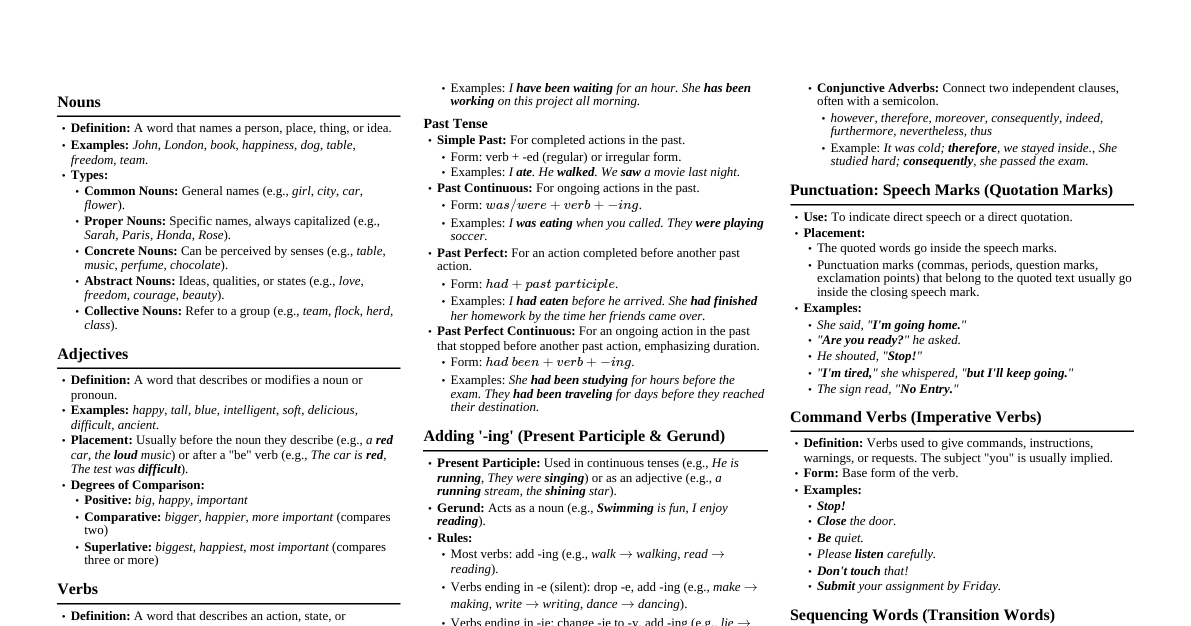
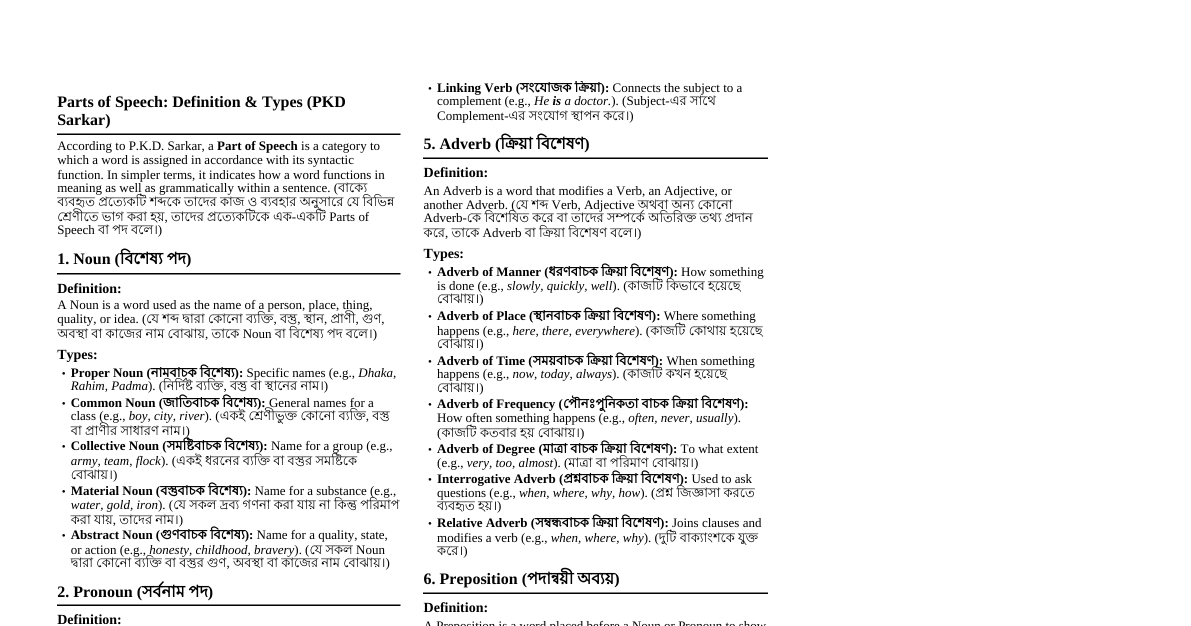
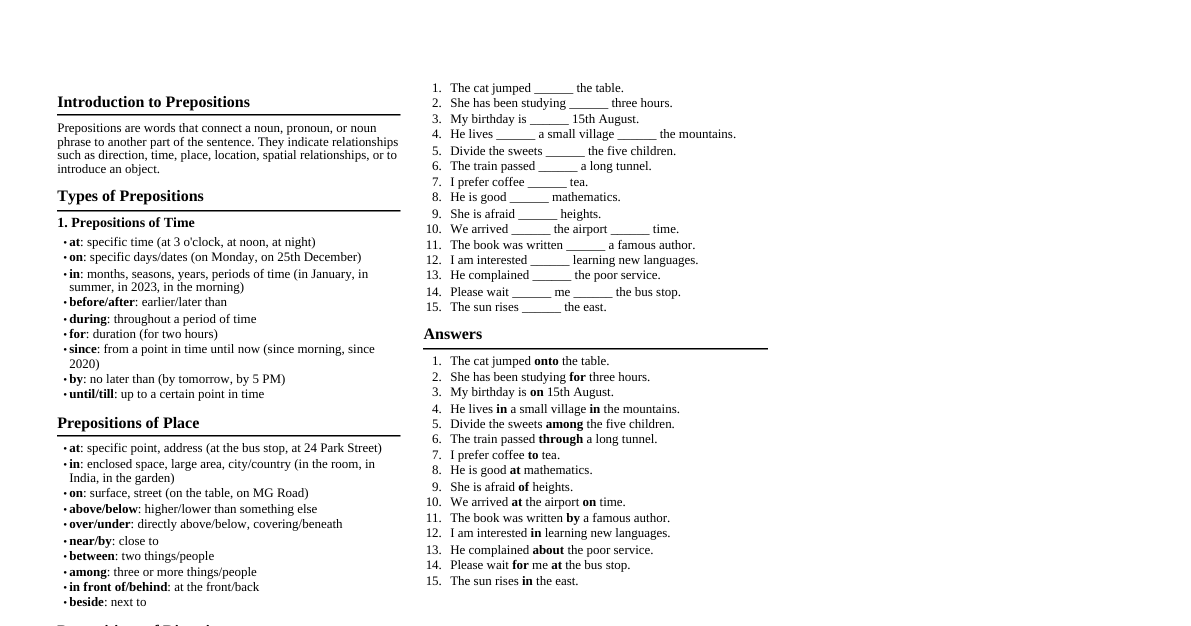
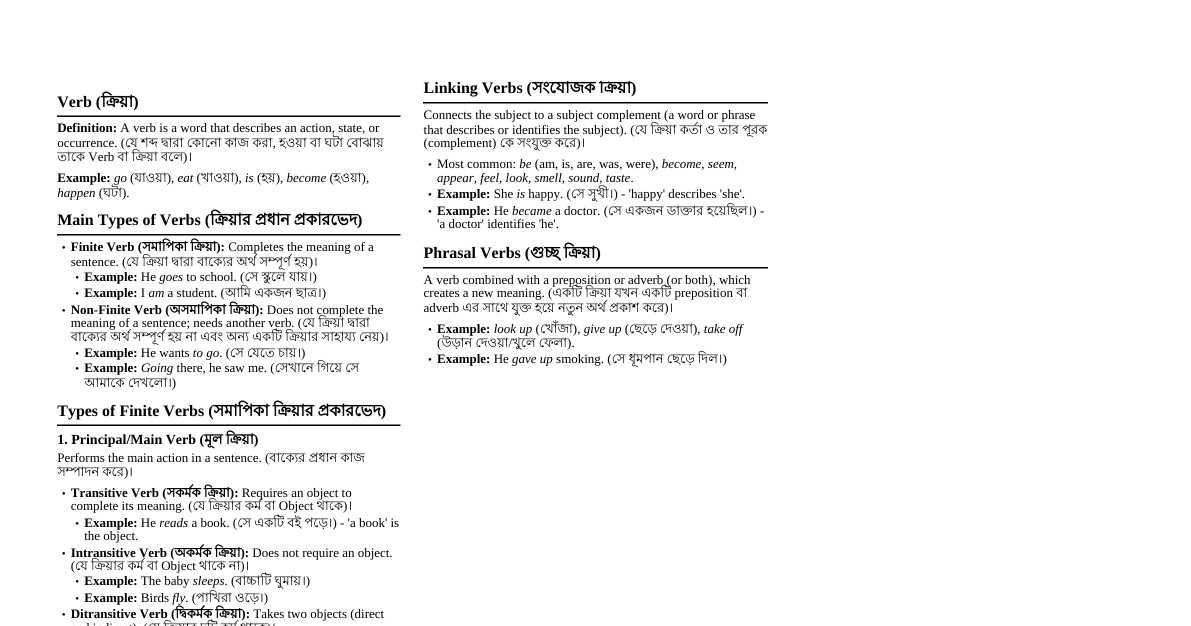
Nouns Definition: A word that names a person, place, thing, or idea. Types: Common Noun: General name (e.g., boy, city, car, happiness ) Proper Noun: Specific name, capitalized (e.g., John, London, Toyota ) Concrete Noun: Can be perceived by senses (e.g., table, music, flower ) Abstract Noun: Idea, quality, or state (e.g., love, freedom, justice ) Collective Noun: Group of people or things (e.g., team, flock, family ) Function: Subject, object of a verb, object of a preposition. Example: The cat sat on the mat . Love is a powerful emotion . Pronouns Definition: A word that replaces a noun or noun phrase. Types: Personal: I, you, he, she, it, we, they, me, him, her, us, them Possessive: mine, yours, his, hers, its, ours, theirs Reflexive/Intensive: myself, yourself, himself, herself, itself, ourselves, yourselves, themselves Demonstrative: this, that, these, those Interrogative: who, whom, whose, which, what Relative: who, whom, whose, which, that (introduce dependent clauses) Indefinite: all, any, both, each, few, many, none, some, etc. Function: Avoids repetition of nouns. Example: She gave him the book. That is my car. Verbs Definition: A word that describes an action, state, or occurrence. Types: Action Verbs: Describe an action (e.g., run, eat, think, write ) Linking Verbs: Connect the subject to a noun or adjective (e.g., be, seem, become, feel ) Auxiliary/Helping Verbs: Used with main verbs to form tenses, moods (e.g., be, have, do, can, will, might ) Tenses: Past, Present, Future (and their perfect/progressive forms). Voice: Active (subject performs action) or Passive (subject receives action). Example: He runs every day. She is happy. They have finished their work. Adjectives Definition: A word that describes or modifies a noun or pronoun. Function: Answers questions like "which one?", "what kind?", "how many?". Degrees of Comparison: Positive: tall Comparative: taller (compares two) Superlative: tallest (compares three or more) Example: The red car is fast . She bought three beautiful flowers. Adverbs Definition: A word that modifies a verb, an adjective, or another adverb. Function: Answers questions like "how?", "when?", "where?", "to what extent?". Common Endings: Often end in "-ly" (e.g., quickly, happily, softly ) Example: He walks slowly . She is very happy. They left yesterday . Prepositions Definition: A word that shows the relationship between a noun/pronoun and another word in the sentence. Function: Introduces a prepositional phrase. Common Prepositions: in, on, at, by, with, for, from, about, above, below, through, during, before, after, etc. Example: The book is on the table. She walked to the store. Conjunctions Definition: A word that connects words, phrases, or clauses. Types: Coordinating Conjunctions: Connect grammatically equal elements (FANBOYS: for, and, nor, but, or, yet, so ) Subordinating Conjunctions: Introduce a dependent clause (e.g., although, because, while, since, if, when, unless ) Correlative Conjunctions: Pairs of conjunctions (e.g., either...or, neither...nor, both...and, not only...but also ) Example: I like coffee and tea. Because it was raining, we stayed inside. Interjections Definition: A word or phrase that expresses strong emotion or surprise. Function: Often stands alone or is followed by an exclamation mark. Example: Wow! That's amazing. Ouch! That hurt. Oh, no! I forgot my keys.