Parts of Speech (PKD Sarkar)
Cheatsheet Content
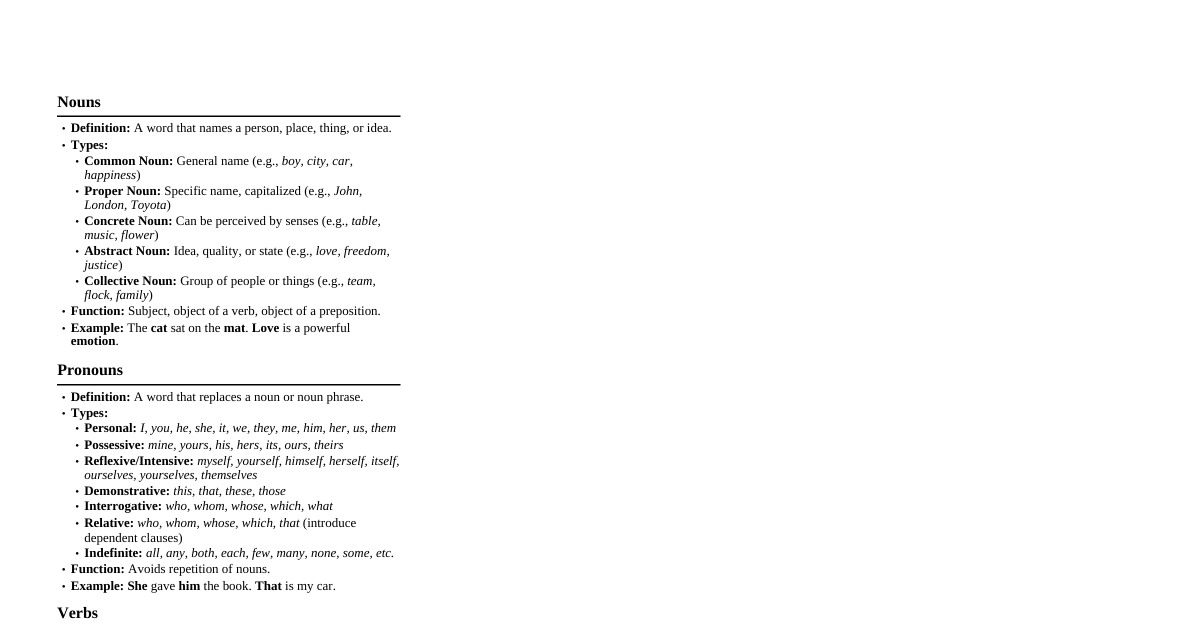
Parts of Speech: Definition & Types (PKD Sarkar) According to P.K.D. Sarkar, a Part of Speech is a category to which a word is assigned in accordance with its syntactic function. In simpler terms, it indicates how a word functions in meaning as well as grammatically within a sentence. (বাক্যে ব্যবহৃত প্রত্যেকটি শব্দকে তাদের কাজ ও ব্যবহার অনুসারে যে বিভিন্ন শ্রেণীতে ভাগ করা হয়, তাদের প্রত্যেকটিকে এক-একটি Parts of Speech বা পদ বলে।) 1. Noun (বিশেষ্য পদ) Definition: A Noun is a word used as the name of a person, place, thing, quality, or idea. (যে শব্দ দ্বারা কোনো ব্যক্তি, বস্তু, স্থান, প্রাণী, গুণ, অবস্থা বা কাজের নাম বোঝায়, তাকে Noun বা বিশেষ্য পদ বলে।) Types: Proper Noun (নামবাচক বিশেষ্য): Specific names (e.g., Dhaka, Rahim, Padma ). (নির্দিষ্ট ব্যক্তি, বস্তু বা স্থানের নাম।) Common Noun (জাতিবাচক বিশেষ্য): General names for a class (e.g., boy, city, river ). (একই শ্রেণীভুক্ত কোনো ব্যক্তি, বস্তু বা প্রাণীর সাধারণ নাম।) Collective Noun (সমষ্টিবাচক বিশেষ্য): Name for a group (e.g., army, team, flock ). (একই ধরনের ব্যক্তি বা বস্তুর সমষ্টিকে বোঝায়।) Material Noun (বস্তুবাচক বিশেষ্য): Name for a substance (e.g., water, gold, iron ). (যে সকল দ্রব্য গণনা করা যায় না কিন্তু পরিমাপ করা যায়, তাদের নাম।) Abstract Noun (গুণবাচক বিশেষ্য): Name for a quality, state, or action (e.g., honesty, childhood, bravery ). (যে সকল Noun দ্বারা কোনো ব্যক্তি বা বস্তুর গুণ, অবস্থা বা কাজের নাম বোঝায়।) 2. Pronoun (সর্বনাম পদ) Definition: A Pronoun is a word used instead of a Noun. (যে শব্দ Noun-এর পরিবর্তে ব্যবহৃত হয়, তাকে Pronoun বা সর্বনাম পদ বলে।) Types: Personal Pronoun (ব্যক্তিবাচক সর্বনাম): Refers to persons (e.g., I, you, he, she, it, we, they ). (ব্যক্তিকে বোঝায়।) Demonstrative Pronoun (নির্দেশক সর্বনাম): Points out objects (e.g., this, that, these, those ). (কোনো ব্যক্তি বা বস্তুকে নির্দেশ করে।) Interrogative Pronoun (প্রশ্নবাচক সর্বনাম): Used to ask questions (e.g., who, what, which, whom, whose ). (প্রশ্ন জিজ্ঞাসা করতে ব্যবহৃত হয়।) Relative Pronoun (সম্বন্ধবাচক সর্বনাম): Joins clauses and refers back to a noun (e.g., who, which, that, whom, whose ). (দুটি বাক্য বা বাক্যাংশের মধ্যে সম্পর্ক স্থাপন করে।) Indefinite Pronoun (অনির্দিষ্ট সর্বনাম): Refers to non-specific persons or things (e.g., some, any, nobody, everyone ). (অনির্দিষ্ট ব্যক্তি বা বস্তুকে বোঝায়।) Reflexive/Emphatic Pronoun (আত্মবাচক/জোরদানকারী সর্বনাম): Ends in -self/-selves (e.g., myself, himself, ourselves ). (ক্রিয়ার বিষয়বস্তু যখন কর্তা নিজেই হয় বা কর্তার উপর জোর দেয়।) Distributive Pronoun (বণ্টনবাচক সর্বনাম): Refers to persons or things one at a time (e.g., each, either, neither ). (একের বেশি ব্যক্তি বা বস্তুর মধ্যে প্রত্যেককে আলাদাভাবে বোঝায়।) 3. Adjective (বিশেষণ পদ) Definition: An Adjective is a word that modifies or describes a Noun or Pronoun. (যে শব্দ Noun বা Pronoun-এর দোষ, গুণ, অবস্থা, সংখ্যা, পরিমাণ ইত্যাদি প্রকাশ করে, তাকে Adjective বা বিশেষণ পদ বলে।) Types: Adjective of Quality (গুণবাচক বিশেষণ): Describes quality (e.g., good, bad, beautiful ). (গুণ বা দোষ বোঝায়।) Adjective of Quantity (পরিমাণবাচক বিশেষণ): Describes quantity (e.g., much, little, some, enough ). (পরিমাণ বোঝায়।) Adjective of Number (সংখ্যাবাচক বিশেষণ): Describes number (e.g., one, two, first, many ). (সংখ্যা বোঝায়।) Demonstrative Adjective (নির্দেশক বিশেষণ): Points out (e.g., this, that, these, those book ). (Noun-এর আগে বসে নির্দেশ করে।) Interrogative Adjective (প্রশ্নবাচক বিশেষণ): Used with nouns to ask questions (e.g., which pen , what kind ). (Noun-এর আগে বসে প্রশ্ন জিজ্ঞাসা করে।) Possessive Adjective (সম্বন্ধসূচক বিশেষণ): Shows possession (e.g., my, your, his, her book ). (Noun-এর আগে বসে অধিকার বোঝায়।) Distributive Adjective (বণ্টনবাচক বিশেষণ): Refers to each one of a number (e.g., each boy , every student ). (Noun-এর আগে বসে আলাদাভাবে প্রত্যেককে বোঝায়।) 4. Verb (ক্রিয়া পদ) Definition: A Verb is a word that describes an action, state, or occurrence. (যে শব্দ দ্বারা কোনো কাজ করা, হওয়া বা থাকা বোঝায়, তাকে Verb বা ক্রিয়া পদ বলে।) Types: Main Verb / Principal Verb (মূল ক্রিয়া): Expresses the main action (e.g., go, eat, write ). (বাক্যের প্রধান কাজ বোঝায়।) Auxiliary Verb / Helping Verb (সাহায্যকারী ক্রিয়া): Helps main verbs (e.g., be, have, do, can, may ). (Main Verb-কে বাক্য গঠনে সাহায্য করে।) Transitive Verb (সকর্মক ক্রিয়া): Requires an object (e.g., He reads a book. ). (যার একটি কর্ম বা Object থাকে।) Intransitive Verb (অকর্মক ক্রিয়া): Does not require an object (e.g., He sleeps . ). (যার কোনো কর্ম বা Object থাকে না।) Linking Verb (সংযোজক ক্রিয়া): Connects the subject to a complement (e.g., He is a doctor. ). (Subject-এর সাথে Complement-এর সংযোগ স্থাপন করে।) 5. Adverb (ক্রিয়া বিশেষণ) Definition: An Adverb is a word that modifies a Verb, an Adjective, or another Adverb. (যে শব্দ Verb, Adjective অথবা অন্য কোনো Adverb-কে বিশেষিত করে বা তাদের সম্পর্কে অতিরিক্ত তথ্য প্রদান করে, তাকে Adverb বা ক্রিয়া বিশেষণ বলে।) Types: Adverb of Manner (ধরণবাচক ক্রিয়া বিশেষণ): How something is done (e.g., slowly, quickly, well ). (কাজটি কিভাবে হয়েছে বোঝায়।) Adverb of Place (স্থানবাচক ক্রিয়া বিশেষণ): Where something happens (e.g., here, there, everywhere ). (কাজটি কোথায় হয়েছে বোঝায়।) Adverb of Time (সময়বাচক ক্রিয়া বিশেষণ): When something happens (e.g., now, today, always ). (কাজটি কখন হয়েছে বোঝায়।) Adverb of Frequency (পৌনঃপুনিকতা বাচক ক্রিয়া বিশেষণ): How often something happens (e.g., often, never, usually ). (কাজটি কতবার হয় বোঝায়।) Adverb of Degree (মাত্রা বাচক ক্রিয়া বিশেষণ): To what extent (e.g., very, too, almost ). (মাত্রা বা পরিমাণ বোঝায়।) Interrogative Adverb (প্রশ্নবাচক ক্রিয়া বিশেষণ): Used to ask questions (e.g., when, where, why, how ). (প্রশ্ন জিজ্ঞাসা করতে ব্যবহৃত হয়।) Relative Adverb (সম্বন্ধবাচক ক্রিয়া বিশেষণ): Joins clauses and modifies a verb (e.g., when, where, why ). (দুটি বাক্যাংশকে যুক্ত করে।) 6. Preposition (পদান্বয়ী অব্যয়) Definition: A Preposition is a word placed before a Noun or Pronoun to show its relation to some other word in the sentence. (যে শব্দ কোনো Noun বা Pronoun-এর পূর্বে বসে বাক্যের অন্য কোনো শব্দের সাথে তার সম্পর্ক স্থাপন করে, তাকে Preposition বা পদান্বয়ী অব্যয় বলে।) Examples: in, on, at, by, for, with, to, from, under, over, above, below, among, between, beside, behind, through, into, upon, around, about, before, after, during, since, till, until, up, down, off, of, out. 7. Conjunction (সংযোজক অব্যয়) Definition: A Conjunction is a word that joins words, phrases, clauses, or sentences. (যে শব্দ দুই বা ততোধিক শব্দ, শব্দগুচ্ছ, বাক্য বা বাক্যাংশকে যুক্ত করে, তাকে Conjunction বা সংযোজক অব্যয় বলে।) Types: Coordinating Conjunction (সমন্বয়কারী অব্যয়): Joins elements of equal rank (e.g., and, but, or, for, nor, yet, so ). (সমান পদমর্যাদার শব্দ বা বাক্যকে যুক্ত করে।) Subordinating Conjunction (অধীনতাজ্ঞাপক অব্যয়): Joins a dependent clause to an independent clause (e.g., although, because, if, when, while, since, as, unless, until, before, after, that ). (একটি প্রধান বাক্যের সাথে একটি অপ্রধান বাক্যকে যুক্ত করে।) Correlative Conjunction (অন্বয়ী অব্যয়): Pairs of conjunctions (e.g., either...or, neither...nor, both...and, not only...but also ). (জোড়ায় জোড়ায় ব্যবহৃত হয়।) 8. Interjection (আবেগসূচক অব্যয়) Definition: An Interjection is a word that expresses some sudden feeling or emotion. (যে শব্দ দ্বারা মনের আকস্মিক আনন্দ, দুঃখ, বিস্ময়, ভয় ইত্যাদি আবেগ প্রকাশ পায়, তাকে Interjection বা আবেগসূচক অব্যয় বলে।) Examples: Hurrah!, Alas!, Oh!, Bravo!, Hello!, Ah!, Wow!, Hush!