Surface Chemistry (BITSAT)
Cheatsheet Content
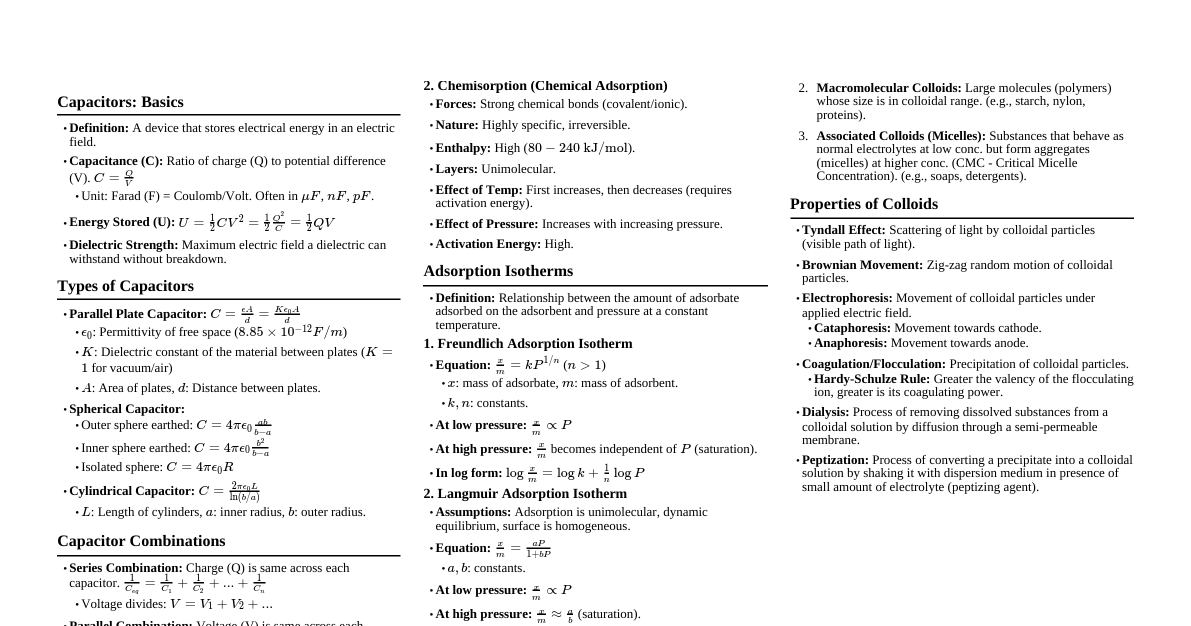
### Adsorption Fundamentals - **Definition:** Accumulation of molecular species at the surface rather than in the bulk of a solid or liquid. - **Adsorbate:** The substance which is adsorbed on the surface. - **Adsorbent:** The substance on whose surface adsorption takes place. - **Sorption:** When adsorption and absorption occur simultaneously. - **Desorption:** Process of removing an adsorbed substance from a surface. - **Occlusion:** Adsorption of gases on the surface of metals. #### Types of Adsorption - **Physisorption (Physical Adsorption):** - Caused by weak van der Waals forces. - Low enthalpy of adsorption (20-40 kJ/mol). - Reversible. - Multimolecular layers. - Non-specific. - Decreases with increase in temperature. - Increases with increase in pressure (until saturation). - No significant activation energy. - **Chemisorption (Chemical Adsorption):** - Caused by strong chemical bonds (covalent or ionic). - High enthalpy of adsorption (80-240 kJ/mol). - Irreversible. - Unimolecular layer. - Highly specific. - Increases with temperature initially, then decreases. - Increases with pressure. - High activation energy sometimes required. #### Factors Affecting Adsorption - **Nature of Adsorbate:** Easily liquefiable gases (high critical temp) are more readily adsorbed (e.g., $\text{SO}_2 > \text{CH}_4 > \text{H}_2$). - **Nature of Adsorbent:** Activated charcoal, silica gel, alumina are good adsorbents due to porous nature and large surface area. - **Temperature:** Physisorption decreases, Chemisorption increases then decreases. - **Pressure:** Increases with pressure for both, especially for gases on solids. ### Adsorption Isotherms - **Definition:** Relationship between the amount of adsorbate adsorbed by the adsorbent and the equilibrium pressure (for gases) or concentration (for solutions) at a constant temperature. #### Freundlich Adsorption Isotherm - **Formula:** $\frac{x}{m} = kP^{1/n}$ or $\frac{x}{m} = kC^{1/n}$ (for solutions) - $x$: mass of adsorbate - $m$: mass of adsorbent - $P$: equilibrium pressure - $C$: equilibrium concentration - $k, n$: constants ($n > 1$) - **Logarithmic form:** $\log\frac{x}{m} = \log k + \frac{1}{n}\log P$ - **Limitations:** Fails at high pressures; empirical relationship, no theoretical basis. #### Langmuir Adsorption Isotherm - **Assumptions:** 1. Adsorption sites are fixed and finite. 2. Each site can hold only one molecule (unimolecular layer). 3. Adsorption and desorption are dynamic equilibrium processes. 4. Adsorbed molecules do not interact with each other. - **Formula:** $\frac{x}{m} = \frac{aP}{1+bP}$ - $a, b$: Langmuir constants - **Linearized form:** $\frac{P}{x/m} = \frac{1}{a} + \frac{b}{a}P$ (Plot $P/(x/m)$ vs $P$ to get a straight line) - **At low pressure:** $\frac{x}{m} \approx aP$ (first order) - **At high pressure:** $\frac{x}{m} \approx \frac{a}{b}$ (zero order, saturation) ### Catalysis - **Definition:** Process of changing the rate of a chemical reaction by adding a substance called a catalyst. - **Catalyst:** A substance that alters the rate of a reaction without being consumed in the reaction. It provides an alternative reaction pathway with lower activation energy. - **Promoters:** Substances that enhance the activity of a catalyst (e.g., Mo in Haber process). - **Poison (Inhibitor):** Substances that decrease the activity of a catalyst (e.g., $\text{H}_2\text{S}$ for $\text{Pt}$ catalyst). #### Types of Catalysis - **Homogeneous Catalysis:** Reactants and catalyst are in the same phase. - Example: Hydrolysis of ester by acid ($\text{CH}_3\text{COOC}_2\text{H}_5(l) + \text{H}_2\text{O}(l) \xrightarrow{\text{H}^+(l)} \text{CH}_3\text{COOH}(l) + \text{C}_2\text{H}_5\text{OH}(l)$). - **Heterogeneous Catalysis:** Reactants and catalyst are in different phases (usually solid catalyst, gaseous/liquid reactants). - Example: Haber process ($\text{N}_2(g) + 3\text{H}_2(g) \xrightarrow{\text{Fe}(s)} 2\text{NH}_3(g)$). - **Mechanism:** Adsorption of reactants, formation of intermediate, desorption of products. #### Important Characteristics of Catalysts - **Specificity:** A catalyst is specific for a particular reaction. - **Activity:** Ability to increase the rate of reaction. - **Selectivity:** Ability to direct a reaction to yield a particular product (e.g., $\text{CO} + 2\text{H}_2 \xrightarrow{\text{Cu/ZnO-Cr}_2\text{O}_3} \text{CH}_3\text{OH}$). - **Optimum Temperature and pH:** Enzyme catalysts show activity at specific temperature and pH ranges. #### Zeolites (Shape-Selective Catalysis) - **Definition:** Aluminosilicates with 3D network structure containing pores and cavities. - **Shape-selective:** Catalytic activity depends on the pore structure of the catalyst and the size and shape of reactant and product molecules. - **Example:** ZSM-5 (Zeolite Socony Mobil-5) converts alcohols directly into gasoline by dehydrating them. ### Colloidal State (Colloids) - **Definition:** A heterogeneous system in which one substance is dispersed as very fine particles (dispersed phase) in another substance (dispersion medium). - **Particle size:** $1 \text{ nm}$ to $1000 \text{ nm}$ (or $10^{-9}$ to $10^{-6}$ m). - **True solution:** < $1 \text{ nm}$ (homogeneous). - **Suspension:** > $1000 \text{ nm}$ (heterogeneous). #### Classification of Colloids 1. **Based on Physical State of Dispersed Phase & Dispersion Medium:** | Dispersed Phase | Dispersion Medium | Name | Example | |-----------------|-------------------|---------------|-----------------------------------------| | Solid | Gas | Aerosol | Smoke, Dust | | Solid | Liquid | Sol | Paints, Cell fluids | | Solid | Solid | Solid Sol | Colored glass, Gemstones | | Liquid | Gas | Aerosol | Fog, Mist, Cloud | | Liquid | Liquid | Emulsion | Milk, Hair cream | | Liquid | Solid | Gel | Cheese, Jellies | | Gas | Liquid | Foam | Froth, Whipped cream | | Gas | Solid | Solid Foam | Pumice stone, Foam rubber | 2. **Based on Nature of Interaction between Dispersed Phase & Dispersion Medium:** - **Lyophilic Colloids (Solvent-loving):** - Strong affinity between phases. - Reversible (can be reformed after evaporation). - Stable, not easily coagulated. - Prepared directly by mixing. - Examples: Starch, Gum, Proteins, Gelatin. - **Lyophobic Colloids (Solvent-hating):** - Little or no affinity between phases. - Irreversible. - Less stable, easily coagulated. - Require special methods for preparation. - Examples: Metal sols (Au, Ag), Metal hydroxides, Sulfides. 3. **Based on Type of Particles of Dispersed Phase:** - **Multimolecular Colloids:** Formed by aggregation of a large number of atoms or small molecules. (e.g., Gold sol, Sulfur sol). - **Macromolecular Colloids:** Large molecules (polymers) whose size falls in colloidal range. (e.g., Starch, Nylon, Proteins). - **Associated Colloids (Micelles):** Substances that behave as normal electrolytes at low concentrations but form aggregates (micelles) at higher concentrations. - **Critical Micelle Concentration (CMC):** Minimum concentration required for micelle formation. - **Kraft Temperature ($T_k$):** Minimum temperature required for micelle formation. - Example: Soaps and detergents (e.g., $\text{CH}_3(\text{CH}_2)_{16}\text{COO}^-\text{Na}^+$). ### Preparation & Purification of Colloids #### Preparation Methods - **Condensation Methods:** Aggregate smaller particles into colloidal size. - **Chemical Methods:** Double decomposition ($\text{As}_2\text{O}_3 + 3\text{H}_2\text{S} \rightarrow \text{As}_2\text{S}_3 + 3\text{H}_2\text{O}$), oxidation, reduction (gold sol), hydrolysis ($\text{FeCl}_3 + 3\text{H}_2\text{O} \rightarrow \text{Fe}(\text{OH})_3 + 3\text{HCl}$). - **Excessive Cooling:** Ice formation in ether-water mixture. - **Solvent Exchange:** Sulfur sol in alcohol-water. - **Dispersion Methods:** Break down larger particles into colloidal size. - **Mechanical Dispersion:** Colloidal mill (e.g., paints, inks). - **Electrical Disintegration (Bredig's Arc Method):** For metals like Au, Ag, Pt. Arc struck between metal electrodes under water. - **Peptization:** Process of converting a precipitate into colloidal sol by shaking it with dispersion medium in the presence of a small amount of electrolyte (peptizing agent). (e.g., $\text{Fe}(\text{OH})_3$ ppt with $\text{FeCl}_3$). #### Purification Methods - **Dialysis:** Removal of dissolved substances (crystalloids) from colloidal solution by diffusion through a semi-permeable membrane. - **Electro-dialysis:** Faster dialysis using electric field. - **Ultrafiltration:** Separation of colloidal particles from crystalloids by passing through specially prepared filters (ultrafilters) which are permeable to true solution particles but not colloids. ### Properties of Colloids - **Colligative Properties:** Exhibit lower values compared to true solutions at same concentration (due to fewer particles). - **Tyndall Effect:** Scattering of light by colloidal particles. - **Conditions:** Diameter of dispersed particles not much smaller than wavelength of light; refractive indices of dispersed phase and dispersion medium must differ greatly. - Used to distinguish between true solutions and colloids. - **Brownian Movement:** Zig-zag, random motion of colloidal particles in a dispersion medium. - Caused by unbalanced bombardment of colloidal particles by molecules of dispersion medium. - Prevents particles from settling. - **Color:** Depends on wavelength of light scattered, size and shape of particles, and method of preparation. - **Charge on Colloidal Particles:** - All colloidal particles in a given sol carry the same type of charge (positive or negative). - Origin of charge: Preferential adsorption of ions from solution, dissociation of surface molecules, frictional electrification. - **Examples:** - Positive sols: Hydrated metal oxides ($\text{Fe}(\text{OH})_3$, $\text{Al}(\text{OH})_3$), Basic dyes (Methylene Blue), Hemoglobin. - Negative sols: Metal sulfides ($\text{As}_2\text{S}_3$, $\text{CdS}$), Acid dyes (Congo Red), Starch, Clay, Gold sol. - **Electrophoresis (Cataphoresis):** Movement of charged colloidal particles under the influence of an electric field towards the oppositely charged electrode. - **Electro-osmosis:** Movement of dispersion medium (liquid) under the influence of an electric field, while colloidal particles are prevented from moving. - **Coagulation/Flocculation:** Precipitation of colloidal particles by adding an electrolyte. - **Hardy-Schulze Rule:** 1. The greater the valency of the flocculating ion added, the greater is its coagulating power. 2. Ions carrying charge opposite to that of sol particles are effective in causing coagulation. - **Example:** For positive sol, $\text{SO}_4^{2-} > \text{Cl}^- > \text{NO}_3^-$. For negative sol, $\text{Al}^{3+} > \text{Ba}^{2+} > \text{Na}^+$. - **Coagulating Value (Flocculation Value):** Minimum concentration of an electrolyte (in millimoles per liter) required to cause coagulation of a sol in 2 hours. Lower value = higher coagulating power. - **Protection of Colloids:** Lyophilic colloids add stability to lyophobic colloids (protective colloids). - **Gold Number:** Minimum weight of protective colloid (in milligrams) required to prevent coagulation of $10 \text{ ml}$ of a standard gold sol when $1 \text{ ml}$ of $10\%$ $\text{NaCl}$ solution is added. Lower gold number = higher protective power. ### Emulsions - **Definition:** Colloidal systems in which both dispersed phase and dispersion medium are liquids. - **Types:** 1. **Oil in Water (O/W):** Oil is dispersed phase, water is dispersion medium (e.g., Milk, Vanishing cream). 2. **Water in Oil (W/O):** Water is dispersed phase, oil is dispersion medium (e.g., Butter, Cold cream). - **Emulsifying Agent (Emulsifier):** Stabilizes an emulsion (e.g., Soaps, detergents, proteins, gums). They form an interfacial film between oil and water. - **Demulsification:** Breaking of an emulsion into constituent liquids (e.g., heating, centrifuging, adding electrolytes). ### Applications of Colloids & Adsorption - **Adsorption:** Gas masks, heterogeneous catalysis, removal of coloring matter from sugar solutions (charcoal), de-humidifiers (silica gel), foam formation. - **Colloids:** - **Medicines:** Colloidal medicines are more effective (e.g., Argyrol for eye, colloidal antimony for kala azar, colloidal gold for intramuscular injection). - **Purification of water:** Alum is added to precipitate suspended impurities. - **Smoke precipitation:** Cottrell precipitator (removes carbon particles from smoke). - **Tanning:** Animal hides (positively charged) are tanned by soaking in tannin (negatively charged). - **Artificial Rain:** Spraying oppositely charged colloidal dust or sand over clouds. - **Rubber Industry:** Rubber plating (negatively charged rubber particles on metal). - **Sewage Disposal:** Electrical precipitation of dirt particles.