Capacitors & Surface Chemistry
Shared 3/25/2026•72 views
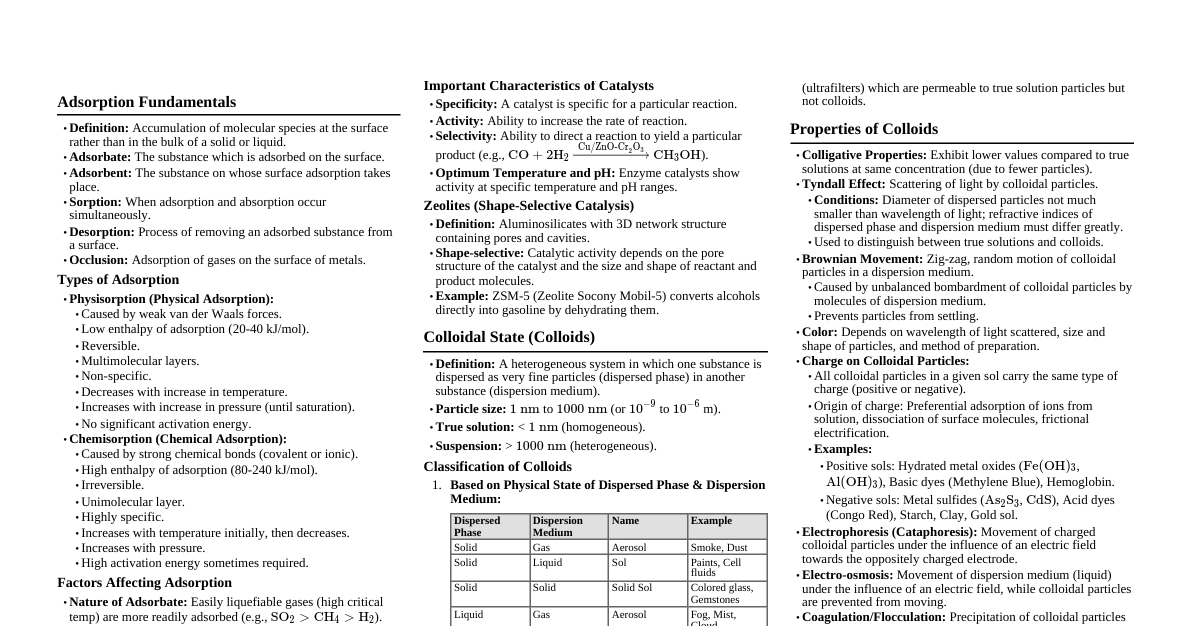
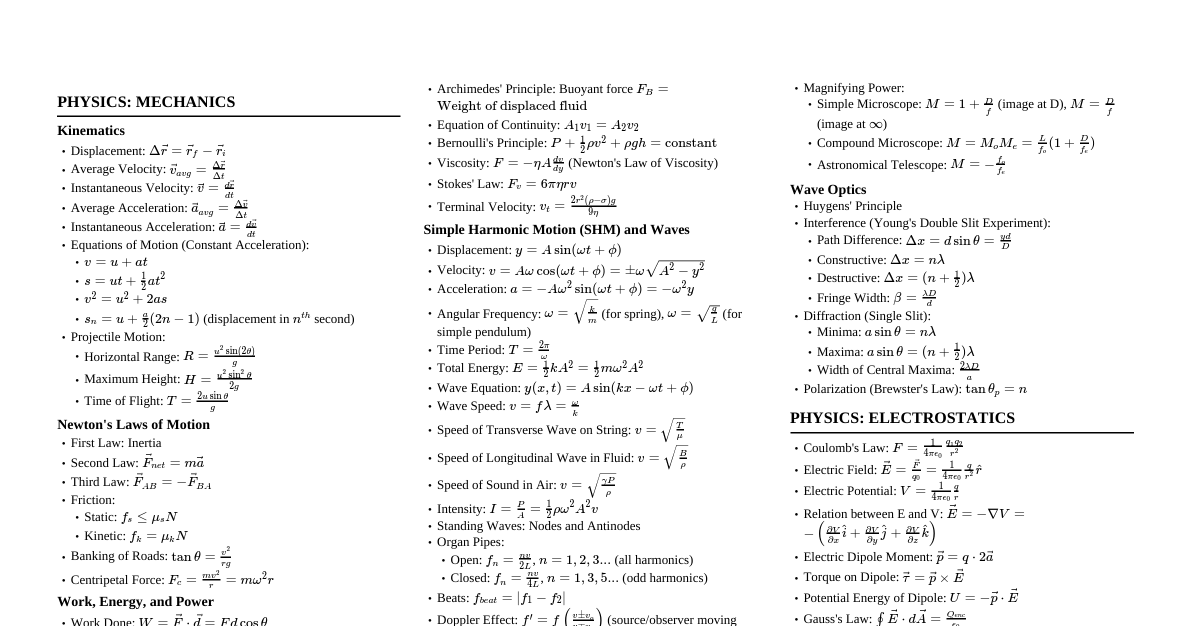
### Capacitors: Basics - **Definition:** A device that stores electrical energy in an electric field. - **Capacitance (C):** Ratio of charge (Q) to potential difference (V). $$ C = \frac{Q}{V} $$ - Unit: Farad (F) = Coulomb/Volt. Often in $\mu F$, $nF$, $pF$. - **Energy Stored (U):** $$ U = \frac{1}{2}CV^2 = \frac{1}{2}\frac{Q^2}{C} = \frac{1}{2}QV $$ - **Dielectric Strength:** Maximum electric field a dielectric can withstand without breakdown. ### Types of Capacitors - **Parallel Plate Capacitor:** $$ C = \frac{\epsilon A}{d} = \frac{K\epsilon_0 A}{d} $$ - $\epsilon_0$: Permittivity of free space ($8.85 \times 10^{-12} F/m$) - $K$: Dielectric constant of the material between plates ($K=1$ for vacuum/air) - $A$: Area of plates, $d$: Distance between plates. - **Spherical Capacitor:** - Outer sphere earthed: $C = 4\pi\epsilon_0 \frac{ab}{b-a}$ - Inner sphere earthed: $C = 4\pi\epsilon_0 \frac{b^2}{b-a}$ - Isolated sphere: $C = 4\pi\epsilon_0 R$ - **Cylindrical Capacitor:** $$ C = \frac{2\pi\epsilon_0 L}{\ln(b/a)} $$ - $L$: Length of cylinders, $a$: inner radius, $b$: outer radius. ### Capacitor Combinations - **Series Combination:** Charge (Q) is same across each capacitor. $$ \frac{1}{C_{eq}} = \frac{1}{C_1} + \frac{1}{C_2} + ... + \frac{1}{C_n} $$ - Voltage divides: $V = V_1 + V_2 + ...$ - **Parallel Combination:** Voltage (V) is same across each capacitor. $$ C_{eq} = C_1 + C_2 + ... + C_n $$ - Charge divides: $Q = Q_1 + Q_2 + ...$ ### Dielectrics - **Effect of Dielectric:** Increases capacitance by factor $K$. - $C' = KC$ - Electric field inside dielectric: $E' = E_0/K$ - Potential difference: $V' = V_0/K$ - If battery connected: Q increases, V constant. - If battery disconnected: Q constant, V decreases. - **Polarization:** Alignment of molecular dipoles in an external electric field. - **Polar Dielectrics:** Possess permanent dipole moments (e.g., water). - **Non-Polar Dielectrics:** Acquire dipole moments when external field applied (e.g., H2, O2). ### RC Circuits - **Charging of a Capacitor:** $$ Q(t) = Q_0(1 - e^{-t/RC}) $$ $$ V(t) = V_0(1 - e^{-t/RC}) $$ $$ I(t) = I_0 e^{-t/RC} $$ - **Discharging of a Capacitor:** $$ Q(t) = Q_0 e^{-t/RC} $$ $$ V(t) = V_0 e^{-t/RC} $$ $$ I(t) = -I_0 e^{-t/RC} $$ - **Time Constant ($\tau$):** $\tau = RC$. Time for charge/voltage to reach 63.2% of max or discharge to 36.8% of initial. ### Surface Chemistry: Basics - **Definition:** Branch of chemistry dealing with phenomena occurring at the interfaces or surfaces of phases. - **Key Phenomena:** Adsorption, Catalysis, Colloids. ### Adsorption - **Definition:** Accumulation of molecular species at the surface rather than in the bulk of a solid or liquid. - **Adsorbate:** Substance adsorbed. - **Adsorbent:** Substance on whose surface adsorption occurs. - **Absorption:** Penetration of molecules into the bulk of a solid or liquid. - **Sorption:** When both adsorption and absorption occur simultaneously. - **Desorption:** Removal of an adsorbed substance from a surface. - **Enthalpy of Adsorption ($\Delta H_{ads}$):** Always negative (exothermic process). - **Entropy of Adsorption ($\Delta S_{ads}$):** Always negative (restricted movement). - **Gibbs Free Energy ($\Delta G$):** $\Delta G = \Delta H - T\Delta S$. For spontaneous adsorption, $\Delta G$ must be negative. ### Types of Adsorption #### 1. Physisorption (Physical Adsorption) - **Forces:** Weak van der Waals forces. - **Nature:** Non-specific, reversible. - **Enthalpy:** Low ($20-40 \text{ kJ/mol}$). - **Layers:** Multimolecular. - **Effect of Temp:** Decreases with increasing temp. - **Effect of Pressure:** Increases with increasing pressure. - **Activation Energy:** Low. #### 2. Chemisorption (Chemical Adsorption) - **Forces:** Strong chemical bonds (covalent/ionic). - **Nature:** Highly specific, irreversible. - **Enthalpy:** High ($80-240 \text{ kJ/mol}$). - **Layers:** Unimolecular. - **Effect of Temp:** First increases, then decreases (requires activation energy). - **Effect of Pressure:** Increases with increasing pressure. - **Activation Energy:** High. ### Adsorption Isotherms - **Definition:** Relationship between the amount of adsorbate adsorbed on the adsorbent and pressure at a constant temperature. #### 1. Freundlich Adsorption Isotherm - **Equation:** $\frac{x}{m} = kP^{1/n}$ ($n>1$) - $x$: mass of adsorbate, $m$: mass of adsorbent. - $k, n$: constants. - **At low pressure:** $\frac{x}{m} \propto P$ - **At high pressure:** $\frac{x}{m}$ becomes independent of $P$ (saturation). - **In log form:** $\log \frac{x}{m} = \log k + \frac{1}{n}\log P$ #### 2. Langmuir Adsorption Isotherm - **Assumptions:** Adsorption is unimolecular, dynamic equilibrium, surface is homogeneous. - **Equation:** $\frac{x}{m} = \frac{aP}{1+bP}$ - $a, b$: constants. - **At low pressure:** $\frac{x}{m} \propto P$ - **At high pressure:** $\frac{x}{m} \approx \frac{a}{b}$ (saturation). ### Catalysis - **Catalyst:** Substance that alters the rate of a reaction without itself being consumed. - **Promoters:** Enhance activity of catalyst. - **Poisons:** Decrease activity of catalyst. - **Types of Catalysis:** - **Homogeneous:** Reactants and catalyst in same phase (e.g., acid-base catalysis). - **Heterogeneous:** Reactants and catalyst in different phases (e.g., Haber process, Ostwald process). - **Mechanism of Heterogeneous Catalysis:** 1. Diffusion of reactants to the catalyst surface. 2. Adsorption of reactants on the surface. 3. Chemical reaction on the catalyst surface. 4. Desorption of products from the surface. 5. Diffusion of products away from the surface. - **Enzyme Catalysis:** Biocatalysts, highly specific, high efficiency. ### Colloidal State - **Definition:** A heterogeneous system in which one substance is dispersed as very fine particles in another substance, called the dispersion medium. - **Particle Size:** $1 \text{ nm} - 1000 \text{ nm}$. - **True Solution:** < 1 nm (homogeneous). - **Suspension:** > 1000 nm (heterogeneous, particles settle). - **Phases:** - **Dispersed Phase (DP):** The substance distributed as colloidal particles. - **Dispersion Medium (DM):** The substance in which colloidal particles are dispersed. ### Classification of Colloids #### Based on Physical State of DP and DM | Dispersed Phase | Dispersion Medium | Name | Examples | |---|---|---|---| | Solid | Solid | Solid Sol | Colored glass, gemstones | | Solid | Liquid | Sol | Paint, cell fluids | | Solid | Gas | Aerosol | Smoke, dust | | Liquid | Solid | Gel | Cheese, butter, jellies | | Liquid | Liquid | Emulsion | Milk, hair cream | | Liquid | Gas | Aerosol | Fog, mist, cloud | | Gas | Solid | Solid Foam | Pumice stone, foam rubber | | Gas | Liquid | Foam | Froth, whipped cream | #### Based on Nature of Interaction between DP and DM 1. **Lyophilic Colloids (Solvent-Loving):** - Strong affinity between DP and DM. - Easily prepared, stable, reversible. - Examples: Gum, starch, proteins. 2. **Lyophobic Colloids (Solvent-Hating):** - Weak affinity between DP and DM. - Difficult to prepare, less stable, irreversible. - Examples: Metal sols, metal sulfide sols. #### Based on Type of Particles of DP 1. **Multimolecular Colloids:** Aggregation of many atoms/small molecules. (e.g., sulfur sol, gold sol). 2. **Macromolecular Colloids:** Large molecules (polymers) whose size is in colloidal range. (e.g., starch, nylon, proteins). 3. **Associated Colloids (Micelles):** Substances that behave as normal electrolytes at low conc. but form aggregates (micelles) at higher conc. (CMC - Critical Micelle Concentration). (e.g., soaps, detergents). ### Properties of Colloids - **Tyndall Effect:** Scattering of light by colloidal particles (visible path of light). - **Brownian Movement:** Zig-zag random motion of colloidal particles. - **Electrophoresis:** Movement of colloidal particles under applied electric field. - **Cataphoresis:** Movement towards cathode. - **Anaphoresis:** Movement towards anode. - **Coagulation/Flocculation:** Precipitation of colloidal particles. - **Hardy-Schulze Rule:** Greater the valency of the flocculating ion, greater is its coagulating power. - **Dialysis:** Process of removing dissolved substances from a colloidal solution by diffusion through a semi-permeable membrane. - **Peptization:** Process of converting a precipitate into a colloidal solution by shaking it with dispersion medium in presence of small amount of electrolyte (peptizing agent).