Health & Diseases
Cheatsheet Content
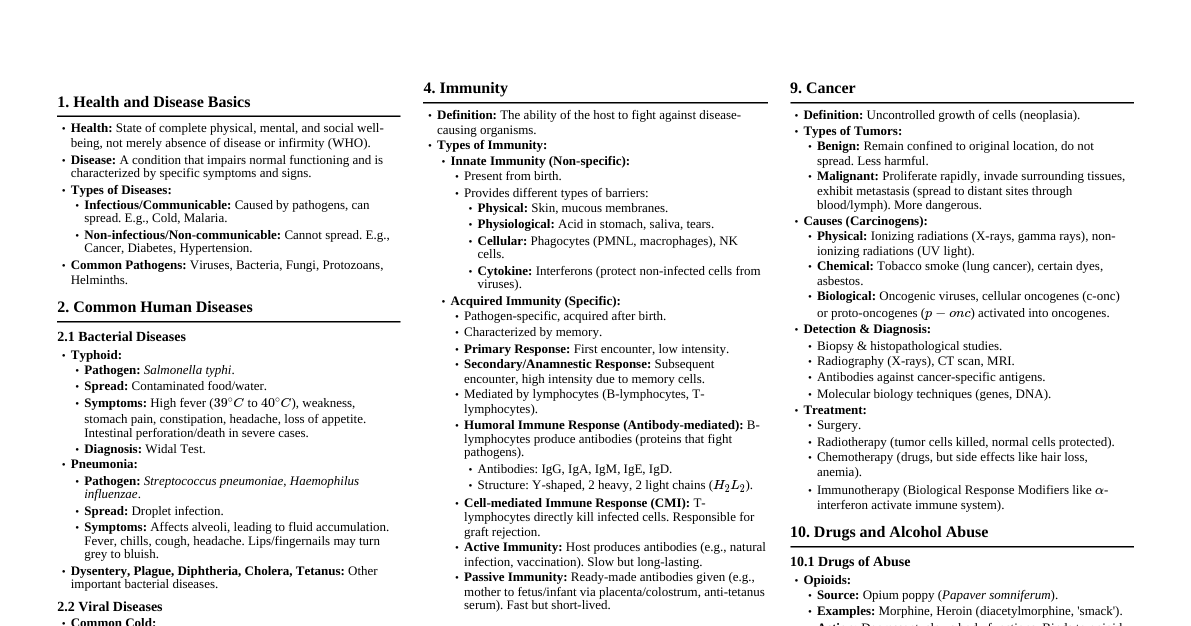
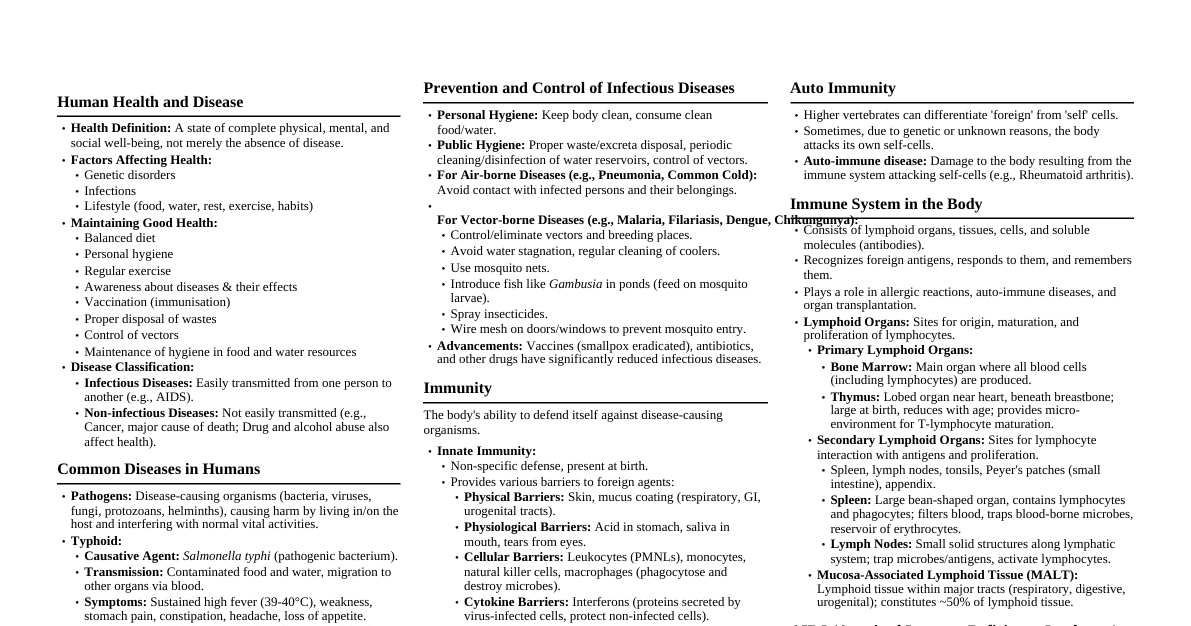
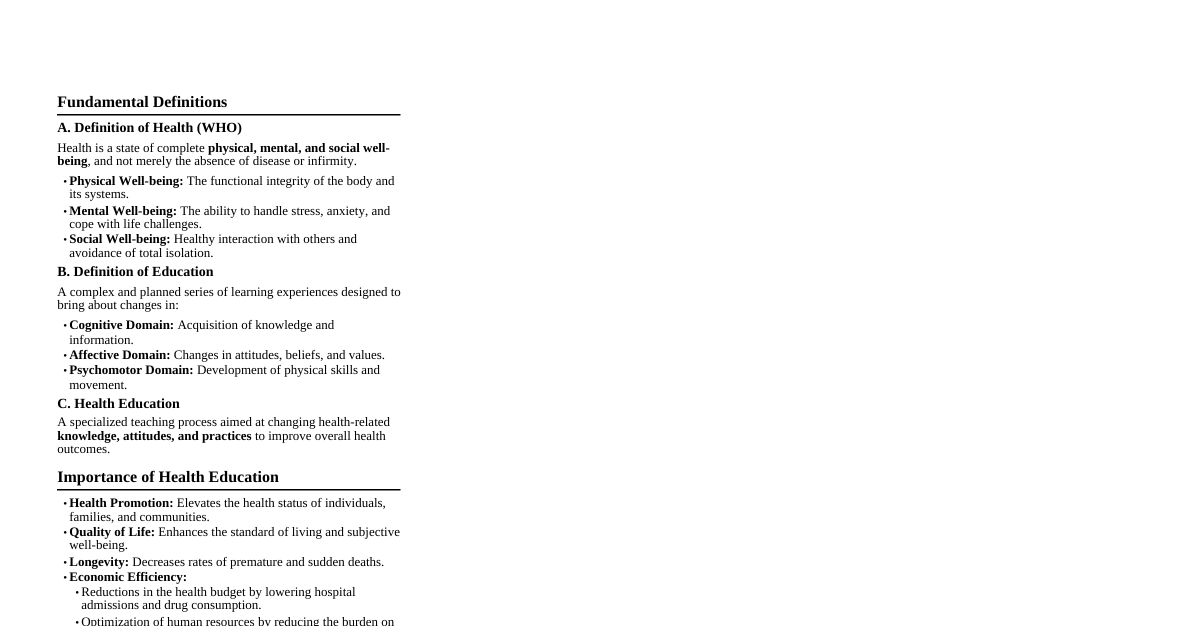
### Health: The Ultimate Treasure According to the **World Health Organization (WHO)**, health is defined as: “A state of complete physical, mental and social well-being and not merely the absence of disease or infirmity.” (WHO, 1948) ### How Can We Stay Healthy? Staying healthy means eating nutritious food, maintaining hygiene, staying in a clean place, exercising regularly, getting proper sleep, spending time with family and friends, and having a positive attitude. **Healthy Habits:** - Keep yourself clean and maintain personal hygiene. - Eat a healthy and balanced diet. - Exercise regularly. - Make time to relax or meditate every day. - Get enough sleep to help your body and mind rest and recover. - Practice yoga or simple breathing exercises like pranayama regularly. - Say 'NO' to harmful substances like tobacco, alcohol, and addictive drugs. **Unhealthy Habits to Avoid:** - Spending too much time on mobile phones or other digital screens. - Eating fast food and other junk food every day. - Sleeping very late or not getting enough sleep. - Skipping meals, especially breakfast. - Avoiding physical activity. - Excessive screen time. ### Ways We Know We Are Unwell? #### 1. Physical Symptoms These are changes we can feel or see in our body, such as: - Fever - Pain (headache, stomach pain, joint pain) - Cough, cold, sore throat - Vomiting or diarrhea - Fatigue or weakness - Loss of appetite - Swelling, rashes, etc. #### 2. Mental Symptoms Changes in thoughts or feelings, such as: - Stress or anxiety - Sadness or depression - Lack of concentration - Irritability or mood swings - Trouble sleeping #### 3. Social and Behavioral Changes - Not feeling like talking to others - Losing interest in daily activities - Poor performance in school or work - Staying isolated or inactive ### Factors Affecting Health #### 1. Genetic Factors (Heredity) - Diseases passed from parents (e.g., diabetes, hypertension, hemophilia) #### 2. Environmental Factors - Air, water, soil pollution - Climate, sanitation, living conditions #### 3. Lifestyle and Habits - Diet, exercise, sleep - Smoking, alcohol, drug abuse - Hygiene practices #### 4. Pathogens / Infectious Agents - Bacteria, viruses, fungi, parasites causing diseases (e.g., malaria, flu) ### Definition of Disease? A disease is a condition in which the normal functioning of the body or any of its parts is disturbed, leading to discomfort, dysfunction, or ill health. It is any abnormal state that impairs the body's ability to function properly. ### Types of Diseases with Examples Diseases can be classified in many ways. Here are the main types: #### 1. Infectious (Communicable) Diseases - Caused by pathogens like bacteria, viruses, fungi, parasites - Can spread from person to person - **Examples:** Tuberculosis (bacteria), COVID-19 (virus), Malaria (protozoa), Ringworm (fungus) #### 2. Non-Infectious (Non-Communicable) Diseases - Not caused by pathogens - Do NOT spread from person to person - **Examples:** Diabetes, Cancer, Hypertension, Asthma #### 3. Acute Diseases - Short duration, sudden onset - Patient recovers quickly - **Examples:** Common cold, Typhoid (if treated), Influenza #### 4. Chronic Diseases - Long-lasting, may stay for years or lifelong - Often affect lifestyle and organs - **Examples:** Diabetes, Arthritis, Kidney failure, HIV/AIDS #### 5. Congenital Diseases - Present since birth - Due to genetic defect or developmental issues - **Examples:** Hemophilia, Down syndrome, Heart defects at birth #### 6. Acquired Diseases - Develop after birth due to infection, lifestyle, etc. - **Examples:** AIDS (infection), Hypertension (lifestyle) #### 7. Deficiency Diseases - Caused due to lack of nutrients (vitamins, minerals, proteins) - **Examples:** Scurvy (Vitamin C deficiency), Rickets (Vitamin D deficiency), Anemia (Iron deficiency) #### 8. Mental Diseases - Affect brain and behavior - **Examples:** Depression, Anxiety disorder, Alzheimer's disease ### Definition of Pathogen? A pathogen is a disease-causing organism or agent that enters the body and disturbs normal body functions, leading to illness. It can be microscopic (like bacteria, viruses) or larger (like worms). ### Types of Pathogens with Examples | Type of Pathogen | Description | Examples of Diseases | | :--------------- | :--------------------------- | :----------------------------------- | | **1. Bacteria** | Single-celled microorganisms | Tuberculosis, Typhoid, Cholera | | **2. Virus** | Smallest infectious agents; need host cell to reproduce | COVID-19, HIV/AIDS, Common cold, Rabies | | **3. Fungi** | Can be unicellular or multicellular | Ringworm, Athlete's foot, Yeast infection | | **4. Protozoa** | Single-celled eukaryotic organisms | Malaria, Amoebiasis, Sleeping sickness | | **5. Helminths (Worms)** | Parasitic worms | Ascariasis, Tapeworm infection, Filariasis | | **6. Prions** | Infectious proteins (no DNA/RNA) | Mad cow disease, Creutzfeldt-Jakob disease | ### Difference Between Communicable and Non-Communicable Diseases | Feature | Communicable Diseases | Non-Communicable Diseases | | :---------- | :-------------------------------------------------- | :-------------------------------------------------- | | **Meaning** | Diseases that can spread from one person to another | Diseases that do not spread from person to person | | **Cause** | Caused by pathogens (bacteria, virus, fungi, protozoa, worms) | Caused by genetic factors, lifestyle, deficiency, or organ failure | | **Mode of Spread** | Spread through air, water, food, contact, vectors (mosquito, flies), etc. | Do not spread; remain limited to the person affected | | **Examples** | Tuberculosis, COVID-19, Malaria, Cholera, Chickenpox | Diabetes, Cancer, Hypertension, Asthma, Heart disease | | **Nature** | Mostly acute (short-term) but can also be chronic | Mostly chronic (long-term) conditions | | **Prevention** | Vaccination, sanitation, hygiene, vector control | Healthy lifestyle, balanced diet, exercise, regular checkup | | **Treatment** | Antibiotics, antivirals, antifungals, etc. | Long-term management, medicines, lifestyle changes | | **Agent Involved** | Pathogens (infectious agents) | No pathogen involved | ### Definition of Antigen? An antigen is any foreign substance (such as a protein, toxin, or microorganism) that enters the body and triggers an immune response. It stimulates the body to produce antibodies. **Examples of Antigens:** - Bacteria - Viruses - Pollen - Toxins - Transplanted tissues ### Definition of Antibody? An antibody is a protein produced by the body's immune system (specifically by B-lymphocytes) in response to an antigen. It helps in neutralizing, destroying, or removing the antigen from the body. **Other names:** Immunoglobulins (Ig) **Examples of Antibodies:** IgG IgM IgA IgE IgD ### Mode of Transmission Examples of Diseases | Disease | Causative Agent | Site of Infection | Type of Pathogen | Mode of Transmission | Prevention | Vector (if any) | | :-------------- | :------------------------ | :--------------------- | :--------------- | :--------------------- | :------------------------------- | :------------------- | | **Common Cold** | Rhinovirus | Nose, throat | Virus | Airborne droplets, direct contact | Hygiene, avoid close contact | No vector | | **Influenza (Flu)** | Influenza virus | Respiratory tract | Virus | Airborne droplets, contact | Flu vaccine, mask, hygiene | No vector | | **Measles** | Measles virus | Respiratory tract, skin | Virus | Airborne, coughing/sneezing | MMR vaccine | No vector | | **Chickenpox** | Varicella-zoster virus | Skin, respiratory tract | Virus | Airborne, contact with blisters | Varicella vaccine | No vector | | **Tuberculosis (TB)** | Mycobacterium tuberculosis | Lungs (main), other organs | Bacteria | Airborne droplets | BCG vaccine, avoid exposure | No vector | | **Hepatitis A** | Hepatitis A virus (HAV) | Liver | Virus | Contaminated food & water (fecal-oral) | Hepatitis A vaccine, clean water | No vector | | **Cholera** | Vibrio cholerae | Small intestine | Bacteria | Contaminated water/food | ORS, clean water, sanitation | No vector | | **Typhoid** | Salmonella typhi | Small intestine, blood | Bacteria | Contaminated food & water | Typhoid vaccine, hygiene | No vector | | **Ascariasis** | Ascaris lumbricoides | Intestine | Helminth (worm) | Contaminated soil/food | Deworming, sanitation | No vector | | **Malaria** | Plasmodium spp. | Liver & RBCs | Protozoa | Bite of infected female mosquito | Nets, repellents, control breeding | Female Anopheles mosquito | | **Dengue** | Dengue virus | Blood, immune cells | Virus | Mosquito bite | Remove stagnant water, nets | Aedes aegypti mosquito | | **Ringworm** | Trichophyton, Microsporum | Skin, hair, nails | Fungi | Direct contact, shared objects | Hygiene, antifungal cream | No vector | | **Pneumonia** | Streptococcus pneumoniae / Virus | Lungs (alveoli) | Bacteria/Virus | Airborne droplets | Pneumococcal vaccine, hygiene | No vector | | **Amoebiasis** | Entamoeba histolytica | Large intestine | Protozoa | Contaminated food & water | Boiled water, sanitation | No vector | ### Malaria: Types, Causative Agents, Life Cycle, Host, and Transmission #### Types of Malaria (Based on Plasmodium Species) | Plasmodium Species | Type of Malaria | Incubation Period | Severity | Special Features | | :----------------- | :----------------- | :---------------- | :---------- | :------------------------------------ | | **P. vivax** | Benign tertian malaria | 10-17 days | Mild to moderate | Recurrent relapse, infects young RBCs | | **P. falciparum** | Malignant tertian malaria | 9-14 days | Most dangerous, can be fatal | Cerebral malaria, kidney failure, infects all RBCs | | **P. malariae** | Quartan malaria | 18-30 days | Mild | Fever every 72 hrs (4th day) | | **P. ovale** | Mild tertian malaria | 16-18 days | Mild | Relapse possible | - **Most common in India:** *P. vivax* and *P. falciparum* - **Most fatal worldwide:** *P. falciparum* #### Causative Agent, Host & Vector | Role | Name | | :--------------------------- | :--------------------------- | | **Pathogen (Protozoan)** | *Plasmodium* spp. | | **Primary Host (Sexual reproduction)** | Female *Anopheles* mosquito | | **Secondary / Intermediate Host (Asexual reproduction)** | Human | | **Vector (Carrier)** | Female *Anopheles* mosquito | - Sexual cycle = in mosquito. Asexual cycle = in humans. - Only female mosquito feeds on blood (for egg development). #### Life Cycle of Plasmodium (Simplified) **In Mosquito (Sexual Cycle / Sporogony)** 1. Mosquito bites infected human $\rightarrow$ takes gametocytes in blood. 2. Gametocytes fuse $\rightarrow$ zygote (in stomach of mosquito). 3. Zygote becomes ookinete $\rightarrow$ penetrates stomach wall $\rightarrow$ forms oocyst. 4. Oocyst releases sporozoites. 5. Sporozoites migrate to salivary glands $\rightarrow$ mosquito becomes infective. - Next time mosquito bites a person $\rightarrow$ sporozoites enter human blood. **In Humans (Asexual Cycle / Schizogony)** **(A) Liver Stage – Exo-erythrocytic** - Sporozoites reach liver $\rightarrow$ form schizonts $\rightarrow$ release merozoites - No symptoms yet **(B) Blood Stage – Erythrocytic** - Merozoites enter RBCs $\rightarrow$ multiply $\rightarrow$ burst RBCs - Causes fever with chills (because RBCs burst in cycles) - Repeated RBC rupture $\rightarrow$ fever cycles - Some merozoites $\rightarrow$ form gametocytes $\rightarrow$ taken by mosquito #### Fever Pattern (Important for Exams) | Plasmodium | Fever Cycle | | :------------------ | :----------------------------- | | *P. vivax*, *P. falciparum*, *P. ovale* | Every 48 hours (Tertian fever) | | *P. malariae* | Every 72 hours (Quartan fever) | #### Symptoms of Malaria - High fever with chills & sweating - Headache, nausea, vomiting - Enlarged spleen & liver - Anemia (due to RBC destruction) - In *P. falciparum* $\rightarrow$ coma, organ failure (cerebral malaria) #### Prevention & Control - Mosquito nets, repellents - Remove stagnant water (breeding sites) - Antimalarial drugs: Chloroquine, Artemisinin, Quinine - Vaccination: RTS, S malaria vaccine. ### Mode of Transmission Examples of Diseases - **Air-borne:** Common cold, Influenza, Measles, Tuberculosis, COVID-19, Chickenpox - **Water-borne:** Cholera, Typhoid, Hepatitis A, Amoebiasis, Giardiasis - **Food-borne:** Food poisoning (Salmonella), Botulism, Tapeworm infection, Typhoid, Listeriosis - **Vector-borne:** Malaria (mosquito), Dengue (mosquito), Plague (rat flea), Sleeping sickness (tsetse fly), Chikungunya (mosquito), Kala-azar (sandfly) - **Direct contact:** Ringworm, Scabies, Chickenpox. #### Examples of vectors and the diseases they spread: - **Female *Anopheles* mosquito** – spreads Malaria - **Aedes mosquito** – spreads Dengue, Chikungunya, Zika virus, Yellow fever - **Culex mosquito** – spreads Filariasis (Elephantiasis) and Japanese Encephalitis - **Sandfly** – spreads Kala-azar (Leishmaniasis) - **Tsetse fly** - spreads Sleeping sickness (African Trypanosomiasis) - **Housefly** - spreads Cholera, Typhoid, Dysentery (mechanical carrier). ### How to Prevent Infectious Diseases? #### 1. Personal Hygiene - Wash hands regularly with soap - Bathe daily - Cover mouth when coughing or sneezing - Do not share personal items (razor, toothbrush) #### 2. Safe Food & Water Practices - Drink clean, boiled, or filtered water - Eat properly cooked food - Wash fruits and vegetables before eating - Avoid street food during outbreaks #### 3. Vaccination (Immunization) - Get vaccines for diseases like measles, polio, hepatitis B, COVID-19, etc. #### 4. Control of Vectors - Use mosquito nets and repellents - Remove stagnant water (mosquito breeding) - Spray insecticides where needed #### 5. Safe Blood & Injections - Use only sterilized needles and syringes - Ensure screened (tested) blood transfusion #### 6. Isolation of Infected Persons - Avoid close contact with sick people - Use masks and protective equipment during outbreaks. ### Main Causes of Non-Communicable Diseases? #### 1. Genetic / Hereditary Factors - Passed from parents to children through genes - **Example:** Diabetes type-1, Sickle cell anemia, Thalassemia, Hemophilia #### 2. Unhealthy Lifestyle - Poor eating habits (junk food, high sugar, high fat) - Lack of physical activity - Smoking, alcohol, drug use - **Example:** Obesity, Diabetes type-2, Hypertension, Heart disease #### 3. Environmental Factors - Pollution (air, water, soil) - Chemicals, radiation, toxins - **Example:** Lung cancer due to smoking or pollution, Skin cancer due to UV rays #### 4. Ageing - Body organs weaken with age - **Example:** Osteoporosis, Alzheimer's disease, Cataract #### 5. Nutritional Deficiency - Lack of essential nutrients like vitamins, minerals, proteins - **Example:** - Iron deficiency $\rightarrow$ Anemia - Vitamin D deficiency $\rightarrow$ Rickets - Iodine deficiency $\rightarrow$ Goitre #### 6. Hormonal Imbalance - Problems in glands / endocrine system - **Example:** Hypothyroidism, Diabetes (insulin disorder) ### What is Immunity? Immunity is the ability of the body to resist or fight against disease-causing organisms (pathogens) like bacteria, viruses, fungi, parasites, etc. It is the defense system of our body. ### Types of Immunity Immunity is mainly of two types: #### 1. Innate Immunity (Natural / Inborn Immunity) - Present from birth - Non-specific (acts against all pathogens) - Works immediately - **Example:** Skin, tears, saliva, stomach acid, phagocytic WBCs **Components of Innate Immunity:** 1. **Physical barriers** – skin, hairs, mucous 2. **Physiological barriers** – HCl in stomach, saliva, tears 3. **Cellular barriers** – WBCs like macrophages, neutrophils 4. **Cytokines & chemicals** – interferons, complement proteins #### 2. Acquired Immunity (Adaptive / Specific Immunity) - Develops after birth - Specific to a particular pathogen - Has memory (faster response on second attack) **Types of Acquired Immunity:** | Type | Natural / Artificial | Active / Passive | Example | | :------------------- | :------------------- | :--------------- | :-------------------------------- | | **Natural Active** | Natural | Active | Infection (e.g., chickenpox) | | **Natural Passive** | Natural | Passive | Antibodies from mother to baby (placenta, breast milk) | | **Artificial Active** | Artificial | Active | Vaccination | | **Artificial Passive** | Artificial | Passive | Injected antibodies (antiserum, anti-venom) | ### What is Acquired Immunity? Acquired immunity (also called adaptive or specific immunity) is the type of immunity that develops after birth when the body is exposed to a pathogen or receives antibodies from an external source. It is highly specific, has memory, and gives long-term protection. #### Key Characteristics of Acquired Immunity | Feature | Description | | :-------------- | :---------------------------------------------- | | **Specificity** | Works against a particular pathogen | | **Memory** | Faster & stronger response on second exposure | | **Slow to develop** | Takes time after first infection | | **Involves** | Lymphocytes B-cells & T-cells | | **Antibody production** | Done by plasma cells | #### Types of Acquired Immunity Acquired immunity is divided into two main types: #### 1. Active Immunity - Body produces its own antibodies - Long-lasting (may last for years or lifetime) - Develops after natural infection or vaccination **Types of Active Immunity:** | Type | How it develops | Example | | :------------------- | :--------------------------- | :---------------------------------- | | **Natural Active Immunity** | After natural infection | Chickenpox, measles infection | | **Artificial Active Immunity** | After vaccination | Polio vaccine, COVID vaccine, Hepatitis B vaccine | #### 2. Passive Immunity - Ready-made antibodies are given from outside - Immediate protection but short-lasting - Body does not produce antibodies itself **Types of Passive Immunity:** | Type | How it develops | Example | | :------------------- | :----------------------------------- | :---------------------------------- | | **Natural Passive Immunity** | Mother $\rightarrow$ baby (placenta, breast milk) | IgG through placenta, IgA in milk | | **Artificial Passive Immunity** | Injection of antibodies | Anti-rabies serum, anti-tetanus serum, anti-venom for snake bite | #### Difference Between Active and Passive Immunity. | Feature | Active Immunity | Passive Immunity | | :------------ | :------------------------------------ | :--------------------------------------- | | **Antibody source** | Produced by own body | Given from outside | | **Response time** | Slow | Immediate | | **Duration** | Long-lasting (months-years) | Short-lived (few weeks) | | **Memory** | Present | Absent | | **Example** | Vaccination | Anti-rabies injection | #### Cells Involved in Acquired Immunity | Cell Type | Function | | :---------------------------- | :-------------------------------------------- | | **B-lymphocytes (B-cells)** | Produce antibodies (humoral immunity) | | **T-lymphocytes (T-cells)** | Destroy infected cells (cell-mediated immunity) | | **Memory cells** | Store memory of pathogen for future response | #### Types of Acquired Immune Response | Type | Description | Example | | :------------------------ | :-------------------------------------------- | :------------------------------------ | | **Humoral immunity** | Antibodies in blood (B-cells) | Vaccines, antitoxins | | **Cell-mediated immunity** | T-cells attack infected or cancerous cells | Organ rejection, viral infection defense | #### Antibodies in Acquired Immunity | Antibody Type | Location / Function | | :------------ | :-------------------------------------------- | | **IgG** | Most abundant, crosses placenta (passive immunity) | | **IgA** | Present in milk, saliva, tears, mucus | | **IgM** | First antibody produced during infection | | **IgE** | Allergic reactions, anti-parasitic | | **IgD** | On surface of B-cells (activation role) | ### What is an Antibody? An antibody (also called immunoglobulin / Ig) is a Y-shaped protein produced by B-lymphocytes (plasma cells) in response to a foreign substance (antigen). Its main function is to recognize, bind, and neutralize pathogens like bacteria, viruses, and toxins. #### Chemical Nature - Protein in nature - Made of 4 polypeptide chains - 2 heavy chains (H-chains) - 2 light chains (L-chains) - Chains are held by disulfide bonds #### Structure of Antibody - Y-shaped #### Functions of Antibodies 1. **Neutralization** – binds to toxins/viruses and blocks them 2. **Agglutination** – clumps pathogens together 3. **Opsonization** – marks pathogens for destruction by phagocytes 4. **Complement activation** – destroys pathogen cell membrane 5. **Antibody-dependent killing** – helps NK cells destroy infected cells 6. **Prevents attachment** of pathogens to host cells ### What is Vaccination? Vaccination is a medical process in which a person is given a vaccine to develop immunity against a specific disease. It is a method of artificially inducing acquired active immunity. #### What is a Vaccine? A vaccine is a biological preparation that contains: - Weakened (attenuated) pathogens - Killed (inactivated) pathogens - Toxoids (inactive toxins) - Parts of pathogens (proteins, antigens, subunits, mRNA, etc.) These do not cause disease, but they stimulate the immune system to produce antibodies and memory cells. #### How Vaccination Works (Mechanism): 1. Vaccine enters the body 2. Immune system identifies antigens as foreign 3. B-lymphocytes produce antibodies against that antigen 4. Memory cells are formed 5. If the real pathogen attacks later $\rightarrow$ immune system responds rapidly and prevents disease #### Types of Vaccines: | Type | Contains | Example | | :------------------------ | :------------------------------------------ | :------------------------------------ | | **Live attenuated** | Weakened living microbe | MMR (Measles, Mumps, Rubella), BCG | | **Killed / Inactivated** | Dead pathogen | Polio (IPV), Hepatitis A | | **Toxoid** | Inactivated toxins | Tetanus, Diphtheria | | **Subunit / Recombinant** | Only antigenic parts | Hepatitis B, HPV | | **mRNA vaccine** | mRNA that makes viral protein inside body | COVID-19 (Pfizer, Moderna) | | **Vector-based vaccine** | Harmless virus carrying antigen gene | Covishield, Johnson & Johnson | #### Examples of Common Vaccines: - BCG – Tuberculosis - DPT – Diphtheria, Pertussis, Tetanus - Hepatitis B Vaccine - Polio Vaccine (OPV / IPV) - COVID-19 vaccines (Covaxin, Covishield, Pfizer, Moderna) - MMR vaccine – Measles, Mumps, Rubella - HPV vaccine – Cervical cancer prevention #### Who Discovered Vaccination? - **Edward Jenner (1796)** – first vaccine against Smallpox using Cowpox virus. - **Louis Pasteur & Development of Modern Vaccines** - Improved Jenner's work using attenuation (weakening microbes) - Created vaccines for: - Rabies - Anthrax - Chicken cholera ### Antibiotic – Detailed Explanation #### Definition An antibiotic is a chemical substance (naturally obtained or synthetically made) that kills or inhibits the growth of disease-causing bacteria without harming human cells. - Work only against bacteria, not viruses (so they do NOT cure cold, flu, dengue, measles, COVID, etc.) #### Discovery of Antibiotics | Scientist | Discovery | Year | Source | | :------------------ | :---------------------------- | :--- | :------------------------------- | | **Alexander Fleming** | First antibiotic – Penicillin | 1928 | Mold *Penicillium notatum* | | **Howard Florey & Ernst Chain** | Developed penicillin into medicine | 1940s | Mass production in WWII | - Fleming called penicillin “mold juice” at first - It saved millions of soldiers during World War II #### How Antibiotics Work? (Modes of Action) 1. **Inhibit cell wall synthesis** $\rightarrow$ bacteria burst - **Example:** Penicillin, Cephalosporins 2. **Inhibit protein synthesis** $\rightarrow$ bacteria can't make enzymes - **Example:** Tetracycline, Erythromycin 3. **Inhibit DNA/RNA synthesis** - **Example:** Ciprofloxacin, Rifampicin 4. **Disrupt cell membrane** - **Example:** Polymyxin 5. **Block metabolic pathways** - **Example:** Sulfonamides (antimetabolites) #### Types of Antibiotics **Based on Spectrum** | Type | Meaning | Example | | :---------------- | :------------------------- | :----------------------------- | | **Narrow spectrum** | Works on few bacteria | Penicillin (Gram + only) | | **Broad spectrum** | Works on many bacteria | Tetracycline, Amoxicillin | ### How Bacteria Become Resistant to Antibiotics? (Detailed Explanation) Antibiotic resistance means bacteria change in such a way that antibiotics no longer work against them. #### Main Ways Bacteria Become Resistant 1. **Mutation (Natural genetic change)** - Bacteria reproduce very fast - Random mutation in DNA $\rightarrow$ makes some bacteria resistant - Antibiotic kills normal bacteria, but mutated ones survive and multiply - **Example:** TB bacteria becoming resistant to Rifampicin 2. **Gene Transfer (Borrowing resistance from other bacteria)** - Bacteria can share resistance genes with each other through: | Process | How it Happens | | :---------------- | :------------------------------------------------ | | **Conjugation** | One bacteria transfers plasmid (DNA) to another through a tube-like structure (pilus) | | **Transformation** | Bacteria pick up resistance genes from dead bacteria around them | | **Transduction** | Virus (bacteriophage) transfers genes from one bacteria to another | 3. **Overuse / Misuse of Antibiotics in Humans** - Taking antibiotics for common cold (viral) - Not completing full course - Using leftover / self-medication - Taking antibiotics without prescription - This leaves some bacteria alive $\rightarrow$ they become stronger #### Antibiotics Used in Animals & Poultry - Animals are given antibiotics to grow faster - Resistant bacteria develop in animals $\rightarrow$ spread to humans through meat, milk, environment #### How Antibiotic Resistance Spreads in the Community Antibiotic-resistant bacteria spread just like normal bacteria, but they are harder to kill because antibiotics no longer work on them. Once a person, animal, or environment carries resistant bacteria, they can easily spread to others. #### Ways Antibiotic Resistance Spreads in a Community 1. **Person-to-Person Contact** - Touching infected person - Sharing towels, utensils, soap, clothes, phones - Coughing, sneezing (airborne bacteria) - **Example:** MRSA spreading in schools, gyms, hospitals 2. **Through Food and Animals** - Meat, eggs, milk from animals treated with antibiotics - Resistant bacteria survive in food $\rightarrow$ enter human gut - Poorly cooked meat spreads resistant bacteria - Animal waste in soil/water $\rightarrow$ crops get contaminated - **Example:** Resistant *Salmonella* and *E. coli* from poultry & cattle 3. **Through Water and Sewage** - Hospital waste, human stool, animal waste contain resistant bacteria - If not treated properly $\rightarrow$ mixes with drinking water or rivers - People using contaminated water get resistant infection - **Example:** Typhoid and cholera with resistant strains 4. **Through Hospitals & Clinics (Nosocomial Spread)** - Patients using many antibiotics $\rightarrow$ "superbugs" develop - Spread through unclean hands, instruments, bedsheets, catheter, IV lines - **Example:** Hospital-acquired MRSA, VRE, MDR-TB 5. **Travel & Global Spread** - A person carrying resistant bacteria can travel to another city/country - Within hours, bacteria can reach new populations - **Example:** NDM-1 resistant bacteria first found in India $\rightarrow$ spread to UK 6. **Through Touching Contaminated Surfaces** - Door handles, money, mobile phones, taps, bus seats, toilets - Bacteria stay alive for hours to days ### What is Cancer? Cancer is a disease in which cells divide uncontrollably and do not stop growing, forming a mass called a tumor. It is caused by uncontrolled cell division due to mutation in DNA. #### Normal Cell vs Cancer Cell | Normal Cell | Cancer Cell | | :-------------------------- | :------------------------------------ | | Divides in a controlled way | Divides rapidly & uncontrollably | | Follows cell cycle rules | Ignores cell cycle control | | Dies after lifespan (apoptosis) | Does not die $\rightarrow$ immortal | | Stays in one place | Can spread to other body parts | #### Types of Tumors #### 1. Benign Tumor - Non-cancerous - Does not spread - **Example:** Warts, lipoma #### 2. Malignant Tumor - Cancerous - Spreads to other organs (metastasis) - Damages tissues and organs #### Metastasis - Process by which cancer cells spread from one part of the body to another through blood or lymph. - Main reason cancer becomes dangerous. #### Causes / Risk Factors of Cancer - **Genetic mutations** (inherited or acquired) - **Carcinogens (cancer-causing substances):** - Tobacco (smoking, chewing) $\rightarrow$ Lung, mouth cancer - Alcohol $\rightarrow$ Liver, throat cancer - Radiation (UV rays, X-rays) $\rightarrow$ Skin cancer - Chemicals (asbestos, benzene, dyes) - **Virus-induced cancer (Oncogenic viruses):** - HPV $\rightarrow$ Cervical cancer - Hepatitis B & C $\rightarrow$ Liver cancer - **Unhealthy lifestyle:** junk food, no exercise - **Hormonal imbalance** - **Obesity** - **Ageing** (older cells = more mutation) #### Types of Cancer (Based on Tissue of Origin) | Type | Origin | Example | | :------------- | :------------------------------------- | :----------------------------------- | | **Carcinoma** | Epithelial tissue | Breast, lung, stomach cancer | | **Sarcoma** | Connective tissue (bone, muscle) | Bone cancer (osteosarcoma) | | **Leukemia** | Blood & bone marrow | Blood cancer | | **Lymphoma** | Lymph nodes/immune system | Hodgkin lymphoma | | **Melanoma** | Pigment cells (melanocytes) | Skin cancer | #### Common Symptoms of Cancer - Lump or swelling - Unexplained weight loss - Persistent fatigue - Unusual bleeding - Change in mole/skin patch - Long-lasting cough or hoarseness - Changes in bowel/bladder habits #### Diagnosis of Cancer - Biopsy (most reliable) - Blood tests (ex: leukemia) - CT scan, MRI, X-ray - Endoscopy - Pap smear (cervical cancer) - PSA test (prostate cancer) #### Treatment of Cancer | Method | Description | | :--------------- | :----------------------------------- | | **Surgery** | Removes tumor physically | | **Radiotherapy** | Uses radiation to kill cells | | **Chemotherapy** | Uses drugs to stop cell division | | **Immunotherapy** | Boosts body's immune system | | **Hormone Therapy** | Stops hormone-dependent cancer | | **Targeted Therapy** | Drugs attack cancer cells only | #### Prevention of Cancer - Avoid smoking & alcohol - Healthy diet (fruits, vegetables, fibre) - Regular exercise & weight control - Vaccination (HPV, Hepatitis B) - Avoid excessive sunlight (UV rays) - Regular screening tests: - Mammography (breast) - Pap smear (cervix) - Colonoscopy (colon)