Multi-Variable Calculus Essentials
Cheatsheet Content
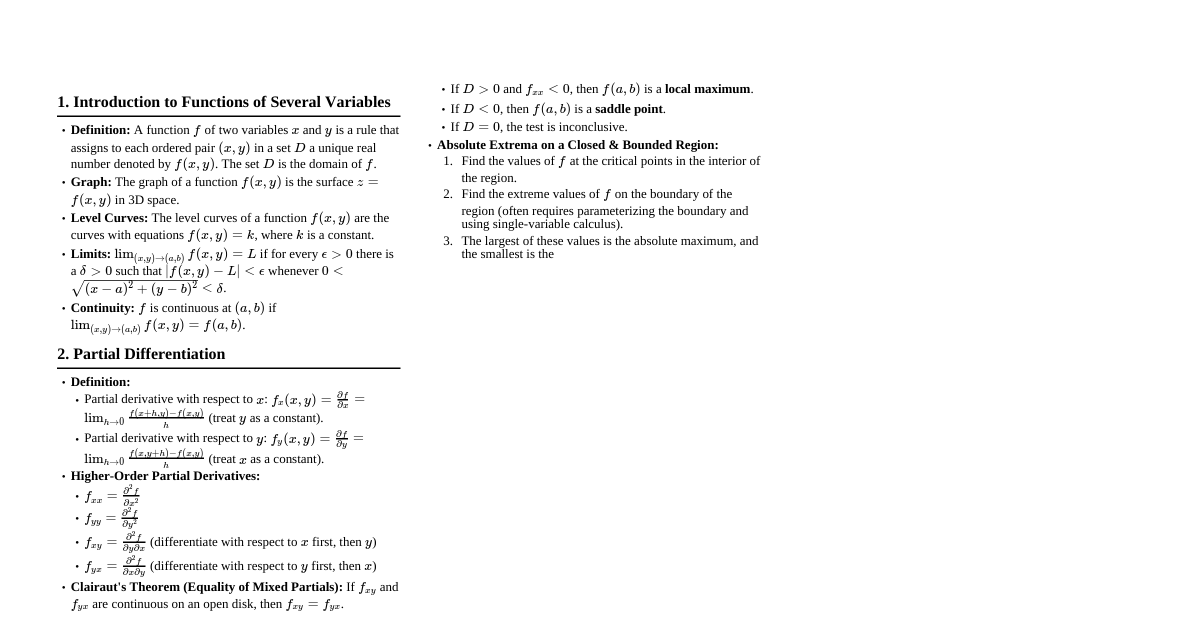
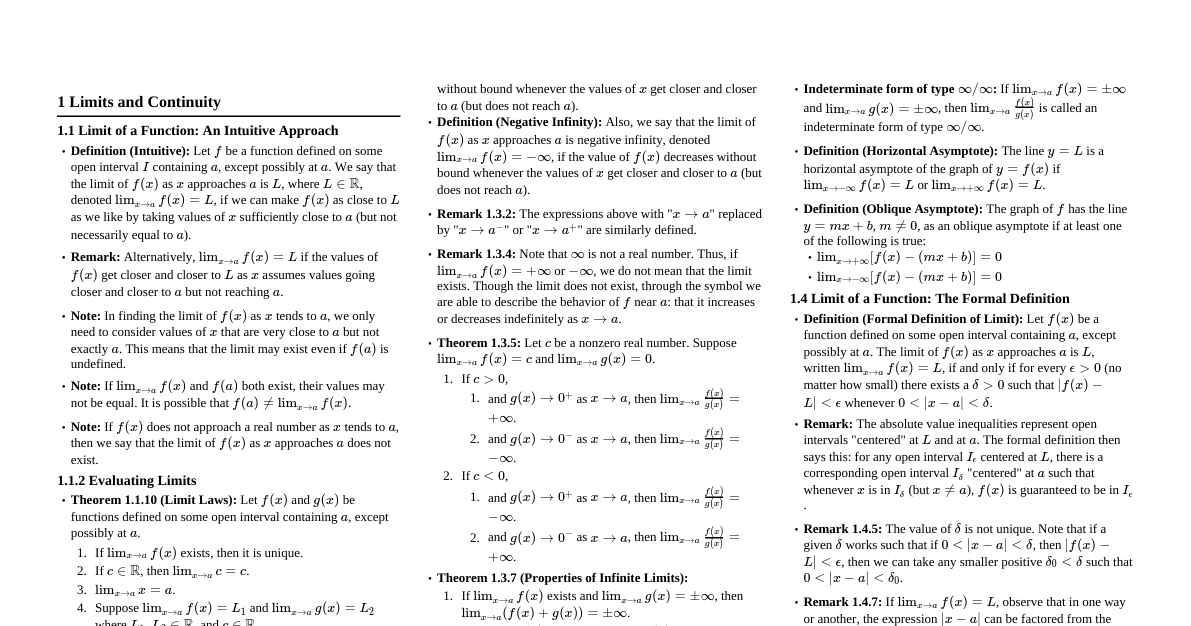
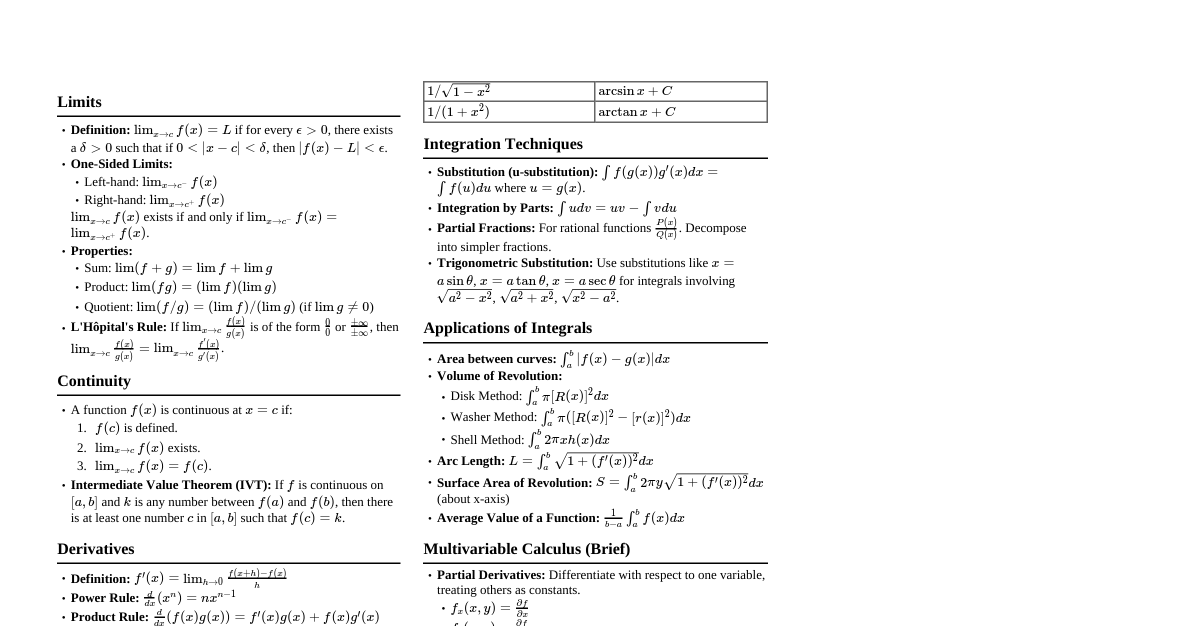
Limits and Continuity Evaluating Limits Limit of a multi-variable function $f(x,y)$ as $(x,y) \to (a,b)$ To evaluate, substitute $(a,b)$ if the function is continuous. If direct substitution leads to an indeterminate form (e.g., $0/0$), try algebraic manipulation, polar coordinates, or approaching along different paths ($y=mx$, $y=mx^2$). Example: $\lim_{(x,y) \to (1,2)} \frac{2x^2y}{x^2+y^2+1}$ Substitute: $\frac{2(1)^2(2)}{(1)^2+(2)^2+1} = \frac{4}{1+4+1} = \frac{4}{6} = \frac{2}{3}$ Example: $\lim_{(x,y) \to (0,0)} \frac{x-y}{2x+y}$ Along $y=mx$: $\lim_{x \to 0} \frac{x-mx}{2x+mx} = \lim_{x \to 0} \frac{x(1-m)}{x(2+m)} = \frac{1-m}{2+m}$ Since the limit depends on $m$, the limit does not exist. Continuity of a Function A function $f(x,y)$ is continuous at $(a,b)$ if: $f(a,b)$ is defined. $\lim_{(x,y) \to (a,b)} f(x,y)$ exists. $\lim_{(x,y) \to (a,b)} f(x,y) = f(a,b)$. Example: Discuss continuity of $f(x,y) = \begin{cases} \frac{2xy}{x^2+y^2} & (x,y) \neq (0,0) \\ 0 & (x,y) = (0,0) \end{cases}$ at $(0,0)$. $f(0,0)=0$ (defined). Check limit along $y=mx$: $\lim_{x \to 0} \frac{2x(mx)}{x^2+(mx)^2} = \lim_{x \to 0} \frac{2m x^2}{x^2(1+m^2)} = \frac{2m}{1+m^2}$. Since the limit depends on $m$, the limit does not exist. Thus, $f(x,y)$ is not continuous at $(0,0)$. Partial Differentiation Definitions For a function $f(x,y)$: Partial derivative with respect to $x$: $\frac{\partial f}{\partial x}$ (treat $y$ as a constant). Partial derivative with respect to $y$: $\frac{\partial f}{\partial y}$ (treat $x$ as a constant). Higher-Order Partial Derivatives $\frac{\partial^2 f}{\partial x^2} = \frac{\partial}{\partial x} \left(\frac{\partial f}{\partial x}\right)$ $\frac{\partial^2 f}{\partial y^2} = \frac{\partial}{\partial y} \left(\frac{\partial f}{\partial y}\right)$ Mixed partial derivatives: $\frac{\partial^2 f}{\partial x \partial y} = \frac{\partial}{\partial x} \left(\frac{\partial f}{\partial y}\right)$ and $\frac{\partial^2 f}{\partial y \partial x} = \frac{\partial}{\partial y} \left(\frac{\partial f}{\partial x}\right)$. Clairaut's Theorem: If $\frac{\partial^2 f}{\partial x \partial y}$ and $\frac{\partial^2 f}{\partial y \partial x}$ are continuous, then $\frac{\partial^2 f}{\partial x \partial y} = \frac{\partial^2 f}{\partial y \partial x}$. Chain Rule for Multi-variable Functions If $z = f(x,y)$ and $x = g(t)$, $y = h(t)$, then $\frac{dz}{dt} = \frac{\partial z}{\partial x}\frac{dx}{dt} + \frac{\partial z}{\partial y}\frac{dy}{dt}$. If $z = f(x,y)$ and $x = g(s,t)$, $y = h(s,t)$, then: $\frac{\partial z}{\partial s} = \frac{\partial z}{\partial x}\frac{\partial x}{\partial s} + \frac{\partial z}{\partial y}\frac{\partial y}{\partial s}$ $\frac{\partial z}{\partial t} = \frac{\partial z}{\partial x}\frac{\partial x}{\partial t} + \frac{\partial z}{\partial y}\frac{\partial y}{\partial t}$ Homogeneous Functions A function $f(x,y)$ is homogeneous of degree $n$ if $f(tx,ty) = t^n f(x,y)$. Euler's Theorem for Homogeneous Functions: If $f(x,y)$ is a homogeneous function of degree $n$, then $x\frac{\partial f}{\partial x} + y\frac{\partial f}{\partial y} = n f$. For three variables $f(x,y,z)$: $x\frac{\partial f}{\partial x} + y\frac{\partial f}{\partial y} + z\frac{\partial f}{\partial z} = n f$. Jacobians Definition If $u=f(x,y)$ and $v=g(x,y)$ are two functions of $x$ and $y$, the Jacobian of $u,v$ with respect to $x,y$ is: $$J = \frac{\partial(u,v)}{\partial(x,y)} = \begin{vmatrix} \frac{\partial u}{\partial x} & \frac{\partial u}{\partial y} \\ \frac{\partial v}{\partial x} & \frac{\partial v}{\partial y} \end{vmatrix} = \frac{\partial u}{\partial x}\frac{\partial v}{\partial y} - \frac{\partial u}{\partial y}\frac{\partial v}{\partial x}$$ For three variables $u(x,y,z), v(x,y,z), w(x,y,z)$: $$J = \frac{\partial(u,v,w)}{\partial(x,y,z)} = \begin{vmatrix} \frac{\partial u}{\partial x} & \frac{\partial u}{\partial y} & \frac{\partial u}{\partial z} \\ \frac{\partial v}{\partial x} & \frac{\partial v}{\partial y} & \frac{\partial v}{\partial z} \\ \frac{\partial w}{\partial x} & \frac{\partial w}{\partial y} & \frac{\partial w}{\partial z} \end{vmatrix}$$ Properties of Jacobians If $u,v$ are functions of $x,y$ and $x,y$ are functions of $s,t$: $$\frac{\partial(u,v)}{\partial(s,t)} = \frac{\partial(u,v)}{\partial(x,y)} \frac{\partial(x,y)}{\partial(s,t)}$$ If $J = \frac{\partial(u,v)}{\partial(x,y)}$ and $J' = \frac{\partial(x,y)}{\partial(u,v)}$, then $J \cdot J' = 1$. Functionally Dependent: If $J = \frac{\partial(u,v)}{\partial(x,y)} = 0$, then $u$ and $v$ are functionally dependent (one can be expressed as a function of the other). Maxima and Minima of Functions of Two Variables Procedure Find $\frac{\partial f}{\partial x}$ and $\frac{\partial f}{\partial y}$. Set $\frac{\partial f}{\partial x} = 0$ and $\frac{\partial f}{\partial y} = 0$ to solve for critical points $(a,b)$. Calculate the second partial derivatives: $A = \frac{\partial^2 f}{\partial x^2}$ $B = \frac{\partial^2 f}{\partial x \partial y}$ $C = \frac{\partial^2 f}{\partial y^2}$ Evaluate $AC - B^2$ at each critical point $(a,b)$. If $AC - B^2 > 0$ and $A > 0$: Local Minimum. If $AC - B^2 > 0$ and $A If $AC - B^2 If $AC - B^2 = 0$: Test is inconclusive. Lagrange Multipliers Method for Constrained Optimization To find the maximum or minimum of $f(x,y,z)$ subject to the constraint $g(x,y,z) = k$: Form the Lagrangian function: $L(x,y,z,\lambda) = f(x,y,z) - \lambda g(x,y,z)$. (Some use $L = f + \lambda g$) Find the partial derivatives of $L$ with respect to $x, y, z,$ and $\lambda$: $\frac{\partial L}{\partial x} = \frac{\partial f}{\partial x} - \lambda \frac{\partial g}{\partial x} = 0 \implies \frac{\partial f}{\partial x} = \lambda \frac{\partial g}{\partial x}$ $\frac{\partial L}{\partial y} = \frac{\partial f}{\partial y} - \lambda \frac{\partial g}{\partial y} = 0 \implies \frac{\partial f}{\partial y} = \lambda \frac{\partial g}{\partial y}$ $\frac{\partial L}{\partial z} = \frac{\partial f}{\partial z} - \lambda \frac{\partial g}{\partial z} = 0 \implies \frac{\partial f}{\partial z} = \lambda \frac{\partial g}{\partial z}$ $\frac{\partial L}{\partial \lambda} = -g(x,y,z) = 0 \implies g(x,y,z) = k$ Solve this system of equations for $x, y, z,$ and $\lambda$. Substitute the obtained $(x,y,z)$ values into $f(x,y,z)$ to find the maximum/minimum values. Alternative (equivalent) system: $\nabla f = \lambda \nabla g$ and $g(x,y,z)=k$.