Multivariate Calculus Essentials
Cheatsheet Content
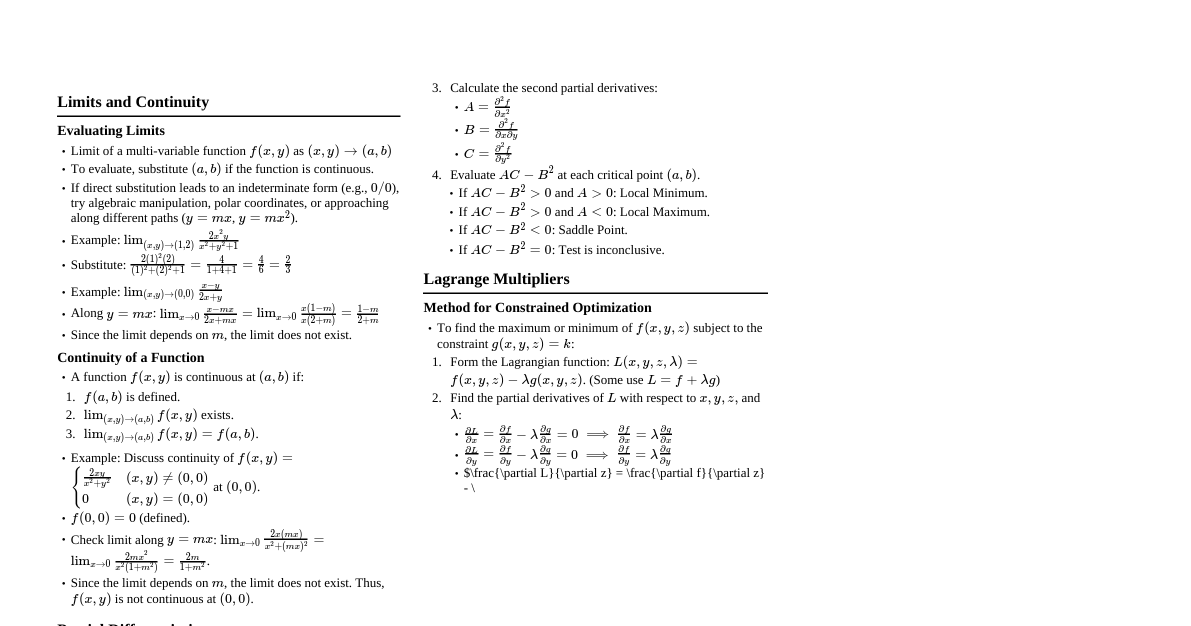
1. Introduction to Functions of Several Variables Definition: A function $f$ of two variables $x$ and $y$ is a rule that assigns to each ordered pair $(x, y)$ in a set $D$ a unique real number denoted by $f(x, y)$. The set $D$ is the domain of $f$. Graph: The graph of a function $f(x, y)$ is the surface $z = f(x, y)$ in 3D space. Level Curves: The level curves of a function $f(x, y)$ are the curves with equations $f(x, y) = k$, where $k$ is a constant. Limits: $\lim_{(x,y) \to (a,b)} f(x,y) = L$ if for every $\epsilon > 0$ there is a $\delta > 0$ such that $|f(x,y) - L| Continuity: $f$ is continuous at $(a,b)$ if $\lim_{(x,y) \to (a,b)} f(x,y) = f(a,b)$. 2. Partial Differentiation Definition: Partial derivative with respect to $x$: $f_x(x,y) = \frac{\partial f}{\partial x} = \lim_{h \to 0} \frac{f(x+h, y) - f(x,y)}{h}$ (treat $y$ as a constant). Partial derivative with respect to $y$: $f_y(x,y) = \frac{\partial f}{\partial y} = \lim_{h \to 0} \frac{f(x, y+h) - f(x,y)}{h}$ (treat $x$ as a constant). Higher-Order Partial Derivatives: $f_{xx} = \frac{\partial^2 f}{\partial x^2}$ $f_{yy} = \frac{\partial^2 f}{\partial y^2}$ $f_{xy} = \frac{\partial^2 f}{\partial y \partial x}$ (differentiate with respect to $x$ first, then $y$) $f_{yx} = \frac{\partial^2 f}{\partial x \partial y}$ (differentiate with respect to $y$ first, then $x$) Clairaut's Theorem (Equality of Mixed Partials): If $f_{xy}$ and $f_{yx}$ are continuous on an open disk, then $f_{xy} = f_{yx}$. 3. Total Derivative Definition (for $z = f(x,y)$): The total differential $dz$ is given by $dz = \frac{\partial f}{\partial x} dx + \frac{\partial f}{\partial y} dy$. Interpretation: Represents the approximate change in $z$ for small changes $dx$ and $dy$ in $x$ and $y$. Generalization (for $w = f(x_1, \dots, x_n)$): $dw = \frac{\partial f}{\partial x_1} dx_1 + \dots + \frac{\partial f}{\partial x_n} dx_n$. 4. Differentiation of Composite Functions (Chain Rule) Case 1: $z = f(x,y)$, where $x = g(t)$, $y = h(t)$ $\frac{dz}{dt} = \frac{\partial f}{\partial x} \frac{dx}{dt} + \frac{\partial f}{\partial y} \frac{dy}{dt}$ Case 2: $z = f(x,y)$, where $x = g(s,t)$, $y = h(s,t)$ $\frac{\partial z}{\partial s} = \frac{\partial f}{\partial x} \frac{\partial x}{\partial s} + \frac{\partial f}{\partial y} \frac{\partial y}{\partial s}$ $\frac{\partial z}{\partial t} = \frac{\partial f}{\partial x} \frac{\partial x}{\partial t} + \frac{\partial f}{\partial y} \frac{\partial y}{\partial t}$ Implicit Differentiation: If $F(x,y) = 0$ defines $y$ implicitly as a function of $x$, then $\frac{dy}{dx} = - \frac{F_x}{F_y}$ (provided $F_y \neq 0$). 5. Jacobians Definition (for $u=f(x,y)$, $v=g(x,y)$): The Jacobian determinant is given by: $$ J = \frac{\partial(u,v)}{\partial(x,y)} = \begin{vmatrix} \frac{\partial u}{\partial x} & \frac{\partial u}{\partial y} \\ \frac{\partial v}{\partial x} & \frac{\partial v}{\partial y} \end{vmatrix} = \frac{\partial u}{\partial x} \frac{\partial v}{\partial y} - \frac{\partial u}{\partial y} \frac{\partial v}{\partial x} $$ Interpretation: Represents the scaling factor for area (or volume in higher dimensions) when transforming coordinates. Inverse Function Theorem: If $\frac{\partial(u,v)}{\partial(x,y)} \neq 0$, then the transformation is locally invertible, and $\frac{\partial(x,y)}{\partial(u,v)} = \left(\frac{\partial(u,v)}{\partial(x,y)}\right)^{-1}$. Chain Rule for Jacobians: If $(u,v)$ are functions of $(x,y)$ and $(x,y)$ are functions of $(s,t)$, then $\frac{\partial(u,v)}{\partial(s,t)} = \frac{\partial(u,v)}{\partial(x,y)} \frac{\partial(x,y)}{\partial(s,t)}$. 6. Taylor's and Maclaurin's Series for Two Variables Taylor's Series Expansion for $f(x,y)$ about $(a,b)$: $$ f(x,y) = f(a,b) + \left[ (x-a)\frac{\partial}{\partial x} + (y-b)\frac{\partial}{\partial y} \right] f(a,b) + \frac{1}{2!} \left[ (x-a)\frac{\partial}{\partial x} + (y-b)\frac{\partial}{\partial y} \right]^2 f(a,b) + \dots + R_n $$ where the operator notation means: $$ \left[ (x-a)\frac{\partial}{\partial x} + (y-b)\frac{\partial}{\partial y} \right]^2 f(a,b) = (x-a)^2 \frac{\partial^2 f}{\partial x^2}(a,b) + 2(x-a)(y-b) \frac{\partial^2 f}{\partial x \partial y}(a,b) + (y-b)^2 \frac{\partial^2 f}{\partial y^2}(a,b) $$ Maclaurin's Series Expansion for $f(x,y)$ (Taylor's series about $(0,0)$): $$ f(x,y) = f(0,0) + \left( x\frac{\partial f}{\partial x} + y\frac{\partial f}{\partial y} \right)_{(0,0)} + \frac{1}{2!} \left( x^2\frac{\partial^2 f}{\partial x^2} + 2xy\frac{\partial^2 f}{\partial x \partial y} + y^2\frac{\partial^2 f}{\partial y^2} \right)_{(0,0)} + \dots $$ 7. Maxima and Minima for Functions of Two Variables Critical Points: A point $(a,b)$ is a critical point if $f_x(a,b) = 0$ and $f_y(a,b) = 0$, or if one of the partial derivatives does not exist. Second Derivative Test (for $f(x,y)$): Let $(a,b)$ be a critical point and let $D(x,y) = f_{xx}(x,y)f_{yy}(x,y) - [f_{xy}(x,y)]^2$. Evaluate $D = D(a,b)$ and $f_{xx} = f_{xx}(a,b)$. If $D > 0$ and $f_{xx} > 0$, then $f(a,b)$ is a local minimum . If $D > 0$ and $f_{xx} local maximum . If $D saddle point . If $D = 0$, the test is inconclusive. Absolute Extrema on a Closed & Bounded Region: Find the values of $f$ at the critical points in the interior of the region. Find the extreme values of $f$ on the boundary of the region (often requires parameterizing the boundary and using single-variable calculus). The largest of these values is the absolute maximum, and the smallest is the absolute minimum.