A-Level Chemistry
Cheatsheet Content
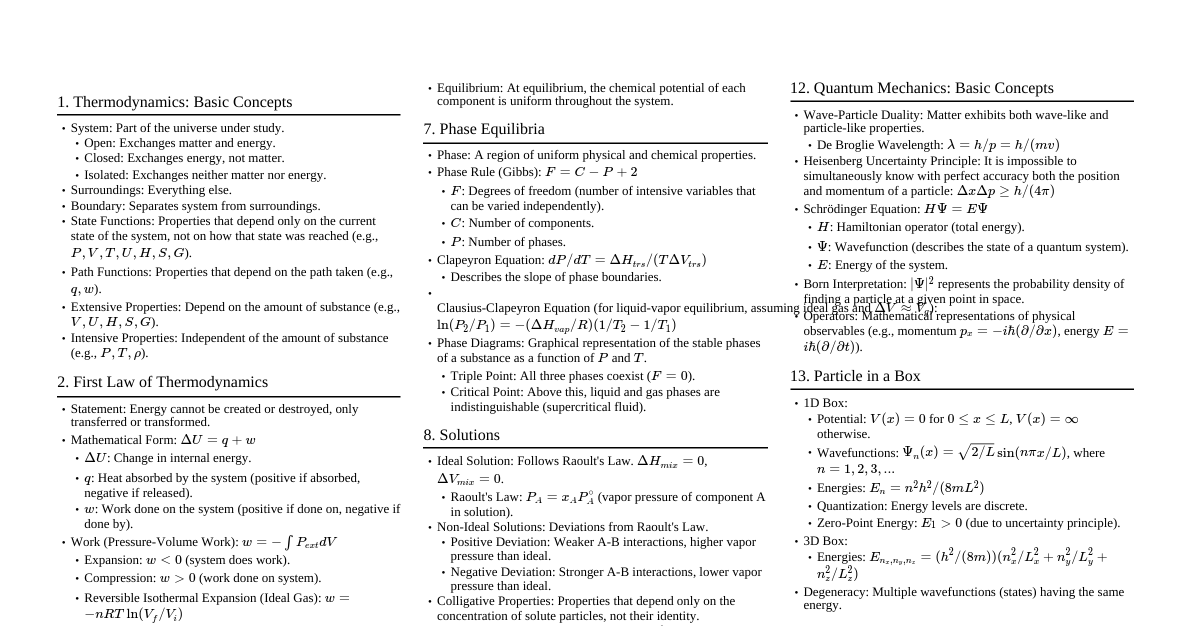
### Stoichiometry, Atoms, and Molecules - **Relative Atomic Mass ($A_r$):** Weighted average mass of isotopes compared to 1/12th mass of a carbon-12 atom. - **Relative Molecular Mass ($M_r$):** Sum of $A_r$ of all atoms in a molecule. - **Moles (n):** $n = \frac{\text{mass (g)}}{M_r}$ or $n = \text{concentration (mol dm}^{-3}) \times \text{volume (dm}^3)$. - **Avogadro's Constant ($N_A$):** $6.022 \times 10^{23}$ particles/mol. - **Molar Gas Volume:** 24 dm$^3$ at room temperature and pressure (r.t.p.). - **Ideal Gas Equation:** $PV=nRT$, where $P$ is pressure (Pa), $V$ is volume (m$^3$), $n$ is moles, $R$ is ideal gas constant ($8.31 \text{ J K}^{-1} \text{ mol}^{-1}$), $T$ is temperature (K). - **Empirical Formula:** Simplest whole number ratio of atoms in a compound. - **Molecular Formula:** Actual number of atoms of each element in a molecule. ### Atomic Structure - **Subatomic Particles:** - Proton: Relative mass 1, charge +1, in nucleus. - Neutron: Relative mass 1, charge 0, in nucleus. - Electron: Relative mass $1/1836$, charge -1, in shells. - **Atomic Number (Z):** Number of protons. Defines the element. - **Mass Number (A):** Number of protons + neutrons. - **Isotopes:** Atoms of the same element with the same number of protons but different numbers of neutrons. - **Electron Configuration:** - Orbitals: s (2 e-), p (6 e-), d (10 e-), f (14 e-). - Pauli Exclusion Principle: Max 2 electrons per orbital with opposite spins. - Hund's Rule: Electrons fill degenerate orbitals singly first before pairing. - Aufbau Principle: Fill lowest energy orbitals first. ### Chemical Bonding - **Ionic Bonding:** Electrostatic attraction between oppositely charged ions, formed by transfer of electrons (metal + non-metal). - Properties: High melting/boiling points, conducts electricity when molten/aqueous. - **Covalent Bonding:** Sharing of electrons between atoms (non-metal + non-metal). - **Sigma ($\sigma$) bond:** Head-on overlap of orbitals. - **Pi ($\pi$) bond:** Sideways overlap of p-orbitals. - **Dative (coordinate) bond:** One atom provides both electrons for the shared pair. - **Metallic Bonding:** Electrostatic attraction between positive metal ions and a 'sea' of delocalised electrons. - Properties: Conducts electricity, malleable, ductile, high melting/boiling points. - **Intermolecular Forces (IMFs):** - **Van der Waals forces:** - **London Dispersion Forces (LDFs):** Temporary dipoles due to electron movement (all molecules). - **Permanent dipole-dipole forces:** Between polar molecules. - **Hydrogen Bonding:** Strongest IMF, between H and F/O/N. - **Shapes of Molecules (VSEPR):** Electron pairs repel to minimise repulsion. - 2 electron pairs: Linear (180°) - 3 electron pairs: Trigonal planar (120°) - 4 electron pairs: Tetrahedral (109.5°), Pyramidal (107°), Bent (104.5°) - 5 electron pairs: Trigonal bipyramidal - 6 electron pairs: Octahedral ### States of Matter - **Solid:** Fixed shape and volume, strong forces, particles vibrate about fixed positions. - **Liquid:** Fixed volume, no fixed shape, weaker forces, particles can move past each other. - **Gas:** No fixed shape or volume, very weak forces, particles move randomly and rapidly. - **Changes of State:** Melting, freezing, boiling, condensation, sublimation, deposition. - **Heating Curve:** Shows temperature change with heat added, plateaus during phase changes as energy is used to overcome IMFs. ### Chemical Energetics - **Enthalpy Change ($\Delta H$):** Heat energy change at constant pressure. - **Exothermic:** $\Delta H 0$, absorbs heat (e.g., thermal decomposition). - **Standard Enthalpy Change of Formation ($\Delta H_f^\theta$):** 1 mole of compound from its elements in standard states. - **Standard Enthalpy Change of Combustion ($\Delta H_c^\theta$):** 1 mole of substance completely burned in oxygen. - **Bond Enthalpy:** Energy required to break 1 mole of a specific bond in the gaseous state. - $\Delta H = \sum \text{bond enthalpies (reactants)} - \sum \text{bond enthalpies (products)}$ - **Hess's Law:** The total enthalpy change for a reaction is independent of the route taken. - Cycle 1: $\Delta H_R = \sum \Delta H_f^\theta (\text{products}) - \sum \Delta H_f^\theta (\text{reactants})$ - Cycle 2: $\Delta H_R = \sum \Delta H_c^\theta (\text{reactants}) - \sum \Delta H_c^\theta (\text{products})$ ### Reaction Kinetics - **Rate of Reaction:** Change in concentration of reactant or product per unit time. - **Factors Affecting Rate:** - **Concentration/Pressure:** Higher concentration/pressure = more frequent collisions. - **Temperature:** Higher temperature = more frequent collisions and higher proportion of particles with $E_a$. - **Surface Area:** Larger surface area = more sites for reaction. - **Catalyst:** Provides alternative reaction pathway with lower activation energy ($E_a$). - **Activation Energy ($E_a$):** Minimum energy required for a reaction to occur. - **Boltzmann Distribution:** Shows distribution of molecular energies at a given temperature. - **Rate Equation:** Rate $= k[A]^m[B]^n$, where $k$ is rate constant, $m$ and $n$ are orders of reaction. - **Order of Reaction:** Determined experimentally, not from stoichiometry. - **Overall Order:** $m+n$. - **Half-life ($t_{1/2}$):** Time taken for concentration of reactant to halve. - For first-order reactions, $t_{1/2}$ is constant. - **Arrhenius Equation:** $k = A e^{-E_a/RT}$ ### Equilibria - **Reversible Reaction:** Products can react to reform reactants. - **Dynamic Equilibrium:** Forward and reverse reaction rates are equal, concentrations of reactants and products remain constant. - **Le Chatelier's Principle:** If conditions are changed in a system at equilibrium, the position of equilibrium will shift to counteract the change. - **Concentration:** Increase reactant, shifts right; increase product, shifts left. - **Pressure:** Increase pressure, shifts to side with fewer gas moles. - **Temperature:** Increase temperature, shifts in endothermic direction. - **Catalyst:** No effect on equilibrium position, only speeds up attainment of equilibrium. - **Equilibrium Constant ($K_c$):** $K_c = \frac{[C]^c[D]^d}{[A]^a[B]^b}$ for $aA + bB \rightleftharpoons cC + dD$. - Only aqueous and gaseous species included. - **Equilibrium Constant ($K_p$):** For gases, uses partial pressures. $K_p = \frac{(P_C)^c(P_D)^d}{(P_A)^a(P_B)^b}$. - $P_{\text{gas}} = \text{mole fraction} \times \text{total pressure}$. - **Acids & Bases:** - **Brønsted-Lowry:** Acid donates H$^+$, base accepts H$^+$. - **Strong Acid/Base:** Fully dissociates in water. - **Weak Acid/Base:** Partially dissociates in water. - **pH:** $-\log_{10}[H^+]$. - **$K_a$ (acid dissociation constant):** $K_a = \frac{[H^+][A^-]}{[HA]}$. $pK_a = -\log_{10}K_a$. - **$K_w$ (ionic product of water):** $K_w = [H^+][OH^-] = 1.0 \times 10^{-14} \text{ mol}^2 \text{ dm}^{-6}$ at 298 K. - **Buffer Solution:** Resists changes in pH upon addition of small amounts of acid/base. Contains a weak acid and its conjugate base. - Henderson-Hasselbalch: $pH = pK_a + \log_{10} \frac{[A^-]}{[HA]}$. ### Electrochemistry - **Redox Reactions:** Oxidation (loss of electrons, increase in oxidation state), Reduction (gain of electrons, decrease in oxidation state). - **Oxidation States:** Rules for assigning. - **Electrochemical Cells:** Convert chemical energy to electrical energy. - **Half-cells:** Contain an electrode and an electrolyte. - **Standard Electrode Potential ($E^\theta$):** Potential difference of a half-cell compared to standard hydrogen electrode (SHE) under standard conditions (298 K, 1 atm, 1 mol dm$^{-3}$). - **Standard Cell Potential ($E^\theta_{\text{cell}}$):** $E^\theta_{\text{cell}} = E^\theta_{\text{reduction}} - E^\theta_{\text{oxidation}}$ (or $E^\theta_{\text{RHS}} - E^\theta_{\text{LHS}}$). - **Feasibility:** Reaction is feasible if $E^\theta_{\text{cell}} > 0$. - **Electrolytic Cells:** Convert electrical energy to chemical energy (non-spontaneous reactions). - **Electrolysis:** Decomposition of a compound using electric current. - **Faraday's Law:** Quantity of charge (Q) = current (I) x time (t). $Q = n_e F$, where $n_e$ is moles of electrons, $F$ is Faraday constant ($96485 \text{ C mol}^{-1}$). ### Chemistry Periodicity - **Periodic Table:** Elements arranged by increasing atomic number. - **Trends Across a Period (Left to Right):** - **Atomic Radius:** Decreases (increasing nuclear charge, same shielding). - **First Ionisation Energy:** Generally increases (increasing nuclear charge, decreasing atomic radius). - **Electronegativity:** Increases (increasing nuclear charge, decreasing atomic radius). - **Metallic Character:** Decreases. - **Trends Down a Group:** - **Atomic Radius:** Increases (increasing number of electron shells). - **First Ionisation Energy:** Decreases (increasing atomic radius, increasing shielding). - **Electronegativity:** Decreases. - **Metallic Character:** Increases. - **Oxides:** - From basic (Group 1/2) to amphoteric (Al) to acidic (non-metals) across a period. ### Group 2 Elements (Alkaline Earth Metals) - **General Trends:** - Atomic radius: Increases down the group. - First ionisation energy: Decreases down the group. - Melting points: Generally decrease (except Mg). - Reactivity: Increases down the group. - **Reactions:** - React with water: $M(s) + 2H_2O(l) \rightarrow M(OH)_2(aq) + H_2(g)$ (reactivity increases down group). - React with oxygen: $2M(s) + O_2(g) \rightarrow 2MO(s)$. - React with dilute acids: $M(s) + 2HCl(aq) \rightarrow MCl_2(aq) + H_2(g)$. - **Hydroxides ($M(OH)_2$):** Solubility increases down the group. - Mg(OH)$_2$ (sparingly soluble), Ba(OH)$_2$ (soluble). - Basicity increases down the group. - **Sulfates ($MSO_4$):** Solubility decreases down the group. - MgSO$_4$ (soluble), BaSO$_4$ (insoluble, used for "barium meal"). - **Thermal Decomposition of Nitrates and Carbonates:** - Nitrates: $2M(NO_3)_2(s) \rightarrow 2MO(s) + 4NO_2(g) + O_2(g)$. Ease of decomposition increases for smaller ions (higher charge density). - Carbonates: $MCO_3(s) \rightarrow MO(s) + CO_2(g)$. Ease of decomposition increases for smaller ions. ### Group 4 Elements - **Elements:** C, Si, Ge, Sn, Pb. - **Trends:** - Down the group, metallic character increases (C is non-metal, Si is metalloid, Sn/Pb are metals). - Catenation decreases down the group. - Stability of +2 oxidation state increases down the group (inert pair effect). - Stability of +4 oxidation state decreases down the group. - **Oxides:** - CO$_2$: Acidic, gas. - SiO$_2$: Acidic, giant covalent. - SnO$_2$, PbO$_2$: Amphoteric. - CO: Neutral. - **Chlorides:** - CCl$_4$: Does not hydrolyse (no empty d-orbitals). - SiCl$_4$: Hydrolyses readily with water to form SiO$_2$ and HCl. - SnCl$_4$: Hydrolyses. - PbCl$_2$: Ionic, insoluble. - **Lead Chemistry:** - Pb(II) compounds are more stable than Pb(IV). - PbO$_2$ is an oxidising agent. ### Group 7 Elements (Halogens) - **Elements:** F, Cl, Br, I, At. - **Physical Properties:** - Colour: F$_2$ (pale yellow gas), Cl$_2$ (green-yellow gas), Br$_2$ (red-brown liquid), I$_2$ (grey solid, sublimes to purple vapour). - Boiling point: Increases down the group (increasing LDFs). - **Trends:** - Electronegativity: Decreases down the group. - Oxidising power: Decreases down the group (F$_2$ is strongest oxidising agent). - Reactivity: Decreases down the group. - **Reactions with Halides (Displacement):** - A more reactive halogen displaces a less reactive halide from solution. - E.g., Cl$_2(aq) + 2Br^-(aq) \rightarrow 2Cl^-(aq) + Br_2(aq)$. - **Reactions with Hydrogen:** - Form hydrogen halides (HX). - Thermal stability of HX: Decreases down the group (HF > HCl > HBr > HI). - Acidity of HX: Increases down the group (HI > HBr > HCl > HF). - **Reactions with Water:** - Cl$_2(aq) + H_2O(l) \rightleftharpoons HCl(aq) + HClO(aq)$ (disproportionation). - Br$_2$ undergoes similar but less extensive reaction. - I$_2$ is almost insoluble in water. - **Halide Ions ($X^-$) as Reducing Agents:** - Reducing power increases down the group (I$^-$ > Br$^-$ > Cl$^-$ > F$^-$). - Reaction with conc. H$_2$SO$_4$: - Cl$^-$: No redox, just acid-base: $Cl^- + H_2SO_4 \rightarrow HCl + HSO_4^-$. - Br$^-$: Reduces H$_2$SO$_4$ to SO$_2$: $2Br^- + H_2SO_4 \rightarrow Br_2 + SO_2 + 2H_2O$. - I$^-$: Reduces H$_2$SO$_4$ to SO$_2$, S, H$_2$S: $2I^- + H_2SO_4 \rightarrow I_2 + SO_2 + 2H_2O$. Further reduction occurs. - **Test for Halide Ions:** Add dilute nitric acid, then silver nitrate solution. - Cl$^-$: White ppt of AgCl, soluble in dilute NH$_3$. - Br$^-$: Cream ppt of AgBr, soluble in conc NH$_3$. - I$^-$: Yellow ppt of AgI, insoluble in conc NH$_3$.